Copyright © 2004, American Society for Microbiology. All Rights Reserved.
Molecular Cloning and Characterization of Tropomyosin, a Major
Allergen of Chironomus kiiensis, a Dominant Species
of Nonbiting Midges in Korea
Kyoung Yong Jeong,
1Hye-Yung Yum,
2In-Yong Lee,
1Han-Il Ree,
1Chein-Soo Hong,
3Dong Soo Kim,
4and Tai-Soon Yong
1*
Department of Parasitology and Institute of Tropical Medicine,
1Department of Internal Medicine and Institute of
Allergy,
3and Department of Pediatrics,
4Yonsei University College of Medicine, Seoul, and Department of
Pediatrics, College of Medicine, Pochon CHA University-CHA General Hospital,
Pochon-gun,
2South Korea
Received 11 September 2003/Returned for modification 3 November 2003/Accepted 21 November 2003
Chironomids are widely and abundantly distributed in the vicinity of standing waters. Larvae of Chironomus
and some other genera are known to contain hemoglobins, which have been described as a major allergen, and
the adults that have no hemoglobins also have been reported to contain allergens. In this study, we tried to
establish the role of chironomid allergy and characterize the allergen of Chironomus kiiensis adults. Skin tests
using C. kiiensis adult extracts were performed on patients with allergic symptoms. A cDNA library of C. kiiensis
adults was screened with C. kiiensis immune mouse sera to identify allergens, and results were confirmed using
skin test-positive human sera. Recombinant allergen was expressed in Escherichia coli and purified by affinity
chromatography using nickel-nitrilotriacetic acid agarose to investigate its allergenic properties. Out of 275
allergic patients 14.2% showed a positive reaction to C. kiiensis adult crude extracts in the skin test. The
tropomyosin was cloned by immunoscreening and expressed in Escherichia coli. C. kiiensis tropomyosin has a
high homology at the amino acid level with tropomyosins which were previously known to be allergens in
various arthropods (Periplaneta americana, 86.3%; Panulirus stimpson, 78.9%; Dermatophagoides pteronyssinus,
76.5%). Specific immunoglobulin E antibodies reacting to recombinant tropomyosin were detected in 17 (81%)
of 21 patients whose skin test results were positive. Cross-reactivity against house dust mites and other insects
was noticed with mouse anti-recombinant tropomyosin immune serum. C. kiiensis adults were shown to be an
important source of inhalant allergens in Korea. Molecular cloning of C. kiiensis tropomyosin was performed
and IgE reactivity was demonstrated using skin test-positive human sera. Recombinant tropomyosin will be
useful for further studies or clinical applications.
Adults and larvae of nonbiting midges are known to have
potent allergens that cause immunoglobulin E (IgE)-mediated
asthma or, less frequently, allergic conjunctivitis. Allergy
no-menclature in this paper follows the revised version (7). It has
been reported that Cladotanytarsus lewisi occurred in
enor-mous numbers in the Nile basins in Sudan and caused severe
respiratory diseases in people living close to the Nile (10).
Chironomid larvae were widely used as fish food in Germany
and elicit occupational allergic diseases in a significant number
of people who were exposed to these larvae (1, 15).
Hemoglobins, which are unique components in chironomid
larvae among insects, have been identified as the most
impor-tant allergen found in asthmatic patients (2, 3, 9, 18, 28). On
the other hand, 40% of Japanese, Taiwanese, and Swedish sera
from patients with IgE-mediated asthma showed positive
re-actions against crude extracts of a midge (Cricotopus sylvestris)
extract which contained no hemoglobin (29). Up to the
pres-ent, several clinical cases in which patients had positive skin
tests or positive results for chironomid-specific IgE have been
reported. Few studies on chironomid allergens except for
he-moglobin have been carried out, although a protein with a high
molecular weight in the whole-body extract of chironomid
adults has been suggested to be more allergenic than
hemo-globin (16).
People are unlikely to inhale the hemoglobin of chironomid
larvae, which live under water, but the dead debris of
ephem-eral chironomid adults, which often swarm and gather around
lights, is more likely to contact persons and cause allergic
diseases.
Chironomus kiiensis and Chironomus flaviplumus were
re-ported to be the most prevalent species of chironomids in
Korea out of about 50 recorded species to date (20). The latter
emerges from eutrophic waters in urban areas, whereas the
former is distributed mainly in rural areas, breeding in rice
paddies, lakes, and other clean waters.
In the present study, IgE immunoblot analyses were
per-formed using both human sera from individuals who had
pos-itive skin test reactions to the chironomid extract and the
immunized BALB/c mouse sera in order to identify
IgE-bind-ing proteins in whole-body extracts of C. kiiensis adults, which
represent the dominant species of nonbiting midges in Korea.
MATERIALS AND METHODS
Collection of C. kiiensis and preparation of the crude extract.C. kiiensis adults
were collected every three to four days per week from July to October in 1997 using three light-traps on rice paddies at Dokyang-gu, Koyang-si, Kyonggi-do,
* Corresponding author. Mailing address: Department of
Parasitol-ogy and Institute of Tropical Medicine, Brain Korea 21 Project for
Medical Science, Yonsei University College of Medicine, Seoul
120-752, Korea. Phone: 82-2-361-5290. Fax: 82-2-363-8676. E-mail: tsyong212
@yumc.yonsei.ac.kr.
Korea. C. kiiensis adults were identified following the key for morphological identification and stored at⫺70°C until used (20).
Frozen midges were defrosted, homogenized, and then extracted in 10 mM phosphate-buffered saline, pH 7.4, by incubation for 10 h at 4°C. The extracts were used for the enzyme-linked immunosorbent assay or immunoblot analysis. Lyophilized midges were extracted in the modified Coca solution (0.9% NaCl, 0.25% NaHCO3, 0.04% phenol), and 1:40 (wt/vol) diluted extract at a final
concentration of 1.5 mg/ml was used for the skin prick test (19). The tip of a 26-gauge needle was introduced through a drop of the extract into the superficial layers of the skin, which were gently lifted. A reaction was considered positive when a wheal with a diameter of 3 mm developed. Positive (histamine dihydro-chloride [1 mg/ml]; Bayer) and negative (albumin-saline with phenol; Bayer) controls were applied in all tests.
Skin prick test and collection of human sera.The skin prick test using
C. kiiensis crude extracts was performed on patients who came to the allergy
clinic of the Severance Hospital, Yonsei University College of Medicine, Seoul, Korea. A total of 275 subjects, which included females 10 to 75 years old (n⫽ 138; average age, 41 years) and males 15 to 69 years old (n⫽ 147; average age, 31 years), were enrolled in the study. All subjects underwent the skin prick test using extracts of Dermatophagoides pteronyssinus, Dermatophagoides
fari-nae, Blattella germanica, Periplaneta americana, C. kiiensis, Momomorium pharaonis, Drosophila melanogaster, Penicillium mix, and Aspergillus fumigatus
(Bencard Co., Gaggenau, Germany). Sera of the skin test-positive subjects were collected from September 1998 to February 1999 and kept frozen at ⫺20°C.
Production of antisera against C. kiiensis adult crude extract in mice.Three 6-week-old female BALB/c mice were immunized to obtain antiserum. Alumi-num hydroxide gel (alum) was prepared as described previously (21). Twenty micrograms of the crude extract in phosphate-buffered saline was mixed with 1 ml of alum, and the mice received intraperitoneal injections with the crude extract-gel (0.1 ml, containing 2g of the crude extract and about 14 mg of alum) at 0-, 4-, and 8-week intervals.
Construction of a cDNA expression library.The frozen sample of C. kiiensis after morphological identification was homogenized in liquid nitrogen and mRNA was purified by using the mRNA isolation kit (Stratagene, La Jolla, Calif.), and a cDNA expression library in the ZAP Express vector (Stratagene) was constructed using a ZAP Express cDNA Gigapack II gold cloning kit (Strat-agene) according to the manufacturer’s instruction. Immunoscreening was car-ried out by phage dot immunoblot analysis using a picoBlue immunoscreening kit (Stratagene) with a 1:500 dilution of serum from mice immunized with crude extract of C. kiiensis and alkaline phosphatase-labeled anti-mouse IgG1. Positive clones were rescreened until all plaques on the plate were positive. Selected clones in ZAP Express vector were excised in vivo with ExAssist helper phages (Stratagene).
DNA sequencing and homology search.DNA sequencing of plasmid purified from the transformed bacteria was performed by the dideoxy nucleotide chain termination method (26) using a Sequenase version 2.0 DNA sequencing kit (Amersham Life Science, Cleveland, Ohio). Analysis of the derived nucleotide and deduced amino acid sequences was performed using the NCBI/BLAST network service of the National Center for Biotechnology Information, Be-thesda, Md. A homology search in GenBank was performed using the NCBI Blast program.
Production of the recombinant tropomyosin.Tropomyosin-encoding cDNA was subcloned into the BamHI and XhoI sites of the expression vector pET-28a and expressed in Escherichia coli BL21(DE3). The cells were grown to an optical density at 600 nm of 0.6 in Luria-Bertani broth (23) containing kanamycin (50 g/ml), and then expression was induced by the addition of isopropyl-thio--galactoside to a final concentration of 1 mM. Incubation was continued for another 5 h, and the cells were harvested by centrifugation. Recombinant tro-pomyosin was purified by affinity column chromatography using Ni-NTA Aga-rose (QIAGEN, Valencia, Calif.) according to the manufacturer’s manual.
IgE immunoblot analysis.Proteins after sodium dodecyl sulfate (SDS)-poly-acrylamide gel electrophoresis were electrophoretically transferred onto the ni-trocellulose membranes and reacted with 1:2-diluted human sera overnight at room temperature. After washing five times, the membranes were incubated with 1:1,000-diluted monoclonal (clone GE-1) anti-human IgE alkaline phosphatase conjugate (catalog no. A-3076; Sigma, St. Louis, Mo.) for 1 h at room temper-ature. Color was developed with 3-bromo-4-chloro-5-indolyl-phosphate (758 ng/ ml) and nitroblue tetrazolium (379 ng/ml) in a solution containing 100 mM Tris-Cl (pH 9.5), 100 mM NaCl, and 5 mM MgCl2.
RESULTS
Frequency of chironomid allergy among allergic patients in
Korea.
Patients complaining of allergic asthma, allergic
rhini-tis, allergic urticaria, allergic conjunctivirhini-tis, throat irritation,
atopic eczema/dermatitis syndrome, or itching underwent the
skin prick test (Fig. 1). Thirty-nine of 275 subjects with the
symp-toms of allergic asthma, allergic rhinitis, allergic urticaria, or
throat irritation showed a positive reaction to the C. kiiensis
crude extract. As shown in Fig. 1, house dust mites are the most
potent elicitor of allergic disease, and cockroaches are the second.
Cloning of C. kiiensis tropomyosin.
Six strongly positive
clones were identified by immunoscreening with serum from
mice immunized with C. kiiensis crude extract, and all clones
were found to have the identical cDNA sequence.
The cloned cDNA sequence contains an 855-bp open
read-ing frame codread-ing for 285 amino acids, with an estimated
mo-lecular mass of 32,531 Da and a pI of 4.58. No potential
N-linked glycosylation sites were found (Fig. 2). As shown in
Fig. 3, BLAST search showed that C. kiiensis tropomyosin has
the highest homology with insect tropomyosins (D.
melano-gaster, 89.1%; Periplaneta americana, 86.3%). It also has high
sequence identities with those of two other major arthropod
groups that are known to be major allergens, such as Panulirus
stimpson (Crustacea, 78.9%) and D. pteronyssinus (Chelicerata,
76.5%). This sequence, which was deposited in the GenBank
under accession number AJ012184, was designated as Chi k 10,
according to the allergen nomenclature of the World Health
Organization and the International Union of Immunological
Societies (13).
Purification of recombinant tropomyosin.
The purified
re-combinant tropomyosin containing 34 more amino acids at the
N terminus gave a band on Coomassie blue-stained
SDS-poly-acrylamide gels with an apparent molecular mass of 45 kDa.
The size is larger than the one calculated from the nucleotide
sequence. The mobility of the tropomyosin significantly reduced
in the presence of 6 M urea, giving an apparent molecular mass
of 67.6 kDa, whereas ovalbumin migrated at the expected
po-sition (Fig. 4). The final yield of the purified recombinant
pro-tein measured by Bradford assay (Bio-Rad, Hercules, Calif.)
was approximately 2 mg/liter of E. coli culture.
FIG. 1. Skin test reactivity to respiratory allergens among patients.
Abbreviations: Dp, D. pterronyssis; Df, D. farinae; CR, P. americana
and B. germanica; Mp, M. pharaonis; Dm, D. melanogaster; Ck, C.
IgE immunoblot analysis.
Immunoblot analysis was carried
out to confirm the reactivity of the recombinant protein.
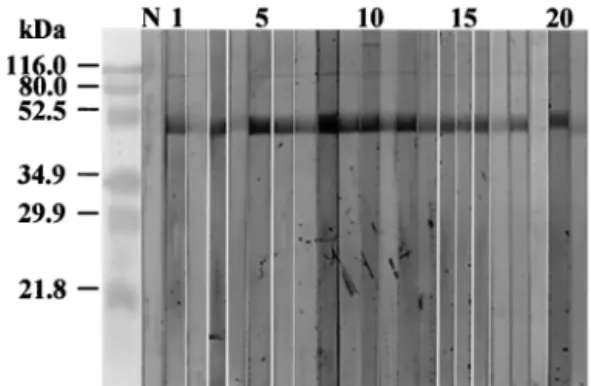
IgE-reacting antibodies to the recombinant tropomyosin were
de-tected in 17 (81%) of 21 sera tested (Fig. 5). Serum from the
nonallergic control was not reactive to the recombinant
pro-tein.
DISCUSSION
Two cases of asthmatic patients allergic to Chironomus
plu-mosus and Tokunagayusurika akamusi extracts were reported
in Korea (11). Twenty percent of the Korean patients with
respiratory allergic symptoms were shown to react positively
with chironomid extracts (19). Since the two species of
chi-ronomids that were used in these experiments are rarely found
in Korea, the results indicate that their chironomid antigens
contained materials cross-reactive to other chironomid species
which are widely distributed in Korea. A high frequency of IgE
antibody responses to chironomids was also demonstrated in
Japanese patients with allergic asthma (14).
Chironomid allergy accounts for 14.2% of allergic subjects,
which is more than the proportion of other allergic diseases
that are caused by known indoor allergens except those caused
by house dust mites and cockroaches. Large numbers of
pa-tients are likely to be found in the vicinity of standing waters
where nonbiting midges emerge in large numbers. High levels
of chironomid antigens in both air and soil were demonstrated,
and a seasonal fluctuation in the air which peaked only in the
autumn was also examined (12).
We have previously reported that the various bands of 110,
80, 73, 46, 40, 37, and 34 kDa of the chironomid adult extracts
were found to react with skin test-positive human sera by IgE
immunoblot analysis (31).
Change of allergenicity during metamorphosis was
investi-gated. Mature adult extracts were shown to contain more
sub-stances that bound to the IgE of those chironomid allergic
subjects (16, 17). Hemoglobin, known as a major allergen of
chironomids (4, 27, 30), is known to be degraded during
meta-morphosis (17, 24). Galindo et al. have reported that subjects
unexposed to midges could have IgE to chironomid
hemoglo-bin (5) and hypersensitivity to these larvae without apparent
contact with them (6). This led us to suppose that a different
kind of allergen could be found in the adult. By using the IgG1
FIG. 2. Nucleotide and deduced amino acid sequences of C.
kiien-sis tropomyosin. The estimated molecular mass is 32.531 kDa, and no
potential N-linked glycosylation sites were identified.
FIG. 3. Alignment of amino acid sequences of four arthropod tropomyosins: midge (C. kiiensis, accession number CAA09938), fruit fly (D.
melanogaster, accession number P43689), cockroach (P. americana, accession number CAB38086), lobster (P. stimpson, accession number AF030063),
of mouse immune serum, which is known to be produced by
the influence of interleukin-4, tropomyosin was cloned from
the cDNA library of chironomid adults. Recombinant protein
was expressed in bacteria to test the allergenicity. The change
in migration on electrophoresis in SDS gels containing 6 M
urea is characteristic of tropomyosins (25).
Tropomyosin-spe-cific IgE was detected from 17 of 21 sera tested by
immuno-blotting, which indicated that tropomyosin is a major allergen
of adult chironomid. Fifteen patients of 17 that were
tropomy-osin positive also had positive reactions to dust mites in the
skin prick test. Of the 21 patients whose sera (19 patients were
positive to dust mites) were used in IgE immunoblotting, only
one patient had a positive reaction to C. kiiensis extract and
negative reactions to mites and cockroaches. Five patients
showed a stronger reaction (larger wheal size) to C. kiiensis
than to mites and cockroaches in the skin test, implying the
true sensitization of C. kiiensis tropomyosin. Only five subjects
showed a stronger reaction to the mites and cockroaches. The
other 10 persons showed similar reaction to the mites,
cock-roaches, and chironomid extract.
Tropomyosin, a kind of muscle protein, is a highly
cross-reactive allergen which sensitizes individuals who are
geneti-cally predisposed to food or house dust allergy (22). It is
suggested that tropomyosin is an invertebrate pan-allergen
be-cause of its high cross-reactivity. In the immunoblot
experi-ments, the bands of 70 to 80 kDa are thought to be the dimers,
and the bands of 30 to 50 are considered to be isoforms (data
not shown). This pattern of tropomyosin bands is consistent
with avian ones (8) and may implicate the potential
cross-reactivity of other arthropods.
In conclusion, we have identified tropomyosin from C.
ki-iensis as an important adult nonbiting midge allergen.
Tropo-myosins of invertebrates share a high degree of sequence
identity. Further investigations are necessary to examine the
possibility of cross-sensitization between allergic disorders
caused by mites and insects. This recombinant allergen will be
useful for clinical applications and allow a more detailed
im-munological characterization to be made.
ACKNOWLEDGMENTS
We are greatly indebted to Jongweon Lee for his skillful technical
assistance.
This work was supported by the Brain Korea 21 Project for Medical
Science, Yonsei University.
REFERENCES
1. Baur, X., M. Dewair, G. Fruhmann, H. Aschauer, J. Pfletschinger, and G. Braunitzer.1982. Hypersensitivity to chironomids (non-biting midges): lo-calization of the antigenic determinants within certain polypeptide se-quences of hemoglobins (erythrocruorins) of Chironomus thummi thummi (Diptera). J. Allergy Clin. Immunol. 69:66–76.
2. Baur, X., H. Aschauer, G. Mazur, M. Dewair, H. Prelicz, and W. Steige-mann.1986. Structure, antigenic determinants of some clinically important insect allergens: chironomid hemoglobins. Science 233:351–354.
3. Cranston, P. S. 1988. Allergens of non-biting midges (Diptera: Chironomi-dae): a systematic survey of chironomid haemoglobins. Med. Vet. Entomol. 2:117–127.
4. Czisch, M., V. Liebers, R. Bernstein, X. Chen, X. Baur, and T. A. Holak. 1994. Conformations of peptide fragments comprising the complete se-quence of component III of Chi t I and their relationship to T-cell stimula-tion. Biochemistry 16:9420–9427.
5. Galindo, P. A., M. Lombardero, P. Mur, F. Feo, E. Gomez, J. Borja, R. Garcia, and D. Barber.1999. Patterns of immunoglobulin E sensitization to chironomids in exposed and unexposed subjects. Investig. Allergol. Clin. Immunol. 9:117–122.
6. Galindo, P. A., F. Feo, E. Gomez, J. Borja, R. Melero, M. Lombardero, D. Barber, and R. G. Rodriguez.1998. Hypersensitivity to chironomid larvae. Investig. Allergol. Clin. Immunol. 8:219–225.
7. Johansson, S. G. O., J. O. Hourihane, J. Bousquet, C. Bruijnzeel-Koomen, S. Dreborg, T. Haahtela, M. L. Kowalski, N. Mygind, J. Ring, P. van Cauwen-berge, M. L. van Hage-Hamsten, and B. Wuthrich.2001. A revised nomen-clature for allergy. An EAACI position statement from EAACI nomencla-ture task force. Allergy 56:813–824.
8. Kardami, E., D. Montarras, and M. Fiszman. 1983. Fast and slow chicken muscles contain different␣- and -tropomyosins. Biochem. Biophys. Res. Commun. 110:147–154.
9. Kawai, K., H. Tagoh, K. Yoshizaki, G. Murakami, and A. Muraguchi. 1996. Purification and characterization of an allergenic monomeric hemoglobin from a chironomid distributed worldwide, Polypedium nubifer. Int. Arch. Allergy Immunol. 110:288–297.
10. Kay, A. B., E. L. Gad, M. O. Rab, J. Stewart, and H. H. Erwa. 1978. Widespread IgE-mediated hypersensitivity in Northern Sudan to the chi-ronomid Cladotanytarsus lewisi. Clin. Exp. Immunol. 34:106–110. 11. Kim, Y. J., and H. S. Park. 1994. Skin reactivity and specific IgE antibody to
two non-biting midges in Korea respiratory allergy patients. J. Korean Med. Sci. 9:21–28.
12. Kimura, K. Y., H. Matsuoka, and A. Ishii. 1990. ELISA inhibition method in detection of mite and chironomid antigens in environmental samples of dust, soil and air. Allergy 45:167–173.
13. King, T. P., D. Hoffman, H. Lowenstein, D. G. Marsh, T. A. E. Platts-Mills, and W. Thomas.1994. Allergen nomenclature. Int. Arch. Allergy Immunol. 105:224–233.
14. Kino, T., J. Chihara, K. Fukuda, Y. Sasaki, Y. Shogaki, and S. Oshima. 1987. Allergy to insects in Japan. III. High frequency of IgE antibody responses to insects (moth, butterfly, caddis fly, and chironomid) in patients with bron-chial asthma and immunochemical quantitation of the insect-related air-borne particles smaller than 10 microns in diameter. J. Allergy Clin. Immu-nol. 79:857–866.
FIG. 4. Mass production of the recombinant allergen. (A)
Recom-binant tropomyosin was expressed in E. coli BL21(DE3) and purified
by affinity column chromatography using Ni-NTA agarose. (B)
Mo-bility of the recombinant allergen was tested in SDS-polyacrylamide
gel containing 6 M urea. Lanes: L, lysate of E. coli; R, recombinant
tropomyosin; A, ovalbumin.
FIG. 5. IgE immunoblotting. Patients 2, 4, 17, 19, and 21 tested
negative. Lanes: N, negative control; 1 to 21, sera of humans skin test
positive to C. kiiensis extract.
15. Lieberis, V., M. Hoernstein, and X. Baur. 1993. Humoral immune response to the insect allergen Chi t 1 in aquarists and fish-food factory workers. Allergy 48:236–239.
16. Matsuoka, H., A. Ishii, and S. Noono. 1988. Detection of IgE antibodies to larvae and adults of chironomids by enzyme-linked immunosorbent assay. Allergy 43:425–429.
17. Matsuoka, H., A. Ishii, J. Y. Kimura, and S. Noono. 1990. Developmental change of chironomid allergen during metamorphosis. Allergy 45:115–120. 18. Mazur, G., W. M. Becker, and X. Baur. 1987. Epitope mapping of major insect allergens (chironomid hemoglobins) with monoclonal antibodies. J. Allergy Clin. Immunol. 80:876–883.
19. Park, H. S., N. S. Rhu, D. I. Cho, and J. W. Kim. 1991. Two cases of bronchial asthma induced by Chironomus plumosus and Tokunagayusurika
akamusi. J. Korean Soc. Allergol. 11:362–367.
20. Ree, H. I. 1993. Breeding places of non-biting midges (Chironomidae, Diptera) in Korea. Korean J. Entomol. 23:169–176.
21. Ree, H. I., S. H. Lee, Y. K. Kim, S. Jeon, J. K. Chang, and Y. S. Kim. 1996. Identification and characterization of allergens of Chironomus falviplumus adults (Chironomidae, Diptera) in mice. Korean J. Parasitol. 34:35–47. 22. Reese, G., R. Ayuso, and S. B. Lehrer. 1999. Tropomyosin: an invertebrate
pan-allergen. Int. Arch. Allergy Immunol. 119:247–258.
23. Sambrook, J., E. F. Fritsch, and T. Maniatis. 1989. Molecular cloning: a laboratory manual, 2nd ed. Cold Spring Harbor Laboratory Press, Cold Spring Harbor, N.Y.
24. Schin, K., J. J. Poluhowich, T. Gamo, and H. Laufer. 1974. Degradation of
haemoglobin in Chironomus during metamorphosis. J. Insect Physiol. 20: 561–571.
25. Smillie, L. B. 1982. Preparation and identification of␣- and -tropomyosins. Methods Enzymol. 85:231–241.
26. Tabor, S., and C. C. Richardson. 1987. DNA sequence analysis with a modified bacteriophage T7 DNA polymerase. Proc. Natl. Acad. Sci. USA 84:4767–4771.
27. Tautz, C., H. P. Rihs, A. Thiele, P. Zwollo, L. R. Freidhoff, D. G. Marsh, and X. Baur.1994. Association of class II sequences encoding DR1 and DQ5 specificities with hypersensitivity to chironomid allergen Chi t I. J. Allergy Clin. Immunol. 93:918–925.
28. van Kampen, V., W. M. Becker, Z. Chen, H. P. Rihs, G. Mazur, M. Raulf, V. Liebers, S. Isringhausen-Bley, and X. Baur.1994. Analysis of B-cell epitopes in the N-terminal region of Chi t I component III using monoclonal anti-bodies. Mol. Immunol. 31:1133–1404.
29. van Kampen, V., V. Liebers, A. Cruppon, and X. Baur. 1994. Chironomidae hemoglobin allergy in Japanese, Swedish, and German populations. Allergy 49:9–12.
30. van Kampen, V., V. Liebers, I. Sander, Z. Chen, X. Baur, M. Raulf-Heim-soth, and F. W. Falkenberg.2001. B-cell epitopes of the allergen Chi t 1.01: peptide mapping of epitopes recognized by rabbit, murine, and human an-tibodies. Allergy 56:118–125.
31. Yong, T. S., J. S. Lee, I. Y. Lee, S. J. Park, G. M. Park, H. I. Ree, J. W. Park, C. S. Hong, and H. S. Park.1999. Identification of Chironomus kiiensis allergens, a dominant species of non-biting midges in Korea. Korean J. Para-sitol. 37:171–179.