sensors
ISSN 1424-8220 www.mdpi.com/journal/sensors
Article
Modeling and Analysis of an Energy-Efficient Mobility
Management Scheme in IP-Based Wireless Networks
†Ho Young Hwang1, Sun-Jong Kwon2, Yun Won Chung3, Dan Keun Sung4 and Suwon Park5,⋆ 1 Department of Computer Engineering, Kwangwoon University, Seoul 139-701, Korea;
E-Mail: [email protected]
2 Central R&D Laboratory, KT, Seoul 137-792, Korea; E-Mail: [email protected] 3 School of Electronic Engineering, Soongsil University, Seoul 156-743, Korea;
E-Mail: [email protected]
4 Department of Electrical Engineering, Korea Advanced Institute of Science and Technology,
Daejeon 305-701, Korea; E-Mail: [email protected]
5 Department of Electronics and Communications Engineering, Kwangwoon University,
Seoul 139-701, Korea
†This work was presented in part at the Global Telecommunications Conference (GLOBECOM) 2002,
Taipei, Taiwan, 17–21 November 2002, and Future Generation Information Technology (FGIT) 2010, Jeju Island, Korea, 13–15 December 2010.
⋆ Author to whom correspondence should be addressed; E-Mail: [email protected];
Tel.: +82-2-940-5139; Fax: +82-2-909-5441.
Received: 11 October 2011; in revised form: 7 November 2011 / Accepted: 21 November 2011 / Published: 28 November 2011
Abstract: An energy-efficient mobility management scheme in IP-based wireless networks is proposed to reduce the battery power consumption of mobile hosts (MHs). The proposed scheme manages seven MH states, including transmitting, receiving, attention/cell-connected, attention/paging area(PA)-connected, idle, off/attached, and detached states, to efficiently manage battery power, radio resources, and network load. We derive the stationary probabilities and steady state probabilities of the seven MH states for the proposed scheme in IP-based wireless networks in compact form. The effects of various input parameters on MH steady state probabilities and power consumption are investigated in the proposed scheme compared to the conventional scheme. Network costs such as cell updates, PA updates, binding-lifetime-based registrations, and paging messages are analyzed in the proposed and conventional schemes. The optimal values of PA size
and registration interval are derived to minimize the network cost of the proposed scheme. The combined network and power costs are investigated for the proposed and conventional schemes. The results provide guidelines to select the proper system parameters in IP-based wireless networks.
Keywords: energy-efficient mobility management; steady state analysis; Mobile IP
1. Introduction
Wireless networks and systems have evolved toward an IP-based network architecture. In such networks and systems, mobility needs to be handled at the IP layer based on the Internet Engineering Task Force (IETF) concept. Many IP-based mobility protocols, such as Mobile IPv4 (MIPv4) [1], Mobile IPv6 (MIPv6) [2], and IP micro-mobility protocols (e.g., Cellular IP [3] and HAWAII [4]) have been proposed and studied. MIPv4 [1] and MIPv6 [2] do not distinguish idle mobile hosts (MHs) from active MHs. These MIP protocols support registration but not paging. Hence, a care-of-address (CoA) needs to be updated whenever an MH moves to a different subnet which is served by a different foreign agent (FA) in the MIPv4 [1] or by a different access router (AR) in the MIPv6 [2] without regard to the MH states, i.e., active and idle. This results in a significant waste of the MH battery power and an unnecessary signaling load because it is expected that wireless IP users are not actively communicating most of the time.
Various schemes on IP paging services for MHs have been studied. The P-MIP [5-6] is an extension to MIP which is proposed to reduce the signaling load in the core Internet. In this scheme, two MH states, i.e., active and idle, were defined. In the active state of an MH, registration occurs whenever the MH changes its cell. On the other hand, in the idle state of an MH, a registration occurs only if the MH changes its paging area (PA). When there are any incoming data for the idle MH, paging is performed in order to find the exact location of the called MH.
Many enhancements for the MIP protocols, such as hierarchical Mobile IPv6 (HMIPv6) [7] and fast handover for Mobile IPv6 (FMIPv6) [8], have been investigated. Recently, the IETF Network-based Localized Mobility Management (NETLMM) working group proposed the NETLMM protocol [9-10]. The Proxy Mobile IPv6 (PMIPv6) [11] was also developed by the IETF NETLMM working group. In PMIPv6, the network supports IP mobility management on behalf of the MHs. Qualitative and quantitative comparisons between MIPv6 and PMIPv6 have been investigated by Kong et al. [12]. The PMIPv6-based global mobility management architecture and protocol procedure known as GPMIP was presented by Zhou et al. [13].
In our earlier study [14], we proposed a mobility management scheme that considered the detached and off states for IP-based mobile networks. We analyzed an optimal rate of binding-lifetime (BL)-based registrations which yields a minimum network cost when the registrations are utilized as a means of identifying the off state of MHs. To reduce MH power consumption, it is important to manage the idle MH state in the mobility management scheme for an efficient battery power management of MHs. In many IP-based mobility management schemes including that in our earlier study, MHs perform a
PA-based registration in the idle or dormant state. However, to operate the MHs as a fully power-saving mode in the idle or dormant state, the state for the PA-based registration may need to be distinguished from the idle or dormant state.
In our earlier study [15], we proposed six MH states in which the communicating state was not divided into transmitting and receiving states. We derived the state transition probabilities and mean sojourn times in six MH states, and analyzed the effects of parameters based on simple exponential distribution assumed on session holding time and binding-lifetime. In our recent study [16], we derived the stationary probabilities and steady state probabilities of the proposed six MH states. The effects of session holding time on MH steady state probabilities and power consumption were investigated. We considered more practical distributions, i.e., Erlang and Gamma distributions, on session holding time.
In this paper, we propose an energy-efficient mobility management scheme for reducing MH power consumption in IP-based wireless networks. The proposed scheme manages seven MH states, including transmitting, receiving, attention/cell-connected, attention/PA-connected, idle, off/attached, and detached states, to efficiently manage battery power, radio resources, and network load. To compare the power-saving effect of the proposed scheme with that of the conventional scheme, we derive the stationary probabilities and steady state probabilities of both the proposed scheme with the seven MH states and the conventional scheme for Mobile IP-based wireless networks in compact form. The effects of various input parameters on MH steady state probabilities and power consumption are investigated in both the proposed scheme and conventional scheme with consideration of exponential and fixed distributions on the interval of BL-based registration. Network costs such as cell updates, PA updates, binding-lifetime-based registrations, and paging messages are analyzed in the proposed and conventional schemes. The effects of various input parameters on the network costs for the proposed and conventional schemes are investigated. The optimal values of PA size and registration interval are derived to minimize the network cost of the proposed scheme. We also investigate the combined network and power cost for the proposed and conventional schemes using various weighting factors. These analytical results provide guidelines to select the proper system parameters. The results can be utilized to analyze the performance of mobility management schemes in IP-based wireless networks.
This paper is organized as follows: An IP-based wireless network architecture and an energy-efficient mobility management scheme are presented in Section 2. The MH state transitions are modeled, and the stationary probabilities and steady state probabilities of the seven MH states are analyzed. The MH energy consumptions as well as the network costs for both the proposed and conventional schemes are analyzed. The optimal values of PA size and registration interval are derived to minimize the network cost in Section 3. Numerical examples are used to investigate the MH steady state probabilities, the power saving effect, and the network costs compared with the conventional scheme for Mobile IP-based wireless networks in Section4. Finally, conclusions are presented in Section5.
2. IP-Based Wireless Network Architecture and MH State Transition Model
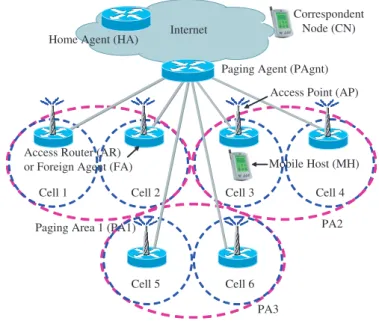
An IP-based wireless network architecture is shown in Figure1[15]. An access router (AR) provides MHs with IP connectivity. The AR acts as a default router to the currently served MHs. Since MIPv6 [2] provides many advantages over MIPv4 [1], MIPv6 [2] is considered a reference mobility protocol in this paper. However, we note that the proposed scheme can be applied to both the MIPv4 and MIPv6-based
wireless networks. An energy-efficient mobility management scheme is proposed to manage the following seven MH states: transmitting, receiving, attention/cell-connected, attention/PA-connected, idle, off/attached, and detached states. Transmitting, receiving, and attention/cell-connected MHs behave in the same manner as MIP. The correspondent node (CN) and home agent (HA) do not need to be changed. The MH and paging agent (PAgnt) require only minor changes. The PAgnt conducts paging-related functions and manages one or more PAs. Two or more ARs can exist in a PA. To establish the PA identity, a unique PA identifier (PAI) can be used.
Figure 1. An IP-based wireless network architecture.
Internet
Mobile Host (MH) Access Router (AR)
or Foreign Agent (FA) Home Agent (HA)
Correspondent Node (CN)
Paging Agent (PAgnt)
Cell 3 Cell 4
Cell 1 Cell 2
Paging Area 1 (PA1) PA2
Access Point (AP)
PA3
Cell 5 Cell 6
A transmitting, receiving, or attention/cell-connected MH registers its collocated care-of address (CCoA) at the corresponding HA as in MIP. Hence, the PAgnt does not need to be involved in the MIP registration procedure. When a transmitting, receiving, or attention/cell-connected MH moves to a different cell which is served by a different AR, the MH conducts cell-based registration in the same manner as the MIP registration. After the data session is completed, the MH enters the attention/cell-connected state and an attention timer is reset and restarted. The attention timer is used to decide the instant when the MH enters the idle state. If the attention timer expires, an attentive MH that is in the attention/cell-connected state or attention/PA-connected state enters the idle state by conducting PA-based registration. Through this PA-based registration, the MH can register a PAI of the current PA at the PAgnt. A paging agent care-of address (PAgnt-CoA) of the current PAgnt is registered at the corresponding HA of the MH. Whenever an idle MH moves to a different PA or PAgnt, the MH enters the attention/PA-connected state to conduct the PA-based registration and the attention timer is reset and restarted.
When data packets which are destined for an idle MH arrive at the HA, the packets are tunneled to the PAgnt. Hence, the HA is unaware of the idle state of the MH. The PAgnt buffers the data packets and sends paging request messages to ARs in the PA. The signaling messages can be sent to MHs via access points which are connected to the ARs. The corresponding idle MH enters the receiving state,
and sends paging reply messages to the PAgnt. Concurrently, the MH registers its CCoA at the HA as the MIP registration. The PAgnt can forward the buffered data packets.
The MH power-off state can be detected by a BL-based registration and an unsuccessful paging. When the HA or the PAgnt sets a limitation on the maximum binding lifetime, the BL-based registration can be used to detect the power-off state of MHs. The network considers the MH state as detached when it detects a silence for more than an agreed time period or the MH does not respond to paging.
In the proposed scheme, an MH has the following seven states:
(1) Transmitting: The MH registers its CCoA at the corresponding HA as MIP. In this state, the MH has outgoing sessions. The MH remains during the session holding time. The MH exits this state upon completing outgoing data sessions or a switch-off action.
(2) Receiving: After the MH registers its CCoA at the corresponding HA as in MIP, the MH can receive the data packets. An exit from this state is caused by incoming session completion or switch-off action.
(3) Attention/cell-connected: There is no incoming or outgoing session for the MH. The MH conducts a cell-based registration whenever it enters this state from the off/attached state or detached state or it changes its serving AR. Thus, the MH location is known in the network with cell accuracy. When an incoming or outgoing session arrives, the MH enters the transmitting or receiving state. When an attention timer expires, the MH enters the idle state by performing a PA-based registration.
(4) Attention/PA-connected: The MH conducts the PA-based registration. Thus, the MH location is known in the network with PA accuracy. When an attention timer expires, the MH reenters the idle state. When an incoming or outgoing session arrives, the MH enters the communicating state. If the MH is switched off, it enters the off/attached state.
(5) Idle: The MH is not currently involved in ongoing sessions and signaling messages. Thus, the idle MH can operate in a power-saving mode. When the idle MH moves to a different PA or PAgnt, the MH enters the attention/PA-connected state to perform the PA-based registration. When an MH is in the idle state, its current location information is maintained in terms of PA.
(6) Off/attached: If the MH is powered off, the PAgnt is not immediately informed of the power-off state. The power-off state can be detected by a BL-based registration and an unsuccessful paging. When the binding-lifetime expires or paging is unsuccessful, the network detaches the MH. When the MH is switched on, it enters the attention/cell-connected state by performing the MIP registration.
(7) Detached: If the network detects an MH switch-off action, it detaches the MH. The MH neither responds to paging nor sends location registration messages.
3. Analysis of an Energy-Efficient Mobility Management Scheme 3.1. Stationary Probabilities and Steady State Probabilities
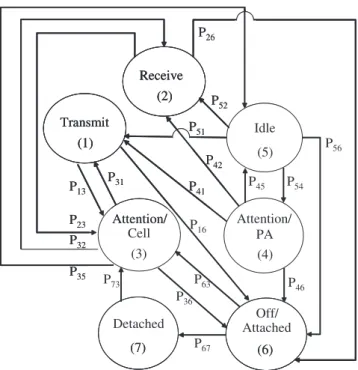
We derive the stationary probabilities and steady state probabilities of seven MH states for the proposed energy-efficient mobility management scheme in IP-based wireless networks in
compact form. MH state transitions are shown in Figure 2. We assume the following density functions of random variables:
• Incoming (receiving) and outgoing (transmitting) sessions occur at an MH according to a Poisson process with parameters λiand λo, respectively.
• The cell and PA residence durations are exponentially distributed with parameters 1/λcand 1/λPA,
respectively.
• Switch-off actions take place according to a Poisson process with a parameter of λoff.
• The duration that an MH remains switched-off follows an exponential distribution with a parameter of 1/µoff.
Since the residence time of the MH in each state is not exponentially distributed, we analyze the MH state transitions using a semi-Markov process approach [15-17]. The stationary probabilities of the imbedded Markov chain are obtained by solving the balancing equations:
πj = 7 ∑ i=1 πiPij, j = 1, 2, ..., 7 (1) 1 = 7 ∑ i=1 πi (2)
where πi denotes the stationary probability of state i while Pij denotes the state transition probability
from state i to state j. The state transition probability matrix P = [Pij] for the MH state transitions is
expressed as: P = 0 0 P13 0 0 P16 0 0 0 P23 0 0 P26 0 P31 P32 0 0 P35 P36 0 P41 P42 0 0 P45 P46 0 P51 P52 0 P54 0 P56 0 0 0 P63 0 0 0 P67 0 0 P73 0 0 0 0 (3)
From Equations (1–3) the stationary probabilities of the seven MH states are solved as: π1 = 1 D [{ (P31(1− P45P54) + P35(P41P54+ P51) } (P63+ P73P67) ] (4) π2 = 1 D [{ (P32(1− P45P54) + P35(P42P54+ P52) } (P63+ P73P67)] ] (5) π3 = 1 D [ (1− P45P54)(P63+ P73P67) ] (6) π4 = 1 D [ P35P54(P63+ P73P67) ] (7) π5 = 1 D [ P35(P63+ P73P67) ] (8) π6 = 1 D [ (1−P13P31−P23P32)(1−P45P54)−P13P35(P51+P41P54)−P23P35(P52+P42P54) ] (9) π7 = 1 D [ P67 { (1−P13P31−P23P32)(1−P45P54)−P13P35(P51+P41P54)−P23P35(P52+P42P54) }] (10)
where D consists of the state transition probabilities Pij.
The steady state probabilities of the semi-Markov process are obtained by: Pi=
πiT¯i
∑7
j=1πjT¯j
, i = 1, 2, ..., 7 (11)
where the values of the mean sojourn times of the MH in each state i, ¯Ti are expressed as [15]:
¯ T1 = 1− Fs∗(λoff) λoff , T¯2 = 1− Fs∗(λoff) λoff (12) ¯ T3 = 1− e−(λi+λo+λoff+λc)TA
λi+ λo+ λoff + λce−(λi+λo+λoff+λc)TA
, T¯4 = 1− e−(λi+λo+λoff)TA λi+ λo+ λoff (13) ¯ T5 = 1− Fr∗(λi+λo+λoff+λPA) λi+ λo+ λoff + λPA , T¯6 = 1 λi+µoff {1− λr λi+µoff [1−Fr∗(λi+µoff)]} (14) ¯ T7 = 1 µoff (15) The steady state probabilities of the seven MH states for the proposed scheme are derived in compact form as [16]: P1 = µoff λoff + µoff λo(1− Fs∗(λoff)) λs+ λoff [ 1− λs λs+ λoff Fs∗(λoff) ]−1 (16) P2 = µoff λoff + µoff λi(1− Fs∗(λoff)) λs+ λoff [ 1− λs λs+ λoff Fs∗(λoff) ]−1 (17) P3 = λoffµoff λoff + µoff 1− e−λ2 λ1+ λce−λ2 [ 1− λs λs+ λoff Fs∗(λoff) ]−1 (18) P4 = λoffµoff λoff + µoff λ1Fr∗(λ1+ λPA) + λPA λ1[1− e−λ3Fr∗(λ1 + λPA)] + λPA(1− e−λ3) · (λ1+ λc)(1− e−λ3)e−λ2 λ1(λ1+ λce−λ2) [ 1− λs λs+ λoff Fs∗(λoff) ]−1 (19) P5 = λoffµoff λoff + µoff 1− Fr∗(λ1+ λPA) λ1[1− e−λ3Fr∗(λ1 + λPA)] + λPA(1− e−λ3) · (λ1+ λc)e−λ2 λ1+ λce−λ2 [ 1− λs λs+ λoff Fs∗(λoff) ]−1 (20) P6 = 1 λi+ µoff λoffµoff λoff + µoff [ 1− λr λi+ µoff (1− Fr∗(λi+ µoff)) ] (21) P7 = 1 λi+ µoff λoff λoff + µoff [ λi+ λrµoff λi+ µoff (1− Fr∗(λi+ µoff)) ] (22) where λ1 = λi+ λo+ λoff, λ2 = (λ1+ λc)TA, λ3 = λ1TA, λs = λi+ λo. λidenotes the mean arrival rate
of incoming sessions, λodenotes the mean arrival rate of outgoing sessions, 1/λc denotes the mean cell
residence duration, 1/λP A denotes the mean PA residence duration, λoff denotes the mean switch-off
rate, 1/µoff denotes the mean switch-off duration, and TAdenotes the attention timer value. The session
holding time is assumed to follow a general distribution with a density function fs(t) with a mean 1/µs
while Fs∗(θ) is the Laplace transform of fs(t). Since the Gamma distribution has the same trend as a
The Erlang and Gamma distributions can be used for the session holding time. The interval of BL-based registration is assumed to follow a general distribution with a density function fr(t) with a mean of 1/λr
while Fr∗(θ) is the Laplace transform of fr(t).
Figure 2. The mobile host (MH) state transitions.
Attention/ Cell (3) Detached (7) Off/ (6) Attached Attention/ PA (4) Transmit (1) P73 P36 P63 P67 P46 P16 P13 P31 P 41 P45 P54 P56 Idle (5) P51 Receive (2) P 52 P42 P26 P23 P32 P35 Attention/ Attention/ Cell (3) Detached (7) (7) Off/ (6) (6) Attached Attention/ PA (4) Transmit (1) Transmit (1) P73 P36 P63 P67 P46 P16 P13 P31 P 41 P45 P54 P56 Idle (5) P51 Receive (2) Receive (2) P 52 P42 P26 P23 P32 P35
3.2. The Power-Saving Effect
The power-saving effect of the proposed scheme is analyzed compared to the conventional scheme for Mobile IP-based wireless networks. To analyze the power-saving effect, let P ci denote power
consumption in state i. The energy consumption for the proposed scheme is obtained by:
Eprop =
5
∑
i=1
P ciPit (23)
When an idle MH moves to a different PA or PAgnt, the MH enters the attention/PA-connected state to perform the PA-based registration. The idle MH enters the communicating state when either an incoming or outgoing session arrives. Thus, the idle MH can operate in a power-saving mode since the idle MH may not have communicating sessions or signaling messages. The power consumption in each state of the MH has the following condition:
P c1 ≥ P c2 ≥ P c3 ≥ P c4 ≫ P c5 (24)
Since the conventional MIP protocol [1-2] supports registration but not paging, it does not distinguish active MHs from idle ones. Hence, the value of the attention timer TA approaches∞. Therefore, the
lim
TA→∞P1 = P1, TA→∞limP2 = P2
lim TA→∞P3 = [1− λs λs+ λoff Fs∗(λoff)]−1 λoffµoff λoff + µoff 1 λ1 lim
TA→∞P4 = 0, TA→∞limP5 = 0
lim TA→∞P6 = P6 = λoffµoff λoff + µoff 1 λi+ µoff [1− λr λi+ µoff (1− Fr∗(λi+ µoff))] lim TA→∞P7 = P7 = λoff λoff + µoff 1 λi+ µoff [λi+ λrµoff λi+ µoff (1− Fr∗(λi+ µoff))]
Then, the energy consumption for the conventional MIP scheme is obtained by: Econv = lim TA→∞ 5 ∑ i=1 P ciPit = (P c1P1+ P c2P2+ P c3 lim TA→∞P3)t = {P c1P1+ P c2P2+ P c3(P3+ P4+ P5)}t (25)
From Equations (23–25), the relationship of the energy consumption between the proposed and conventional schemes is expressed as Eprop≤ Econv. Therefore, the energy consumption for the proposed
scheme is always lower than that for the conventional scheme. Additionally, the proposed scheme with a proper value of attention timer TA yields significant power savings compared with the conventional
mobility management scheme for Mobile IP-based wireless networks. 3.3. Network Cost
We analyze the network cost due to registration and paging messages using the steady state probabilities. When an MH is in the transmitting, receiving or attention/cell-connected state, the MH performs a cell-based registration. If an MH is in the attention/PA-connected or idle state, the MH performs a PA-based registration, and the system can page the MH if data packets are destined for the MH. If an MH is not switched off, it performs a BL-based registration.
Let ρMH and Atot denote the density of MHs within a total area and the size of the total area,
respectively. The rates of cell-based registration, PA-based registration, BL-based registration, and paging messages for the proposed scheme are expressed as:
λcellprop = ρMHAtot(P1+ P2+ P3)λc (26)
λPAprop = ρMHAtot(P4+ P5)λPA = ρMHAtot(P4+ P5)λc/
√ Ncell/P A (27) λBLprop = ρMHAtot 5 ∑ i=1 Pi ¯ NBL,i ¯ Ti (28)
λpagprop = ρMHAtot(P4+ P5+ kP6)λiNcell/PA (29)
where Ncell/PA is the number of cells in PA, ¯NBL,i is the mean number of BL-based registrations
during the mean sojourn time in state i, and k is the number of paging repetitions when the paging is unsuccessful. In Equation (27), λPAis expressed with λc and Ncell/P Aunder the assumptions of a square
shaped configuration of cell and PA, and a fluid flow mobility model of MHs [5], [22]. In Equation (29), λpag
prop is expressed with Ncell/PA because an additional paging cost is incurred as different cells in PA
We consider that MHs move at an average speed of Vi according to the environment type which
consists of stationary user environment (i = 0), urban in-building environment (i = 1), urban pedestrian environment (i = 2), and urban vehicular environment (i = 3) [23-25]. It is considered that MHs move in directions which are uniformly distributed over [0, 2π], and the MHs are uniformly distributed with a density of ρMH. The average number of MHs crossing out of the cell and the PA per unit time, rcell and
rP A, respectively, are given by:
rcell = ρMHlcell π 3 ∑ i=0 PenviVi, rP A = ρMHlP A π 3 ∑ i=0 PenviVi
where lcell and lP A are the length of the cell perimeter and the PA perimeter, respectively. The average
rates of cell updates and PA updates of an MH are obtained by:
λc = rcell (lcell4 )2ρ M H = 16 πlcell 3 ∑ i=0 PenviVi λP A = rPA (lPA4 )2ρ M H = 16 πlcell √ Ncell/PA 3 ∑ i=0 PenviVi
Let r1 be the time interval from the instant that the MH enters state i to the instant that the MH
conducts the first BL-based registration in the state. Let fr1(t) and fTi(t) denote the density functions
of the time interval r1 and the sojourn time Ti, respectively. Then, the mean number of BL-based
registrations ¯NBL,iis obtained by:
¯ NBL,i = ∞ ∑ n=1 nP r[NBL,i = n] = ∞ ∑ n=1 n 2πj ∫ σ+j∞ σ−j∞ Fr∗1(θ)[Fr∗(θ)]n−1[1− Fr∗(θ)] θ F ∗ Ti(−θ)dθ (30)
where Fr∗1(θ) and FTi∗(θ) denote the Laplace transforms of fr1(t) and fTi(t), respectively. Equation (30)
is evaluated using the Residue theorem [26]. We define a cost function as the weighted sum of the rates of cell-based registration, PA-based registration, BL-based registration, and paging messages for the proposed scheme as follows:
Cproptot = Cpropreg + Cproppag (31)
Cpropreg = Cpropcell + CpropPA + CpropBL = wcellλcellprop+ wPAλPAprop+ wBLλBLprop (32)
Cproppag = wpagλpagprop (33)
where wcell, wP A, wBL, and wpag are weighting factors. If the registration interval and session holding
time follow exponential distributions, an optimal value of the mean rate of BL-based registration λ∗r that minimizes Ctot
propis derived as:
λ∗r =−(λi+ µoff) +
√
wpagkλiλoffNcell/PA
wBL
The optimal rate of BL-based registration is determined by incoming session rate, the duration that an MH remains switched-off, the number of paging repetitions, the number of cells in PA, the switch-off rate, and the weighting factors wpagand wBL. We can also derive an optimal value of the number of cells
in PA Ncell/PA∗ that minimizes Ctot propas: Ncell/PA∗ = ( wPA wpag λc 2λi P4 + P5 P4+ P5+ kP6 )2/3 (35) where the sum of steady state probabilities P4+ P5 is derived from Equations (19) and (20).
P4+ P5 = λoffµoff λoff + µoff (λ1+ λc)e−λ1 λ1(λ1+ λce−λ1) [ 1− λs λs+ λoff Fs∗(λoff) ]−1 (36) The optimal number of cells in PA is determined by incoming session rate, the cell-based registration rate, the number of paging repetitions, the weighting factors wPA and wpag, and the steady state
probabilities P4+ P5and P6.
Since the conventional MIP protocol [1-2] does not distinguish between active and idle MHs, the value of attention timer TA approaches∞. The rates of cell-based registration, BL-based registration,
and paging messages for the conventional scheme are obtained as: λcellconv = ρMHAtot(P1+ P2+ lim
TA→∞P3)λc = ρMHAtot 5 ∑ i=1 Piλc (37) λBLconv = ρMHAtot 5 ∑ i=1 Pi ¯ NBL,i ¯ Ti (38)
λpagconv = ρMHAtotkP6λi (39)
If an MH is in the off/attached state, the MH does not respond to paging for incoming sessions. We consider this unsuccessful paging in the conventional MIP protocol. We define the network cost for the conventional scheme as the weighted sum of the rates of cell-based registration, BL-based registration, and paging messages as follows:
Cconvtot = Cconvreg + Cconvpag (40)
Cconvreg = Cconvcell + CconvBL = wcellλcellconv+ wBLλBLconv (41)
Cconvpag = wpagλpagconv (42)
From Equations (26–33) and (37–42), the relationship of the registration cost between the proposed and conventional schemes is expressed as Creg
prop≤ Cconvreg if wcell = wP A. Since the conventional scheme
considers only unsuccessful paging for the off/attached MHs, the relationship of the paging cost between the proposed and conventional schemes is obtained by Cproppag ≥ Cconvpag .
4. Numerical Examples
The effects of various input parameters on the steady state probabilities and power consumption of the proposed and conventional schemes are investigated. The values of input parameters assumed for numerical examples are shown in Table1[14–16], [27–29].
Table 1.Input Parameters. Parameter Value λi 1 (/h) λo 1 (/h) µs 3,600/300 (/h) λc 4 (/h) λPA λc/ √ Ncell/P A(/h) Ncell/P A 16 TA 120/3,600 (h) λr 1 (/h) λoff 1/4 (/h) µoff 1 (/h) P c1 1.10 (W) P c2 0.90 (W) P c3 0.80 (W) P c4 0.70 (W) P c5 0.01 (W) P c6 0 (W) P c7 0 (W)
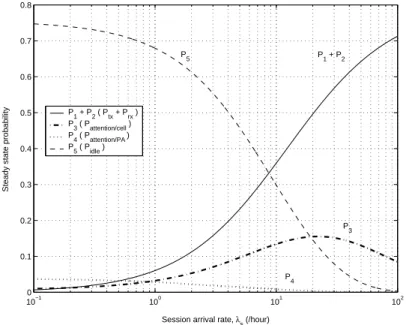
Figure 3 shows the effect of session arrival rate λs on the steady state probabilities. The session
arrival rate λsis expressed as λs = λi + λo. The higher the session arrival rate, the higher the transition
probabilities P31, P41, P51P32, P42, and P52due to the high rate of incoming or outgoing session arrivals.
Therefore, as the value of λsincreases, the probability P1+P2increases, but the probability P5decreases.
Figure 4 shows the effect of session arrival rate λs on the power consumption for the proposed
and conventional schemes. The power consumption is calculated as the energy consumption divided by time. The energy consumption for the proposed and conventional schemes is calculated using Equations (23) and (25), respectively. The power consumption for the proposed and conventional schemes increases as the value of λsincreases because it is more likely that MHs stay in the transmitting
and receiving states as the value of λsincreases. The MH power consumption in the proposed scheme is
approximately 0.1126 W, 0.1763 W and 0.4756 W at the session arrival rate λs= 1(/h), λs = 2(/h), and
λs = 10(/h), respectively. The MH power consumption for the conventional scheme is approximately
0.6521 W, 0.6625 W and 0.7119 W at λs = 1(/h), λs = 2(/h), and λs = 10(/h), respectively. Thus, for
2 ≤ λs ≤ 10, the power consumption of the proposed scheme is reduced by about 33.2% ∼ 73.4%
compared with the conventional scheme. Furthermore, if the session arrival rate is low (λs ≤ 1), the
proposed scheme can save about 82.7% of the battery power consumption at the MH compared with the conventional scheme in Mobile IP-based wireless networks.
Figure 3. The effect of λson the steady state probabilities. 10−1 100 101 102 0 0.1 0.2 0.3 0.4 0.5 0.6 0.7 0.8
Session arrival rate, λs (/hour)
Steady state probability
P 1 + P2 ( Ptx + Prx ) P3 ( Pattention/cell ) P4 ( Pattention/PA ) P5 ( Pidle ) P1 + P2 P5 P 3 P4
Figure 4. The comparison of the power consumption in the proposed and conventional schemes for varying the values of λs.
10−1 100 101 102 0 0.1 0.2 0.3 0.4 0.5 0.6 0.7 0.8
Session arrival rate, λs (/hour)
Power consumption (Joule/sec)
Pc
conventional
Pc proposed
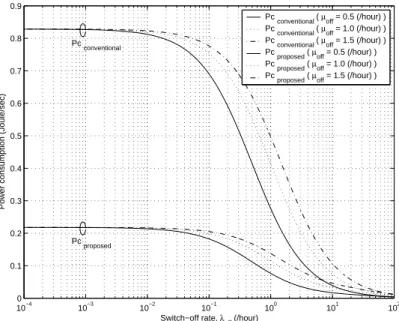
Figure5shows the effect of switch-off rate λoff on the steady state probabilities. As the switch-off rate
λoff increases, the probabilities P6 and P7 increase, but the probabilities P1, P2, P3, P4, and P5decrease.
Because it is more likely that MHs stay in the off/attached state and detached state as the switch-off rate λoff increases. Figure 6compares the power consumption of the proposed scheme with that of the
conventional scheme for varying the values of λoff and µoff. When an MH is in the off/attached state
or detached state, the MH does not consume power because the MH is powered off. As the switch-off rate λoff increases and the mean switch-off duration 1/µoff increases, the power consumption for the
Figure 5. The effect of λoff on the steady state probabilities. 10−4 10−3 10−2 10−1 100 101 102 0 0.1 0.2 0.3 0.4 0.5 0.6 0.7 0.8
Switch−off rate, λoff (/hour)
Steady state probability
P1 + P2 ( Ptx + Prx ) P3 ( Pattention/cell ) P 4 ( Pattention/PA ) P5 ( Pidle ) P6 ( Poff/attached ) P7 ( Pdetached ) P1 + P2 P 3 P7 P 5 P 6 P4
Figure 6. The comparison of the power consumption in the proposed and conventional schemes for varying the values of λoff and µoff.
10−4 10−3 10−2 10−1 100 101 102 0 0.1 0.2 0.3 0.4 0.5 0.6 0.7 0.8 0.9
Switch−off rate, λoff (/hour)
Power consumption (Joule/sec)
Pc conventional ( µoff = 0.5 (/hour) ) Pc
conventional ( µoff = 1.0 (/hour) )
Pc
conventional ( µoff = 1.5 (/hour) )
Pc proposed ( µoff = 0.5 (/hour) )
Pc proposed ( µoff = 1.0 (/hour) ) Pc
proposed ( µoff = 1.5 (/hour) )
Pc
conventional
Pc
proposed
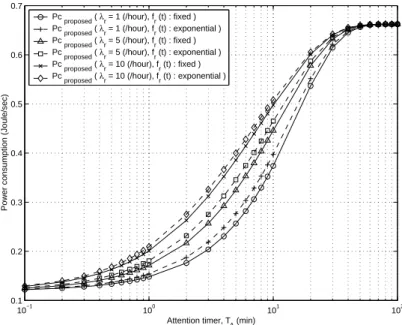
Figure 7 shows the effect of attention timer value TA on the power consumption of the proposed
scheme for various values of BL-based registration rate λrif the registration interval is fixed (solid line)
or exponentially (dashed line) distributed. As the values of TA and λr increase, power consumption of
the proposed scheme increases because the probability P5 that an MH stays in the idle state decreases.
An MH battery’s power is saved more as the value of attention timer TAdecreases. However, the value
of TAneeds to be determined by considering the incoming session rate and the data session delay. The
results show that the power consumption of the proposed scheme depends on the distribution of the registration intervals. The fixed registration intervals are better than the exponential registration intervals from the viewpoint of the power-saving effect of the proposed scheme.
Figure 7. The effect of TAon the power consumption of the proposed scheme for various
values of λr if the interval of binding-lifetime-based registration is fixed (solid line) or
exponentially (dashed line) distributed.
10−1 100 101 102 0.1 0.2 0.3 0.4 0.5 0.6 0.7
Attention timer, TA (min)
Power consumption (Joule/sec)
Pc proposed ( λr = 1 (/hour), fr (t) : fixed )
Pc proposed ( λr = 1 (/hour), fr (t) : exponential ) Pc proposed ( λr = 5 (/hour), fr (t) : fixed ) Pc proposed ( λr = 5 (/hour), fr (t) : exponential ) Pc
proposed ( λr = 10 (/hour), fr (t) : fixed )
Pc
proposed ( λr = 10 (/hour), fr (t) : exponential )
Figure8 shows the effect of cell update rate λc on the power consumption of the proposed scheme
for various values of Ncell/P A. As MH mobility increases, both the cell update rate λc and the power
consumption increases because the probability P5that the MH stays in the idle state decreases as the cell
update rate λc increases. As the number of cells in PA Ncell/P A decreases, both the PA update rate λP A
and the power consumption increases.
Figure 8. The effect of λc on the power consumption of the proposed scheme for various
values of Ncell/P A. 10−1 100 101 0.16 0.17 0.18 0.19 0.2 0.21 0.22 0.23
Cell update rate, λc (/hour)
Power consumption (Joule/sec)
Pc proposed ( Ncell/PA = 4 ) Pc proposed ( Ncell/PA = 9 ) Pc proposed ( Ncell/PA = 16 ) Pc proposed ( Ncell/PA = 25 ) Pc proposed ( Ncell/PA = 36 )
The effects of various input parameters on the network cost of the proposed scheme in IP-based wireless networks are investigated. The values of input parameters assumed for numerical examples are shown in Table2[23-25].
Table 2.Input Parameters.
Parameter Value Parameter Value
λi 1/2 (/h) λo 1/2 (/h)
µs 10 (/h) TA 1/15 (h)
λoff 1/4 (/h) µoff 1/3 (/h)
Tr 1 (h) wregcell, wregPA 1
k 3 wBL reg, wpag 1 ρM H 100 (/km2) lcell 2 (km) V0 0 (km/hr) Penv0 0.40 V1 2 (km/hr) Penv1 0.25 V2 4 (km/hr) Penv2 0.20 V3 60 (km/hr) Penv3 0.15
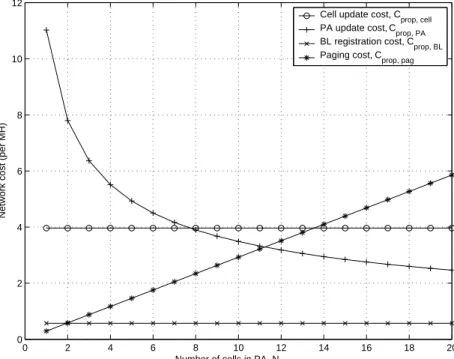
Figure9shows the effect of Ncell/P Aon the network cost of the proposed scheme which consists of
cell update cost Cpropcell , PA update cost CpropPA , BL-based registration cost CpropBL, and paging cost Cproppag . As the number of cells in PA Ncell/P A increases, the PA update cost decreases due to infrequent crossing
out of the PA, while the paging cost increases due to paging messages for the large number of cells in PA. The cell update cost and the BL-based registration cost are fixed with various numbers of cells in PA Ncell/P A according to Equations (26) and (28).
Figure 9. The effect of Ncell/P Aon the network cost of the proposed scheme.
0 2 4 6 8 10 12 14 16 18 20 0 2 4 6 8 10 12
Number of cells in PA, N
cell/PA
Network cost (per MH)
Cell update cost, Cprop, cell PA update cost, Cprop, PA BL registration cost, C
prop, BL
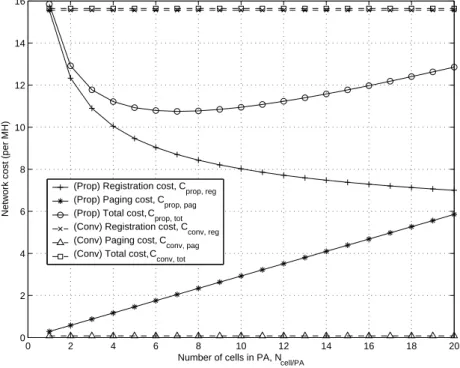
Figure10shows the effect of Ncell/P Aon registration cost Cpropreg , Cconvreg , paging cost Cproppag, Cconvpag , and
total network cost Cproptot , Cconvtot for the proposed and conventional schemes. The network costs for the conventional scheme are fixed with varying Ncell/P A according to Equations (37–42). The numerical
results show that Cpag
prop ≥ Cconvpag and Cpropreg ≤ Cconvreg when wcell = wP A. For the proposed scheme, the
optimal number of cells in PA Ncell/P A∗ can exist. The result shows that total network cost with the input parameters is a minimum value at Ncell/P A∗ = 7 which is consistent with Equation (35).
Figure 10. The optimal number of cells in paging area (PA) Ncell/P A∗ of the proposed scheme.
0 2 4 6 8 10 12 14 16 18 20 0 2 4 6 8 10 12 14 16
Number of cells in PA, Ncell/PA
Network cost (per MH)
(Prop) Registration cost, Cprop, reg (Prop) Paging cost, Cprop, pag (Prop) Total cost, Cprop, tot (Conv) Registration cost, Cconv, reg (Conv) Paging cost, Cconv, pag (Conv) Total cost, C
conv, tot
We define the combined network and power cost for the proposed scheme Cpropcomb and that for the conventional scheme Ccomb
conv as:
Cpropcomb = wnetCproptot + wpowP cprop = wnetCproptot + wpowEprop/t (43)
Cconvcomb = wnetCconvtot + wpowP cconv= wnetCconvtot + wpowEconv/t (44)
where wnet and wpow are weighting factors for network cost and power consumption, respectively.
Figure 11 shows the combined network and power cost Ccomb
prop for the proposed scheme with varying
the values of Ncell/P A∗ and wpow. As the weighting factor wpowincreases as 1, 25, and 50 with fixed value
of wnet, the optimal number of cells in PA Ncell/P A∗ increases as 7, 9, and 11 for the combined network
and power cost. It is because the MH power consumption for the proposed scheme decreases as Ncell/P A
increases as shown in Figure8.
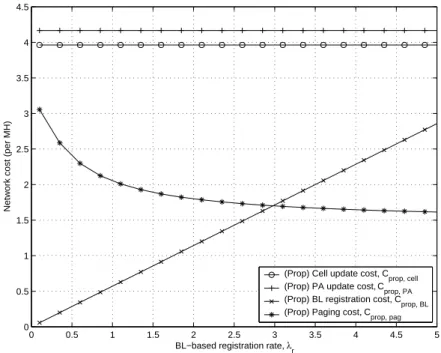
Figure 12 shows the effect of mean rate of BL-based registration λr on the network cost of the
proposed scheme which consists of cell update cost Cpropcell, PA update cost CpropPA , BL-based registration cost CpropBL , and paging cost Cproppag . As the BL-based registration rate λr increases, the BL-based
registration cost increases and the paging cost decreases due to the frequent BL-based registrations. The rates of cell-based registration and PA-based registration are fixed with various values of λraccording to
Figure 11. Combined network and power cost for the proposed scheme for varying the values of Ncell/P A. 0 2 4 6 8 10 12 14 16 18 20 10 15 20 25 30 35
Number of cells in PA, N
cell/PA
Combined network and power cost
w net : wpow = 1:1 w net : wpow = 1:25 w net : wpow = 1:50
Figure 12. The effect of λron the network cost of the proposed scheme.
0 0.5 1 1.5 2 2.5 3 3.5 4 4.5 5 0 0.5 1 1.5 2 2.5 3 3.5 4 4.5
BL−based registration rate, λr
Network cost (per MH)
(Prop) Cell update cost, C
prop, cell
(Prop) PA update cost, C
prop, PA
(Prop) BL registration cost, C
prop, BL
(Prop) Paging cost, C
prop, pag
Figure13shows the effect of λron the total network cost Ctotand the optimal BL-based registration
rate λ∗r for two types of distributions of registration intervals, exponential (dashed line) and fixed (solid line) distributions. The result shows that the distribution of the BL-based registration intervals affects the network cost. If the BL-based registration intervals follow an exponential distribution, the total network cost Ctot is a minimum value of 10.98 at λ∗r = 0.8 which is consistent with Equation (34).
λ∗r = 0.8. Therefore, the fixed BL-based registration intervals are preferred over the exponential BL-based registration intervals since the fixed BL-based registration intervals yield a lower network cost in the proposed scheme for IP-based wireless networks.
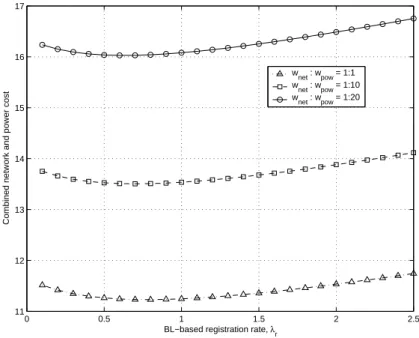
Figure 14 shows the combined network and power cost Ccomb
prop for the proposed scheme with
exponential BL-based registration intervals for various values of λrand wpow. As shown in Figure7, the
power consumption of MHs for the proposed scheme increases as λr increases. Hence, as the weighting
factor wpowincreases as 1, 10, and 20 with fixed value of wnet, the optimal BL-based registration rate λ∗r
for the combined network and power cost decreases as 0.8, 0.7, and 0.6.
Figure 13.The optimal binding-lifetime-based registration rate λ∗r of the proposed scheme.
0 0.5 1 1.5 2 2.5 10.7 10.8 10.9 11 11.1 11.2 11.3 11.4 11.5 11.6
BL−based registration rate, λr
Network cost (per MH)
Total cost, Ctot : fixed
Total cost, C
tot : exponential
Figure 14.Combined network and power cost of the proposed scheme for varying the values of λr. 0 0.5 1 1.5 2 2.5 11 12 13 14 15 16 17
BL−based registration rate, λr
Combined network and power cost
wnet : wpow = 1:1
wnet : wpow = 1:10
w
5. Conclusions
An energy-efficient mobility management scheme was proposed to reduce MH power consumption in IP-based wireless networks. The proposed scheme manages the following seven MH states, including transmitting, receiving, attention/cell-connected, attention/PA-connected, idle, off/attached, and detached states, to efficiently manage battery power, radio resources, and network load. The MH state transition behavior was modeled. We derived the stationary probabilities and steady state probabilities of the MH states for the proposed and conventional schemes in IP-based wireless networks in compact form. The effects of various input parameters on the MH steady state probabilities and power consumption were investigated in the proposed scheme compared to the conventional scheme with consideration of exponential and fixed distributions on interval of BL-based registration. The proposed scheme yielded significant power savings compared with the conventional mobility management scheme for Mobile IP based wireless networks. Network costs such as cell updates, PA updates, BL-based registrations, and paging messages were analyzed in the proposed and conventional schemes for IP-based wireless networks. The optimal values of PA size and registration interval were derived to minimize the network cost of the proposed scheme. The effects of various input parameters on the network cost were investigated. We also investigated the combined network and power cost with various weighting factors for the proposed and conventional schemes. These analytical results provide guidelines to select proper system parameters. The results can be utilized to analyze the performance of mobility management schemes in IP-based wireless networks.
Acknowledgements
This work was supported in part by the Korea Research Foundation Grant funded by the Korean Government (KRF-2008-357-D00181) and in part by the Research Grant of Kwangwoon University in 2011.
References
1. Perkins, C. IP Mobility Support for IPv4; IETF RFC 3344; The Internet Society: Washington, DC, USA, August 2002.
2. Johnson, D.B.; Perkins, C.; Arkko, J. Mobility Support in IPv6; IETF RFC 3775; The Internet Society: Washington, DC, USA, June 2004.
3. Reinbold, P.; Bonaventure, O. IP micro-mobility protocols. IEEE Commun. Surv. Tutor. 2003, 5, 40–56.
4. Ramjee, R.; Varadhan, K.; Salgarelli, L.; Thuel, S.R.; Wang, S.-Y.; La Porta, T. HAWAII: A domain-based approach for supporting mobility in wide-area wireless networks. IEEE/ACM Trans. Netw. 2002, 10, 396–410.
5. Zhang, X.; Castellanos, J.G.; Campbell, A.T. P-MIP: Paging extensions for mobile IP. Mob. Netw. Appl. 2002, 7, 127–141.
6. Chung, Y.W.; Sung, D.K.; Aghvami, A.H. Steady state analysis of P-MIP mobility management. IEEE Commun. Lett. 2003, 7, 278–280.
7. Soliman, H.; Castelluccia, C.; Malki, K.E.; Bellier, L. Hierarchical Mobile IPv6 Mobility Management (HMIPv6); IETF RFC 4140; The Internet Society: Washington, DC, USA, August 2005.
8. Koodli, R. Fast Handover for Mobile IPv6; IETF RFC 4068; The Internet Society: Washington, DC, USA, July 2005.
9. Kempf, J. Problem Statement for Network-Based Localized Mobility Management (NETLMM); IETF RFC 4830; The Internet Society: Washington, DC, USA, April 2007.
10. Kempf, J. Goals for Network-Based Localized Mobility Management (NETLMM); IETF RFC 4831; The Internet Society: Washington, DC, USA, April 2007.
11. Gundavelli, S.; Leung, K.; Devarapalli, V.; Chowdhury, K.; Patil, B. Proxy Mobile IPv6; IETF RFC 5213; The Internet Society: Washington, DC, USA, August 2008.
12. Kong, K.; Han, Y.; Shin, M.; Yoo, H.; Lee, W. Mobility management for all-IP mobile networks: Mobile IPv6 vs. proxy mobile IPv6. IEEE Wirel. Commun. 2008, 15, 36–45.
13. Zhou, H.; Zhang, H.; Qin, Y.; Wang, H.-C.; Chao, H.-C. A proxy mobile IPv6 based global mobility management architecture and protocol. Mob. Netw. Appl. 2010, 15, 530–542.
14. Kwon, S.-J.; Nam, S.Y.; Hwang, H.Y.; Sung, D.K. Analysis of a mobility management scheme considering battery power conservation in IP-based mobile networks. IEEE Trans. Veh. Technol. 2004, 53, 1882–1890.
15. Hwang, H.Y.; Kwon, S.-J.; Chung, Y.W.; Sung, D.K. A mobility management scheme for reducing power consumption in IP-based wireless networks. In Proceedings of the GLOBECOM, Taipei, Taiwan, November 2002; pp. 2979–2983.
16. Hwang, H.Y.; Kwon, S.-J.; Chung, Y.W.; Sung, D.K.; Park, S. Steady state analysis of an energy efficient mobility management scheme in IP-based wireless networks. In Proceedings of the FGIT, LNCS 6485, Jeju Island, Korea, December 2010; pp. 145–153.
17. Ross, S.M. Stochastic Process; John Wiley & Sons: Hoboken, NJ, USA, 1996.
18. Lin, P.; Lin, Y.-B. Channel allocation for GPRS. IEEE Trans. Veh. Technol. 2001, 50, 375–387. 19. Yang, S.-R. Dynamic power saving mechanism for 3G UMTS system. Mob. Netw. Appl. 2007, 12,
5–14.
20. Lin, Y.-B. Eliminating tromboning mobile call setup for international roaming users. IEEE Trans. Wirel. Commun. 2009, 8, 320–325.
21. Lin, Y.-B.; Tsai, M.-H.; Dai, H.-W.; Chen, Y.-K. Bearer reservation with preemption for voice call continuity. IEEE Trans. Wirel. Commun. 2009, 8, 2716–2725.
22. Watanabe, Y.; Yabusaki, M. Mobility/traffic adaptive location management. IEICE Trans. Commun. 2002, E85-B, 2076–2082.
23. Methodology for the Calculation of IMT-2000 Terrestrial Spectrum Requirement; Rec. ITU-R, M.1390; International Telecommunication Union (ITU): Geneva, Switzerland, May 2000. 24. Spectrum Requirements for IMT-2000; Rep. ITU-R, M.2023; International Telecommunication
Union (ITU): Geneva, Switzerland, May 2000.
25. Methodology for Calculation of Spectrum Requirements for the Future Development of IMT-2000 and Systems beyond IMT-2000 from the Year 2010 Onwards; Rec. ITU-R, M.1768; International Telecommunication Union (ITU): Geneva, Switzerland, June 2006.
26. Fang, Y.; Chlamtac, I.; Lin, Y.-B. Portable movement modeling for PCS networks. IEEE Trans. Veh. Technol. 2000, 49, 1356–1363.
27. Shih, E.; Cho, S.-H.; Nathan, I.; Min, R.; Sinha, A.; Wang, A.; Chandrakasan, A. Physical layer driven protocol and algorithm design for energy-efficient wireless sensor networks. In Proceedings of the MobiCom, Rome, Italy, 16–21 July 2001; pp. 272–287.
28. Feeney, L.M.; Nilsson, M. Investigating the energy consumption of a wireless network interface in an ad hoc networking environment. In Proceedings of the INFOCOM, Anchorage, AK, USA, 22–26 April 2001; Volume 3, pp. 1548–1557.
29. Shih, E.; Bahl, P.; Sinclair, M.J. Wake on wireless: An event driven energy saving strategy for battery operated devices. In Proceedings of the MobiCom, Atlanta, GA, USA, 23–28 September 2002; pp. 160–171.
c
⃝ 2011 by the authors; licensee MDPI, Basel, Switzerland. This article is an open access article distributed under the terms and conditions of the Creative Commons Attribution license (http://creativecommons.org/licenses/by/3.0/).