446 Vol. 62, No. 5
© 2014 The Pharmaceutical Society of Japan
Synthesis and Anticancer Activity of Novel Deoxoartemisinin–Glycolipid
Hybrids
Dongguk Min,
a,#Minkyu Kim,
a,#Jérémy Ricci,
aSora Jung,
aKirim Kim,
bWon-Yoon Chung,
bKwang-Kyun Park,
band Mankil Jung*
,aa Department of Chemistry, Yonsei University; Seoul 120–749, Korea: and b Department of Oral Biology, College of Dentistry, Yonsei University; Seoul 120–752, Korea.
Received January 13, 2014; accepted February 28, 2014; advance publication released online March 7, 2014
The practical synthesis and anticancer activity of novel deoxoartemisinin–glycolipid hybrids, which incorporate two drugs into a single molecule and can impact multiple targets simultaneously are presented. These hybrids exhibited potent in vitro anticancer activity against several human cancer cell lines. The de-oxoartemisinin–glycolipid hybrids generally demonstrated better anticancer activity than either artemisinin or daumone alone and cisplatin.
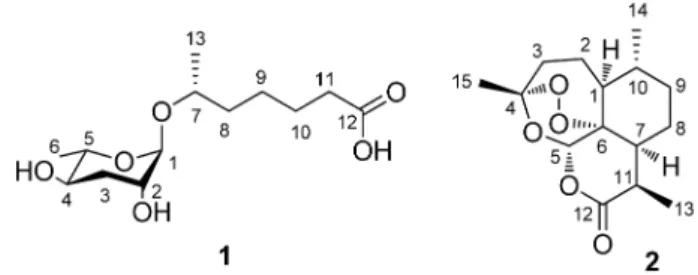
Key words anticancer activity; oral squamous carcinoma; deoxoartemisinin; glycolipid hybrid Daumone (1) (Fig. 1), a life expanding glycolipid isolated
from Caenorhabditis elegans, was identified for the first time by our laboratory as a dauer-inducing pheromone, and its total synthesis was presented.1) While some previous studies have
presented glycolipid derivatives with anticancer activity, the relatively weak activity for this compound class has generally discouraged its use for anticancer chemotherapeutic agents.2–6)
However, glycosphingolipids found in a specific class of in-vertebrate that do not have sialic acids suppressed melanoma cell proliferation.7) Furthermore, glycolipids isolated from
spinach have been shown to inhibit DNA polymerase activity and mitochondrial pol replication.8) Recently, we reported the
synthesis of novel glycolipid derivatives through stereospecific
α-glycosylation to afford di- and tri-rhamnoside daumone
de-rivatives.9) Most of the derivatives possessed potent anticancer
activity against human cancer cell lines with an effective concentration in the nanomolar range, comparable to doxoru-bicin.9)
Artemisinin (2) (Fig. 1), also known as qinghaosu, a natu-ral tetracyclic sesquiterpene trioxane isolated from Artemisia
annua L.,10) and its derivatives have been used clinically to
treat drug-resistant malaria.11–15) In addition to their
well-known antimalarial activity, artemisinin and its derivatives also possess potent antiangiogenic activity,16–23) and several
research groups have demonstrated potential antitumor prop-erties for this compound class.20,24–31) We have shown that
non-acetal 12β(C–C)-type amide derivatives of deoxoartemi-sinin exhibit higher in vitro anticancer activity22) along with
20 times greater acid stability than acetal (C–O)-type deriva-tives of artemisinin.32)
One approach that has been developed to improve anti-cancer activity is the use of hybrid drugs, which incorporate two drugs into a single molecule33) and can impact multiple
targets simultaneously. Since cancer is a complex disease, it is unlikely that a single functional targeted drug will be effec-tive for treating this most advanced disease. Combined drugs that impact multiple targets simultaneously are better at con-trolling complex disease systems, are less prone to drug resis-tance.33) We recently reported that non-acetal 12β(C–C)-type
artemisinin–glycolipid hybrids show strong antiangiogenic activity,22) with twice the potency of the known antiangiogenic
agents fumagillin and thalidomide.22)
These promising results encouraged us to further prepare a series of 12β(C–C)-type deoxoartemisinin–glycolipid hy-brids and to test them as anticancer agents. Although gefitinib has been reported to be cytotoxic against an oral cancer cell line,34) no other anti-oral cancer agent has been reported in
the literature to date. In this study we report the practical synthesis and exceptional in vitro anti-oral and anti-lung can-cer activities of novel non-acetal deoxoartemisinin–glycolipid hybrids.
Results and Discussion
As outlined in Chart 1, artemisinin derivative 4 was ob-tained through a 4 reaction sequence from either artemisinin35)
(2) or artemisinic acid36) (3) according to previously reported
procedures. Direct oxidation of the terminal double bond of allyl deoxoartemisinin 4 using KMnO4 and NaIO4 provided
carboxymethyldeoxoartemisinin (5).22) Esterification of acid
5 with methanol in the presence of H2SO4 afforded ester 6
in 97% yield. β-isomer 6 (12S) in natural configuration was exclusively obtained (J12,11=4.7 Hz).
In order to examine the role of the hybrid glycolipid link-age, different glycolipids were synthesized (Chart 2). Briefly, in the course of the stereospecific total synthesis of daumone (1) via eight steps from L-rhamnose,1) intermediate 7a had
been prepared. Debenzoylation of compound 7a with NaOMe provided dihydroxy 7b1) in 91% yield. Protection of the
alco-hol moiety of 4-(hydroxymethyl) benzoic acid (8a) using tert-butyl dimethylsilyl chloride and imidazole as nucleophilic cat-Regular Article
* To whom correspondence should be addressed. e-mail: [email protected] The authors declare no conflict of interest.
# These authors contributed equally to this work.
alyst provided compound 8b.22) The coupling reaction between
compounds 7b and 8b using 1-(3-dimethylaminopropyl)-3-ethylcarbodiimide hydrochloride (EDC) and 4-dimethyl-aminopyridine (DMAP) as previously presented afforded benzoylated lipids 9a, 10, and 11a.22) Silyl ether deprotection
of compounds 9a and 11a using tetrabutylammonium fluoride gave compounds 9b (94% yield) and 11b (49% yield) as link-ers, respectively.
The route used for the preparation of deoxoartemisinin– glycolipid hybrids 12, 13, and 14 according to the previously described method is illustrated in Chart 3.22) Coupling of
carboxymethyl deoxoartemisinin (5) with functionalized dau-mone precursor 7b by esterification using EDC and DMAP afforded compounds 12 (22% yield), 13 (20% yield), and 14 (32% yield). The absolute configurations of C1-H and C2-H of L-rhamnose of the hybrid 12 and C3-H and C4-H of that
of the hybrid 13 were assigned as cis diequatorial and trans diaxial as shown in stuctures 12 and 13, respectively. In order to determine the effect of functional groups in the glycolipid portion of the hybrid on anticancer activity, we synthesized a compound library from compounds 13 and 14. Controlled hy-droboration and subsequent oxidation of compound 13 using 9-BBN and H2O2–NaOH provided alcohol 15 (70% yield).
Mesylation of compound 15 as previously described followed by addition of sodium azide provided hybrid azide 16 (57%). A click reaction between azide 16 and 4′-(2-propynyloxy)-acetophenone initiated by CuSO4·5H2O and sodium ascorbate
provided triazole 17 (32% yield). Ozonolysis of compound 13 followed by reduction with sodium borohydride gave alcohol
18 (75% yield). Mesylation of compound 18 using mesylate
chloride with triethylamine as base followed by substitution
using lithium bromide provided bromide 19 (79% yield). Bromide substitution of compound 19 with mercaptopyridine in the presence of potassium carbonate gave compound 20 (85% yield). A controlled ozonolysis of hybrid 14 provided the isolable ozonide 21 (75% yield). Direct one-step oxidation of compound 14 using sodium periodate and potassium perman-ganate gave acid 22 (52% yield).
The synthesis of further deoxoartemisinin–glycolipid hy-brids from glycolipids 9b and 11b are shown in Chart 4. The coupling reaction between carboxymethyldeoxoartemisinin (5) and glycolipid 9b using EDC and DMAP provided the 4-(hydroxymethyl) benzoic acid-linked hybrids 23 and 24 (55%). Coupling between compound (5) and glycolipid 11b using the same conditions provided hybrid 25 (61% yield).
In vitro anticancer activities of deoxoartemisinin–glycolipid
hybrids 16–23 and 25, along with daumone (1), artemisinin (2), and artemisinin derivative 6 were tested against the cancer cell lines MDA-MB-231, MCF-7, A549, HSC-2, and Ca.9-22 using the 3-(4,5-dimethylthiazol-2-yl)-2,5-diphenyl-2H-tetra-zolium bromide (MTT) colorimetric method. The results of these assays are summarized in Table 1. The drug standard used for comparison was cisplatin. Under our conditions, artemisinin (2) and its derivative (6) as well as daumone (1) failed to show notable activity at concentrations below 50 µM.
However, deoxoartemisinin–glycolipid hybrids showed more potent activity than either glycolipid or artemisinin alone. Among the hybrid compounds, 17 and 18 did not exhibit no-table anticancer activity. An alcohol or triazole function seems to interfere with the anticancer activity in these cancer cell lines. However, the other hybrids exhibited good anticancer activity, even better than cisplatin in specific cell lines. The
Reagents and conditions: Yeilds: (a) NaOMe, amberlite resin (H+), MeOH, rt, 12 h, 91%; (b) imidazole, TBDMSCI, DMF, rt, 4 h, 31%; (c) EDC, DMAP, DMF, rt, 24 h, 9a (10%), 10 (19%), 11a (27%); (d) TBAF, THF–H2O (20 : 1), rt, 24 h, 9b (74%), 11b (49%).
Chart 2
Reagents and conditions: Yields: (a) KMnO4, NaIO4, H2O–acetone (1 : 1), rt, 12 h, 99%; (b) H2SO4, MeOH, N2, reflux, 9 h, 97%.
4-(methoxy) benzoic acid linker between deoxoartemisinin and the glycolipid in hybrid 25 increased the anticancer activity, with the metastatic breast cancer cell line (MDA-MB-231) in which the cytotoxicity was approximately five times greater than cisplatin with a IC50 value of 11.8 µM. For the metastatic
breast cancer cell line, all of the hybrid compounds 16, 20, 21,
22, and 25 showed better activity than the reference,
particu-larly the dimeric hybrids 21 and 22 with superior IC50 values
of 10 µM. For the breast (MCF-7) cancer cell line, hybrids 19
and 20 showed greater than 5 times higher anticancer activity than cisplatin. In the lung cancer cell line (A549), hybrids 16,
19, and 20 showed 5 to 6 times more potent anticancer
activ-ity than the reference at concentrations of 9.7, 8.1, and 6.8 µM,
respectively. For the oral squamous (mouth origin) carcinoma
Reagents and conditions: Yields: (a) EDC, DMAP, DMF, rt, 12 h, 12 (22%), 13 (20%) and 14 (34%); (b) 9-BBN, THF, rt, 1 h, 70%; (c) MsCl, Et3N, CH2Cl2, 10 min, NaN3, DMF, 60°C, 10 h, 57%; (d) CuSO4·5H2O, NaAsc, CH2Cl2–H2O (1 : 1, v/v), rt, 1 h, 32%; (e) O3, CH2Cl2 −78°C, 5 min, NaBH4, THF–MeOH (1 : 1, v/v), 0°C, 8 h, 60%; (f) MsCl, Et3N, CH2Cl2, rt, 10 min, LiBr, acetone, reflux, 10 h, 79%; (g) K2CO3, percaptopyridine, acetone, reflux, 10 h, 85%; (h) O3, CH2Cl2, −78°C, 5 min, 75%; (i) NaIO4, acetone–H2O (1 : 1, v/v), rt, 4 h, 52%.
cell line (Ca.9-22), deoxoartemisinin–glycolipid hybrids 16,
19, and 20 showed anticancer activity with IC50 values
be-tween 34.6 and 29.0 µM, which reflect weaker potency than
cisplatin. However, for the oral squamous (gingival origin) carcinoma cell line (HSC-2), the mono or di-deoxoartemis-inin–glycolipid hybrids 16, 19, 20, and 22 with IC50 values
below 5.5 µM, generally showed greater than two fold anti-oral
cancer activity compared to cisplatin. As expected, the anti-cancer activities of the hybrids were much more potent than the individual components artemisinin or glycolipid. However, the aromatic ring-linked hybrids (23, 25) exhibited weaker activities than non-linked types. The chemical functions from the glycolipid terminal double bond seem to play an important role in enhancing anticancer activity. The best results were ob-tained with azide, bromide, thiol, trioxolane, and acid groups.
Conclusion
In conclusion, ten new non-acetal deoxoartemisinin–glyco-lipid hybrids were synthesized, which showed potent anti-oral and anti lung cancer activity. It is also noteworthy that the hybrid compounds generally showed dramatic increases in anticancer activity compared with the non-coupled molecules daumone (1) or artemisinin (2) and also compared with cispla-tin. The deoxoartemisinin–glycolipid hybrids deserve further evaluation as possible anti-oral and anti-lung cancer drug candidates.
Experimental
Chemistry All commercial reagents and solvents were
used as received without further purification unless otherwise indicated. Reaction solvents were distilled from calcium hy-dride for dichloromethane and from sodium metal and benzo-phenone for tetrahydrofuran. Air- and moisture-sensitive reac-tions were carried out in oven dried sealed glassware under a positive pressure of dry nitrogen. The reactions were moni-tored and the Rf values were determined using analytical thin layer chromatography (TLC) with Merck silica gel 60 and F254
precoated plates (0.25-mm thickness). Spots on the TLC plates were visualized using ultraviolet light (254 nm) and a basic potassium permanganate solution or cerium sulfate/ammo-nium dimolybdate/sulfuric acid solution followed by heating on a hot plate. Flash column chromatography was performed with Merck silica gel 60 (230–400 mesh). 1H-NMR spectra
were recorded on Bruker DRX-250 or Bruker DRX-400 NMR spectrometers. Proton chemical shifts are reported in ppm (δ) relative to internal tetramethylsilane (TMS, δ 0.00). Data were reported as follows: chemical shift (δ, ppm), integra-tion, multiplicity (s= singlet, br s= broad singlet, d= doublet, t= triplet, q= quartet, and m= multiplet), coupling constants (J, Hz). 13C-NMR spectra were recorded on Bruker DRX-250
(63 MHz) or Bruker DRX-400 (100 MHz) NMR spectrometers with complete proton decoupling. Carbon chemical shifts were reported in ppm (δ) relative to TMS with the respective sol-vent resonance as the internal standard (CDCl3, δ 77.0 ppm).
High resolution-mass spectrometer (HR-MS) analyses were
Reagents and conditions: Yields: (a) EDC, DMAP, DMF, rt, 24 h, 23 (17%), 24 (55%); (b) EDC, DMAP, DMF, rt, 24 h, 61%.
Chart 4 Table 1. Cytotoxic Activities of Deoxoartemisinin–Glycolipid Hybrids (1, 2, 6, 16–23, 25) against Five Human Cancer Cell Lines
Compounds IC50 values (µM) MDA-MB-231 MCF-7 A549 HSC-2 Ca.9-22 Artemisinin (1) >50 >50 >50 >50 >50 Daumone (2) >50 >50 >50 >50 >50 6 >50 >50 >50 >50 >50 16 21.7 32.9 9.7 5.4 33.7 17 >50 >50 >50 >50 >50 18 >50 >50 >50 >50 >50 19 >50 9.2 8.1 5.4 34.6 20 48.0 8.8 6.8 5.4 29.0 21 6.4 >50 43.9 16.0 >50 22 6.7 46.4 20.7 5.5 >50 23 >50 >50 >50 >50 >50 25 11.8 >50 >50 >50 >50 Cisplatine >50 >50 >50 11.3 8.1
MDA-MB-231: metastatic breast cancer cells (estrogen receptor-negative); MCF-7: breast cancer cells (estrogen receptor-positive); A549: lung cancer cells; HSC-2: oral squamous carcinoma cells (gingival origin); Ca.9-22: oral squamous carcinoma cell (mouth origin).
recorded on a JEOL JMS-700 analyzer spectrometer (FAB). Matrix-assisted laser desorption/ionization-time-of-flight (MALDI-TOF) masses were recorded on an Applied Biosys-tems 4700 proteomics analyzer spectrometer.
Synthesis of 10β-(Methylethanoate) Deoxoartemisinin 6 To a stirred solution of carboxylic acid 522) (600 mg,
2.32 mmol) in 40 mL of MeOH under nitrogen H2SO4 (150 µL,
2.78 mmol) was added. The mixture was stirred and heated to reflux for 9 h. After completion (TLC), the mixture was cooled to room temperature and EtOAc (40 mL) was added. The reac-tion mixture was treated with a saturated solureac-tion of NaHCO3
until basic. The aqueous phase was extracted with EtOAc (3×20 mL) and the combined organic extracts were washed with brine (20 mL), dried over MgSO4 and concentrated in
reduced pressure. The product was purified by flash column chromatography on silica gel with hexane–EtOAc (3 : 2, v/v) as eluant to give compound 6 (770 mg, 97%) as a colorless oil. Compound 6: [α]D20 +143 (c=0.03, CHCl3); 1H-NMR (250 MHz, CDCl3) δ: 5.21 (1H, s), 4.70 (1H, m), 3.59 (3H, s), 2.67–2.46 (2H, m), 2.34 (1H, dd, J=15.1, 3.9 Hz), 2.21 (1H, td, J=13.7, 3.6 Hz), 2.02–1.34 (7H, m), 1.30 (3H, s), 1.28–1.04 (3H, m), 0.85 (3H, d, J=5.8 Hz), 0.76 (3H, d, J=7.6 Hz); 13C-NMR (63 MHz, CDCl3) δ: 172.0, 103.1, 89.1, 80.8, 71.4, 52.1, 51.8, 44.1, 37.4, 36.4, 35.8, 34.3, 29.7, 25.9, 24.7, 24.6, 20.1, 12.9; MALDI-TOF MS: Found 363.1594 [M+ Na]+. HR-MS (FAB)
Calcd for C18H29O6 [M+ H]+ m/z 341.1964, Found 341.1965. IR.
Synthesis of Deoxoartemisinin–Glycolipid Hybrids 12, 13, and 14 To a stirred solution of
12-carboxymethyldeoxo-artemisin 522) (0.48 g, 1.47 mmol), EDC (2.82 g, 14.71 mmol)
and DMAP (1.80 g, 14.71 mmol) in N,N-dimethylformamide (DMF) (10 mL), compound 7b1) (0.38 g, 1.47 mmol) was added
and stirred at room temperature for 12 h. After completion (TLC), the reaction mixture was quenched with slow addition of satured citric acid (10 mL). The organic phase was extracted with EtOAc (3×10 mL) and washed with brine (3×10 mL). The organic layer was dried over MgSO4, filtered and
con-centrated in reduced pressure. The product was purified by flash columns chromatography on silica gel with EtOAc as eluant to give compound 12 (0.18 g, 0.32 mmol, 22%), com-pound 13 (0.16 g, 0.28 mmol, 20%), and comcom-pound 14 (0.22 g, 0.25 mmol, 34%). Compound 12: [α]D20 +14 (c=0.1, CHCl3); 1H-NMR (250 MHz, CDCl 3) δ: 0.87 (d, J=7.58 Hz, 3H), 0,96 (d, J=5.37, 3H), 1.07–1.24 (m, 4H), 1.12 (d, J=6.32 Hz, 3H), 1.21 (d, J=6.00 Hz, 3H), 1.40 (s, 3H), 1.48–2.23 (m, 17H), 2.24–2.56 (m, 2H), 2.60–2.84 (m, 2H), 3.72–3.85 (m, 2H), 3.89 (m, 1H), 4.67–4.82 (m, 1H), 4.71 (s, 1H), 4.83–4.92 (m, 1H), 4.95 (d, J=10.23 Hz, 1H), 5.00 (d, J=16.94 Hz, 1H), 5.32 (s, 1H), 5.82 (tdd, J=16.94, 10.23 Hz, 1H): IR (KBr, cm−1) ν max 3473, 2927, 2873, 2360, 2342, 1736, 1463, 1373, 1202, 1130, 1103, 1039; HR-MS (FAB) Calcd for C31H50NaO9 [M+ Na]+ m/z 589.3353, Found 589.3377. Anal. Calcd for C31H50O9: C,
65.72; H, 8.83. Found: C, 65.74; H, 8.91. Compound 13. [α]D20 +22 (c=0.1, CHCl3); 1H-NMR (250 MHz, CDCl3) δ: 0.87 (d, J=7.58 Hz, 3H,) 0.97 (d, J=5.69 Hz, 3H), 1.11 (d, J=6.00 Hz, 3H), 1.16–1.27 (m, 4H), 1.28 (d, J=5.69 Hz, 3H), 1.41 (s, 3H), 1.49–2.23 (m, 17H), 2.25–2.49 (m, 2H), 2.61–2.83 (m, 1H), 3.58–3.85 (m, 3H), 3.63–3.71 (m, 1H), 4.70–4.82 (m, 1H), 4.73 (s, 1H), 4.91 (br s, 1H), 4.94 (d, J=10.19 Hz, 1H), 5.00 (d, J=16.98 Hz, 1H), 5.34 (s, 1H), 5.70–5.93 (tdd, J=16.98, 10.19 Hz, 1H). IR (KBr, cm−1) ν max 2924, 2851, 2369, 2337,
1734, 1456, 1368: HR-MS (FAB) Calcd for C31H49O9 [M+ H]+
m/z 567.9899, Found 567.9833. Anal. Calcd for C31H49O9: C,
65.84; H, 8.67. Found: C, 65.79; H, 8.66. Compound 14. [α]D20 +47 (c=0.1, CHCl3); 1H-NMR (250 MHz, CDCl3) δ: 5.72–5.92 (1H, m), 5.29–5.37 (2H, m), 4.83–5.08 (4H, m), 4.75 (3H, m), 3.66–3.96 (2H, m), 2.58–2.88 (4H, m), 2.42–2.59 (2H, m), 2.23–2.41 (2H, m), 1.41 (6H, s), 1.24–2.21 (30H, m), 1.20 (3H, d, J=6.0 Hz), 1.12 (3H, d, J=5.8 Hz), 0.97 (6H, d, J=5.4 Hz), 0.87 (6H, d, J=7.3 Hz). 13C-NMR (63 MHz, CDCl 3) δ: 170.6, 138.9, 114.4, 103.8, 103.3, 92.9, 88.9, 88.8, 80.9, 80.8, 77.5, 77.0, 76.5, 72.5, 71.7, 71.1, 70.7, 69.9, 66.7, 52.3, 44.3, 37.3, 36.8, 36.5, 36.4, 35.5, 34.4, 33.9, 29.6, 26.0, 25.7, 25.1, 24.8, 20.2, 19.2, 17.7, 14.1, 13.2; MALDI-TOF MS: Found 897.5077 [M+ Na]+. Calcd 874.5123 for C
48H74O14.
Synthesis of Deoxoartemisinin–Glycolipid Hybrid 16
Under N2 atmosphere, a 9-BBN solution in tetrahydrofuran
(THF) (0.5 M, 0.16 mmol) was added to the hybrid 13 (47.0 mg,
0.083 mmol) and the mixture was stirred for 1 h at room tem-perature. After the conversion was completed (TLC), H2O2–
NaOH (3 N) (1 : 1, v/v) solution was added until pH 7–8. EtOAc
(10 mL) was added and the organic layer was washed with NaHCO3 (10 mL) and brine (10 mL). The organic layer was
dried over MgSO4, filtered and concentrated under reduced
pressure. The product was purified by silica gel column chro-matography using hexane–EtOAc (1 : 1, v/v) to give compound
15 (33.1 mg, 0.058 mmol, 70%). Mesylate chloride (5.4 L,
0.069 mmol) was added to a stirred solution of compound 15 (33.1 mg, 0.058 mmol) and triethylamine (16.0 L, 0.116 mmol) in dry CH2Cl2 (5 mL) at room temperature. When TLC showed
that starting material was completely disappeared (10 min), the reaction was quenched by addition of water (10 mL). The or-ganic layer was extracted with EtOAc (3×10 mL), washed with brine (10 mL), dried over MgSO4, filtered and the filtrate
con-centrated under reduced pressure. NaN3 (7.5 mg, 0.116 mmol)
in DMF (5 mL) was added to the crude, stirred and warmed at 60°C for 10 h. On completion (TLC), the reaction mixture was washed with NH4Cl (10 mL). The organic layer was extracted
with EtOAc (3×10 mL), dried over MgSO4, filtered and
evapo-rated under reduced pressure. The product was purified by sili-ca gel column chromatography using hexane–EtOAc (1 : 1, v/v) as eluant to give compound 16 (20.2 mg, 0.033 mmol, 57%) as a colorless syrup. Compound 16: [α]D20 −81 (c=0.08, CHCl3); 1H-NMR (250 MHz, CDCl 3) δ: 5.31 (1H, s), 4.97–4.84 (1H, m), 4.80–4.69 (2H, m), 3.95–3.72 (3H, m), 3.27 (2H, t, J=6.79 Hz), 2.83–2.61 (2H, m), 2.47 (1H, dd, J=15.0, 4.3 Hz), 2.32 (1H, td, J=13.8, 3.8 Hz), 2.18–1.42 (22H, m), 1.39 (3H, s), 1.21 (3H, d, J=6.3 Hz), 1.12 (3H, d, J=6.0 Hz), 0.96 (3H, d, J=5.8 Hz), 0.86 (3H, d, J=7.6 Hz); 13C-NMR (63 MHz, CDCl 3) δ: 170.9, 103.4, 96.4, 89.1, 81.0, 72.1, 71.8, 70.4, 69.0, 67.4, 52.4, 51.6, 44.4, 37.6, 37.2, 36.6, 34.6, 32.2, 29.8, 29.3, 29.0, 26.8, 26.1, 25.7, 24.8, 20.3, 19.1, 17.8, 13.2; MALDI-TOF MS: Found 632.3568 [M+ Na]+. HR-MS (FAB) Calcd for C
31H52N3O9 [M+ H]+ m/z
610.3704, Found 610.3694.
Synthesis of Deoxoartemisinin–Glycolipid Hybrid 17
4′-(Propagyloxy) acetophenone (2.9 mg 0.016 mmol) was added to a solution of 16 (10.0 mg, 0.016 mmol), CuSO4·5H2O (4.1 mg,
0.016 mmol) and sodium ascorbate (6.5 mg, 0.033 mmol) in CH2Cl2–H2O (5 mL, 1 : 1, v/v) for 1 h. On completion (TLC),
brine was added (10 mL) and the organic phase was extracted with EtOAc (3×10 mL), dried over MgSO4, filtered and the
filtrate was concentrated under reduced pressure. The product was purified by silica gel column chromatography using
hex-ane–EtOAc (1 : 1, v/v) as eluant to give 17 (4 mg, 0.005 mmol, 32%). Compound 17: [α]D20 −32 (c=0.06, CHCl3); 1H-NMR (250 MHz, CDCl3) δ: 8.00–7.91 (2H, m), 7.62 (1H, s), 7.08–7.00 (2H, m), 5.31 (1H, s), 5.28 (2H, s), 4.97–4.83 (1H, m), 4.80–4.68 (2H, m), 4.37 (2H, t, J=7.0 Hz), 3.92–3.70 (3H, m), 2.81–2.62 (2H, m), 2.55 (3H, s), 2.53–2.43 (1H, m), 2.39–2.25 (1H, m), 2.16–1.43 (22H, m), 1.38 (3H, s), 1.20 (3H, d, J=6.2 Hz), 1.11 (3H, d, J=6.0 Hz), 0.95 (3H, d, J=4.4 Hz), 0.85 (3H, d, J=7.1 Hz); 13C-NMR (100 MHz, CDCl 3) δ: 196.7, 170.7, 162.0, 143.4, 130.7, 130.6, 122.6, 114.4, 103.3, 96.3, 88.9, 80.9, 71.9, 71.7, 70.2, 68.8, 67.3, 62.1, 52.2, 50.5, 44.2, 37.4, 37.0, 36.5, 36.4, 34.4, 32.0, 30.3, 29.7, 29.6, 29.0, 26.4, 25.9, 25.4, 24.7, 20.2, 19.0, 17.7, 13.1; MALDI-TOF MS: Found 806.3607 [M+ Na]+. HR-MS (FAB) Calcd for C
42H62N3O11 [M+ H]+ m/z
784.4384, Found 784.4388.
Synthesis of Deoxoartemisinin–Glycolipid Hybrid 18 A
solution of compound 13 (100 mg, 0.176 mmol) in dry CH2Cl2
(10 mL) was flushed with N2 and then subjected to a steady
stream of O3 at −78°C until the solution became saturated
and appeared blue. Excess O3 was flushed out from the
solu-tion with N2 and the solvent removed under reduced pressure.
THF–MeOH (20 mL, 1 : 1, v/v) was added and the solution was carefully treated with excess of sodium tetrahydroborate (66.0 mg, 1.76 mmol) at 0°C for 8 h. The resulting mixture was concentrated under reduced pressure, followed by addition of water (5 mL) and EtOAc (10 mL). The organic layer was ex-tracted by EtOAc (3×10 mL), dried over MgSO4, filtered and
solvent evaporated under reduced pressure. The crude prod-uct was purified by flash silica gel column chromatography using hexane–EtOAc (3 : 2, v/v) as eluant to give compound 18 (54 mg, 0.095 mmol, 60%) as a colorless syrup. Compound 18. [α]D20 −13 (c=0.1, CHCl3); 1H-NMR (250 MHz, CDCl3), δ: 5.29 (1H, s), 4.95–4.82 (1H, m), 4.76–4.66 (2H, m), 3.93–3.72 (3H, m), 3.63 (2H, t, J=6.6 Hz), 2.80–2.60 (2H, m), 2.45 (1H, dd, J=15.0, 4.4 Hz), 2.30 (1H, td, J=13.8, =3.7 Hz), 2.14–1.40 (20H, m), 1.37 (3H, s), 1.19 (3H, d, J=6.3 Hz), 1.10 (3H, d, J=6.2 Hz), 0.94 (3H, d, J=5.8 Hz), 0.84 (3H, d, J=7.6 Hz); 13C-NMR (63 MHz, CDCl3) δ: 170.7, 103.3, 96.2, 88.9, 80.8, 71.9, 71.8, 70.5, 68.9, 67.3, 62.9, 52.4, 44.4, 37.6, 37.2, 36.6, 34.6, 32.8, 32.1, 29.7, 26.0, 25.8, 25.6, 24.8, 20.3, 19.1, 17.8, 13.2; MALDI-TOF MS: Found 593.3291 [M+ Na]+. HR-MS (FAB) Calcd for
C30H51O10 [M+ H]+ m/z 571.3482, Found 571.3470.
Synthesis of Deoxoartemisinin–Glycolipid Hybrid 19
Mesylate chloride (8 µL, 0.104 mmol) was added to a stirred solution of compound 18 (54.0 mg, 0.095 mmol) and trieth-ylamine (27 µL, 0.189 mmol) in dry CH2Cl2 (5 mL) at room
temperature. When TLC showed that starting material was completely disappeared (10 min), the reaction was quenched by addition of water (10 mL). The organic layer was washed with brine (10 mL), dried over MgSO4, filtered and the filtrate
concentrated under reduced pressure. The crude was added to a stirred solution of LiBr (24.7 mg 0.284 mmol) in acetone (5 mL) and the mixture was refluxed. On completion (TLC), the reaction was quenched with brine (10 mL). The organic layer was extracted with EtOAc (3×10 mL), dried over MgSO4,
filtered and the filtrate was concentrated under reduced pres-sure. The product was purified by silica gel column chroma-tography using hexane–EtOAc (1 : 1, v/v) to give compound
19 (47.1 mg, 0.074 mmol, 79%) as a colorless syrup. [α]D20 +40
(c=0.02, CHCl3); 1H-NMR (250 MHz, CDCl3) δ: 5.30 (1H, s), 4.96–4.83 (1H, m), 4.79–4.67 (2H, m), 3.93–3.71 (3H, m), 3.41 (2H, t, J=6.9 Hz), 2.83–2.59 (2H, m), 2.45 (1H, dd, J=15.0, 4.3 Hz), 2.31 (1H, td, J=14.4, 3.6 Hz), 2.18–1.40 (20H, m), 1.38 (3H, s), 1.20 (3H, d, J=6.3 Hz), 1.12 (3H, d, J=6.2 Hz), 0.95 (3H, d, J=5.7 Hz), 0.85 (3H, d, J=7.4 Hz); 13C-NMR (63 MHz, CDCl3) δ: 170.9, 103.4, 96.4, 89.1, 81.0, 71.9, 71.8, 70.4, 68.9, 67.4, 52.4, 44.4, 37.6, 37.1, 36.6, 34.6, 33.9, 32.8, 32.1, 29.7, 28.3, 26.0, 24.9, 24.8, 20.3, 19.1, 17.8, 13.2; MALDI-TOF MS: Found 655.3136 [M+ Na]+. HR-MS (FAB) Calcd for
C30H50BrO9 [M+ H]+ m/z 633.2638, Found 633.2636.
Synthesis of Deoxoartemisinin–Glycolipid Hybrid 20
A solution of compound 19 (27.0 mg, 0.043 mmol), K2CO3 (17.7 mg 0.128 mmol) and mercaptopyridine (4.7 mg
0.043 mmol) in acetone (10 mL) was stirred at reflux. On completion (TLC), brine (10 mL) was added. The organic layer was extracted with EtOAc (3×10 mL), dried over MgSO4,
filtered and the filtrate was concentrated under reduced pres-sure. The product was purified by silica gel column chroma-tography using hexane–EtOAc (1 : 1, v/v) to give compound
20 (24.2 mg, 0.036 mmol, 85%) as a colorless syrup. [α]D20 −45
(c=0.1, CHCl3); 1H-NMR (250 MHz, CDCl3) δ: 8.44–8.37 (1H, m), 7.50–7.41 (1H, m), 7.19–7.12 (1H, m), 6.95 (1H, ddd, J=7.27, 5.0, 1.0 Hz), 5.30 (1H, s), 4.89 (1H, m), 4.79–4.67 (2H, m), 3.94–3.71 (3H, m), 3.16 (2H, t, J=7.4 Hz), 2.81–2.59 (2H, m), 2.44 (1H, J=15.0, 4.4 Hz), 2.39–2.24 (1H, m), 2.18–1.41 (20H, m), 1.38 (3H, s), 1.20 (3H, d, J=6.3 Hz), 1.11 (3H, d, J=6.0 Hz), 0.94 (3H, d, J=5.8 Hz), 0.84 (3H, d, J=7.4 Hz); 13C-NMR (63 MHz, CDCl 3) δ: 170.8, 149.4, 135.8, 122.2, 119.2, 103.2, 96.3, 89.0, 80.8, 71.9, 71.6, 70.3, 68.8, 67.2, 52.3, 44.3, 37.4, 37.0, 36.5, 36.4, 34.5, 32.0, 30.0, 29.6, 29.4, 28.9, 25.9, 25.3, 24.7, 24.7, 20.2, 19.0, 17.7, 13.0; MALDI-TOF MS: Found 686.3982 [M+ Na]+. HR-MS (FAB) Calcd for C
35H54NO9S
[M+ H]+ m/z 664.3519, Found 664.3522.
Synthesis of Deoxoartemisinin–Glycolipid Hybrid 21 A
solution of compound 14 (50.0 mg, 0.057 mmol) in dry CH2Cl2
(10 mL) was flushed with N2 and then subjected to a steady
stream of O3 at −78°C until the solution became saturated and
appeared blue. After the reaction completed, excess O3 was
flushed out from the solution with N2 and the solvent removed
under reduced pressure. The product was purified by silica gel column chromatography using hexane–EtOAc (3 : 2, v/v) as eluant to give compound 21 (39.3 mg, 0.043 mmol, 75%). [α]D20 +50 (c=0.1, CHCl3); 1H-NMR (250 MHz, CDCl3) δ: 5.33 (1H, s), 5.32 (1H, s), 5.21 (1H, s), 5.14 (1H, d, J=4.8 Hz), 5.05 (1H, s), 4.99–4.85 (2H, m), 4.84–4.66 (3H, m), 3.95–3.80 (1H, m), 3.78–3.65 (1H, m), 2.89–2.61 (4H, m), 2.57–2.42 (2H, m), 2.41–2.23 (2H, m), 2.22–1.46 (30H, m), 1.41 (6H, s), 1.20 (3H, d, J=6.2 Hz), 1.12 (3H, d, J=6.0 Hz), 0.97 (6H, d, J=5.7 Hz), 0.87 (6H, d, J=7.4 Hz); 13C-NMR (63 MHz, CDCl 3) δ: 170.9, 170.6, 103.6, 103.3, 103.3, 94.0, 93.4, 88.9, 88.8, 80.8, 72.2, 71.8, 71.6, 70.8, 69.9, 66.9, 52.3, 52.2, 44.3, 44.2, 37.4, 37.3, 36.8, 36.4, 35.4, 34.4, 31.1, 29.6, 29.5, 25.9, 25.4, 24.7, 24.6, 24.5, 23.8, 20.2, 19.0, 17.7, 13.2, 13.1; HR-MS (FAB) Calcd for C48H74O17 [M+ H]+ m/z 923.5004, Found 923.5002.
Synthesis of Deoxoartemisinin–Glycolipid Hybrid 22 In
a stirred solution of compound 14 (100 mg, 0.114 mmol) in acetone–water (1 : 1, v/v, 20 mL) was added sodium periodate (16 mg, 0.075 mmol) and potassium permanganate (72 mg, 0.457 mmol) at room temperature. After completion (4 h, TLC), the solvent was evaporated. Water (10 mL) and EtOAc (10 mL) were added and the organic phase was extracted with EtOAc (3×10 mL). The crude product was purified by flash silica gel
column chromatography using hexane–EtOAc (1 : 1, v/v) as eluant to compound 22 (52.7 mg, 0.059 mmol, 52%). [α]D20 +69
(c=0.06, CHCl3); 1H-NMR (250 MHz, CDCl3) δ: 5.41 (1H, s), 5.33 (1H, s), 5.03–4.69 (5H, m), 3.99–3.68 (2H, m), 2.92–2.61 (4H, m), 2.61–2.23 (6H, m), 2.22–1.46 (28H, m), 1.41 (6H, s), 1.24 (3H, d, J=6.8 Hz), 1.12 (3H, d, J=5.7 Hz), 0.97 (6H, d, J=5.4 Hz), 0.88 (6H, d, J=6.6 Hz); 13C-NMR (63 MHz, CDCl 3) δ: 170.9, 170.6, 103.8, 103.3, 92.9, 88.8, 88.7, 80.9, 80.8, 72.5, 71.7, 71.1, 70.7, 69.9, 66.9, 52.3, 44.3, 37.7, 36.8, 36.5, 36.4, 35.5, 34.4, 33.9, 29.6, 26.0, 25.7, 25.1, 24.8, 20.2, 19.2, 17.7, 14.1, 13.2; MALDI-TOF MS: Found 915.5246 [M+ Na]+. HR-MS (FAB)
Calcd for C47H73O16 [M+ H]+ m/z 893.4899, Found 893.4873.
Synthesis of Glycolipid Derivatives 9a, b, 10, and 11a, b
A solution of compound 8b22) (86 mg, 0.32 mmol), EDC
(618 mg, 3.2 mmol) and DMAP (394 mg, 3.2 mmol) in DMF (5 mL) was combined with compound 7b1) (100 mg, 0.39 mmol)
at room temperature. The reaction mixture was stirred for 24 h. After completion (TLC), the reaction mixture was quenched with slow addition of saturated citric acid (10 mL), extracted with EtOAc (3×5 mL) and washed with brine (10 mL). Organic layers were combined and dried over MgSO4,
filtered and the solvent evaporated under reduced pressure. The crude products were purified by flash column chromatog-raphy on silica gel using hexane–EtOAc (2 : 2, v/v) as eluant to give compound 9a (16 mg, 0.03 mmol, 10%), compound
10 (23.1 mg, 0.3 mmol, 19%) and compound 11a (43.3 mg,
0.08 mmol, 27%) as white powders. Compound 9a. 1H-NMR
(400 MHz, CDCl3) δ: 8.01 (2H, d, J=8.1 Hz), 7.39 (2H, d, J=8.1 Hz), 5.74–5.90 (1H, m), 4.91–5.22 (3H, m), 4.84–4.91
(1H, m), 4.80 (2H, s), 3.63–3.87 (3H, m), 2.15–2.26 (1H, m), 1.94–2.13 (3H, m), 1.55–1.71 (2H, m), 1.36–1.52 (4H, m), 1.32 (3H, d, J=5.9 Hz), 1.15 (3H, d, J=6.0 Hz), 0.95 (9H, s), 0.11 (6H, s). MALDI-TOF MS: Found 529.3077 [M+ Na]+. Calcd
506.3149 for C28H46O6Si. Compound 10. 1H-NMR (400 MHz,
CDCl3) δ: 8.07 (2H, d, J=8.1 Hz), 8.01 (2H, d, J=8.2 Hz), 7.38–7.45 (4H, m), 5.84 (1H, m), 5.11–5.24 (2H, m), 4.92–5.11 (3H, m), 4.78–4.83 (4H, m), 4.06–4.17 (1H, m), 3.79–3.89 (1H, m), 2.36–2.45 (1H, m), 2.16–2.26 (1H, m), 2.03–2.15 (2H, m), 1.56–1.68 (2H, m), 1.37–1.56 (4H, m), 1.28 (3H, d, J=5.6 Hz), 1.19 (3H, d, J=6.0 Hz), 0.96 (9H, s), 0.95 (9H, s), 0.11 (6H, s), 0.11 (6H, s). MALDI-TOF MS: Found 777.4221 [M+ Na]+.
Calcd 754.4323 for C42H66O8Si2. Compound 11a. 1H-NMR
(400 MHz, CDCl3) δ: 8.04 (2H, d, J=8.1 Hz), 7.57 (2H, d, J=7.3 Hz), 5.75–5.92 (1H, m), 4.86–5.15 (3H, m), 4.75–4.83
(1H, m), 4.80 (2H, s), 3.63–3.91 (3H, m), 2.17–2.29 (1H, m), 1.96–2.15 (3H, m), 1.55–1.71 (2H, m), 1.35–1.54 (4H, m), 1.24 (3H, d, J=6.4 Hz), 1.15 (3H, d, J=6.0 Hz), 0.95 (9H, s), 0.11 (6H, s). MALDI-TOF MS: Found 529.3053 [M+ Na]+. Calcd
506.3149 for C28H46O6Si. Compound 11b 1H-NMR (400 MHz,
CDCl3) δ: 8.03 (2H, d, J=8.0 Hz), 7.58 (2H, d, J=7.2 Hz),
5.74–5.93 (1H, m), 4.87–5.14 (3H, m), 4.72–4.81 (1H, m), 4.78 (2H, s), 3.61–3.89 (3H, m), 2.17–2.27 (1H, m), 1.97–2.31 (3H, m), 1.54–1.71 (2H, m), 1.36–1.55 (4H, m), 1.23 (3H, d,
J=6.5 Hz), 1.16 (3H, d, J=6.0 Hz). MALDI-TOF MS: Found
415.2107 [M+ Na]+. Calcd 392.2268 for C 22H32O6.
Tetrabutylammonium fluoride (89.0 mg, 0.34 mmol) was added to a solution of compound 9a (43.3 mg, 0.085 mmol) in THF–water (5 mL, 20 : 1, v/v). The mixture was stirred for 24 h at room temperature. After completion (TLC), ether (10 mL) and water (10 mL) were added and the organic phase was washed with water (3×10 mL) and brine (10 mL). The
organic phase was dried over MgSO4, filtered and the solvent
was evaporated under reduced pressure. The product was purified by flash column chromatography on silica gel using EtOAc as eluant to give compound 9b (24.8 mg, 0.063 mmol, 74%). Compound 9b. 1H-NMR (400 MHz, CDCl 3) δ: 8.01 (2H, d, J=8.1 Hz), 7.42 (2H, d, J=8.1 Hz), 5.75–5.90 (1H, m), 4.91–5.12 (3H, m), 4.87 (1H, s), 4.77 (2H, br s), 3.61–3.89 (3H, m), 2.13–2.26 (2H, m), 1.94–2.13 (2H, m), 1.68–1.82 (1H, m), 1.53–1.68 (1H, m), 1.44 (4H, m), 1.32 (3H, d, J=5.9 Hz), 1.15 (3H, d, J=5.9 Hz). MALDI-TOF MS: Found 415.2137 [M+ Na]+. Calcd 392.2227 for C
22H32O6.
Synthesis of Deoxoartemisinin–Glycolipid Hybrids 23 and 24 To a stirred solution of 5 (23.6 mg, 0.07 mmol), EDC
(139 mg, 0.72 mmol) and DMAP (88.0 mg, 0.72 mmol) in DMF (5 mL), compound 9b (28.4 mg, 0.07 mmol) was added at room temperature and the reaction mixture was stirred for 12 h. After completion (TLC), the reaction mixture was quenched with slow addition of satured citric acid (5 mL), extracted with EtOAc (3×10 mL) and washed with brine (3×10 mL). The or-ganic layer was dried over MgSO4, filtered and concentrated
under reduced pressure. The product was purified by flash col-umns chromatography on silica gel with hexane–EtOAc (3 : 2, v/v) as eluant to give compound 23 (8.6 mg, 0.012 mmol, 17%) and compound 24 (27.6 mg, 0.039 mmol, 55%). Compound
23: [α]D20 +30 (c=0.1, CHCl3); 1H-NMR (250 MHz, CDCl3) δ: 8.05 (2H, d, J=8.1 Hz), 7.45 (2H, d, J=8.1 Hz), 5.83 (1H, tdd, J=6.6, 17.0, 10.2 Hz), 5.35 (1H, s), 5.23 (2H, br s), 5.13–4.91 (3H, m), 4.90–4.68 (3H, m), 4.05–3.87 (1H, m), 3.86–3.74 (1H, m), 3.86–1.44 (24H, m), 1.41 (3H, s), 1.32 (3H, d, J=6.6 Hz), 1.16 (3H, d, J=6.0 Hz), 0.96 (3H, d, J=5.5 Hz), 0.87 (3H, d, J=7.4 Hz); 13C-NMR (63 MHz, CDCl 3) δ: 171.3, 165.4, 141.3, 138.9, 129.9, 129.5, 127.5, 114.4, 103.2, 93.4, 89.0, 72.0, 80.8, 71.9, 71.7, 69.5, 68.4, 52.2, 65.6, 44.1, 37.4, 36.9, 36.4, 36.0, 34.4, 33.7, 32.7, 29.7, 28.8, 26.0, 25.2, 24.6, 20.1, 19.1, 17.7, 13.0. MALDI-TOF MS: Found 701.4027 [M+ H]+. HR-MS (FAB)
Calcd for C40H63N2O10 [M+ H]+ m/z 701.3901, Found 701.3897.
Compound 24: 1H-NMR (250 MHz, CDCl 3) δ: 0.81–0.91 (m, 5H) 0.96 (d, J=5.84 Hz, 2H) 1.15 (d, J=6.00 Hz, 2H) 1.32 (d, J=5.84 Hz, 3H) 1.41 (s, 3H) 2.14–2.43 (m, 1H) 2.46–2.59 (m, 1H) 2.69–2.85 (m, 1H) 3.60–3.87 (m, 1H) 4.79–4.90 (m, 2H) 4.91–5.13 (m, 1H) 5.23 (d, J=4.90 Hz, 2H) 5.27–5.32 (m, 1H) 5.36 (s, 1H) 5.72–5.92 (m, 1H) 7.46 (d, J=8.06 Hz, 2H) 8.03 (d, J=8.21 Hz, 2H): 13C-NMR (63 MHz, CDCl 3) δ: 13.04 17.71 19.07 20.12 24.65 25.19 28.77 29.66 32.74 33.70 34.39 36.94 37.40 44.11 52.19 65.59 68.41 69.54 71.70 71.87 72.03 80.83 89.00 93.45 103.25 114.37 127.53 129.54 129.90 138.87 141.32 165.36 171.34; MALDI-TOF MS: Found 723.3771 [M+ Na]+.
Calcd 700.3873 for C39H56O11.
Synthesis of Deoxoartemisinin–Glycolipid Hybrid 25
Tetrabutylammonium fluoride (32.8 mg, 0.17 mmol) was added to a solution of compound 11a (15.9 mg, 0.031 mmol) in THF– water (5 mL, 20 : 1 v/v). The mixture was stirred for 24 h at room temperature. After completion (TLC), ether (10 mL) and water (10 mL) were added and the organic phase was washed with water (3×10 mL) and brine (10 mL). The organic phase was dried over MgSO4, filtered and the solvent evaporated
under reduced pressure. The product was purified by flash column chromatography on silica gel using EtOAc as eluant to give compound 11b (6.1 mg, 0.015 mmol, 49%). To a stirred solution of compound 5 (5.0 mg, 0.015 mmol), EDC (29.3 mg, 0.15 mmol) and DMAP (18.7 mg, 0.15 mmol) in DMF (5 mL),
compound 11b (6.0 mg, 0.015 mmol) was added at room tem-perature and the mixture stirred for 12 h. After completion (TLC), the reaction mixture was quenched with slow addi-tion of satured citric acid (5 mL), extracted with ethyl acetate (3×10 mL) and washed with brine (3×10 mL). The organic layer was dried over MgSO4, filtered and concentrated under
reduced pressure. The product was purified by flash columns chromatography on silica gel with hexane–EtOAc (3 : 2, v/v) as eluant to give compound 25 (6.5 mg, 0.009 mmol, 61%). Com-pound 25: [α]D20 −37 (c=0.03, CHCl3); 1H-NMR (250 MHz, CDCl3) δ: 8.01 (2H, d, J=8.1 Hz), 7.45 (2H, d, J=8.1 Hz), 5.94–5.73 (1H, m), 5.35 (1H, s), 5.29–4.74 (7H, m), 4.12–3.95 (1H, m), 3.91–3.58 (2H, m), 2.87–2.62 (2H, m), 2.52 (1H, dd, J=15.0, 3.6 Hz), 2.44–2.16 (2H, m), 2.15–1.43 (19H, m), 1.40 (3H, s), 1.23 (3H, d, J=6.6 Hz), 1.15 (3H, d, J=6.0 Hz), 0.96 (3H, d, J=5.5 Hz), 0.86 (3H, d, J=7.4 Hz); 13C-NMR (63 MHz, CDCl3) δ: 171.4, 165.3, 138.9, 138.2, 129.9, 129.8, 127.6, 114.4, 103.2, 96.2, 89.4, 80.9, 72.0, 71.7, 70.7, 68.9, 67.2, 65.6, 52.2, 44.1, 37.4, 37.2, 29.9, 29.7, 28.8, 26.0, 28.8, 26.0, 25.2, 24.7, 20.1, 19.1, 17.7, 13.1; MALDI-TOF MS: Found 723.3849 [M+ Na]+. HR-MS (FAB) Calcd for C
39H57O11 [M+ H]+ m/z
701.3901, Found 701.3889.
Biology Materials Dulbecco’s modified Eagle’s medium
(DMEM), DMEM/F12, fetal bovine serum (FBS), RPMI1640 were purchased from Gibco BRL (Rockville, MD, U.S.A.). 3-(4,5-Dimethylthiazol-2-yl)-2,4-diphenyl-2H-tetrazolium bro-mide (MTT), dimethyl sulfoxide (DMSO), cholera toxin, hy-drocortisone, insulin, transferrin, triiodothyronine (T3), and cisplatin were obtained from Sigma-Aldrich Chem. Co. (St. Louis, MO, U.S.A.).
Cell Viability Assay The viability of cancer cells was
de-termined via a MTT assay. MCF-7 and MDA-MB-231 breast cancer cells were cultured in DMEM supplemented with 10% FBS in a humidified atmosphere of 5% CO2 at 37°C, and A549
lung cancer cells were maintained in 10% FBS-RPMI1640 medium. HSC-2 and Ca9.22 oral cancer cells were cultured in DMEM–F12 (3 : 1) supplemented with 10% FBS, 1×10⁻¹⁰M
cholera toxin, 0.4 mg/mL hydrocortisone, 5 µg/mL insulin, 5 µg/ mL transferrin and 2×10⁻¹¹M T3. The compounds were
dis-solved in DMSO and diluted with culture media. Cancer cells (1.0×10⁴ cells/mL) were seeded onto each well of a 96-well
plate with the respective media and incubated to adhere over-night. The cells were then treated with various concentrations of each compound in serum-free medium for 24 h. Twenty microliters of a MTT solution (5 mg/mL) was added to each well, and the cells were incubated for 4 h at 37°C. The medium was then removed, and 200 µL of DMSO was added to each well. The absorbance was determined at 570 nm using a micro-plate reader (Bio-Rad Laboratories, Hercules, CA, U.S.A.).
Acknowledgments This study was supported by a Grant
of the Korean Health Technology R&D Project, the Ministry of Health and Welfare, the Republic of Korea (Project No. A121443). D. M., M. K., J. R., and S. J. received fellowships from the BK21 program of the Ministry of Education and Human Resources Development, Republic of Korea.
References
1) Jeong P. Y., Jung M., Yim Y., Kim H., Park M., Hong E., Lee W., Kim Y., Kim K., Paik Y., Nature (London), 433, 541–545 (2005). 2) Gorbach V. I., Krasikova I. N., Luk’yanov P. A., Loenko Y. N.,
Solov’eva T. F., Ovodov Y. S., Deev V. V., Pimenov A. A., Carbo-hydr. Res., 260, 73–82 (1994).
3) Reggiardo Z., Infect. Immun., 21, 914–917 (1978).
4) Amano K., Ribi E., Cantrell J. L., J. Biochem., 93, 1391–1399 (1983).
5) Kusama T., Soga T., Ono Y., Kumazawa E., Shioya E., Nakayama K., Uoto K., Osada Y., Chem. Pharm. Bull., 39, 3244–3253 (1991). 6) Erukulla R. K., Zhou X., Samadder P., Arthur G., Bittman R., J.
Med. Chem., 39, 1545–1548 (1996).
7) Sonoda Y., Hada N., Kaneda T., Suzuki T., Ohshio T., Takeda T., Kasahara T., Biol. Pharm. Bull., 31, 1279–1283 (2008).
8) Maeda N., Yoshida H., Mizushina Y., Bioact. Foods Promot. Health, 393–405 (2010).
9) Jung M., Lee Y., Moon H., Jung Y., Jung H., Oh M., Eur. J. Med. Chem., 44, 3120–3129 (2009).
10) Klayman D. L., Science, 228, 1049–1055 (1985). 11) Warhurst D. C., Infection, 27 (Suppl. 2), S55–S58 (1999). 12) Trape J. F., Am. J. Trop. Med. Hyg., 64, 12–17 (2001).
13) Marquiño W., Huilca M., Calampa C., Falconi E., Cabezas C., Naupay R., Ruebush T. K. II, Am. J. Trop. Med. Hyg., 68, 608–612 (2003).
14) Lin A. J., Lee M., Klayman D. L., J. Med. Chem., 32, 1249–1252 (1989).
15) Lin A. J., Klayman D. L., Milhous W. K., J. Med. Chem., 30, 2147– 2150 (1987).
16) Chen H.-H., Zhou H.-J., Wang W.-Q., Wu G.-D., Cancer Chemother. Pharmacol., 53, 423–432 (2004).
17) Chen H.-H., You L.-L., Li S.-B., Cancer Lett., 211, 163–173 (2004). 18) Oh S., Jeong I., Ahn C., Shin W., Lee S., Bioorg. Med. Chem., 12,
3783–3790 (2004).
19) Dell’Eva R., Pfeffer U., Vene R., Anfosso L., Forlani A., Albini A., Efferth T., Biochem. Pharmacol., 68, 2359–2366 (2004).
20) Jung M., Park N., Moon H., Lee Y., Chung W., Park K., Bioorg. Med. Chem. Lett., 19, 6303–6306 (2009).
21) Jung M., Tak J., Chung W., Park K., Bioorg. Med. Chem. Lett., 16, 1227–1230 (2006).
22) Ricci J., Park J., Chung W.-Y., Park K.-K., Jung M., Bioorg. Med. Chem. Lett., 20, 6858–6860 (2010).
23) Wartenberg M., Wolf S., Budde P., Grüenheck F., Acker H., Hesche-ler J., Wartenberg G., Sauer H., Lab. Invest., 83, 1647–1655 (2003). 24) Jung M. W. O., Patent 2004078762 (2004).
25) Jung M., Lee S., Ham J., Lee K., Kim H., Kim S. K., J. Med. Chem., 46, 987–994 (2003).
26) Beekman A. C., Barentsen A. R. W., Woerdenbag H. J., Van Uden W., Pras N., Konings A. W. T., El-Feraly F. S., Galal A. M., Wik-ströem H. V., J. Nat. Prod., 60, 325–330 (1997).
27) Li Y., Shan F., Wu J. M., Wu G. S., Ding J., Xiao D., Yang W. Y., Atassi G., Leonce S., Caignard D. H., Renard P., Bioorg. Med. Chem. Lett., 11, 5–8 (2001).
28) Posner G. H., Paik I.-H., Sur S., McRiner A. J., Borstnik K., Xie S., Shapiro T. A., J. Med. Chem., 46, 1060–1065 (2003).
29) Lai H., Sasaki T., Singh N. P., Messay A., Life Sci., 76, 1267–1279 (2005).
30) Efferth T., Drug Resist. Updat., 8, 85–97 (2005).
31) Jung M., Lee K., Kim H., Park M., Curr. Med. Chem., 11, 1265– 1284 (2004).
32) Jung M., Lee S., Bioorg. Med. Chem. Lett., 8, 1003–1006 (1998). 33) Gediya L. K., Njar V. C. O., Expert Opin. Drug Discovery, 4,
1099–1111 (2009).
34) Chu Q., Amano O., Kanda Y., Kunii S., Wang Q., Sakagami H., Anticancer Res., 29, 5023–5031 (2009).
35) Chadwick J., Mercer A. E., Park B. K., Cosstick R., O’Neill P., Bioorg. Med. Chem., 17, 1325–1338 (2009).
36) Jung M., Freitas A. C. C., McChesney J. D., ElSohly H. N., Hetero-cycles, 39, 23–29 (1994).