https://doi.org/10.4174/astr.2021.100.1.1 Annals of Surgical Treatment and Research
Initial experiences of robotic SP cholecystectomy:
a comparative analysis with robotic Si single-site
cholecystectomy
Charles Jimenez Cruz1,2,4,5, Frederick Huynh3,4,5, Incheon Kang3,4,*, Woo Jung Lee4,5, Chang Moo Kang4,5
1Liver and Pancreas Center, Department of Surgery, The Medical City Clark, Mabalacat, Philippines 2Department of Surgery, Centro Medico De Santisimo Rosario Hospital, City of Balanga, Philippines 3HepatoPancreatoBiliary Service, Alfred Health, Melbourne, VIC, Australia
4Division of Hepatobiliary and Pancreatic Surgery, Department of Surgery, Yonsei University College of Medicine, Seoul, Korea 5Pancreatobiliary Cancer Center, Yonsei Cancer Center, Severance Hospital, Seoul, Korea
INTRODUCTION
The evolution of minimally invasive surgery may be best represented by its role in cholecystectomy. From initially being labeled as a gimmick, laparoscopic cholecystectomy has become
the gold standard in the management of benign gallbladder disease [1]. The wide acceptance of laparoscopy is due to the established benefits of less postoperative pain, better cosmesis, and shorter length of hospital stay, which translates to earlier recovery [2]. Subsequent studies also showed that the smaller
Received June 10, 2020, Revised October 19, 2020, Accepted November 3, 2020
Corresponding Author: Chang Moo Kang
Department of Surgery, Yonsei University College of Medicine, #201 Ludlow Faculty Research Building, 50-1 Yonsei-ro, Seodaemun-gu, Seoul 03722, Korea
Tel: +82-2-2228-2100, Fax: +82-2-313-8289 E-mail: [email protected]
ORCID: https://orcid.org/0000-0002-5382-4658
*Current affiliation: Division of Hepatobiliary and Pancreatic Surgery, Department of Surgery, CHA Bundang Medical Center, CHA University, Seongnam, Korea.
Copyright ⓒ 2021, the Korean Surgical Society
cc Annals of Surgical Treatment and Research is an Open Access Journal. All articles are distributed under the terms of the Creative Commons Attribution Non-Commercial License (http://creativecommons.org/licenses/by-nc/4.0/) which permits unrestricted non-commercial use, distribution, and reproduction in any medium, provided the original work is properly cited.
Purpose: The da Vinci SP robotic surgical system (Intuitive Surgical) offers pure SP with 4 lumens, which accommodates
the fully-wristed endoscope and 3 arms with multijoint feature. We herein present our initial experience of the da Vinci SP surgical system in robotic single-site cholecystectomy.
Methods: Thirty consecutive patients with a preoperative diagnosis of gallstones and/or chronic cholecystitis who
underwent robotic SP cholecystectomy (RSPC) using da Vinci SP surgical system from January to May 2019 were reviewed. The perioperative outcomes were assessed and compared with those performed using Si-robotic single-site surgical system.
Results: Mean docking time was 5.2 minutes. The mean actual dissection time was 14.6 minutes while the mean operation
time was 75.1 minutes. Postoperative course was unremarkable and patients were discharged after a mean hospital stay of 1.5 days. In comparative analysis, operation time (109.5 ± 30.0 minutes vs. 75.1 ± 17.5 minutes, P = 0.001), docking time (11.9 ± 4.3 minutes vs. 5.2 ± 1.9 minutes, P = 0.001), actual dissection time (34.6 ± 18.4 minutes vs. 14.6 ± 5.1 minutes, P = 0.001), console time (58.7 ± 23.0 minutes vs. 32.4 ± 11.6 minutes, P = 0.001), immediate postoperative pain (4.6 ± 1.3 vs. 3.2 ± 1.0, P = 0.001), and pain prior to discharge (2.0 ± 0.6 vs. 1.4 ± 0.0, P = 0.002) were significantly improved in RSPC.
Conclusion: RSPC is feasible, safe, and effective. The perioperative outcomes are better compared with Si-robotic
single-site surgical systems.
[Ann Surg Treat Res 2021;100(1):1-7]
the wound, the lesser the operative stress [3].
On this basis, efforts have been made to further reduce incision to achieve better results, hence the advent of reduced-port laparoscopy, and eventually the introduction of single incision laparoscopic surgery (SILS) [4]. Each new development adheres to the same principle of ensuring not only an equally safe but also an equally, if not more beneficial, outcome. However, the major obstacle in the progress of reduced-port laparoscopy and SILS is the accompanying technical difficulty due to non-ergonomic movements brought about by the absence of angulation motion [4].
The advent of robotic single-site surgery (RSSS) platforms was very promising in addressing several limitations of SILS [5]. In the area of cholecystectomy, robotic single-site cholecystectomy (RSSC) paved the way for the preservation of ergonomic movement in single-site cholecystectomy [6,7]. Yet, some limitations, mainly the absence of endo-wrist motion limited the functionality of RSSS. A new platform from da Vinci (Intuitive Surgical, Sunnyvale, CA, USA) offers a solution to these problems [8].
Herein, we report our initial experience of the da Vinci SP system, robotic SP cholecystectomy (RSPC), and compare it with our institution’s previous initial experience of RSSC using the da Vinci Si system.
METHODS
Review of medical records
The medical records of the patients who underwent RSPC from January 2019 to May 2019 were retrospectively reviewed. It is thought that SP robotic surgery is one of the tool options in achieving the goal of minimally invasive reduced-port surgery. Therefore, currently available surgical options are provided to the patients. Each surgical technique, the advantages and disadvantages of conventional laparoscopic and SP robotic approach for SP minimally invasive cholecystectomy, are expected to be explained to the patients. Then, the surgical option that is regarded as most appropriate for them is chosen by them. However, surgeons, from time to time, help them choose the optimal surgical approach according to patients’ general condition and estimated inflammatory degree of their gallbladder.
The institution’s existing selection criteria for RSSC was employed for RSPC cases; specifically, benign gallbladder disease with no secondary change of acute inflammation based on preoperative images, and laboratory findings such as severe gallbladder distension, edematous change of gallbladder wall, inflammatory infiltration to Calot triangle organ, no leukocytosis, no jaundice, or patient cosmetic concern [6]. Patient profiles and perioperative surgical outcomes, including postoperative pain score measured in the immediate postoperative period and in the morning of discharge were investigated and compared with those of the initial 30 cases of
A B C D 1 2 3 C
Fig. 1. Trocar system of the robotic SP cholecys tectomy. (A) SP robotic system has pure single port with 4 lumens. Flexible scope and three individual instruments can be simply docked to the system (B–D).
RSSC. All cases were performed by a single surgeon (CMK). This study was approved by the Institutional Review Board (IRB) of Severance Hospital, Yonsei University College of Medicine (No. 4-2019-0185). Informed consent for using intraoperative images was waived by the IRB because it was regarded as anonymous clinical data.
The da Vinci SP robotic surgical system
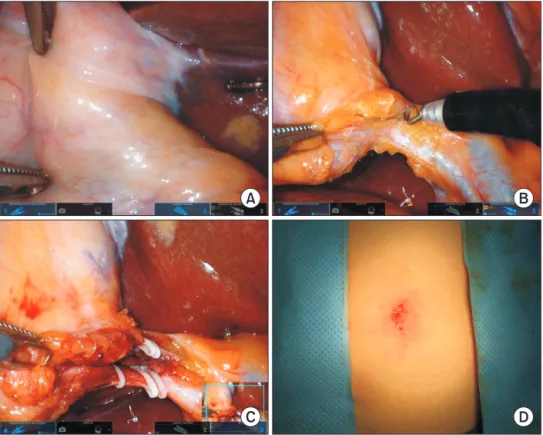
The da Vinci SP robotic surgical system is the latest addition to the da Vinci surgical system. The patient-side cart has 1 major arm which harbors 4 arms with the corresponding instruments, oriented parallel to each other. The 4 arms are connected to a boom that can rotate 360°, adding to the degree of freedom of movement. Among the new features of da Vinci SP is the multijoint capability of its instruments and endoscope, made possible by elbow and wrist motion. A 2.5-cm diameter pure SP with 4 lumens accommodates the endoscope and 3 instruments (Fig. 1). There is no extra port for assistant surgeon. Insufflation is via an adaptor attached to the side of the SP. The surgeon console and the vision cart are universal for all the 4th generation platforms and, hence, can be used in Si, Xi, and SP patient side cart models. Surgical techniques for Si RSSC and RSPC have been previously described [6,9] (Fig. 2, Supplementary Video).
Statistics
Continuous data are reported in terms of mean ± standard deviation and range; categorical data are reported in terms
of count and percentage. Independent sample t-test was used for continuous and ordinal data, while chi-square test was used to compare percentages (Table 1). A P-value of <0.05 was considered statistically significant. IBM SPSS Statistics ver. 23 for Mac (IBM Corp., Armonk, NY, USA) was used.
RESULTS
General characteristics of patients
All 30 patients successfully underwent RSPC. There were 12 males and 18 females with a mean age of 46.4 years (range, 27–66 years). Most of the patients had American Society of Anesthesiologists (ASA) physical status (PS) classification I and II, with 3 patients having ASA PS classification III. The majority of the patients had gallstones and chronic cholecystitis as preoperative diagnoses. All patients had no signs of severe inflammation based on preoperative abdominal CT-scan or ultrasound. None of the patients had biliary obstruction by imaging and laboratory work-up. Patient demographics are presented in Table 1.
Intraoperative outcome
Mean docking time was 5.2 ± 1.9 minutes. Mean actual dissection time (time from initiation of dissection of Calot triangle to separation of gallbladder from its bed [10]) was 14.6 ± 5.1 minutes. Mean total operation time was 75.1 ± 17.5 minutes (Table 1). One patient had a small bowel injury during port placement due to unexpected intra-abdominal adhesions,
A B
C D
Fig. 2. Procedure description of the robotic SP chole cystectomy. With effective gallbladder retraction (A), calot trianlge is dissected by using remaining two robotic artms (B). (C) Cystic duct and artery are clipped under magnified operation field. (D) Final postoperative wound.
which was repaired intra-corporeally. Blood loss was minimal for all cases and there was no conversion to laparoscopic or open surgery.
Postoperative outcome
Postoperative courses were unremarkable. Pain was adequately controlled for all patients with mean numerical pain intensity scores (NPIS) of 3.2 ± 1.0 (range, 2.5–7) and 1.4 ± 0.9 (range, 0–7) during the immediate postoperative period and just prior to discharge, respectively. Mean postoperative hospital stay was 1.5 ± 0.7 days.
Comparative analysis between RSSC and RSPC
RSPC patients were older compared to RSSC patients (46.4 ± 9.4 years vs. 40.8 ±10.8 years, P = 0.034). In both groups, the majority of the patients were female (80% in RSSC, 60% in RSPC). There was no difference in terms of body mass indexand ASA PS classification between the 2 groups. The majority of RSSC patients had a diagnosis of cholelithiasis, while RSPC patients had chronic cholecystitis and gallstones as the most common diagnoses. The total operation time was 31% shorter in RSPC compared to RSSC (109.5 ± 30.0 minutes vs. 75.1 ± 17.5 minutes, P < 0.001). Its subsets—docking time (11.9 ± 4.3 minutes vs. 5.2 ± 1.9 minutes, P < 0.001), actual dissection time (34.6 ± 18.4 minutes vs. 14.6 ± 5.1 minutes, P < 0.001), and console time (58.7 ± 23.0 minutes vs. 32.4 ± 11.6 minutes, P < 0.001) were also significantly shorter in RSPC than RSSC. There was no significant difference in intraoperative complications. One patient in the RSSC group was converted to laparoscopic surgery due to difficulty in gallbladder bed dissection, while there was no conversion to laparoscopy or open surgery in the RSPC group. Conversion rates between the 2 groups were not statistically significant (P = 0.388). Pain in the immediate postoperative periods (4.6 ± 1.3 [range, 3–6.5] Table 1. Comparison between robotic single-site cholecystectomy (RSSC) and robotic single-port cholecystectomy (RSPC)
Characteristic RSSC (n = 30) RSPC (n = 30) P-value
Age (yr) 40.8 ± 10.8 (22–59) 46.4 ± 9.4 (27–66) 0.034
Sex 0.020
Male 6 (20.0) 12 (40.0)
Female 24 (80.0) 18 (60.0)
Body mass index (kg/m2) 24.0 ± 4.6 24.5 ± 5.3 0.627
ASA PS classification 0.056 I 18 (60.0) 10 (33.3) II 8 (26.7) 17 (56.7) III 4 (13.3) 3 (10.0) IV 0 (0) 0 (0) Preoperative diagnosis 0.001 Chronic cholecystitis 0 (0) 16 (53.3) Polyp 0 (0) 2 (6.7) Cholesterol polyp 7 (23.3) 0 (0) GB stone 21 (70.0) 11 (36.7) Adenomyomatosis 1 (3.3) 1 (3.3)
Adenomyomatosis with stone 1 (3.3) 0 (0)
Docking time (min) 11.9 ± 4.3 5.2 ± 1.9 0.001
Actual dissection time (min) 34.6 ± 18.4 14.6 ± 5.1 0.001
Console time (min) 58.7 ± 23.0 32.4 ± 11.6 0.001
Total operation time (min) 109.5 ± 30.0 75.1 ± 17.5 0.001
Intraoperative complication 0 (0) 1 (3.3) >0.999 Conversion 0.388 Laparoscopic 1 (3.3) 0 (0) Open 0 (0) 0 (0) Blood loss (mL) 17.8 ± 19.1 11.2 ± 7.4 0.080 Pain, NPIS Immediate postoperative 4.6 ± 1.3 (3–6.5) 3.2 ± 1.0 (2.5–7) 0.001 Prior to discharge 2.0 ± 0.6 (3–6.5) 1.4 ± 0.9 (0–7) 0.002 Postoperative complication 0 (0) 0 (0)
Postoperative stay (day) 1.9 ± 1.0 1.5 ± 0.7 0.333
Values are presented as mean ± standard deviation (range) or number (%).
vs. 3.2 ± 1.0 [2.5–7], P < 0.001) and on the day of discharge (2.0 ± 0.6 [3–6.5] vs. 1.4 ± 0.9 [0–7], P < 0.002) were significantly reduced in the RSPC group compared to RSSC group. There were no recorded postoperative complications for either of the groups. Postoperative hospital stay was comparable (1.9 ± 1.0 days vs. 1.5 ± 0.7 days, P = 0.333).
DISCUSSION
The series of firsts in single incision minimally invasive surgery spans over 24 years. From the first single incision laparoscopic cholecystectomy by Navarra et al. in 1997 [11] and later Piskun and Rajpal in 1999 [12] to the first RSSS reported by Kroh et al. in 2011 [13].
Our early experience with single site laparoscopic cholecystectomy (SILC) in 2009 showed that it has a longer operating time but better pain control and lower cost compared to the conventional laparoscopic cholecystectomy [10]. In 2013, our institution started doing RSSC using the da Vinci Si system. The initial cases of RSSC were compared to the initial cases of SILC. It was found that RSSC had comparable operative outcomes (intraoperative blood loss, bile spillage during operation, postoperative pain, and hospital stay) with SILC. However, actual dissection time and total operation time was longer in RSSC [6]. Based on accumulating experiences, subsequent propensity score-matching analysis for RSSC and SILC showed that there are comparable perioperative outcomes between RSSC and SILC, but the technical stability and clinically undetected advantages of RSSC are expected to prompt surgeons to perform this more reliable procedure [14].
With the introduction of the new da Vinci SP surgical system, it is to the author’s best knowledge that this is the first report on the early experiences on this new platform in the general surgical field, particularly in cholecystectomy. After experiencing a successful first case of RSPC [9], careful clinical application of the da Vinci SP robotic surgical system is increasing. According to the present results comparing RSPC and RSSC, it was noted that the overall postoperative complication rates, conversion rates, blood loss, and hospital stay were comparable between the 2 groups, suggesting that the da Vinci SP platform is feasible and equally as safe as the da Vinci Si and Xi.
However, several clinically important observations need to be noted. Firstly, the present results showed that RSPC significantly reduced total operation time and its subsets; docking time, actual dissection time, and console time. As previously described [9], additional new features of the SP system include the fully-wristed endoscope, and a graphical user interface in the surgeon console and vision cart showing real-time position of instruments relative to each other. These differences may be attributed to several new features of the
da Vinci SP system. Docking in RSPC is significantly faster, as only 1 trocar needs to be docked compared to 3 trocars in RSSC. Among the limitations of RSSC is the loss of endo-wrist motion that is already being enjoyed in its multiport counterpart. Prior to the publication of reverse-port technique [7], traditional RSSC retracts the gallbladder fundus superomedially, which narrows the triangle of Calot. In RSPC, ideal superolateral retraction of the gallbladder fundus is accomplished by the third arm. This retraction can be changed according to the surgeon’s preference depending on the need in different phases of the operation. The endo-wrist movement present in the multiport Si and Xi systems is not only restored but improved in the SP system via the multijoint instruments, providing distal triangulation, which is very helpful, especially in narrow-access surgery. A 360° rotating boom adds to the degree of freedom of movement of the instruments.
Secondly, the indications for RSSC seemed to be extended with the use of the da Vinci SP system. Despite the fact that there were significantly more patients with signs of inflammation preoperatively in RSPC compared to RSSC (chronic cholecystitis, 16 vs. 0; cholesterol polyp, 0 vs. 7; gallbladder stone, 11 vs. 21; P < 0.001) and a much older group of patients in the former than the latter (46.4 ± 9.4 years [range, 27–66 years] vs. 40.8 ± 10.8 years [range, 22–59 years], P = 0.034), the use of da Vinci SP system resulted in shorter operating times with a comparable perioperative complication rate. This may be due to a greater degree of movement and the ideal fundal retraction provided by the SP surgical system, contributing to improved efficacy of intraoperative surgical movement, making more difficult dissection possible.
Thirdly, in spite of frequent cases with signs of inflammation, shorter overall operation times were noted, indirectly suggesting potential benefits of RSPC in shortening the learning curve compared to RSSC. As long as surgeons can understand the new concept of robotic SP surgical systems and keep the surgical principle of safe cholecystectomy in mind, it is thought that a very short learning curve period is highly expected. The learning curve issue needs to be investigated further based on more accumulated experiences.
Lastly, improvement in postoperative pain score in RSPC may have been contributed by one of the major changes in the new platform—the pure SP. As the results suggest, albeit without statistical significance, RSPC patients appeared to have a shorter length of hospital stay compared to RSSC patients (1.5 ± 0.7 days vs. 1.9 ± 1.0 days, P = 0.333). The Si and Xi RSSC actually have multiple trocars converging within a single gel port. Hence, in reality, the predecessor platform has 3 remote centers immediately adjacent to each other. The da Vinci SP, on the other hand, has a pure SP and pure single trocar with a single remote center, ensuring less trauma to the insertion site. Several studies have conflicting results regarding the effect
of the reduction in number of ports to postoperative pain [15-17]. Whether the reduction in number of actual remote centers contributed to improved pain control remains to be verified in accumulated experience.
Despite the clear advantages, there were several potential disadvantages identified. An important note in the new da Vinci platform is the elimination of the accessory port for an assistant surgeon. Though it is no longer needed to manually retract the gallbladder fundus, as this is already being done by the third robotic arm, the absence of accessory port may also work as a disadvantage as there is no means for prompt intervention by an assistant surgeon in circumstances like bile spillage from gallbladder perforation or in difficult to control bleeding situations. Some surgical tactics can be prepared, such as placing several gauzes into the abdominal cavity before robotic docking to the patients, or inserting small pieces of gauze through the SP guidance after removing the 3rd arm from the system. However, these managements are very annoying, time-consuming procedures, and even can provide potential damage to the robotic system.
Additionally, to maximize the great advantage of full range of motion of the SP surgical system, the target area of dissection needs to be at a specific distance from the tip of the SP site. In patients with a small abdominal cavity, this system is not applicable. A more specialized umbilical port system, likely a shorter one, will need to be developed in the future to optimize the port-to-dissection distance. Therefore, instead of widely expanding surgical indications for RSPC, careful clinical application to well-selected patients who can take advantage of the current characteristics of SP robotic surgical system is much more important.
In summary, this study demonstrated interim results of early experiences of RSPC. Although limited by its small sample size and single-surgeon dataset, the present data confirmed that it is feasible, safe, and effective as shown by comparable conversion rates, intraoperative and postoperative complications, and blood loss. In addition, several advantages of the SP system were noted over its predecessor Si and Xi systems. New techniques and instruments to compensate for the absence of
an accessory port for the assistant surgeon, and to optimize the working distance from the tip of the SP to target organ need to be developed for more complicated surgery. Further study from accumulated cases is mandatory.
SUPPLEMENTARY MATERIALS
Supplementary Video can be found via https://doi.org/10.4174/ astr.2021.100.1.1.
ACKNOWLEDGEMENTS
Authors would like to express sincere appreciation to our nurses for SP robotic surgery, Ms. Song, Hyun Jung, Ms. Lim, Kuk Hee, and Ms. Lee, Hyun Jin for excellant assist and intraoperative nursing for the patients. Without there devotion, this work would not have be done.
Conflict of Interest
No potential conflict of interest relevant to this article was reported.
ORCID iD
Charles Jimenez Cruz: https://orcid.org/0000-0003-1184-1174 Frederick Huynh: https://orcid.org/0000-0001-5995-3998 Incheon Kang: https://orcid.org/0000-0003-4236-5094 Woo Jung Lee: https://orcid.org/0000-0001-9273-261X Chang Moo Kang: https://orcid.org/0000-0002-5382-4658
Author Contribution
Conceptualization, Visualization: CMK
Data curation, Formal Analysis, Investigation, Methodology, Resources, Validation: CJC
Software: IK Supervision: WJL
Approval of final manuscript: all authors Writing – Original Draft: CJC
Writing – Review & Editing: FH
REFERENCES
1. Begos DG, Modlin IM. Laparoscopic cholecystectomy: from gimmick to gold standard. J Clin Gastroenterol 1994;19: 325-30.
2. Lee YJ, Moon JI, Choi IS, Lee SE, Sung NS, Kwon SW, et al. A large-cohort comparison
between single incision laparoscopic cholecystectomy and conventional laparoscopic cholecystectomy from a single center; 2080 cases. Ann Hepatobiliary Pancreat Surg 2018;22:367-73.
3. Antoniou SA, Antoniou GA, Antoniou AI,
Granderath FA. Past, present, and future of minimally invasive abdominal surgery. JSLS 2015;19:e2015.00052.
4. Rao PP, Rao PP, Bhagwat S. Single-incision laparoscopic surgery: current status and controversies. J Minim Access Surg 2011;
7:6-16.
5. Ayloo S, Choudhury N. Single-site robotic cholecystectomy. JSLS 2014;18:e2014. 00266.
6. Lee SH, Jung MJ, Hwang HK, Kang CM, Lee WJ. The first experiences of robotic single-site cholecystectomy in Asia: a potential way to expand minimally-invasive single-site surgery? Yonsei Med J 2015;56:189-95.
7. Jung MJ, Lee SY, Lee SH, Kang CM, Lee WJ. Single-site robotic cholecystectomy: reverse-port technique. Medicine (Balti-more) 2015;94:e1871.
8. Lobe TE. Da Vinci SP Surgical System, Endowrist SP Instruments, and accessories [Internet]. Los Angeles: Society of American Gastrointestinal and Endoscopic Surgeons; 2019 [cited 2019 Jul 29]. Available from: https://www.sages.org/publications/tavac/ da-vinci-sp-surgical-system-endowrist-sp-instruments-and-accessories/.
9. Cruz CJ, Yang HY, Kang I, Kang CM, Lee WJ. Technical feasibility of da Vinci SP
single-port robotic cholecystectomy: a case report. Ann Surg Treat Res 2019;97:217-21. 10. Hwang HK, Choi SH, Kang CM, Lee
WJ. Single-fulcrum laparoscopic chole-cystectomy in uncomplicated gallbladder diseases: a retrospective comparative analysis with conventional laparoscopic cholecystectomy. Yonsei Med J 2013;54: 1471-7.
11. Navarra G, Pozza E, Occhinorelli S, Carcoforo P, Donini I. One-wound laparoscopic cholecystectomy. Br J Surg 1997;84:695.
12. Piskun G, Rajpal S. Transumbilical laparoscopic cholecystectomy utilizes no incisions outside the umbilicus. J Laparoendosc Adv Surg Tech A 1999;9:361-4.
13. Kroh M, El-Hayek K, Rosenblatt S, Chand B, Escobar P, Kaouk J, et al. First human surgery with a novel single-port robotic system: cholecystectomy using the da Vinci Single-Site platform. Surg Endosc 2011;25:3566-73.
14. Han DH, Choi SH, Kang CM, Lee WJ. Propensity score-matching analysis for single-site robotic cholecystectomy versus single-incision laparoscopic cholecystectomy: a retrospective cohort study. Int J Surg 2020;78:138-42.
15. Cheng Y, Jiang ZS, Xu XP, Zhang Z, Xu TC, Zhou CJ, et al. Laparoendoscopic single-site cholecystectomy vs three-port laparoscopic cholecystectomy: a large-scale retrospective study. World J Gastroenterol 2013;19:4209-13.
16. Sulu B, Yildiz BD, Ilingi ED, Gunerhan Y, Cakmur H, Anuk T, et al. Single port vs. four port cholecystectomy: randomized trial on quality of life. Adv Clin Exp Med 2015;24:469-73.
17. Hajong R, Hajong D, Natung T, Anand M, Sharma G. A comparative study of single incision versus conventional four ports laparoscopic cholecystectomy. J Clin Diagn Res 2016;10:PC06-9.