Current Research on Agriculture and Life Science (2015) 33(2): 65−68 http://dx.doi.org/10.14518/crals.2015.33.2.012
Online ISSN 2288-0356 Print ISSN 2287-271X
Original Article
Effect of Polyphenol Oxidase Activity and Total Phenolic Content on
Browning and Quality of Dried-Persimmon According to Maturity
Degree of Astringent Persimmon
Kyung-Mi Jung1,2, In-Gyu Song1,Se-Jong Kim1, and Sang-Han Lee2*
1Sangju Persimmon Experiment Station, GyeongSangBuk-Do Agricultural Technology Administration, Sangju 37268, Korea 2Department of Food Science & Technology, Kyungpook National University, Daegu 41566, Korea
Received: December 4 2015 / Revised: December 23 2015 / Accepted: December 23 2015
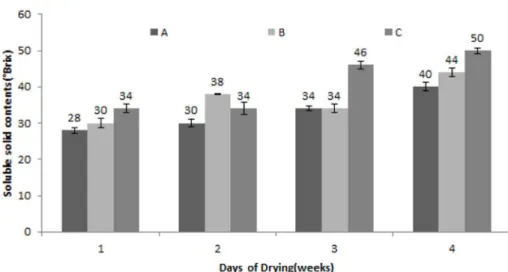
Abstract Hunter's color value “a” in dried-persimmon of table and full ripe fruit was higher than that in unripe fruit. In case of soluble solid content, full ripe fruit was 50o Brix, the highest degree, while unripe fruit was 40o Brix, the lowest degree. PPO activation of unripe fruit was 4.7, which was higher than table-ripe fruit (0.7) and full ripe (1.0). Polyphenol oxidase activation remained even while drying, but there was no difference in PPO activation degree as drying period increased. Total phenol content of unripe fruit was 101.4, which was higher than table-ripe fruit (57.5) and full ripe fruit (67.4). Total phenol content level increased as drying period increased, which was based on fresh weight. Hardness of unripe and table ripe fruit continued to decrease until three weeks during softening. After that, hardness was high and it started drying. However, in full ripe fruit, hardness increased after two weeks and softening was fast during the drying period, and its weight reduction rate was lower than that of unripe and table ripe fruit.
Keywords: astringent persimmon, dried-persimmon, sulfur fumigation, browning, polyphenol oxidase
Introduction
Astringent persimmon is difficult to consume as a fresh fruit due to
its astringent taste. Hence, they need to be processed to (semi-) dried persimmon, soft persimmon, dried-slices of persimmon, vinegar, iced-soft persimmon, etc., before consumption (1,2). During the process, browning occurs on the surface of persimmon while peeling and drying. Therefore, persimmon farmers conduct sulfur fumigation to prevent microorganism growth and browning. Food browning can be enzymatic and non-enzymatic browning. Moreover, plant tissue browning is caused by enzymatic oxidization of phenolic compounds. Enzymatic browning needs activated enzyme, oxygen, and substrate; absence of any of these factors can prevent enzymatic browning (3).
Since browning in agricultural products or food is an important quality index characteristic, the process of browning during food processing is being extensively studied. In Fuji apples, there is no significant difference found in the phenolic compound content and the activity of phenolic compound oxidizing enzymes (e.g. PPO) between browning fruits and normal fruits. The increase of PPO activation or phenolic compound was ambiguous in the sweet persimmons generated by browning (6). In case of peeled garlic, it was reported that the browning of surface and the activity of PPO increased as storage period increased, while in green pepper, with increased browning the activity of the enzyme reduced (4). Hence, this study was carried out to review the effects of the polyphenol oxidase activity and total phenolic content on browning and quality of dried-persimmon according to maturity degree of astringent persimmon.
Materials and Methods
Samples
“Sangjudungsi,” a cultivar of astringent persimmon is harvested around the end of October in the Sangju area and is processed into dried persimmon. The determination of maturity was based on fruit skin color. Unripe fruit was green from center to fruit apex, *Corresponding author: Sang-Han Lee
Tel: 82-53-950-7754; Fax: 82-53-950-6772 E-mail: [email protected]
This is an Open Access article distributed under the terms of the Creative Commons Attribution Non-Commercial License (http://creativecommons. org/licenses/by-nc/3.0/) which permits unrestricted non-commercial use, distribution, and reproduction in any medium, provided the original work is properly cited.
© 2015 Institute of Agricultural Science and Technology, Kyungpook National University
66 Jung et al.
Curr Res Agric Life Sci (2015) 33(2): 65−68
table ripe fruit was all orange, and full ripe fruit was scarlet. Astringent persimmons were peeled and air-dried without sulfur fumigation.
Measurements of color and hardness
Surface colors and hardness were measured using Minolta CR-300 (Japan), Compac-100, ¹25 was used as an adaptor.
Analysis of polyphenol oxidase
PPO was analyzed as follows; 5 g of fruit flesh was frozen in liquid nitrogen and then triturated. Then, 10 ml of sodium phosphate buffer (0.1 M, pH 7.0, 0.25% Triton X-100 and 0.5 g PVP) was added, homogenized, and centrifuged, and the supernatant was used as an enzyme extract. The protein content of the enzyme extract was measured by Bradford method, and 200µl of the enzyme extract was mixed with 3 ml of assay solution (12 mM 4-Methylcatechol in sodium acetate buffer, 0.1 M and pH 5.0). Absorbance was measured at 410 nm for 3 min at an interval of 30 s by a spectrophotometer (25oC).
Measurement of total polyphenolics
Total phenolic content was analyzed as follows; 5 g fruit flesh was frozen in liquid nitrogen and triturated. Then, 10 ml of 1% HCl/ MeOH was added to 1 g of frozen specimen powder, and was covered and stored overnight in refrigerator at 4oC. It was then
centrifuged and the supernatant was used as a phenol extract. Then 400ìl of 7.5% carbonate, 500µl of Folin-Ciocalteu reagent, and 50µl of 1% HCl/MeOH were vortexed with 50 µl of phenol extract. Then the mixture was left at room temperature for 30 min. Absorbance was measured at 765 nm and the total phenolic content was indicated as mg/g fresh weight.
Results and Discussion
Hunter's color value a for dried persimmons
Value a decreases as the drying period increases. The value a, which is responsible for the red color, of table and full ripe fruit was higher than that of the unripe fruit. Climacteric fruits, such as tomato, banana, and pineapple, are processed with ethylene, which facilitates the coloring of the fruit. Ethylene dissolves the chlorophyll present in the fruit peel of persimmons and tomato and synthesizes lycopene to create a red color (3). Similarly, in case of table and full ripe fruit, ethylene has a strong influence on maturity. Fruit color changes to yellow or red according to the type and amount of carotenoids; hence, in matured persimmon the surface of table and full ripe fruit is more red and better than unripe fruit (5).
Figure 2. A classical feature of dried-persimmon which was made of unripe (A), table ripe (B), and fully ripe (C) fruits. Figure 1. Comparison of Hunter's color value a of dried-persimmons (A:Unripe, B: Table ripe, C: Full ripe).
Effect of Polyphenol Oxidase Activity and Total Phenolic Content on Browning and Quality of... 67
Curr Res Agric Life Sci (2015) 33(2): 65−68 Soluble solid contents of dried persimmons
The soluble solid content increases as drying period increases in every treatment. Hence, the soluble solid content of table and full ripe fruit was higher than that of unripe fruit. The concentration of soluble sugar increases with the evaporation of moisture, which increase the soluble solid content gradually as drying period increases (2). The starch content in unripe fruit is greater than ripe fruit, as starch content reduces and sugar content increases with maturity. PPO activation of dried-persimmons
PPO activation of unripe fruit was 4.7, which was higher than table (0.7) and full ripe (1.0). Browning of unripe fruit was
stronger than that of table and full ripe fruit when dried persimmons were made with unripe fruit. The results are shown in Table 1. PPO activation degree in dried persimmon of table ripe fruit increased a little but activation degree did not make a significant difference. Since PPO activation remained even while drying, PPO was regarded as quite a stable enzyme. The reason that PPO activation degree increased a little during drying period was that water was evaporated and enzyme was concentrated during drying period. It is assumed that PPO activation is deactivated during drying.
Total phenol contents of dried-persimmon
Total phenol content of unripe fruit was 101.4, which was higher Figure 3. Comparison of soluble solid contents of dried-persimmon (A: Unripe, B: Table ripe, C: Full ripe).
Table 1. PPO activation degree soon after peeling by each maturity degree
Maturity degree PPO activation degree (A410/min/mg protein) A B C 4.7 ± 1.27a 0.7 ± 0.08b 1.0 ± 0.09b
Figure 4. PPO activation in dried-persimmons of table ripe.
Table 2. Total phenol content soon after peeling by each maturity degree Maturity Total phenol contents (mg/g fresh wt)
A B C 101.4 ± 8.7a 057.5 ± 4.3b 067.4 ± 9.1b
68 Jung et al.
Curr Res Agric Life Sci (2015) 33(2): 65−68
than ripe table fruit (57.5) and full ripe fruit (67.4). Browning in dried persimmon of unripe fruit was stronger than that of table and full ripe fruit. The total phenol content is the substrate of PPO enzyme; hence, the substrate content is directly proportional to the enzyme activation. Therefore, it is assumed that browning of unripe fruit was stronger than that of table and full ripe fruit. Hardness of dried persimmons
Hardness of dried persimmon decreased during its softening period in every treatment. As the moisture evaporates, the hardness increases. Hardness of full ripe fruit was lower than that of unripe and table ripe fruit. With maturity, protopectin changed to soluble pectin causing decrease in pectic acid. Hence, some of the cell walls dissolve to make the fruit flesh soft. Softening occurred simultaneously with drying when dried persimmons were processed from full ripe fruit.
Reduction rate in weight of dried-persimmon
The reduction rate in weight of unripe fruit was higher than that of table and full ripe fruit. It is because free water of table and full ripe fruit was less than that of unripe fruit, suggesting that moisture was evaporated well in unripe fruit.
References
Kim YB, Lee JS, Lim BS (1995) Actual survey of astringent persimmon on storage, processing and using. National Institute of Horticultural & Herbal Science, pp. 15-31.
The Ministry of Agriculture and Fisheries. Statistical Year Book (2002) pp. 106 -107.
Park SJ, Kim CC (2002) Influence of ethylene generator on fruit color in ‘Cheongdobansi’ persimmon (diospyros kaki). J Kor Soc Hort Sci 43: 725-727.
Park WP, Cho SH, Lee DS (1998) Screening of antibrowning agents for minimally processed vegetables. Korean J Food Sci Technol 30: 278-282. Kim JH, Kim JC, Ko GC (1986) Orchard horticulture outline.
Hyangmoonsa, pp. 220-229.
Choi SJ (1997) The effect of ethylene on the fruit flesh browning in Fuyu persimmon. Korean J Post Harvest Sci 4: 39-44.
Figure 5. Total phenol content of dried-persimmon during drying period (table ripe fruits were used). Table 3. Hardness of dried-persimmons according to each maturity degree
(Unit: g/ø5 mm) Days of drying (wk) Maturity degree 0 1 2 3 4 5 A 02949.7 ± 19.6 0497.4 ± 17.1 0194.7 ± 10.1 0178.4 ± 12.1 0236.4 ± 10.8 318.1 ± 9.8 B 02597.8 ± 16.8 0342.2 ± 11.2 235.9 ± 9.7 0208.1 ± 10.1 243.7 ± 4.1 356.8 ± 7.8 C 1546.4 ± 9.1 255.4 ± 5.1 0104.4 ± 10.1 210.2 ± 4.7 315.1 ± 6.2 396.3 ± 4.9
Table 4. The changes in reduction rate of weight by each maturity degree Class Maturity degree Weight (g) Reduction rate of weight (%) Fresh persimmon After 5 weeks of drying A B C 150.8 ± 4.1 147.9 ± 2.7 148.4 ± 1.9 35.1 ± 1.2 37.4 ± 3.0 43.2 ± 2.9 76.7 ± 2.0a 74.7 ± 1.9ab 70.9 ± 1.4b