introduction
Valgization high tibial osteotomy (HTO) was first described in the 1960s1). It has been considered a successful procedure to cor-rect varus malalignment by shifting the weight-bearing axis to the unaffected lateral knee compartment. Brouwer et al.2), in their Cochrane review, analyzed 13 high quality studies to demonstrate
the efficacy of HTO. All the studies included patients with medial compartment arthritis. They suggested that knee osteotomy was an effective treatment for improving knee function and providing pain relief. In general, HTO has been considered a better choice for younger and physically active patients who suffer from uni-compartmental knee osteoarthritis.
After the introduction of computer-assisted systems for ortho-pedic surgery of the spine3) and pelvis4) and total joint replace-ment5), they have also been used for HTOs6). Computer naviga-tion systems were designed to improve the precision of implant positioning, and the technology has continued to evolve with hardware and software upgrades. Based on a review of current literature suggesting the use of computer-assisted navigation system for improvement in limb alignment and implant position-ing7-10), we conducted a meta-analysis of comparative studies to determine whether computer-assisted navigation HTO improves limb alignment compared to conventional HTO. The hypothesis was that navigation HTO would result in more accurate limb
Imageless Navigation Versus Conventional Open
Wedge High Tibial Osteotomy: A Meta-Analysis of
Comparative Studies
Hyun Jung Kim, PhD
1,*, Jung-Ro Yoon, MD
2,*, Gi Won Choi, MD
2, and Jae-Hyuk Yang, MD
21Department of Preventive Medicine, Korea University College of Medicine, Seoul; 2Department of Orthopaedic Surgery, Veterans Health Service Medical Center, Seoul, Korea
purpose: To summarize and compare radiological and clinical outcomes of open wedge high tibial osteotomy (HTO) using imageless
computer-assisted navigation with conventional HTO.
methods: A literature search of online register databases was conducted. The risk ratio (RR) of radiological outliers and mean differences in clinical outcomes were compared between navigated and conventional HTOs. Radiological results were evaluated by subgroup analyses according to the study period (concurrent/consecutive) and the use of locking fixation device.
results: Seven comparative studies with a total sample size of 406 knees were included in this review. Radiographically, the mechanical axis [MA] was within the acceptable range (0°–6°) in 83.7% of the navigation HTO group, showing significant difference from 62.1% of the conventional HTO group. Clinically, despite the forest plot demonstrating a general trend of favoring the navigation system, there were not sufficient studies to determine statistical significance in the meta-analysis. None of the subgroup analyses demonstrated significant differences in the RR of MA outliers.
conclusions: The present meta-analysis indicates that the use of navigation in open wedge HTO improves the precision of mechanical alignment by decreasing the incidence of outliers; however, the clinical benefit is not conclusive. Additionally, none of the subgroup analyses demonstrated significant difference in the RR of MA outliers.
Keywords: tibia, osteotomy, computer-assisted, navigation, meta-analysis
pISSN 2234-0726 · eISSN 2234-2451
Knee Surgery & Related Research
Received April 22, 2015; Revised June 25, 2015; Accepted June 28, 2015
Correspondence to: Jae-Hyuk Yang, MD
Department of Orthopaedic Surgery, Veterans Health Service Medical Center, 53 Jinhwangdo-ro 61-gil, Gangdong-gu, Seoul 05368, Korea Tel: +82-2-2225-1609, Fax: +82-2-2225-1910
E-mail: [email protected]
*The first two authors contributed equally to this study.
16
This is an Open Access article distributed under the terms of the Creative Commons Attribution Non-Commercial License (http://creativecommons.org/licenses/by-nc/4.0/) which permits unrestricted non-commercial use, distribution, and reproduction in any medium, provided the original work is properly cited.
alignment with lesser amount of outliers and better clinical out-comes than conventional HTO.
methods
1. research Question
Does computer-assisted navigation HTO improve radiological alignment compared to conventional HTO?
2. data Source and Search Strategy
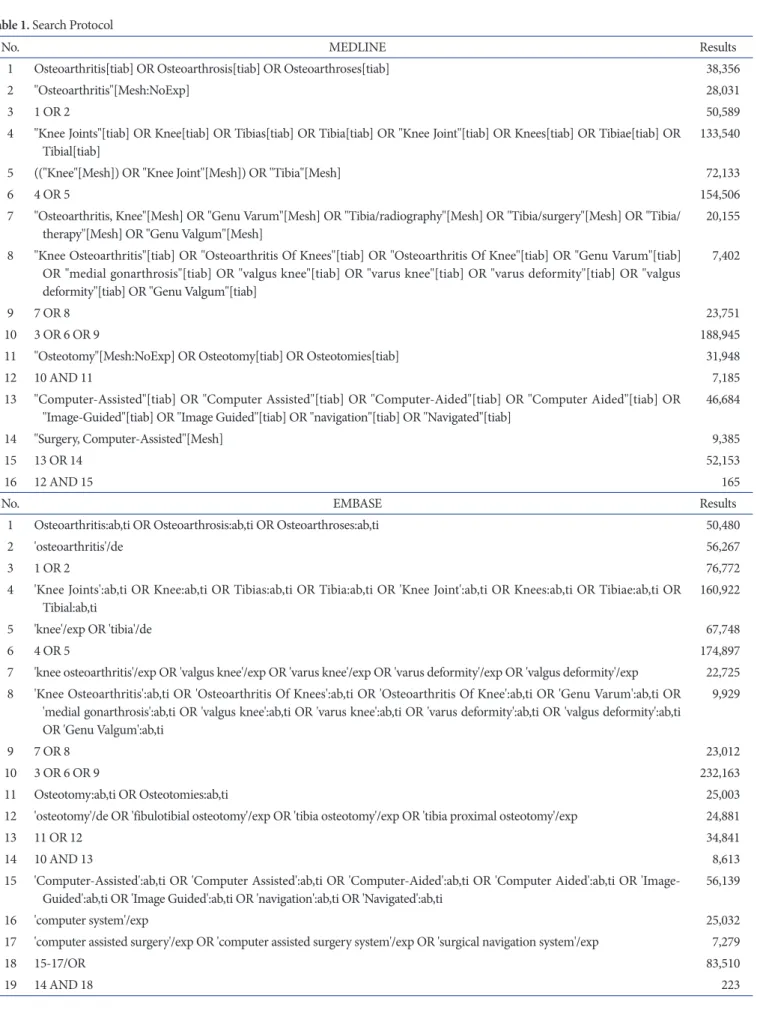
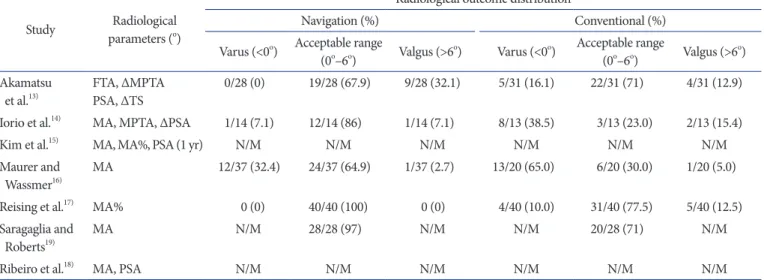
Clinical trials that compared computer-assisted navigation HTO with conventional HTO were identified. An electronic literature search was performed using MEDLINE, EMBASE, Cochrane library database, and KoreaMed. Keywords were se-lected based on the Cochrane acronym; population, intervention, comparison, and outcomes format of the research question. The following keywords were used along with the Boolean search function: computer-assisted, navigation, image-guided, osteo-arthritis, genu varum, genu valgum, osteotomy, tibial, and knee. Different search protocols were employed for each database (Table 1). The last electronic search was carried out on September 30, 2014. The entire search process was conducted in four phases as per guidelines from PRISMA (Preferred Reporting Items for Systematic Reviews and Meta-analyses) statement (http://www. prisma-statement.org).
3. inclusion and exclusion criteria
All types of studies (randomized controlled trials, non-random-ized cohort studies, and retrospective studies) were included. Two authors (Yang and Choi) identified the titles and abstracts and any disagreements were resolved by consensus. The abstracts, regardless of language and years of publication, were screened based on the following inclusion criteria: 1) patients undergoing HTO had operations using either a computer-assisted or a con-ventional technique; 2) the study was a comparative study (either randomized controlled trials and/or retrospective studies); 3) there was a report on at least one of the radiographic or clini-cal outcome measures described subsequently. Only studies on computer-assisted navigation HTO vs. conventional HTO were selected for analysis. Some articles were excluded from this re-view because they were non-comparative studies or non-human studies, or had inadequate study designs. In addition, since there was only one article on closed HTO11), it was also excluded.
4. data collection
Data from included studies were extracted independently by
two of the authors (Yang and Choi). Since restoration of the limb alignment to slight valgus position (mechanical axis [MA] of 0o– 6o) is the major goal of HTO, this radiological measure was used as a primary endpoint. Radiological outcome data were com-prised of mechanical/anatomical leg axis, coronal tibial angle, and sagittal tibial angle. Functional scores were used as the secondary endpoint, which included the Hospital for Special Surgery (HSS) knee scoring system, Knee Society score (KSS) (summation of the functional and knee scores), Lysholm knee scoring scale, modified Cincinnati knee rating score, and visual analogue scale (VAS). In addition, study setting, study year, population, type of navigation system, method of osteotomy gap management (us-age of bone graft material), and the type of fixation device were documented.
5. Statistical analysis and Synthesis of results
For continuous variables, a random effect model was used to measure the weighted mean differences. For dichotomous vari-ables, such as the prevalence of outliers of the leg axis alignment, the differences were determined using the risk ratio (RR) and 95% confidence interval (CI) as the summary statistics. Radio-logical outcome was considered ‘‘acceptable’’ when the MA was 0o–6o, whereas ‘‘outlier’’ when the value was less than 0o or more than 6o. I2 statistic was used to evaluate statistical homogeneity. A score between 0% and 100% is possible on the I2 statistic. A score of ≤25% corresponds to low heterogeneity, 50% to moderate, and 75% to high heterogeneity12). Forest plots were also used to assess heterogeneity. The chi-square statistic p-value was used to determine homogeneity. The lower the p-value is, the greater the tendency for a study to be heterogeneous. Generally, a p-value of <0.05 is considered to suggest heterogeneity. The RR was utilized to check probability relationship between two binary variables. A RR of 1 implies that the event occurs equally in both groups. A RR of >1 indicates that the event is more likely to occur in the first group (conventional HTO group in this review). Further subgroup analyses were performed with regard to the radiologi-cal outliers according to the consecutive vs. concurrent patient series and the use of a fixation device. All statistical analyses were performed using RevMan ver. 5.3 (The Nordic Cochrane Centre, Copenhagen, Denmark) and SPSS ver. 10.1 (SPSS Inc., Chicago, IL, USA).
results
1. Search results
Table 1. Search Protocol
No. MEDLINE Results
1 Osteoarthritis[tiab] OR Osteoarthrosis[tiab] OR Osteoarthroses[tiab] 38,356
2 "Osteoarthritis"[Mesh:NoExp] 28,031
3 1 OR 2 50,589
4 "Knee Joints"[tiab] OR Knee[tiab] OR Tibias[tiab] OR Tibia[tiab] OR "Knee Joint"[tiab] OR Knees[tiab] OR Tibiae[tiab] OR
Tibial[tiab] 133,540
5 (("Knee"[Mesh]) OR "Knee Joint"[Mesh]) OR "Tibia"[Mesh] 72,133
6 4 OR 5 154,506
7 "Osteoarthritis, Knee"[Mesh] OR "Genu Varum"[Mesh] OR "Tibia/radiography"[Mesh] OR "Tibia/surgery"[Mesh] OR "Tibia/
therapy"[Mesh] OR "Genu Valgum"[Mesh] 20,155
8 "Knee Osteoarthritis"[tiab] OR "Osteoarthritis Of Knees"[tiab] OR "Osteoarthritis Of Knee"[tiab] OR "Genu Varum"[tiab] OR "medial gonarthrosis"[tiab] OR "valgus knee"[tiab] OR "varus knee"[tiab] OR "varus deformity"[tiab] OR "valgus deformity"[tiab] OR "Genu Valgum"[tiab]
7,402
9 7 OR 8 23,751
10 3 OR 6 OR 9 188,945
11 "Osteotomy"[Mesh:NoExp] OR Osteotomy[tiab] OR Osteotomies[tiab] 31,948
12 10 AND 11 7,185
13 "Computer-Assisted"[tiab] OR "Computer Assisted"[tiab] OR "Computer-Aided"[tiab] OR "Computer Aided"[tiab] OR
"Image-Guided"[tiab] OR "Image Guided"[tiab] OR "navigation"[tiab] OR "Navigated"[tiab] 46,684
14 "Surgery, Computer-Assisted"[Mesh] 9,385
15 13 OR 14 52,153
16 12 AND 15 165
No. EMBASE Results
1 Osteoarthritis:ab,ti OR Osteoarthrosis:ab,ti OR Osteoarthroses:ab,ti 50,480
2 'osteoarthritis'/de 56,267
3 1 OR 2 76,772
4 'Knee Joints':ab,ti OR Knee:ab,ti OR Tibias:ab,ti OR Tibia:ab,ti OR 'Knee Joint':ab,ti OR Knees:ab,ti OR Tibiae:ab,ti OR
Tibial:ab,ti 160,922
5 'knee'/exp OR 'tibia'/de 67,748
6 4 OR 5 174,897
7 'knee osteoarthritis'/exp OR 'valgus knee'/exp OR 'varus knee'/exp OR 'varus deformity'/exp OR 'valgus deformity'/exp 22,725 8 'Knee Osteoarthritis':ab,ti OR 'Osteoarthritis Of Knees':ab,ti OR 'Osteoarthritis Of Knee':ab,ti OR 'Genu Varum':ab,ti OR
'medial gonarthrosis':ab,ti OR 'valgus knee':ab,ti OR 'varus knee':ab,ti OR 'varus deformity':ab,ti OR 'valgus deformity':ab,ti OR 'Genu Valgum':ab,ti
9,929
9 7 OR 8 23,012
10 3 OR 6 OR 9 232,163
11 Osteotomy:ab,ti OR Osteotomies:ab,ti 25,003
12 'osteotomy'/de OR 'fibulotibial osteotomy'/exp OR 'tibia osteotomy'/exp OR 'tibia proximal osteotomy'/exp 24,881
13 11 OR 12 34,841
14 10 AND 13 8,613
15 'Computer-Assisted':ab,ti OR 'Computer Assisted':ab,ti OR 'Computer-Aided':ab,ti OR 'Computer Aided':ab,ti OR
'Image-Guided':ab,ti OR 'Image 'Image-Guided':ab,ti OR 'navigation':ab,ti OR 'Navigated':ab,ti 56,139
16 'computer system'/exp 25,032
17 'computer assisted surgery'/exp OR 'computer assisted surgery system'/exp OR 'surgical navigation system'/exp 7,279
18 15-17/OR 83,510
Table 1. Continued
No. Cochrane Results
1 MeSH descriptor: [Osteoarthritis] this term only 1,561
2 Osteoarthritis or Osteoarthrosis or Osteoarthroses:ti,ab,kw (Word variations have been searched) 5,728
3 #1 or #2 5,728
4 MeSH descriptor: [Knee] explode all trees 573
5 MeSH descriptor: [Knee Joint] explode all trees 2,304
6 MeSH descriptor: [Tibia] explode all trees 393
7 #4-6/or 3,095
8 "Knee Joints" or Knee or Tibias or tibia or "Knee Joint" or Knees or Tibiae or Tibial:ti,ab,kw (Word variations have been
searched) 12,086
9 #7 or #8 12,089
10 MeSH descriptor: [Osteoarthritis, Knee] explode all trees 1,627
11 MeSH descriptor: [Genu Varum] explode all trees 6
12 MeSH descriptor: [Tibia] explode all trees and with qualifier(s): [Radiography - RA] 95 13 MeSH descriptor: [Tibia] explode all trees and with qualifier(s): [Surgery - SU] 184
14 MeSH descriptor: [Tibia] explode all trees 393
15 MeSH descriptor: [Genu Valgum] explode all trees 3
16 0-15/or 1,948
17 "Knee Osteoarthritis" or "Osteoarthritis Of Knees" or "Osteoarthritis Of Knee" or "Genu Varum" or "medial gonarthrosis" or "valgus knee" or "varus knee" or "varus deformity" or "valgus deformity" or "Genu Valgum":ti,ab,kw (Word variations have been searched)
1,458
18 #16 or #17 2,674
19 #3 or #9 or #18 14,457
20 MeSH descriptor: [Osteotomy] this term only 413
21 Osteotomy or Osteotomies:ti,ab,kw (Word variations have been searched) 823
22 #20 or #21 823
23 #19 and #22 179
24 MeSH descriptor: [Surgery, Computer-Assisted] explode all trees 529
25 "Computer-Assisted" or "Computer Assisted" or "Computer-Aided" or "Computer Aided" or "Image-Guided" or "Image
Guided" or "navigation" or "Navigated":ti,ab,kw (Word variations have been searched) 8,946
26 #24 or #25 8,946
27 #23 and #26 6
No. KoreaMed Results
1 "Osteoarthritis" [ALL] 808
2 Knee[ALL] OR Tibia[ALL] 3,492
3 1 OR 2 3,887
4 "Knee Osteoarthritis"[ALL] OR "Osteoarthritis Of Knees"[ALL] OR "Osteoarthritis Of Knee"[ALL] OR "Genu Varum"[ALL] OR "medial gonarthrosis"[ALL] OR "valgus knee"[ALL] OR "varus knee"[ALL] OR "varus deformity"[ALL] OR "valgus deformity"[ALL] OR "Genu Valgum"[ALL]
405
5 3 OR 4 3,996
6 "Osteotomy"[ALL] OR Osteotomies[ALL] 912
7 5 AND 6 107
8 "Computer-Assisted"[ALL] OR "Computer-Aided"[ALL] OR "Image-Guided"[ALL] OR "navigation"[ALL] 740
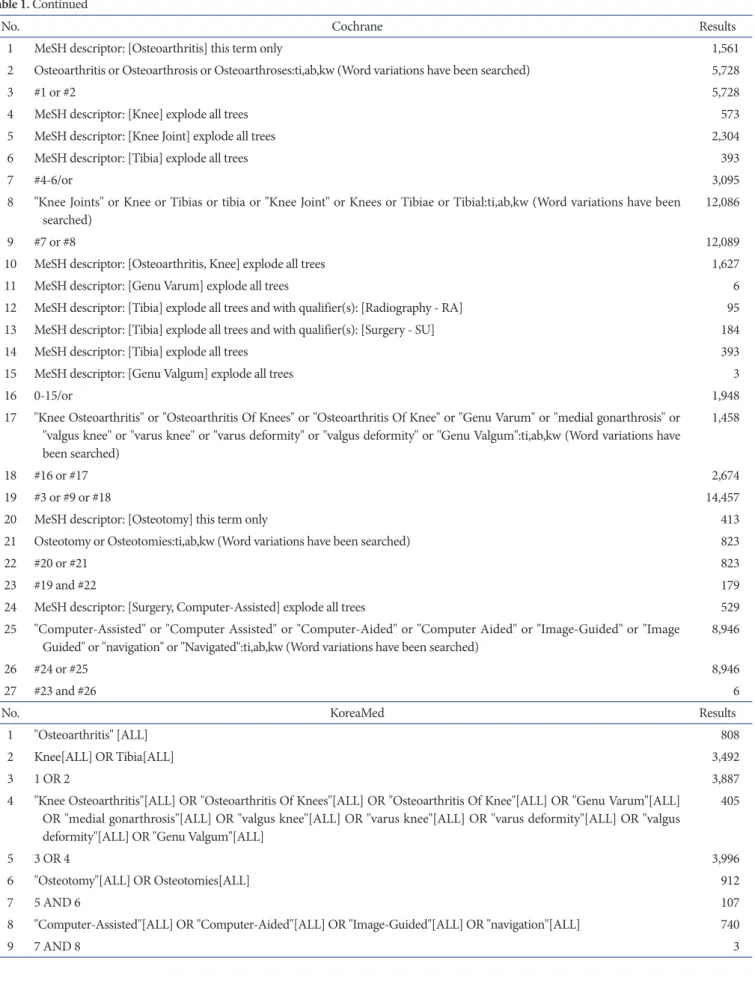
(MEDLINE: 165, EMBASE: 223, Cochrane: 6, and KoreaMed: 3), and 377 studies were excluded after reviewing titles and abstracts. The remaining 20 studies were evaluated for full review and 13 studies were excluded for various reasons, leaving 7 studies eli-gible for review (Fig. 1). All studies were written in English, and they were all retrospective comparative studies. All studies were on open HTO13-19). All studies used the Orthopilot Aesculap navi-gation system (B. Braun-Aesculap, Tuttlingen, Germany). There were 3 studies13,15,19) with consecutive and 3 studies16-18) with con-current patient series. Allograft bone material was used in 5 open HTO studies13-15,18,19). Two studies16,17) did not mention whether they used bone material for the osteotomy gap. Autogenous bone material was used for conventional HTO group in 1 study18). Fixation was performed with a locking device in 3 studies13,16,17) and a non-locking device in 4 studies14,15,18,19). The characteristics of included studies are presented in Table 2.
2. Quality assessment
The methodological quality of each study was assessed using the Newcastle-Ottawa scale (NOS)20). The assessment was carried out on three domains: study group selection, inter-group compa-rability, and ascertainment of exposure and outcome of interest. With regard to the “selection” (four numbered items) and “expo-sure” (three numbered items) domains, each assessed study could be awarded a maximum of one star for each numbered item. Regarding the “comparability” (one numbered item) domain, a maximum of two stars could be awarded. On the NOS, the higher the score, the higher the study quality (Table 3). All of the scores were determined by the two reviewers (Kim and Yoon), first independently and then by consensus. Details on the
NOS-based methodological quality assessment of the included studies are presented in Table 3. The non-randomized studies had cohort and control groups (in each study) that were well-matched in terms of demographics, prognostic variables, and surgical tech-nique.
3. clinical results
Three studies16,17,19) did not report preoperative and postopera-tive clinical outcomes. There were 3 studies13,15,18) using Lysholm scoring system, 2 studies13,14) using KSS, 1 study15) using HSS score, 1 study14) using VAS, and 1 study14) using modified Cincin-nati rating system questionnaire. Although the forest plot dem-onstrated a general trend of clinical outcomes (KSS and Lysholm scoring system) favoring navigation-assisted HTO (Fig. 2), there were not sufficient study results to determine statistical signifi-cance for the meta-analysis.
4. radiological results
The MA of the lower limb was the most frequent measure-ment14-16,18,19), with an ideal value defined as 0o–6o. Multiple stud-ies measured the anatomical femoro-tibial angle (FTA), MA%, and medial proximal tibial angle (MPTA). Several papers13-15,18) included the posterior slope angle of the tibia or sagittal tibial alignment and the change in tibial slope angle, but due to vari-ous measurements, such studies were not included in the meta-analysis.
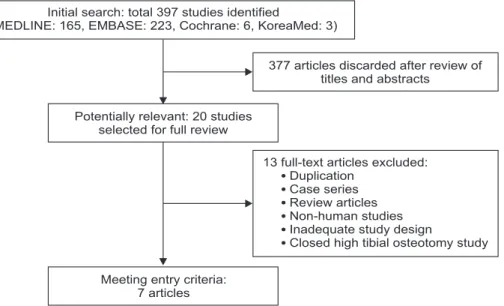
Five studies13,14,16,17,19) presented the radiological results in terms of the number of knees in which the measured angle did not fall within the acceptable range; “outlier” with an MA of less than 0o or more than 6o (Table 4). In these 5 studies (279 knees)14,15,17,18,20),
Fig. 1. PRISMA (Preferred Reporting Items
for Systematic Reviews and Meta-analyses) flow diagram.
Initial search: total 397 studies identified
(MEDLINE: 165, EMBASE: 223, Cochrane: 6, KoreaMed: 3)
377 articles discarded after review of titles and abstracts
Potentially relevant: 20 studies selected for full review
13 full-text articles excluded: Duplication
Case series Review articles Non-human studies Inadequate study design
Closed high tibial osteotomy study Meeting entry criteria:
Ta bl e 2. St ud y C ha rac ter ist ics St ud y Ty pe o f H TO Set tin g/co un try St ud y y ea r St ud y p op ul at io n Fo llo w-u p per io d Typ e o f n av iga tio n Ga p m an ag em en t (a ut o/ allo/sy nt het ic/n on e) Fixa tio n de vice N av iga tio n Con ve nt ion al N av iga tio n Con ve nt ion al Aka m ats u et a l. 13) O pen Yo ko ha m a Ci ty U ni ver sit y H os pi ta l/J ap an N av iga tio n: 2006–2009 Conv en tio na l: 2003–2006 26 22 1 y r Or th op ilo t, Aes cu lap , T ut tlin gen, G er m an y (v er . 1.3) Tw o β-t ric alci um p hos ph ate we dg es (O lym pu s T er um o Bio m ater ial s, T ok yo , Jap an ) To m oFix To m oFix Io rio et a l. 14) O pen S. A ndr ea H os pi ta l U ni v Ro m e/I ta ly N ot m en tio ne d 14 13 3 mo Or th op ilo t, Aes cu lap , T ut tlin gen, G er m an y (v er . 1.4) D eh ydra te d e quin e w edg e (O sto pl an t, B io te ck, I ta ly) Posi tio n HT O Pl ate (B . B ra un-Aes cu lap) Posi tio n HT O P lat e (B . B ra un-Aes cu lap) Kim et a l. 15) O pen Yo ns ei U ni ver sit y H os pit al/ Kor ea N av iga tio n: N ov 2005–D ec 2007 Co nv en tio na l: A pr 2004–N ov 2005 47 43 1 y r Or th op ilo t, Aes cu lap , T ut tlin gen, G er m an y Al lo b on e c hi p D ua l o pen we d g e p lat es M odif ied Pudd u pl at e M aur er a nd W as sm er 16) O pen H os pi ta l S t Eli sa bet h/ G er m any 2003–2006 44 23 No
t men- tioned
Or th op ilo t, Aes cu lap , T ut tlin gen, G er m an y (v er .1.3) N ot c lea r To m oFix To m oFix Rei sin g et a l. 17) O pen Fr eib ur g Uni ver sit y H os pi ta l/ G er m any 2005–2009 40 40 2–45 d ay a) Or th op ilo t, Aes cu lap , T ut tlin gen, G er m an y (v er . 1.5) N ot c lea r To m oFix To m oFix Ri beir o et a l. 18) O pen Sa nt a C as a de M i ser ico rdi a de Sao P au lo/B razi l 2004–2012 18 20 1 y r Or th op ilo t, Aes cu lap , T ut tlin gen, G er m an y (v er . 1.5) N av iga tio n: B ios orb (β - t ri c alci um ph osp ha te we d g e, O tis, F ra nce) Co n v en tio na l: a ut o g e n ou s trico rtic al b on e g ra ft HT O p lat e (B . B ra un-Aes cu lap) Ant ho ny p lat e (F ra nce B lo c S.A, CE n0499, ISO 9001, EN46001) Sa ra ga gli a a nd Ro ber ts 19) O pen H os pit al S ud in Ec hir olles/F ra nce N av iga tio n: M ar 2001–A pr 2002 Co nv en tio na l: J an 1997–D ec 2000 28 28 3 mo Or th op ilo t, Aes cu lap , T ut tlin gen, G er m an y Tr ica lci um p hos ph at e we dge AO T -p lat e (n on-lo ck in g) AO T -p lat e (n on-lo ck in g) HT O: hig h t ib ia l os te ot om y, A O: A rb eitsg em ein sc ha ft f ür O ste osy nt hes ef ra gen. a) Radio log ica l e va lu at io n wa s co nd uc te d p os to pera tiv ely o nce t he p at ien t co uld ac hie ve f ul l ext en sio n a nd p ain les s di str ib ut io n o f 50% b od yw eig ht t o t he a ffe ct ed ext remi ty.
83.7% (range, 65% to 100%) of the computer-assisted naviga-tion HTO group showed an acceptable range (MA of 0o–6o), significantly different from the 62.1% (range, 23% to 78%) of the conventional HTO group (RR=1.37, p<0.01, 95% CI [1.06–1.78], I2=63%) (Fig. 3). Regarding the MA malalignment of less than 0o or more than 6o (outliers), computer-assisted navigation HTO significantly reduced the incidence of outliers compared to con-ventional HTO.
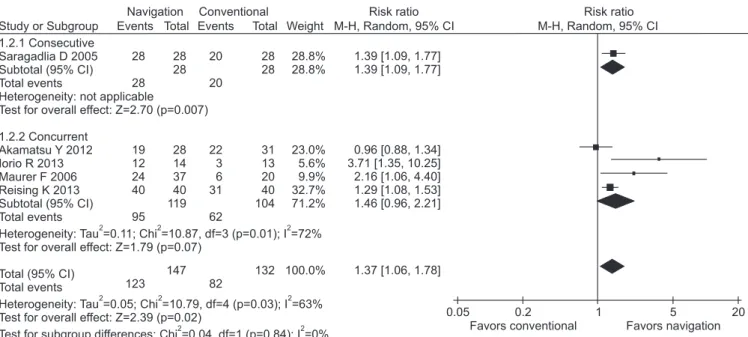
Further subgroup meta-analysis was performed to identify any variable factors affecting the relative RR of MA outliers. Regard-ing the comparison of consecutive vs. concurrent patient series, chi-square test showed a p-value of >0.1 (i.e., 0.84) and I2 statistic of 0%, suggesting low heterogeneity (Fig. 4). On the comparison of fixation with a locking device vs. a non-locking device, chi square test showed a p-value of >0.1 (i.e., 0.40) and I2 statistic of 0%, suggesting low heterogeneity (Fig. 5). None of the subgroup analyses demonstrated significant influence of the variable
fac-tors on the RR of MA outliers.
5. complications
Clinical and radiological complications were reported in 3 stud-ies13-15). Kim et al.15) reported 2/47 cases (4.3%) of delayed union, 1/47 case (2.1%) of varus collapse in the computer-assisted navi-gation HTO group, and 2/43 cases of delayed union (4.7%) in the conventional HTO group. Akamatsu et al.13) reported lateral unstable knee (cortex breakage and tibial plateau fracture) in 2/26 cases (19.2%) in the computer-assisted navigation HTO group, and 4/24 cases (16.7%) in the conventional HTO group. Iorio et al.14) reported no complication in the computer-assisted naviga-tion HTO group and 2/13 cases (15.4%) of broken screws in the conventional HTO group.
discussion
The most important finding of the present study was that com-puter-assisted navigation HTO resulted in more accurate limb alignment (in terms of MA) with lesser outliers compared to con-ventional HTO. For optimum results in HTO, precise planning for limb alignment is needed, for which both computer-assisted and conventional techniques are currently used. Previously known conventional methods for correction angle calculation include the trigonometric principle, weight bearing line method, grid lines or reference to the joint line surface; however, their pre-cision is limited and there is a high risk of technical error21). With respect to the radiological alignment after open wedge HTO, computer-assisted technique seems to be more useful in
achiev-Table 3. Newcastle-Ottawa Quality Assessment Scale (Cohort Study)20)
Author (★★★★)Selection Comparability (★★) Exposure (★★★)
Akamatsu et al.13) ★★★★ ★ ★
Iorio et al.14) ★★★★ ★ ★
Kim et al.15) ★★★★ ★ ★
Maurer and Wassmer16) ★★★★ ★
Reising et al.17) ★★★★ ★★
Ribeiro et al.18) ★★★★ ★★ ★★
Saragaglia and Roberts19) ★★★★ ★★
Table 4. Postoperative Radiological Parameters and Outliers
Study parameters (Radiological o)
Radiological outcome distribution
Navigation (%) Conventional (%)
Varus (<0o) Acceptable range
(0o–6o) Valgus (>6o) Varus (<0o) Acceptable range (0o–6o) Valgus (>6o)
Akamatsu
et al.13) FTA, ΔMPTAPSA, ΔTS 0/28 (0) 19/28 (67.9) 9/28 (32.1) 5/31 (16.1) 22/31 (71) 4/31 (12.9)
Iorio et al.14) MA, MPTA, ΔPSA 1/14 (7.1) 12/14 (86) 1/14 (7.1) 8/13 (38.5) 3/13 (23.0) 2/13 (15.4)
Kim et al.15) MA, MA%, PSA (1 yr) N/M N/M N/M N/M N/M N/M
Maurer and
Wassmer16) MA 12/37 (32.4) 24/37 (64.9) 1/37 (2.7) 13/20 (65.0) 6/20 (30.0) 1/20 (5.0)
Reising et al.17) MA% 0 (0) 40/40 (100) 0 (0) 4/40 (10.0) 31/40 (77.5) 5/40 (12.5)
Saragaglia and
Roberts19) MA N/M 28/28 (97) N/M N/M 20/28 (71) N/M
Ribeiro et al.18) MA, PSA N/M N/M N/M N/M N/M N/M
ing satisfactory alignment. However, the meta-analysis showed no notable clinical benefit of computer-assisted HTO. Out of 7 recruited studies, 3 studies16,17,19) did not report preoperative and postoperative clinical outcome. The other 4 studies demonstrated heterogeneity in clinical scoring systems, rendering it impossible to obtain statistical significance in the meta-analysis. Therefore, clinical superiority of the navigation system for open wedge HTO could not be demonstrated. To our knowledge, this is the first meta-analysis comparing navigation-assisted HTO with conven-tional HTO.
The majority of previous reports on HTO define correction tar-get as an intersection of the MA with the tibial plateau at 62%22). However, reports regarding the postoperative limb alignment variables have been different. The acceptable range was defined as 50%–70% MA% in some studies17,23,24). An ideal range was suggested as 60%–70% MA% by Miniaci et al.25). Dugdale et al.26)
proposed 50%–75% MA% as the acceptable range. Some authors suggested acceptable range as FTA of 8o–12o valgus27,28). Five out of 7 studies reported postoperative radiological outliers. Those studies presented the “acceptable” range as within 0o–6o of MA (Table 4). In the 5 studies (279 knees), the MA was within the ac-ceptable range in 83.7% (range, 65% to 100%) of the computer-assisted navigation HTO group, which was significantly higher than 62.1% (range, 23% to 78%) of the conventional HTO group (RR=1.37, p<0.01, 95% CI [1.06–1.78], I2=63%) (Fig. 3). Regard-ing the MA outliers, computer-assisted navigation significantly reduced the incidence of outliers compared to the conventional method.
All 7 included studies reported postoperative radiological pa-rameters, 2 studies15,18), however, did not report the range of outli-ers. They only reported the absolute values of limb alignment. Kim et al.15) reported a postoperative mean MA of 3.9o (standard
Fig. 2. Comparison of clinical outcomes between navigation-assisted high tibial osteotomy (HTO) and conventional HTO. Although the forest plot
demonstrated a general trend in clinical outcomes (Knee Society score [KSS], Lysholm) favoring navigation-assisted HTO, there were not sufficient study results to determine statistical significance in the meta-analysis. SD: standard deviation, CI: confidence interval.
Favors conventional Favors navigation
Navigation
Study or Subgroup Mean SD Total Mean SD Total Weight IV, Random, 95% CI
Conventional Mean difference
IV, Random, 95% CI Mean difference 1.1.1 KSS Akamatsu Y 2012 Iorio R 2013 Subtotal (95% CI)
Heterogeneity: Tau =0.00; Chi =0.24, df=1 (p=0.63); I =0% Test for overall effect: Z=2.75 (p=0.006)
2 2 2 88 85.1 95 85 91.94 8 7.3 5 6 11.67 26 14 40 26 47 18 91 84 79.4 96 83 87.6 8 6.2 6 5 11.12 22 13 35 22 43 20 85 55.7% 44.3% 100.0% 37.2% 52.4% 10.4% 100.0% 4.00 [ 0.54, 8.54] 5.70 [0.60, 10.80] 4.75 [1.36, 8.14] 1.00 [ 4.16, 2.16] 2.00 [ 0.28, 4.28] 4.34 [ 2.93, 11.61] 1.13 [ 1.36, 3.61] 1.1.2 Lysholm Akamatsu Y 2012 Kim SJ 2009 Ribeiro CH 2014 Subtotal (95% CI)
Heterogeneity: Tau =1.72; Chi =3.05, df=2 (p=0.22); I =35% Test for overall effect: Z=0.89 (p=0.37)
2 2 2
Test for subgroup differences: Chi =2.86, df=1 (p=0.09); I =65.0%2 2
20 10 0 10 20
Favors conventional Favors navigation
Navigation
Study or Subgroup Events Total Total Weight M-H, Random, 95% CI
Conventional Risk ratio
M-H, Random, 95% CI Risk ratio Akamatsu Y 2012 Iorio R 2013 Maurer F 2006 Reising K 2013 Saragaglia D 2005 19 12 24 40 28 123 0.96 [0.68, 1.34] 3.71 [1.35, 10.25] 2.16 [1.06, 4.40] 1.29 [1.08, 1.53] 1.39 [1.09, 1.77] 1.37 [1.06, 1.78] Total (95% CI) Total events
Heterogeneity: Tau =0.05; Chi =10.79, df=4 (p=0.03); I =63% Test for overall effect: Z=2.39 (p=0.02)
2 2 2 0.05 0.2 1 5 20 Events 28 14 37 40 28 147 22 3 6 31 20 82 31 13 20 40 28 132 23.0% 5.6% 9.9% 32.7% 28.8% 100.0%
Fig. 3. Comparison of navigation-assisted high tibial osteotomy (HTO) and conventional HTO with respect to the risk ratio of outliers (mechanical
deviation [SD], 1o) for the navigation HTO group, and 2.7o (SD, 2.2o) for the conventional HTO group. They also reported a mean MA% of 62.3% (SD, 2.9%) for the navigation HTO group and 58.7% (SD, 6.6%) for the conventional group. The SD values for both MA and MA% increased statistically significantly in the conventional HTO group. Ribeiro et al.18) reported a postopera-tive mean MA of 3.06o (SD, 1.76o) for the navigation HTO group,
and 3.35o (SD, 3.27o) for the conventional HTO group. In their study, the SD values also increased in the conventional HTO group compared to the navigation HTO group. Reports of lower SD values may refer to lower occurrences of outliers which are consistent with the findings of this meta-analysis.
The type of open wedge HTO study design being consecutive or concurrent (I2=0%), the use of bone graft material at the
oste-Favors conventional Favors navigation
Navigation
Study or Subgroup Events Total Total Weight M-H, Random, 95% CI
Conventional Risk ratio
M-H, Random, 95% CI Risk ratio 1.2.1 Consecutive Saragadlia D 2005 Subtotal (95% CI) Total events
Heterogeneity: not applicable
Test for overall effect: Z=2.70 (p=0.007) 1.2.2 Concurrent Akamatsu Y 2012 Iorio R 2013 Maurer F 2006 Reising K 2013 Subtotal (95% CI) Total events
Heterogeneity: Tau =0.11; Chi =10.87, df=3 (p=0.01); I =72% Test for overall effect: Z=1.79 (p=0.07)
Total (95% CI) Total events
Heterogeneity: Tau =0.05; Chi =10.79, df=4 (p=0.03); I =63% Test for overall effect: Z=2.39 (p=0.02)
Test for subgroup differences: Chi =0.04, df=1 (p=0.84); I =0%
2 2 2 2 2 2 2 2 28 28 19 12 24 40 95 123 1.39 [1.09, 1.77] 1.39 [1.09, 1.77] 0.96 [0.88, 1.34] 3.71 [1.35, 10.25] 2.16 [1.06, 4.40] 1.29 [1.08, 1.53] 1.46 [0.96, 2.21] 1.37 [1.06, 1.78] 0.05 0.2 1 5 20 Events 28 28 28 14 37 40 119 147 20 20 22 3 6 31 62 82 28 28 31 13 20 40 104 132 28.8% 28.8% 23.0% 5.6% 9.9% 32.7% 71.2% 100.0%
Fig. 4. Subgroup (consecutive vs. concurrent patient series) analysis comparing navigation-assisted high tibial osteotomy (HTO) and conventional
HTO with respect to the risk ratio of outliers (mechanical axis of less than 0o or more than 6o). CI: confidence interval.
Favors conventional Favors navigation
Navigation
Study or Subgroup Events Total Total Weight M-H, Random, 95% CI
Conventional Risk ratio
M-H, Random, 95% CI Risk ratio 3.2.1 Locking device Akamatsu Y 2012 Maurer F 2006 Reising K 2013 Subtotal (95% CI) Total events
Heterogeneity: Tau =0.05; Chi =4.96, df=2 (p=0.08); I =60% Test for overall effect: Z=1.38 (p=0.17)
3.2.2 Non-locking device Iorio R 2013
Saragadlia D 2005 Subtotal (95% CI) Total events
Heterogeneity: Tau =0.56; Chi =4.95, df=3 (p=0.03); I =63% Test for overall effect: Z=1.26 (p=0.21)
Total (95% CI) Total events
Heterogeneity: Tau =0.05; Chi =10.79, df=4 (p=0.03); I =63% Test for overall effect: Z=2.39 (p=0.02)
Test for subgroup differences: Chi =0.70, df=1 (p=0.40); I =0%
2 2 2 2 2 2 2 2 2 2 2 19 24 40 83 0.96 [0.68, 1.34] 2.16 [1.06, 4.40] 1.29 [1.08, 1.53] 1.25 [0.91, 1.72] 0.01 0.1 1 10 100 Events 28 37 40 105 22 6 31 59 12 28 40 123 14 28 42 147 3 20 23 82 31 20 40 91 13 28 41 132 23.0% 9.9% 23.7% 65.6% 5.6% 28.8% 34.4% 100.0% 3.71 [1.35, 10.25] 1.39 [1.09, 1.77] 2.08 [0.66, 6.51] 1.37 [1.06, 1.78]
Fig. 5. Subgroup (fixation with a locking device vs. a non-locking device) analysis comparing navigation-assisted high tibial osteotomy (HTO) and
otomy gap, and the use of locking device for fixation (I2=0%) may all affect the outcome of HTO regardless of the use of computer-assisted navigation system. However, these variable factors did not show any difference in the subgroup analysis (Figs. 4 and 5). Further studies are necessary for analysis regarding these issues.
Several limitations of this study should be noted. First, as other meta-analysis studies, results of this study may have been affected by the type and number of variables incorporated into the prima-ry studies. Second, all included studies for this meta-analysis were retrospective comparative studies. Thus, inherent heterogeneity among studies should be taken into consideration (I2=63%, Fig. 3), and further well designed randomized control trials should be performed to confirm our conclusions. Third, the sample sizes of the studies were small; most of the study had less than 50 pa-tients. Fourth, since all the studies used radiographic parameters, such as MA, MA%, MPTA, and FTA, for postoperative assess-ment, there is a potential for inherent measurement errors. Lastly, a meta-analysis could not be performed on clinical outcomes due to the heterogenic reports of clinical scoring systems as well as the lack of reports on clinical assessments.
conclusions
The present meta-analysis indicates that the use of navigation in patients undergoing open wedge HTO improves the precision of MA by decreasing the incidence of outliers. However, the clinical benefit of navigation-assisted HTO is not conclusive. Addition-ally, none of the subgroup analyses according to the study period and the use of a locking fixation device demonstrated significant difference in the RR of MA outliers.
conflict of interest
No potential conflict of interest relevant to this article was re-ported.
references
1. Coventry MB. Osteotomy of the upper portion of the tibia for degenerative arthritis of the knee: a preliminary report. J Bone Joint Surg Am. 1965;47:984-90.
2. Brouwer RW, Huizinga MR, Duivenvoorden T, van Raaij TM, Verhagen AP, Bierma-Zeinstra SM, Verhaar JA. Oste-otomy for treating knee osteoarthritis. Cochrane Database Syst Rev. 2014;12:CD004019.
3. Rampersaud YR, Pik JH, Salonen D, Farooq S. Clinical
ac-curacy of fluoroscopic computer-assisted pedicle screw fixa-tion: a CT analysis. Spine (Phila Pa 1976). 2005;30:E183-90. 4. Stockle U, Krettek C, Pohlemann T, Messmer P. Clinical
ap-plications: pelvis. Injury. 2004;35 Suppl 1:S-A46-56.
5. Amiot LP, Poulin F. Computed tomography-based naviga-tion for hip, knee, and spine surgery. Clin Orthop Relat Res. 2004;(421):77-86.
6. Wang G, Zheng G, Keppler P, Gebhard F, Staubli A, Mueller U, Schmucki D, Fluetsch S, Nolte LP. Implementation, ac-curacy evaluation, and preliminary clinical trial of a CT-free navigation system for high tibial opening wedge osteotomy. Comput Aided Surg. 2005;10:73-85.
7. Cheng T, Zhao S, Peng X, Zhang X. Does computer-assisted surgery improve postoperative leg alignment and implant positioning following total knee arthroplasty? A meta-analysis of randomized controlled trials? Knee Surg Sports Traumatol Arthrosc. 2012;20:1307-22.
8. Fu D, Li G, Chen K, Zhao Y, Hua Y, Cai Z. Comparison of high tibial osteotomy and unicompartmental knee arthro-plasty in the treatment of unicompartmental osteoarthritis: a meta-analysis. J Arthroplasty. 2013;28:759-65.
9. Fu Y, Wang M, Liu Y, Fu Q. Alignment outcomes in navigat-ed total knee arthroplasty: a meta-analysis. Knee Surg Sports Traumatol Arthrosc. 2012;20:1075-82.
10. Weber P, Crispin A, Schmidutz F, Utzschneider S, Pi-etschmann MF, Jansson V, Muller PE. Improved accuracy in computer-assisted unicondylar knee arthroplasty: a meta-analysis. Knee Surg Sports Traumatol Arthrosc. 2013;21: 2453-61.
11. Bae DK, Song SJ, Yoon KH. Closed-wedge high tibial os-teotomy using computer-assisted surgery compared to the conventional technique. J Bone Joint Surg Br. 2009;91:1164-71.
12. Higgins JP, Thompson SG, Deeks JJ, Altman DG. Measuring inconsistency in meta-analyses. BMJ. 2003;327:557-60. 13. Akamatsu Y, Mitsugi N, Mochida Y, Taki N, Kobayashi H,
Takeuchi R, Saito T. Navigated opening wedge high tibial os-teotomy improves intraoperative correction angle compared with conventional method. Knee Surg Sports Traumatol Ar-throsc. 2012;20:586-93.
14. Iorio R, Pagnottelli M, Vadala A, Giannetti S, Di Sette P, Pa-pandrea P, Conteduca F, Ferretti A. Open-wedge high tibial osteotomy: comparison between manual and computer-assisted techniques. Knee Surg Sports Traumatol Arthrosc. 2013;21:113-9.
Medial opening wedge high-tibial osteotomy using a kine-matic navigation system versus a conventional method: a 1-year retrospective, comparative study. Knee Surg Sports Traumatol Arthrosc. 2009;17:128-34.
16. Maurer F, Wassmer G. High tibial osteotomy: does naviga-tion improve results? Orthopedics. 2006;29(10 Suppl):S130-2. 17. Reising K, Strohm PC, Hauschild O, Schmal H, Khattab M,
Sudkamp NP, Niemeyer P. Computer-assisted navigation for the intraoperative assessment of lower limb alignment in high tibial osteotomy can avoid outliers compared with the conventional technique. Knee Surg Sports Traumatol Ar-throsc. 2013;21:181-8.
18. Ribeiro CH, Severino NR, Moraes de Barros Fucs PM. Opening wedge high tibial osteotomy: navigation system compared to the conventional technique in a controlled clinical study. Int Orthop. 2014;38:1627-31.
19. Saragaglia D, Roberts J. Navigated osteotomies around the knee in 170 patients with osteoarthritis secondary to genu varum. Orthopedics. 2005;28(10 Suppl):s1269-74.
20. Wells GA, Shea B, O’Connell D, Peterson J, Welch V, Losos M, Tugwell P. The Newcastle-Ottawa Scale (NOS) for assess-ing the quality of nonrandomised studies in meta-analyses [Internet]. Ottawa, ON: Ottawa Hospital Research Institute; 2011 [cited 2014 Oct 15]. Available from: http://www.ohri. ca/programs/clinical_epidemiology/oxford.asp.
21. Hankemeier S, Hufner T, Wang G, Kendoff D, Zeichen J, Zheng G, Krettek C. Navigated open-wedge high tibial os-teotomy: advantages and disadvantages compared to the conventional technique in a cadaver study. Knee Surg Sports
Traumatol Arthrosc. 2006;14:917-21.
22. Fujisawa Y, Masuhara K, Shiomi S. The effect of high tibial osteotomy on osteoarthritis of the knee: an arthroscopic study of 54 knee joints. Orthop Clin North Am. 1979;10:585-608.
23. Niemeyer P, Koestler W, Kaehny C, Kreuz PC, Brooks CJ, Strohm PC, Helwig P, Suedkamp NP. Two-year results of open-wedge high tibial osteotomy with fixation by medial plate fixator for medial compartment arthritis with varus malalignment of the knee. Arthroscopy. 2008;24:796-804. 24. Niemeyer P, Schmal H, Hauschild O, von Heyden J,
Süd-kamp NP, Kostler W. Open-wedge osteotomy using an internal plate fixator in patients with medial-compartment gonarthritis and varus malalignment: 3-year results with re-gard to preoperative arthroscopic and radiographic findings. Arthroscopy. 2010;26:1607-16.
25. Miniaci A, Ballmer FT, Ballmer PM, Jakob RP. Proximal tibial osteotomy: a new fixation device. Clin Orthop Relat Res. 1989;(246):250-9.
26. Dugdale TW, Noyes FR, Styer D. Preoperative planning for high tibial osteotomy. The effect of lateral tibiofemoral sepa-ration and tibiofemoral length. Clin Orthop Relat Res. 1992; (274):248-64.
27. Coventry MB. Osteotomy about the knee for degenerative and rheumatoid arthritis. J Bone Joint Surg Am. 1973;55:23-48.
28. Insall JN, Joseph DM, Msika C. High tibial osteotomy for varus gonarthrosis: a long-term follow-up study. J Bone Joint Surg Am. 1984;66:1040-8.