Contents lists available atScienceDirect
Journal of Membrane Science
journal homepage:www.elsevier.com/locate/memsciMixed-matrix carbon molecular sieve membranes using hierarchical zeolite:
A simple approach towards high CO
2
permeability enhancements
Wen Li
a,1, Kunli Goh
b,1, Chong Yang Chuah
a,b, Tae-Hyun Bae
a,b,c,∗aSchool of Chemical and Biomedical Engineering, Nanyang Technological University, Singapore, 637459, Singapore bSingapore Membrane Technology Centre, Nanyang Technological University, Singapore, 637141, Singapore
cDepartment of Chemical and Biomolecular Engineering, Korea Advanced Institute of Science and Technology, Daejeon, 34141, Republic of Korea
A R T I C L E I N F O Keywords:
Hierarchical zeolite 5A Carbon molecular sieve membrane CO2/CH4separation
Robeson upper bound Findex
A B S T R A C T
Membrane process is a robust technology for CO2/CH4separation. To achieve the energy-efficiency necessary for
a cost-effective membrane-based CO2/CH4separation, high-performance membranes are often desirable. There
are several approaches that can be undertaken to realize such membranes. In this study, we amalgamated three strategies: 1)filler design optimization by synthesizing hierarchical zeolite 5A comprising micro and mesoporous domains to strengthen the second strategy; 2) mixed-matrix approach by incorporating zeolitefillers to facilitate CO2diffusion and reduce transport resistance through a Matrimid®matrix; and 3) membrane carbonization to
induce thermal rearrangement, and create free volumes and pore apertures for a faster CO2transport. These
efforts afforded mixed-matrix carbon molecular sieve membranes with results confirming that our membrane at 30 wt% loading of hierarchical zeolite 5A was able to surpass the 2008 Robeson upper bound limit given a performance of 2450 barrers CO2permeability and 19.3 CO2/CH4selectivity. Notably, at this loading, the
ne-gative effect brought by the interfacial nanogaps between the filler and carbon matrix diminished, unleashing the potential of the mesopores in facilitating CO2diffusion, which led to a two orders of magnitude enhancement
in the CO2permeability relative to the unfilled carbon molecular sieve membrane. Despite a decrease in the
CO2/CH4selectivity, the hierarchical zeolite 5A is effective in alleviating the intensity of the
permeability-selectivity trade-off. Also, benchmarking of the filler effectiveness is first demonstrated using a new filler en-hancement index, Findex. The largest Findexvalue in this study was 1.97. This attaches a label of“competent” to
our hierarchical zeolite 5Afiller at 30 wt% loading, demonstrating the success of our strategies.
1. Introduction
Natural gas and biogas, which consist of methane gas (CH4), are
important energy resources for relieving our reliance on fossil fuels. To fully capitalize on CH4as an alternative fuel, enriching the CH4content
by separating carbon dioxide (CO2) gas in natural gas and biogas is
critical. For this purpose membrane-based technology offers strong advantages such as safe operation, energy-efficiency, cost-effectiveness alongside small plant footprint to stay competitive against conventional technologies, which include physical and chemical scrubbing as well as pressure swing adsorption [1]. Polymeric membranes [2,3] are by far the most commonly used membrane materials for many gas separation processes, including hydrogen purification, biogas upgrading and air separation [4,5], due to their well-established industrial fabrication methods and high cost-competitiveness as compared to other materials
(e.g. inorganic materials) [6,7].
One of the biggest issues with polymeric membranes is their re-current permeability-selectivity trade-off [8] driven by a solution-dif-fusion transport mechanism within the dense structure of the mem-branes. As this is a limitation inherent to the polymers used, efforts to alleviate the issue are usually materials-oriented [9]. Among these ef-forts, thermal treatment is a process to decarboxylate polymer pre-cursors at high temperatures. During the process, the structure of the polymer chains changes, disrupting the polymer's rigidity [10] and creating fractional free volumes which comprise cavities and constric-tions that allow discrimination of gas molecules based on their kinetic diameters. The resulting membranes, termed as carbon molecular sieve membranes (CMSMs) due to the highly graphitic domains after carbo-nization [11], usually exhibit substantial improvement in gas perme-ability without sacrificing on the membrane selectivity [12], making
https://doi.org/10.1016/j.memsci.2019.117220
Received 5 March 2019; Received in revised form 19 June 2019; Accepted 27 June 2019
∗Corresponding author. School of Chemical and Biomedical Engineering, Nanyang Technological University, Singapore, 637459, Singapore.
E-mail address:[email protected](T.-H. Bae).
1These authors contributed equally to this work.
Available online 28 June 2019
0376-7388/ © 2019 Elsevier B.V. All rights reserved.
them highly versatile for separating a wide range of gas pairs, like CO2/
CH4separation, air and hydrocarbons separation.
The permeability-selectivity trade-off is clearly demonstrated in Robeson plots (log-log plots of permeability against selectivity) where an upper bound limit is defined to highlight the best performances from polymeric membranes. To drive CMSMs to surpass this upper bound, researchers have to optimize several carbonization conditions, in-cluding the atmospheric environment (He, Ar, N2, CO2, vacuum),
heating rate, thermal soak time and pyrolysis temperature (500–1000 °C) [13,14]. For instance, administering a He environment can increase CO2permeance but leads to a significant loss in CO2/CH4
selectivity while that of an Ar environment tends to result in an increase in the gas selectivity of CMSMs. A higher pyrolysis temperature is also known to produce CMSMs of higher density and compactness [13]. Despite this, carbonization conditions are not always generalizable to all types of precursor polymers. As such, researchers are required to carry out painstaking optimization on a case-by-case basis. Alter-natively, high-performance CMSMs can be realized from precursor polymers with outstanding intrinsic separation capacities, such as the highly permeable/selective 6FDA-based polymers [13]. However, such precursor polymers are more highly priced compared to zeolites and commercial polymers (Matrimid®). In addition, to successfully prepare 6FDA-TMPDA polyimide polymer, every step during the synthesis needs to be carefully carried out, as described in our previous work [15]. For instance, the requirement for monomers purification before the reaction, synthesis procedures to be kept under inert environment as well as complete removal of residual solvents within products are essential steps affecting the quality of the precursors. Overall, apart from economic consideration, such laborious and more complex synthesis methods are critically stifling the commercial potential of such high-performance polymer precursors.
To close these technological gaps, we adopted a simple approach to elevate the separation performances of CMSMs. The approach involves amalgamating CMSM fabrications with a mixed-matrix approach, where porousfiller materials are incorporated within the carbon gra-phitic domains to either create low-resistance transport pathways or serve as barriers to impede the less permeable gas molecules [16]. To date, filler materials such as mesoporous carbon [17], SBA-15 and MCM-48 [18], as well as zeolite T [19], zeolite KY [20] and zeolite L [21] have been utilized to create either enhancements in CO2
perme-ability and/or CO2/CH4 selectivity of CMSMs. Apart from this
ap-proach, we also strategize onfiller design optimization to further drive the CO2/CH4separation performances beyond the upper bound limit.
Hence, we selected Matrimid®5218 polyimide and zeolite 5A as the precursor polymer and filler material, respectively, to realize our mixed-matrix CMSM design. Matrimid®5218 was chosen because of its commercial availability, cost-competitiveness as well as its high in-trinsic CO2/CH4selectivity of 37.5 under the measurement conditions
of 35 °C and 2 bar feed pressure [22]. Zeolite 5A, on the other hand, is a classical filler material which possesses molecular channels and rigid cavities that can provide optimized free spaces and void volumes for effective gas transport, especially CO2[23,24]. It is worth noting that,
as compared to 4A which is the original form containing Na+as the counter cation, 5A zeolite possessing Ca2+as the counter cation allows a much faster CO2diffusion as evidenced by the CO2adsorption study
(Fig. S3). The previous studies also reported that the CO2permeability
of 4A zeolite is less than 10 barrer, indicating that 4A zeolite is not effective in improving the CO2permeability of CMSM which is much
higher than 10 barrer [9,25,26]. More importantly, the pore structure of zeolite 5A can be easily optimized by tuning with the aid of a pore expanding agent, leading to a hierarchical structure with both meso and micropores. Comparing this filler to bulk zeolite 5A with mono-mi-cropores, the presence of mesopores in hierarchical zeolite 5A (H-zeo-lite 5A) creates more open channels for CO2transport.
For this reason, we optimized our CMSMs from Matrimid®precursor incorporating H-zeolite 5A (LTA topology) filler. Our results
demonstrate that the H-zeolite 5A is indeed highly effective in enhan-cing the CO2permeability, which helps to moderate the adverse effects
brought by the permeability-selectivity trade-off. In particular, at 30 wt % H-zeolite 5A loading, our membrane was able to achieve a two orders of magnitude enhancement in the CO2permeability compared to the
unfilled CMSM. A filler enhancement index, Findex, was also used to
evaluate the effectiveness of our H-zeolite 5A [27], benchmarking the filler as “competent” at a loading of 30 wt%. Effectively, our strategy was successfully demonstrated as the performance of our mixed-matrix CMSM surpassed the 2008 Robeson upper bound limit.
2. Experimental
2.1. Materials
Sodium metasilicate pentahydrate (≥95.0%), sodium hydroxide (≥98.5%), sodium aluminate (Al: 50–56%; Na: 37–45%), dimethy-loctadecyl[3-(trimethoxysilyl)propyl]ammonium chloride solution (TPOAC, 42 wt% in methanol) and calcium nitrate tetrahydrate (Ca (NO3)2) were purchased from Sigma-Aldrich, Merck. Chloroform
(≥99.8%) was purchased from VWR. The reagents and solvent were used as-received. Matrimid®5218 was purchased from Ciba Specialty Chemicals and was dried in vacuum oven at 180 °C overnight prior to use.
2.2. Synthesis of bulk and hierarchical zeolite 5A
Bulk and H-zeolite 5A were synthesized as described in the litera-ture [28]. For H-zeolite 5A (with both microporous and mesoporous domains), the precursor gel with a molar ratio of 10 Al2O3/40 Na2O/15
SiO2/2400 H2O/1.25 TPOAC were prepared at room temperature. In
separate polypropylene bottles, one solution containing sodium meta-silicate pentahydrate, sodium hydroxide, TPOAC and deionized (DI) water was mixed, while another solution comprising sodium aluminate dissolved in DI water was separately prepared. After the solutions were strongly agitated for 2 h, both solutions were mixed and heated at 100 °C for 4 h. Upon completion of reaction, the products were collected via vacuumfiltration, which were then washed with copious amount of DI water to remove unreacted raw materials and impurities. The re-sulting products were dried at 100 °C overnight in a convection oven, followed by calcination at 550 °C for 3 h in a furnace at a heating rate of 1 °C/min. This step helped to remove TPOAC that was present in the mesopores, affording hierarchical zeolite 4A. In the following step, Na+
cations in LTA zeolite domains (zeolite 4A) was replaced with Ca2+ cations using ion-exchange to yield zeolite 5A. Briefly, 1 g of zeolite 4A wasfirst dispersed in 50 mL of 0.5 M Ca(NO3)2solution before vigorous
stirring at 60 °C for 12 h. This ion-exchange procedure was repeated once more to ensure a higher degree of substitution to Ca2+. The
H-zeolite 5A was obtained byfiltering the product solution and drying at 80 °C for 24 h. On the other hand, the synthesis of bulk zeolite 5A (with only microporous domains) was prepared using the same procedure as hierarchical zeolite 5A except without the addition of TPOAC. The molar ratio of the precursor gel for bulk zeolite 5A was 10 Al2O3/40
Na2O/15 SiO2/2400 H2O.
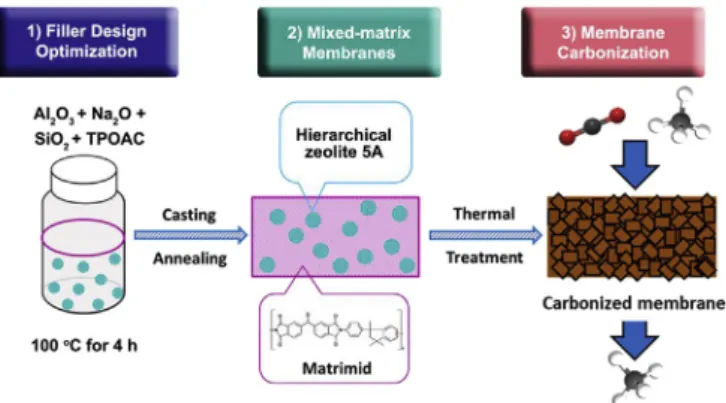
2.3. Synthesis of mixed-matrix carbon molecular sieve membranes The synthesis of CMSMs was summarized inScheme 1. Polymeric flat sheet precursor membranes were fabricated using a solution-casting technique as reported elsewhere [29,30]. For the synthesis of polymeric mixed-matrix membranes containing bulk and H-zeolite 5A (10, 20 and 30 wt%), thefillers were first ground and dispersed in chloroform with the aid of a sonication horn (Qsonica, Q125) to obtain a homogeneous dispersion. Next, Matrimid®powder was incorporated into the suspen-sion, followed by vigorous stirring until the polymer was dissolved completely. The viscosity of the dope solution was controlled byfixing
the concentration of Matrimid®in the range of 10–15 wt%. Flat sheet membranes were cast onto a glass plate with a casting knife in a glove bag that wasfilled with chloroform vapor to slow down the solvent evaporation time. Upon phase inversion, the membranes were annealed at 180 °C overnight to remove any residual solvents. The precursor membranes then underwent a carbonization process in a tube furnace (Carbolite GERO, CTF 12/100/900). Ar gas (purity of 99.9995%, Air-liquide) wasfirst purged into the quartz tube for approximately 1 h to create an inert environment and to remove any residual air and moisture that could potentially trap inside the tube. Following, the membrane precursors were treated via a two-step ramp-dwell profile comprising 380 °C heating for 30 min at a rate of 2 °C/min and 550 °C heating for 2 h at a rate of 0.5 °C/min. After completion, the carbonized membranes were cooled to room temperature before storing them for future performance evaluations and characterization.
2.4. Materials and membranes characterization
Powdered X-ray diffraction (PXRD) patterns of zeolites, precursor membranes and CMSMs were measured with a Bruker D2 phaser dif-fractometer equipped with a Cu Kα source in the 2θ range of 5–50°. Thermal stabilities of zeolites and precursor membranes were de-termined using a thermogravimetric/differential thermal analyzer (TGA, SDT Q600 TA Instrument). The experiments were operated under N2purging at 100 ml/min, with a heating rate of 10 °C/min and
tem-perature ranging from 50 to 900 °C. The morphologies of zeolites, precursor membranes and CMSMs were observed using afield emission-scanning electron microscope (FE-SEM, JSM6701 JOEL). To preserve the cross-sectional morphologies, the samples werefirst cryogenically fractured in liquid nitrogen prior to gold coating. The particle size distribution of zeolites was measured via dynamic light scattering (DLS, BIC PALS ZetaSizer). N2physisorption at−196 °C (77 K) and a P/Po
range of 0–1 bar (Autosorb 6B, Quantachrome) was used to evaluate the porosity properties of both bulk and H-zeolite 5A. The samples were first activated at 250 °C for 24 h under high vacuum prior to the mea-surement and the mesopore size distributions were determined from a Barrett-Joyner-Halenda (BJH) algorithm. On the other hand, CO2and
CH4adsorption isotherms were acquired via a volumetric gas sorption
analyzer (iSorb HP1, Quantachrome) under a pressure range of 0–1 bar. The measurements were conducted at a controlled temperature of 35 °C using a water circulator.
2.5. Mixture gas permeation evaluations
Mixture gas permeation tests were conducted using a constant pressure-variable volume system (GTR Tec Corporation). The CO2/CH4
(50/50) mixture and helium (He, purity of 99.9995%) gases used in the system were purchased from Airliquide. Membranes werefirst mounted onto a permeation cell before exposing to continuousflow of He and CO2/CH4mixture gas on the down and upstream sides at a feed and
permeate pressure of 1 bar, respectively. The temperature of the per-meation cell was set at 35 °C. At a specific time interval, the down-stream gas was swept by He until the concentration of the permeating gas remained unchanged. The CO2 and CH4 concentration of the
permeate gas were calculated from the gas chromatogram. Each per-meation measurement was repeated at least three times for both pre-cursor membranes and CMSMs to ensure reproducibility in the results. In this work, our goal was to investigate the improved separation per-formance of CMSMs for specifically biogas upgrading. Although there exist negligible amount of other gases, biogas mainly consists of CH4
(60–70 vol%) and CO2(30–40 vol%) [27]. Therefore, a mixture gas of
CO2/CH4(50/50) applied in this work was representative of the biogas
composition.
Based on the separation performances obtained, afiller enhance-ment index, Findex, was calculated for each mixed-matrix CMSM using
the following equation:
⎜ ⎟ ⎜ ⎟ = ⎛ ⎝ ⎞ ⎠ + ⎛ ⎝ ⎞ ⎠ F P P η α α ln ln index filled unfilled filled unfilled (1)
where Pfilledand Punfilledrefer to the CO2permeability whileαfilledand
αunfilledare the CO2/CH4 selectivity of the mixed-matrix and unfilled
CMSMs, respectively, and η is an enhancement coefficient of value 2.636, which stems from the slope of the 2008 Robeson upper bound. The Findex was empirically developed to evaluate the effectiveness of
fillers in enhancing the separation performance of mixed-matrix membranes [27], which we utilized here to help us understand the effects brought by the bulk and H-zeolite 5A fillers.
3. Results and discussion
3.1. Properties of bulk and hierarchical zeolite 5A
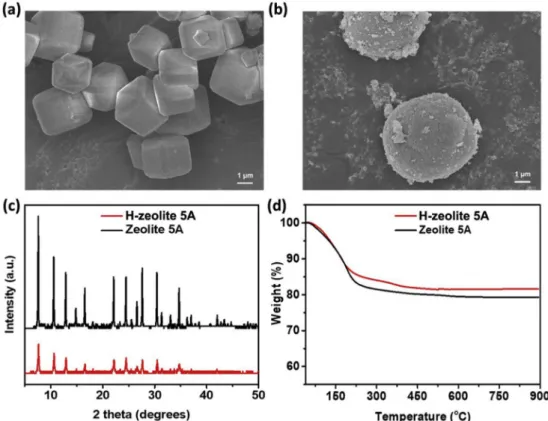
Fig. 1(a) and (b) illustrated the overall morphologies of zeolite 5A, showing uniform structures for both bulk (cubic) and H-zeolite 5A (spherical). The particle size of bulk and H-zeolite 5A was estimated from the FE-SEM images to be around 2–3 μm and 6–7 μm respectively. These results were also verified via DLS analysis as illustrated inFig. S1. It is noteworthy that we were unable to control the size of H-zeolite 5A due to its complicated reaction system. Thus, we intentionally chose this large 5A bulk zeolite particle, which is the largest one among the samples we successfully synthesized previously (ranged from 300 nm to 2–3 μm) [28,32,33], to minimize the effect of particle size on mem-brane performance. Next, successful synthesis of bulk and H-zeolite 5A was verified by PXRD. As shown inFig. 1(c), the characteristic peaks of both zeolites resemble the XRD patterns as those reported in the lit-erature [28]. Noteworthy of mentioning is the lower peak intensities of H-zeolite 5A as compared to the bulk zeolite 5A. The determination of relative crystallinity in XRD patterns is based on the relative intensity of specific peaks. As described inFig. 1(c), the characteristic peak located at 2θ = 7.6° of H-zeolite 5A was much lower and the ratio of peak in-tensity was around 0.283 as compared to zeolite 5A. This phenomenon suggested a lower crystallinity of H-zeolite 5A probably because of the presence of mesoporosity, which leads to a lower fraction of zeolitic domains. To determine the suitability of the zeolites for the subsequent carbonization process, the thermal stabilities were evaluated from 50 to 900 °C (Fig. 1(d)). Based on the TGA profile, a continuous weight loss (c.a. 15–20%) up to 220 °C was observed for both bulk and H-zeolite 5A, which we attributed to the presence of moisture inside the pores. After heating beyond 220 °C, all moisture was removed and further weight loss was not observed for both zeolites even at a temperature as high as 900 °C. This suggests that both zeolites are capable of retaining their crystallinity and pore structures in the Matrimid®matrix after carbonization at 550 °C.
Porosity properties of both bulk and H-zeolite 5A were quantified using N2physisorption isotherm at−196 °C (77 K) and P/Porange from
0 to 1 bar (Fig. 2(a)). In general, both bulk and H-zeolite 5A demon-strated high N2sorption at low P/Povalues, indicating the presence of
large micropore volumes. While the H-zeolite 5A exhibited lower N2
sorption compared to the bulk zeolite 5A at low P/Povalues, the
pre-sence of a hysteresis loop between the adsorption and desorption curves showed the existence of mesopores. As demonstrated inFig. S2, the mesopore sizes of both H-zeolite 4A and 5A were determined by a BJH algorithm [34] to be around 6.9 and 8.5 nm, respectively, providing evidence that the pore size was expanded after ion-exchange of Na+
with Ca2+. Based on the N
2physisorption isotherms, surface area as
well as the micropore surface area and micropore volume were com-puted using the Brunauer–Emmett–Teller (BET) theory, Langmuir equation and t-plot method, respectively. Our results show that the surface area and micropore volume of H-zeolite 5A are found to be slightly lower than that of the bulk zeolite 5A, indicating a lower crystallinity which is most likely due to the presence of mesoporosity
(Table S1).
Next, pure component CO2and CH4adsorption of bulk and
H-zeo-lite 5A were investigated to evaluate their affinities towards these gases. A close analysis ofFig. 2(b) shows a rapid CO2adsorption at low
CO2partial pressures for both zeolites. This suggests the existence of
favorable interactions between CO2 molecules and active sites in the
zeolitic frameworks as facilitated by induced dipole-dipole interaction and driven by a stronger polarizability (29.11 × 10⁻²⁵cm3 vs. 25.93 × 10⁻²⁵cm3) and quadrupole moment (4.30 × 10⁻²⁶esu cm2
vs. 0 esu cm2) of CO
2as compared to CH4molecules. At increasing CO2
partial pressure, both zeolites starts to show a gradual saturation of the CO2adsorption with increasing feed pressure. CH4adsorption, on the
other hand, exhibits a linear CH4isotherm, indicating a weaker affinity
of the CH4molecules towards both zeolites. A weaker CO2and CH4
adsorption of the H-zeolite 5A as relative to the bulk zeolite 5A also implies a slight decrease in the number of active sites as a result of the Fig. 1. Field emission-scanning electron microscope (FE-SEM) morphologies of (a) bulk and (b) H-zeolite 5A; (c) Powder X-ray diffraction (PXRD) patterns of bulk and H-zeolite 5A; (d) Thermogravimetric analysis (TGA) curves of bulk and H-zeolite 5A from 50 to 900 °C.
Fig. 2. (a) N2physisorption isotherms of bulk and H-zeolite 5A measured at−196 °C (77 K) under the P/Porange of 0–1 bar; (b) CO2and CH4adsorption capacities
introduction of mesoporous domains in the zeolitic framework of H-zeolite 5A.
3.2. Properties of precursor and carbon molecular sieve membranes
Characterization of the as-prepared membranes is evaluated from three aspects, namely, thermal stability, structural intactness, and membrane integrity. Previously, the thermal stability of the zeolite 5A was demonstrated by heating up to 900 °C without showing signs of structural degradation (Fig. 1 (d)). Similarly, the same was observed when the zeolites were incorporated into the membrane matrix as evidenced by the TGA results represented inFig. S4. At a temperature of 520 °C, the substantial weight loss observed by all membranes, in-cluding the unfilled Matrimid®, suggests that the polymer starts to
un-dergo thermal rearrangement and carbonize at this temperature. In this regard, we have chosen a slightly higher carbonization temperature at 550 °C. The thermal stability of the zeolite 5A after incorporating into membrane matrix is also apparent from the PXRD results. Particularly, membranes comprising bulk and H-zeolite 5A shows characteristic peaks of zeolite 5A, suggesting that the crystallinity of the zeolitic do-mains remain intact after carbonization (Fig. 3). In fact, throughout the process of carbonization, the most significant change only happens to the Matrimid®matrix as corroborated by a shift in the broad XRD peak of the Matrimid® matrix from 2θ = 16° to a lower angle of 2θ = 9° (Fig. 3). Structurally, this implies an increase in the d-spacing (frac-tional free volume) as the nature of the matrix changes from polymeric to carbon [35,36], which has important implications for the membrane performances.
The interfacial morphologies of CMSMs after zeolite 5A incorpora-tion were observed by probing the membrane cross-secincorpora-tional morphologies using FE-SEM. Critically, the mixed-matrix precursor membranes displayed clear defects before carbonization. These defects appeared in the form of sieve-in-a-cage morphologies as exemplified by the presence of voids at the polymer/zeolite interfaces (Fig. S5). Sieve-in-a-cage morphologies are reportedly due to the poor interfacial com-patibility between the zeolite 5A and Matrimid® matrix, which is a common challenge arising from pairing an inorganicfiller with an or-ganic polymeric material [16,32]. However, after carbonization, the interfacial voids between the zeolite 5A and carbon matrix were see-mingly narrowed (Fig. 4). We believe that the glassy Matrimid®polymer matrix became rubbery as it reached its glass transition temperature, Tg,
of 319 °C during carbonization [37]. This rendered the polymer chains enoughflexibility to close up the interfacial voids before matrix car-bonization occurred at a higher temperature. Nevertheless, while no visible voids are observed under FE-SEM (Fig. 4), we remain doubtful on the complete sealing of the interfacial voids. Realistically speaking, there is a possibility that microscopically invisible nanogaps may con-tinue to linger at the carbon/zeolite interfaces, which we will provide
evidence in the next section.
It is well-known that a major disadvantage that hinders the practical applications of CMSMs is their poor mechanical stability. To date, several researchers have attempted to improve the mechanical prop-erties of CMSMs. For instance, Yoshimune and Haraya et al. introduced sulfonic groups into polyimide polymer and obtained a moreflexible carbon hollowfiber membrane with a small radius [38]. In addition, Ismail et al. claimed that the utilization of polyacrylonitrile (PAN) as a precursor, which was widely applied in high strength carbonfiber, was feasible in minimizing brittleness [39]. However, the mechanical sta-bility remains dramatically influenced by factors such as pyrolysis temperature [13]. In this work, the mechanical properties of our CMSMs are comparably brittle, making accurate evaluation using ty-pical measurements extremely challenging. Hence, further studies on the effect of filler loadings on the mechanical properties of mixed-ma-trix CMSMs will be an interesting follow-up topic to be pursued by unconventional methods.
3.3. CO2/CH4separation performance of precursor and carbon molecular
sieve membranes
To substantiate our deductions in characterization and verify the success of our strategy used in membrane design, we next evaluate the separation performances of our CMSMs under mixture gas permeation conditions. The CO2permeability and CO2/CH4selectivity of unfilled
Matrimid®precursor membrane were reported as 11 barrers and 36.7, respectively (Table 1). These values are comparable with data reported in the literature (10.2 barrers and 33.6 selectivity) which was measured under similar conditions of 40 °C and 1 bar pressure using 50:50 CO2/
CH4mixture [32]. Upon carbonization, the unfilled Matrimid®CMSM
reported an enhanced CO2permeability of 29 barrers and 49.2 CO2/
CH4selectivity (Table 1). As previously mentioned in our interpretation
of the d-spacing of the Matrimid®matrix (Fig. 3), this enhancement in separation performance can be attributed to the increase in the frac-tional free volume brought by the thermal rearrangement of the matrix during carbonization. Without carbonization, enhancement in separa-tion performances can also be achieved by incorporating bulk and H-zeolite 5A fillers into polymeric Martimid® membranes. While the outcome of this standalone mixed-matrix approach is positive, the ob-tainable enhancement in performance is limited and insufficient for achieving our goal of surpassing the 2008 Robeson upper bound limit [8].
For this reason, we have adopted to combine a mixed-matrix ap-proach with a membrane carbonization strategy. The incorporation of bulk and H-zeolite 5A into the carbon matrix has seen the CO2
per-meability of the mixed-matrix CMSMs demonstrating a different extent of increment with increasingfiller loading. With bulk zeolite 5A, the CO2permeability was enhanced above 3000% asfiller loading increases
from 10 to 30 wt%. With H-zeolite 5A, we observed an exceptional two orders of magnitude enhancement, reaching a high CO2permeability of
2450 barrers (Table 1). To determine the origin of these enhancements, we examined the CO2/CH4selectivity of these membranes. Firstly, a
decrease in the selectivity of about∼48% was observed with 10 wt% loading of each type of zeolite 5A. This was followed by another∼20% decrease in the selectivity as the loading increased to 20 wt% before stabilizing considerably at 30 wt% (Table 1). These results corroborate our deductions in FE-SEM characterization, which suggest that narrow nanogaps continue to remain at the carbon/zeolite interfaces after carbonization, leading to a decrease in the selectivity as loadings in-creased. The impact caused by these nanogaps, however, weakens as the loading enters the region of 20–30 wt%. At a loading of 30 wt%, the pore size effect arising from zeolite 5A becomes apparent. Matrimid®/
H-zeolite 5A-30% was able to maintain an almost comparable se-lectivity as Matrimid®/Zeolite 5A-30% (Table 1), suggesting that the presence of mesopores in thefiller exert a nominal impact on the se-lectivity of the CMSMs. More importantly, the mesopores serve with great capacity as transport pathways supplementary to the intrinsic micropores of zeolite 5A. This is evidenced by the 1.6-folds strong en-hancement in the CO2permeability as we compare the performance of
Matrimid®/Zeolite 5A-30% to Matrimid®/H-zeolite 5A-30% (Table 1). In general, the particle sizes, shapes and even degree of crystallinity offillers would influence the integrity of the mixed-matrix membranes, leading to different gas transport properties. For instance, based on the FE-SEM images inFig. 1(a) and (b), the shape of the H-zeolite 5A was spherical, resembling that of the cubic zeolite 5A. Hence the impact of the particle shape would be minor, especially compared to the effect of
pore size. Besides, the crystallinity degree of H-zeolite 5A was lower than that of bulk zeolite 5A as described inFig. 1(c). In this case, a smaller improvement in the separation performance was expected by thefiller with a lower crystallinity. However, with the addition of H-zeolite 5A, a much better CO2/CH4separation performance was
ob-tained, indicating that the influence of pore size was again more im-portant than the degree of crystallinity. Furthermore, we have tried to make a comparison of the performances of other mixed-matrix CMSMs as summarized in Table S2. While some papers reported significant enhancement of CO2/CH4selectivity, our enhancement in CO2
perme-ability remains outstanding among these works, despite a considerable drop in the CO2/CH4selectivity. Nevertheless, such a comparison is not
entirely unbiased. As depicted inTable S2, different membrane con-figurations, different filler types/loadings, different polymer matrices as well as testing conditions were reported. Hence, benchmarking mem-brane performances by a sheer comparison of absolute values are not sufficient in understanding filler effectiveness in the carbon matrix. 3.4. Benchmarking performances to Robeson upper bound and Findex
Up to now, our analysis appears to demonstrate the success of our strategy in using filler design optimization alongside membrane car-bonization to realize high CO2/CH4separation performances. To attest
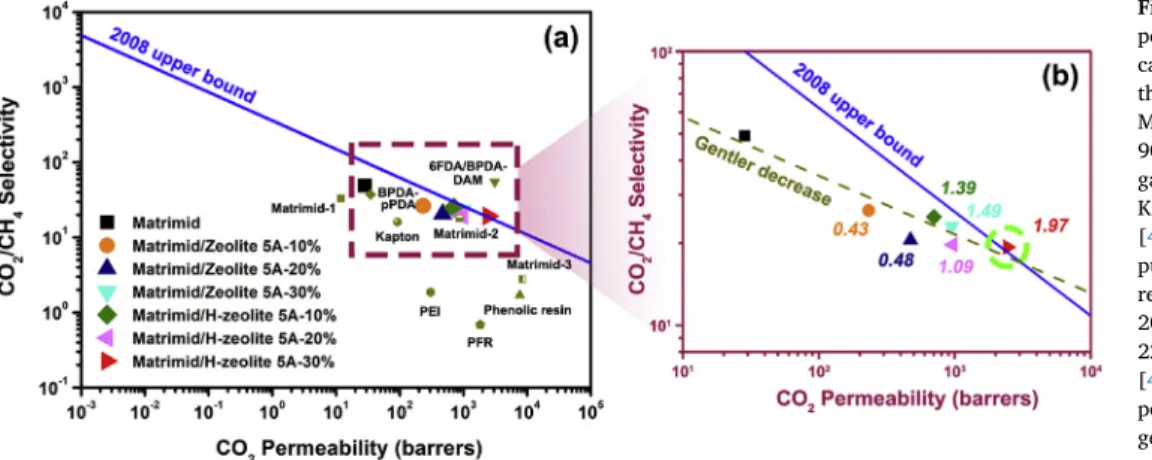
this claim, we carry out benchmarking analysis to evaluate the posi-tioning of our membranes performances (Fig. 5(a)). As observed in the literature, it is generally challenging for current performance of CMSMs to surpass the 2008 upper bound limit except for one that was derived from an in-house made 6FDA/BPDA-DAM polymer, which is costly to Fig. 4. Cross-sectionalfield emission-scanning electron microscope (FE-SEM) morphologies of carbon molecular sieve membranes with (a) 10 wt%, (b) 20 wt%, and (c) 30 wt% bulk zeolite 5A, as well as (d) 10 wt%, (e) 20 wt%, and (f) 30 wt% H-zeolite 5Afillers.
Table 1
Mixed gas permeation results measured at 35 °C and 1 bar upstream pressure (CO2/CH4= 50/50) and Findexvalues for Matrimid®precursor membrane as well as
unfilled Matrimid®and mixed-matrix carbon molecular sieve membranes.
Carbonization Membrane CO2permeabilitya(barrer) CO2/CH4selectivityb Findexc
Before Matrimid® 11 ± 0 36.7 ± 1.3 –
After Matrimid® 29 ± 1 49.2 ± 2.0 –
Matrimid®/Zeolite 5A-10% 233 ± 2 26.3 ± 0.3 0.43
Matrimid®/Zeolite 5A-20% 473 ± 19 20.5 ± 0.2 0.48
Matrimid®/Zeolite 5A-30% 951 ± 3 23.0 ± 0.2 1.49
Matrimid®/H-zeolite 5A-10% 704 ± 17 24.9 ± 0.5 1.39
Matrimid®/H-zeolite 5A-20% 967 ± 24 19.7 ± 0.1 1.09
Matrimid®/H-zeolite 5A-30% 2450 ± 40 19.3 ± 0.1 1.97
a 1 barrer = 10−10. ⋅ ⋅ ⋅ cmSTP cm cm S cmHg 3 2 b Ratio of CO
2permeability over CH4permeability.
c Based on statistical analysis of 470fillers in the literature, fillers having different F
indexvalues are classified into 5 labels, namely, 1: ideal (> 8.00), 2: exemplary
synthesize and has little commercial value. On the other hand, in this work, the Achilles heel of our mixed-matrix CMSMs is in the perme-ability-selectivity trade-off as presence of interfacial nanogaps tend to reduce the membrane selectivity up to afiller loading of 20 wt%. This impact, however, diminishes at 30 wt%filler loading. At this specific loading, the positive effect from the mesopores in H-zeolite 5A emerges and drives the performance of Matrimid®/H-zeolite 5A–30% to hit or slightly surpass the 2008 upper bound limit (Fig. 5(a)). In this regard, it is important to emphasize that, while our strategy is unable to com-pletely reverse the trade-off phenomenon, the strong enhancement in CO2 permeability by 30 wt% loading of H-zeolite 5A in the carbon
matrix is able to alleviate the intensity of the trade-off as exemplified by a gentler decrease in the performance of our CMSMs shown in the Robeson plot (dotted line inFig. 5(b)). Such an assessment would more accurately reflect the impact resulting from our strategy.
We also contemplated with the Findex as a means to measure the
effectiveness of our H-zeolite 5A when loaded at 30 wt% in the carbon matrix. The Findex is an empirical rating metric, which was recently
developed by our group to evaluatefiller effectiveness [27]. Owing to the fact that most mixed-matrix membranes have performances gov-erned strongly by the intrinsic separation properties of the polymer matrices, performance benchmarking by the Robeson upper bound is insufficient to showcase the filler effectiveness. Hence, we empirically arrive at a Findex, which downplays the matrix effect to highlight the
filler effectiveness. This is achieved by normalizing the permeability and selectivity terms as highlighted in eq(1). By taking into account both the permeability and selectivity enhancements, the Findexis aimed
at providing a single rating that can accurately measure the effective-ness of thefiller irrespective of the matrix it is incorporated into. The formula (eq(1)) has an extra weighting (designated asη) tagged on the selectivity enhancement term to emphasize the importance of up-holding the selectivity of mixed-matrix membranes as well as to credit fillers that are capable of enhancing membrane selectivity with a higher Findexvalue. In view of this, we calculated the Findexvalues of all
mixed-matrix CMSMs. Generally, the Findexvalues increase as membrane
per-formances approach the upper bound limit. When the performance of Matrimid®/H-zeolite 5A–30% exceeded the upper bound, the Findexgave
the highest value at 1.97 (Fig. 5(b)). This suggests that at 30 wt% loading the H-zeolite 5A is effective in elevating the performance of the CMSM despite experiencing a significant drop in the CO2/CH4
se-lectivity (Table 1). Based on our statistical analysis of 470fillers, a Findex
value of 1.97 would make H-zeolite 5A at 30 wt% loading eligible for the“competent” filler label while the bulk zeolite 5A or H-zeolite 5A at lower loadings could only settle for an inferior “moderate” label (Table 1) [27]. Accordingly, the two orders of magnitude enhancement in the CO2 permeability, enabled only by H-zeolite 5A at 30 wt%
loading, overwhelmingly nullify the negative impact brought by the
decrease in selectivity and compellingly push the Findexvalue into range
of“competent” filler label. 4. Conclusion
In this study, we have successfully demonstrated the strategy of filler design optimization with membrane carbonization to realize mixed-matrix carbon molecular sieve membranes incorporating hier-archical zeolite 5Afiller. The hierarchical filler not only possesses in-trinsic micropores but also mesopores of ∼8 nm to offer additional transport pathways to facilitate CO2diffusion through the carbon
ma-trix of the membranes. For these reasons, a strong enhancement in the CO2permeability of two order of magnitude was observed when 30 wt
% loading of the hierarchical zeolite 5Afiller was incorporated into the carbon molecular sieve membrane. Despite a decrease in the CO2/CH4
selectivity due to the presence of nanogaps at thefiller/matrix inter-faces, the mixed-matrix carbon molecular sieve membrane (Matrimid®/ H-zeolite 5A–30%) is still able to surpass the 2008 Robeson upper bound limit. Using a different benchmark, the hierarchical zeolite 5A filler at 30 wt% loading is also deemed “competent” based upon our analysis of a recently developedfiller enhancement index. Taken alto-gether, our strategy is both more cost-effective and less sophisticated in approach. In this regard, our mixed-matrix carbon molecular sieve membranes offer greater competitive advantages when compared to other carbon molecular sieve membranes such as those derived from high-permeable polymers like 6FDA-based and PIM-1 polymers. Again, this demonstrate that our strategy holds promise in realizing high-performance membranes for CO2/CH4separation.
Acknowledgement
This research is supported by the National Research Foundation, Prime Minister’s Office, Singapore, and the National Environment Agency Singapore, Ministry of the Environment and Water Resources -Singapore, under the Waste-to-Energy Competitive Research Programme (WTE CRP 1601 105). T. -H. Bae would like to thank KAIST for thefinancial support.
Appendix A. Supplementary data
Supplementary data to this article can be found online athttps:// doi.org/10.1016/j.memsci.2019.117220.
References
[1] A. Petersson, A. WeLLInGer, Biogas upgrading technologies–developments and in-novations, IEA Bioenergy 20 (2009) 1–19.
[2] K. Ghosal, B.D. Freeman, Gas separation using polymer membranes: an overview,
Fig. 5. (a) Robeson plot comparing CO2
permeabilities and CO2/CH4selectivities of
carbon molecular sieve membranes used in this work and those reported elsewhere. Matrimid®-1: 25 °C, 1 bar, CO2/CH4= 10/
90 [40]; Matrimid®-2: 35 °C, 10 bar, pure gas [41]; Matrimid®-3: 40 °C, pure gas [42]; Kapton®-1: 25 °C, 1 bar, CO2/CH4= 10/90
[40]; PEI (polyetherimide): 25 °C, 2 bar, pure gas [43]; PFR (phenol–formaldehyde resin): 20 °C, pure gas [44]; Phenolic resin: 20 °C, pure gas [45]; 6FDA/BPDA-DAM: 22 °C [46]; BPDA-pPDA: 25 °C, pure gas [47]. (b) The separation performances re-ported in this study, showing clearly a gentler decrease in the slope (dotted line), which suggests a trade-off of less intensity. The Findexvalues of our mixed-matrix carbon molecular sieve membranes are included here. It is interesting to note that as the membrane performances approach or
Polym. Adv. Technol. 5 (1994) 673–697.
[3] G. Maier, Gas separation with polymer membranes, Angew. Chem. Int. Ed. 37 (1998) 2960–2974.
[4] C.A. Scholes, G.W. Stevens, S.E. Kentish, Membrane gas separation applications in natural gas processing, Fuel 96 (2012) 15–28.
[5] R.W. Baker, K. Lokhandwala, Natural gas processing with membranes: an overview, Ind. Eng. Chem. Res. 47 (2008) 2109–2121.
[6] S. Basu, A.L. Khan, A. Cano-Odena, C. Liu, I.F. Vankelecom, Membrane-based technologies for biogas separations, Chem. Soc. Rev. 39 (2010) 750–768. [7] D. Bastani, N. Esmaeili, M. Asadollahi, Polymeric mixed matrix membranes
con-taining zeolites as afiller for gas separation applications: a review, J. Ind. Eng. Chem. 19 (2013) 375–393.
[8] L.M. Robeson, The upper bound revisited, J. Membr. Sci. 320 (2008) 390–400. [9] N. Jusoh, Y.F. Yeong, T.L. Chew, K.K. Lau, A.M. Shariff, Current development and
challenges of mixed matrix membranes for CO2/CH4separation, Separ. Purif. Rev.
45 (2016) 321–344.
[10] H.B. Park, C.H. Jung, Y.M. Lee, A.J. Hill, S.J. Pas, S.T. Mudie, E. Van Wagner, B.D. Freeman, D.J. Cookson, Polymers with cavities tuned for fast selective trans-port of small molecules and ions, Science 318 (2007) 254–258.
[11] R. Swaidan, X. Ma, E. Litwiller, I. Pinnau, High pressure pure- and mixed-gas se-paration of CO2/CH4by thermally-rearranged and carbon molecular sieve
mem-branes derived from a polyimide of intrinsic microporosity, J. Membr. Sci. 447 (2013) 387–394.
[12] Y. Zhang, J. Sunarso, S. Liu, R. Wang, Current status and development of mem-branes for CO2/CH4separation: a review, Int. J. Greenh. Gas Con. 12 (2013)
84–107.
[13] W.N.W. Salleh, A.F. Ismail, T. Matsuura, M.S. Abdullah, Precursor selection and process conditions in the preparation of carbon membrane for gas separation: a review, Separ. Purif. Rev. 40 (2011) 261–311.
[14] W.N.W. Salleh, A.F. Ismail, Effects of carbonization heating rate on CO2 separation of derived carbon membranes, Separ. Purif. Technol. 88 (2012) 174–183. [15] H. Gong, C.Y. Chuah, Y. Yang, T.-H. Bae, High performance composite membranes
comprising Zn(pyrz)2(SiF6) nanocrystals for CO2/CH4separation, J. Ind. Eng.
Chem. 60 (2018) 279–285.
[16] P.S. Goh, A.F. Ismail, S.M. Sanip, B.C. Ng, M. Aziz, Recent advances of inorganic fillers in mixed matrix membrane for gas separation, Separ. Purif. Technol. 81 (2011) 243–264.
[17] Z. Bing, S. Yi, Y. Wu, T. Wang, J. Qiu, Towards the preparation of ordered meso-porous carbon/carbon composite membranes for gas separation, Separ. Sci. Technol. 49 (2014) 171–178.
[18] L. Li, T. Wang, Q. Liu, Y. Cao, J. Qiu, A high CO2permselective mesoporous silica/
carbon composite membrane for CO2separation, Carbon 50 (2012) 5186–5195.
[19] X. Yin, N. Chu, J. Yang, J. Wang, Z. Li, Thin zeolite T/carbon composite membranes supported on the porous alumina tubes for CO2separation, Int. J. Greenh. Gas Con.
15 (2013) 55–64.
[20] P.S. Tin, T.-S. Chung, L. Jiang, S. Kulprathipanja, Carbon–zeolite composite mem-branes for gas separation, Carbon 43 (2005) 2025–2027.
[21] X. Yin, J. Wang, N. Chu, J. Yang, J. Lu, Y. Zhang, D. Yin, Zeolite L/carbon nano-composite membranes on the porous alumina tubes and their gas separation properties, J. Membr. Sci. 348 (2010) 181–189.
[22] C. Duan, X. Jie, H. Zhu, D. Liu, W. Peng, Y. Cao, Gas‐permeation performance of metal organic framework/polyimide mixed‐matrix membranes and additional ex-planation from the particle size angle, J. Appl. Polym. Sci. 135 (2018) 45728. [23] Y. Li, H.-M. Guan, T.-S. Chung, S. Kulprathipanja, Effects of novel silane
mod-ification of zeolite surface on polymer chain rigidmod-ification and partial pore blockage in polyethersulfone (PES)–zeolite A mixed matrix membranes, J. Membr. Sci. 275 (2006) 17–28.
[24] Y. Li, T.-S. Chung, C. Cao, S. Kulprathipanja, The effects of polymer chain rigidi-fication, zeolite pore size and pore blockage on polyethersulfone (PES)-zeolite A mixed matrix membranes, J. Membr. Sci. 260 (2005) 45–55.
[25] O. Bakhtiari, S. Mosleh, T. Khosravi, T. Mohammadi, Preparation, characterization and gas permeation of polyimide mixed matrix membranes, J. Membr. Sci. Technol. 1 (2011) 1–6.
[26] D. Sen, H. Kalipcilar, L. Yilmaz, Development of zeolitefilled polycarbonate mixed matrix gas separation membranes, Desalination 200 (2006) 222–224.
[27] C.Y. Chuah, K. Goh, Y. Yang, H. Gong, W. Li, H.E. Karahan, M.D. Guiver, R. Wang, T.-H. Bae, Harnessingfiller materials for enhancing biogas separation membranes, Chem. Rev. 118 (2018) 8655–8769.
[28] T.H. Nguyen, S. Kim, M. Yoon, T.H. Bae, Hierarchical zeolites with amine-func-tionalized mesoporous domains for carbon dioxide capture, ChemSusChem 9 (2016) 455–461.
[29] W. Li, S. Samarasinghe, T.-H. Bae, Enhancing CO2/CH4separation performance and
mechanical strength of mixed-matrix membrane via combined use of graphene oxide and ZIF-8, J. Ind. Eng. Chem. 67 (2018) 156–163.
[30] T.H. Bae, J.S. Lee, W. Qiu, W.J. Koros, C.W. Jones, S. Nair, A high‐performance gas‐separation membrane containing submicrometer‐sized metal–organic frame-work crystals, Angew. Chem. Int. Ed. 49 (2010) 9863–9866.
[31] N. Prasetya, A.A. Teck, B.P. Ladewig, Matrimid-JUC-62 and Matrimid-PCN-250 mixed matrix membranes displaying light-responsive gas separation and beneficial ageing characteristics for CO2/N2separation, Sci. Rep. 8 (2018) 2944.
[32] H. Gong, S.S. Lee, T.-H. Bae, Mixed-matrix membranes containing inorganically surface-modified 5A zeolite for enhanced CO2/CH4separation, Microporous
Mesoporous Mater. 237 (2017) 82–89.
[33] T.-H. Bae, J. Liu, J.A. Thompson, W.J. Koros, C.W. Jones, S. Nair, Solvothermal deposition and characterization of magnesium hydroxide nanostructures on zeolite crystals, Microporous Mesoporous Mater. 139 (2011) 120–129.
[34] C.Y. Chuah, S. Yu, K. Na, T.-H. Bae, Enhanced SF6 recovery by hierarchically structured MFI zeolite, J. Ind. Eng. Chem. 62 (2018) 64–71.
[35] M. Calle, Y.M. Lee, Thermally rearranged (TR) poly (ether− benzoxazole) mem-branes for gas separation, Macromolecules 44 (2011) 1156–1165.
[36] S.H. Han, N. Misdan, S. Kim, C.M. Doherty, A.J. Hill, Y.M. Lee, Thermally rear-ranged (TR) polybenzoxazole: effects of diverse imidization routes on physical properties and gas transport behaviors, Macromolecules 43 (2010) 7657–7667. [37] F. Weigelt, P. Georgopanos, S. Shishatskiy, V. Filiz, T. Brinkmann, V. Abetz,
Development and characterization of defect-free Matrimid® mixed-matrix mem-branes containing activated carbon particles for gas separation, Polymers 10 (2018) 51.
[38] M. Yoshimune, K. Haraya, Flexible carbon hollowfiber membranes derived from sulfonated poly(phenylene oxide), Separ. Purif. Technol. 75 (2010) 193–197. [39] A.F. Ismail, L. David, A review on the latest development of carbon membranes for
gas separation, J. Membr. Sci. 193 (2001) 1–18.
[40] A. Fuertes, D. Nevskaia, T. Centeno, Carbon composite membranes from Matrimid® and Kapton® polyimides for gas separation, Microporous Mesoporous Mater. 33 (1999) 115–125.
[41] Y. Xiao, Y. Dai, T.-S. Chung, M.D. Guiver, Effects of brominating Matrimid poly-imide on the physical and gas transport properties of derived carbon membranes, Macromolecules 38 (2005) 10042–10049.
[42] E. Favvas, G. Kapantaidakis, J. Nolan, A.C. Mitropoulos, N. Kanellopoulos, Preparation, characterization and gas permeation properties of carbon hollowfiber membranes based on Matrimid® 5218 precursor, J. Mater. Process. Technol. 186 (2007) 102–110.
[43] A.K. Itta, H.-H. Tseng, M.-Y. Wey, Effect of dry/wet-phase inversion method on
fabricating polyetherimide-derived CMS membrane for H2/N2separation, Int. J.
Hydrogen Energy 35 (2010) 1650–1658.
[44] W. Wei, G. Qin, H. Hu, L. You, G. Chen, Preparation of supported carbon molecular sieve membrane from novolac phenol–formaldehyde resin, J. Membr. Sci. 303 (2007) 80–85.
[45] T.A. Centeno, J.L. Vilas, A.B. Fuertes, Effects of phenolic resin pyrolysis conditions on carbon membrane performance for gas separation, J. Membr. Sci. 228 (2004) 45–54.
[46] M. Kiyono, P.J. Williams, W.J. Koros, Effect of pyrolysis atmosphere on separation performance of carbon molecular sieve membranes, J. Membr. Sci. 359 (2010) 2–10.
[47] A. Fuertes, T. Centeno, Preparation of supported asymmetric carbon molecular sieve membranes, J. Membr. Sci. 144 (1998) 105–111.