Thermodynamic Properties Lab
Department of Energy Chemical Engineering Kyungpook National University, Sangju
Campus
Thermodynamic Properties Lab
Department of Energy Chemical Engineering Kyungpook National University, Sangju
Campus
Chapter 14:
• The transformation of raw materials into products of greater value by means of chemical reaction is a major industry, and a vast array of commercial products is obtained by chemical
synthesis.
• Sulfuric acid, ammonia, ethylene, propylene, phosphoric acid, chlorine, nitric acid, urea, benzene, methanol, ethanol, and ethylene glycol are examples of chemicals produced in the United States in billions of kilograms each year.
These in turn are used in the large-scale manufacture of fibers, paints, detergents, plastics, rubber, paper, fertilizers, insecticides, etc.
• Clearly, the chemical engineer must be familiar with chemical-reactor design and operation.
• Both the rate and the equilibrium conversion of a chemical
reaction depend on the temperature, pressure, and
composition of reactants.
Lecture 1 2
• Consider, for example, the oxidation of sulfur dioxide to sulfur trioxide. A catalyst is required if a reasonable reaction rate is to be attained.
With a vanadium pentoxide catalyst the rate becomes appreciable at about 573.15 K (300°C) and continues to increase at higher temperatures.
On the basis of rate alone, one would operate the reactor at the highest practical temperature.
However, the equilibrium conversion to sulfur trioxide falls as temperature rises, decreasing from about 90% at 793.15 K (520°C) to 50% at about 953.15 K (680°C).
These values represent maximum possible conversions regardless of catalyst or reaction rate.
• The evident conclusion is that both equilibrium and rate must be considered in the exploitation of chemical reactions for commercial purposes.
Although reaction rates are not susceptible to thermodynamic treatment, equilibrium conversions are.
• Therefore, the purpose of this chapter is to determine the effect of
temperature, pressure, and initial composition on the equilibrium conversions of chemical reactions.
Lecture 1 3
Lecture 1 4
Chemical-Reaction Equilibria
Both the rate and equilibrium conversion of a chemical
reaction depend on the temperature, pressure, and
composition of reactants.
Although reaction rates are not susceptible to
thermodynamic
treatment,
equilibrium
conversions are.
The purpose of this lecture is to determine the effect
of temperature, pressure, and initial composition
on the equilibrium conversions of chemical
• Reaction stoichiometry is treated in Sec. 13.1 • reaction equilibrium, in Sec. 14.2.
• The equilibrium constant is introduced in Sec. 14.3,
• its temperature dependence and evaluation are considered in Secs. 14.4 and 14.5.
• The connection between the equilibrium constant and composition is developed in Sec. 14.6.
• The calculation of equilibrium conversions for single reactions is taken up in Sec. 14.7.
• In Sec. 14.8, the phase rule is reconsidered; • Multireaction equilibrium is treated in Sec. 14.9.
• finally, in Sec. 14.10 the fuel cell is given an introductory treatment.
A general chemical reaction:
positive (+)for products and negative (-)for reactants
the stoichiometric numbers are:
... ... 3 3 4 4 2 2 1 1 A v A v A v A v
14.1 Reaction coordinate
; stoichiometric coefficient Ai ; chemical formula. νi ; stoichiometric numbers 1 v (14.1)• The stoichiometric number for an inert species is zero.
• For the reaction represented by Eq. (14.1), the changes in the numbers of moles of the species present are in direct proportion to the stoichiometric numbers.
Thus for the preceding reaction, if 0.5 mol of CH4 disappears by reaction, 0.5 mol of H2O must also disappear; simultaneously 0.5 mol of CO and 1.5 mol of H2 are formed. 4 2 1( 0.5 ) 2( 1.5 ) ( 0.5) ( 1) ( 3) CH H dn dn d v v if
• Applied to a differential amount of reaction, this principle provides the equations:
• It has the advantage that the change in the extent of reaction dε is the same for each component,
whereas the changes in the number of moles dni are different for
different species taking part in the reaction.
• The general relation between a differential change dni in the number of moles of a reacting species and dε is therefore
• Equations (14.2) and (14.3) define changes in ε with respect to changes in the numbers of moles of the reacting species.
d v dn v dn v dn v dn ... 4 4 3 3 2 2 1 1 ) ..., , 2 , 1 (i N d v dni i
Reaction coordinate
(14.2) (14.3) i i i i n v n v 4 2 1( 0.5 ) 2( 1.5 ) ( 0.5) ( 1) ( 3) CH H dn dn d v v • Reaction coordinate ε ; characterizes the extent or degree to which a
reaction has taken place.
• The definition of ε itself is completed for each application by setting it equal to zero for the initial state of the system prior to reaction.
) ..., , 2 , 1 (i N d v dni i
Reaction coordinate
The νi are pure numbers without units; Eq. (14.3) therefore requires ε to be expressed in moles.
This leads to the concept of a mole of reaction, meaning a change in ε of one
mole.
When △ε = 1 mol, the reaction proceeds to such an extent that the change in mole number of each reactant and product is equal to its stoichiometric number.
i i i i n v n v (14.3) i i dn d v
Thus, integration of Eq. (14.3) from an initial unreacted state where ε = 0 and ni = ni0, to a state reached after an arbitrary amount of reaction gives:
Reaction coordinate
0 0 0 0 ( 1, 2, ..., ) ( 1, 2, ..., ) i i n i i n i i i i i i dn v d i N n n v n n v i N
0 0 i i i i i i n n n v n v 0 0 i i i i i total n n v n y n n v n ) ..., , 2 , 1 (i N d v dni i
(14.3)Summation over all species yields:
Thus the mole fractions yi of the species present are related to ε by:
(14.5) (14.4)
Example 14. 1 For a system in which the following reaction occurs,
assume there are present initially 2 mol CH4, 1 mol H2O, 1 mol CO and 4 mol H2. Determine expressions for the mole fractions yi as functions of ε.
2 3 1 1 1
i i 4 2 2 CH + H O CO + 3H
v n v n n n yi i i i 0 0 2 1 1 4 8 0 0
i i n n
2 8 2 4 CH y
2 8 1 CO y
2 8 1 2 O H y
2 8 3 4 2 H y The mole fractions of the species in the reacting mixture are seen to be functions of the single variable ε.
initially 4 2 2 CH + H O CO + 3H 0 8 2 n n v
0 i i i n n v CH4 H2O CO H2 ni0 2 1 1 4 νi -1 -1 1 3Example 14. 1_1 For a system in which the following reaction occurs,
assume there are present initially 3 mol CH4, 2 mol H2O. Determine expressions for the mole fractions yi as functions of ε.
2 3 1 1 1
i i
4 2 2 CH + H O CO + 3H
v n v n n n yi i i i 0 0 0 i0 3 2 0 0 5 i n
n 4 3 5 2 CH y
0 5 2 CO y
2 2 5 2 H O y
2 0 3 5 2 H y
The mole fractions of the species in the reacting mixtureare seen to be functions of the single variable ε. initially 4 2 2
CH + H O
CO + 3H
0 5 2 n n v
CH4 H2O CO H2 ni0 3 2 0 0 νi -1 -1 1 3 0 i i i n n v Example 14. 2 Consider a vessel which initially contains only n0 mol of water vapor. If decomposition occurs according to the reaction,
find expressions which relate the number of moles and the mole fraction of each
chemical species to the reaction coordinate ε.
2 1 2 1 1 1 i i 2 2 2 2 1 O H O H
v
n
v
n
n
n
y
i i i i
0 0 0 0 0 n n n i i
2 1 0 0 2 n n yH O 2 0 0 1 2 H y n 2 0 1 0 2 1 2 O y n 2 0 ( 1) H O n n 2 1 0 ( ) 2 O n 2 0 ( 1) H n 0 0 1 2 n n v n Fractional decomposition of water vapor is:2 0 0 0 0 0 0 ( ) H O n n n n n n n
when n0=1, ε is identified with the fractional decomposition of water vapor
0( 0) i i i n n n v 2 2 2 2 1 O H O H
Multi-reaction Stoichiometry
• Two or more independent reactions proceed simultaneously A separate reaction coordinate εj applies to each reaction.
The stoichiometric numbers are doubly subscripted to identify their association with both a species and a reaction.
νi,j : the stoichiometric number of species i in reaction j. • The change of the moles of a species ni:
j j j i i v d dn
,
i j i j , total stoichiometric number:
j j j i i i n v n 0
,
integration summation
0 , 0 , i i j j i j i i j j j in
n
v
n
v
j j j v n n 0
j j j j j j i i i v n v n y
0 , 0 i idn
v d
0 0 , i j i n i i j j n jdn
v d
) ..., , 2 , 1 ( 0 0 N i d v dn i n n i i i
cf; ) ..., , 2 , 1 ( 0 v i N n ni i i ( i = 1, 2, ... , N ) reaction index 0 , i i i j j n n v
(14.6) (14.7)Example 14.3 Consider a system in which the following reactions occur,
if there are present initially 2 mol CH4 and 3 mol H2O, determine expressions for the yi as functions of ε1 and ε2 .
2 2 4 H O CO 3H CH 2 2 2 4 2H O CO 4H CH j j j j j j i i i v n v n y
0 , 0 4 4 4 4 2 0 , ,1 1 ,2 2 1 2 0 1 1 2 2 1 ( 2 ) ( ) ( 2 3) ( ) i CH i j j CH CH j CH j j j n v v v y n v v v
(1) (2)
i j i j , 1 2 1 1 1 3 2 1 2 1 4 2 j i i j i i
0 i0 2 3 5 i n
n i CH4 H2O CO CO2 H2 j νj 1 -1 -1 1 0 3 2 2 -1 -2 0 1 4 2 2 1 2 12
2
5
2
4
CHy
2 1 2 1 2 2 5 2 3 2
O H y 2 1 1 2 2 5
CO y 2 1 2 2 2 5 2
CO y 2 1 2 1 2 2 5 4 3 2
Hy The composition of the system is a function of independent variables ε 1 and ε2. 2 2 2 2 2 0 , ,1 1 ,2 2 1 2 0 1 1 2 2 1
( 3
)
(
)
(
2
3)
(
)
i H O i j j H O H O j H O j j jn
v
v
v
y
n
v
v
v
2 2 4 H O CO 3H CH 2 2 2 4 2H O CO 4H CH Initially 2 mol CH4 ,3 mol H2O
2 1 2 1
2
2
5
2
4
CHy
i CH4 H2O CO CO2 H2 j νj 1 -1 -1 1 0 3 2 2 -1 -2 0 1 4 214.2 Application of Equilibrium criteria to chemical reactions
• The total Gibbs energy of a closed system at constant T and P must decrease during an irreversible process and that the condition for equilibrium is reached when Gt attains its minimum value.
Figure 14.1 The total Gibbs energy in
relation to the reaction coordinate =
ε εe
• Thus if a mixture of chemical species is not in chemical equilibrium,
any reaction that occurs at constant T and P must lead to a decrease in the total Gibbs energy of the system.
At this equilibrium state, (dGt)
14.2 Application of Equilibrium criteria to chemical reactions
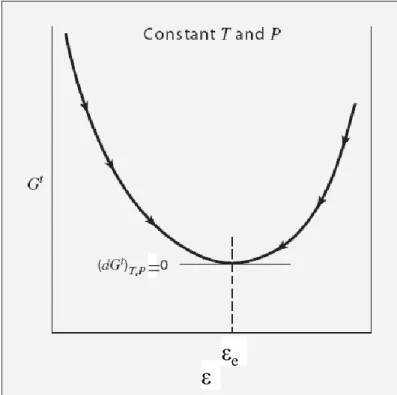
The significance of this for a single chemical reaction is seen in Fig. 14.1, which shows a schematic diagram of Gt vs. ε, the reaction
coordinate.
Since ε is the single variable that characterizes the progress of the reaction, and therefore the
composition of the system, the total Gibbs energy at constant T and P is determined by ε.
The arrows along the curve in Fig. 14.1 indicate the directions of changes in (Gt)
T,P
are possible on account of reaction.
(dGt)
T,P=0
Figure 14.1 The total Gibbs energy in
relation to the reaction coordinate
(14-64)
=
• The reaction coordinate has its equilibrium value εe, at the minimum of the curve.
The meaning of Eq. (14.64) is that differential displacements of the chemical reaction can occur at the equilibrium state without causing changes in the total Gibbs energy of the system.
• Figure 14.1 indicates the two distinctive features of the equilibrium state for given temperature and pressure:
▪ The total Gibbs energy Gt is a minimum. ▪ Its differential is zero.
dGt T,P 0 (14.64)=
Figure 14.1 The total Gibbs energy in
relation to the reaction coordinate
εe ε
• Each of these may serve as a criterion of equilibrium.
Thus, we may write an expression for Gt as
a function of ε and seek the value of ε which minimizes Gt,
or we may differentiate the expression,
equate it to zero, and solve for ε .
The latter procedure is almost always used for single reactions (Fig. 14.1), and leads to the method of equilibrium constants, as described in the following sections.
It may also be extended to multiple reactions, but in this case the direct minimization of Gt is often more convenient,
and is considered in Sec. 14.9.
Gt=f(), seek the value of ε which minimizes Gt
=
Figure 14.1 The total Gibbs energy in
relation to the reaction coordinate
ε εe
• Although the equilibrium expressions are developed for closed systems at constant T and P, they are not restricted in application to systems that are actually closed and reach equilibrium states along paths of constant T and P.
Once an equilibrium state is reached, no further changes occur, and the system continues to exist in this state at fixed T and P.
How this state was actually attained does not matter. Once it is known that an equilibrium state exists at given T and P, the criteria apply.
14.3 Standard Gibbs energy change and the equilibrium constant
i i idn dT nS dP nV nG d ( ) ( ) ( ) d v dni i
i i i d dT nS dP nV nG d ( ) ( ) ( ) 0 ) ( ) ( , ,
at equilibriu m P T t P T i i i G nG Equation (11.2), the fundamental property relation for single-phase systems, provides an expression for the total differential of the Gibbs energy:
(11.2)
Since nG is a state function, the right side of this equation is an exact differential expression
• Thus the quantity ∑νiμi represents, in general, the rate of change of the total Gibbs
energy of the system with the reaction coordinate at constant T and P.
• Figure 14.1 shows that this quantity is zero at the equilibrium state. • A criterion of chemical-reaction equilibrium is therefore:
0 i i i
i i n T P i n P n T dn n nG dT T nG dP P nG nG d j , , , , ) ( ) ( ) ( ) ( (14.8)The fugacity of a species in solution:
i i
i
(
T
)
RT
ln
f
ˆ
For pure species i in its standard state: o
i i o i
T
RT
f
G
(
)
ln
o i i o i i f f RT G ˆ ln 0
i i i 0
ˆ
ln
i o i i o i if
f
RT
G
ˆ
ln
0
i v o i i i o i i if
G
RT
f
RT G f f i i io i v o i i i
ˆ ln K f f i v o i i i
ˆ( −
ˆ ln( ) 0 o o i i i i G RT f f
3 1 2 3 1 2 1 2 3 ˆ ln 0 ˆ ln ˆ ˆ ˆ ln ln ln i i v o i i i o i i i o v i i i i o i i v v v o o o f G RT f G f f RT f f f f f f ˆ ln( ) o o i Gi RT f fi ˆ ln i v i o i i f f ˆ exp exp i o v i i o i i o i i G f G K f RT RT
(14.9) (11.42) (14.10) 0 0 0 i i i G G G
(14.12) (14.11a) ln o G K RT (14.11b)• Since Gio is a property of pure species i in its standard state at fixed pressure, it depends
only on temperature.
By Eq. (14.12) it follows that ∆Go and hence K, are also functions of temperature only.
• In spite of its dependence on temperature, K is called the equilibrium constant for the reaction; ∑νi Gio, represented by ∆Go , is called the standard Gibbs-energy change of
reaction.
• The fugacity ratios in Eq. (14.10) provide the connection between the equilibrium state
of interest and the standard states of the individual species, for which data are presumed
available, as discussed in Sec. 14.5.
• The standard states are arbitrary, but must always be at the equilibrium temperature T.
The standard states selected need not be the same for all species taking part in a reaction.
However, for a particular species the standard state represented by Gio must be the
same state as for the fugacity fio.
o o o i i i i i G G G
(14.10) (14.12) K f f i v o i i i
ˆ ˆ exp exp i o v i i o i i o i i G f G K f RT RT
• The function ∆Go =∑ν
i Gioin Eq. (14.12) is the difference between the Gibbs energies
of the products and reactants (weighted by their stoichiometric coefficients) when each
is in its standard state as a pure substance at the standard-state pressure, but at the
system temperature.
Thus the value of ∆Go is fixed for a given reaction once the temperature is
established, and is independent of the equilibrium pressure and composition.
Other standard property changes of reaction are similarly defined. Thus, for the
general property M: o o o i i i i i G G G
(14.12) o o i i i M M
• In accord with this, △Hois defined by Eq. (4.14) and △Cpo; by Eq. (4.16).
• These quantities are functions of temperature only for a given reaction, and are related to one another by equations analogous to property relations for pure species.
• For example, the relation between the standard heat of reaction and the standard Gibbs energy change of reaction may be developed from Eq. (6.39) written for species i in its standard state: dT RT G d RT H o i o i 2 dT RT G d RT H i o i i i o i i
2 o o i i i H H
i o o P i P i C C
Multiplication of both sides by vi and summation over all species RT G K o exp
dT
RT
G
d
RT
H
i o i i i o i i
2
dT
RT
G
d
RT
H
o o
2dT
K
d
RT
H
oln
2
0 lnK G RT (14.13) o o i i i M M
o o i i i H H
o o i i i G G
,14.4 Effect of Temperature on the Equilibrium Constant
dT RT G d RT H o o 2 dT K d RT H o ln 2 • Equation (14.14) gives the effect of temperature on the equilibrium constant, and hence on the equilibrium conversion.
• If ∆Ho is negative, i.e., if the reaction is exothermic, the equilibrium constant
decreases as the temperature increases.
• Conversely, K increases with T for an endothermic reaction.
• If ∆Ho, the standard enthalpy change (heat) of reaction, is assumed
independent of T,
integration of Eq. (14.14) from a particular temperature T' to an arbitrary temperature T leads to the simple result:
(14.15)
(14.14)
• Since the standard-state temperature is that of the equilibrium mixture, the standard property changes of reaction, such as △G˚ and △H˚, vary with the equilibrium temperature. The dependence of △G˚ on T is given by Eq. (14.13)
(14.13)
2 o o G d H RT dT RT 0 lnK G RT 2 ' ' 1 1 ln , ln ' ' o o K T K T H dT K H d K R T K R T T
14.4 Effect of Temperature on the Equilibrium Constant ' ' 1 1 ln o K H K R T T
• This approximate equation implies that a plot of In K vs. the reciprocal of absolute
temperature is a straight line.
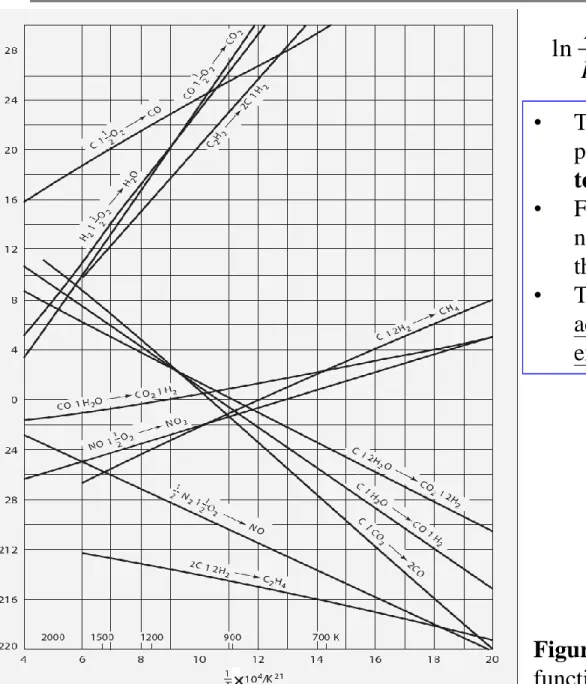
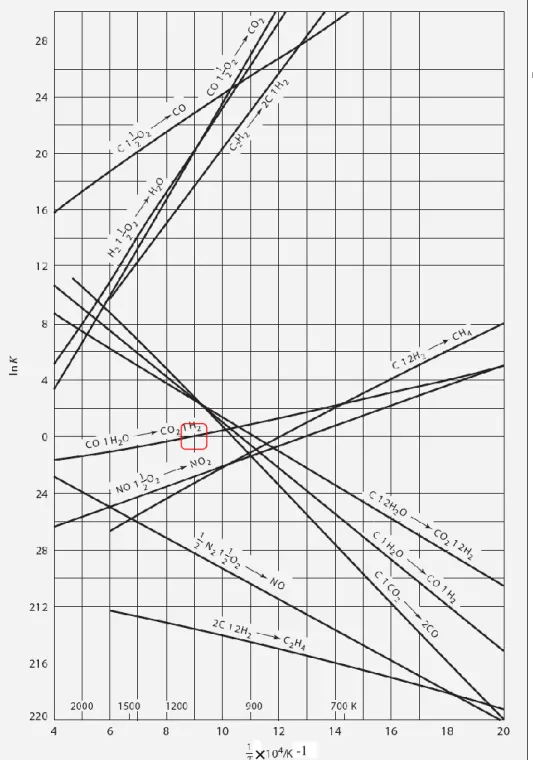
• Figure 14.2, a plot of In K vs. 1/T for a number of common reactions, illustrates this near linearity.
• Thus, Eq. (14.15) provides a reasonably accurate relation for the interpolation and extrapolation of equilibrium-constant data.
(14.15)
×
Figure 14.2 Equilibrium constants as a function of temperature
o i o i o i
H
TS
G
i
i i io o i i i o i iG
H
T
S
o o o S T H G and summation
T T o P o o dT R C R H H 0 0
T T o P o o T dT R C R S S 0 0 0 0 0 0 T G H S o o o
0 0 0 0 0 0 0 0 0 0 0 0 0 0 ( ) o o o o o T T o P o P T T o o T T o o P P T T o o T T o o o P P T T G H T S C C dT H R dT T S R R R T C C dT H T S R dT RT R R T C C T dT H H G R dT RT T R R T
• The rigorous development of the effect of temperature on the equilibrium constant is based on the definition of the Gibbs energy, written for a chemical species in its standard state: Multiplication by νi (4.18) P P dT V dS C dP T T
At const. std. state pressure Po
o o o S T H G (14.18) (6-21) (14.17)
0 0 0 0 0 0 o o T T o o o o P P T T T C C dT G H H G R dT RT T R R T
0 0 0 0 0 01
o o o o o o T T P P T TG
G
H
H
C
C
dT
dT
RT
RT
RT
T
R
R
T
1 ; RT 0 IDCPH(T0,T;DA,DB,DC,DD) o T P T C dT R
0 2 0 0 2 2 0 1 ln ( 1) 2 T P T C dT D A BT CT R T T
0 IDCPS(T0,T;DA,DB,DC,DD) o T P T C dT R T
(14-18) 0 2 2 3 3 0 0 0 0 1 ( ) ( 1) ( 1) ( 1) 2 3 T P T C B C D dT A T T T R T
0 , , , i i i T T A A B C and D
Thus △GO/RT(=-InK) as given by Eq. (14.18) is readily calculated at any
temperature from the standard heat of reaction and the standard Gibbs-energy change of reaction at a reference temperature [usually 298.15 K (25˚C)], and from two functions which can be evaluated by standard computational procedures.
0 0 0 0 0 0 o o T T o o o o P P T T T C C dT G H H G R dT RT T R R T
RT G K o ln Readily calculated at any temperature from the standard heat of reaction
and the standard Gibbs energy change of reaction at a reference temperature.
2 1 0
K
K
K
K
0 0 0 exp RT G K o T T RT H K o 0 0 0 1 exp 1 T T o P T T o P T dT R C dT R C T K 0 0 1 exp 2 0 0 0 0 0 0 0 0 0 0 0 0 0 0 0 0 0 0 0 0 0 1 0 0 0 ln ln 1 ln 1 o o o o o o T T P P T T o o o o o o o o o o T T T P P P T T T G H T H T G R C RT C dT K dT RT RT RTT RTT RT R RT R T T G G K RTT RT H T H H H H T K RT RTT RT RT RT T R C RT C dT C dT dT RT R RT R T T R
0 ln 2 o T P T C dT K R T
• The first factor K0 represents the equilibrium constant at reference temperature T0
• The second factor K1 is a multiplier that supplies the major effect of temperature, such that the product K0Kl is the equilibrium constant at temperature T when the heat of reaction is assumed independent of temperature
• The third factor K2 accounts for the much smaller temperature influence resulting from the change of ∆Ho with temperature:
0 1 2 ln ln ln ln K K K K 1 ; RT
Figure 14.2 Equilibrium constants as a function of temperature
• Values of ∆Go for many formation reactions are tabulated in standard reference.
• The reported values of ∆Go
f not measured experimentally, but are calculated by
Eq. (14.16).
• The determination of ∆So
f ; may be based on the third law of thermodynamics,
discussed in Sec. 5.10.
Combination of values from Eq. (5.40) for the absolute entropies of the species taking part in the reaction gives the value of ∆So
f.
Entropies (and heat capacities) are also commonly determined from statistical calculations based on spectroscopic data.
14.5 Evaluation of Equilibrium Constant
o o o
S
T
H
G
• Values of ∆Go
f298 or a limited number of chemical compounds are listed in
Table C.4 of App. C.
These are for a temperature of 298.15 K (25℃), as are the values of
∆Ho
f298 listed in the same table.
• Values of ∆Go for other reactions are calculated from formation-reaction
values in exactly the same way that ∆Ho values for other reactions are
determined from formation-reaction values (Sec. 4.4). • In more extensive compilations of data, values of ∆Go
f and ∆Hof are given
for a wide range of temperatures, rather than just at 298.15 K (25°C).
Where data are lacking, methods of estimation are available; these are reviewed by Reid, Prausnitz, and Poling.
14.5 Evaluation of Equilibrium Constant
o o o
S
T
H
G
Example 14.4 Calculation the equilibrium constant for the vapor-phase hydration of ethylene at 145 and at 320 °C from data given in App.C.
2 4 2 2 5
C H +H O C H OH
The heat capacity data:
2 1 0
K
K
K
K
C2H5OH
C2H4
H2O
0 0 0 exp RT G K o T T RT H K o 0 0 0 1 exp 1
T T o P T T o P T dT R C dT R C T K 0 0 1 exp 2 From Table C.4 mol J H H0o 298o 45792 mol J G G0o 298o 8378 T K0 K1 K2 K 298.15 29.366 1 1 29.366 418.15 29.366 4.985x10⁻³ 0.986 1.443x10⁻¹ 593.15 29.366 1.023x10⁻⁴ 0.9794 2.942x10⁻³ RT G K o ln 0 0 0 exp RT G K o T T RT H K o 0 0 0 1 exp 1
T T o P T T o P T dT R C dT R C T K 0 0 1 exp 2 RT G K o ln 2 1 0K
K
K
K
△H = △H -(△H + △H )
O R O f, C2H5OH O f, C2H4 O f, H2OC
2H
4(g) + H
2O(g) =>C
2H
5OH(g)
0 0 0 0 0 01
o o o o o o T T P P T TG
G
H
H
C
C
dT
dT
RT
RT
RT
T
R
R
T
Lecture 1 35 0 0 0 0 0 0
1
o o o o o o T T P P T TG
G
H
H
C
C
dT
dT
RT
RT
RT
T
R
R
T
RT G K o lnFor T=418.15 K 0 0 0 0 0 0 1 o o o o o o T T P P T T G G H H C C dT dT RT RT RT T R R T
0 2 0 0 2 2 0 1 ln ( 1) 2 T P T C dT D A BT CT R T T
0 2 2 3 3 0 0 0 0 1 ( ) ( 1) ( 1) ( 1) 2 3 T P T C B C D dT A T T T R T
0 IDCPH(T0,T;DA,DB,DC,DD) o T P T C dT R 0 IDCPS(T0,T;DA,DB,DC,DD) o T P T C dT R T RT G K o lnLecture 1 37 RT G K o ln 0 0 0 0 0 0 1 o o o o o o T T P P T T G G H H C C dT dT RT RT RT T R R T
For T=593.15 KLecture 1 38 0 0 0 exp RT G K o 0 0 1 0 0 3 exp 1 , 1 exp{ 18.473 * (1 )} 1.4025 4.98401 * 10 o H T T K RT T T 0 0 2 1 exp 1 { ( 23.121) exp 418.15 ( 0.06924)} 0.9860 o T P T o T P T C dT T R K C dT R T
For T=418.15 K 0 1 2 3 1 29.366 4.985 * 10 0.9860 1.443 10 K K K K Gas phase reaction:
• The standard state for a gas is the ideal-gas state of the pure gas at the standard-state pressure Po of 1 bar.
Since the fugacity of an ideal gas is equal to its pressure, fio=Po for each species i .
Thus for gas-phase reactions
• The equilibrium constant K is a function of temperature only. However, Eq. (14.25) relates K to fugacities of the reacting species as they exist in the real equilibrium mixture.
These fugacities reflect the nonidealities of the equilibrium mixture and are functions of temperature, pressure, and composition.
This means that for a fixed temperature the composition at equilibrium must change with pressure in such a way that remains constant.
K f f i v o i i i
ˆ o o iP
f
K P f i v o i i
ˆ fˆ i ˆi yiP
i i 14.6 Relation of Equilibrium Constants to Composition
ˆ o ˆ o i i i f f f P (14.25)
ˆ / o
vi i i f P K 40 K f f i v o i i i
ˆ o o iP
f
K P f i v o i i
ˆ fˆ i ˆi yiP
ˆ ˆ ˆ i i i i i v v v v v i i i i o o o o i i i v i i o i y P y P P P K where P P P P P y K P
i i (14.25)K f f i v o i i i
ˆ o o iP
f
K P f i v o i i
ˆ fˆ i ˆi yiP
K P P y o i v i i i
ˆ
i i An ideal solution: ˆi i
K P P y o i v i i i
An ideal gas: ˆ i 1
K P P y o i v i i
f (T) f (P) f (composition)• The yi's may be eliminated in favor of the equilibrium value of the reaction coordinate εe,. Then, for a fixed temperature Eq. (14.26) relates εe, to P.
• In principle, specification of the pressure allows solution for εe.
However, the problem may be complicated by the dependence of on composition, i.e., on εe,. The methods of Secs. 11.6 and 11.7 can be applied to the calculation of values, for example,
by Eq. (11.61).
Because of the complexity of the calculations, an iterative procedure, initiated by setting = 1 and formulated for computer solution, is indicated.
Once the initial set {yi }is calculated, { } is determined, and the procedure is repeated to convergence. (14.26) ˆ i ˆ i ˆ i (2 ) 2 1 ˆ ln ik ij i j j i kk k B y y RT P
• Each φi for a pure species can be evaluated from a generalized correlation once the equilibrium T
and P are specified.
• For pressures sufficiently low or temperatures sufficiently high, the equilibrium mixture behaves essentially as an ideal gas.
ˆ i
• According to Eq. (14.14), the effect of temperature on the equilibrium constant K is determined by the sign of ∆Ho . Thus when ∆Ho is positive, i.e., when the standard
reaction is endothermic, an increase in T results in an increase in K.
• Equation (14.28) shows that an increase in K at constant P results in an increase in
; this implies a shift of the reaction to the right and an increase in εe.
• Conversely, when ∆Ho is negative, i.e., when the standard reaction is exothermic, an
increase in T causes a decrease in K and a decrease in at constant P. This
implies a shift of the reaction to the left and a decrease in εe.
• If the total stoichiometric number ν (≡Σ νi) is negative, Eq. (14.28) shows that an
increase in P at constant T causes an increase in , implying a shift of the reaction to the right and an increase in εe.
• If ν is positive, an increase in P at constant T causes a decrease in , a shift of the reaction to the left, and a decrease in εe.
Lecture 1 42 dT K d RT H o ln 2 vi i i y vi i i y vi i i y vi i i y
K P P y o i v i i
f (T) f (P) f (composition) (14.28) (14.14) RT G K o ln• Liquid phase reaction:
K f f i v o i i i
ˆ fi ixi fi ˆ K f f x i v o i i i i i
o i i P P i o i i f f RT dP V G G
o ln
RT P P V f f i o o i i ln
i exp
o v i i i i i i P P x K V RT
Except at high pressures
x
K i v i i i
Ideal solution
x K i v i i
Law of mass action(14.10) P y fˆ i ˆi i cf. 1 2 1 2 N N a a a a a a
e
e
e
e
1 1 exp( ) exp N N i i i i a a
exp exp exp exp i i i i i v o i i i i v o v i i i i i v o o v i i i i i i i i V P P x K RT V P P x K RT V P P V P P x K K RT RT Lecture 1 44
14.7 Equilibrium conversions for single reactions
Single reaction in a homogeneous system:
assuming an ideal gas and the equilibrium constant is known:
assuming an ideal solution and the equilibrium constant is known:
the phase composition at equilibrium can be obtained
K P P y o i v i i
x K i v i i
Example 14. 5 The water-gas-shift reaction, is carried out under the different sets of conditions described below. Calculate the fraction of steam reacted in each case. Assume the mixture behave as an ideal gas.
2 2
2O CO H
H
CO
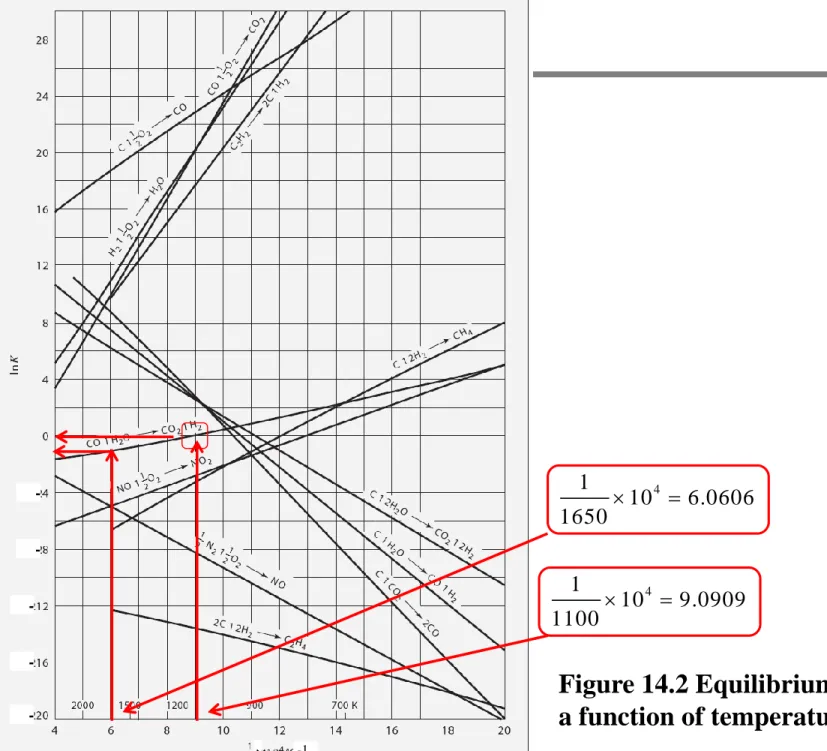
(a) the reactant consists of 1 mol of H2O vapor and 1 mol of CO, T = 1100 K, P = 1 bar From Fig 14.2, K = 1
K P P y o i v i i
0
i i
2 2 2 1 i v H CO i i CO H O y y y K y y
v n v n n n yi i i i 0 0 2 1 e CO y
2 2 e CO y
2 1 2 e O H y
2 2 e H y
0.5 e
2 2 2 2 1 1 1 (1 ) 2 2 e e e e e e From Fig 14.2, lnK = 0 or K=1. i 1 1 1 1 0 i
the reaction mixture is as an ideal gas, Eq. (14.28)
2 2 2 1 i v H CO i i CO H O y y y K y y
Figure 14.2 Equilibrium constants as a function of temperature 4 1 10 9.0909 1100 4 1 10 6.0606 1650 × -1
-2 2 2O CO H H CO From Fig 14.2, K = 1
K P P y o i v i i
0
i i
2 2 2 1 i v H CO i i CO H O y y y K y y
(b) the same as (a) except that the pressure is 10 bar
Since v = 0, the increase in pressure has no effect on the ideal gas reaction:
e 0.5 (c) the same as (a) except that 2 mol of N2 is included in the reactantsSince N2 does not take part in the reaction and serves as a diluent: Increasing the initial number of moles n0 from 2 to 4.
5 . 0 e
1 4 e CO y 2 4 e CO y 2 1 4 e H O y 2 4 e H y 2 2 2 1 i v H CO i i CO H O y y y K y y 2 2 2 2 2 4 4 1 1 1 (1 ) 4 4 e e H CO e e e CO H O e y y y y (d) the reactants are 2 mol of H2O and 1 mol of CO. other conditions are the same as (a)
v n v n n n yi i i i 0 0 3 1 e CO y
3 2 e CO y
3 2 2 e O H y
3 2 e H y
667 . 0 e The fraction of steam that reacts is then 0.667 / 2 = 0.333(e) the reactants are 1 mol of H2O and 2 mol of CO. other conditions are the same as (a)
v n v n n n yi i i i 0 0 3 2 e CO y
3 2 e CO y
3 1 2 e O H y
3 2 e H y
667 . 0 e The fraction of steam that reacts is then 0.667/1=0.667(f) the initial mixture consists of 1 mol of H2O, 1 mol of CO and 1 mol of CO2 . other conditions are the same as (a)
v n v n n n yi i i i 0 0 3 1 e CO y
3 1 2 e CO y
3 1 2 e O H y
3 2 e H y
333 . 0 e The fraction of steam that reacts is then 0.333/1=0.333
2 1 (1 )(2 ) e e e 2 1 (2 )(1 ) e e e 2 (1 ) 1 (1 ) e e e 2 2 2O CO H H CO 2 2 2O CO H H CO
(g) same as (a) except that the temperature is 1650 K At 1650 K, 104/T=6.0606 K = 0.316, From Fig 14.2, ln K=-1.15 or K=0.316
K P P y o i v i i
0
i i 316 . 0 2 2 2 O H CO CO H y y y y
v n v n n n yi i i i 0 0 2 1 e CO y
2 2 e CO y
2 1 2 e O H y
2 2 e H y
0.36 e The reaction is exothermic, and conversion decreases with increasing temperature.
2 2 2 2 0.316 1 1 (1 ) 2 2 e e e e e e
Example 14.6 Estimate the maximum conversion of ethylene to ethanol by vapor
phase hydration at 250°C and 35 bars for an initial steam-to-ethylene ratio of 5. For a temperature of 250°C, K = 10.02 x 10⁻³
K P P y o i v i i i
ˆAssuming the reaction mixture is an ideal solution.
i i ˆ OH H C O H H C2 4 2 2 5 1
i i ) 10 02 . 10 ( 3 2 2 4 2 4 2 o O H O H H C H C EtOH EtOH P P y y y Tc /K Pc /bar ω Tri Pri B0 B1 φ i C2H4 282.3 50.40 0.087 1.853 0.694 -0.074 0.126 0.977 H2O 647.1 220.55 0.345 0.808 0.159 -0.511 -0.281 0.887 EtOH 513.9 61.48 0.645 1.018 0.569 -0.327 -0.021 0.827 ) 10 02 . 10 ( 1 35 ) 887 . 0 ( ) 977 . 0 ( ) 827 . 0 ( 3 2 4 2 2 2 4 2 4 2 O H H C EtOH O H O H H C H C EtOH EtOH y y y y y y e e H C y
6 1 4 2
v n v n n n yi i i i 0 0 e e O H y
6 5 2 e e EtOH y
6
e 0.233 (14.26)The equilibrium conversion is a function of temperature, pressure, and the steam-to-ethylene ratio in the feed:
Example 14. 7 In a laboratory investigation, acetylene is catalytically hydrogenated
to ethylene at 1120 °C and 1 bar. If the feed is an equilmolar mixture of acetylene and hydrogen, what is the composition of the product stream at equilibrium?
2 2 2H 2C H C 4 2 2 2 2C H C H 4 2 2 2 2H H C H C o II o I o G G G RT G K o ln II I RT K K RT K RT ln ln ln