Cases of outbreaks caused by COVID-19 variants in the Republic of Korea
In December 2020, the UK variant of concern (VOC) of SARS-CoV-2, the virus that causes COVID-19, was first identified in an international traveler entering South Korea. Thereafter, 162 cases of VOCs occurred and 5 cases of VOCs in cluster outbreaks were confirmed as of March 1, 2021. Detailed epidemiological investigations were conducted for 3 outbreaks. The purpose of this report was to describe the transmission pathways and epidemiological relationships between groups, and to present the results of contact follow-up management. On the basis of this report, it is recommended to respond proactively to the occurrence of confirmed patients in groups with a high risk of having VOCs and to establish measures to prevent spread in the local community.
Keywords: COVID-19, Variant, inflow from abroad
Eun-Young Kim1, Shin Young Park1, Seon-Young Lee1, Jeong-Hee Yu1, Hyunju Lee2, Boyeong Ryu2, Se-Jin Jeong2, Mi Gyeong Ji2, Na-young Kim3, Junghee Hyun3, Miyoung Kim3, Youngman Kim4, YoungJoonPark4,*
1Honam Regional Center for Disease Control and Prevention,
2Gyeongnam Regional Center for Disease Control and Prevention,
3Capital Regional Center for Disease Control and Prevention,
4Epidemic Investigation Team, Epidemiological Investigation and Analysis Task Force, Korea Disease Control and Prevention
Agency (KDCA)
Introduction
The variants of the severe acute respiratory syndrome coronavirus 2 (SARS-CoV-2) reported in the United Kingdom, South Africa, and Brazil between December 2020 and January 2021 are reported to differ from non-mutant forms of SARS-CoV-2 in terms of transmissibility and immune response. Countries throughout the world are strengthening the monitoring and management of SARS-CoV-2 variants [1,2].
In South Korea, in order to minimize imported cases and locally transmitted cases, strengthened measures have been implemented, including expanded virus monitoring for individuals traveling from abroad, stricter quarantine, enhanced infection management within treatment facilities for individuals
confirmed to have a variant of concern (VOC), and an expanded range of contact investigation and testing [3].
The variant originating from the United Kingdom (501Y.V1) was first detected in an individual entering South Korea from abroad in December 2020, and a total of 162 cases have since been confirmed as of March 1, 2021 [4]. As of January 2021, the VOC patients confirmed in South Korea were 5 cohabitating family members of the imported case. A locally transmitted VOC case was confirmed in a local contact outside of the cohabitating family members on February 1, 2021; therefore, to reduce additional local transmissions, the transmission route and contacts were re-investigated, and VOC monitoring was strengthened in the locations where infections occurred in order to understand the extent of the spread.
This report was prepared for use as reference material for epidemiological investigations and responses to future VOC cluster infections.
Study participants and methods
VOC patients are defined as those who were confirmed to have the UK variant (501Y.V1), the South African variant (501Y. V2), or the Brazilian variant (501Y.V3) based on SARS-CoV-2 whole-genome sequencing [1]. The study participants were drawn from 3 clusters of VOC infections that underwent detailed epidemiological investigations among the 5 clusters that had been identified in South Korea as of March 1. Patients were included in the same cluster if there was a history of contact in terms of time and space during the window of transmission of a previously confirmed case based on an epidemiological investigation of the date of symptom onset and activities of each confirmed case [5]. Among patients in a cluster, a confirmed case of VOC refers to a case when a VOC was confirmed through laboratory analysis, and an epidemiologically related case refers to a case with a confirmed history of contact with a confirmed case of VOC in
the absence of any other epidemiologically possible source of infection despite the lack of confirmation through a laboratory analysis.
Results
The epidemiological pattern, transmission routes, and results of strengthened community monitoring of 3 VOC clusters confirmed as of March 1, 2021 were investigated.
1. Epidemiological patterns
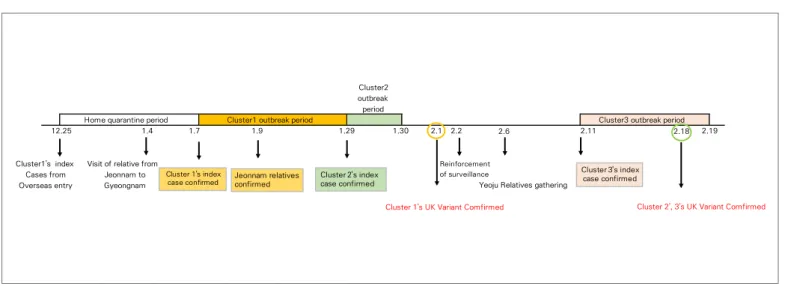
The index patient of cluster 1 was a foreign national who entered South Korea from abroad on December 25, 2020 and was confirmed in a test conducted before release from quarantine on January 7, 2021 (Figure 1). A total of 38 patients were recorded until January 29, 2021, including family members who lived in Jeonnam and visited the home of the index patient during the quarantine period. The index patient of cluster 2 was a foreign national who lived in Siheung-si, Gyeonggi-do, and was confirmed on January 29. Contact tracing of this index patient
2.6 2.18
Cluster 1's UK Variant Comfirmed
Yeoju Relatives gathering Cluster1's index
Cases from Overseas entry
Visit of relative from Jeonnam to Gyeongnam Cluster2 outbreak period 1.30 2.1 2.2 2.11
Home quarantine period Cluster1 outbreak period Cluster3 outbreak period
12.25 1.4 1.7 1.9 1.29 2.19
Cluster 2', 3's UK Variant Comfirmed
Reinforcement of surveillance Cluster 1's index case confirmed Cluster 3's index case confirmed Jeonnam relatives
confirmed Cluster 2's index case confirmed
resulted in 8 cases by January 30. The index patient of cluster 3 was a foreign national residing in Yeoju, Gyeonggi-do, who tested positive on February 10 while living in Jeonnam. By February 23, a total of 31 confirmed cases related to a family gathering on February 6 were reported. As a result of strengthened community monitoring of VOC, the UK variant (501Y1.V1) was confirmed on February 18, which was 3 days after the last case in cluster 1, 19 days after the last case in cluster 2, and 8 days after the first case in cluster 3. In all 3 clusters, transmission occurred through family gatherings of foreign residents. Most (over 95%) of the confirmed cases were foreign nationals of a single nationality. In addition to transmission routes within each cluster, transmission routes between clusters were also investigated.
2. Transmission routes
A. Cluster 1 (gathering of foreign relatives in Gyeongnam/ Jeonnam)
While the index patient was in quarantine, family members who lived in Jeonnam visited and met with cohabitating family
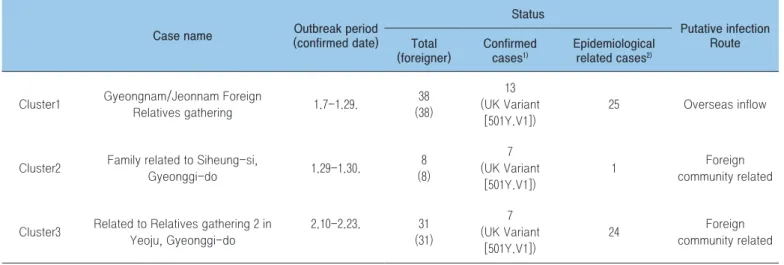
members of the index patient. After the visit, the visitors and other family members in Jeonnam tested positive. The index patient was a foreign resident and was quarantined at home (second floor of a house) after receiving a negative polymerase chain reaction test conducted at entry. The patient reported that there was no direct contact with family members, but the indoor space was not separated, and exposure between family members was suspected, since the cohabiting and visiting family members tested positive. The VOC-confirmed foreign patients in Gyeongnam/Jeonnam did not have a history of traveling since December and worked in the automobile parts and scrap vehicle export industry. Among 38 cases related to the gathering of the relatives of the foreign resident in Gyeongnam/Jeonnam, 13 were confirmed cases of VOC, and 25 were epidemiologically related cases (Table 1).
B. Cluster 2 (family members in Siheung-si, Gyeonggi-do)
The index patient was a foreign national residing in Siheung-si, Gyeonggi-do, who tested positive on January 29, 2021 (Figure 1). Through contact tracing, 7 family members additionally tested positive, resulting in 8 cases. The patients in this cluster were of
Table 1. Status of variants identification among clusters (as of March 21, 2021)
Case name (confirmed date)Outbreak period
Status Putative infection Route Total (foreigner) Confirmed cases1) Epidemiological related cases2)
Cluster1 Gyeongnam/Jeonnam Foreign
Relatives gathering 1.7-1.29. 38 (38) 13 (UK Variant [501Y.V1]) 25 Overseas inflow
Cluster2 Family related to Siheung-si,
Gyeonggi-do 1.29-1.30. 8 (8) 7 (UK Variant [501Y.V1]) 1 Foreign community related
Cluster3 Related to Relatives gathering 2 in Yeoju, Gyeonggi-do 2.10-2.23. 31 (31) 7 (UK Variant [501Y.V1]) 24 Foreign community related
1) Variant confirmed cases: A case of confirmed mutant strains (UK, South Africa, Brazil) as a result of the virus analysis
2) Epidemiological related cases: The mutant virus analysis was not performed, but the contact history with the mutant virus infected person was confirmed in a situation where no other infectious source was identified epidemiologically.
the same nationality as the patients in cluster 1 (relatives of the foreign resident in Gyeongnam/Jeonnam) and were in the same industry and community, but no direct connections were made. Global positioning system (GPS) data indicated no extraordinary activities outside of work and home during the contact tracing time period, and none of the 8 cases had any records of travel abroad.
C. Cluster 3 (gathering of relatives in Yeoju, Gyeonggi-do)
Contact tracing following the positive test of the index patient resulted in information about a gathering of relatives in Yeoju on February 6, 2021. Participants in the gathering and related family members also tested positive (Figure 2). The relatives in Jeonnam with whom the index patient was living at the time of testing positive were the index patient’s aunt’s family. All 8 cohabiting family members tested positive during tracing. The aunt’s family members were not contacts of the Gyeongnam/Jeonnam cluster (cluster 1), and they tested negative when all foreign nationals were preemptively tested following identification of the UK variant (501Y1.V1) on February 1, 2021.
The epidemiological investigation showed that the cases in this cluster did not have a history of travel abroad, but were of the same nationality as the previous 2 clusters and were working in the same industry. A total of 31 cases occurred, of which 7 were confirmed VOC cases and 24 were epidemiologically related cases (Table 1).
3. Results of strengthened community
monitoring
When a VOC was first confirmed in the cluster involving a gathering of foreign relatives in Gyeongnam/Jeonnam on February 1, diagnostic testing expanded to additionally confirmed contacts and possible contacts identified after re-evaluating the contact management situation. Contacts were assigned to self-isolation, active monitoring, and passive monitoring depending on the level of contact and were tested additionally. Additional testing was given to all cases regardless of the test done before release from quarantine and the presence of symptoms. Possible contacts were also preemptively tested regardless of the presence
0 2 4 6 8 10 12 14 16 Ja n. 1 Ja n. 2 Ja n. 3 Ja n. 4 Ja n. 5 Ja n. 6 Ja n. 7 Ja n. 8 Ja n. 9 Ja n. 1 0 Ja n. 1 1 Ja n. 1 2 Ja n. 1 3 Ja n. 1 4 Ja n. 1 5 Ja n. 1 6 Ja n. 1 7 Ja n. 1 8 Ja n. 1 9 Ja n. 2 0 Ja n. 2 1 Ja n. 2 2 Ja n. 2 3 Ja n. 2 4 Ja n. 2 5 Ja n. 2 6 Ja n. 2 7 Ja n. 2 8 Ja n. 2 9 Ja n. 3 0 Ja n. 3 1 Fe b. 1 Fe b. 2 Fe b. 3 Fe b. 4 Fe b. 5 Fe b. 6 Fe b. 7 Fe b. 8 Fe b. 9 Fe b. 1 0 Fe b. 1 1 Fe b. 1 2 Fe b. 1 3 Fe b. 1 4 Fe b. 1 5 Fe b. 1 6 Fe b. 1 7 Fe b. 1 8 Fe b. 1 9 Fe b. 2 0 Fe b. 2 1 Fe b. 2 2 No . o f c as es
Group1 Group2 Group3
*Sign and symptom onset date (asymptomatic: use confirmed date)
of symptoms. As a result, 630 individuals related to the 3 clusters were tested. Among these individuals, 1 additional case related to the gathering of foreign relatives in Gyeongnam/Jeonnam was identified, but an epidemiological connection to a confirmed case in cluster 1 was not made (Table 2).
Conclusion
VOC clusters occurred in Gimhae, Gyeongnam and Naju, Jeonnam in mid-January, Siheung, Gyeonggi-do in late January, and Yeoju, Gyeonggi-do and Naju, Jeonnam after mid-February. All clusters consisted of foreign nationals, and transmission occurred mainly through relatives and family gatherings.
The transmission of cluster 1 is suspected to have originated from an imported case, but patient 0 of the other 2 clusters was not identified. The patients in each cluster reported that the patients in other clusters were not their relatives or acquaintances, but most (over 95%) were foreign nationals of the same nationality, some cases in clusters 1 and 2 lived in the same area, and some cases in clusters 2 and 3 were in the same community within Gyeonggi Province; therefore, it is possible that transmission occurred within this community of foreign nationals.
Strengthened community monitoring found no additional cases other than close contacts of known cases, suggesting that the infection was not widespread in each location. However, the finding of an additional case in a foreign national who did not have an identified contact with known cases suggests that the virus could have been spreading through a different transmission route.
There were some issues in communication when conducting the epidemiological investigation with the foreign nationals, and it was difficult to check movements through GPS as not everyone carried mobile phones at all times. As such, there were various limitations to the information collection during the in-depth investigation. When cases occur among foreign nationals, information should be collected with support from translators or by administering the epidemiological survey in multiple languages. Moreover, it is necessary to further strengthen community monitoring of VOCs and to conduct rapid VOC testing in clusters among foreign nationals.
Table 2. Results of strengthening community monitoring
Target group (RT-PCR)Test Negative Positive
Management group Quarantine 52 52 0
Active monitoring 53 53 0
Passive monitoring 14 14 0
Preemptive test
group Workplace 383 383 0
Others (foreigner preemptive test) 128 127 1
Acknowledgments
Conflict of Interest
No potential conflicts of interest were disclosed.
Correspondence to: Young Joon Park
Epidemic Investigation Team, Epidemiological Investigation and Analysis Task Force, Korea Disease Control and Prevention Agency, Cheongju, Korea
E-mail: [email protected], Tel: +82-43-719-7950
Submitted: March 17, 2021; Revised: March 23, 2021; Accepted: March 23, 2021
① What was previously known?
The variants of the severe acute respiratory syndrome coronavirus 2 (SARS-CoV-2) reported in the United Kingdom, South Africa, and Brazil between December 2020 and January 2021 are reported to differ from non-mutant forms of SARS-CoV-2 in terms of transmissibility and immune response. Countries throughout the world are strengthening the monitoring and management of SARS-CoV-2 variants.
② What is newly learned?
Since the UK variant (501Y.V1) was first detected in an individual entering South Korea from abroad in December 2020, a total of 162 cases of variants of concern (VOCs) were confirmed as of March 1, 2021. Five clusters of VOCs were confirmed as of March 1, 2021. Of these, detailed epidemiological investigations were conducted for 3 clusters. Clusters of 8 to 39 people of family members and relatives of foreign nationals residing in Gyeongnam, Jeonnam, and Gyeonggi-do were identified. An epidemiological connection between the three clusters was not confirmed. Through the strengthened community monitoring conducted after the identification of the VOC infections, 630 additional individuals beyond the initially investigated cases were traced, among whom 1 confirmed VOC case was identified. ③ Implications?
In light of reports that VOCs have higher transmissibility and are associated with a lower efficacy of vaccination, in order to effectively limit the COVID-19 pandemic moving forward, expanded monitoring of VOCs and strengthened patient and contact tracing and management should continue.
References
1. WHO. Coronavirus disease (COVID-2019) situation reports [2021 March 2], Available from: https://www.who.int/emergencies/ diseases/ novel-coronavirus-2020/situation-reports
2. Summer. E. Gallerway et al. Emergence of SARS-CoV-2 B.1.1.7 Lineage, Morbidity Mortality Weekly Report (MMWR). 2020;70(3):95-99.
3. KDCA. Quarantine of the 9-4th Edition of the COVID-19 Response
Guideline. 2020.
4. Coronavirus Disease-19. Republic of Korea. http://ncov.mohw.go.kr 5. KDCA. Introduction of the 9-5th Edition of the COVID-19
Response Guideline. 2021.
This article has been translated from the Public Health Weekly Report (PHWR) Volume 14, Number 13, 2021.