1)
Received 30 September 2020, revised 15 February 2021, accepted 5 April 2021. *Corresponding author: Daehee Choi (E-mail: [email protected]) ∙김지영 (연구사) / Jiyoung Kim (Researcher)
경상북도 영천시 금호읍 고수골길 22, 38874
22, Gosugol-gil, Geumho-eup, Yeongcheon-si, Gyeongsangbuk-do 38874, Republic of Korea ∙윤원상 (석사) / Wonsang Yun (Master Student)
경상북도 경산시 대학로 280, 38541
280, Daehak-ro, Gyeongsan-si, Gyeongsangbuk-do 38541, Republic of Korea ∙정진영 (교수) / Jinyoung Jung (Professor)
경상북도 경산시 대학로 280, 38541
280, Daehak-ro, Gyeongsan-si, Gyeongsangbuk-do 38541, Republic of Korea ∙최대희 (대학원생) / Daehee Choi (Graduate Student)
경상북도 경산시 대학로 280, 38541
280, Daehak-ro, Gyeongsan-si, Gyeongsangbuk-do 38541, Republic of Korea
This is an Open-Access article distributed under the terms of the Creative Commons Attribution Non-Commercial License (http://creativecommons.org/licenses/by-nc/3.0) which permits unrestricted non-commercial use, distribution, and reproduction in any medium, provided the original work is properly cited.
입상형태와 합성담체에 고정화된 혐기성 암모늄
산화균의 연속배양 특성 평가
Evaluation of continuous cultivation of anaerobic ammonium
oxidation bacteria immobilized on synthetic media and granular form
김지영1・윤원상2・정진영2・최대희2,*
Jiyoung Kim1・Wonsang Yun2・Jinyoung Jung2・Daehee Choi2,* 1경상북도 보건환경연구원 대기보전과, 2영남대학교 환경공학과
1Department of Air Conservation, Gyeongsangbuk-do Government Public Institute of Health & Environment, 2Environmental Engineering, Yeungnam University
ABSTRACT
The activity of anaerobic ammonium oxidation (ANAMMOX) immobilized in synthetic media (Poly Ethylene Glycol, PEG) and granular form was evaluated comparatively to investigate the effect of influent nitrogen concentration and exposure of oxygen. In ANAMMOX granule reactor, when concentration of influent total nitrogen increased to 500mg/L, removal efficiency of ammonium, nitrite and nitrate were shown to 90.5±6.5, 96.6±4.9, and 93.2±6.1%, respectively. In the case of the PEG gel, it showed lower nitrogen removal performance, resulting in that the removal efficiency of ammonium, nitrite and nitrate were shown to 83.3±13.0, 96.4±6.1, and 90.3±7.5%, respectively. In second step, when exposed to oxygen, the nitrogen removal performance in the ANAMMOX granule reactor also remained stable, but the activity of PEG gel ANAMMOX was found to be inhibited. Consequently, the PEG gel ANAMMOX was a higher sensitivity than that of granular ANAMMOX with two variables applied in this study.
Key words: Anaerobic ammonium oxidation, Granule, PEG, Nitrogen removal 주제어: 혐기성 암모늄 산화, 그래뉼, 폴리에틸렌글리콜, 질소 제거
1. 서 론
하・폐수 처리장에서는 질소를 처리하기 위하여 생 물학적 처리공정이 주로 이용되고 있다. 그 중에서도 전 세계적으로 가장 많이 적용되고 있는 공정은 재래 식 질산화/탈질화로 구성된 공법이다 (Choi et al., 2018b; Lim et al., 2009). 하수 내 잔류하는 암모늄은 호기성 조건에서 질산화 미생물(Nitrifying bacteria)에 의해 질산염으로 산화되고, 산화된 질산성 질소는 무 산소 조건에서 탈질 미생물(Denitrifying bacteria)에 의 해 질소 가스로 전환되며 이때에는 외부 탄소원의 주 입을 필요로 한다. 이러한 공정을 기반으로 한 화학양 론식에 의하면 1 g의 질소를 제거하기 위해 4.57 g O2/gNH4+-N와 2.47 gCH3OH/gNO3--N이 요구된다 (Sahinkaya et al., 2011). 최근에는 기존 재래식 공정 대비 에너지 사용량 및 유지 관리 비용이 절약 되는 에너지 효율적인 생물학 적 질소 제거 공법, 혐기성 암모늄 산화 공정 (ANaerobic AMMonium OXidation, ANAMMOX)에 대 한 연구가 많이 수행되어 왔다 (Choi et al., 2018a; Kartal et al., 2010, Kuenen, 2008). ANAMMOX는 유입 암모늄을 혐기성 조건에서 질소 가스로 산화시키는 공정이며, 이때 아질삼연은 전자 수용체로 사용되어 동시에 제거 된다. ANAMMOX 미생물은 독립영양 미 생물이기 때문에 유기 탄소원이 불필요하며 재래식 질소 제거 공정 대비 폭기 비용이 대폭 절감된다 (Choi et al., 2019a; Van Loosdrecht et al., 2004; Yu et al., 2013). 하지만 ANAMMOX 미생물의 배가 시간은 약 11일 정도로 매우 길고 0.11 g VSS/g NH4+-N으로수율이 낮은 문제는 공정 안정성 향상 및 시운전 기 간 단축시 큰 문제점으로 지적되고 있다 (Tang et al., 2009; Van der Star et al., 2007). 이뿐만 아니라 공정 운전 중에 발생하는 슬러지 wash-out에 대한 대처 방 안은 ANAMMOX 공정 안정성 측면에서 항상 해결해 야 될 과제로 지적되어 오고 있다 (Dapena‐Mora et al., 2004; Kieling et al., 2007). 이러한 문제점을 해결하기 위하여 활성도가 높은 ANAMMOX 미생물을 반응기내에 효과적 보유하기 위한 연구는 많이 수행되어 왔으며, 대표적인 기술 중 하나로 포괄 고정화 기술이 고려되고 있다. 미생물을 고정화하기 위한 기술의 형태는 크게 3가지로 분류된 다 (Ali and Okabe, 2015; Choi et al., 2017; Choi et al.,
2019b; Date et al., 2008; Ni et al., 2009; Zekker et al., 2012). 첫 번째는 입상 슬러지 형태의 고정화 기술, 두 번째는 담체 표면에 형성되는 생물막을 이용한 고정 화 기술, 세 번째는 합성 폴리머를 이용한 고정화 기 술이다. 이러한 기술들 중 입상 슬러지와 담체 표면에 형성되는 생물막을 이용한 고정화 기술은 물리적 충 격으로 인하여 구조가 파괴되기 쉬운 단점을 지니고 있으며, 높은 질소 부하를 처리할 경우 발생되는 많은 양의 N2 gas에 의해 슬러지 및 담체가 부상하는 문제
는 보고되었다 (Gao et al., 2012; Yang et al., 2013). 이 에 반해, 합성 폴리머를 이용한 포괄 고정화 기술은 적정 담체를 제조하는데 짧은 시간이 요구되며 기계 적인 강도가 우수하여 물리적인 충격에도 강한 내성 을 나타낸다 (Bae et al., 2015; Quan et al., 2011).
본 연구에서는 포괄고정화를 위해 사용되는 다양한 합성 폴리머들 중 ANAMMOX 미생물의 색 변화를 쉽게 관찰 가능한 PEG(Poly Ethylene Glycol)가 적용되 었고(Ahmad et al., 2020), 고정화된 미생물 담체의 효 율을 조사하고자 하였다. 비교 및 평가된 미생물 고정 화 형태는 입상 형태의 ANAMMOX 미생물이 사용되 었다. 현장 규모의 ANAMMOX 공정 운전시 발생 가 능한 문제점들을 고려하여 본 연구에서 적용된 주요 변수는 유입수 농도 증가와 산소 노출 조건이었으며, 각 변수에 따른 질소 제거능은 비교되었다.
2. 실험방법
2.1 유입 합성폐수의 특성
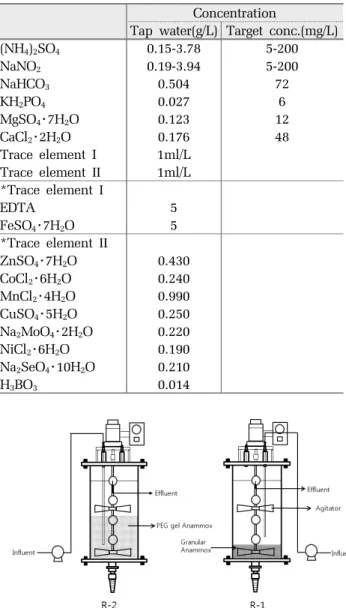
본 연구에 사용된 합성폐수의 조성은 Table 1에 나 타내었다. ANAMMOX 미생물 배양을 위해 유입 암모 늄과 아질산염의 비는 1:1로 유지되었으며, 유입 총 질소 농도는 40 mg/L에서 500 mg/L까지 단계적으로 조절되었다. ANAMMOX 미생물의 무기탄소원으로는 중탄산나트륨을 첨가하여 적정 알칼리도는 유지되었 고, 성장에 필요한 미량 무기물질을 첨가하여 최적 성 장조건을 유지하였다.2.2 반응조 구성
본 연구에서는 두 세트의 연속 반응기를 이용하여 ANAMMOX 미생물에 의한 질소 제거능은 평가되었 다. 각 반응기는 부피 3.5 L로써 아크릴로 제작되었고Table 1. Composition of synthetic wastewater
Concentration
Tap water(g/L) Target conc.(mg/L) (NH4)2SO4 0.15-3.78 5-200 NaNO2 0.19-3.94 5-200 NaHCO3 0.504 72 KH2PO4 0.027 6 MgSO4・7H2O 0.123 12 CaCl2・2H2O 0.176 48 Trace element I 1ml/L Trace element Ⅱ 1ml/L *Trace element Ⅰ EDTA 5 FeSO4・7H2O 5 *Trace element Ⅱ ZnSO4・7H2O 0.430 CoCl2・6H2O 0.240 MnCl2・4H2O 0.990 CuSO4・5H2O 0.250 Na2MoO4・2H2O 0.220 NiCl2・6H2O 0.190 Na2SeO4・10H2O 0.210 H3BO3 0.014
Fig. 1. Photo of granular Anammox(R-1) and PEG Gel Anammox
reactor(R-2).
입상형태 ANAMMOX 미생물(R-1)과 PEG gel에 포 괄 고정화된 ANAMMOX 미생물(R-2)이 각각 충진 되 었다 (Fig. 1). R-1에서 충진된 미생물 농도는 2,121±29 mgMLSS/L이었다. PEG와 ANAMMOX 미생물 함유량 이 18%(w/v), 0.4%(w/v) 로 제조된 PEG gel은 R-2 반 응조에 40% 충진되었다. 미생물의 성장 조건에 적합 하도록 온도 조절이 가능한 항온실에 반응조는 설치 되어 평균 31±0.5 oC의 온도를 유지하였다. 반응기로 유입되는 합성폐수와 유출수를 각각 샘플링하여 질소 분석을 통해 미생물의 활성을 비교・평가하였으며 유 출수가 나오는 포트에는 부직포를 막아 미생물의 wash-out을 최대한 방지하였다.
2.3 반응조 운전 조건
R-1에서는 반응 초기 미생물의 활성도를 증가시키 기 위해 fed-batch 형태의 운전 전략은 적용되었고, R-2에서는 30%로 충진된 PEG에 포함된 아민계열의 물질을 빠른 시간 내에 씻어내기 위해 운전 초기 빠 른 HRT를 적용하였다. 이후 각 반응조의 수리학적 체 류시간은 1 day로 조절되었다. 반응조로 유입되는 총 질소 농도는 40 mg/L에서 500 mg/L까지 점차 증가되 었다. 유입 질소 농도에 따른 실험결과 도출 이후 산 소 노출에 따른 미생물 활성을 조사하기 위한 추가 실험은 진행되었다. 이를 위하여 유입수 내 잔류 산소 를 제거하기 위한 질소 가스 purging 시스템은 운전 100일을 기점으로 off/on 되었는데, 제조된 유입수에 는 99.9% 질소 가스를 20분간 주입하여 잔류 DO 농 도는 최대한 감소되었다. 해당 실험에서는 유입수 총 질소 농도를 400 mg/L로 조절하여, 유입수 질소 농도 에 따른 ANAMMOX 활성 변화는 최소화 되었다.2.4 물질 분석방법
각 반응기의 유입수와 유출수를 샘플링하여 질소분 석을 통해 미생물의 활성을 비교・평가하였다. 채취한 시료는 0.45 μm GF/C membrane filter에 여과한 후 분 석하였다. NH4+-N은 질소분석기(2200 Kjeltec AutoDistillation, FOSS TECATORS)를 이용하여 분석하였 고 NO3--N은 이온크로마토그래피(DX-600, DIONEX) 를, NO2--N, 알칼리도, 온도 및 pH는 standard method 에 준하여 측정・분석하였다 (APHA, 1998).
3. 결 과
3.1 기질 농도 변화에 따른 질소 제거능 평가
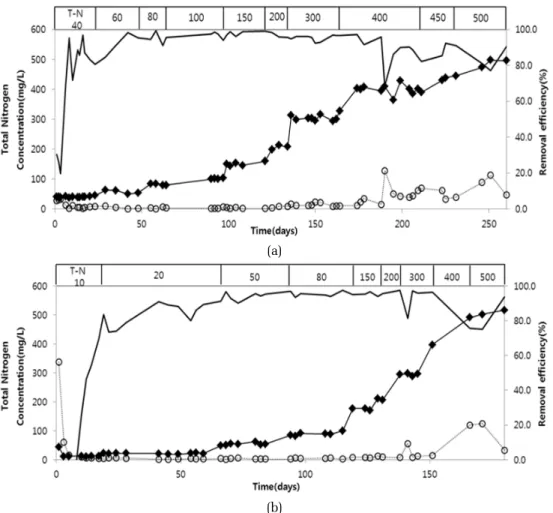
유입 합성폐수 내 총 질소 농도는 40 mg/L에서 500 mg/L까지 단계적으로 높여주었고, R-1과 R-2에 대한 질소 제거능은 Fig. 2에 나타내었다. R-1의 경우 운전 초기 미생물 적응기간 동안 질소 제거율은 다소 변동되었으나, 곧 회복되었고 온도 유 지장치가 고장난 운전 190일째를 제외하고는 모든 구 간에서 안정적인 질소 제거 효율은 달성되었다. 전체운전 기간 동안 암모늄, 아질산염, 총 질소의 제거율은 각각 90.5±6.6, 96.6±4.9, 93.2±6.1%로 나타났다. 유입 질소 부하는 0.04에서 0.5 kg/m3/d로 점차 증가되었으 며, 이때 달성한 최대 질소 제거 속도는 0.44 kg/m3/d 이었다. R-2의 경우 운전 초기 유출 아질산염의 농도는 5.4±14.19 mg/L로 나타나 96.4±6.11%의 안정적인 제거 효율을 달성한 반면, 유출 암모늄 농도는 유입 질소 농도 보다 높게 검출되었다. 최대 검출된 암모늄 농도 는 319.2 mg/L이었다. 조사 결과 이는 PEG gel 제조시 사용되는 아민 계열의 물질이 점차 용출되어 유출수 내 암모늄 질소 농도에 영향을 주는 것으로 나타났다 (Watanabe et al., 1981). 따라서 R-2 반응조에서는 운전 초기 HRT를 1시간으로 조절하며, 용출되는 아민 계열 의 질소 성분을 빠르게 배출해주었으며, 운전 60일 이 후부터는 유입 질소 농도를 단계적으로 높여주었다. 그 결과 유입 질소 농도 증가와 함께 유입 질소 부하 는 0.01에서 0.5 kg/m3/d으로 점차 증가되었으며, 안정 적인 질소 제거능과 함께 달성한 최대 질소 제거 속 도는 0.48 kg/m3/d이었다. ANAMMOX 미생물에 의한 질소 제거 정도를 평가 하기 위하여 식 1을 바탕으로 ANAMMOX 미생물에 의한 기질 제거비(NO2/NH4 비)와 기질 생성 비 (NO3/NH4 비)는 조사되었다. NH4+ + 1.31NO2- + 0.066HCO3- + 0.13H+ → 1.02N2 + 0.26NO3- + 0.066CH2O0.5N0.15 + 2.03H2O (1) Strous et al. (1998)에서 제안된 식 1에 의하면 유입 암모늄 1 mole을 기준으로 1.32 mole의 아질삼염이 제 거되고 반응의 부산물로써 0.26 mole의 질산염이 생성 된다. 본 연구 결과 R-1의 경우 제거된 NO2/NH4 비는 1.2±0.14이었고, 생성된 NO3/NH4 비는 0.23±0.08로 나 (a) (b)
Fig. 2. Variation of total nitrogen concentration and removal efficiency in the continuous granular ANAMMOX reactor, R-1
타나 이론적인 기질 제거 및 소모비와 유사한 것으로 나타났다. R-2에서도 마찬가지로 제거된 NO2/NH4 비 와 생성된 NO3/NH4 비는 각각 1.3±0.43, 0.28±0.04로 나타나 이론적인 ANAMMOX 미생물의 기질 제거 및 생성비와 유사한 것으로 조사되었다. 각 반응조별로 유입 총 질소 농도 500 mg/L에도 불구하고 전체적으 로 ANAMMOX 미생물에 의한 안정적인 질소 제거능 은 달성되었다.
3.2 산소 노출에 따른 질소 제거능 평가
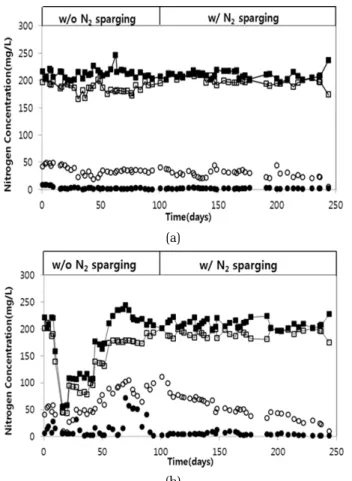
유입수 내 잔류하는 용존 산소 농도에 따른 각 반 응조별 질소 제거능은 비교 및 평가 되었다. 운전 100 일까지는 유입 합성폐수 제조 후 질소 가스 purging 없 이 유입수를 공급하여 산소에 노출되도록 하였고(유입 수 내 DO 농도 8.4±0.23 mgO2/L), 이후에는 질소 가스 purging 시스템을 적용하여 유입수 DO농도를 0.5 mgO2/L로 낮추어 주었다. 기질 농도 변화에 따른 활성 평가 실험을 위하여 유입수 내 질소 농도를 400 mg/L 로 고정하여 실험하였고, 주요 연구 결과는 Fig. 3에 나타내었다. R-1의 경우 유입수 질소 purging 여부와 관계없이 유출수내 암모늄 및 아질산염의 농도는 각각 35.2±7.9, 2.4±2.5 mg/L로 나타나 매우 안정적인 질소 제거능을 나타내었다. ANAMMOX 미생물이 산소에 노출되었을 때 암모늄, 아질산염, 총 질소 제거율은 각각 81.3±3.8, 98.9±1.2, 90.6±2.3 %이었고, 질소 가스 purging 시스템 적용 이후에는 각각 85.8±3.8, 99.2±0.3, 92.7±1.8 %로 나타났다. 이처럼 질소 가스 purging 시스템 적용 유무 에 관계 없이, R-1에서는 안정적인 질소 제거가 가능하 였다. 이는 식종된 ANAMMOX 미생물의 granule에서의 DO diffusion limitation 영향으로 보이며, ANAMMOX granule에 의한 연구 결과에서 이는 증명되었다 (Wang et al., 2020; Wu and Zhang, 2017). ANAMMOX 미생물 은 self-aggregation에 의해 granule 형태로 존재하는데 (Bae et al., 2010), 간헐적인 폭기 시스템이 적용되는 단 일 반응 시스템에서의 ANAMMOX 미생물은 1.0 mgO2/L이상의 비교적 높은 DO 농도에서도 안정적인 질소 제거 성능이 달성되는 것으로 보고되었다 (Trojanowicz et al., 2019; Wunderlin et al., 2013).
R-2에서 유입슈 purging 적용 전 유입수 내 DO 농 도는 8.4±0.2 mgO2/L이었고, 운전 100일 이후 잔류
DO 농도는 0.6±0.1 mg/L로 감소되었다. 유입수 질소
(a)
(b)
Fig. 3. Variation of nitrogen concentration in the continuous
granular ANAMMOX reactor, R-1 (A) and PER gel ANAMMOX reactor, R-2 (B). Influent ammonium nitrogen(□), effluent ammonium nitrogen(○), influent nitrite nitrogen(■) and effluent nitrite nitrogen(●).
purging없이 운전될 경우 유출수 내의 아질산염의 농 도는 저해 농도인 50 mg/L를 초과하여 검출되는 것으 로 나타났다. ANAMMOX 미생물은 혐기성 조건에서 활성을 나타내는 미생물로 산소 농도에 강한 독성 영 향을 나타낸다. 높은 DO에 노출된 ANAMMOX 미생 물은 활성이 저해됨에 따라 ANAMMOX 활성에 저해 를 미치는 또 다른 저해 인자인 아질산염이 축적되기 시작하였다 (Choi et al., 2018a; Strous et al., 1999). 따 라서 기질 저해 영향을 최소화 하기 위하여 일시적으 로 유입수 내 아질산염 농도는 ANAMMOX 미생물 활성에 악영향을 미치는 저해 수준인 50 mg/L 이하로 조절되었고, 이후 활성 회복 정도에 따라 유입수 내 총 질소 농도는 400 mg/L까지 단계적으로 증가되었 다. 미생물이 산소에 노출되었을 때 암모늄, 아질산염, 총 질소 제거율은 각각 R-1대비 낮은 58.1±13.3,
90.7±8.7, 76.1±7.9%로 나타났고, 유입수 질소 purging 이후에는 72.1±11.4, 98.0±1.1, 85.6±5.6%로 질소 제거 능이 증가되는 것으로 나타났다. 담체 내 기질 확산 계수에 의하여 담체 내부에 포 괄 고정화된 미생물은 저해 물질로부터 보호될 수 있 으며, 이는 포괄 고정화 기술의 주된 장점으로 고려된 다 (Quan et al., 2010; Quan et al., 2011). 하지만 본 연 구에서는 PEG담체에 포괄 고정화된 ANAMMOX 미 생물이 ANAMMOX granule 공정보다 공정 조건 변화 에 보다 취약한 것으로 나타났다. 포괄 고정화 기술은 낮은 확산 계수로 인하여 담체 내부로 기질이 적절하 게 확산되지 못하여 담체 외부 조건이 ANAMMOX 미생물이 성장하기에 보다 적합하다. 본 연구에서 적 용된 PEG를 이용한 포괄 고정화 기술 역시 PEG gel 내부 및 외부에 ANAMMOX 미생물이 균등하게 분포 하는 것이 아닌 담체 외부에 ANAMMOX 미생물이 보다 배양된 것으로 판단되며(Isaka et al., 2007), 이로 인하여 입상 형태의 ANAMMOX 미생물보다 반응 표 면적이 작은 PEG gel이 다양한 조건 변화에 대해 취 약한 것으로 판단된다 (Gao et al., 2012).
3.3 Granular ANAMMOX와 PEG gel ANAMMOX 비
교 평가
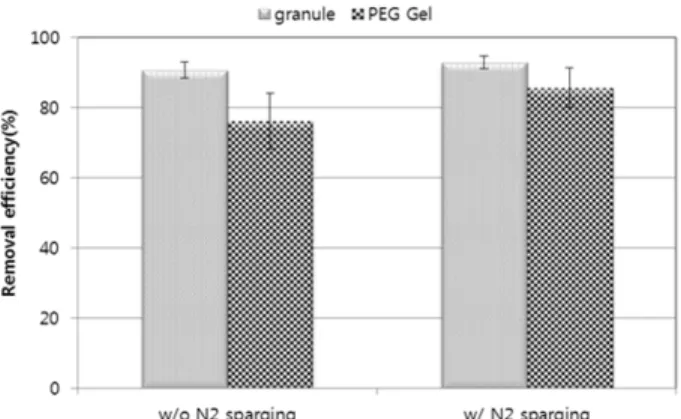
반응조 운영 형태별 산소 노출 유무에 따른 질소 제거 능은 비교 및 평가 되었다 (Fig. 4, Fig. 5). ANAMMOX granule이 충진된 R-1에서의 질소 제거율은 산소 노출 유무에 관계없이 유사한 것으로 나타났으며, PEG gel 이 충진된 R-2보다 높은 질소 제거능을 나타내었다. R-2의 경우에는 유입수 purging 시스템 적용 여부에 따라 질소 제거 효율이 상이한 것으로 조사되었으며, ANAMMOX granule 대비 산소 노출 유무에 보다 취 약한 것으로 조사되었다. PEG에 고정화된 ANAMMOX 미생물을 이용하여 용존 산소에 대한 영향을 조사한 유사 연구 결과에서 도 이러한 특성은 나타났다. KIMURA et al. (2011)는 PEG gel에 포괄 고정화된 ANAMMOX 미생물을 이용 하여 반응조 내 DO농도에 따른 영향을 조사하였다. 그 결과 유입수 내 DO농도가 2.5 mg/L를 초과할 경우 전반적인 질소 제거능에 악영향을 미치는 것으로 나 타났으며, DO 농도가 5 mg/L일 ANAMMOX 미생물의 활성이 심각하게 감소하는 것으로 보고하였다.
Fig. 4. Comparison of total nitrogen removal efficiency at
different operating conditions.
Fig. 5. Comparison of nitrogen removal rate in the granular
and PEG Gel Anammox reactor.
ANAMMOX granule은 높은 침강성으로 인하여 공 정 안정성을 향상 시킬 뿐만 아니라 PEG를 이용한 포 괄 고정화 기법 대비 저해 물질에 대한 저항성이 보 다 높은 것으로 나타났다. 이러한 특성은 다양한 변수 가 고려되어야 하는 현장 운전 조건에서 ANAMMOX 공정의 안정성을 향상 시킬 수 있는 방안으로 고려될 수 있을 것이다.
4. 결 론
본 연구에서는 ANAMMOX 미생물을 입자상 형태 와 PEG 담체에 포괄 고정화된 형태로 구분하여 유입 질소 농도 및 산소 노출 유무에 따른 질소 제거 효율 은 분석・비교되었다. 유입 질소 농도를 500 mg/L까지 증가시킬 경우 PEG gel에 고정화된 ANAMMOX 미생 물과 입상형태의 ANAMMOX 미생물 모두 유입되는 총 질소의 농도가 높을수록 제거율이 감소하는 추세를 보였으나, 입상 형태의 ANAMMOX 미생물이 보다 안정적인 질소 제거능을 나타내었다. 이러한 결과는 유입수 내 잔류 DO 농도를 조절하지 않았을 경우에 도 마찬가지로 나타났다. 대규모 반응조를 운전할 경 우 유입수 내 질소 농도 및 용존 산소 농도는 조절되 기 어려운 변수이며, 본 연구에서는 입자상 ANAMMOX 미생물이 이러한 발생 가능한 변수에 대 하여 보다 안정적인 질소 제거 성능을 나타내었다.
사 사
본 연구는 한국연구재단(NRF-2019R1I1A3A01062509) 의 지원으로 수행되었습니다.References
Ahmad, H.A., Ni, S.Q., Ahmad, S., Zhang, J., Ali, M., Ngo, H.H., Guo, W., Tan, Z. and Wang, Q. (2020). Gel immobilization: A strategy to improve the performance of anaerobic ammonium oxidation (anammox) bacteria for nitrogen-rich wastewater treatment, Bioresour. Technol., 313, 123642.
Ali, M. and Okabe, S. (2015). Anammox-based technologies for nitrogen removal: advances in process start-up and remaining issues, Chemosphere, 141, 144-153. APHA, A. (1998). Standard Methods for the Examination of
Water and Wastewater, 20th ed., United Book Press, USA. Bae, H.K., Choi, M.K., Lee, C.S., Chung, Y.C., Yoo, Y.J. and
Lee, S.H. (2015). Enrichment of ANAMMOX bacteria from conventional activated sludge entrapped in poly (vinyl alcohol)/sodium alginate gel, Chem. Eng. J., 281, 531-540. Bae, H.K., Chung, Y.C. and Jung, J.Y. (2010). Microbial
community structure and occurrence of diverse autotrophic ammonium oxidizing microorganisms in the anammox process, Water Sci. Technol., 61, 2723-2732.
Choi, D.H., Cho, K.J. and Jung, J.Y. (2019a). Optimization of nitrogen removal performance in a single-stage SBR based on partial nitritation and ANAMMOX, Water Res., 162, 105-114.
Choi, D.H., Cho, S.H. and Jung, J.Y. (2018a). Key operating parameters affecting nitrogen removal rate in single-stage deammonification, Chemosphere, 207, 357-364. Choi, D.H., Khan, M.H. and Jung, J.Y. (2019b). Crosslinking
of PVA/alginate carriers by glutaraldehyde with improved
mechanical strength and enhanced inhibition of deammonification sludge, Int. Biodeterior. Biodegrad., 145, 104788.
Choi, D.H., Kim, J.H., Youn, B.S. and Jung, J.Y. (2018b). Feed distribution based on sensing ammonium concentration after sub-feeding to achieve target effluent nitrogen concentration in sequencing batch reactors, Int. Biodeterior. Biodegrad., 133, 187-193.
Choi, D.H., Lee, D.R., Yun, W.S. and Jung, J.Y. (2017). Addition of a foaming agent to improve N2 gas permeability of PVA/alginate carriers for deammonification process, Int. J. Hydrogen Energy, 42, 27812-27819.
Dapena‐Mora, A., Arrojo, B., Campos, J.L., Mosquera‐Corral, A. and Méndez, R. (2004). Improvement of the settling properties of Anammox sludge in an SBR, J. Chem. Technol. Biotechnol. : Int. Res. Process, Environ. Clean Technol., 79, 1417-1420.
Date, Y., Isaka, K., Sumino, T., Tsuneda, S. and Inamori, Y. (2008). Microbial community of anammox bacteria immobilized in polyethylene glycol gel carrier, Water Sci. Technol., 58, 1121-1128.
Gao, Y., Liu, Z., Liu, F. and Furukawa, K. (2012). Mechanical shear contributes to granule formation resulting in quick start-up and stability of a hybrid anammox reactor, Biodegradation, 23, 363-372.
Isaka, K., Date, Y., Sumino, T. and Tsuneda, S. (2007). Ammonium removal performance of anaerobic ammonium-oxidizing bacteria immobilized in polyethylene glycol gel carrier, Appl. Microbiol. Biotechnol., 76, 1457-1465.
Kartal, B., Kuenen, J.V. and Van Loosdrecht, M. (2010). Sewage treatment with anammox, Sci., 328, 702-703.
Kieling, D.D., Reginatto, V., Schmidell, W., Travers, D., Menes, R.J. and Soares, H.M. (2007). Sludge wash-out as strategy for Anammox process start-up, Process Biochem., 42, 1579-1585.
KIMURA, Y., ISAKA, K. and KAZAMA, F. (2011). Tolerance level of dissolved oxygen to feed into anaerobic ammonium oxidation (anammox) reactor, J. Water Environ. Technol., 9, 169-178.
Kuenen, J.G. (2008). Anammox bacteria: from discovery to application, Nature Rev. Microbiol., 6, 320-326. Lim, E.T., Jeong, G.T., Bhang, S.H., Park, S.H. and Park, D.H.
(2009). Evaluation of pilot-scale modified A2O processes for the removal of nitrogen compounds from sewage, Bioresour. Technol., 100, 6149-6154.
H.Q. (2009). Modeling a granule‐based anaerobic ammonium oxidizing (ANAMMOX) process, Biotechnol. Bioeng., 103, 490-499.
Quan, L., Liem, T.T., Khanh, D. and Furukawa, K. (2010). High ammonium wastewater treatment of stirred tank anammox reactor using polyvinyl alcohol/alginate gel as biomass carrier, Jpn. J. Water Treat. Biol., 46, 109-117. Quan, L.M., Hira, D., Fujii, T. and Furukawa, K. (2011). Reject
water treatment by improvement of whole cell anammox entrapment using polyvinyl alcohol/alginate gel, Biodegrad., 22, 1155-1167.
Sahinkaya, E., Dursun, N., Kilic, A., Demirel, S., Uyanik, S. and Cinar, O. (2011). Simultaneous heterotrophic and sulfur-oxidizing autotrophic denitrification process for drinking water treatment: control of sulfate production, Water Res., 45, 6661-6667.
Strous, M., Heijnen, J., Kuenen, J.G. and Jetten, M. (1998). The sequencing batch reactor as a powerful tool for the study of slowly growing anaerobic ammonium-oxidizing microorganisms, Appl, Microbiol. Biotechnol., 50, 589-596.
Strous, M., Kuenen, J.G. and Jetten, M.S. (1999). Key physiology of anaerobic ammonium oxidation, Appl. Environ. Microbiol., 65, 3248-3250.
Tang, C.J., Zheng, P., Mahmood, Q. and Chen, J.W. (2009). Start-up and inhibition analysis of the Anammox process seeded with anaerobic granular sludge, J. Ind. Microbiol. Biotechnol., 36, 1093.
Trojanowicz, K., Trela, J. and Plaza, E. (2019). Possible mechanism of efficient mainstream partial nitritation/anammox (PN/A) in hybrid bioreactors (IFAS), Environ. Technol., 1-15.
Van der Star, W.R., Abma, W.R., Blommers, D., Mulder, J.W., Tokutomi, T., Strous, M., Picioreanu, C. and van Loosdrecht, M.C. (2007). Startup of reactors for anoxic ammonium oxidation: experiences from the first full-scale anammox reactor in Rotterdam, Water Res., 41, 4149-4163.
Van Loosdrecht, M., Hao, X., Jetten, M. and Abma, W. (2004). Use of Anammox in urban wastewater treatment, Water Sci. Technol. : Water Supply, 4, 87-94.
Wang, J., Hou, J., Xia, L., Jia, Z., He, X., Li, D. and Zhou, Y. (2020). The combined effect of dissolved oxygen and COD/N on nitrogen removal and the corresponding mechanisms in intermittent aeration constructed wetlands, Biochem. Eng. J., 153, 107400.
Watanabe, N., Ohzeki, H. and Niki, E. (1981). Enantiomeric resolution of amino acids by high-performance ligand-exchange chromatography using a chemically modified hydrophilic porous polymer gel, J. Chromatogr. A, 216, 406-412.
Wu, J. and Zhang, Y. (2017). Evaluation of the impact of organic material on the anaerobic methane and ammonium removal in a membrane aerated biofilm reactor (MABR) based on the multispecies biofilm modeling, Environ, Sci, Pollut. Res., 24, 1677-1685.
Wunderlin, P., Joss, A., Kipf, M. and Siegrist, H. (2013). Monitoring N2O emission for indirect NO2-measurement and nitritation-anammox processcontrol, ETHLibrary,163. Yang, G.F., Ni, W.M., Wu, K., Wang, H., Yang, B.E., Jia,
X.Y. and Jin, R.C. (2013). The effect of Cu (II) stress on the activity, performance and recovery on the anaerobic ammonium-oxidizing (Anammox) process, Chem. Eng. J., 226, 39-45.
Yu, J.J., Chen, H., Zhang, J., Ji, Y.-X., Liu, Q.Z. and Jin, R.C. (2013). Enhancement of ANAMMOX activity by low-intensity ultrasound irradiation at ambient temperature, Bioresour. Technol., 142, 693-696.
Zekker, I., Rikmann, E., Tenno, T., Lemmiksoo, V., Menert, A., Loorits, L., Vabamäe, P., Tomingas, M. and Tenno, T. (2012). Anammox enrichment from reject water on blank biofilm carriers and carriers containing nitrifying biomass: operation of two moving bed biofilm reactors (MBBR), Biodegrad., 23, 547-560.