
The Effectiveness of Coil Spring System for EDG System in Ulchin 2 Unit
Min Kyu Kim,a Hyoung Oh Kwon,b Young Sun Choun,a Jeong Moon Seo,aa Integrate Safety Assessment Division, Korea Atomic Energy Research Institute, Youseong, Daejeon,
b VE Tech Corporation, Seongnam, Kyunggi 1. Introduction
The vibration of a rotating machine is a common problem of an industrial field. The Emergency Diesel Generator (EDG) is an important piece of equipment for the safety of a Nuclear Power Plant (NPP). The EDG system also has a vibration problem. So, in this study, the operating vibration of EDG system was measured. The target EDG system is Ulchin 2 unit which was produced by SACM and the model is UD45V 20S5D. The foundation of this EDG system has a seismic mass block and coil spring system. Therefore the purpose of this study is the evaluation of the isolation effect of vibration isolation system of Ulchin 2 unit EDG system.
2. Measurement Overview 2.1 Emergency Diesel Generator
Target EDG system has two engines and one generator system. The generating power of this EDG is 4500kW and the operating velocity is 1200RPM. The testing operation period is two month and the testing power is 30% of full power.
2.2 Foundation System
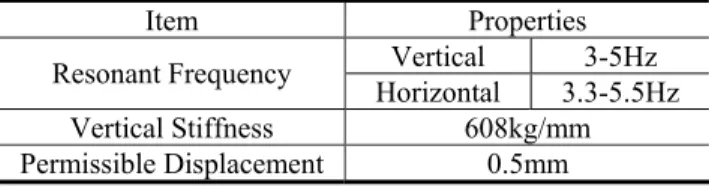
The foundation of EDG system in the Ulchin 2 unit follows a typical seismic mounting system. The coil spring of the EDG system is shown in Fig. 1. There are 12 set of this type of system used for this isolation. The conceptual drawing of the seismic mountings for vibration isolation is shown in the Figure 2. As shown in a Figure 2, the seismic mass is adopted for the vibrating machine. The isolation devices are the V1B-5798 model which is produced by Vibrachoc Company. The properties of this isolator are summarized as below in Table 1.
Fig. 1 Spring System of Fig. 2 The Conceptual Drawing
Ulchin 2 unit EDG of Rotational Machine Table 1. The Properties of Spring System
Item Properties Vertical 3-5Hz Resonant Frequency Horizontal 3.3-5.5Hz Vertical Stiffness 608kg/mm Permissible Displacement 0.5mm 2.3 Vibration Measurement
For the measurement of the vibration of the operating EDG, the measurement system was installed as shown in Figure 3. As shown in Figure 3, there are eight accelerometers and two displacement tranceducers used in this measurement. Six accelerometers are installed on the foundation and one is on the pedestal and the other is on the floor. A signal conditioner & power unit, tape recorder and signal analyzer were used for vibration measurement. The vibration was measured for two cases; before a operation and a normal operation. Time and frequency domain responses are measured.
Fig. 3. Schematic Diagram of Measurement System
Transactions of the Korean Nuclear Society Autumn Meeting Busan, Korea, October 27-28, 2005
3. Measurement Result 3.1 Acceleration Response
The measurements of acceleration response are shown in the Table 2. The results of the frequency ranges are 1-100Hz. The results are shown in one of foundation point (P1), the pedestal (P7) and the floor point (P8). As shown in Table 2, the isolation effects can be determined in both the before and normal operation situations. In the case of a normal operation in the time domain, the vibration decreased as almost 4% and more 20dB.
Table 2. Vibration Measurement of EDG [1]
Time Domain Frequency Domain Status Measuring Location
Peak
[m/s2] Peak [dB] [m/sO.A. 2] O.A. [dB]
Block (P1) 0.061 75.7 0.048 73.6 Pedestal (P7) 0.020 65.9 0.005 54.4 Before Operation Floor (P8) 0.014 62.6 0.004 51.6 Block (P1) 4.181 112.4 1.843 105.3 Pedestal (P7) 0.177 85.0 0.061 75.7 Normal Operation Floor (P8) 0.109 80.8 0.033 70.3
These results can compare to the results of previous measurement of the EDG in Yonggwang 5 and Ulchin 3 unit. The vibration reduction of fixed foundation system of the EDG in Yonggwang 5 unit is only about 50%. And that of coil spring and viscous damper system used of the EDG in Ulchin 3 unit is about 2% [2]. The reason of the coil spring and viscous damper system have a good performance is the viscous damper controlled the amplitude. But in this case seismic mass contribute the vibration isolation so only the coil spring system have a good vibration reduction effect. The time domain and frequency domain vibration histories are shown in a Figure 4.
P1
P7
P8
Time Domain Frequency Domain
Fig. 4 Acceleration Response of Normal Operation [1] As shown in Figure 4, the resonant frequencies are clearly recognized in the foundation point, but it is not so in the pedestal and the floor points. This because that the amplitudes are clearly decreased using the isolation system.
3.2 Displacement Response
The relative displacement between the pedestal and the foundation were measured and shown in Figure 5. The displacement measurement positions are a front and rear position of seismic block. As shown in Figure 5, the displacements of two different points are really similar and the relative displacements after start the EDG were regularly keep stability. In case of starting time, the maximum displacement is only 0.3mm and in the normal operation situation is only 0.035mm. So, it can be said that the isolation system which uses the seismic mass is stable.
(a) front position (b) rear position Fig. 5 Displacement Time history of EDG [1]
4. Conclusion
In this study, the operating vibration of the EDG system was measured. The purpose of this measurement is for a verification of the vibration isolation effect of the spring system which is installed with the seismic mass. The seismic mass with coil spring system reduce the vibration about 4% and the maximum displacement in 0.3mm. As a result, it can be said that the spring with a seismic mass system of the EDG is more effective for the vibration isolation when compared to the other system.
This research was supported by the Mid- and Long-Term Nuclear Research & Development Program of the Ministry of Science and Technology, Korea.
REFERENCES
[1] VE Tech Corporation, 2005, Vibration Measurement Report of Emergency Diesel Generator in the Nuclear Power Plant.
[2] Min Kyu Kim, Young Sun Choun, Hyoung Oh Kwon, Jeong Moon Seo, Evaluation of a Spring-Viscous Damper Vibration Isolation System by Measuring the Vibration of the Emergency Diesel Generator, Proceeding of the Korean Nuclear Society Spring Meeting, Jeju, Korea, May, 2005.
![Fig. 4 Acceleration Response of Normal Operation [1] As shown in Figure 4, the resonant frequencies are clearly recognized in the foundation point, but it is not so in the pedestal and the floor points](https://thumb-ap.123doks.com/thumbv2/123dokinfo/4970971.52965/2.892.80.435.400.570/acceleration-response-operation-resonant-frequencies-recognized-foundation-pedestal.webp)
