Thermal Treatment of Salt-Loaded Zeolite
Jeong-Guk Kim,Jae-Hee Lee,Eung-Ho Kim,and Joon-Hyung Kim
Nuclear Chemical Engineering Research Dept., Atomic Energy Research Institute [email protected]
1. Introduction
For disposal in a geological repository, the waste salts such as molten LiCl salt from an oxide fuel reduction process and molten LiCl-KCl eutectic salt from an electro refining process must meet the acceptance criteria. For a waste form containing chloride salt, two of the more important criteria are known to be leach resistance and waste form durability [1].
US Argonne National Laboratory (ANL) developed a ceramic waste form (CWF) fabrication technology for LiCl-KCl eutectic salt from ANL Experimental Breeder Reactor-II (EBR-II)[2]. The CWF, which was made by first occluding salt in zeolite A at 730 K and then encapsulating the zeolite in a borosilicate binder glass by a hot isostatic press (HIP) method or pressureless consolidation (PC) method, has the phase composition of about 70% sodalite, 25% binder glass, and a 5% total of inclusion phases (halite, nepheline, and various oxides and silicates). US ANL showed that the chemical durability and leach resistance of the CWF were higher than those of glass waste form for high level waste from aqueous process, by a 7-day product consistency test (PCT).
However, the waste form fabrication process for waste LiCl salt is somewhat different in mixing temperature from that for LiCl-KCl eutectic salt at US ANL. The former is mixed at 920 K, whereas, the later mixing is accomplished at 730 K. Such difference in mixing temperature results in the different major phase of SLZ, that is, zeolite Li-A from LiCl salt, and unchanged zeolite A from LiCl-KCl eutectic salt. This unchanged phase of zeolite A during an immobilization step is transformed to sodalite, which was known to be very high leach-resistant, in the step of encapsulating with borosilicate glass.
In this work, we tried to investigate the transformation
of major phase of SLZ, from zeolite Li-A to Na8Cl2-Sod
using zeolite only sodalite, by a quantitative analysis with a software for X-ray diffractometer during the thermal treatment under 1170 K.
2. Experimental 2.1 Sample Preparation
The SLZ samples were prepared by mixing of LiCl salt and zeolite A with a mixing ratio of LiCl to zeolite, r = 15,
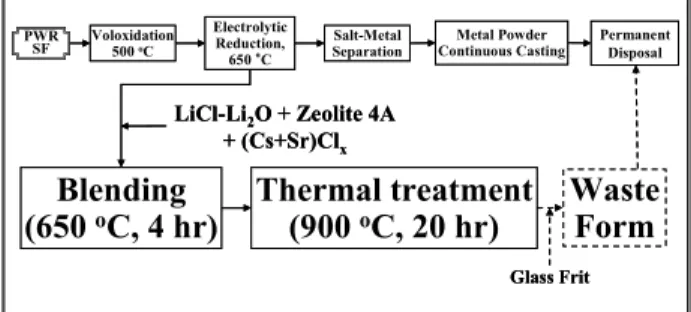
10, 4.5, 1, 0.5, 0.4, 0.25, and 0.1, which was shown in Fig. 1. The more detailed description is showed in our previous works [3]. PWR SF Electrolytic Reduction, 650 °C Metal Powder Continuous Casting
Blending
(650
oC, 4 hr)
Thermal treatment
(900
oC, 20 hr)
Waste
Form
Permanent Disposal Salt-Metal Separation Glass Frit LiCl-Li2O + Zeolite 4A + (Cs+Sr)Clx Voloxidation 500 oC PWR SF Electrolytic Reduction, 650 °C Metal Powder Continuous Casting
Blending
(650
oC, 4 hr)
Thermal treatment
(900
oC, 20 hr)
Waste
Form
Permanent Disposal Salt-Metal Separation Glass Frit LiCl-Li2O + Zeolite 4A + (Cs+Sr)Clx Voloxidation 500 oC
Figure 1. The schematic diagram of waste salt treatment process involving the SLZ sample preparation
2.2 Analysis
The crystalline structures of SLZ sample and the thermal treated sample were quantitatively analyzed by a TOPAS software for Bruker D8 advance X-ray diffractometer.
3. Results and Discussion
3.1 Crystal Structure of SLZ Sample and thermal treated sample
During the salt occluding in zeolite 4A
(Na12Al12Si12O48), the zeolite 4A was transformed to
zeolite Li-A (Li2Al2Si2O80), with some minor phases such
as Li8Cl2-Sod (Li8(AlSiO4)6Cl2) and halite (NaCl)
according to the mixing ratio. And such transformation started very fast, from a half hour after contacting the zeolite with molten LiCl salt.
As the mixing ratio, r (=LiCl/zeolite) decreased below
0.5, halite and Li8Cl2-Sod appeared. At the very low
mixing ratio, r=0.1, which was the same ratio as that of the SLZ for LiCl-KCl eutectic salt at US ANL, the stable
and very high leach-resistant crystal phase, Na8Cl2-Sod
(Na8(AlSiO4)6Cl2) was found as a major phase in SLZ
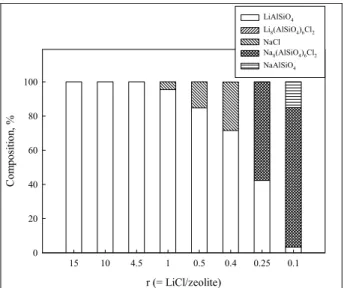
sample. This SLZ sample, however, also had some minor phases such as about 30% Li-A, 11% halite, and 20%
nepheline (NaAlSiO4), which is known as poor leach
resistant.
Transactions of the Korean Nuclear Society Autumn Meeting Busan, Korea, October 27-28, 2005
LiCl CsCl SrCl2 Na12(AlSiO4)12 LiAlSiO4 Li8(AlSiO4)6Cl2 Na8(AlSiO)6Cl2 LiAlSiO4 NaAlSiO4 LiAlSiO4 LiAlSiO4 Na8(AlSiO4)6Cl2 Na8(AlSiO)6Cl2 LiAlSiO4 NaAlSiO4 650 oC 900 oC r=15~0.25 r=15~0.4 r=0.25 r=0.1 r=0.1 LiCl CsCl SrCl2 Na12(AlSiO4)12 LiAlSiO4 Li8(AlSiO4)6Cl2 Na8(AlSiO)6Cl2 LiAlSiO4 NaAlSiO4 LiAlSiO4 LiAlSiO4 Na8(AlSiO4)6Cl2 Na8(AlSiO)6Cl2 LiAlSiO4 NaAlSiO4 650 oC 900 oC r=15~0.25 r=15~0.4 r=0.25 r=0.1 r=0.1
Figure 2. The transformation of SLZ sample after the thermal treatment at 1170 K
After thermal treatment at 1170 K for more than 4 h, the SLZ sample was transformed to new SLZ sample with
the major phase of Na8Cl2-Sod (about 82%), and some
minor phases such as about 15% nepheline and 3% Li-A. US ANL showed that an addition of glass frit in encapsulating step was necessary to fabricate the CWF
with a major crystal structure of Na8Cl2-Sod.[4]. Such
addition of glass frit gave better consolidation of waste salt, however, which rather brings increase in waste volume 4 times as much as its original waste generation.
The SLZ sample with r=0.25, which did not contain any nepheline phase, was transformed from the crystal structure with about 44% Li-A, 41% halite, and 15%
Na8Cl2-Sod. before the thermal treatment to one with
about 58% Na8Cl2-Sod. and 42% Li-A. Therefore, the
optimum mixing condition, containing less both 5% nepheline and Li-A, seems to lie between 0.25 and 0.1.
r (= LiCl/zeolite) 15 10 4.5 1 0.5 0.4 0.25 0.1 C om po sit io n, % 0 20 40 60 80 100 LiAlSiO4 Li8(AlSiO4)6Cl2 NaCl Na8(AlSiO4)6Cl2 NaAlSiO4
Figure 3. The crystal phase compositions of SLZ sample after thermal treatment at 1170 K.
REFERENCES
[1] M.A. Lewis, D.F. Fisher, and L.J. Smith, “Sal-Occluded Zeolites as an Immobilization Matrix for Chloride Waste Salts,” J. Am. Ceramic Soc., 76(11), 2826-2832 (1993) [2] M.A. Lewis, D.C. Hash, A.S. Hebden, and W.L. Ebert, “Tests
with Ceramic Waste Form Materials Made by Pressureless Consolidation,” ANL-02/10, Argonne National Laboratory, (2002);
[3] J.-G. Kim, et. al., “The Properties of Zeolite A in Molten LiCl Waste,” Proc. of ICEM’03, Sep. 21-25, 2003, Oxford, England (2003); “Treatment of Waste Salt from the Advanced spent fuel Conditioning Process (I); Characterization of Zeolite A in Molten LiCl Salt,” Proc. Of KNS Autumn Meeting, Oct. 30-31, 2003, Yongpyong, Korea (2003). [4] M.A. Lewis, M. Hash, and D. Glandorf, “Effect of Glass and
Zeolite-A Compositions on the Leach Resistance of Ceramic Waste Forms,” Mat. Res. Soc. Symp. Proc. Vol. 465, Materials Research Society, pp. 433-440, 1997.