KOR J CEREBROVASCULAR SURGERY June 2OO6 Vol. 8 No 2, page 132-4
132
Introduction
The persistent primitive hypoglossal artery (PPHA) is a rare remnant of one of the four embryonal carotid-basilar anastomoses.9) It is reported to ocean in 0.02~0.26% of angiograms or of autopsy cases.1)3) More than a hundred cases of PPHA have been reported in the literature. Ususally the PPHA is detected as a coincidental finding in neuroradiological examinations for cerebral aneurysm,7)12) cerebral ischemic disease,11)arteriovenous malformation,5)13) brain tumor4)and so on. Some were discovered in patients with neurological findings related to PPHA itself such as syncope.6) In this report, we describe a case of PPHA associated with the left ICA aneurysm and discuss the radiological findings and clinical implications of PPHA.
Case Report
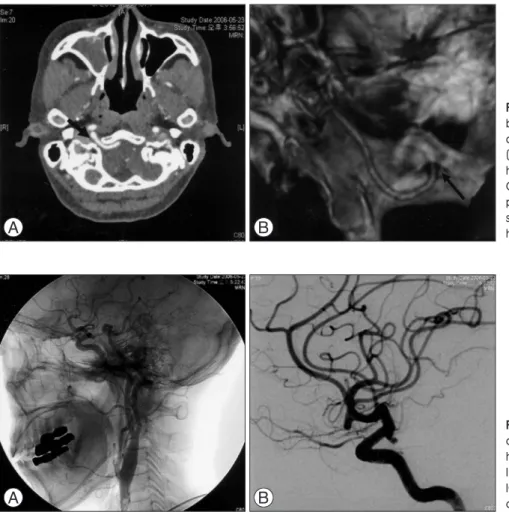
A 66-year-old woman had a 5-day history of headache and photophobia. On admission, she was alert with no deficit other than a left-sided ptosis with an associated fixed dilated pupil. A complete work-up showed that the patient did not have diabetes mellitus. There was no history of trauma, hypertension, heart disease, stroke, or cancer. Computed tomographic (CT) scan showed no subarachnoid hemorrhage. However, three-dimensional CT angiography revealed an aneurysm of the left internal carotid artery (ICA) with postero-lateral direction. Contrast-enhanced CT with a bony window, with an axial view, demonstrated the anomalous artery to pass through the right hypoglossal canal (Fig. 1A). Three-dimensional CT angiography revealed a PPHA on the right side, which entered the skull via the hypoglossal canal (Fig. 1B). A right ICA angiogram demonstrated a PPHA originating from the ICA at the C-2 vertebral level (Fig. 2). The right Pcomm was well-developed, but the left Pcomm was aplastic. Vertebral angiography showed the left vertebral artery was hypoplastic and provided blood flow to the posterior inferior cerebellar artery without connection to the basilar artery. The right vertebral artery was not detected. An Aneurysm was originated from the left supraclinoid ICA.
Persistent Primitive Hypoglossal Artery Associated
with Cerebral Aneurysm
Department of 1Neurosurgery and 2Diagnostic Radiology, Yonsei University College of Medicine, Seoul, Korea
Chang Ki Hong, MD
1·Sang Hyun Suh, MD
2·Jung Yong Ahn, MD
1·Jin Yang Joo, MD
1ABSTRACT
A persistent primitive hypoglossal artery (PPHA) is a rare vascular anomaly, which belongs to the group of carotid-basilar anastomosis that may occur in adults. The association of PPHA with cerebral aneurysms has also rarely reported. A review of the published cases of PPHA with cerebral aneurysms is made including the author’s own case of 66 years-old woman with the left internal carotid artery aneurysm, which treated with surgical clipping. Key points concerning the definition, imaging, and clinical series data available for PPHA with cerebral aneurysm are highlighted. (Kor J Cerebrovascular Surgery 8:132-4, 2006)
KEY WORDS : Persistent primitive hypoglossal artery·Cerebral aneurysm·Hypoglossal canal
논문접수일 : 2006년 6월 26일 심사완료일 : 2006년 6월 26일
교신저자 : Jung Yong Ahn, MD, Department of Neurosurgery, Yonsei University College of Medicine, 146-92, Dogok-dong, Kangnam-gu, Seoul, 135-720, South Korea
전화 : (02) 2019-3391 전송 : (02) 3461-9229 E-mail : [email protected]
Clipping of the aneurysm was performed by a pterional approach because of decompression of aneurysmal mass effect to third cranial nerve. Intraoperatively, the anterior choroidal artery was seen, but the posterior communicating artery could not be identified. The aneurysm was successfully clipped and the anterior choroidal artery was preserved. The patient made a full recovery including complete resolution of her third cranial nerve palsy and was discharged.
Discussion
A PPHA is one of the persistent embryonic carotid-basilar
anastomoses.9)It is rarely encountered and is usually found
incidentally at the time of cerebral angiography, and the
estimated incidence has been reported to be 0.025%.1)3)The
criteria for diagnosis of PPHA are that the artery arises from the cervical ICA at the levels of C-1 to C-3, the artery passes through the hypoglossal canal to the posterior cranial fossa, the basilar artery is filled only by the distal part of the
junction with the anastomosis, and angiography indicates deficiency or absence of the posterior communicating
artery.2)When a PPHA is present, usually the vertebral artery
is either absent on the ipsilateral side and hypoplastic on the
opposite side, or hypoplastic on both sides.10) Our case
satisfied these criteria. In addition, 3D-CT angiography demonstrated that the artery passed through the hypoglossal canal which confirmed the diagnosis. In this case, CT scan demonstrated the right hypoglossal canal to be larger than that on the left side. There were no findings suggesting any bony destruction of the hypoglossal canal. In the present case a CT scan and 3D-CT angiography were done, and these findings directly demonstrated the PPHA to pass through the large hypoglossal canal, which was the most reliable finding for the diagnosis of PPHA.
Patients with PPHA may have various associated lesions. Like other persistent primitive arteries, the main coexisting lesions are cerebral aneurysm and occlusive cerebrovascular
disease.7)11)12)The clinical features of 134 patients with PPHA
associated with intra- or extracranial lesions showed that
Chang Ki Hong·Sang Hyun Suh·Jung Yong Ahn·Jin Yang Joo
133 Kor J Cerebrovascular Surgery 8:132-4, 2006
Fig. 2. A right ICA angiogram (A) demonstrates a persistent primitive hypoglossal artery originating from the ICA at the C-2 vertebral level. A left ICA angiogram (B) reveals an aneurysm of the left internal carotid artery. Fig. 1. Contrast-enhanced CT with a bony window (A), with an axial view, demonstrates the anomalous artery (arrow) to pass through the right hypoglossal canal. Three-dimensional CT angiogram (B) shows a persistent primitive hypoglossal artery on the right side, which entered the skull via the hypoglossal canal (arrow).
Persistent Primitive Hypoglossal Artery Associated with Cerebral Aneurysm
134 Kor J Cerebrovascular Surgery 8:132-4, 2006
cerebral aneurysms were the most frequent association (26.9%), followed by occlusive cerebrovascular disease (20.9%), brain
tumors (9.7%), and arteriovenous malformation (3.0%).13)
These high incidences may be explained by the contribution of congenital factors. The fragility of the vascular wall and/or hemodynamic stress due to the presence of a PPHA are reportedly related to aneurysm formation. In the literature review, the patients were between 30 and 59 years of age (mean 45.6 years) in 65.8% of these cases, indicating that the age of patients with PPHA is lower than that usually
seen in patients with subarachnoid hemorrhage.8) With
respect to the location of these aneurysms, 31.4% were located at the PPHA-basilar artery junction and 53% in the posterior circulation. In cases in which anterior circulation aneurysms were present, the distal anterior cerebral artery and the middle cerebral artery were involved in 13.7% and 11.8% of cases, respectively; in only 5.9% of cases was the anterior communicating artery involved and in no reported case was the ICA-posterior communicating artery involved. In cases in which there was a PPHA, many aneurysms were located in the posterior circulation. The PPHA is considered to have some association with aneurysms arising in the posterior circulation. In our patient the PPHA was thought to have been unrelated to development of the aneurysm.
Conclusions
The PPHA represents a rare carotid-basilar anastomosis. The existence of PPHA has been related with increased incidence of cerebral aneurysms. CT angiography provides excellent anatomic localization of PPHA in its parts and depicts clearly its entrance to the hypoglossal canal.
REFERENCES
01) Agnoli AL. Vascular anomalies and subarachnoid
hemorrhage associated with persisting embryonic vessels. Acta Neurochir (Wien) 60:183-99, 1982
02) Brismar J. Persistent hypoglossal artery. Report of a case.
Acta Radiol Diag (Stockh) 17:160-6, 1976
03) Debaena A, Farnarier P, Gufour M, Legre J. Hypoglossal
artery: a rare abnormal carotid-basilar anastomosis. Neuroradiology 4:233-8, 1974
04) Fujita N, Shimada N, Takimoto H, Satou T. MR appearance of
the persistent hypoglossal artery. AJNR Am J Neuroradiol 16:990-2, 1995
05) Garza-Mercado R, Cavazos E, Urrutia G. Persistent
hypoglossal artery in combination with multifocal arteriovenous malformations of the brain: Case report. Neurosurgery 26:871-6, 1990
06) Jackson FE. Syncope associated with persistent hypoglossal
artery: Case report. J Neurosurg 21:139-41, 1964
07) Kanai H, Nagai H, Wakabayashi S, Hashimoto N. A large
aneurysm of the persistent primitive hypoglossal artery. Neurosurgery 30:794-7, 1992
08) Kanematsu M, Satoh K, Nakajima N, Hamazaki F, Nagahiro S.
Ruptured aneurysm arising from a basilar artery fenestration and associated with a persistent primitive hypoglossal artery. J Neurosurg 101:532-5, 2004
09) Padget DH. The development of the cranial arteries in the
human embryo. Contrib Embryo 32:205-61, 1948
10) Springer TD, Fishbone G, Shapiro R. Persistent hypoglossal
artery associated with superior cerebellar artery aneurysm. Case report. Neurosurgery 40:397-9, 1974
11) Touho H, Ohnishi H, Seno M, Furuoka N, Komatsu T, Karasawa J. Percutaneous transluminal angioplasty of stenotic
primitive hypoglossal artery: Case report. Neurol Med Chir (Tokyo) 34:371-4, 1994
12) Yamamoto S, Sunada I, Matsuoka Y, Hakuba A, Nishimura S.
Persistent primitive hypoglossal artery aneurysms: Report of two cases. Neurol Med Chir (Tokyo) 31:199-202, 1991
13) Yamanaka K, Noguchi K, Hayasaki K, Matsuoka Y. Persistent
primitive hypoglossal artery associated with arteriovenous malformation. Case report. Neurol Med Chir (Tokyo) 30:949-55, 1990