514 https://e-kcj.org
ABSTRACT
Background and Objectives: Geographic distribution of hypertension management in Korea
has never been reported. We investigated temporal and regional trends of hypertension
management in Korea.
Methods: For each calendar year from 2002 to 2016, we identified 2,423,245 to 7,549,989
persons aged ≥30 years treated for hypertension (total 80,564,109 cases). We calculated
yearly age-sex standardized rates for medication adherence, combination therapy, blood
test, and urine test according to geographic regions. We then used multivariate logistic
regression to calculate odds ratios for hypertension management adjusted for individual-level
sociodemographic factors.
Results: Adherence rates have markedly increased from 24.4% (2002) to 71.6% (2016)
nationwide. Regional difference was prominent in 2002 (highest, 31.7% in Seoul; lowest,
14.4% in Jeonbuk), but has become less noticeable over 15 years (highest, 73.1% in Daejeon;
lowest, 69.0% in Jeonnam, 2016). Combination therapy rates increased from 42.8% (2002)
to 61.0% (2011), but are in decreasing trend after 2011. Blood test rates were 58.8% in 2016,
whereas urine test rates have been stagnant below 50% across all regions. Geographic
variations of combination therapy and complication screening rates were not profound.
Results from multivariable logistic regression, adjusted for age and sex, were in agreement
with trends observed by standardized rates. The odds ratios remained unchanged when the
models were further adjusted for employment status and household income.
Conclusions: Regional difference in hypertension management was evident in the past, but
has become less apparent over the last 15 years in Korea.
Keywords:
Hypertension; Medication adherence; Spatio-temporal analysis
INTRODUCTION
Hypertension is a major risk factor for cardiovascular morbidity and mortality worldwide.
1)Although effective blood pressure (BP)-lowering medications have been developed,
awareness and control for hypertension often differ by various sociodemographic factors.
2-4)Korean Circ J. 2019 Jun;49(6):514-527 https://doi.org/10.4070/kcj.2018.0358 pISSN 1738-5520·eISSN 1738-5555
Original Article
Received: Oct 4, 2018 Revised: Nov 26, 2018 Accepted: Jan 4, 2019 Correspondence toHyeon Chang Kim, MD, PhD, FAHA Department of Preventive Medicine, Yonsei University College of Medicine, 50-1, Yonsei-ro, Seodaemun-gu, Seoul 03722, Korea. E-mail: [email protected]
Copyright © 2019. The Korean Society of Cardiology
This is an Open Access article distributed under the terms of the Creative Commons Attribution Non-Commercial License (https:// creativecommons.org/licenses/by-nc/4.0) which permits unrestricted noncommercial use, distribution, and reproduction in any medium, provided the original work is properly cited. ORCID iDs Hokyou Lee https://orcid.org/0000-0002-5034-8422 Sungha Park https://orcid.org/0000-0001-5362-478X Hyeon Chang Kim
https://orcid.org/0000-0001-7867-1240
Funding
This work was partially supported by a grant of the Korea Health Technology R&D Project through the Korea Health Industry Development Institute, funded by the Ministry of Health and Welfare, Republic of Korea (grant No. HI13C0715). HL was supported by the Physician-Scientist Fellowship Program, Yonsei University College of Medicine, Seoul, Korea.
Hokyou Lee
, MD
1,2,3, Sungha Park
, MD, PhD
2,4, and
Hyeon Chang Kim
, MD, PhD, FAHA
1,2,51Department of Preventive Medicine, Yonsei University College of Medicine, Seoul, Korea
2Department of Internal Medicine, Yonsei University College of Medicine, Seoul, Korea
3Graduate School, Yonsei University College of Medicine, Seoul, Korea
4Division of Cardiology, Severance Cardiovascular Hospital and Cardiovascular Research Institute, Yonsei
University College of Medicine, Seoul, Korea
5Big Data Steering Department, National Health Insurance Service, Wonju, Korea
Temporal and Geospatial Trends of
Hypertension Management in Korea:
a Nationwide Study 2002–2016
Conflict of Interest
The authors have no financial conflicts of interest.
Author Contributions
Conceptualization: Lee H, Kim HC. Formal analysis: Lee H. Funding acquisition: Kim HC. Supervision: Kim HC. Visualization: Lee H. Writing - original draft: Lee H. Writing - review & editing: Park S, Kim HC.
In particular, geographic variations have been reported for hypertension prevalence and
management in both high- and low-resource settings.
5-10)However, determinants for regional
health disparity remains poorly understood.
In South Korea, National Health Insurance Service (NHIS) is the single provider of universal
and compulsory healthcare coverage. Per capita doctor visits in Korea is the highest
among OECD countries,
11)and national health screening is widely provided, with high
participation rate (77.7% in 2016).
12)Therefore, health disparity in Korea is expected to be
less pronounced than in other high-income countries. The Korean Society of Hypertension
reported overall increasing trend of diagnosis and treatment for hypertension over the last 15
years.
13)However, geographic distribution of hypertension management in Korea has never
been reported. We thus investigated the temporal and geospatial pattern of hypertension
management in Korea, including medication adherence, use of combination therapy, and
screening tests for complication.
METHODS
Data source
We constructed a nationwide repeated cross-sectional dataset of calendar years 2002
to 2016 from the NHIS database, which includes de-identified records of the entire
Korean population. NHIS offers National Health Insurance (NHI) program for 97% of the
population, and Medical Aid for the remaining 3% with financial needs or under special
provision (e.g., national meritorious persons). The NHIS database contains claims and
diagnoses, coded with International Classification of Disease, 10th edition (ICD-10), as well
as individual-level sociodemographic details, including residential area.
14)The study protocol
was approved by the Institutional Review Board of Severance Hospital, Yonsei University
Health System, Seoul, Korea (approval No. 4-2017-0322), and the requirement for informed
consent was waived.
Study population
For each calendar year, we identified all individuals, aged 30 years or more, claimed for
primary hypertension (ICD-10: I10) and antihypertensive medication (
Supplementary
Table 1
). We excluded persons with incomplete geographic, sociodemographic, or hospital
information—e.g., foreigners, military personnel, Medical Aid beneficiaries, etc. The same
individual could be included in multiple calendar years, but would contribute only one
observation per year included. The final dataset included a total of 80,564,109 observations
(2,423,245 to 7,549,989 persons in 2002 to 2016), and the population size in each calendar
year are summarized in
Supplementary Table 2
.
Regional and sociodemographic information
There are 8 metropolitan cities (Seoul, Busan, Daegu, Incheon, Gwangju, Daejeon, Ulsan,
and Sejong) and 9 provinces (Gyeonggi, Gangwon, Chungbuk, Chungnam, Jeonbuk,
Jeonnam, Gyeongbuk, Gyeongnam, and Jeju) in South Korea. For analytical purpose, we
merged Sejong city with Chungnam province, since Sejong was named a metropolitan city
only after 2012. Seoul is the capital city; together with adjacent regions, Seoul, Incheon,
and Gyeonggi are considered capital area. Metropolitan cities and provinces comprise
municipal divisions:
si, gun, or gu. Further submunicipal divisions include dong as a unit
of urban area; and
eup - myeon - ri as units of rural area. For each individual, urbanization
515 https://e-kcj.org https://doi.org/10.4070/kcj.2018.0358
level of residential area was categorized as metropolitan, urban, or rural according to the
aforesaid regional units. Working status was categorized into either employed or self-/
non-employed. As a proxy for household income, we used insurance premium, determined
by salary and asset information. We classified household income into quartiles, excluding
Medical Aid.
Indicators of hypertension management
Quality of hypertension management was assessed for each calendar year. We used three
indicators—adherence rate, combination therapy rate, and complication screening rate—
each of which was calculated as percentage among treated patients. Adherence to treatment
was defined as being prescribed antihypertensive medication for ≥290 days (80%) in a given
year. Presence of multiple antihypertensive classes in a single prescription was regarded as
combination therapy. Identification of antihypertensive regimen, duration, and the hospital
prescribing the medication followed the protocol developed for the Korea Hypertension
Fact Sheet.
13)Complication screening rates were calculated for blood chemistry (as serum
creatinine test) and proteinuria test (as random urinalysis and/or urine microalbumin test),
separately. Presence of at least one claim for a particular test was considered screened in a
given year.
Statistical analysis
Population characteristics were reported as frequency and percentage, or median and
interquartile range. For each calendar year, hypertension management rates were directly
age-sex standardized to the 2016 population. We chose four representative years of 4- or
5-year intervals (2002, 2006, 2011, and 2016), and visualized the geographic distribution of
hypertension management on a map. We then used logistic regression to calculate odds ratio
(OR) and 95% confidence interval (CI), for each indicator of hypertension management,
according to geographic region and urbanization level, in each representative year.
Multivariable logistic model was adjusted for age, sex, employment status, and household
income quartiles. All analyses were performed using SAS version 9.4 (SAS Institute Inc.,
Cary, NC, USA) and R version 3.4.4 (R Foundation for Statistical Computing, Vienna, Austria;
http://www.R-project.org).
RESULTS
Subject characteristics
In 2002, a total of 2,423,245 individuals were treated for hypertension, and the number of
treated patients gradually increased, reaching 7,549,989 in 2016 (
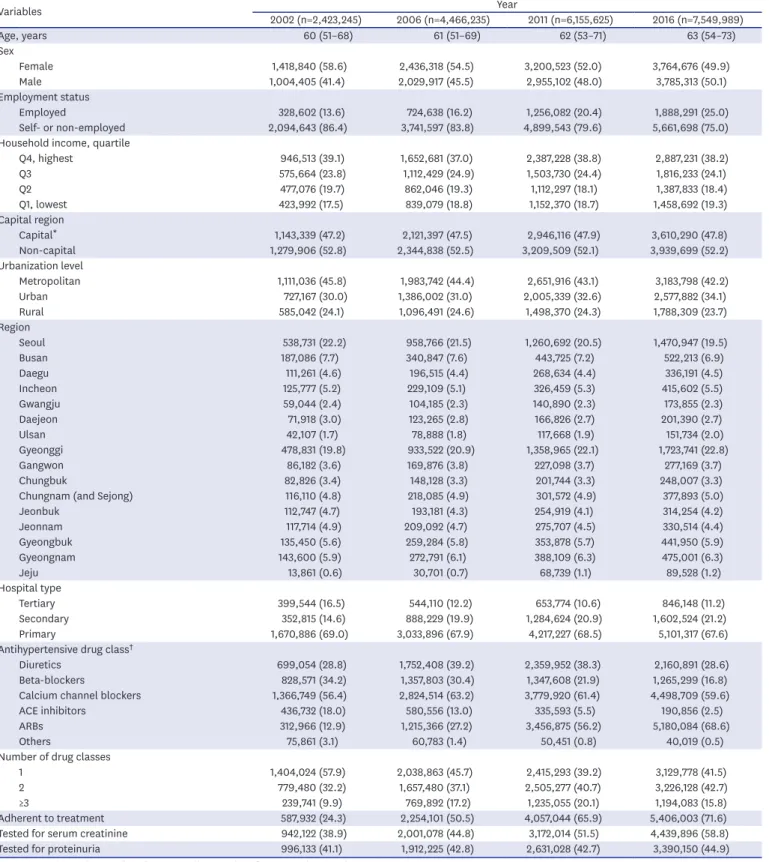
Table 1
). The proportion of
male sex and employed workers among treated patients increased over time. The geographic
distribution of patients remained largely unchanged, but an increasing proportion of
patients living in non-metropolitan urban areas was observed. Regarding antihypertensive
drug classes, the use of angiotensin II receptor blockers abruptly increased, from 12.9% in
2002 to 68.6% in 2016, while the use of beta-blockers or angiotensin-converting-enzyme
(ACE) inhibitors declined over time. The percentage of dual therapy continuously increased,
whereas the percentage of using 3 or more classes peaked at 2011 (20.1%) and started
decreasing. The proportion of patients adherent to antihypertensive treatment was 24.3% in
2002, but markedly increased reaching 71.6% in 2016. The proportion of patients screened
for complications also increased over time, although not dramatically.
516 https://e-kcj.org https://doi.org/10.4070/kcj.2018.0358
517 https://e-kcj.org https://doi.org/10.4070/kcj.2018.0358
Hypertension Management in Korea
Table 1. Population characteristics by calendar year
Variables 2002 (n=2,423,245) 2006 (n=4,466,235) Year 2011 (n=6,155,625) 2016 (n=7,549,989) Age, years 60 (51–68) 61 (51–69) 62 (53–71) 63 (54–73) Sex Female 1,418,840 (58.6) 2,436,318 (54.5) 3,200,523 (52.0) 3,764,676 (49.9) Male 1,004,405 (41.4) 2,029,917 (45.5) 2,955,102 (48.0) 3,785,313 (50.1) Employment status Employed 328,602 (13.6) 724,638 (16.2) 1,256,082 (20.4) 1,888,291 (25.0) Self- or non-employed 2,094,643 (86.4) 3,741,597 (83.8) 4,899,543 (79.6) 5,661,698 (75.0)
Household income, quartile
Q4, highest 946,513 (39.1) 1,652,681 (37.0) 2,387,228 (38.8) 2,887,231 (38.2) Q3 575,664 (23.8) 1,112,429 (24.9) 1,503,730 (24.4) 1,816,233 (24.1) Q2 477,076 (19.7) 862,046 (19.3) 1,112,297 (18.1) 1,387,833 (18.4) Q1, lowest 423,992 (17.5) 839,079 (18.8) 1,152,370 (18.7) 1,458,692 (19.3) Capital region Capital* 1,143,339 (47.2) 2,121,397 (47.5) 2,946,116 (47.9) 3,610,290 (47.8) Non-capital 1,279,906 (52.8) 2,344,838 (52.5) 3,209,509 (52.1) 3,939,699 (52.2) Urbanization level Metropolitan 1,111,036 (45.8) 1,983,742 (44.4) 2,651,916 (43.1) 3,183,798 (42.2) Urban 727,167 (30.0) 1,386,002 (31.0) 2,005,339 (32.6) 2,577,882 (34.1) Rural 585,042 (24.1) 1,096,491 (24.6) 1,498,370 (24.3) 1,788,309 (23.7) Region Seoul 538,731 (22.2) 958,766 (21.5) 1,260,692 (20.5) 1,470,947 (19.5) Busan 187,086 (7.7) 340,847 (7.6) 443,725 (7.2) 522,213 (6.9) Daegu 111,261 (4.6) 196,515 (4.4) 268,634 (4.4) 336,191 (4.5) Incheon 125,777 (5.2) 229,109 (5.1) 326,459 (5.3) 415,602 (5.5) Gwangju 59,044 (2.4) 104,185 (2.3) 140,890 (2.3) 173,855 (2.3) Daejeon 71,918 (3.0) 123,265 (2.8) 166,826 (2.7) 201,390 (2.7) Ulsan 42,107 (1.7) 78,888 (1.8) 117,668 (1.9) 151,734 (2.0) Gyeonggi 478,831 (19.8) 933,522 (20.9) 1,358,965 (22.1) 1,723,741 (22.8) Gangwon 86,182 (3.6) 169,876 (3.8) 227,098 (3.7) 277,169 (3.7) Chungbuk 82,826 (3.4) 148,128 (3.3) 201,744 (3.3) 248,007 (3.3)
Chungnam (and Sejong) 116,110 (4.8) 218,085 (4.9) 301,572 (4.9) 377,893 (5.0)
Jeonbuk 112,747 (4.7) 193,181 (4.3) 254,919 (4.1) 314,254 (4.2) Jeonnam 117,714 (4.9) 209,092 (4.7) 275,707 (4.5) 330,514 (4.4) Gyeongbuk 135,450 (5.6) 259,284 (5.8) 353,878 (5.7) 441,950 (5.9) Gyeongnam 143,600 (5.9) 272,791 (6.1) 388,109 (6.3) 475,001 (6.3) Jeju 13,861 (0.6) 30,701 (0.7) 68,739 (1.1) 89,528 (1.2) Hospital type Tertiary 399,544 (16.5) 544,110 (12.2) 653,774 (10.6) 846,148 (11.2) Secondary 352,815 (14.6) 888,229 (19.9) 1,284,624 (20.9) 1,602,524 (21.2) Primary 1,670,886 (69.0) 3,033,896 (67.9) 4,217,227 (68.5) 5,101,317 (67.6)
Antihypertensive drug class†
Diuretics 699,054 (28.8) 1,752,408 (39.2) 2,359,952 (38.3) 2,160,891 (28.6)
Beta-blockers 828,571 (34.2) 1,357,803 (30.4) 1,347,608 (21.9) 1,265,299 (16.8)
Calcium channel blockers 1,366,749 (56.4) 2,824,514 (63.2) 3,779,920 (61.4) 4,498,709 (59.6)
ACE inhibitors 436,732 (18.0) 580,556 (13.0) 335,593 (5.5) 190,856 (2.5)
ARBs 312,966 (12.9) 1,215,366 (27.2) 3,456,875 (56.2) 5,180,084 (68.6)
Others 75,861 (3.1) 60,783 (1.4) 50,451 (0.8) 40,019 (0.5)
Number of drug classes
1 1,404,024 (57.9) 2,038,863 (45.7) 2,415,293 (39.2) 3,129,778 (41.5)
2 779,480 (32.2) 1,657,480 (37.1) 2,505,277 (40.7) 3,226,128 (42.7)
≥3 239,741 (9.9) 769,892 (17.2) 1,235,055 (20.1) 1,194,083 (15.8)
Adherent to treatment 587,932 (24.3) 2,254,101 (50.5) 4,057,044 (65.9) 5,406,003 (71.6)
Tested for serum creatinine 942,122 (38.9) 2,001,078 (44.8) 3,172,014 (51.5) 4,439,896 (58.8)
Tested for proteinuria 996,133 (41.1) 1,912,225 (42.8) 2,631,028 (42.7) 3,390,150 (44.9)
Data are presented as median (interquartile range) or frequency (percent). ACE = angiotensin-converting-enzyme; ARB = angiotensin II receptor blocker.
Management of hypertension by geographic region
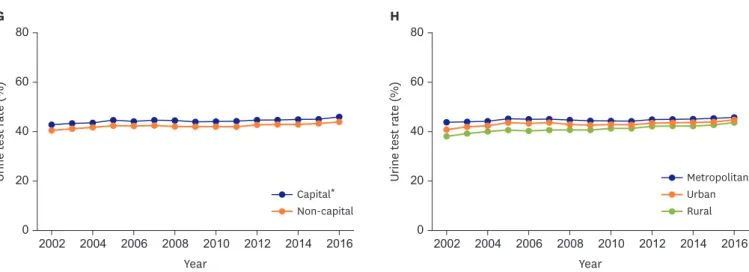
Yearly standardized rates of adherence, combination therapy, and complication screening by
capital/non-capital region or urbanization level are plotted in
Figure 1
. The same indicators
in four representative years were map-visualized in
Figure 2
, and their numeric values
518 https://e-kcj.org https://doi.org/10.4070/kcj.2018.0358
Hypertension Management in Korea
0 20 40 60 80 2002 2004 2006 2008 2010 2012 2014 2016 Year
A
Adher ence r at e (%) 0 20 40 60 80 2002 2004 2006 2008 2010 2012 2014 2016 YearB
Adher ence r at e (%) Capital* Non-capital Metropolitan Urban Rural 0 20 40 60 80 2002 2004 2006 2008 2010 2012 2014 2016 YearC
Combination ther ap y r at e (%) 0 20 40 60 80 2002 2004 2006 2008 2010 2012 2014 2016 YearD
Combination ther ap y r at e (%) Capital* Non-capital Metropolitan Urban Rural Capital* Non-capital Metropolitan Urban Rural 0 20 40 60 80 2002 2004 2006 2008 2010 2012 2014 2016 YearE
Bl ood t est r at e (%) 0 20 40 60 80 2002 2004 2006 2008 2010 2012 2014 2016 YearF
Bl ood t est r at e (%) Capital* Non-capital Metropolitan Urban Rural 0 20 40 60 80 2002 2004 2006 2008 2010 2012 2014 2016 YearG
Urine t est r at e (%) 0 20 40 60 80 2002 2004 2006 2008 2010 2012 2014 2016 YearH
Urine t est r at e (%)Figure 1. Age-sex standardized rates of hypertension management by regional characteristics and calendar year. All rates (%) are directly age-sex standardized to the 2016 population. (A, B) Adherence rates. (C, D) Combination therapy rates. (E, F) Blood test rates. (G, H) Urine test rates. (A, C, E, G) are stratified into
519 https://e-kcj.org https://doi.org/10.4070/kcj.2018.0358
Hypertension Management in Korea
% 70–75 65–70 60–65 55–60 50–55 45–50 40–45 35–40 30–35 25–30 20–25 <20 % 70–75 65–70 60–65 55–60 50–55 45–50 40–45 35–40 30–35 25–30 20–25 <20
Adherence rate
2002
2006
2011
2016
Combination therapy rate
2002
2006
2011
2016
Blood test rate
2002
2006
2011
2016
Urine test rate
2002
2006
2011
2016
Figure 2. Map visualization of hypertension management by geographic region and calendar year. Yearly rates of adherence, combination therapy, blood test, and urine test are directly age-sex standardized to the 2016 population. Fill colors represent rates in percent. Crude and standardized rates in numeric forms are
available in Supplementary Tables 3-6. (continued to the next page)
0 20 40 60 80 2002 2004 2006 2008 2010 2012 2014 2016 Year
A
Adher ence r at e (%) 0 20 40 60 80 2002 2004 2006 2008 2010 2012 2014 2016 YearB
Adher ence r at e (%) Capital* Non-capital Metropolitan Urban Rural 0 20 40 60 80 2002 2004 2006 2008 2010 2012 2014 2016 YearC
Combination ther ap y r at e (%) 0 20 40 60 80 2002 2004 2006 2008 2010 2012 2014 2016 YearD
Combination ther ap y r at e (%) Capital* Non-capital Metropolitan Urban Rural Capital* Non-capital Metropolitan Urban Rural 0 20 40 60 80 2002 2004 2006 2008 2010 2012 2014 2016 YearE
Bl ood t est r at e (%) 0 20 40 60 80 2002 2004 2006 2008 2010 2012 2014 2016 YearF
Bl ood t est r at e (%) Capital* Non-capital Metropolitan Urban Rural 0 20 40 60 80 2002 2004 2006 2008 2010 2012 2014 2016 YearG
Urine t est r at e (%) 0 20 40 60 80 2002 2004 2006 2008 2010 2012 2014 2016 YearH
Urine t est r at e (%)Figure 1. (Continued) Age-sex standardized rates of hypertension management by regional characteristics and calendar year. All rates (%) are directly age-sex standardized to the 2016 population. (A, B) Adherence rates. (C, D) Combination therapy rates. (E, F) Blood test rates. (G, H) Urine test rates. (A, C, E, G) are stratified into capital or non-capital regions. (B, D, F, H) are stratified into metropolitan, urban, or rural area.
are provided as supplements (
Supplementary Tables 3
-
6
). In 2002, age-sex standardized
adherence rates were 29.1% in the capital region, and 28.2% in metropolitan cities (31.7%
in Seoul, 27.6% in Daegu, descending), whereas adherence rates in rural areas, especially
in the southern provinces, were below 20% (14.4% in Jeonbuk, 15.6% in Jeonnam, 18.6%
in Gyeongnam, ascending). In 2006, adherence rate in Seoul reached 56.3%, but southern
regions, including Jeonnam and Jeonbuk, showed adherence rates below 45%. By 2011, all
regions reached adherence rates above 60%, and in 2016, above 65% (highest, 73.1% in
Daejeon; lowest, 69.0% in Jeonnam).
Combination therapy and complication screening rates were less heterogeneous across
regions. In 2002, the highest combination therapy rate was 48.6% in Busan, followed by
46.4% in Gangwon, while the lowest rates were 37.0% in Jeonnam and 39.5% in Gwangju. By
2011, most regions reached 60% combination therapy rate (highest, 64.6% in Gangwon), but
the rates showed decreasing trend thereafter, especially in metropolitan cities (lowest, 56.5%
in Seoul and Daegu, 2016). As for complication screening, blood test rates increased from
39.3% to 58.8% nationwide, whereas urine test rates remained below 50% across all regions
(lowest, 40.9% in Ulsan, 41.8% in Gyeongbuk, 2016).
520 https://e-kcj.org https://doi.org/10.4070/kcj.2018.0358
Hypertension Management in Korea
% 70–75 65–70 60–65 55–60 50–55 45–50 40–45 35–40 30–35 25–30 20–25 <20 % 70–75 65–70 60–65 55–60 50–55 45–50 40–45 35–40 30–35 25–30 20–25 <20
Adherence rate
2002
2006
2011
2016
Combination therapy rate
2002
2006
2011
2016
Blood test rate
2002
2006
2011
2016
Urine test rate
2002
2006
2011
2016
Figure 2. (Continued) Map visualization of hypertension management by geographic region and calendar year. Yearly rates of adherence, combination therapy, blood test, and urine test are directly age-sex standardized to the 2016 population. Fill colors represent rates in percent. Crude and standardized rates in
When stratified by sex, women, especially those living in non-capital or rural area,
had lower rates of hypertension management compared with men in 2002. However,
adherence rate and complication screening rate in women exceeded those in men over time.
Combination therapy rate, on the other hand, remained lower in women. The pattern of
hypertension management according to regional characteristics were similar in both sexes
(
Supplementary Figure 1
).
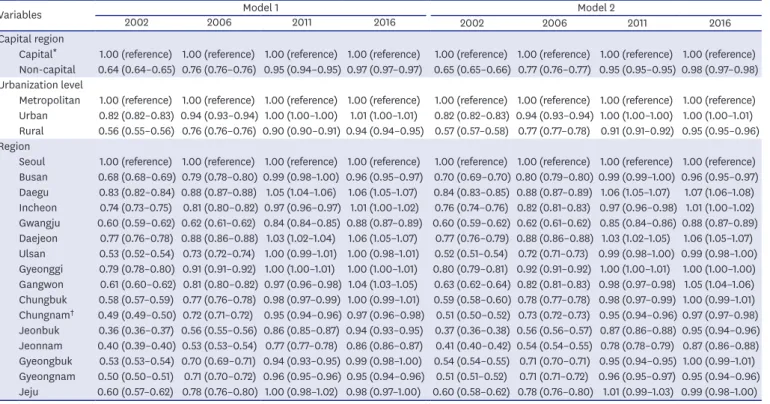
In multivariable logistic regression at individual level (
Tables 2
-
5
), the odds for being adherent
to antihypertensive treatment in most provinces were less than 60% of that in Seoul, when
adjusted for age and sex, in 2002 (lowest in Jeonbuk: OR, 0.36; 95% CI, 0.36–0.37;
Table 2
,
model 1). However, the regional difference gradually diminished over time, arriving within
20% in 2016 (highest in Daegu: OR, 1.06; 95% CI, 1.05–1.07 and lowest in Jeonnam: OR,
0.86; 95% CI, 0.86–0.87;
Table 2
, model 1). Also, for combination therapy and complication
screening, results from logistic regression were in agreement with our observations with
age-sex standardized rates. Furthermore, for all indicators of hypertension management, the
ORs remained largely unchanged, when the models were adjusted for employment status and
household income (
Tables 2
-
5
, model 2).
Finally, as some patients may visit out-of-region hospitals, we also calculated adherence
rate and combination therapy rate according to geographic region and characteristics of
the hospital prescribing the medications (
Supplementary Figures 2
and
3
). The trend of
hypertension management by region of hospital were largely similar to that by region of
residence. When stratified by hospital type, adherence rate in primary clinics was lower
than that in tertiary hospitals in 2002 (primary, 22.1%; tertiary, 36.6%), but the rate rapidly
521 https://e-kcj.org https://doi.org/10.4070/kcj.2018.0358
Hypertension Management in Korea
Table 2. Adjusted odds ratios for medication adherence according to geographic region and calendar year
Variables 2002 2006 Model 1 2011 2016 2002 2006 Model 2 2011 2016
Capital region
Capital* 1.00 (reference) 1.00 (reference) 1.00 (reference) 1.00 (reference) 1.00 (reference) 1.00 (reference) 1.00 (reference) 1.00 (reference)
Non-capital 0.64 (0.64–0.65) 0.76 (0.76–0.76) 0.95 (0.94–0.95) 0.97 (0.97–0.97) 0.65 (0.65–0.66) 0.77 (0.76–0.77) 0.95 (0.95–0.95) 0.98 (0.97–0.98)
Urbanization level
Metropolitan 1.00 (reference) 1.00 (reference) 1.00 (reference) 1.00 (reference) 1.00 (reference) 1.00 (reference) 1.00 (reference) 1.00 (reference)
Urban 0.82 (0.82–0.83) 0.94 (0.93–0.94) 1.00 (1.00–1.00) 1.01 (1.00–1.01) 0.82 (0.82–0.83) 0.94 (0.93–0.94) 1.00 (1.00–1.00) 1.00 (1.00–1.01)
Rural 0.56 (0.55–0.56) 0.76 (0.76–0.76) 0.90 (0.90–0.91) 0.94 (0.94–0.95) 0.57 (0.57–0.58) 0.77 (0.77–0.78) 0.91 (0.91–0.92) 0.95 (0.95–0.96)
Region
Seoul 1.00 (reference) 1.00 (reference) 1.00 (reference) 1.00 (reference) 1.00 (reference) 1.00 (reference) 1.00 (reference) 1.00 (reference)
Busan 0.68 (0.68–0.69) 0.79 (0.78–0.80) 0.99 (0.98–1.00) 0.96 (0.95–0.97) 0.70 (0.69–0.70) 0.80 (0.79–0.80) 0.99 (0.99–1.00) 0.96 (0.95–0.97) Daegu 0.83 (0.82–0.84) 0.88 (0.87–0.88) 1.05 (1.04–1.06) 1.06 (1.05–1.07) 0.84 (0.83–0.85) 0.88 (0.87–0.89) 1.06 (1.05–1.07) 1.07 (1.06–1.08) Incheon 0.74 (0.73–0.75) 0.81 (0.80–0.82) 0.97 (0.96–0.97) 1.01 (1.00–1.02) 0.76 (0.74–0.76) 0.82 (0.81–0.83) 0.97 (0.96–0.98) 1.01 (1.00–1.02) Gwangju 0.60 (0.59–0.62) 0.62 (0.61–0.62) 0.84 (0.84–0.85) 0.88 (0.87–0.89) 0.60 (0.59–0.62) 0.62 (0.61–0.62) 0.85 (0.84–0.86) 0.88 (0.87–0.89) Daejeon 0.77 (0.76–0.78) 0.88 (0.86–0.88) 1.03 (1.02–1.04) 1.06 (1.05–1.07) 0.77 (0.76–0.79) 0.88 (0.86–0.88) 1.03 (1.02–1.05) 1.06 (1.05–1.07) Ulsan 0.53 (0.52–0.54) 0.73 (0.72–0.74) 1.00 (0.99–1.01) 1.00 (0.98–1.01) 0.52 (0.51–0.54) 0.72 (0.71–0.73) 0.99 (0.98–1.00) 0.99 (0.98–1.00) Gyeonggi 0.79 (0.78–0.80) 0.91 (0.91–0.92) 1.00 (1.00–1.01) 1.00 (1.00–1.01) 0.80 (0.79–0.81) 0.92 (0.91–0.92) 1.00 (1.00–1.01) 1.00 (1.00–1.00) Gangwon 0.61 (0.60–0.62) 0.81 (0.80–0.82) 0.97 (0.96–0.98) 1.04 (1.03–1.05) 0.63 (0.62–0.64) 0.82 (0.81–0.83) 0.98 (0.97–0.98) 1.05 (1.04–1.06) Chungbuk 0.58 (0.57–0.59) 0.77 (0.76–0.78) 0.98 (0.97–0.99) 1.00 (0.99–1.01) 0.59 (0.58–0.60) 0.78 (0.77–0.78) 0.98 (0.97–0.99) 1.00 (0.99–1.01) Chungnam† 0.49 (0.49–0.50) 0.72 (0.71–0.72) 0.95 (0.94–0.96) 0.97 (0.96–0.98) 0.51 (0.50–0.52) 0.73 (0.72–0.73) 0.95 (0.94–0.96) 0.97 (0.97–0.98) Jeonbuk 0.36 (0.36–0.37) 0.56 (0.55–0.56) 0.86 (0.85–0.87) 0.94 (0.93–0.95) 0.37 (0.36–0.38) 0.56 (0.56–0.57) 0.87 (0.86–0.88) 0.95 (0.94–0.96) Jeonnam 0.40 (0.39–0.40) 0.53 (0.53–0.54) 0.77 (0.77–0.78) 0.86 (0.86–0.87) 0.41 (0.40–0.42) 0.54 (0.54–0.55) 0.78 (0.78–0.79) 0.87 (0.86–0.88) Gyeongbuk 0.53 (0.53–0.54) 0.70 (0.69–0.71) 0.94 (0.93–0.95) 0.99 (0.98–1.00) 0.54 (0.54–0.55) 0.71 (0.70–0.71) 0.95 (0.94–0.95) 1.00 (0.99–1.01) Gyeongnam 0.50 (0.50–0.51) 0.71 (0.70–0.72) 0.96 (0.95–0.96) 0.95 (0.94–0.96) 0.51 (0.51–0.52) 0.71 (0.71–0.72) 0.96 (0.95–0.97) 0.95 (0.94–0.96) Jeju 0.60 (0.57–0.62) 0.78 (0.76–0.80) 1.00 (0.98–1.02) 0.98 (0.97–1.00) 0.60 (0.58–0.62) 0.78 (0.76–0.80) 1.01 (0.99–1.03) 0.99 (0.98–1.00)
All values are reported as odds ratios (and 95% confidence intervals). Model 1 was adjusted for age and sex. Model 2 was further adjusted for employment status and income quartiles.
522 https://e-kcj.org https://doi.org/10.4070/kcj.2018.0358
Hypertension Management in Korea
Table 3. Adjusted odds ratios for combination therapy according to geographic region and calendar year
Variables 2002 2006 Model 1 2011 2016 2002 2006 Model 2 2011 2016
Capital region
Capital* 1.00 (reference) 1.00 (reference) 1.00 (reference) 1.00 (reference) 1.00 (reference) 1.00 (reference) 1.00 (reference) 1.00 (reference)
Non-capital 0.97 (0.97–0.98) 1.02 (1.02–1.02) 1.03 (1.03–1.03) 1.07 (1.06–1.07) 0.97 (0.97–0.98) 1.02 (1.02–1.02) 1.03 (1.02–1.03) 1.06 (1.06–1.07)
Urbanization level
Metropolitan 1.00 (reference) 1.00 (reference) 1.00 (reference) 1.00 (reference) 1.00 (reference) 1.00 (reference) 1.00 (reference) 1.00 (reference)
Urban 0.97 (0.96–0.97) 1.00 (0.99–1.00) 1.02 (1.01–1.02) 1.05 (1.04–1.05) 0.97 (0.96–0.97) 1.00 (0.99–1.00) 1.02 (1.01–1.02) 1.05 (1.04–1.05)
Rural 0.86 (0.86–0.87) 0.97 (0.97–0.98) 1.04 (1.03–1.04) 1.11 (1.11–1.12) 0.86 (0.86–0.87) 0.97 (0.97–0.98) 1.03 (1.03–1.04) 1.11 (1.10–1.11)
Region
Seoul 1.00 (reference) 1.00 (reference) 1.00 (reference) 1.00 (reference) 1.00 (reference) 1.00 (reference) 1.00 (reference) 1.00 (reference)
Busan 1.21 (1.20–1.22) 1.23 (1.22–1.24) 1.19 (1.18–1.20) 1.18 (1.17–1.19) 1.21 (1.19–1.22) 1.22 (1.21–1.23) 1.18 (1.17–1.19) 1.17 (1.17–1.18) Daegu 0.94 (0.92–0.95) 0.97 (0.96–0.98) 0.96 (0.95–0.96) 1.00 (1.00–1.01) 0.94 (0.92–0.95) 0.96 (0.96–0.98) 0.95 (0.94–0.96) 1.00 (0.99–1.01) Incheon 0.96 (0.94–0.97) 1.04 (1.03–1.05) 1.09 (1.09–1.10) 1.12 (1.11–1.13) 0.95 (0.94–0.96) 1.04 (1.03–1.05) 1.09 (1.08–1.10) 1.12 (1.11–1.12) Gwangju 0.84 (0.82–0.85) 0.97 (0.96–0.98) 1.00 (0.99–1.01) 1.03 (1.02–1.04) 0.84 (0.82–0.85) 0.97 (0.96–0.98) 1.00 (0.99–1.01) 1.03 (1.02–1.04) Daejeon 0.90 (0.88–0.91) 0.99 (0.98–1.00) 1.02 (1.01–1.03) 1.05 (1.04–1.06) 0.90 (0.88–0.91) 0.99 (0.98–1.00) 1.02 (1.01–1.03) 1.04 (1.04–1.05) Ulsan 1.03 (1.01–1.05) 1.11 (1.09–1.13) 1.16 (1.14–1.17) 1.12 (1.10–1.13) 1.03 (1.01–1.05) 1.12 (1.10–1.13) 1.17 (1.15–1.18) 1.13 (1.12–1.14) Gyeonggi 0.95 (0.94–0.96) 1.03 (1.03–1.04) 1.06 (1.06–1.07) 1.09 (1.09–1.10) 0.95 (0.94–0.96) 1.03 (1.02–1.04) 1.06 (1.05–1.07) 1.09 (1.08–1.09) Gangwon 1.12 (1.10–1.13) 1.20 (1.19–1.21) 1.23 (1.22–1.24) 1.27 (1.26–1.28) 1.11 (1.10–1.13) 1.19 (1.18–1.21) 1.23 (1.21–1.24) 1.26 (1.25–1.27) Chungbuk 0.94 (0.93–0.96) 1.00 (0.99–1.01) 1.07 (1.06–1.08) 1.17 (1.16–1.18) 0.94 (0.93–0.96) 0.99 (0.98–1.00) 1.06 (1.05–1.07) 1.16 (1.15–1.17) Chungnam† 0.85 (0.84–0.86) 1.02 (1.01–1.03) 1.12 (1.11–1.13) 1.16 (1.15–1.17) 0.85 (0.84–0.86) 1.02 (1.01–1.03) 1.12 (1.11–1.13) 1.16 (1.15–1.16) Jeonbuk 0.88 (0.87–0.90) 1.00 (0.99–1.01) 1.00 (1.00–1.01) 1.12 (1.11–1.13) 0.88 (0.87–0.89) 1.00 (0.99–1.01) 1.00 (0.99–1.01) 1.11 (1.11–1.12) Jeonnam 0.76 (0.74–0.76) 0.91 (0.90–0.92) 1.01 (1.00–1.02) 1.16 (1.15–1.17) 0.75 (0.74–0.76) 0.90 (0.89–0.91) 1.01 (1.00–1.01) 1.15 (1.14–1.16) Gyeongbuk 0.86 (0.85–0.87) 1.00 (0.99–1.01) 1.01 (1.01–1.02) 1.08 (1.08–1.09) 0.86 (0.85–0.87) 1.00 (0.99–1.01) 1.01 (1.00–1.02) 1.08 (1.07–1.09) Gyeongnam 1.01 (1.00–1.02) 1.04 (1.03–1.05) 1.07 (1.07–1.08) 1.14 (1.13–1.15) 1.01 (1.00–1.02) 1.04 (1.03–1.05) 1.07 (1.06–1.08) 1.14 (1.13–1.15) Jeju 0.87 (0.84–0.90) 0.99 (0.97–1.01) 1.00 (0.99–1.02) 1.10 (1.08–1.12) 0.87 (0.84–0.90) 0.99 (0.97–1.01) 1.00 (0.98–1.01) 1.09 (1.08–1.11)
All values are reported as odds ratios (and 95% confidence intervals). Model 1 was adjusted for age and sex. Model 2 was further adjusted for employment status and income quartiles.
*Capital region includes Seoul, Incheon, and Gyeonggi; †Sejong was merged with Chungnam.
Table 4. Adjusted odds ratios for blood test according to geographic region and calendar year
Variables 2002 2006 Model 1 2011 2016 2002 2006 Model 2 2011 2016
Capital region
Capital* 1.00 (reference) 1.00 (reference) 1.00 (reference) 1.00 (reference) 1.00 (reference) 1.00 (reference) 1.00 (reference) 1.00 (reference)
Non-capital 0.76 (0.75–0.76) 0.86 (0.85–0.86) 0.86 (0.86–0.86) 0.91 (0.90–0.91) 0.76 (0.75–0.76) 0.85 (0.85–0.86) 0.86 (0.85–0.86) 0.90 (0.90–0.90)
Urbanization level
Metropolitan 1.00 (reference) 1.00 (reference) 1.00 (reference) 1.00 (reference) 1.00 (reference) 1.00 (reference) 1.00 (reference) 1.00 (reference)
Urban 0.93 (0.92–0.94) 0.99 (0.99–1.00) 0.99 (0.99–1.00) 1.02 (1.02–1.03) 0.93 (0.92–0.94) 0.99 (0.99–1.00) 0.99 (0.99–1.00) 1.03 (1.02–1.03)
Rural 0.80 (0.80–0.81) 0.87 (0.86–0.87) 0.93 (0.93–0.94) 0.98 (0.98–0.98) 0.80 (0.80–0.81) 0.86 (0.86–0.87) 0.92 (0.92–0.93) 0.97 (0.97–0.97)
Region
Seoul 1.00 (reference) 1.00 (reference) 1.00 (reference) 1.00 (reference) 1.00 (reference) 1.00 (reference) 1.00 (reference) 1.00 (reference)
Busan 0.64 (0.64–0.65) 0.78 (0.78–0.79) 0.75 (0.74–0.75) 0.83 (0.82–0.83) 0.65 (0.64–0.66) 0.79 (0.78–0.80) 0.75 (0.74–0.75) 0.82 (0.82–0.83) Daegu 0.65 (0.64–0.66) 0.81 (0.80–0.82) 0.77 (0.76–0.77) 0.84 (0.83–0.84) 0.65 (0.64–0.66) 0.81 (0.80–0.82) 0.76 (0.76–0.77) 0.83 (0.82–0.84) Incheon 0.73 (0.72–0.74) 0.84 (0.84–0.85) 0.91 (0.90–0.92) 0.90 (0.90–0.91) 0.74 (0.73–0.75) 0.85 (0.85–0.86) 0.91 (0.91–0.92) 0.90 (0.90–0.91) Gwangju 0.78 (0.76–0.79) 0.92 (0.91–0.93) 0.88 (0.87–0.89) 0.93 (0.92–0.94) 0.77 (0.76–0.79) 0.92 (0.91–0.93) 0.88 (0.87–0.89) 0.92 (0.92–0.93) Daejeon 0.72 (0.71–0.73) 0.86 (0.86–0.88) 0.76 (0.75–0.77) 0.73 (0.72–0.74) 0.72 (0.71–0.73) 0.86 (0.86–0.88) 0.76 (0.75–0.77) 0.73 (0.72–0.74) Ulsan 0.69 (0.68–0.70) 0.76 (0.75–0.77) 0.77 (0.76–0.78) 0.84 (0.83–0.85) 0.69 (0.68–0.71) 0.76 (0.75–0.77) 0.76 (0.75–0.77) 0.83 (0.82–0.84) Gyeonggi 0.82 (0.81–0.83) 0.92 (0.92–0.92) 0.90 (0.90–0.91) 0.95 (0.94–0.95) 0.82 (0.82–0.83) 0.92 (0.92–0.93) 0.91 (0.90–0.91) 0.95 (0.95–0.96) Gangwon 0.84 (0.83–0.85) 0.86 (0.85–0.87) 0.93 (0.92–0.94) 1.04 (1.03–1.05) 0.84 (0.83–0.86) 0.86 (0.85–0.87) 0.92 (0.92–0.93) 1.04 (1.03–1.04) Chungbuk 0.61 (0.60–0.62) 0.75 (0.74–0.76) 0.80 (0.79–0.81) 0.90 (0.89–0.91) 0.62 (0.61–0.63) 0.75 (0.74–0.76) 0.80 (0.79–0.81) 0.90 (0.89–0.90) Chungnam† 0.70 (0.70–0.71) 0.84 (0.83–0.85) 0.87 (0.87–0.88) 0.89 (0.88–0.90) 0.71 (0.70–0.72) 0.84 (0.83–0.85) 0.87 (0.86–0.88) 0.88 (0.87–0.89) Jeonbuk 0.70 (0.69–0.71) 0.75 (0.74–0.76) 0.79 (0.78–0.79) 0.85 (0.85–0.86) 0.70 (0.69–0.71) 0.75 (0.74–0.76) 0.78 (0.78–0.79) 0.84 (0.84–0.85) Jeonnam 0.61 (0.60–0.62) 0.82 (0.81–0.82) 0.83 (0.83–0.84) 0.88 (0.87–0.88) 0.61 (0.60–0.62) 0.82 (0.81–0.82) 0.83 (0.82–0.83) 0.87 (0.86–0.87) Gyeongbuk 0.66 (0.65–0.67) 0.75 (0.74–0.75) 0.78 (0.77–0.78) 0.84 (0.84–0.85) 0.66 (0.65–0.67) 0.75 (0.74–0.75) 0.77 (0.77–0.78) 0.83 (0.83–0.84) Gyeongnam 0.61 (0.60–0.62) 0.84 (0.83–0.84) 0.83 (0.82–0.84) 0.90 (0.90–0.91) 0.62 (0.61–0.62) 0.84 (0.83–0.84) 0.82 (0.82–0.83) 0.90 (0.89–0.90) Jeju 0.77 (0.74–0.80) 1.16 (1.14–1.19) 1.07 (1.05–1.08) 1.10 (1.08–1.11) 0.77 (0.74–0.80) 1.16 (1.13–1.19) 1.06 (1.04–1.08) 1.09 (1.07–1.10)
All values are reported as odds ratios (and 95% confidence intervals). Model 1 was adjusted for age and sex. Model 2 was further adjusted for employment status and income quartiles.
improved and exceeded that of tertiary hospitals in 2008 and thereafter (primary, 74.7%;
tertiary, 70.1%; in 2016). In case of combination therapy rate, the overall trend of rise and
fall was observed in all three hospital types, but the decline after 2011 was more rapid in
secondary and tertiary hospitals than in primary clinics.
DISCUSSION
In this nationwide study of persons treated for hypertension in Korea, we observed a trend
of diminishing regional variation in hypertension management from 2002 to 2016. The
largest inter-regional difference in the OR for medication adherence decreased from 64%
in 2002 to 20% in 2016; and for combination therapy, from 45% in 2002 to 27% in 2016.
Geographic distributions of complication screening rates were less heterogeneous. Of note,
this is the first study to describe regional difference of hypertension management in Korea.
Given that the NHI was universally implemented by 1989, finding of such low adherence
rates and large regional differences in the early 2000s is interesting, as is the rapid
improvements made thereafter.
Adherence rates have substantially increased nationwide, reaching 70% in most regions by
2013. On the other hand, the recent decreasing trend of combination therapy rate is quite
unexpected. While dual therapy rates are constantly increasing, triple (or higher) therapy
rates have been slowly decreasing across all regions after 2011. As we do not have data on
achieved BPs, it is unclear whether this trend reflects less intensive BP control, less need for
triple therapy to achieve target BP, or a greater influx of new patients with initial single or
523 https://e-kcj.org https://doi.org/10.4070/kcj.2018.0358
Hypertension Management in Korea
Table 5. Adjusted odds ratios for urine test according to geographic region and calendar year
Variables 2002 2006 Model 1 2011 2016 2002 2006 Model 2 2011 2016
Capital region
Capital* 1.00 (reference) 1.00 (reference) 1.00 (reference) 1.00 (reference) 1.00 (reference) 1.00 (reference) 1.00 (reference) 1.00 (reference)
Non-capital 0.92 (0.92–0.93) 0.92 (0.92–0.93) 0.92 (0.91–0.92) 0.93 (0.93–0.93) 0.92 (0.92–0.93) 0.92 (0.92–0.92) 0.91 (0.91–0.92) 0.92 (0.92–0.92)
Urbanization level
Metropolitan 1.00 (reference) 1.00 (reference) 1.00 (reference) 1.00 (reference) 1.00 (reference) 1.00 (reference) 1.00 (reference) 1.00 (reference)
Urban 0.90 (0.90–0.91) 0.94 (0.93–0.94) 0.94 (0.94–0.94) 0.96 (0.96–0.96) 0.90 (0.90–0.91) 0.94 (0.93–0.94) 0.94 (0.94–0.94) 0.96 (0.96–0.96)
Rural 0.80 (0.80–0.81) 0.83 (0.83–0.84) 0.88 (0.88–0.89) 0.91 (0.91–0.92) 0.80 (0.79–0.80) 0.83 (0.83–0.84) 0.88 (0.87–0.88) 0.91 (0.90–0.91)
Region
Seoul 1.00 (reference) 1.00 (reference) 1.00 (reference) 1.00 (reference) 1.00 (reference) 1.00 (reference) 1.00 (reference) 1.00 (reference)
Busan 0.85 (0.84–0.86) 0.91 (0.90–0.92) 0.89 (0.89–0.90) 0.93 (0.92–0.94) 0.85 (0.84–0.86) 0.91 (0.91–0.92) 0.89 (0.89–0.90) 0.93 (0.92–0.93) Daegu 0.91 (0.90–0.92) 0.98 (0.97–0.99) 0.91 (0.90–0.91) 0.89 (0.88–0.90) 0.91 (0.90–0.92) 0.98 (0.97–0.99) 0.90 (0.90–0.91) 0.88 (0.88–0.89) Incheon 0.86 (0.85–0.87) 0.92 (0.91–0.92) 0.96 (0.95–0.97) 0.98 (0.98–0.99) 0.87 (0.86–0.88) 0.92 (0.92–0.93) 0.96 (0.96–0.97) 0.98 (0.98–0.99) Gwangju 1.14 (1.12–1.16) 1.09 (1.08–1.11) 1.03 (1.02–1.04) 1.07 (1.05–1.08) 1.14 (1.12–1.16) 1.09 (1.08–1.11) 1.03 (1.02–1.04) 1.06 (1.05–1.07) Daejeon 0.89 (0.88–0.90) 0.97 (0.96–0.98) 0.86 (0.85–0.87) 0.88 (0.87–0.89) 0.89 (0.88–0.90) 0.97 (0.96–0.99) 0.86 (0.85–0.87) 0.88 (0.87–0.89) Ulsan 0.81 (0.80–0.83) 0.84 (0.82–0.85) 0.78 (0.77–0.79) 0.78 (0.78–0.79) 0.82 (0.80–0.83) 0.84 (0.82–0.85) 0.78 (0.77–0.79) 0.78 (0.77–0.79) Gyeonggi 0.82 (0.82–0.83) 0.91 (0.90–0.91) 0.90 (0.90–0.90) 0.93 (0.93–0.94) 0.83 (0.82–0.83) 0.91 (0.91–0.92) 0.90 (0.90–0.90) 0.93 (0.93–0.94) Gangwon 0.82 (0.80–0.83) 0.82 (0.81–0.82) 0.86 (0.86–0.87) 0.89 (0.88–0.89) 0.81 (0.80–0.83) 0.82 (0.81–0.83) 0.86 (0.85–0.87) 0.88 (0.87–0.89) Chungbuk 0.74 (0.73–0.75) 0.77 (0.76–0.78) 0.81 (0.80–0.82) 0.85 (0.85–0.86) 0.74 (0.73–0.75) 0.78 (0.77–0.78) 0.81 (0.80–0.81) 0.85 (0.84–0.86) Chungnam† 0.82 (0.81–0.84) 0.84 (0.83–0.84) 0.86 (0.85–0.86) 0.89 (0.88–0.90) 0.82 (0.81–0.84) 0.84 (0.83–0.84) 0.85 (0.84–0.86) 0.88 (0.88–0.89) Jeonbuk 0.95 (0.94–0.96) 0.93 (0.92–0.94) 0.94 (0.93–0.95) 0.99 (0.98–1.00) 0.95 (0.94–0.96) 0.93 (0.92–0.94) 0.93 (0.93–0.94) 0.98 (0.97–0.99) Jeonnam 0.80 (0.80–0.82) 0.89 (0.88–0.90) 0.90 (0.90–0.91) 0.93 (0.92–0.94) 0.80 (0.79–0.82) 0.89 (0.88–0.90) 0.90 (0.89–0.91) 0.92 (0.91–0.93) Gyeongbuk 0.80 (0.79–0.81) 0.79 (0.79–0.80) 0.80 (0.79–0.80) 0.82 (0.81–0.82) 0.80 (0.79–0.81) 0.79 (0.79–0.80) 0.79 (0.79–0.80) 0.81 (0.80–0.81) Gyeongnam 0.70 (0.69–0.71) 0.82 (0.81–0.82) 0.82 (0.82–0.83) 0.85 (0.85–0.86) 0.70 (0.69–0.71) 0.82 (0.81–0.82) 0.82 (0.82–0.83) 0.85 (0.84–0.85) Jeju 0.82 (0.80–0.85) 1.01 (0.99–1.04) 0.99 (0.97–1.00) 1.10 (1.09–1.12) 0.82 (0.79–0.85) 1.01 (0.99–1.03) 0.98 (0.96–1.00) 1.10 (1.08–1.11)
All values are reported as odds ratios (and 95% confidence intervals). Model 1 was adjusted for age and sex. Model 2 was further adjusted for employment status and income quartiles.
dual therapy. In the Korean National Health and Nutrition Examination Survey (KNHANES),
1998–2016, the rate of BP control below 140/90 mmHg have plateaued at 70% among treated
patients after 2010.
13)However, information on antihypertensive regimen was not available
in KNHANES. In the early- to mid-2010s, results from the Action to Control Cardiovascular
Risk in Diabetes blood pressure (ACCORD BP) trial
15)and the subsequent 2013 European
Society of Hypertension (ESH)/European Society of Cardiology (ESC)
16)and the 2014 Eighth
Joint National Committee (JNC-8)
17)hypertension guidelines de-emphasized the importance
of intensive BP lowering. The impact of such guidelines may have been reflected in this
decreasing trend of combination therapy after 2011, especially in secondary and tertiary
hospitals. In this regard, it would be interesting to see the impact of Systolic Blood Pressure
Intervention Trial (SPRINT)
18)and the recent 2017 American College of Cardiology/American
Heart Association
19)and 2018 ESC/ESH
20)guidelines on combination therapy rate in Korea in
the near future.
For complication screening, The Korean Society of Hypertension recommends annual testing
for proteinuria, and blood chemistry, including creatinine and electrolytes.
21)22)Blood test
rates have modestly improved, but still remains below 60% in most regions. Urine test rates
have been stagnant below 50% across all regions. Particularly, urine microalbumin tests are
done in less than 30%, with no improvement over 15 years. Measurement of random urine
albumin-to-creatinine ratio, for screening glomerular injury, should be more advocated as
per international guidelines.
19)20)The reason for regional variation in hypertension management is not entirely understood.
A British study on hypertension treatment found attenuated regional effect when adjusted
for sociodemographic factors including employment, education, etc.
6)However, the
study compared London with the rest of England, rather than inter-comparing regions or
districts. Another study using small spatial units in Germany suggested areal deprivation to
be associated with disease distribution.
10)In our study, geographic effect on hypertension
management remained unchanged, even after serial adjustment for individual-level
sociodemographic variables, although lifestyle factors were not included in the model. In
this regard, the large regional difference in the early 2000s, as well as its resolution, may be
related to regional characteristics or infrastructures, rather than individual-level risk factors.
Our study has some notable strengths. Using a nationwide database of the entire Korean
population, we captured nearly all cases of treated hypertension, providing representative
indicators that may be useful for local governments and policymakers. Importantly, these
indicators of hypertension management, as well as other covariates, were derived from
objective data rather than self-report. Furthermore, individual-level data on residential
areas, sociodemographic factors, and healthcare utilization were available. However, our
study also has some limitations. First, diagnosis of hypertension was based on medical
claims rather than clinical information. Definition of hypertension using administrative
data has been well reviewed elsewhere.
23)However, the true prevalence of hypertension
cannot be determined, and individuals untreated or with no healthcare utilization would
not be identified by claims data. Second, analyses on smaller regional units were not done.
Aggregate figures are weighed more on populous subunits, and thus may underrepresent less
inhabited areas. Using smaller areal units, with smoothing methods,
24)would achieve a finer
geospatial assessment, but would deviate from our purpose of providing useful indicators at
provincial level. Third, in the logistic model, temporal and geospatial effects were analyzed
separately rather than simultaneously. Therefore, inference on the change of geospatial effect
524 https://e-kcj.org https://doi.org/10.4070/kcj.2018.0358
over time cannot be made, and would instead require a multilevel approach. Fourth, lifestyle
factors and other unmeasured confounders may have contributed to geographic variations
at individual level. Lastly, this study excluded Medical Aid beneficiaries, and thus should be
interpreted accordingly.
In conclusion, geographic variation of hypertension management in Korea had been
concerning, but the difference has become less apparent over the last 15 years. Adherence
rates have plateaued above 70% nationwide. Recently decreasing trend of combination
therapy rates should be noted, but its clinical implication is yet unclear. Finally, there is still
room for improvement in complication screening, especially for proteinuria.
SUPPLEMENTARY MATERIALS
Supplementary Table 1
Index drug codes
Click here to view
Supplementary Table 2
Study population size
Click here to view
Supplementary Table 3
Crude and standardized adherence rates by geographic region and calendar year
Click here to view
Supplementary Table 4
Crude and standardized combination therapy rates by geographic region and calendar year
Click here to view
Supplementary Table 5
Crude and standardized blood test rates by geographic region and calendar year
Click here to view
Supplementary Table 6
Crude and standardized urine test rates by geographic region and calendar year
Click here to view
Supplementary Figure 1
Age-standardized rates of hypertension management stratified by sex.
Click here to view
525 https://e-kcj.org https://doi.org/10.4070/kcj.2018.0358
Supplementary Figure 2
Age-sex standardized rates of hypertension management by hospital characteristics and
calendar year.
Click here to view
Supplementary Figure 3
Map visualization of hypertension management by hospital region and calendar year.
Click here to view
REFERENCES
1. GBD 2016 Risk Factors Collaborators. Global, regional, and national comparative risk assessment of 84 behavioural, environmental and occupational, and metabolic risks or clusters of risks, 1990–2016: a
systematic analysis for the Global Burden of Disease Study 2016. Lancet 2017;390:1345-422.
PUBMED | CROSSREF
2. Grotto I, Huerta M, Sharabi Y. Hypertension and socioeconomic status. Curr Opin Cardiol 2008;23:335-9.
PUBMED | CROSSREF
3. Chow CK, Teo KK, Rangarajan S, et al. Prevalence, awareness, treatment, and control of hypertension in
rural and urban communities in high-, middle-, and low-income countries. JAMA 2013;310:959-68.
PUBMED | CROSSREF
4. Lloyd-Sherlock P, Beard J, Minicuci N, Ebrahim S, Chatterji S. Hypertension among older adults in low-
and middle-income countries: prevalence, awareness and control. Int J Epidemiol 2014;43:116-28.
PUBMED | CROSSREF
5. Reynolds K, Gu D, Muntner P, et al. Geographic variations in the prevalence, awareness, treatment and
control of hypertension in China. J Hypertens 2003;21:1273-81.
PUBMED | CROSSREF
6. Mindell JS, Shelton NJ, Roth MA, Chaudhury M, Falaschetti E. Persistent regional variation in treatment
of hypertension. Public Health 2012;126:317-23.
PUBMED | CROSSREF
7. Marques-Vidal P, Paccaud F. Regional differences in self-reported screening, prevalence and management
of cardiovascular risk factors in Switzerland. BMC Public Health 2012;12:246.
PUBMED | CROSSREF
8. Stöckl D, Rückert-Eheberg IM, Heier M, et al. Regional variability of lifestyle factors and hypertension with prediabetes and newly diagnosed type 2 diabetes mellitus: the population-based KORA-F4 and
SHIP-TREND studies in Germany. PLoS One 2016;11:e0156736.
PUBMED | CROSSREF
9. Yin M, Augustin B, Fu Z, Yan M, Fu A, Yin P. Geographic distributions in hypertension diagnosis, measurement, prevalence, awareness, treatment and control rates among middle-aged and older adults in
China. Sci Rep 2016;6:37020.
PUBMED | CROSSREF
10. Kauhl B, Maier W, Schweikart J, Keste A, Moskwyn M. Exploring the small-scale spatial distribution of hypertension and its association to area deprivation based on health insurance claims in Northeastern
Germany. BMC Public Health 2018;18:121.
PUBMED | CROSSREF
11. OECD iLibrary. Doctors' Consultations. [place unknown]: OECD iLibrary; 2018.
CROSSREF
12. National Health Insurance Service. 2016 National Health Screening Statistical Yearbook. Wonju: National Health
Insurance Service; 2017.
13. Korean Society Hypertension (KSH); Hypertension Epidemiology Research Working Group, Kim HC,
Cho MC. Korea hypertension fact sheet 2018. Clin Hypertens 2018;24:13.
PUBMED | CROSSREF
14. Seong SC, Kim YY, Khang YH, et al. Data resource profile: the national health information database of
the national health insurance service in South Korea. Int J Epidemiol 2017;46:799-800.
PUBMED | CROSSREF
526 https://e-kcj.org https://doi.org/10.4070/kcj.2018.0358
15. ACCORD Study Group, Cushman WC, Evans GW, et al. Effects of intensive blood-pressure control in type
2 diabetes mellitus. N Engl J Med 2010;362:1575-85.
PUBMED | CROSSREF
16. Mancia G, Fagard R, Narkiewicz K, et al. 2013 ESH/ESC guidelines for the management of arterial hypertension: the Task Force for the Management of Arterial Hypertension of the European Society of
Hypertension (ESH) and of the European Society of Cardiology (ESC). Eur Heart J 2013;34:2159-219.
PUBMED | CROSSREF
17. James PA, Oparil S, Carter BL, et al. 2014 evidence-based guideline for the management of high blood pressure in adults: report from the panel members appointed to the Eighth Joint National Committee
(JNC 8). JAMA 2014;311:507-20.
PUBMED | CROSSREF
18. SPRINT Research Group, Wright JT Jr, Williamson JD, et al. A randomized trial of intensive versus
standard blood-pressure control. N Engl J Med 2015;373:2103-16.
PUBMED | CROSSREF
19. Whelton PK, Carey RM, Aronow WS, et al. 2017 ACC/AHA/AAPA/ABC/ACPM/AGS/APhA/ASH/ASPC/ NMA/PCNA guideline for the prevention, detection, evaluation, and management of high blood pressure in adults: a report of the American College of Cardiology/American Heart Association Task Force on
Clinical Practice Guidelines. Hypertension 2018;71:e13-115.
PUBMED | CROSSREF
20. Williams B, Mancia G, Spiering W, et al. 2018 ESC/ESH guidelines for the management of arterial
hypertension. Eur Heart J 2018;39:3021-104.
PUBMED | CROSSREF
21. Shin J, Park JB, Kim KI, et al. 2013 Korean Society of Hypertension guidelines for the management of
hypertension: part I-epidemiology and diagnosis of hypertension. Clin Hypertens 2015;21:1.
PUBMED | CROSSREF
22. Shin J, Park JB, Kim KI, et al. 2013 Korean Society of Hypertension guidelines for the management of
hypertension: part II-treatments of hypertension. Clin Hypertens 2015;21:2.
PUBMED | CROSSREF
23. Halpern MT, Khan ZM, Schmier JK, et al. Recommendations for evaluating compliance and persistence
with hypertension therapy using retrospective data. Hypertension 2006;47:1039-48.
PUBMED | CROSSREF
24. Pedigo A, Aldrich T, Odoi A. Neighborhood disparities in stroke and myocardial infarction mortality: a
GIS and spatial scan statistics approach. BMC Public Health 2011;11:644.
PUBMED | CROSSREF
527 https://e-kcj.org https://doi.org/10.4070/kcj.2018.0358