들어가는 말
진드기는 분류상 거미강(Class: Arachnida)에 속하며, 다리가 4쌍 이고 날개가 없는 것이 특 징인 절지 동 물 이다. 세 계 적 으 로 약 5 0 ,0 0 0 종 이 상 의 진드 기가 보 고 되었고 , 참진드기과(Family: Ixodidae)의 진드기는 약 700종이 기록되어 있으며, 국내에서는 5속 27종이 보고되었다[1]. 참진드기는 바이러스 , 세균, 리케치아 및 기생충 등 다양 한 병원체를 전파하는 감염병 매개체로 잘 알려져 있다. 국내에 서식하고 있는 참진드기가 매개하 는 질병은 진드기매개티프 스(tick-2018년 참진드기 전국 분포조사 현황
질병관리본부 감염병분석센터 매개체분석과 노병언, 이욱교, 이희일, 조신형* *교신저자 : [email protected], 043-719-8520Geographical distribution of ticks in the Republic of Korea in 2018
Noh Byung-Eon, Lee Wook-Gyo, Lee Hee il, Cho Shin-Hyeong
Division of Vectors and Parasitic Diseases, Center for Laboratory Control of Infectious Diseases, KCDC
Tick-borne diseases are caused by various pathogens, such as severe fever with thrombocytopenia syndrome (SFTS) virus, tick-borne encephalitis (TBE) virus, arthropod-associated bacteria (e.g., Borrelia, Richettsia), and protozoan parasites (e.g., Babesia). Reported cases of diseases caused by these pathogens have been steadily on the increase in the Republic of Korea in recent year. The present study was conducted to monitor the distribution of ticks, which are the main vectors transmitting these pathogens. A flagging method was used in four different types of environments, including graveyards, mountain roads, copses, and grasslands, in 46 regions of the Republic of Korea. In total, 45,974 ticks belonging to five species and three genera were collected through this survey. Haemaphysalis longicornis was the predominant species at all collection sites, reaching abundances of 44,161 (96.1%) of the ticks found. The second most common species was H. flava (1,427 ticks; 3.1% of the total), followed by Ixodes nipponensis (310 ticks; 0.7%), H. japonica (66 ticks; 0.1%), and Amblyomma testudinarium (10 ticks; < 0.1%). The flag index (F.I.) was the highest in Gyeonggi-do (77.8), and the lowest in Seoul (0.1). The majority of ticks were collected in grassland environments (13,075 ticks; 28.4% of the total), followed by copses (12,377 ticks; 26.9%), mountain roads (10,641 ticks; 23.1%), and graveyards (9,881 ticks; 21.5%). The continuous surveillance of tick-borne diseases vectors is becoming increasingly important to geopathology in the Republic of Korea. Thus, efforts to expand the number and scale of collection sites and periods surveyed and monitored for ticks are necessary to protect public health.
A. testudinarium < 0.1% H. flava3.1% H. japonica 0.1% H. longicornis 96.1% I. nipponensis 0.7%
Figure 1. Species ratio of collected ticks in 46 areas
Table 1. Flag Index* of collected ticks from 46 area using flagging methods in seven metropolitan cities and nine provinces during May and June in 2018
Genus Species Area
Amblyomma Haemaphysalis Ixodes
Total testudinarium flava japonica longicornis nipponensis
Seoul 0.0 0.0 0.0 0.1 0.0 0.1 Busan 0.0 0.0 0.0 66.5 0.0 66.5 Daegu 0.0 0.5 0.0 25.7 0.1 26.3 Incheon 0.0 0.6 0.0 42.4 0.1 43.1 Gwangju 0.0 0.0 0.0 26.4 0.0 26.4 Daejeon 0.0 0.0 0.0 5.9 0.0 5.9 Ulsan 0.0 0.0 0.0 61.8 4.9 66.7 Gyeonggi-do 0.0 0.7 0.0 77.1 < 0.1 77.8 Gangwon-do 0.0 1.6 0.3 46.2 0.3 48.5 Chungcheongbuk-do 0.0 0.7 0.0 19.7 < 0.1 20.4 Chungcheongnam-do 0.0 3.4 0.0 36.0 0.5 39.9 Jeollabuk-do < 0.1 0.6 0.0 35.5 0.2 36.3 Jeollanam-do < 0.1 1.2 0.0 30.4 0.1 31.7 Gyeongsangbuk-do 0.0 2.7 0.0 41.3 0.4 44.4 Gyeongsangnam-do < 0.1 1.4 0.0 44.5 0.0 45.9 Jeju-do 0.0 1.5 0.0 31.2 0.0 32.7 Total < 0.1 1.3 0.1 40.0 0.3 41.6
borne typhus), 진드기매개뇌염(tick-borne encephalitis), 아나 플라즈마 증(anaplasmosis), 에르리히증(Ehrlichiosis), 야 토 병 ( t u l a r e m i a ) , 바 베 스 열 원 충 증 ( b a b e s i o s i s ) , 타일레리아증(theileriasis) 등이 있다[2,3,4]. 국내에 서식하는 참진드기에서는 작은소피참진드기(Haemaphysalis longicornis), 개피참진드기(H. flava), 일본참진드기(Ixodes nipponensis)가 주요 종으로 확인되었으며, 이들 종에서 리케치아, 진드기매개뇌염 바이러스, 중 증열성혈소판감소증후군 (S evere Fever with Thrombocytopenia Syndrome, SFTS) 바이러스 유전자 검출이 보고되었다[4,5]. 2013년 국내에서 중증열성혈소판감소증후군(SFTS) 환자가 처음으로 보고된 후 동년 36건, ’14년 55건, ’15년 79건, ’16년 165건, ’17년 272건으로 매년 증가되는 추세에 있다[6]. 또한 참진드기에 의한 라임병(Lyme disease)도 2012년 첫 환자 발생 이후 계속 증가하고 있다. 참진드기는 모기, 이, 벼룩 등 다른 위생곤충에 비해 생활사가 길고 매년 다른 발생 양상을 보이기 때문에 장기적 조사를 통하여 생태학적 자료 수집이 필요하다. 따라서 질병관리본부 매개체분석과에서는 매개체 전파질환의 효율적인 예방 및 관리를 위해 참진드기의 발생밀도 및 분포, 병원체 감염률에 대한 기초자료를 확보하고자 「권역별 기후변화 매개체 감시 거점센터」를 대상으로 지속적인 조사감시 체계를 구축하여
(A) Total ticks (B) H. longicornis (C) H. flava
(D) I. nipponensis (E) A. testudinarium (F) H. japonica
운영하고 있다. 이 글에서는 2018년 거점센터에서 수행한 참진드기 전국분포 현황을 분석하여 참진드기 매개질환의 예방 및 관리를 위한 기초자료를 제공하고자 한다.
몸 말
1) 지역별 분포
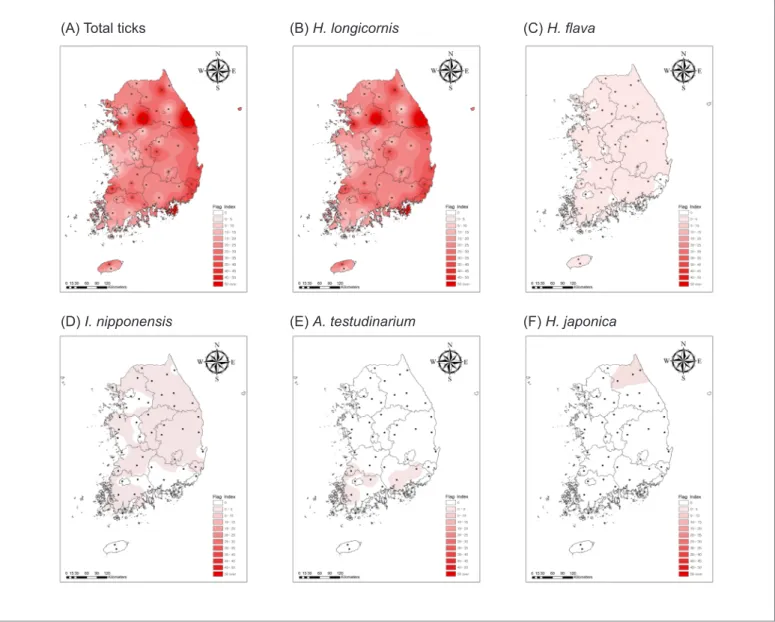
기후변화 대응 감염병 매개체 조사감시 사업의 일환으로 참진드기의 전국분포를 조사하기 위해 3년 주기로 조사를 실시하고 있다. 올해(2018)는 16개의 거점센터에서 전국 참진드기 분포조사를 실시하였으며, 조사지역은 총 46개 지역으로 서울특별시와 광역시 6개 지역(부산, 대전, 대구, 광주, 울산, 인천), 강원 8개 지역(삼척, 속초, 영월, 인제, 철원, 춘천, 평창, 횡성), 경기 4개 지역(여주, 포천, 화성, 광주), 경남 4개 지역(거제, 밀양, 진주, 함양), 경북 6개 지역(문경, 상주, 안동, 영덕, 울진, 포항), 전남 5개 지역(곡성, 광양, 보성, 영암, 완도), 전북 4개 지역(고창, 군산, 임실, 진안), 충북 2개 지역(보은, 음성), 충남 4개 지역(당진, 보령, 천안, 홍성), 제주 2개 지역(제주, 서귀포)에서 채집을 실시하였다. 조사는 5월과 6월에 월 1회로 지역별로 4개의 환경(잡목림, 초지, 무덤, 산길)을 선정하여 flagging method(채집용 천 : 1 m × 1 m)를 이용하여 채집환경 당 20회(20 ㎡)를 실시하였다. 전국 분포조사 를 수행한 결과 3속 5종, 45,974개체의 참진드기를 채집하였으며, 채집된 참진드기의 종별 분포로는 작은소피참진드기 44,161개체(96.1%), 개피참진드기 1,427개체(3.1%), 일본참진드기 310개체(0.7%) 사 슴피참진드기(H. japonica ) 66개체(0.1%), 뭉뚝참진드기(Amblyomma testudinarium ) 10개체(< 0.1%) 순이었으며, 작은소피참진드기가 국내 우점종임을 확인하였다(Figure 1). Flag Index(F.I; No. of tick/No. of flagging)가 가장 높게 나타난 지역은 경기도지역(F.I. 77.8)이었으며, 가장 낮은 지역은 서울특별시(F.I. 0.1)였다(Table 1). 뭉뚝참진드기의 경우에는 경남, 전남, 전북지역에서만 채집되었으며, 사슴피참진드기는 강원도에서만 채집되었다. 채집된 진드기는 종별로도 지역적인 차이를 보였으며, 지역마다 개체수의 차이도 보였다(Figure 2).2) 환경별 분포
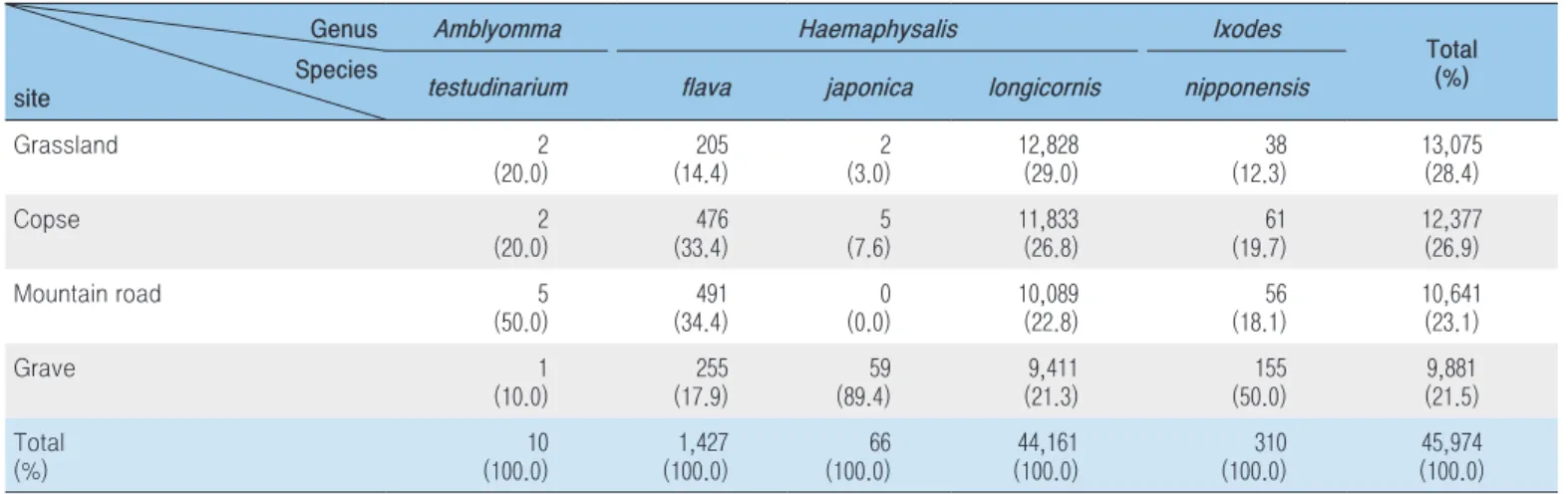
서식환경별 조 사 는 초지(grassland), 잡목림(copse), 산길(mountain road), 무덤(grave)으로 구분하여 참진드기 채집 개체수를 비교한 결과, 초지에서 13,075개체로 가장 많은 개체가 채집 되었고, 다음이 잡목림(12,377개체), 산길(10,641개체) 그리고 무덤(9,881개체) 순으로 나타났다(Table 2). 작은소피참진드기는 초지(29.0%), 잡목림(26.8%), 산길(22.8%), 무덤(21.3%) 순으로 높은 비율을 차지하였다. 개피참진드기는 산길(34.4%), 잡목림(33.4%)에서 높 은 개 체 수 가 채 집 되 었 고 , 사 슴 피 참 진 드 기 ( 8 9 . 4 % ) 와Table 2. Total number of ticks and species ratio from four environments
Genus Species site
Amblyomma Haemaphysalis Ixodes
Total (%) testudinarium flava japonica longicornis nipponensis
Grassland 2 (20.0) 205 (14.4) 2 (3.0) 12,828 (29.0) 38 (12.3) 13,075 (28.4) Copse 2 (20.0) 476 (33.4) 5 (7.6) 11,833 (26.8) 61 (19.7) 12,377 (26.9) Mountain road 5 (50.0) 491 (34.4) 0 (0.0) 10,089 (22.8) 56 (18.1) 10,641 (23.1) Grave 1 (10.0) 255 (17.9) 59 (89.4) 9,411 (21.3) 155 (50.0) 9,881 (21.5) Total (%) 10 (100.0) 1,427 (100.0) 66 (100.0) 44,161 (100.0) 310 (100.0) 45,974 (100.0)
일 본 참진 드 기 (5 0 . 0 %) 는 대 부 분 무덤에 서 채 집되었으 며, 뭉뚝참진드기는 산길(50.0%)에서 가장 많이 채집되었다(Table 2).
맺는 말
국내에서 참진드기로 인해 발생되는 중증열성혈소판감소증후군 (SFTS)은 2013년에 첫 환자가 발생한 이후 매년 환자 발생 및 사망자 수가 지속적으로 증가 추세에 있고, 또한 최근 참진드기 매개질환인 라임병, 아나플라즈마증 등의 환자도 발생하고 있다. 향후 기후·환경 변화에 의해 감염병 매개체의 서식·분포가 확대될 수 있음에 따라 매개체 전파 질환의 대유행 가능성에 대한 대비가 필요하다. 따라서 현재 중증열성혈소판감소증후군 위주의 참진드기 감시체계에서 라임병, 아나플라즈마증 등도 포함된 감시체계 확대·구축이 필요할 것으로 판단된다. 이번 참진드기 전국 분포 조 사 를 통해, 중 증열성혈소판 감소증후군의 주요 매개종으 로 알려진 작은소피참진드기는 이번 조사에서 전국적으로 넓은 분포 범위와 높은 발생밀도를 나 타냈으며, 개피참진드 기와 일본 참진드 기도 채집된 개체 수는 적으나 전국적으로 분포하는 것으로 확인하였다. 특히 작은소피참진드기는 서식환경별 분포에서도 다양한 환경에서 높은 발생밀도를 보이고 있어 야외활동이 잦은 시기에 참진드기에 노출을 줄여 물리지 않기 위한 보다 적극적인 홍보를 통한 예방·관리의 강화가 필요한 것으로 판단된다. 또한 중증열성혈소판감소증후군을 비롯한 여러 참진드기 매개질환에 대한 방제 및 예방·관리 전략 등을 수립하는 기초자료로 활용하기 위해서는 감시기간 확대 등 지속적인 조사·감시가 필요할 것으로 사료된다.참고문헌
1. 신이현. 중증열성혈소판감소증후군 매개 참진드기의 종류와 인체 교상 사례, 주간 건강과 질병. 2014;7(16):342-345.2. Kim JY, Cho SH, Joo HN, Tsuji M, Cho SR, Park IJ, et al. First case
of human babesiosis in Korea: detection and characterization of a novel type of babesia sp. (KO1) similar to ovine babesia. J Clin Microbiol. 2007;45(6):2084-2087.
3. Kim KH, Yi J, Kim G. Severe fever with thrombocytopenia syndrome.
Emerg Infect Dis. 2013;19(11):1892-1894.
4. Moon SJ, Gwack J, Hwang KJ, Kwon DK, Kim SY, Noh YT, et al. (2013) Autochthonous Lyme Borreliosis in Humans and Ticks in Korea. OsongPHRP. 2013;4(1):52-56.
5. Kim CH-M, Yi Y-H, Yu D-H, Lee M-J, Cho M-R, Atul R. et al. Tick-Borne Rickettsial Pathogens in Ticks and Small Mammals in Korea. Appl Environ Microbiol. 2006;72(9):5766-5776.
6. Korea Centers for Disease Control and Prevention (KCDC). Disease Web Statistics System. Cheongju-si, Republic of Korea.