Investigation of COVID-19 outbreaks through Zumba dance classes in Korea
Chungnam Center for Infectious Diseases Control and Prevention;
Epidemiology & Case Management Team, COVID-19 National Emergency Response Center, KCDC
Introduction
On January 9th, 2020, the Chinese government announced that the pathogen responsible for the cases of pneumonia of unknown cause that emerged in Wuhan in December 2019 is the 2019 novel coronavirus (later named severe acute respiratory syndrome coronavirus 2, or SARS-CoV-2). Subsequently, cases of coronavirus disease-19 (COVID-19) have occurred in 155 countries—including South Korea—as of March 16th, 2020 [1].
In South Korea, there were 8,961 confirmed cases as of midnight of March 23rd, including 111 deaths [2]. After the first case in South Korea was confirmed on January 21st, the average daily number of
confirmed cases held relatively steady at roughly 1.5 cases per day, until the outbreak on February 20th linked to the religious activities of the Shincheonji Church of Jesus (hereafter, Shincheonji). The number of confirmed cases then surged due to the infection clusters in the Daegu/ Gyeongbuk area caused by Shincheonji, reaching a peak of 813 patients on February 29th. Subsequently, the number of new daily cases has trended downwards, to 64 patients on March 22nd. The recent outbreak of COVID-19 in Iran, which was amplified by a religious event involving close physical contact between people, can be understood in a similar vein. Similarly, reports have described COVID-19 outbreaks in a prison in China and a sanatorium in the US—both environments where close contact between people takes place in a shared closed space.
Since the first patients of coronavirus disease-19 (COVID-19) outbreaks through Zumba dance classes were confirmed on February 24, 2020, the number of confirmed cases rapidly increased in South Korea. As of March 11, 2020, 116 cases of COVID-19 related to Zumba dance classes were confirmed. This report aims to investigate the epidemiological characteristics of outbreaks through Zumba dance classes in South Korea. To accomplish this purpose, we analyzed 116 confirmed cases of COVID-19 obtained from epidemiological monitoring. There were 29 male (25.0%) and 87 female (75.0%) cases. The average age was 39.1 (median 42.0). Ninety-five cases (81.9%) lived in Cheonan where Zumba workshop was held. Of the 116 cases, 65 cases (56.0%) were transmitted in Zumba dance class. Thirty-seven cases (31.9%) were infected through family. Twenty-one cases (20.8%) reported initial symptoms of fever or heat sensation, 18 cases (17.8%) reported having a sore throat, 21 cases (20.8%) reported having a cough. Twelve cases (11.9%) reported having a sputum, five cases (5.0%) reported having the chills, and 14 cases (13.9%) reported having muscle pain. There were 25 asymptomatic cases (24.8%). This case is the first report of COVID-19 outbreak through dance classes, and is expected to contribute to establish a response strategy for COVID-19 outbreak through vigorous exercise in close space.
Keywords: 2019 novel coronavirus (2019-nCoV), Coronavirus disease-19 (COVID-19), Zumba dance, Outbreaks,
The first case in Chungcheongnam-do Province (in a soldier) was confirmed in the city of Gyeryong on February 21st. For 3 days afterwards, there were no confirmed cases, but the number of confirmed cases then started to rapidly increase on February 24th and 35 patients were confirmed on February 27th alone. Three of those confirmed patients started to experience symptoms at a similar time. An investigation of the transmission route of the disease concluded that the suspected place of exposure of those cases was a fitness center.
An official epidemiological investigation was then launched and found that the initial infection occurred among instructors and participants of a Zumba dance class at a fitness center, and then spread to the family members and acquaintances of the participants, resulting in an outbreak. Zumba is a form of aerobic exercise in which participants make sounds intermittently while dancing in close contact in a confined space. This form of aerobic exercise seems to have enabled transmission of COVID-19 through the droplet route, which is the pattern of spread characteristic of COVID-19.
This report aims to describe the epidemiological characteristics of this outbreak in Chungcheongnam-do Province by presenting the general characteristics of the confirmed cases, epidemic curves, and a diagram of the relationships of the confirmed COVID-19 cases related to the Zumba dance class.
Result
General Characteristics
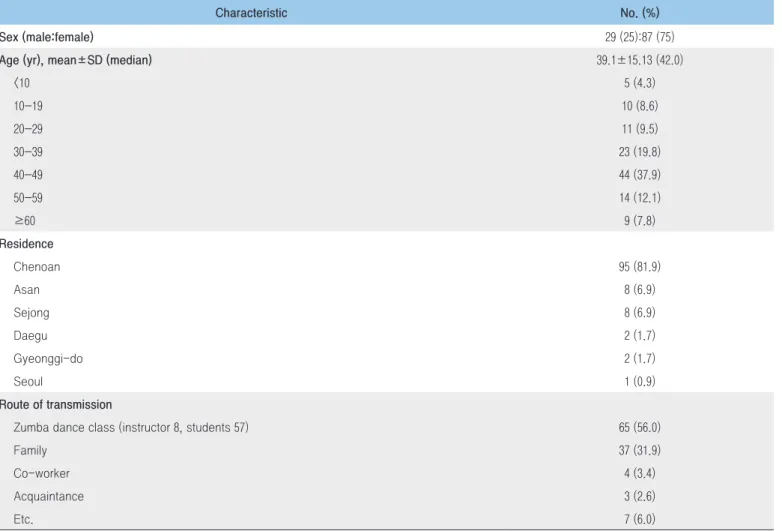
In total, 116 confirmed cases were associated with the Zumba dance class. The patients’ mean age was 39.1 years, and their median age was 42 years. Forty-four cases, constituting a plurality of the confirmed cases, were in their 40s (37.9%), followed by patients in their 30s (19.8%) and 50s (12.1%). Twenty-nine patients were males (25.0%) and 87 were females (75.0%), reflecting the fact that most of the Zumba class participants were females.
Regarding the area of residence, Cheonan in Chungcheongnam-do Province had the highest number of patients, with 95 patients (81.9%), followed by Asan in Chungcheongnam-do Province and Sejong Special Autonomous City with eight patients (6.9%) each, Daegu with two patients (1.7%), Gyeonggi-do Province with two patients (1.7%), and Seoul with one patient (0.9%).
The most common route of infection was from instructors to participants in the Zumba dance class, who accounted for 65 cases (56.0%), and family members of the instructors and participants, who accounted for 37 cases (31.9%). Together, these two groups comprised 87.9% of the total infections. Four patients (3.4%) were co-workers of family members of the participants and other (workplace) co-workers, three patients (2.6%) were acquaintances of the instructors and participants, and seven patients (6.0%) were classified as others, including another user of the fitness center where the Zumba class was held (Table 1).
Initial Symptoms
The analysis of 101 confirmed cases in Chungcheongnam-do Province in the preliminary epidemiological investigation showed the following distribution of initial symptoms at the time of confirmation: 21 patients (20.8%) had fever, 18 (17.8%) had sore throat, 21 (20.8%) had cough, 12 (11.9%) had sputum, five (5.0%) had chills, 14 (13.9%) had muscle pain, 29 (28.7%) had other symptoms such as headache or stomachache, and 25 (24.8%) were asymptomatic (Figure 1).
Epidemic Curves
On the epidemic curves, if the date of symptom occurrence is used to plot the curve, the dates range from February 18th to March 12th (bar graph) and the graph has a gently sloping and wide curve (excepted 4 patients, the date of onset was unclear). Instead, if the date on which cases were confirmed as positive is used to plot the curve, the dates range from February 24th to March 11th (line graph), and the graph shows a steep curve, as 35 cases were confirmed (based on reported KCDC) on February 27th (Figure 2).
Relationship Diagram
In total, 116 cases were confirmed between February 24th and March 11th as part of the outbreak linked to the Zumba dance class. The 116 cases consisted of eight instructors, 57 participants in Zumba dance classes at 10 exercise facilities, and 51 family members and acquaintances of the instructors and the participants of the classes. The outbreak started at a national Zumba dance workshop held in Cheonan, Chungcheongnam-do Province on February 15th, and eight out of the 27 participants in the workshop were infected from an unknown index case. Of the eight confirmed cases, a patient was confirmed by drug utilization review to have had symptoms as early as February 5. However, it is difficult to consider this patient to be the index case, because there were no recorded cases of COVID-19 before February 15th and a
participant from Daegu is not highly likely to have been the index case because the earliest occurrence of symptoms in this outbreak was on February 18th, before the outbreak in Daegu linked to Shincheonji. However, as efforts to characterize the epidemiology of COVID-19 are still continuing, various routes of infection should be investigated, including the latent period of the instructors.
The areas of residence of the eight confirmed cases who participated in the Zumba dance workshop were South Chungcheongnam-do Province (five cases), Sejong (1one case), Seoul (1one case) and Daegu (1one case). It was found that 2nd- to 4th-generation infections originated from five instructors (In1, In2, In3, In5, and In6), while there was no 2nd-generation transmission from three instructors (In4, In7, and In8).
Table 1. Characteristics of coronavirus disease-19 (COVID-19) confirmed cases through Zumba dance classes in South Korea (n=116)
Characteristic No. (%)
Sex (male:female) 29 (25):87 (75)
Age (yr), mean±SD (median) 39.1±15.13 (42.0)
<10 5 (4.3) 10-19 10 (8.6) 20-29 11 (9.5) 30-39 23 (19.8) 40-49 44 (37.9) 50-59 14 (12.1) ≥60 9 (7.8) Residence Chenoan 95 (81.9) Asan 8 (6.9) Sejong 8 (6.9) Daegu 2 (1.7) Gyeonggi-do 2 (1.7) Seoul 1 (0.9) Route of transmission
Zumba dance class (instructor 8, students 57) 65 (56.0)
Family 37 (31.9)
Co-worker 4 (3.4)
Acquaintance 3 (2.6)
The details of the infections transmitted by the five instructors who contributed to 2nd- to 4th-generation infections are presented below (Figure 3). In Figure 3, transmission events of COVID-19 from the Zumba dance instructors to members of the Zumba dance class are represented with dotted lines (with classes denoted as group exercise [GX] groups), and other transmission events are shown with a solid line.
In1 offered Zumba dance classes at four locations (GX1, GX2, GX3, and GX9) in Chungcheongnam-do Province, and 2nd-generation infections occurred in 21 of the participants. Six family members and acquaintances of those participants had 3rd-generation infections, and 4th-3rd-generation infections occurred among the family members of an acquaintance. Thirteen participants in GX9 had 2nd-generation infections, and each family member of two of the participants in GX9 had a 3rd-generation infection.
In2 offered a Zumba dance class at five locations (GX4, GX5, GX6, GX7, and GX8) in Chungcheongnam-do Province. Four participants in GX4 had 2nd-generation infections and one family member of a participant had a 3rd-generation infection. At GX5
and GX6, 2nd-generation infections occurred in one and five participants, respectively. Third-generation infections occurred in each family member of two of the participants infected at GX6. Second-generation infections occurred in four participants, and each family member of two of the participants had 3rd-generation infections at GX7. The most transmission events occurred at GX8, which resulted in 14 confirmed cases. Third-generation infections then occurred in each family member of four of the infected participants, in two family members each of two of the infected participants, and in 3three family members, one acquaintance, and one restaurant employee from infected student 7 (S7). From one of the student’s family members, 4th-generation infections occurred in two co-workers, and another 4th-generation infection occurred in one family member of the restaurant employee who was infected through contact with the student. From In2, one GX employee other than the participants was secondarily infected, and a 3rd-generation infection occurred from the GX employee to a co-worker.
21 18 21 12 5 14 1 29 25 0 5 10 15 20 25 30 35 Fever or heat sensation
Sore throat Cough Sputum Having the
chills
Muscle pain Dyspnea Etc. Asymptomatic
cases N o . o f ca se s
Sign and symptom
Second-generation infections occurred in four family members of In3. In GX9, 2nd-generation infections occurred in four participants from In3 and 3rd-generation infections took place in three family members of the participants. Three users of the fitness center that held the GX9 Zumba dance class were infected, but their relationship with the instructor was not identified. One of those users caused a 3rd-generation infection in a co-worker, from whom 4th-generation infections occurred in two family members. Another user caused a 3rd-generation infection in a family member.
A 2nd-generation infection occurred from In5 to an acquaintance 1 (A1). Second-generation infections occurred in four participants in GX10 in Sejong from In6. From one of those participants (S1), 3rd-generation infections occurred in two people (classified as others) who took violin lessons (E1, E2) from S1, and one family member of the violin lesson participants had a 4th-generation infection (Figure 3).
Conclusions
Starting in late February, there was an outbreak of 116 confirmed cases linked to Zumba dance classes that were held at exercise facilities in Cheonan and Asan. Most of the confirmed cases were women in their 30s to 50s, and the confirmed cases occurred among Zumba dance instructors and participants in the early period after infection. As many of four generations of transmission occurred among the family members, acquaintances, and co-workers of the participants. The vast majority (80.8%) of COVID-19 cases in South Korea (as of March 19th) have been linked to mass outbreaks at locations such as religious facilities, nursing facilities, hospitals, and call centers, which have the common characteristics of being crowded places where droplets are easily emitted and spread. Zumba dance classes are also characterized by strenuous movements in a limited space, with a high risk of exposure to droplets. The proportion of female cases in
N o . o f ca se s Date 4 8 35 17 12 3 3 2 5 11 6 2 1 4 3
Co-worker & acquaintance Etc.
Figure 2. Epidemic curves of coronavirus disease-19 (COVID-19) patients through Zumba dance classes in South Korea (n=116). Line graph,
GX9 In1 S1 S2 S3 S4 S6 S7 S8 S12 S11 S13 S5 S9 S10 F1 F1 In3 In4 In6 In7 In8 In5 A1 In1 F1 In2 E1 C1 F1 F2 F3 F4 In6 In3 GX10 GX9 In1 S1 GX1 F1 In1 A1 S2 F1 S1 GX2 In1 S3 S4 S5 S2 F1 S1 F1 GX3 F1 F2 S1 S2 S3 S4 S1 S2 S3 S4 E1 E2 F1 GX7 In2 S3 S4 F1 S1 F1 S2 GX4 In2 S3 S2 S4 F1 S1 GX5 In2 S1 In2 S3 S4 S5 F1 S2 F1 S1 GX6 C2 F2 In2 S12 S11 S13 S10 S14 S1 S2 S3 S4 S5 S6 S7 S8 S9 F1 F2 F1 F2 F1 F1 F1 F1 F1 C1 F1 F1 F2 F3 A1 E1 GX8
Zumba
Dance
Workshop
GX9 F1 F2 U1 U2 U3 C1 F1 Chungcheongnam-do Sejong, Seoul, Daegu, GyeonggiF3
Figure 3. Relationship diagram of coronavirus disease-19 (COVID-19) patients through Zumba dance classes in South Korea. In, Zumba
this mass infection event is 75%, which is markedly higher than the proportion of 61.5% (as of March 19th) of all COVID-19 patients in South Korea and the proportions reported in previous studies [3,4]. The reason for this is that most of the participants in the Zumba dance classes were females. Similarly, the age distribution of the Zumba dance class participants is thought to explain why the proportion of patients in their 30s to 50s was 69.8%, which is higher than the corresponding nationwide proportion of 43.3% (as of March 19th).
This event is noteworthy in that a mass infection occurred in relatively healthy people capable of engaging in strenuous aerobic exercise, unlike previous mass infection events that occurred at facilities or hospitals. Therefore, this event confirms that many people can be infected through droplet spread—even healthy members of the general population who use physical fitness facilities. This initial report of a COVID-19 outbreak triggered by transmission events at indoor Zumba dance classes will provide useful information for establishing coping strategies against COVID-19 outbreaks transmitted through indoor exercise facilities.
As the results of this study are based on the currently available results of epidemiological investigations, they may change in light of up investigations. In particular, it is anticipated that follow-up investigations will address the infection route involving the index case, the symptom distribution and characteristics of all confirmed cases, and the characteristics of successive stages of transmission, extending to the 4th generation.
Acknowledgements
Conflict of InterestNo potential conflicts of interest relevant to this article was reported.
Correspondence to: Young joon Park
Centers for Disease Control and Prevention, Cheongju, Korea E-mail: [email protected], Tel: +82-43-719-7280
List of Participants
Chungnam Center for Infectious Diseases Control and Prevention: Ho-Jang Kwon, Ji-Ae Lim, Tae-Young Jung, Da-Hye Jo, Gi-Seok Kang, Dong-Kwon Choi, Seung-Hee Jeong, Hye-Jin Kim, Young-Hee Cheon, Jin-A Kim
Epidemiology & Case Management Team, COVID-19 National Emergency Response Center, KCDC: Hwami Kim, Miyoung Kim, Young Joon Park, Siwon Choi, Chaemin Chun, Seung Hwan Shin, Hee Kyoung Kim
Additional Contribution
We would like to express appreciation to the Chungcheongnam-do Epidemiology and Case Management Team (Hyunok Baek, Min-kyo Chun, Younglim Jeong, Hyeongi Lee, Youngmi Kim, Jeongdong Shin, Wontae Cho, Kwanyong Jeong); the Cheonan Seo-buk-gu Health Center (Yeongju Na, Sohee Lee, Jinseon Choi); the Asan Health Center; and the Sejong Special Autonomous City Health Center for their efforts to investigate and
respond to this outbreak of COVID-19.
① What was previously known?
Most cases of COVID-19 transmission in South Korea have been part of clusters, the majority of which have occurred in crowded spaces where droplets are easily emitted and spread, such as religious facilities, nursing facilities, hospitals, and call centers.
② What is newly learned?
Most of the 116 confirmed cases were women in their 30s to 50s. The initial infections occurred among the instructors and participants of Zumba dance classes, and then spread to the family members and acquaintances of the participants, with up to 4four generations of transmission. The proportions of female patients and cases in their 30s to 50s were higher than those reported in previous studies, which is considered to result from the characteristics of Zumba dance class participants.
③ Implications?
This outbreak is distinctive in that it resulted from a mass infection event in relatively healthy people capable of engaging in strenuous cardiovascular exercise, unlike previous mass infections that occurred in facilities or hospitals. Therefore, this outbreak confirms that many people can be infected through droplet spread—even healthy members of the general population who use physical fitness facilities.
References
1. Coronavirus disease (COVID-19) situation reports [Internet]. Geneva: World Health Organization; 2020 [cited 2020 Mar 25]. Available from: https://www.who.int/emergencies/diseases/novel-coronavirus-2019/ situation-reports.
2. Coronavirus disease-19, Republic of Korea [Internet]. Cheongju (KR): Korea Centers for Disease Control and Prevention; 2020 [cited 2020 Mar 25]. Available from: http://ncov.mohw.go.kr/en/.
3. Ki M; Task Force for 2019-nCoV. Epidemiologic characteristics of early cases with 2019 novel coronavirus (2019-nCoV) disease in Korea. Epidemiol Health 2020;42:e2020007.
4. Huang C, Wang Y, Li X, et al. Clinical features of patients infected with 2019 novel coronavirus in Wuhan, China. Lancet 2020;395:497– 506.
This article has been translated from the Public Health Weekly Report (PHWR) Volume 13, Number 13, 2020.