Rh-doped carbon nanotubes as a superior media for the
adsorption of O
2
and O
3
molecules: a density functional
theory study
Hao Cui
1, Xiaoxing Zhang
1,2,♠, Qiang Yao
3, Yulong Miao
3, and Ju Tang
21State Key Laboratory of Power Transmission Equipment & System Security and New Technology, Chongqing University,
Chongq-ing 400044, China
2School of Electrical Engineering, Wuhan University, Wuhan 430072, China 3Chongqing Electric Power Science Academy of State Grid, Chongqing, China
Received 11 December 2017 Accepted 19 February 2018 ♠Corresponding Author E-mail: [email protected] Tel: +8617384081891 Open Access pISSN: 1976-4251 eISSN: 2233-4998
Article Info
Copyright © Korean Carbon Society
http://carbonlett.org
Abstract
Transition-metal-embedded carbon nanotubes (CNTs) have been accepted as a novel type of sensing material due to the combined advantage of the transition metal, which possesses good catalytic behavior for gas interaction, and CNTs, with large effective surface areas that present good adsorption ability towards gas molecules. In this work, we simulate the adsorp-tion of O2 and O3 onto Rh-doped CNT in an effort to understand the adsorbing behavior of
such a surface. Results indicate that the proposed material presents good adsorbing ability and capacities for these two gases, especially O3 molecules, as a result of the relatively large
conductivity changes. The frontier molecular orbital theory reveals that the conductivity of Rh-CNT would undergo a decrease after the adsorption of two such oxidizing gases due to the lower electron activity and density of this media. Our calculations are meaningful as they can supply experimentalists with potential sensing material prospects with which to exploit chemical sensors.
Key words: Rh-doped carbon nanotubes, adsorption, density functional theory method
1. Introduction
Chemical sensors prepared with materials based on single-walled carbon nanotubes (CNTs) and applied for use with gaseous species are widely accepted to have numerous ad-vantages, such as a small size, high sensitivity, and repaid response speeds at room tempera-ture [1]. However, due to the weak interaction depending on the van der Waals force between the CNT surfaces and gas molecules, intrinsic CNTs with limited adsorption capacity cannot detect certain gaseous substances [2]. One feasible means of improving the adsorption and sensing capabilities of CNTs is to embed or dope foreign atom(s), in general transition metal (TM) atoms, on their sidewalls, making them capable of detecting a wider range of gases due to the strong activity and electron withdrawing/donating properties caused by such dop-ing [3]. It has been recommended that one C atom on a CNT sidewall substitutdop-ing a Pt or Pd atom can provide novel materials with good adsorption for gas molecules, including SO2
and SOF2 [4,5]. In addition, previous reports showed that Pt and Pd nanoparticle-functioned
CNTs are frequently employed as good room-temperature hydrogen sensors as a result of the strong binding energy and large electron charge transfer [6,7]. In addition, Rh is a notable TM in the same group with Pd and Pt which also reportedly has strong catalytic activity upon gas adsorption and sensing [8], also making it a viable candidate CNT dopant potentially for use in sensors.
Recently, we theoretically simulated the adsorption process of O2 and O3 molecules
onto Rh-doped CNT (Rh-CNT) surfaces in order to investigate the geometric and
elec-DOI: http://dx.doi.org/
DOI:10.5714/CL.2018.28.055 This is an Open Access article distributed under the terms of the Creative Commons Attribution Non-Commercial License (http://creativecommons.org/licenses/ by-nc/3.0/) which permits unrestricted non-commercial use, distribution, and reproduction in any medium, provided the original work is properly cited.
A brief review on graphene applications in rechargeable lithium ion battery electrode materials
Sameen Akbar, Muhammad Rehan, Liu Haiyang, Iqra Rafique, and Hurria Akbar
KCS Korean Carbon Society
carbonlett.org
pISSN: 1976-4251 eISSN: 2233-4998
REVIEWS
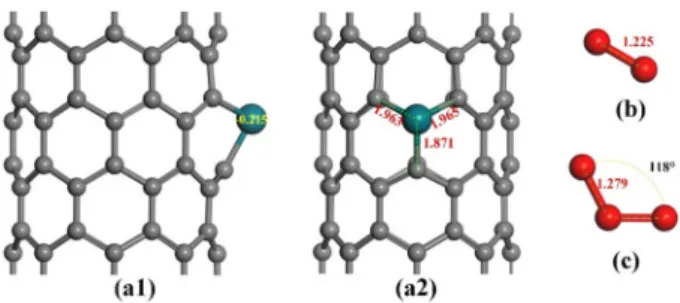
1. Fig. 1a illustrates how the doping Rh remarkably protrudes outward from the CNT sidewall with the Rh-C bonds measured at 1.963, 1.965, and 1.871 Å, much larger than the C-C bond (1.411 Å) of the intrinsic CNT due to the large radius of the Rh atom [5].
As depicted in Fig. 1b, the O-O bond inner O2 molecule is
measured to be 1.225 Å, shorter than the inner O3 molecule
(1.279 Å), as shown in Fig. 1c. This stems from the higher bond energy in the O2 molecule.
3.2. Adsorption analysis of O
2and O
3onto the
Rh-CNT surface
Two types of gas molecules were assessed to determine the possibility of approaching the Rh dopant of the proposed sur-face, which is considered to be an active area. We devised one- and two-molecule adsorbing systems to gain a comprehensive understanding of the adsorption properties and capacities of Rh-CNT with regard to the two gases.
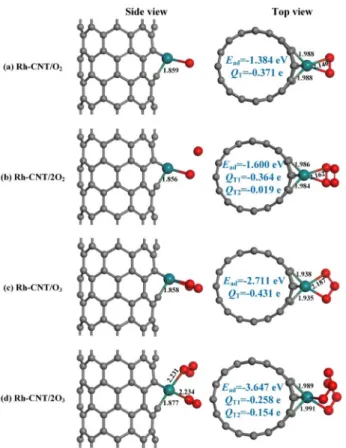
Focusing on the O2 adsorption system first, Fig. 2a and b
indicate that the adsorbent has good adsorption performance towards one O2 molecule, trapping both O atoms onto the Rh
dopant with an adsorbing distance of 2.140 Å, while perform-ing in a weakened capacity upon two O2 molecules, where
only one molecule shows a good response towards the doping surface. In the one-molecule system, Ead and QT are –1.384
eV and –0.371 e, respectively, greater than those in the B-CNT/O2 system published previously [13], suggesting better
adsorption behavior in the Rh-doped case. This negative val-ue in the former case suggests its chemisorption, whereas the latter strong case proves the chemical interaction between the O2 molecule and the Rh-CNT [14], resulting in the
consider-able amount of electron transfer from the adsorbent surface to the adsorbate. In line with the adsorbing configuration of the system with two O2 molecules, Ead undergoes a slight change
while QT of the second O2 molecule is quite small, which
we presume to stem from physisorption towards the second molecule [15].
Upon O3 adsorption, Rh-CNT presents superior adsorbing
behaviors and capacities. In the one-molecule system, two O atoms of O3 are captured by the Rh atom with an adsorbing
dis-tance of 2.187 Å, while in the two-molecule system, one O atom of each O3 molecule is ensnared by the dopant with adsorbing
distances of 2.231 and 2.234 Å, respectively. One phenomenon similar to O2 systems is that the Rh-C bonds of all adsorbing
sys-tronic behavior of this modified surface in the presence of two gaseous species. To the best of our knowledge, there are few studies of the adsorption behavior of Rh-CNT surfaces towards O2 and O3 molecules or of the important roles of the
abovementioned species in the atmosphere, and it appears to be essential to develop straightforward methods and in-troduce new adsorbent materials as adsorbents and sensors for these materials. Our calculations, including a geometric analysis, density-of-state (DOS) as well as frontier molecular orbital theory studies would offer fundamental evidence by which to suggest novel adsorbent or sensing materials which may be capable of O2 and O3 detection.
2. Computational Details
In the present density functional theory (DFT) calculation, the double numerical plus polarization basis sets, based on the Dmol3 package [9], were adopted. Generalized-gradient
approximation with the Perdew-Burke-Ernzerhof functional and spin-unrestricted DFT [3] was utilized to obtain all the results reported below. In order to avoid interactions between adjacent cells, a single-walled CNT with a periodic boundary condition of 20 Å×20 Å×8.5 Å was defined [1]. One C atom on the sidewall of the CNT was replaced by an Rh atom to form Rh-CNT. The core treatment was set to DFT semi-core pseudopods to manage the interaction between the nucleus and valence electrons, whereas Brillouin zone k-point sam-pling was performed in a 1×1×2 Monkhorst-Pack mesh [10], which presents good approximation for (8, 0) CNTs. The en-ergy tolerance accuracy, maximum force, cut-off orbital and displacement were set as 10–5 Ha, 2×10⁻³ Ha/Å, 3.7 Å and
5×10⁻³ Å, respectively [11].
The adsorption energy (Ead) of each system was calculated by
the following equation [12]:
(1) In the formulation, ERh-CNT/gas molecule, ERh-CNT and Egas molecule
re-fer to the total energy levels of the system after adsorption, an isolated Rh-CNT and the optimized gas molecule, respectively.
Based on a Mullikan population analysis, the charge trans-fer number (QT) between the Rh-doped surface and the
ana-lytes can be obtained as the number of electrons carried by gas molecules after adsorption, as the carried electron value for molecules before adsorption is constant at 0. A nega-tive QT indicates that charges transfer from Rh-CNT to gas
molecules, whereas a positive QT indicates a reverse
charge-transfer path.
3. Results and Discussion
3.1. Geometric structural analysis of Rh-CNT
and gas species
To initiate the adsorption processes of O2 and O3 molecules
onto the Rh-CNT surface, these models were preliminarily opti-mized with the lowest geometric energy levels, as shown in Fig.
Fig. 1.
Geometric structures of Rh-CNT and gas molecules. The gray, blue-green and red balls represent C, Rh and O atoms, respectively.3.3. Analyses of DOS and frontier molecular
orbital theory
For a better understanding of the electronic behaviors and conductivity changes of Rh-CNT caused by the adsorption of molecules, the DOS and the frontier molecular orbital theories were considered.
Fig. 3 describes the DOS distribution of two types of gas systems. In Fig. 3a, where the DOS comparison of the O2
sys-tems is presented, it can be found that the DOS peaks of the Rh-CNT/O2 system are obviously shifted towards a higher
region, in good agreement with the loss of the electron for
Rh-CNT [16,17], while the DOS of the Rh-CNT/2O2 system
is basically unchanged and even overlapped with that of the single-molecule system near the Fermi level due to the inac-tive electron property. According to the DOS distributions of O3 systems displayed in Fig. 3b, it is clear that distinct shifts
of the DOS curve can be found not only through a compari-son between an isolated Rh-CNT and the related single O3
molecule adsorbing system, but also in the comparison of the two adsorbing systems. Specifically, a noticeable shift of the peak in the Rh-CNT/O3 system near the Fermi energy occurs
compared to that in the isolated Rh-CNT system, and a fur-ther change, although relatively slight, can also be found in the Rh-CNT/2O3 system compared with the single-molecule
system. It should also be noted that according to the overlap of the Rh atom and O atom in the single-molecule system for O2 and O3 adsorption, we found that the Rh dopant is
strong-ly hybridized with the adsorbed O2 or O3 molecule with the
Rh-O bond, and a larger area of overlap in the Rh-CNT/O3
system implies stronger chemisorption compared to that in the Rh-CNT/O2 system [18,19]. This result is important when
explaining the electronic behavior of adsorbent and gas spe-cies, as it sheds light on the mechanism of the change in the conductivity of Rh-CNT in a qualitative manner.
To illuminate the conductivity change of Rh-CNT re-sponding to the adsorption of molecules, the frontier mo-lecular orbital theory is both essential and helpful, as, based on this theory, the energy gap (Eg) between the lowest
un-occupied molecular orbital (LUMO) and highest un-occupied molecular orbital (HOMO) is widely accepted as a workable and effective indicator of the electrical conductivity of bulk tems experience different extents of prolongation, attributed to
the adsorption process of the gas molecules. On the other hand, Ead (–2.711 eV) in the Rh-CNT/O3 system nearly doubled and
QT (–0.431 e) is even larger compared to those in the Rh-CNT/
O2 system. Moreover, the pronouncedly enhanced Ead (–3.647
eV) of the double O3 molecule system, calculated to be –1.824
eV for the per-molecule adsorption, indicates chemisorption for both molecules, despite the slightly decreased QT values for
the two molecules, which we assume to be a result of the fewer electron-transfer paths in comparison with the single O3
mol-ecule system.
Fig. 2.
Adsorption configurations and related parameters of various sys-tems. (a) Ph-CNT/O2, (b) Rh-CNT/2O2, (c) Ph-CNT/O3, and (d) Rh-CNT/2O3.4. Conclusions
In this paper, we utilized the DFT method and investigated the adsorption behavior of O2 and O3 molecules onto the
pro-posed Rh-CNT surface. Rh dopant as an active catalytic center presents good adsorption ability for the targeted gases, especial-ly O3 molecules. With regard to the adsorption of the two
mole-cules, Rh-CNT possesses better adsorption of O3 molecules than
of O2, leading to higher Ead and QT values in the O3 system with
decreased parameters in the O2 system. This confirms the
stron-ger adsorption performance of Rh-CNT towards O3 as compared
to O2. After adsorption, the proposed material would undergo a
decrease in conductivity, which provides a workable method for further study and exploitation efforts to make such material an excellent sensing material. Our calculations are meaningful as they suggest novel materials to be examined by experimentalists for use as gas adsorbents or chemical sensors.
Conflict of Interest
No potential conflict of interest relevant to this article was reported.
Acknowledgements
We acknowledge the financial support from the Fundamen-tal Research Funds for Central University (No. 106112017CD-JXSYY0001), the Natural Science Foundation of China (No. 51777144) and the Graduate Research and Innovation Founda-tion of Chongqing, China (No. CYB17009).
Author contribution: Hao Cui performed this work and wrote this manuscript, Xiaoxing Zhang guided this work, Qiang Yao and Yulong Miao helped analyze the data, while Hanyan Xiao and Ju Tang modified the writing in order to improve its quality.
materials [20,21]. Referring to a previous report, a lower Eg means higher electrical conductivity, whereas a higher
Eg corresponds to lower electrical conductivity [22]. Fig. 4
indicates that the isolated Rh-CNT has an equally uniform density of the HOMO and LUMO characteristics of Rh atoms with Eg equal to 0.196 eV, a small gap indicating its excellent
conductivity, while upon interaction with different species, significant changes were observed in both the HOMO and LUMO distributions and in the related energies in each sys-tem. Briefly, in terms of O2 adsorption, HOMO is distributed
mainly on Rh atoms, while LUMO is on O2 molecules, unlike
the O3 adsorption system, in which HOMO and LUMO are
both concentrated on Rh atom and analyte molecules. Such relocation of the orbitals for an adsorbing system corresponds to the increases of Eg in the Rh-CNT/O2 and Rh-CNT/O3
sys-tems to 0.577 and 0.586 eV, respectively, which would lead to dramatic decreases in the conductivity of Rh-CNT after the adsorption of the two-gas species. Such results, in practice, are not difficult to understand. From the DOS of Rh-CNT, we can find that the Fermi level of this material is closer to LUMO than to HOMO, indicating its n-type property [8]. Af-ter the adsorption of the two types of oxidizing gases that are prone to electron withdrawing, the proposed surface would donate an electron, causing a decrease in the electron activity and density and thus leading to reduced conductivity.
In addition, in the double-molecule systems, Eg of the
Rh-CNT/2O2 system is slightly enlarged while that of the
Rh-CNT/2O3 system shows only a moderate increase. This is in
accordance with the contention above that Rh-CNT has better adsorption behavior and capacity of O3 compared to O2,
result-ing in a larger change of Eg in the O3 system (0.381 eV)
com-pared to the O2 system (0.390 eV) with respect to the
one-mole-cule system against the pure Rh-CNT system. It also has a much more enlarged gap of O3 adsorption (0.125 eV) compared to O2
adsorption (0.003 eV) when the number of molecules increases from one to two.
tions by the differences of separate total energies: some proce-dures with reduced errors. Mol Phys, 19, 553 (2002). https://doi. org/10.1080/00268977000101561.
[13] Azam MA, Alias FM, Tack LW, Seman RNAR, Taib MFM. Elec-tronic properties and gas adsorption behaviour of pristine, silicon-, and boron-doped (8, 0) single-walled carbon nanotube: a first prin-ciples study. J Mol Graphics Modell, 75, 85 (2017). https://doi. org/10.1016/j.jmgm.2017.05.003.
[14] Rad AS, Zareyee D. Adsorption properties of SO2 and O3
mole-cules on Pt-decorated graphene: a theoretical study. Vacuum, 130, 113 (2016). https://doi.org/10.1016/j.vacuum.2016.05.009. [15] Berahman M, Sheikhi MH, Zarifkar A, Gebauer R, Taheri M, Asad
M. H2S gas sensor based on thin film graphene nanoribbons
deco-rated with copper: a first principles study, in Proceedings of the Ultrafine Grained and Nano-Structured Materials, Tehran, Iran, (2013).
[16] Cuong NT, Chi DH, Kim YT, Mitani T. Structural and electronic properties of Ptn (n=3, 7, 13) clusters on metallic single wall car-bon nanotube. Phys Status Solidi, 243, 3472 (2006). https://doi. org/10.1002/pssb.200669166.
[17] Ganji MD, Sharifi N, Ardjmand M, Ahangari MG. Pt-decorated
graphene as superior media for H2S adsorption: a first-principles
study. Appl Surf Sci, 261, 697 (2012). https://doi.org/10.1016/j. apsusc.2012.08.083.
[18] Garadkar KM, Shirke BS, Hankare PP, Patil DR. Low cost
nano-structured anatase TiO2 as a H2S gas sensor synthesized by
mi-crowave assisted technique. Sens Lett, 9, 526 (2011). https://doi. org/10.1166/sl.2011.1507.
[19] Li Y, Hodak M, Lu W, Bernholc J. Mechanisms of NH3 and NO2
detection in carbon-nanotube-based sensors: an ab initio investi-gation. Carbon, 101, 177 (2016). https://doi.org/10.1016/j.car-bon.2016.01.092.
[20] Kim HS, Lee H, Han KS, Kim JH, Song MS, Park MS, Lee JY, Kang JK. Hydrogen storage in Ni nanoparticle-dispersed mul-tiwalled carbon nanotubes. J Phys Chem B, 109, 8983 (2005). https://doi.org/10.1021/jp044727b.
[21] Yoosefian M, Etminan N, Moghani MZ, Mirzaei S, Abbasi S. The role of boron nitride nanotube as a new chemical sensor and poten-tial reservoir for hydrogen halides environmental pollutants. Su-perlattices Microstruct, 98, 325 (2016). https://doi.org/10.1016/j. spmi.2016.08.049.
[22] Rad AS, Abedini E. Chemisorption of NO on Pt-decorated gra-phene as modified nanostructure media: a first principles study. Appl Surf Sci, 360, 1041 (2016). https://doi.org/10.1016/j.ap-susc.2015.11.126.
References
[1] Zhang X, Cui H, Gui Y, Tang J. Mechanism and application of carbon nanotube sensors in SF6 decomposed production detec-tion: a review. Nanoscale Res Lett, 12, 177 (2017). https://doi. org/10.1186/s11671-017-1945-8.
[2] Yoosefian M, Zahedi M, Mola A, Naserian S. A DFT
compara-tive study of single and double SO2 adsorption on Pt-doped and
Au-doped single-walled carbon nanotube. Appl Surf Sci, 349, 864 (2015). https://doi.org/10.1016/j.apsusc.2015.05.088.
[3] Zhang X, Cui H, Zhang J, Tang J. Adsorption characteristic of Pd-4 cluster carbon nanotube towards transformer oil dissolved compo-nents: a simulation. Appl Surf Sci, 419, 802 (2017). https://doi. org/10.1016/j.apsusc.2017.05.004.
[4] Zhang X, Dai Z, Wei L, Liang N, Wu X. Theoretical calculation of the gas-sensing properties of Pt-decorated carbon nanotubes. Sen-sors, 13, 15159 (2013). https://doi.org/10.3390/s131115159. [5] Jiang HR, Lu Z, Wu MC, Ciucci F, Zhao TS. Borophene: a
prom-ising anode material offering high specific capacity and high rate capability for lithium-ion batteries. Nano Energy, 23, 97 (2016). https://doi.org/10.1016/j.nanoen.2016.03.013.
[6] Rangel E, Sansores E. Theoretical study of hydrogen adsorption on nitrogen doped graphene decorated with palladium clusters. Int J Hydrogen Energy, 39, 6558 (2014). https://doi.org/10.1016/j. ijhydene.2014.02.062.
[7] Ferrari AC, Bonaccorso F, Fal'Ko V, Novoselov KS, Roche S, Bøg-gild P, Borini S, Koppens FH, Palermo V, Pugno N, et al. Science and technology roadmap for graphene, related two-dimensional crystals, and hybrid systems. Nanoscale, 7, 4598 (2015). https:// doi.org/10.1039/c4nr01600a.
[8] Zhao JX, Ding YH. Theoretical study of the interactions of carbon monoxide with Rh-decorated (8,0) single-walled carbon nanotubes. Mater Chem Phys, 110, 411 (2008). https://doi.org/10.1016/j. matchemphys.2008.02.036.
[9] Zhang X, Cui H, Dong X, Chen D, Tang J. Adsorption performance of Rh decorated SWCNT upon SF 6 decomposed components based on DFT method. Appl Surf Sci, 420, 825 (2017). https://doi. org/10.1016/j.apsusc.2017.05.127.
[10] Zhao Q, Buongiorno M, Lu W, Bernholc J. Carbon nanotube-metal cluster composites: a new road to chemical sensors? Nano Lett, 5, 847 (2005). https://doi.org/10.1021/nl050167w.
[11] Wang R, Zhang D, Zhang Y, Liu C. Boron-doped carbon nanotubes serving as a novel chemical sensor for formaldehyde. J Phys Chem B, 110, 18267 (2006). https://doi.org/10.1021/jp061766+. [12] Boys SF, Bernardi F. The calculation of small molecular