PERSPECTIVE AND TREND OF CURRENT RESEARCH
ON GREEN REMEDIATION IN SOUTH KOREA
JUNBOUM PARK i)
ABSTRACT
In the field of soil and groundwater remediation, sustainability was merged into remediation process and green remediation was initiated within the concept of sustainable development. Green remediation was defined and has been already applied to the remediation fields in U.S. In the case of Europe, green remediation has been evaluated for the application of green technology in the remediation industry and they especially defined sustainable remediation following idea of sustainable development. Although green and sustainable remediation is global trends, there are only a few cases about application of green remediation in South Korea. It is needed to develop soil and groundwater remediation technology towards green remediation, considering “Green Growth” as policy direction in South Korea.
Key Words : Green growth, Green remediation, Sustainable development, Sustainable remediation, Soil
and groundwater remediation
1 INTRODUCTION
Sustainable development, which is defined as the development that meets the needs of the present without compromising the ability of future generations to meet their own needs (UN, 1987), has been an issue of interest due to environmental pollution and the exhaustion of natural resources with indiscreet development and rapid growth of population. In the field of soil and groundwater remediation, sustainability was merged into remediation process and green remediation was initiated within the concept of sustainable development.
In the United States, green remediation was defined as the practice of considering all environmental effects of remedy implementation and incorporating options to maximize net environmental benefit of cleanup actions (EPA, 2008). Green remediation has been already applied to the remediation fields in US and the assessment of green remediation applications has been reported. In the case of South Korea, green remediation has just begun to be adopted in the remediation field of soil and groundwater as a result that the government promoted “low carbon and green growth” as a new vision of the nation and the remediation of soil and groundwater was chosen as one of the ten major developments on the environmental technology. Green remediation,
however, has not been fully adapted to the remediation sites in South Korea though feasibility, efficiency and cost of remediation technology were simply considered.
In this paper, green remediation in South Korea and its limitation will be briefly introduced and the future direction of green remediation in South Korea will be suggested by investigating international trends of green remediation considering sustainable development.
2 CURRENT STATUS ON GREEN REMEDIATION IN SOUTH KOREA 2.1 Overview of green policy
South Korea currently imports 97 percent of its energy supply, with 84 percent derived from fossil-based fuel sources. To support its objectives of reducing dependence on imported fossil fuels to enhance national security, adopting a proactive stance on environmental sustainability and combating global climate change, and of re-casting its export-driven economic base to compete on a global scale in the developing green-tech field, South Korea’s Presidential Commission on Green Growth (“PCGG”) recently adopted a strategy modeled on the five-year (2009~2013) planning approach.
The president of South Korea announced a new national policy vision of “Low Carbon, Green
Growth.” The initiative is intended to pursue three primary objectives: (1) promotion of “eco-friendly new growth engines” for the national economy, (2) enhancement of South Korea’s quality of life and (3) contribution to international efforts to fight climate change. To achieve this ambitious vision, the PCGG was established, and a Framework Law on Green Growth has been submitted for deliberation in the National Assembly.
In short order, the PCGG adopted a long-term National Strategy for Green Growth (2009~2050) and a Five-Year Plan for Green Growth (“Five-Year Plan”). This first Five-(“Five-Year Plan covers the period 2009~2013, comprises a manifest of political commitments and a blueprint for government action, contains budgetary earmarks and tasks delegated to relevant ROK ministries, and targets spending of 2 percent of the nation’s GDP on green growth. Given the global economic downturn that impacted South Korea during the genesis of this ambitious policy initiative, its rollout has been touted domestically as a “Green New Deal”. As such, investment will be initially weighted toward infrastructure projects to help combat the sagging economy, with spending shifting toward export-focused green-tech R&D over time.
The Ministry of Environment of South Korea announced the vision and goals of Green Growth. The vision was to be an advanced nation with green technology and the goals were to become one of the advanced nations in environmental technology and industry by 2010 and to facilitate transition to an environmentally-friendly low carbon green economy. To achieve this vision and goals, Green Policies were adopted by the Ministry of Environment of South Korea as shown in Table 1.
2.2 Present condition of remediation in South Korea
Under the “green-growth” policy, Korean government has been introducing the concept of “green remediation”. Exact investigation about existing remediation cases in South Korea is needed to apply green remediation efficiently. Accordingly, the government and academia have started to investigate and analyze existing remediation cases in order to establish the foundation of optimized technologies for green remediation.
According to a research conducted by Korea Ministry of Environment, remediation works for petroleum contaminated sites (Fig. 1) has the highest proportion in remediation industries and 17,000 facilities for petroleum manufacture and storage are wholly operating in South Korea (Jeong, 2007). The ratio of in-situ techniques (such as soil vapor extraction and bioventing) is almost 83% and the other, ex-situ techniques (such as land farming), is 17% in the remediation method (Korea Ministry of Environment, 2007).
Second largest portion of remediation cases is abandoned mine related to heavy metal pollution as shown in fig. 2 (Jeong, 2007). There are 1,276 abandoned mines in South Korea (Park, 2008), and in order to remediate those abandoned mines, some facilities such as landfill system, waterproofing system, and slope protection system were installed. However, most technologies used in abandoned mines are not remediation technologies but simple engineering technologies (Yang and Lee, 2007).
In case of brownfields which locate around the urban area and causes environmental pollution, it is even difficult to estimate how many brownfields
Table 1. Green Policies by the Ministry of Environment of South Korea
Keywords Primary Goals
Low Carbon Green House Gas Reduction Climate Change Adaption
Green Growth Engine Developing Core Environment Technologies Fostering Promising Environment Industry
Green Culture & Green Infra
Practicing Green Lifestyle Making the Land Green Promoting Resource Recycling
Building and Operating Green Growth Governance Green Management and Finance
Green Jobs
Green New Deal
Environment Improvement Project and Creation of Green Jobs Creation of Environmental Jobs
Green Policies
exist because little investigation of them was conducted. However 1,072 waste landfills, which are one of the brownfield, are reported in 2002 in South Korea (Park, 2008).
Recently, remediation of US military base (Fig. 4) has been a large portion of the remediation projects in South Korea. 59 U.S. Armed Forces bases in Korea will be returned (13,550 ha), most representative example is Yongsan military base, in accordance with LPP (Land Partnership Plan) and now remediation of these sites are being conducted using thermal desorption, soil washing, and land farming techniques depending on the conditions of each site (Park, 2008).
Simple information about present condition of remediation industries is already investigated, but the other information for green remediation such as energy consumption, carbon emission is not enough. Eventually, exact investigation of remediation sites is essential to apply green remediation.
2.3 Research of Green remediation in South Korea
The investigation about the contaminated area and the study for field application of green
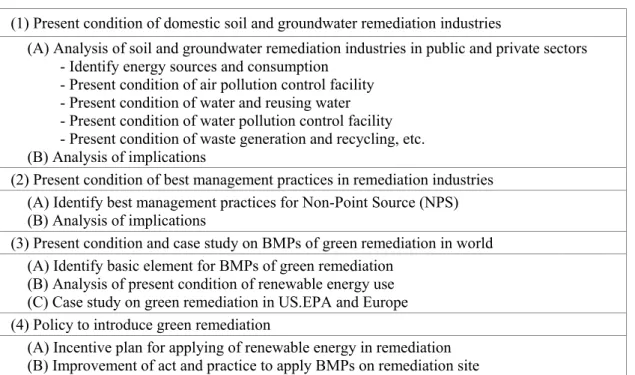
remediation has been performing to introduce green remediation in South Korea. KEI (Korea Environment Institute) has conducted studies for the introduction of BMPs (Best Management Practice) of green remediation, which could reduce environmental footprints minimizing energy consumption and carbon emission in remediation site, in South Korea as shown in table 2 (Korea Environment Institute, 2009). However most of contents in the researches were still in the investigation and analysis on existing remediation site and specific plans for introduction of green remediation have not been proposed by government.
Academia is also performing the studies for the introduction of green remediation. One example is the study on phytoremediation using biofuel plant by Prof. Kim in Seoul National University. The plant for the phytoremediation suggested by Prof. Kim can extract contaminants and then can be used as a source of biofuel after remediation. This study could be one alternative to remediate contaminated soil generated by dredging in 4 river project and is well matched with element of green remediation because of no greenhouse gas emission and no necessary of energy, and we also
Figure 1. Remediation of Oil spill site Figure 2. Pond contaminated by acid mine drainage
Figure 3. Waste landfill Figure 4. Excavation of contaminated soil in US army base
expect to get additional benefit from cropped plant. Remediation technologies suitable for green remediation have not been developed yet in South Korea, although various traditional technologies have already been developed and applied. Therefore political approach is needed at government level to evaluate and apply the remediation technologies as green remediation in South Korea.
3 INTERNATIONAL STATUS ON GREEN REMEDIATION
Some of developed countries including U.S. and Europe have defined the concept of ‘Green Remediation’ and actively incorporated it into cleanup of contaminated sites, unlike South Korea. Especially in case of U.S., EPA (Environment
Protect Agency) primarily focuses on promoting ‘Green Remediation Strategy’ maximizing energy efficiency through optimization of cleanup system and onsite equipment, or using wind, landfill gas, and solar energy system instead of fossil-fuel based energy in remediation of contaminated soil and groundwater, which is in accordance with EPA’s integrated environmental management plan (U.S.EPA, 2006).
In Europe, feasibility test on a technology standpoint has been performed for green remediation and the latest technologies have been introduced into cleanup the site where soil and groundwater were contaminated. Information about these technologies has been lively exchanged through various international conferences or academies regarding green remediation and sustainable remediation. EU Table 2. Basic study of green remediation by KEI (Korea Environment Institute, 2009)
(1) Present condition of domestic soil and groundwater remediation industries
(A) Analysis of soil and groundwater remediation industries in public and private sectors - Identify energy sources and consumption
- Present condition of air pollution control facility - Present condition of water and reusing water - Present condition of water pollution control facility - Present condition of waste generation and recycling, etc. (B) Analysis of implications
(2) Present condition of best management practices in remediation industries (A) Identify best management practices for Non-Point Source (NPS) (B) Analysis of implications
(3) Present condition and case study on BMPs of green remediation in world (A) Identify basic element for BMPs of green remediation
(B) Analysis of present condition of renewable energy use (C) Case study on green remediation in US.EPA and Europe (4) Policy to introduce green remediation
(A) Incentive plan for applying of renewable energy in remediation (B) Improvement of act and practice to apply BMPs on remediation site
Solar, 63% Wind, 25% Landfill Gas, 6% Vegetable Oil, 6% Pump and Treat, 7 SVE, 1 Data Collection, 3 Irrigation, 1 Equipment Operation, 1 Power Generation, 3
Figure 5. Alternative energy sources and uses at 15 study sites; Left: Sources, Right: Uses (Dellens, 2007)
countries have tried to realize ‘Sustainable Remediation’, which succeed to the purpose of ‘Sustainable Development’, with the organizations such as SuRF (Sustainable Remediation Forum), SuRF UK, NICOLE, and Eurodemo as central figure at the national level. So, each organizations have established basic framework to realize
sustainable remediation as the first step and have performed feasibility test on contaminated sites (CL:AIRE, 2010).
Cleanup activity based on green remediation has been already performed in developed countries like this. Green remediation strategy has actually been introduced to many cleanup sites and these results have been actively reported. The cases using renewable energy and improving energy efficiency of traditional remediation technologies are representative cases of green remediation. Two types of case studies of green remediation (renewable energy and energy efficiency) in U.S. and Europe will be reviewed and a new direction for green remediation in South Korea will be suggested.
3.1 Use of renewable energy and reduce of greenhouse gas emission
Using renewable energy in remediation process instead of power grid is the representative strategy for green remediation. This strategy can significantly reduce the amount of electricity used during cleanup process as well as emission of greenhouse gas because renewable energy doesn’t’ consume fossil- fuel. In case of U.S., energy saving and environmental friendly activities have been achieved through the introduction of numerous renewable energy (not totally but partly in most cases) into cleanup system (Dellens, 2007).
The present state of utilization, which is about fifteen remediation sites including superfund sites,
of renewable energy shown in fig. 5 indicates that usage of solar energy system was the largest case, and that of wind energy system was the second largest one. 7 sites (4 sites: solar energy, 2 sites: wind energy, 1 sites: wind and solar energy) used renewable energy system to operate pump and treat system among 15 cases (Fig. 5). Electricity produced by wind and solar energy system was introduced to supply power to operate pump for oil recovery or groundwater and to use mechanical energy directly (e.g. wind energy).
The one remediation case among 15 cases, U.S. Massachusetts Military Reservation (MMR) site, is considered as successful remediation example which used wind energy system to clean-up contaminated site (profiles of green remediation, available at www.cluin.org/greenremedaition). This site was multi-contaminated by organics and heavy metals since there had been used as a military base. 11 groundwater plumes across the 22,000-acre MMR site was remediated using long-term operation of nine pump and treat (P&T) systems to treat approximately 14.5 million gallons of water each day.
In this site, renewable energy system (wind turbine) to offset the high rates of P&T electricity consumption and associated air emissions from power plants was deployed. An onsite wind turbine was installed. This wind turbine annually produced approximately 3,800 MWh of electricity and is expected to reduce approximately 30% of air emissions (Figure 6).
3.2 Maximize of efficiency in cleanup process
It is not only the way for green remediation to use renewable energy. Green remediation could be realized by maximizing efficiency of existing remediation technology. Environmental footprints can be reduced by using high energy efficient equipment in remediation process, and focusing on monitoring and improving the process by which the efficiency of cleanup activity could be increased.
In case of pump and treat system, multi-phase extraction or pulsed extraction is already well known as more efficient and economical method to clean-up contaminated sites than continuous extraction/treatment. Also, the cost for supplying energy can be reduced by multi-phase extraction or pulsed extraction technique and these even can be improved by introducing of automatic control system (U.S.EPA, 2008). A remediation of Voluntary Cleanup Program (VCP) site by Albama could be regarded as a successful remediation example using pulsed extraction system.
• Produce ~ 3,810 MWh yearly = expected to generate 25-30% of total electrical requirment • Expected to reduce ~ 30% air emissions
Figure 6. Picture of the wind turbine located in MMR site and its benefit, available at
www.cluin.org/greenremediation/profiles/subtab_ d32.cfm
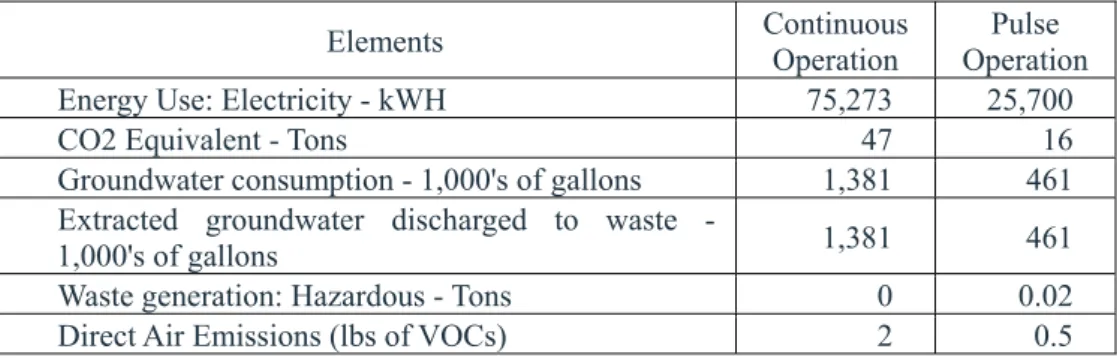
Soil and groundwater in the site was contaminated with 1,1,1-TCA and 1,1-DCE. The basic strategy of cleanup was using Multi-Phase Extraction (MPE) system. In the system, vapor extraction is applied to vadose zone, and groundwater pumping is applied to shallow perched water zone or deep aquifer. The MPE system was used by continuous way from 1994 to January 2007 and changed to pulse operation way from January 2007 to March 2009. As a result, energy consumption, waste generation, and greenhouse gas emission could be reduced as shown in table 3. The cost of operation and monitoring was reduced by 50% (Omer J. Uppal et al., 2010).
4 GREEN REMEDIATION TOWARD SUSTAINABILITY
U.S. EPA has achieved remarkable success through the concept of green remediation results from incorporating the concept of sustainable development into soil and groundwater remediation field. However, there are some differences in detail between the concept of green remediation and sustainable development. The sustainable development defined by the World Commission on Environment and Development in
1987 requires the balance among economy, environment and society. Among the indicators required in sustainable remediation, most of which are difficult to quantify, on the other hand, 5 indicators (energy, air, water, land and ecosystem, and materials and wastes) are selected and are focused in green remediation. In the broad perspective of green remediation, energy, economy, environment are mainly considered (Fig. 7).
To decrease the gap between sustainable development and green remediation, international forums (Europe in main) tries to define ‘sustainable remediation’ containing concept of sustainable development and framework to realize. The main purpose of the forums is to suggest or supply the methods to quantify sustainability based on sustainable remediation such as the tools for green remediation. To achieve this goal, the forum has tried to concretize the indicators which should be considered for sustainable remediation and suggest guidelines to assess the sustainability of remediation implementation considered. For example, a report presented by SuRF Australia (SuRF Australia, 2009) has mentioned some considerable indicators for sustainable remediation (Table 4).
Table 3. Comparison between continuous operation and pulse operation at Albama site
Elements Continuous Operation Operation Pulse
Energy Use: Electricity - kWH 75,273 25,700
CO2 Equivalent - Tons 47 16
Groundwater consumption - 1,000's of gallons 1,381 461
Extracted groundwater discharged to waste -
1,000's of gallons 1,381 461
Waste generation: Hazardous - Tons 0 0.02
Direct Air Emissions (lbs of VOCs) 2 0.5
Figure 7. Sustainable development is a balance between environmental, social and economic factors and green remediation focuses at energy, economy and environment
Some of the indicators in table 4 are not considered in traditional remediation approach and the table contains even more indicators than contents in green remediation. Especially characteristics of community are considered as well as ethical and equity as social indicators in sustainable remediation. Although all the indicators mentioned above have to be considered for sustainable and green remediation, quantification of the indicators is difficult. Therefore, studies and development of the assessment tools which can calculate the sustainability based on these indicators have been conducted at first in order to introduce sustainable remediation.
Among many assessment tools based on sustainable remediation or green remediation, in this article, two representative assessment tools will be reviewed. SRT (Sustainable Remediation Tool) developed by AFCEE (Air Force Center for Engineering and Environment) can calculate the environmental footprints qualitatively such as energy use, CO2 emissions according to each alternative (Table 5). From the data shown by SRT, Clients or users could be supported during decision-making. Most of present assessment tools include similar indicators considered by SRT.
Besides these tools mentioned above, other assessment tools consider various indicators suggested by SuRF, which are needed for Table 4. Possible indicators for a sustainability assessment of remediation options (SuRF Australia, 2009)
Environmental Social Economic
1. Impacts on air 1. Impacts on human health and safety 1. Direct economic costs and benefits 2. Impacts on soil 2. Ethical and equity considerations 2. Indirect economic costs and benefits 3. Impacts on water 3. Impact on neighborhoods or regions 3. Employment and capital gain 4. Impacts on ecology 4. Community involvement and satisfaction 4. Gearing
5. Use of natural resources and generation of wastes
5. Compliance with policy objectives
and strategies 5. Life-span and 'project risks'
6. Intrusiveness 6. Uncertainty and evidence 6. Project flexibility
Table 5. Example of the calculation result by SRT (Maryline Laugier et al., 2010)
Tool Alt. No. Energy Use (kWh) CO2 Emissions (metric tons) Health and Safety Project Costs ($) 1* 1,380,000 1,360 0.23 as injury risk 11.1 as lost hours 4,550,000 SRT
(Tier 1)
2* 590,000 1,142 0.113 as injury risk 5.4 as lost hours 3,930,000
*Alternative1: Completer excavation, Alternative2: Focused excavation
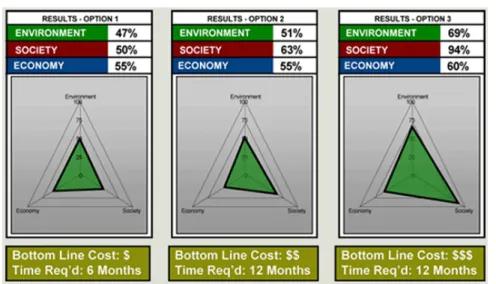
Figure 8. Example of the assessment result by GoldSet, available at
sustainable remediation. Each option or remediation alternative which could be chosen in remediation can be qualified and scored based on the indicators of sustainable remediation with the aid of these tools. Remediation managers can use the results from these tools to decision-making. In the case of GoldSet developed by Golder Associates Ltd, for example, remediation alternatives are evaluated in three viewpoints, environmental, social, economy and a client gets some help to make decision (Fig. 8).
Green remediation has successfully reduced environmental footprints produced by remedial action. Moreover, sustainable remediation which tries to consider social indicators as well was defined in Europe. To realize sustainable remediation, quantification method which can makes success measurable, incremental, establishes validity of greener solutions become more important. As a result, sustainable remediation assessment is continuously developed to becoming a rational standard component of remedy selection, implementation, and optimization in U.S. and Europe.
5 CONCLUSION
In the United States, a policy for green remediation has been established by EPA and the remediation technology based on green remediation has also been researched and widely applied to the remediation sites. In the case of Europe, green remediation has been evaluated for the application of green technology in the remediation industry and they especially defined ‘sustainable remediation’ following idea of ‘sustainable development’ and have developed assessment tools and framework to demonstrate ‘sustainable remediation’. However, there are only a few cases about application of ‘sustainable remediation’ in Korea, and most of contaminated groundwater have been treated by energy-intensive technology, such as thermal desorption, air sparging because domestic policies, laws, systems for green remediation are inadequate.
Soil and groundwater remediation technology should be developed towards green remediation, considering “Green Growth” as policy direction in South Korea. However, it is difficult to apply green and sustainable remediation concept directly, considering the level of remediation technology and market in South Korea. Firstly, the indicators which can be easily quantified such as CO2 emission and energy consumption rate during whole remediation process should be concerned, then sequential development considering the other indicators required for sustainable remediation
should be done. To accomplish this goal, it is necessary to investigate the assessment tools for quantification of the visible net benefit obtained by green and sustainable remediation and financial inducements to boost green and sustainable remediation should be made.
REFERENCES
1) 2006-2011 EPA Strategic Plan: Charting Our Course, (2006): U.S.EPA, Washington, D.C., p. 180.
2) A Framework for Assessing the Sustainability of Soil and Groundwater Remediation, (2009): SuRF Australia, p. 13.
3) A Framework for Assessing the Sustainability of Soil and Groundwater Remediation. Public Consultation March 2010, (2010): CL:AIRE, ISBN 978-1-905046-19-5, London, UK.
4) Basic research for the introduction of optimal management techniques of green remediation, (2009): Korea Environment Institute
5) Dellens, A.D. (2007): “Green Remediation and the Use of Renewable Energy Sources for Remediation Projects”, U.S.EPA, Washington, D.C., p. 47.
6) Environmental Action Plans for Green Growth, (2009): Korea Ministry of Environment.
7) Evans A. (2010): “A Sustainable Greener Remediation Option, Sustainable Approaches to Remediation Contaminated Land in Europe (SARCLE-2010)”, pp.45-46.
8) Green Remediation: Incorporating Sustainable Environmental Practices into Remediation of Contaminated Sites, (2008): U.S.EPA, Cincinnati, OH, p. 48.
9) Guidelines for Soil remediation method, (2007): Korea ministry of environment.
10) Incorporating Sustainable Environmental Practices into Remediation of Contaminated Sites, (2008): EPA. 11) Jeong, J.K., Yoo, K.K., Lee J,C, Kim, M.S. (2007):
“Current Status of Contaminated Soils Remediation in Korea, Applied chemistry”, Applied Chemistry, Vol. 11, No. 2, pp. 582-585.
12) Laugier, M., Hawley, E., Troschinetz, A., Gattenby, J., Brownell, D., and Beil, K. (2010): “A Green and Sustainable Remediation Tool Review and Comparison”, EPA International Conference on Green Remediation.
13) Park, J.J. (2008): “Current Issues and Direction of Geo-Environmental Engineering in Korea”, Proceeding, 2008 Korea Geo-Environment Society Conference, PP 3~22
14) Report of the World Commission on Environment and Development, (1987): UN.
15) Yang, J.W., Lee, Y.J. (2007): “Status of Soil Remediation and Technology Development in Korea”, Korean Chemical Engineering Research, Vol. 45, No. 4, PP. 311-318.
16) Uppal, O.J., Cliff, B.L., Keane, D.P., and Michael C. Marley, M.C. (2010): “Improving Remedial Efficiency and Sustainability of a Multi-Phase Extraction (MPE) System via Pulse Operation”, EPA International Conference on Green Remediation.