Vol. 11, No. 1 December, 2009, 21-28
Effect of Organic Materials in Water Treatment by Hybrid Module of
Multi-channel Ceramic Microfiltration and Activated Carbon Adsorption
Jin Yong Park and Sang Min Lee†
Department of Environmental Sciences & Biotechnology, Hallym University, Kangwon 200-702, Korea *Department of Chemical Engineering, Kwangwoon University, Seoul 139-701, Korea
(Received December 14, 2009, Accepted December 27, 2009)
Abstract: We investigated the effect of organic materials on membrane fouling in advanced drinking water treatment by a hybrid module packed with granular activated carbon (GAC) outside multi-channel ceramic microfiltration membrane. Synthetic water was prepared with humic acid and kaolin to simulate natural water resouces consisting of natural organic matter and inorganic particles. Kaolin concentration was fixed at 30 mg/L and humic acid was changed as 2∼10 mg/L to inspect the effect of organic matters. Periodic back-flushing using permeate water was performed for 10 sec per filtration of 10 min. As a result, both resistance of membrane fouling (Rf) and permeate flux (J) were influenced highly by concen-tration of humic acid. It proved that NOM like humic acid could be an important factor on membrane fouling in drinking water treatment. Turbidity and UV254 absorbance were removed up to above 97.4% and 59.2% respectively.
Keywords: hybrid module, ceramic membrane, GAC, water treatment, multi-channel
1. Introduction 1)
As drinking water source has been severely polluted by various organic matters, turbid materials, and patho-gens, both interests and applications for advanced water treatment have increased in order to remove effectively those pollutants of undesirable source. Furt-hermore, researches of drinking water treatment by membrane separation have been achieved actively [1-5]. Application of membrane separation in the drinking water treatment could achieve not only superior quality of treated water, but also compact facility without limit of installation area compared with conventional water treatment technologies. In addition, quality of treated water was excellent and independent of fluctuation of water source condition because the membrane separa-tion was physical treatment [6].
Recently a major pending problem in drinking water
†Author for all correspondences
(e-mail:[email protected])
treatment plant is to remove effectively NOM that has been known as a precursor of disinfection by-products (DBPs) such as trihalomethanes (THMs). However, it was difficult to remove soluble organic materials such as NOM by only microfiltration (MF) [7]. Therefore, a lot of researches for hybrid process of membrane filtra-tion and activated carbon (AC) adsorpfiltra-tion have been performed to remove NOM [8-11].
Additionally NOM is one of major materials to cause membrane fouling in membrane separation process applied to advanced drinking water treatment. Generally membrane fouling in drinking water treat-ment was made by inorganic particles (e.g. iron, silica and suspended solids) and organic compounds (e.g. humic substances, polysaccharides, proteins and microor-ganisms) [12-14]. And the membrane fouling caused concentration polarization [15] and gel layer formation on membrane surface [16], and adsorption and pore blockage inside membrane pores [17].
chemical resistance, high mechanical strength, stable characteristics at high pressure and temperature, wide available range of pH 0∼14, and long lifetime com-pared with organic membranes. Therefore it has advan-tages to prevent damage and pollution, which happened frequently in organic membranes, by microorganisms and bacillus because of inorganic materials. The cera-mic membrane will be dramatically applied to water treatment field, and play an important role in water treatment because it has high ripple effect on industry [18,19]. We have been continuously reported the advanced drinking water treatment by hybrid module of ceramic microfiltration and activated carbon adsorp-tion [20-24].
However, in this study the hybrid module for advanced drinking water treatment was composed of 1.0 µm pore size multi-channel ceramic MF, which was different with them used in our previous studies [20-24], and GAC adsorption. We investigated effects of organic materials on membrane fouling and treatment efficiencies of turbidity and UV254
absor-bance in advanced water treatment process by this hybrid module.
2. Theory
The resistance-in-series filtration model was applied to analyze experimental data for calculating filtration resistance and permeate flux (J) in this study. The model is well known in the application field of mem-brane separation and can be expressed by equation (1) [25].
(1)
Where J is the permeate flux through membrane, P is trans-membrane pressure (TMP), Rm is the resistance
of membrane, Rb is the resistance of boundary layer,
and Rf is the resistance of membrane fouling.
For filtration of pure water, Rb and Rf do not exist
because of no boundary layer by concentration
polari-zation and no membrane fouling by pollutants. The equation (1) can be simplified to equation (2).
(2)
Where Rm can be calculated from the experimental data of permeate flux for pure water using equation (2). Then, the plot of Rb + Rf vs. t (operation time) can be obtained from the permeate flux data using synthetic water. The intercepting value of y-axis (t = 0) in this plot using only initial 2 data is Rb because
of no Rf at the initial time of filtration, and finally Rf
can be calculated using equation (1).
In addition, both feed water and permeate water is analyzed in our experiment. Treatment efficiencies can be decided by following equation (3).
× (3)
Where R is treatment efficiency, Cf is concentration of
feed water, and Cp is concentration of permeate water.
3. Materials and Methods
3.1. Multi-channel Ceramic Membrane and GAC
Multi-channel ceramic MF membrane (HC10) used in the study was coated with α-alumina on supporting layer of α-alumina, and its pore size was 1.0 µm. We purchased the membrane from Dongseo Inc. in Korea, and it had 7 channels shown in Fig. 1. Its O.D. was 20 mm, I.D. 4 mm, length 235 mm, and total surface area 206.7 cm2, as arranged in Table 1.
GAC used here was coconut shell charcoal (8 × 30 mesh) for water treatment, and specification of the GAC was shown in Table 2. In order to sort uniform particle size before experiments, the GAC was se-parated by 9 mesh (2 mm) and then by 16 mesh (1 mm) sieves. Separated GAC particles (1∼2 mm) were rinsed in distillate water and then dried at 105°C during 2 h.
Fig. 1. Shape of multi-channel ceramic membranes [21]. Table 1. Specification of Multi-channel Ceramic Mem-brane used in This Study
Membrane HC10 Pore size (µm) 1.0 No. of channels 7 Outer diameter (mm) 20 Inner diameter (mm) 4 Length (mm) 235 Surface area (cm2) 206.7
Material alumina coating on alumina support Company Dongseo Inc. (Korea)
3.2. Synthetic Water
In order to modify humic materials to be major portion of natural organic matters and fine inorganic particles such as clay to cause turbidity, a quantity of humic acid and kaolin was dissolved in distilled water. Then it was utilized as synthetic water in our ex-periments.
3.3. Hybrid Membrane Module
To remove turbidity and NOM, hybrid module was composed by packing GAC between module inside and outside of multi-channel ceramic membrane. In addi-tion, 100 mesh (0.150 mm), which was extremely smaller than 1∼2 mm particle size of GAC used here, was installed at outlet of the hybrid module to prevent GAC loss to treated water tank.
Table 2. Specification of GAC Employed in This Study [20]. Parameter Average value
Mesh size Moisture Iodine number Hardness Bulk Density 8 × 30 mesh 2.8% 1,058 mg/g 95.8% 0.48 g/mL 3.4. Experimental Procedures
Advanced water treatment system using hybrid module (6) of ceramic microfiltration and GAC adsorp-tion was shown in Fig. 2. And we performed cross- flow filtration for tubular membrane and periodic water- back-flushing using permeate water. The hybrid module (6) filled with 60 g of GAC was installed in the advanced water treatment system. And then feed tank (1) was filled with prepared 10 L of synthetic water composed of humic acid and kaolin, and temperature of feed water was constantly maintained by using constant temperature circulator (3) (Model 1146, VWR, U.S.A). Also, the synthetic feed water was continuously mixed by stirrer (4) in order to be homogeneous con-dition of feed water, and it was flowed into the inside of the tubular ceramic membrane by pump (2) (Procon, Standex Co., U.S.A) when solenoid valves expressed by “1” were open. Feed flow rate was measured by flowmeter (5) (NP-127, Tokyo keiso, Japan). Flow rate and pressure of feed water which was flowed into the hybrid module was constantly maintained by controll-ing valves (9) of both bypass pipe of pump (2) and concentrate pipe. Permeate flux treated by both ceramic membrane and GAC was measured by electric balance (11) (Ohaus, U.S.A.). Permeate water was flowed into the back-washing tank (13) when permeate flux was not measured. After the treated water was over a certain level in the back-washing tank (13), it was recycled to the feed tank (1) to be constant concentration of the feed water during operation [23].
Kaolin was fixed at 30 mg/L and humic acid was varied as 2, 4, 6, 8 and 10 mg/L at experiment of organic matters effect. Then, we observed resistance of membrane fouling (Rf) and permeate flux (J) during
Fig. 2. Apparatus of advanced water treatment system using hybrid module of multi-channel ceramic microfiltration and GAC adsorption with periodic water-back-flushing [20].
total filtration time of 180 min at each condition. At all experimental conditions, TMP was at 0.80 bar, water-back-flushing pressure at 2.50 bar, feed flow rate at 1.0 L/min, and feed water temperature at 20°C. Also, periodic water-back-flushing using permeate water was performed during 10 sec per filtration of 10 min when solenoid valves expressed by “0” were open. Quality of feed water and treated water was analyzed in order to evaluate treatment efficiencies of turbid materials and dissolved organic matters. Turbidity was measured by turbidimeter (2100N, HACH, U.S.A.) and UV254 absorbance, which was directly proportional to
concentration of humic acid, was analyzed by UV spectrophotometer (GENESYS 10 UV, Thermo, U.S.A.).
4. Results and Discussions
Kaolin was fixed at 30 mg/L and humic acid was changed from 2 to 10 mg/L in synthetic feed water at experiment in order to investigate effect of organic
matters. As a result, the resistance of membrane fouling (Rf) was dramatically raised as increasing concentration
of humic acid from 2 mg/L to 10 mg/L as shown in Fig. 3. In particular, Rf was increased obviously when
the concentration of humic acid was changed from 4 mg/L to 6 mg/L. As summarized in Table 3, the final Rf after 180 min’s operation (Rf,180) at 4 mg/L and 6 mg/L were 0.534 × 10⁻⁹ and 0.668 × 10⁻⁹ kg/m2s re-spectively. However, Rf was increased a little when the concentration of humic acid was changed from 8 mg/L to 10 mg/L, and Rf,180 values at 8 mg/L and 10 mg/L were 0.783 × 10⁻⁹ and 0.817 × 10⁻⁹ kg/m2s, respectively. Finally the experimental values of Rf,180 were signifi-cantly increased according to addition of the humic acid concentration. The result was exactly same with our previous study using tubular ceramic MF mem-brane (NCMT-7231, pore size 0.1 µm) [23].
Fig. 4 showed a change of dimensionless permeate flux (J/Jo), which was permeate flux at given time (J) vs. initial permeate flux (Jo) during operation of water
Table 4. Water Quality and Rejection Rate of Turbidity in the Experiments Using Hybrid Module of HC10 and GAC for Effect of Humic Acid Concentration
Experimental condition Turbidity (NTU)
Average Treatment efficiency (%) Kaolin (mg/L) Humic acid (mg/L)
Feed water Treated water
Range Average Range Average
30 2 21.10∼22.50 21.82 0.15∼0.18 0.16 99.25 4 14.70∼29.60 22.80 0.18∼0.26 0.21 99.01 6 24.00∼26.90 26.15 0.21∼1.50 0.65 97.50 8 27.00∼29.10 27.82 0.24∼1.34 0.72 97.42 10 30.10∼34.50 31.80 0.24∼0.73 0.40 98.74
Table 3. Filtration Factors in the Experiments for Effect of Humic Acid Concentration Experimental Conditions Rf,180 × 10-9 (kg/m2s) Jo × 105 (m/s) J180 × 105 (m/s) J180/Jo VT (L) Kaolin (mg/L) Humic acid (mg/L)
30 2 4 6 8 10 0.426 0.534 0.668 0.783 0.817 31.63 26.74 28.94 28.18 26.53 11.63 9.48 8.35 7.39 7.05 0.368 0.355 0.289 0.262 0.266 33.23 29.60 26.78 26.17 22.97
Fig. 3. Effect of humic acid concentration on resistance of membrane fouling.
treatment. The values of J/Jo tended to decrease as
increasing the humic acid concentration as shown in Fig. 4, because of generating membrane fouling. Thus, final value of J/Jo (J180/Jo) at 2 mg/L and 10 mg/L of
the humic acid concentration were 0.368 and 0.266, respectively. It proved that NOM like humic acid could
Fig. 4. Effect of humic acid concentration on dimen-sionless permeate flux.
be important factor on membrane fouling in drinking water treatment.
As shown in Fig. 5, permeate flux (J) through multi- channel ceramic membrane was also decreased obviously as increasing the humic acid concentration. Final permeate flux (J180) at 2 mg/L and 10 mg/L of the humic
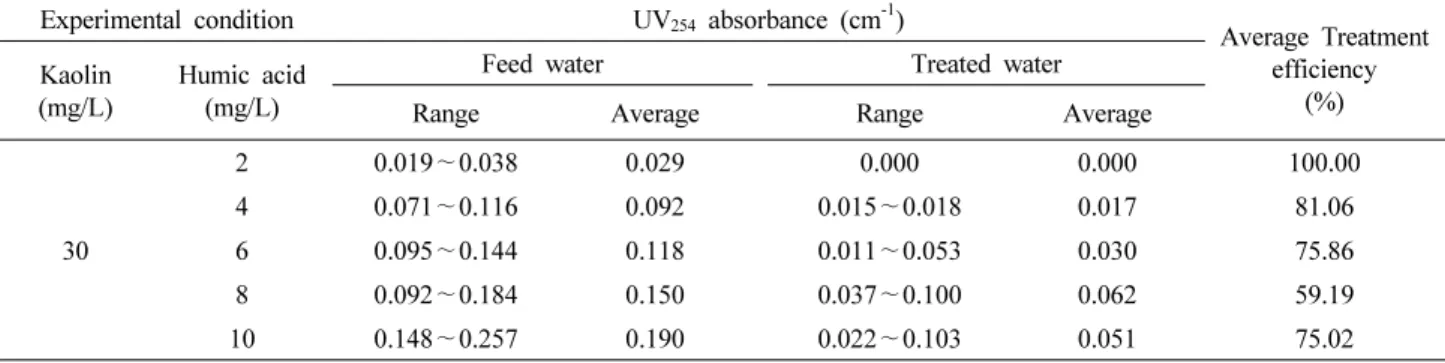
Table 5. Water Quality and Rejection Rate of UV254 Absorbance in the Experiments Using Hybrid Module of HC10 and
GAC for Effect of Humic Acid Concentration
Experimental condition UV254 absorbance (cm-1)
Average Treatment efficiency (%) Kaolin (mg/L) Humic acid (mg/L)
Feed water Treated water
Range Average Range Average
30 2 0.019∼0.038 0.029 0.000 0.000 100.00 4 0.071∼0.116 0.092 0.015∼0.018 0.017 81.06 6 0.095∼0.144 0.118 0.011∼0.053 0.030 75.86 8 0.092∼0.184 0.150 0.037∼0.100 0.062 59.19 10 0.148∼0.257 0.190 0.022∼0.103 0.051 75.02
Fig. 5. Effect of humic acid concentration on permeate flux.
acid concentration were 11.63 × 10⁻⁵ and 7.05 × 10⁻⁵ m/s, respectively. Therefore, organic materials as humic acid could make severely fouling inside membrane and on the surface of membrane.
Total permeated volume (VT) calculated using permeate flux during 180 min’s operation, as shown in Table 3, was the highest value of 33.23 L at the humic acid concentration of 2 mg/L. But VT was much low value
of 22.97 at 10 mg/L of humic acid, because of severe membrane fouling by organic materials.
Then, turbidity of feed water and treated water, and average treatment efficiency was arranged in Table 4. It was high above 97.4%, and the maximum efficiency of 99.25% at 2 mg/L of humic acid. And the average
treatment efficiency of turbidity tended to decrease a little because turbidity of feed and treated water in-creased as increasing the concentration of humic acid, as shown in Table 4.
The average treatment efficiency of UV254
absor-bance, which was directly proportional to concentration of humic acid, was arranged in Table 5. It was the maximum of 100% at 2 mg/L of humic acid, and the minimum of 59.19% at 8 mg/L. Therefore it tended to decrease dramatically as increasing the concentration of humic acid, because UV254 absorbance of feed and
treated water increased as increasing the concentration of humic acid, as shown in Table 5.
5. Conclusion
In this study, we investigated the effect of organic materials on membrane fouling in advanced drinking water treatment by hybrid module packed with granular activated carbon (GAC) outside multi-channel ceramic microfiltration membrane. The experimental results of the effect of organic matters both Rf and J/Jo were
highly dependent on the concentration of humic acid in the synthetic water. In particular, resistance of mem-brane fouling was increased obviously when the con-centration of humic acid was changed from 4 mg/L to 6 mg/L. Therefore, it means that NOM like humic acid could be important factor on membrane fouling in drinking water treatment. Then, treatment efficiencies of turbidity was much high above 97.4%, but those of UV254 absorbance was above 59.2%.
References
1. A. R. Costa and M. N. Pinho, “Performance and cost estimation of nanofiltration for surface water treatment in drinking water production”, Desalina-tion, 196, 55 (2006).
2. L. Fiksdal and T. O. Leiknes, “The effect of coagulation with MF/UF membrane filtration for removal of virus in drinking water”, J. Membr. Sci., 279, 364 (2006).
3. Y. T. Lee and J. K. Oh, “A study on the optimiza-tion of process and operaoptimiza-tion condioptimiza-tion for mem-brane system in tap water treatment”, Memmem-brane Journal, 9, 193 (1999).
4. T. Leiknes, H. Ødegaard, and H. Myklebust, “Removal of natural organic matter (NOM) in drinking water treatment by coagulation-microfiltra-tion using metal membranes”, J. Membr. Sci., 242, 47 (2004).
5. J. I. Oh and S. H. Lee, “Influence of streaming potential on flux decline of microfiltration with in- line rapid pre-coagulation process for drinking water production”, J. Membr. Sci., 254, 39 (2005). 6. M. H. Kim and J. Y. Park, “Membrane fouling
control effect of periodic water-back-flushing in the tubular carbon ceramic ultrafiltration system for recycling paper wastewater”, Membrane Journal, 11, 190 (2001).
7. M. H. Cho, C. H. Lee, and S. H. Lee, “Effect of flocculation conditions on membrane permeability in coagulation-microfiltration”, Desalination, 191, 386 (2006).
8. S. Gur-Reznik, I. Katz, and C. G. Dosoretz, “Re-moval of dissolved organic matter by granular- activated carbon adsorption as a pretreatment to reverse osmosis of membrane bioreactor effluents”, Water Res., 42, 1595 (2008).
9. H. S. Kim, S. Takizawa, and S. Ohgaki, “Applica-tion of microfiltra“Applica-tion systems coupled with po-wdered activated carbon to river treatment”, De-salination, 202, 271 (2007).
10. S. Mozia and M. Tomaszewska, “Treatment of surface water using hybrid processes-adsorption on PAC and ultrafiltration”, Desalination, 162, 23 (2004).
11. H. K. Oh, S. Takizawa, S. Ohgaki, H. Katayama, K. Oguma, and M. J. Yu, “Removal of organics and viruses using hybrid ceramic MF System without draining PAC”, Desalination, 202, 191 (2007).
12. Y. T. Lee and J. K. Oh, “Membrane fouling effect with organic-inorganic materials using the mem-brane separation in drinking water treatment pro-cess”, Membrane Journal, 13, 219 (2003).
13. D. B. Mosqueda-Jimenez and P. M. Huck, “Char-acterization of membrane foulants in drinking water treatment”, Desalination, 198, 173 (2006). 14. W. Yuan, A. Kocic, and A. L. Zydney, “Analysis
of humic acid fouling during microfiltration using a pore blockage-cake filtration model”, J. Membr. Sci., 198, 51 (2002).
15. M. Heran and S. Elmaleh, “Microfiltration through an inorganic tubular membrane with high frequency retrofiltration”, J. Membr. Sci., 188, 181 (2001). 16. S. K. Karode, “Unsteady state flux response: a
method to determine the nature of the solute and gel layer in membrane filtration”, J. Membr. Sci., 188, 9 (2001).
17. P. Rai, C. Rai, G. C. Majumdara, S. D. Gupta, and S. De, “Resistance in series model for ultra-filtration of mosambi (citrus sinensis (L.) osbeck) juice in a stirred continuous Mode”, J. Membr. Sci., 283, 116 (2006).
18. E. O. Kim, “Application of ceramic membrane”, Membrane Journal, 3, 12 (1993).
19. Y. T. Lee and M. H. Song, “Characteristics of the concentration process of Lactobacillus cell using a ceramic membrane”, Membrane Journal, 14, 192 (2004).
20. H. C. Lee and J. Y. Park, “Advanced water treat-ment of high turbidity source by hybrid process of ceramic microfiltration and activated carbon
adsorp-tion: Effect of GAC packing fraction”, Membrane Journal, 18(3), 191 (2008).
21. H. C. Lee and J. Y. Park, “Advanced water treat-ment of high turbidity source by hybrid process of multi-channel ceramic microfiltration and activated carbon adsorption”, Membrane Journal, 18(4), 325 (2008).
22. H. C. Lee and J. Y. Park, “Advanced water treat-ment of high turbidity source by hybrid process of ceramic microfiltration and activated carbon ad-sorption: Effect of water-back-flushing time and period”, Membrane Journal, 19(1), 7 (2009).
23. H. C. Lee, J. Y. Park, and D. Y. Yoon, “Advanced water treatment of high turbidity source by hybrid process of ceramic microfiltration and activated carbon adsorption: Effect of organic/inorganic ma-terials”, Korean J. Chem. Eng., 26(3), 697 (2009). 24. J. Y. Park and G. Y. Park, “Advanced water treat-ment of high turbidity source by hybrid process of ceramic microfiltration and activated carbon ad-sorption: Effect of organic materials in N2-back-
flushing”, Membrane Journal, 19(3), 203 (2009). 25. M. Cheryan, “Ultrafiltration Handbook”, Technomic
![Fig. 1. Shape of multi-channel ceramic membranes [21]. Table 1. Specification of Multi-channel Ceramic Mem-brane used in This Study](https://thumb-ap.123doks.com/thumbv2/123dokinfo/4958213.50491/3.892.135.377.131.377/shape-channel-ceramic-membranes-table-specification-channel-ceramic.webp)
![Fig. 2. Apparatus of advanced water treatment system using hybrid module of multi-channel ceramic microfiltration and GAC adsorption with periodic water-back-flushing [20].](https://thumb-ap.123doks.com/thumbv2/123dokinfo/4958213.50491/4.892.182.713.130.533/apparatus-advanced-treatment-channel-microfiltration-adsorption-periodic-flushing.webp)