Comparison of Power Generating Systems Using Feedback Effect Modeling
Seong Ho Kim*,a Kilyoo Kim,a Tae Woon Kim,aa Korea Atomic Energy Research Institute, Taejeon, South-Korea (*Corresponding author: [email protected])
Keywords: ANP, MCDM, decision attitude, Feedback. 1. Introduction
Comparative assessment of various power systems can be treated as a multicriteria decision-making (MCDM) problem. In reality, there is interdependence among decision elements (e.g., decision goal, decision criteria, and decision alternatives). In our previous work [1], using an analytic hierarchy process (AHP) technique [2], a comprehensive assessment framework for national power systems has been developed. It was assumed in the AHP modeling that there is no interdependence among decision elements.
In the present work, one of interdependence phenomena, feedback effect, is investigated in the context of network structures instead of one-way directional tree structures. Moreover, attitudes of decision-makers can be incorporated into the feedback effect modeling.
The main objectives of this work are to develop a feedback effect modeling using an analytic network process (ANP) technique [3] and to demonstrate the feedback effect using a numerical example in comparison to the hierarchy model.
2. Methods
Concerning the comprehensive assessment of national power sources, in general, an ANP-based network structure is shown in Figure 1.
Figure 1. Network structure for integrated assessment. An ANP technique deals with interdependences and/or feedback effects among decision elements. Corresponding to the network structure, the hierarchy structure for the
AHP model can be reduced from it. It should be noted that AHP models facilitate a benchmark process for the ANP models developed.
The algorithm of the feedback effect modeling is developed and applied to simple numerical examples.
3. Numerical examples
To the end of a demonstration of the developed framework, decision alternatives under consideration are nuclear power system and fossil-fuelled (e.g., coal-fired) system as conventional system as well as solar photovoltaic (PV) system as renewable system. These three alternatives are assessed in terms of three conflicting criteria as follows: the economic dimension represented by the generation cost, the environment by the global warming, the social by the degree of sustainability, and the health by the accident mortality. The decision goal consists of pro-nuclear attitude (i.e., agreement to nuclear energy-centered energy planning) and anti-nuclear attitude towards energy mix avoiding nuclear energy.
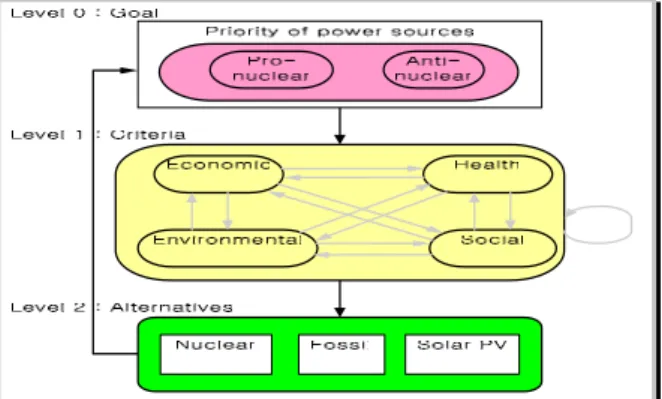
3.1 Network structure modeling for the feedback effect A feedback effect of an alternative cluster on the decision-maker (DM)’s attitude towards power systems is taken into account. Figure 2 shows the network structure of interest.
Figure 2. Network structure for feedback effect model. As shown in Figure 2, the removal of the arc from level 2 to level 1 leads to a hierarchy structure without the feedback effect. Here, both structures are compared. According to the algorithm of the feedback effect model,
Transactions of the Korean Nuclear Society Autumn Meeting Busan, Korea, October 27-28, 2005
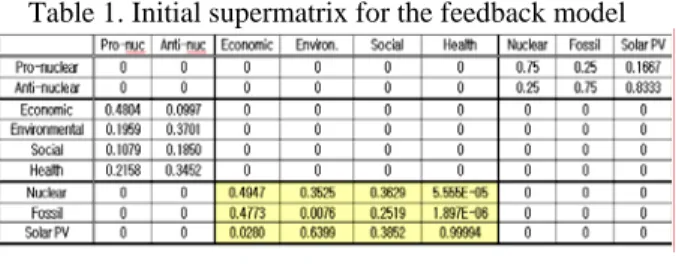
the initial supermatrix given in Table 1 is formed for valuation (or utility).
Table 1. Initial supermatrix for the feedback model
In Table 1, while numerical figures in the yellow alternative-criteria block are evaluation values, the ones of criteria-attitude block and attitude-alternative block are the eigenvectors, respectively. They correspond to the maximal eigenvalues of pair-wise comparison matrices established using a paper-based questionnaire. In the expert’s opinion participated in this survey, it seems to expose that nuclear system has stronger impacts on the pro-nuclear attitude than on the anti-nuclear. The limiting process of the power of the weighted supermatrix shows a repetition of 3-cyclic matrices.
In Table 2, the weights in an ascending order are Social
p
Economicp
Healthp
Environmental.Table 2. stead-state solution matrix for feedback model
Aggregation of two attitudes toward a set of power systems yields overall priority such as PV
f
Nuclearf
Fossil. The reasons for the PV system’s priority over the nuclear are as follows: (1) environmental and health dimensions significantly inter-depend on the anti-nuclear attitude; (2) PV strongly affects anti-nuclear attitude; and (3) PV possesses the most dominant contribution of health and environmental factors; and (4) As for the expert who offers subjective opinion, anti-nuclear attitude is preferable to pro-anti-nuclear attitude. 3.2 Hierarchy structure modelingConcerning no feedback effect, the initial supermatrix is given in Table 3. For the alternative-alternative block, the identity matrix is assigned to make the supermatrix become column stochastic.
Table 3. Initial supermatrix for independence model
The results of this structure reduce to them of the AHP model. It means that an AHP-based hierarchy model becomes a special case of ANP-based network models. Table 4 lists steady-state solution for the independence model. According to each attitude, overall preference has the following order: PV
f
Nuclearf
Fossil.Table 4. Stead-state solution for hierarchy structure
The feedback effect model has the same priority orders as the independence model. From the aggregation viewpoint of two different attitudes, for each system, the overall score for the feedback model can be obtained by a weighted arithmetic mean between the overall scores for the independence model and the attitude scores for the independence model. For instance, the aggregated preference of the nuclear has the following relationship between two models: 0.3432 * 0.3458 + 0.6568 * 0.2469
≈
0.2808.4. Conclusion
An ANP-based feedback assessment framework for DMs’ attitudes has been developed. The feedback assessment model is demonstrated and compared using a numerical example. The aggregation of attitudes of DM (e.g., pro-nuclear, anti-nuclear attitude) can be dealt with using the feedback model. In the near future research, a network framework for more complicated inter-dependences (e.g., inner-dependence combined with feedback effects) will be established and quantified.
Acknowledgement
The work is supported by the Ministry of Science and Technology as a Nuclear R&D Program.
References
[1] S.H. Kim et al.,AHP method for comprehensive national
energy systems, KOSEE 2005 Spring Conference, May 13, 2005, pp.170-175.
[2] T.L. Saaty, The analytic hierarchy process, McGraw-Hill,
New York, 1980.
[3] T.L. Saaty, Decision making with dependence and
feedback: The analytic network process, RWS Publications, Pittsburgh, PA, 1996.
[4] R. P. Hämäläinen and T. O. Seppäläinen, The analytic
network process in energy policy planning, Socio-Economic Planning Sciences, Volume 20, Issue 6, 399-405, 1986.