COMPARATIVE STUDY ON DEWATERING SLUDGE WITH SOLAR DRYING AND SIPHON METHODS
125
COMPARATIVE STUDY ON DEWATERING SLUDGE WITH SOLAR DRYING AND
SIPHON METHODS
JUN TONG i), NORIYUKI YASUFUKU ii), KIYOSHI OMINE iii) and TAIZO KOBAYASHI iv)
ABSTRACT
A large quantity of purified water sludge is generated in modern cities around the world. Dewatering is essential to reduce the volumes transported off-site for disposal. Traditionally employed methods such as solar drying methods are time-consuming. There are urgent demands for developing alternatives to dewater the sludge in a less time-consuming manner. In this paper, siphon method is proposed to dewater the high-water-content sludge with plastic drainage plate installed horizontally. A group of comparative tests are conducted to preliminarily investigate the dewatering behavior of the purified water sludge with siphon and solar drying methods, respectively. On the basis of the test results, the availability and effectiveness of the new method is verified. It may provide an innovative solution to treat the purified water sludge more effectively.
Key Words: Dewatering, Siphon Method, Solar Drying, Horizontal Drainage
1 INTRODUCTION
A large quantity of purified water sludge is generated in modern cities around the world. Typically, sludge is dewatered to reduce the volumes transported off-site for disposal. The material can be a valuable resource although much of it is currently disposed because of economic, logistical or environmental constraints. Whereas, in many countries disposal is becoming more and more difficult owing to the lack of space as well as environmental concerns. Therefore, developing techniques for dewatering to reducing the volume of sludge is of significant necessity. However, traditional dewatering methods are featured by time-consumption [1]. New alternatives are urgently demanded to treat the material time-effectively and environmentally-friendly. In this paper, a new dewatering method—siphon dewatering method with horizontally installed drainage plate is proposed, and the availability and effectiveness of the new method are preliminarily investigated [2~4].
2 TEST SCHEME
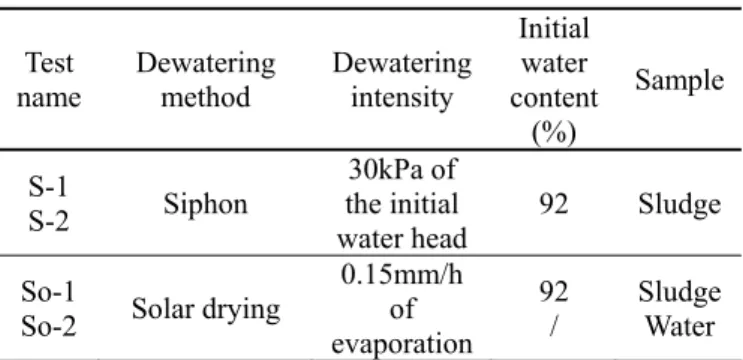
A series of laboratory tests are conducted to comparatively investigate the dewatering behavior of the mud under siphon and solar drying conditions. The test scheme includes 1 group of comparative siphon tests with horizontally installed drainage plate and solar
drying test, as illustrated in Table 1. S-1 and S-2 are 2 parallel siphon tests with the same initial condition, So-1 and So-2 are 2 solar drying dewatering tests, which are carried out with the slurry sample and water only respectively under the same solar intensity. According to the natural water content of the sludge, the initial water contents for all the dewatering tests were chosen as 92%.
Table 1 Test scheme
Test
name Dewatering method Dewatering intensity
Initial water content (%) Sample S-1 S-2 Siphon 30kPa of the initial
water head 92 Sludge So-1
So-2 Solar drying
0.15mm/h of evaporation
92
/ SludgeWater
3 TEST SAMPLE AND EQUIPMENTS
The sludge sample used in the study was taken from Island city, Fukuoka city, Japan. According to the Unified Soil Classification System, the soil can be categorized as MH. Its basic physical properties are presented in Table 2. The illustration for the siphon and
i) PhD student, Department of Civil Engineering, Kyushu University, Fukuoka 819-0395, JAPAN ii) Professor, Department of Civil Engineering, Kyushu University, Fukuoka 819-0395, JAPAN
iii) Associate Professor, Department of Civil Engineering, Kyushu University, Fukuoka 819-0395, JAPAN
JUN TONG, NORIYUKI YASUFUKU, KIYOSHI OMINE and TAIZO KOBAYASHI
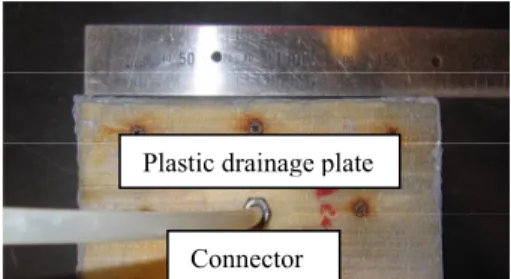
126 solar-drying dewatering test equipments are shown in Figure 1(a) and (b), respectively. For the siphon dewatering tests, the test equipments mainly comprise of perpex tanks, a plastic drainage plates, pore water pressure transducer (PWP transducer) and plastic pipe. As shown in Fig.1 (c), the length, width and thickness of the drainage plate are 17cm, 9.6cm and 3.9mm, respectively. It is installed in the right center of the bottom of the perspex tank horizontally. A 3m long plastic pipe full-filled with de-aired water is utilized to yield 30kPa water head difference, which is equivalent to the corresponding vacuum pressure. The PWP transducer is installed at the end of the piper to monitor the variation of the PWP during the dewatering process. For the solar drying dewatering tests, the bulb was used to simulate the natural solar drying condition. According to the maximum evaporation amount per day in Fukuoka city, Japan, the evaporation intensity for solar drying dewatering test was chosen as 1.5mm/d on the basis of the preliminarily outdoor test.
Table 2 Basic physical properties of test soil Gravity specific GS Natural Water content (%) Liquid limit (%) wL Plastic limit (%) wP Plastic lndex Ip 2.673 89.4-93.1 77.9 36.7 41.2
(2) Enlarged photo for the plastic drainage plate (a) Siphon method
(1) Slurry
(2) Water (b) Solar drying Fig.1.Test equipments
3 TEST RESULTS AND ANALYSIS
Figure 2 shows the variation of dewatered volume with time in the siphon tests. It can be inferred that about 30% of water involved in the mud has been dewatered by the siphon tests. The variation of dewatered volume could be fitted very well with Eq.1, which was proposed by Zeng (1989) [5].
U=1-αe-βt (1)
Whereas the U is the degree of consolidation,α, β Connector
Plastic drainage plate
COMPARATIVE STUDY ON DEWATERING SLUDGE WITH SOLAR DRYING AND SIPHON METHODS
127 are the coefficient dependent with the drainage conditions, respectively. It suggests the siphon dewatering process could be predicted by unified consolidation expression. 0 20 40 60 80 100 120 0 200 400 600 800 1000 1200 1400 1600 Wate r dr a inag e v olu me( cm 3 ) Time(hr) S-1 S-2 Exponential Fitting V = 1277-1192×exp(-t/34.7), R2 =0.993
Fig.2. The variation of dewatered volume with time in the siphon tests
0 20 40 60 80 100 0 -10 -20 -30 -40 -50
Pore water pres
su re (k Pa) Time(hr) S-1 S-2 (a) 10-3 10-2 10-1 100 101 102 0.0 0.2 0.4 0.6 0.8 1.0 V = 1.29-0.28×exp(-t/67.6), R2 =0.890 S-1 S-2 Exponential fitting u/u 0 Time(hr) (b)
Fig.3. The variation of the pore water pressure with time in the siphon tests
Figure 3 shows the variation of the pore water pressure with time in the siphon tests. As shown in Fig.3 (a), the siphon dewatering process could be generally categorized to 3 stages. At the initial stage (the beginning 60 hr), the pore water pressure remains stable with time, the dewatering rate is comparatively high. Thereafter, the negative siphon water head dissipate sharply, the dewatering speed reduces significantly. At a later stage, the PWP remains at a small value, little dewatering volume is observed. Figure 3(b) shows the fitting curve of the pore water pressure in the half-logarithmic coordinate. It is fitted reasonably agreeable with Eq. (1), which is consistent with Fig.2.
Figure 4 shows the evaporated water of the slurry and water with time in the solar-drying test. In the beginning 300hrs, the evaporation speed in the tests So-1 and So-2 are almost the same. However, with the thickness of the sludge crust increases, the evaporation speed of the sludge becomes slower than that of the water. Later, the formation of the crust hinders the development of drying dewatering. However, the sludge dewaters gradually with the development of the crack. 0 100 200 300 400 500 600 0 200 400 600 800 1000 1200 Ev aporate d w ater(g) Time(hr) So-1 So-2 Fig.4. The Evaporated water amount of the slurry and
water with time
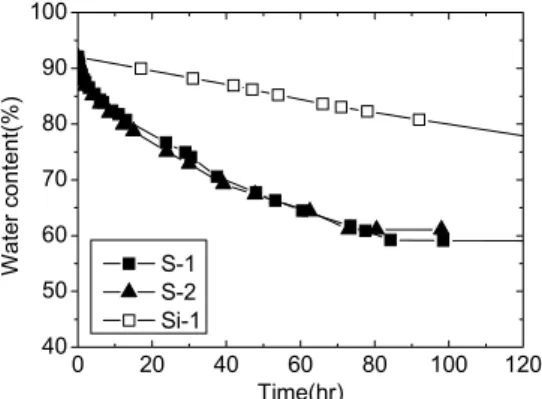
Figure 5 shows the variation of the water content with time in the siphon and solar drying dewatering tests. The initial water contents of the sludge for all the tests are 92%. As mentioned above, the siphon dewatering process could be categorized to 3 stages. At the first stage, the dewatered volume decreases dramatically. Thereafter, the water content decreases very slowly with time. It may account for this phenomenon that the alleviation of the siphon water head with more bubble due to the decrease of the water content. When the water content is below the liquid limit, the cracks develop progressively, and then the drainage plate would expose in the atmosphere through the cracks and little water head would be remained for generating the siphon dewatering pressure. Whereas,
JUN TONG, NORIYUKI YASUFUKU, KIYOSHI OMINE and TAIZO KOBAYASHI
128 the water content of the sludge with solar drying method remains constant. As illustrated in Table 3, when the water contents of the sludge decrease to 90%, the elapsed times for test S-1 and S-2 are 0.3h ,0.2h, respectively. While the correspondingly elapsed time for test So-1 is 17.0h, which is more than 50 times greater than that with siphon method. With the dewatering proceeds, the difference of the elapsed time between the siphon and solar-drying method decreases. Finally, the water content of the sludge in the siphon method remains a stable value, as the dewatering of solar drying case continues with the development of the crack of the crust. However, since the evaporation intensity in the test was chosen as the maximum value, as for the practical field case, the different of dewatering between the siphon and solar drying method could be even much more significant due to the involvement of the discontinuousness of the sunshine in the night and the potential rainfall. It may be inferred that the siphon method is specifically efficient for dewatering the sludge with high water content at the initial stage. However, the solar method could be effective for the consequent dewatering stage. The prospect of the siphon combined solar drying method may be further investigated to maximize the dewatering effect. 0 20 40 60 80 100 120 40 50 60 70 80 90 100 Wate r c ontent(%) Time(hr) S-1 S-2 Si-1
Fig.5. The variation of the water content with time in the siphon and solar drying dewatering tests
Table 3 The water content at different times in the siphon and solar drying dewatering methods
Elapsed time (h) Water content (%) S-1 S-2 So-1 92 0 0 0 90 0.3 0.2 17.0 85 5.5 5.0 54.0 70 38.5 37.8 180.0 60 80.5 79.5 287.0
4 CONCLUSIONS AND PERSPECTIVE
Through a group of siphon and solar drying methods comparative tests, the following conclusions can be drawn.
1. The siphon method exhibits effectiveness for the dewatering of the high water content sludge.
2. The siphon dewatering process could be generally categorized to 3 stages, which exhibit distinct dewatering characteristics at respective stage. The dewatering process of the siphon method can be fit well with the unified consolidation expression.
3. Comparing the solar drying method, the siphon method is specifically efficient for dewatering the sludge with high water content at the initial stage.
The sludge sample is taken from seashore for the preliminary study. Later the purified water sludge sample would be taken to carry out more comprehensive study on the siphon and solar drying dewatering methods. Moreover, the prospect of the combined siphon and solar drying methods would be further investigated.
REFERENCES
1) Guohua CHEN, Po Lock YUE, Arun MUJUMDAR (2002):"Sludge Dewatering and Drying", Drying Technology, 20(4), pp. 883-916.
2) Jun Tong, Noriyuki Yasufuku, Kiyoshi Omine, Taizo Kobayashi. (2010): “ Experimental study on an alternative method to dewater the dredged mud by siphon method”, The
45th Japanese Geotechnical Symposium.(CD-ROM)
3) Jun Tong, Noriyuki Yasufuku, Kiyoshi Omine, Taizo Kobayashi. (2010): “Experimentally comparative study on the dewatering of the dredged mud by siphon and vacuum methods”, 7th International Symposium on Lowland
Technology, September 16-18, 2010. Saga, Japan.(In press)
4) Jun Tong, Noriyuki Yasufuku, Kiyoshi Omine, Taizo Kobayashi. (2010): “ Experimental study on an alternative method to dewater the dredged mud by siphon method”, The
25th Japanese Geosynthetic Symposium.(In press)
5) Zeng, G.X., and Xie, K.H. (1989): “ New development of the vertical drain theories”, In Proceedings of the 12th
International Conference on Soil Mechanics and Foundation Engineering, Rio de Janeiro, Brazil, 13–18 August 1989.