Antiobesity effects of KR-66195, a
synthetic DPP-IV inhibitor in
diet-induced obese mice and obese-diabetic
ob/ob mice
Kim Yunwook
Department of Medical Science
The Graduate School, Yonsei University
Antiobesity effects of KR-66195, a
synthetic DPP-IV inhibitor in
diet-induced obese mice and obese-diabetic
ob/ob mice
Directed by Professor Hyun Chul Lee
The Master's Thesis
submitted to the Department of Medical Science,
the Graduate School of Yonsei University
in partial fulfillment of the requirements for the degree
of Master of Medical Science
Kim Yunwook
This certifies that the Master's Thesis of
Kim Yunwook is approved.
━━━━━━━━
Thesis Supervisor : Hyun Chul Lee
━━━━━━━━
Thesis Committee Member : Bong Soo Cha
━━━━━━━━
Thesis Committee Member : Sahng Wook Park
The Graduate School
Yonsei University
ACKNOWLEDGEMENTS
이 논문을 완성하기까지 여러모로 부족한 저에게
배려와 지도를 아끼지 않으셨던 이현철 교수님께
마음 속 깊이 감사 드립니다. 그리고 바쁘신 중에도
논문의 내용을 세심히 살펴주시고 바로잡아 주신
차봉수 교수님, 박상욱 교수님께도 감사를 드립니다.
또한 학부 시절부터 저에게 많은 가르침을 주신
전용관 교수님, 긴 시간 실험실 생활을 함께 했던
최승호, 박영미, 김수현, 왕혜진 선생님, 동물
실험을
도와주신
실험동물부
김형관,
이용재
선생님을 비롯하여 이 논문 완성이 되기까지 저를
도와주신 모든 분들께 감사 드립니다. 마지막으로
지금까지 저를 믿고 응원해 주신 부모님께 진심으로
감사드립니다.
저자씀
TABLE OF CONTENTS
ABSTRACT --- 1
I. NTRODUCTION --- 3
II. MATERIALS AND METHOD 1. Chemicals --- 7
2. Long term study in C57BL/6 mice --- 7
3. Short term study in ob/ob mice --- 8
4. Glucose tolerance test --- 11
5. Plasma analysis --- 11
6. Quantitation of islet area --- 11
7. Statistics --- 12
III. RESULTS 1. Long term KR-66195 injection prevented C57BL/6 mice from diet-induced obesity --- 13
2. KR-66195 improved glucose tolerance in C57BL/6 mice --- 18
3. KR-66195 increased plasma GLP-1 levels in C57BL/6 mice --- 21 4. Short-term injection of KR-66195 effectively prevented weight
gain in ob/ob mice --- 23
5. KR-66195 improved glucose tolerance in ob/ob mice --- 26
6. KR-66195 increased plasma GLP-1 levels in ob/ob mice ---29
7. KR-66195 increased pancreatic insulin content in ob/ob mice -- 31
IV. DISCUSSION --- 34
V. CONCLUSION --- 38
REFERENCES --- 39
LIST OF FIGURES
Figure 1. Chemical structure of KR-66195 --- 6
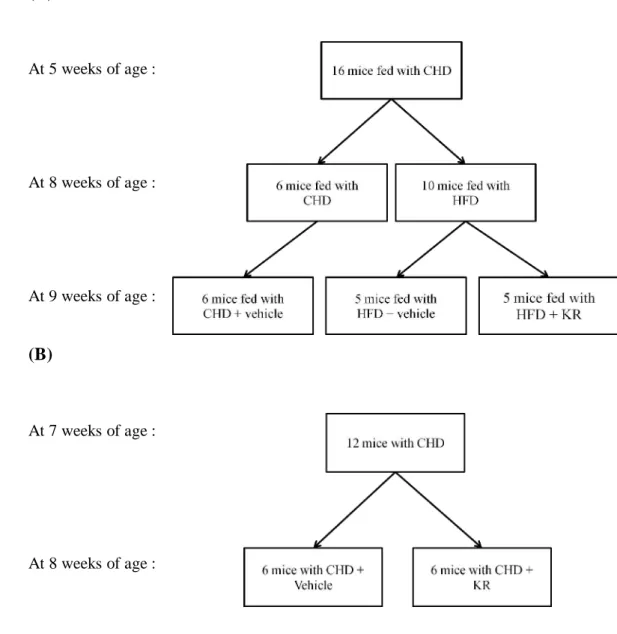
Figure 2. Study design of (A) C57BL/6 and (B) ob/ob mice
--- 10
Figure 3.
A. KR-66195 reduced weight gain in diet-induced
obese C57BL/6 mice --- 15
B. Average food intake for 8 weeks --- 16
C. Epididymal fat ratio of mice --- 17
Figure 4.
A. C57BL/6 mice administrated KR-66195 for 8
weeks showed improved glucose tolerance during
IPGTT --- 19
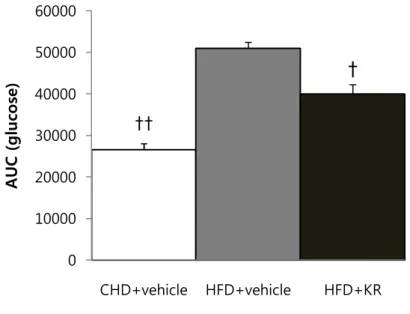
B. AUC of IPGTT --- 20
Figure 5. KR-66195 increased plasma GLP-1 concentration
in C57BL/6 mice --- 22
Figure 6.
A. KR-66195 prevented weight gain in ob/ob mice - 24
B. Average food intake for 3 weeks --- 25
Figure 7. ob/ob mice administered KR-66195 for 3 weeks
showed improved glucose tolerance during IPGTT
---27
Figure 8. KR-66195 increased plasma GLP-1 concentration
in ob/ob mice --- 30
Figure 9. Effects of KR-66195 treatment for 3 weeks on
pancreatic insulin in ob/ob mice --- 32
LIST OF TABLES
Table 1. Bodyweight at the baseline and final in C57BL/6
mice --- 16
Table 2. Bodyweight at the baseline and final in ob/ob mice
<ABSTRACT>
Antiobesity effects of KR-66195, a synthetic DPP-IV inhibitor in diet-induced obese mice and obese-diabetic ob/ob mice
Kim Yunwook
Department of Medical Science The Graduate School, Yonsei University
(Directed by Professor Hyun Chul Lee)
A variety of dipeptidyl peptidase (DPP)-IV inhibitors showed improved
glycemic control in patients with type 2 diabetes by increasing plasma level of
active glucagon like peptide (GLP)–1. However, these DPP-IV inhibitors
failed to show weight reduction. In this study, we found KR-66195, a new
DPP-IV inhibitor could show preventing weight gain effects as well as
improved glycemic control in both diet-induced obese C57BL/6 mice and
obese-diabetic ob/ob mice. In C57BL/6 mice, intraperitoneal administration of
KR-66195 for 8 weeks at 10 mg per kg of body weight once a day resulted in
increase in the amount of plasma GLP-1, improvement of glucose tolerance
and reduction in body weight gain, epididymal fat accumulation and food
resulted in the comparable effects as well as increased pancreatic insulin
content. These results suggest that KR-66195 could be further developed as a
therapeutic medication to treat obesity as well as diabetes.
---
Key words : obesity, diabetes, KR-66195, glucagon like peptide (GLP)-1, dipeptidyl peptidase (DPP)-IV, weight loss, diet-induced obesity, ob/ob, mice
Antiobesity effects of KR-66195, a synthetic DPP-IV inhibitor in diet-induced obese mice and obese-diabetic ob/ob mice
Kim Yunwook
Department of Medical Science The Graduate School, Yonsei University
(Directed by Professor Hyun Chul Lee)
I. INTRODUCTION
Obesity is a major public health problem worldwide and is associated with
significant morbidity and mortality. Ninety percent of patients with type 2
diabetes are overweight or obese.1 It has been reported that obese patients
who lose 5~10% of their initial body weight will have an improvement in
insulin resistance and cardiovascular risk factors.2
However, weight management is more difficult in obese patients with type
2 diabetes and even more so in patients treated with sulphonylureas,
thiazolidinediones or insulin therapy.3-6 Weight loss agents, which are
sibutramine, orlistat and remonabant, recently licensed for the treatment of
obesity lead to statistically and clinically significant improvements in
diabetes.7 But orlistat only has been reported to reduce the incidence of
diabetes in subjects with impaired glucose tolerance. 7 Moreover, their side
effects make it difficult to use in obese patients with type 2 diabetes.
In addition, it has been reported that the incretin effect might be partly
impaired due to a reduction in glucagon-like peptide (GLP)-1 secretion in
patients with type 2 diabetes.8-9 GLP-1 secreted by gut endocrine cells
stimulate glucose-dependent insulin secretion after nutrient ingestion and
exert direct trophic effects on beta-cell proliferation, differentiation, growth
and survival in vitro and in animal models of diabetes.10-12 Furthermore,
GLP-1 inhibits glucose-dependent glucagon secretion and has been reported
to delay gastric emptying, enhance satiety and reduce food intake.13 So it was
thought that GLP-1 would be desirable drug for obese patients with diabetes.
However, the therapeutic potentials of GLP-1 are limited by their rapid
degradation and inactivation in vivo by dipeptidyl peptidase (DPP)-IV.14 Thus,
degradation-resistant GLP-1 receptor agonists and DPP-IV inhibitors have
come into view as new classes of pharmacological agents to enhance incretin
action and thereby improve glycemic control in patients with type 2
diabetes.15-17 Studies have demonstrated the ability of these agents to improve
glycemic control in animal models of diabetes and in patients with type 2
diabetes.18-20 Accumulating evidences suggest that exogenously administered
GLP-1 receptor agonists show trophic effects on pancreatic islets in animal
increasing beta-cell mass.21-24 On the contrary, considerably scant data exist
on in vivo effects of chronic DPP-IV inhibition on pancreatic islets, even less
on antiobesity effects.25-26 Recent studies have shown that chronic treatment
with sitagliptin, an analogue of the DPP-IV inhibitor increased islet insulin
content and improved responsiveness of islets to glucose-stimulated insulin
secretion in high-fat-diet fed streptozotocin mice.27 But these studies did not
show weight reduction or prevention relating to antiobesity effect.
The aim of the present studies was to investigate long term effects of
KR-66195, a recently developed DPP-IV inhibitor, in diet-induced obese
C57BL/6 for 8 weeks and short term effects in obese-diabetic ob/ob mice for
3 weeks. KR-66195 would inhibit GLP-1 degradation by DPP-IV inhibition
and might cause weight loss or inhibit weight gain because of its prolonged
Figure 1. Chemical structure of KR-66195
F
F
F
N
O
NH
2HCl
S
O
H
N
H
N
OEt
O
II. MATERIALS AND METHODS
1. Chemicals
KR-66195 (novel 2-carbonyl-3-acyl-1,3-thiazolindies derivertives) was
synthesized and provided by drug discovery division in Korea Research
Institute of Chemical Technology (KRICT) (Taejon, Korea). (Fig. 1) Doses of
the KR-66195 chosen based on literature review and pilot studies in KRICT.
KR-66195 was diluted in Phosphate buffered saline (PBS) with 2 mg/ml
concentration, then filtered with Millex-GV (Millipore, MA, USA).
KR-66195 injected with 10 mg/kg (chemical/body weight) concentration using
BD ultra fine II insulin syringe with 31 guage needles (Becton, Dickinson and
Company, NJ, USA). All reagents were purchased from Sigma-Aldrich (MO,
USA).
2. long term study in C57BL/6 mice
Male C57BL/6 mice were purchased from at SLC (Tokyo, Japan) at five
weeks of age. All mice were housed under specific pathogen–free conditions
in individual cages and maintained on a 12 h light / dark cycle with
continuous access to food and water. They were acclimatized to the Yonsei
University Health System Clinical Trial Center for 2 weeks, during which
time they were fed a normal chow diet (CHD). CHD was Formulab diet 5008
(Purina LabDiet, IN, USA), which contains 6.5% fat by weight and provides
groups: CHD group (N=6) and high fat diet (HFD) group (N=10). HFD was
D12451 (Research Diets, NJ, USA), which contains 24% fat by weight and
provides 45% total calories from fat. 1 week after commencement of HFD,
the group was also divided into 2 further groups: HFD receiving vehicle (PBS)
injection group (HFD+vehicle) (n=5) and HFD receiving KR-66195 injection
group (HFD+KR) (n=5). All groups, CHD+vehicle, HFD+vehicle and
HFD+KR, were treated with once-daily intraperitoneal (IP) injections of
10mg/kg KR-66195 with vehicle or vehicle alone. Mice were housed in a
single cage. After the mice were injected, body weight and food intake were
monitored 2-3 times per week. After 8 weeks of treatment, glucose tolerance
was assessed by intraperitoneal glucose tolerance test (IPGTT). The study was
completed after 8 weeks of drug treatment and mice were sacrificed 1 day
after final drug treatment.
3. Short term study in ob/ob mice
Female ob/ob mice were purchased from Charles River Laboratories (PQ,
Canada) at seven weeks of age. All mice were housed under specific
pathogen–free conditions in individual cages and maintained on a 12 h light /
dark cycle with continuous access to food and water. They were acclimatized
to the Yonsei University Health System Clinical Trial Center for 1 week,
during which time they were fed with CHD. At 8 weeks of age, they were
Vehicle, were treated with once-daily IP injections of 10 mg/kg KR-66195
with vehicle or vehicle alone. After the mice were injected, body weight and
food intake were monitored 2-3 times per week. Glucose tolerance was
assessed by IPGTT weekly. The study was completed after 3 weeks of drug
(A) At 5 weeks of age : At 8 weeks of age : At 9 weeks of age : (B) At 7 weeks of age : At 8 weeks of age :
3. Glucose tolerance test
Mice were fasted overnight and treated with IP glucose injection (2 g/kg
body wt). Tail blood was collected at 0, 15, 30, 60, 120 min. Blood glucose
concentration was measured using a Accu-Chek Active (Roche, Basel,
Switzerland). In ob/ob mice study, blood glucose concentration was assayed
after dilution with PBS because of high glucose concentration (higher than
600 mg/dl).
4. Plasma analysis
Cardiac blood was collected in EDTA tubes (Sarstedt, Nümbrecht,
Germany) for GLP-1 analysis immediately after sacrifice. After
centrifugation for 10 minutes at 1500g, plasma was stored at -20C.
Concentrations of GLP-1 (7-36) amide were measured with an active GLP-1
ELISA Kit (Linco Research, MO, USA).
5. Quantitation of islet area
Pancreatic sections (4 μm) were incubated overnight at 4°C with guinea pig
anti-insulin antibody (Dako Diagnostics, Ontario, Canada). The samples were
then incubated for 1 h with biotinylated anti-guinea pig antibody (Vector
Laboratories, Ontario, Canada), and subsequently treated for 1 h with
avidin/biotin complex (Vectastain Elite ABC Kit; Vector Laboratories, CA,
tetrahydrochloride (DAB) for 10 min. After DAB staining, the sections were
washed with tap water and counterstained with hematoxylin. Three sections of
whole pancreas from each animal were scanned by Dotslide virtual
microscope (Olympus, Tokyo, Japan) following insulin
immuno-histochemistry. The relative islet area was determined by quantification of the
sectional area occupied by beta-cells and the total pancreatic
cross-sectional area with Metamorph (Universal Imaging, PA, USA) image analysis
software.
6. Statistics
Statistical analyses were performed with the Student’s t test for independent
samples (nonparametric), and data are expressed as means ± standard error
mean (SE) or standard deviation (SD) unless. A P value of <0.05 was
III. RESULTS
Studies in C57BL/6 mice
1. Long term KR-66195 injection prevented C57BL/6 mice from diet-induced obesity
Before initiation of the treatment, it was confirmed that there were no
significant differences between groups of mice allocated to the different
treatment groups in food intake or weight. To determine the effects of
KR-66195 on body weight, animals were divided into three groups at 9 weeks of
age (CHD+vehicle: n=6, HFD+vehicle: n=5, HFD+KR: n=5). HFD+KR
group exhibited significantly less body weight gain over time than
HF+vehicle group, and the trend was sustained over the entire treatment
period (Fig. 3A). As expected, the HFD+vehicle group gained substantially
more body weight than CHD+vehicle group. But HFD+KR group gain less
weight than HFD+vehicle group. After 8 weeks of drug treatment, HFD+KR
group gained 5.38±1.89g, HFD+vehicle group gained 12.08±1.36g and
CHD+vehicle group gained 3.67±2.89g <Table 1>. To examine the
mechanisms underlying the reduced weight gain in the face of an energy-rich
diet, we measured average food intake. KR-66195 treated mice (2.41 ± 0.09 g)
consumed significantly less food daily than vehicle treated mice (2.79 ± 0.11
g) over the 8-week treatment period (P < 0.05) (Fig. 3B). And the reduced
reductions in epididymal fat mass ratio (g organ weight / g body weight) (Fig.
3C). The epididymal fat mass ratio was 0.025 ± 0.0015 in CHD+Vehicle
group, 0.063 ± 0.0033 in HFD+vehicle group and 0.029 ± 0.0021 in HFD+KR
Figure 3A. KR-66195 reduced weight gain in diet-induced obese C57/BL6 mice. Weekly body weight in C57BL/6 mice treated with 10mg/kg KR-66195
with vehicle or vehicle alone once daily by IP injection for 8 weeks. Values
are expressed as means ± SE; n=5-6 mice per group. *, P < 0.05; **, P < 0.01;
†, P < 0.005; and ††, P < 0.001 vs. HFD+vehicle. * * ** ** † †† † †† 20.00 25.00 30.00 35.00 40.00 -1 0 1 2 3 4 5 6 7 8 B od y w eg hi t (g ) Time (weeks) CHD+vehicle HFD+vehicle HFD+KR ↓ start of injection
Table 1. Bodyweight at the baseline and final in C57BL/6 mice.
Difference means difference between baseline weight and final weight.
Values are expressed as means ± SD. ††P < 0.001 vs. HFD+vehicle; *, P < 0.05 vs. CHD+vehicle
Figure 3B. Average food intake for 8 weeks. 10mg/kg KR-66195 treatment
reduced average high-fat food consumption in C57BL/6 mice for 8 weeks.
Values are expressed as means ± SE. *, P < 0.05 vs. HFD+vehicle.
0.00 0.50 1.00 1.50 2.00 2.50 3.00 HFD+vehicle HFD+KR A ve ra ge foo d in ta ke ( g/ da y)
*
Baseline weight Final weight Difference CHD+vehicle 23.33±1.21 g 27.00±1.84 g 3.67±2.89 g HFD+vehicle 24.42±1.24 g 36.50±1.97 g * 12.08±1.36 g HFD+KR 24.25±1.04 g 29.63±2.06 g †† 5.38±1.89 g
Fugure 3C. Epididymal fat ratio of mice. 10mg/kg KR-66195 treatment for
8 weeks prevented epididymal fat accumulation in HFD+KR group. Values
are expressed as means ± SE. ††, P < 0.001 vs HFD+vehicle.
††
0.000 0.010 0.020 0.030 0.040 0.050 0.060 0.070 CHD+vehicle HFD+vehicle HFD+KR Ep id id ym al f at R at io (g o rg an w /g b od y w )††
2. KR-66195 improved glucose tolerance in C57BL/6 mice
After 8 weeks of treatment in long-term study, the mice were not injected
any drug for 40 hours before GTT, fasted for a further 15 h, and were
administered glucose via IP injection, When glucose was administered,
KR-66195 administered group showed significantly reduced the area under the
glucose curve (AUC) compared with HFD+vehicle treated mice (Fig. 4A and
4B). In HFD+KR group, plateau blood glucose level was 440.25 ± 53.47
mg/dl at 30 min, but 500.83 ± 52.29 mg/dl at 60 min in HFD+vehicle group,
Figure 4A. C57BL/6 mice administrated KR-66195 for 8 weeks showed improved glucose tolerance during IPGTT. The mice administered
KR-66195 for 8 weeks showed lowered plateau blood glucose level and improved
blood glucose tolerance during IPGTT (2g glucose/kg body wt). Values are
expressed as means ± SE; n=5-6 mice/group.
0 100 200 300 400 500 600 0 30 60 90 120 Pl as m a gl uc os e (m g/ dl ) time (min)
IPGTT
CHD+vehicle HFD+vehicle HFD+KRFigure 4B. AUC of IPGTT. AUC for the IPGTTs was calculated from 0 to
120 min. Values are expressed as means ± SE. †, P < 0.005; ††, P < 0.001 vs. HFD+vehicle.
†
0 10000 20000 30000 40000 50000 60000 CHD+vehicle HFD+vehicle HFD+KR A U C (g lu co se )††
3. KR-66195 increased plasma GLP-1 levels in C57BL/6 mice
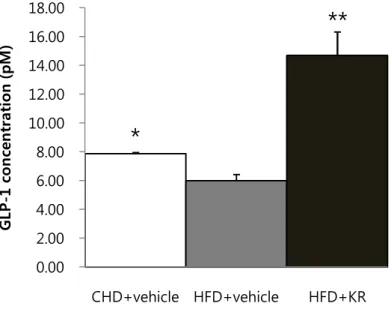
After 8 weeks of treatment, blood was collected during sacrifice. Long-term
treatment with KR-66195 increased basal GLP-1 plasma concentration to
14.70 ± 3.28 pM in HFD+KR group, on the other hands, 6.00 ± 0.75 pM in
Figure 5. KR-66195 increased plasma GLP-1 concentration in C57BL/6 mice. KR-66195 treatment for 8 weeks increased plasma active GLP-1 levels.
Values are expressed as means ± SE; n=5-6 mice per group. *, P < 0.05; **, P
< 0.01 vs. HFD+vehicle.
**
0.00 2.00 4.00 6.00 8.00 10.00 12.00 14.00 16.00 18.00 CHD+vehicle HFD+vehicle HFD+KR G LP -1 c on ce nt ra ti on (p M )*
Studies in ob/ob mice
4. Short-term injection of KR-66195 effectively prevented weight-gain in ob/ob mice
At the beginning of the experiment, initial body weight was higher in KR
group (32.10 ± 3.16) than Vehicle group (30.88 ± 3.40g), but the difference
was statistically insignificant (Fig. 6A). To determine the effects of KR-66195
on body weight, animals were divided into two groups at 8 weeks of age
(Vehicle: n=6, KR: n=6). KR group exhibited significantly less body weight
gain over time than Vehicle group, and the trend was sustained over the entire
treatment period (Fig. 6A). In KR group, cumulative body weight gain was
significantly smaller than that of Vehicle group <Table 2>. Moreover, the
body weight of several mice in KR group was slightly reduced during the
experiment. It was consistent with the study in C57BL/6 mice. After 3 weeks
of drug treatment, KR group gained 1.06±3.76g, Vehicle group gained
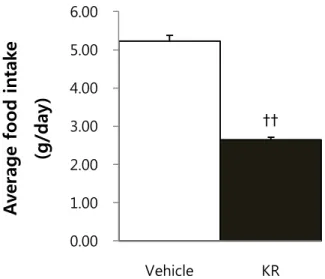
10.78±2.51 g <Table 2>. And KR group (2.65±0.92g) consumed significantly
Figure 6A. KR-66195 prevented weight gain in ob/ob mice. Weekly body
weight in ob/ob mice treated with 10mg/kg KR-66195 with vehicle or vehicle
alone once daily by IP injection for 3 weeks. Values are expressed as means ±
SE; n=6 mice per group. *,P < 0.05; **,P < 0.01 vs. Vehicle.
Table 2. Bodyweight at the baseline and final in ob/ob mice.
Difference means difference between baseline weight and final weight.
Values are expressed as means ± SD. **, P < 0.01 vs. Vehicle.
*
**
20.00 25.00 30.00 35.00 40.00 45.00 50.00 55.00 0 1 2 3 B od y w ei gh t (g ) Times (weeks) Vehicle KRbaseline weight final weight Difference Vehicle 30.88 ± 3.40 g 41.67 ± 5.14 g 10.78 ± 2.51 g
Figure 6B. Average food intake for 3 weeks. 10mg/kg KR-66195 treatment
reduced average food consumption in ob/ob mice for 3 weeks. Values are
expressed as means ± SE; n=6 mice/group. ††, P < 0.001 vs. Vehicle.
††
0.00 1.00 2.00 3.00 4.00 5.00 6.00 Vehicle KRA
ve
ra
ge
f
oo
d
in
ta
ke
(g
/d
ay
)
5. KR-66195 improved glucose tolerance in ob/ob mice
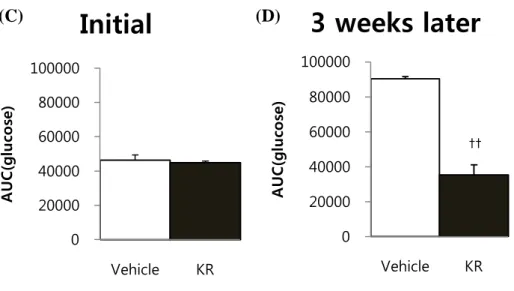
At the beginning of the study, two groups showed similar glucose excursion
profile when glucose was administered via an IP injection (Fig. 7A and 7B).
But, after 3 weeks of treatment, the treatment with KR-66195 prevented
hyperglycemia in ob/ob mice. After 3 weeks of KR-66195 treatment, KR
group showed similar glucose excursion profile with that of the initial,
moreover, glucose clearance ability of KR group was more efficient than that
of Vehicle group (Fig. 7A and 7B). And, KR group showed significantly
(A) (B) 0.0 100.0 200.0 300.0 400.0 500.0 600.0 700.0 800.0 900.0 0 30 60 90 120 B loo d gl uc os e (m g/ dl ) Time (min)
IPGTT (Initial)
Vehicle KR 0.0 100.0 200.0 300.0 400.0 500.0 600.0 700.0 800.0 900.0 0 30 60 90 120 B loo d gl uc os e (m g/ dl ) Time (min)0 20000 40000 60000 80000 100000 Vehicle KR A U C (g lu co se )
Initial
†† 0 20000 40000 60000 80000 100000 Vehicle KR A U C (g lu co se )3 weeks later
(C) (D)Figure 7. ob/ob mice administered KR-66195 for 3 weeks showed improved glucose tolerance during IPGTT. The mice administered
KR-66195 for 3 weeks showed lowered fasting blood glucose level and effective
glucose clearance ability during IPGTT (2g glucose/kg body wt). (A) At the
initial IPGTT, similar glucose excursion profiles were shown. (B) But, 3
weeks later, KR group showed improved blood glucose tolerance and
clearance ability than Vehicle group. (C) AUC for the IPGTTs on initial and
(D) that on 3 weeks later were calculated from 0 to 120 min. Values are
6. KR-66195 increased plasma GLP-1 levels in ob/ob mice
After 3 weeks of treatment, blood was collected during sacrifice. 3 weeks
treatment with KR-66195 significantly increased basal GLP-1 plasma
concentration to 35.95 ± 14.06 pM in KR group, on the other hands, 6.58 ±
Figure 8. KR-66195 increased plasma GLP-1 concentration in ob/ob mice.
KR-66195 treatment for 3 weeks elevated plasma GLP-1 levels in ob/ob mice.
Values are expressed as means ± SE; n=6 mice/group. *, P < 0.05 vs. Vehicle.
*
0 10 20 30 40 50 Vehicle KR G LP -1 c on ce nt ra ti on (p M )7. KR-66195 increased pancreatic insulin content in ob/ob mice.
After 3 weeks of treatment, the pancreas was isolated from each mouse and
analyzed by immunohistochemistry using anti-insulin antibody. This analysis
revealed decreased insulin staining in beta-cells of Vehicle group compared
with KR group, indicating impaired beta-cell function in Vehicle group (Fig.
9A). In contrast, increased insulin staining in the beta-cells was observed in
KR group compared with Vehicle group after 3 weeks of treatment (Fig. 9B).
But, differences of area ratio of beta-cell to whole pancreas on pancreatic
(A) (B) (C) 0 0.005 0.01 0.015 0.02 0.025 0.03 Vehicle KR
Ar
ea
r
at
io
o
f
be
ta
-c
ell
in
pa
nc
re
as
s
ec
tio
n
Figure 9. Effects of KR-66195 treatment for 3 weeks on pancreatic insulin in ob/ob mice. After 3 weeks of KR-66195 treatment, pancreata were isolated
and pancreatic sections were stained with anti-insulin antibody. (A) Vehicle
group showed decreased insulin staining compared with KR group. (B) On the
contrary, KR-group showed increased insulin staining. (C) But, differences of
area ratio of beta-cell to whole pancreas on pancreatic section slides were not
significant. Scale bar = 500 µm. Values are expressed as means ± SE; n=3
IV. DISCUSSION
In many studies, GLP-1 analogs, such as enxendin-4, and DPP-IV
inhibitors showed similar effects on glucose control, but GLP-1 analog only
showed decreased body weight.27-30 The new DPP-IV inhibitor KR-66195
described in this article was able to inhibit circulating DPP-IV activity and
therefore increase plasma GLP-1 concentration; it then effectively reduced
food intake and body weight gain in diet-induced obese C57BL/6 and
obese-diabetic ob/ob mice. Moreover, KR-66195 reduced the glucose excursion
following IPGTT in C57BL/6 and ob/ob mice.
One key outcome in this study was that KR-66195 prevented body weight
gain related with antiobesity effect in both in C57BL/6 mice and ob/ob mice.
It could be explained with reduced food intake which was shown in our
results. One study showed GLP-1 could make taste change or aversion by
modulating taste sensitivity especially to sweet and sour taste.31 GLP-1 is also
known to reduce feeding through a brain originated peptide acting on
hypothalamic GLP-1 receptors, causing hypothalamic anorectic effect.32 And
other gut hormones inactivated or activated by DPP-IV, such as peptide-YY
or oxyntomodulin are likely reasons for their reduced feeding.33-34 These
findings could be reasons for reduced food intake and weight gain in our mice
studies.
Interestingly, Studies have shown hyperglycemia elevated DPP-IV activity
addition, the incretin effect is thought to be partly impaired due to a reduction
in GLP-1 secretion and a reduction in the pancreatic response to GIP.38-40
With these studies, we could predict why the effects of DPP-IV inhibition by
KR-66195 that caused preventing weight gain and increasing GLP-1
concentration are more potent in ob/ob mice than those in C57BL/6 mice in
our studies. Moreover, anorectic effect of KR-66195 was also more potent in
ob/ob mice than that in C57BL/6 mice. The precise mechanisms underlying
the effects of DPP-IV inhibition in ob/ob mice remain to be determined with
more studies.
In addition, KR-66195 decreased epididymal fat ratio in C57BL/6 mice.
KR-66195 administrated group showed significantly low epididymal fat ratio
level. It was almost consistent with the level of CHD+vehicle group. One
study showed DPP-IV inhibitor, vildagliptin, could improve postprandial
plasma triglyceride and apolipoprotein B-48-containing triglyceride-rich
lipoprotein particle metabolism after a fat-rich meal in patients with type 2
diabetes.41 And, another study showed GLP-1 analog could reduce intestinal
lymph flow, triglyceride absorption, and apolipoprotein production in rats.42
Therefore, there could be several possible mechanisms by which KR-66195
could have mediated lowering fat accumulation and increasing lipid
metabolism, as other GLP-1 analogs or DPP-IV inhibitors had shown. To
elucidate precise mechanism, more studies about physical activities or fat
KR-66195 treated mice showed improved glucose tolerance than the
vehicle treated mice following the IPGTT. Furthermore, we could see
increased pancreatic insulin staining in ob/ob study. So, the improvement of
insulin secretion and efficacy, resulting in improved glucose tolerance
observed in this study could have been mediated by enhanced GLP-1
secretion. Moreover it was occurred despite the complete lack of measurable
plasma DPP-IV inhibition after 40 hours drug washout and before glucose
challenge in C57BL/6 study. Taken together, these results suggest that chronic
treatment with KR-66195 potently inhibited DPP-IV, improved beta-cell
function and prevented insulin resistance in both C57BL/6 and ob/ob mice.
Furthermore, this study demonstrated that chronic inhibition of DPP-IV by
KR-66195 could delay the occurrence of type 2 diabetes in diet-induced obese
C56BL/6 and obese-diabetic ob/ob mice. Permanent inhibition of circulating
DPP-IV activity most likely leads to a sustained action of GLP-1 at the
pancreatic level. GLP-1 also stimulates increases in beta-cell mass and insulin
synthesis and thus favors adequate insulin stores in pancreatic islets.43-44
These findings are consistent with our results. It is therefore speculated that in
the clinic, DPP-IV inhibitors such as KR-66195 could delay or even prevent
obesity and the progression from impaired glucose tolerance to type 2
diabetes by improving glucose tolerance and preserving beta-cell function.
As summary, in the present studies, the effect of long term treatment with
C57BL/6 mice and that of short term treatment in obese-diabetic ob/ob mice.
After 8 weeks of treatment in C57BL/6 and 3 weeks of treatment in ob/ob,
KR-66195 potently inhibited plasma DPP-IV activity and increased plasma
active GLP-1 levels, resulting in reduction of food intake, improved glycemic
V. CONCLUSION
In conclusion, long term administration of KR-66195 resulted in increase in
the amount of plasma GLP-1, improvement of glucose tolerance and
reduction in body weight gain, epididymal fat accumulation and food intake in
C57BL/6. And short term administration of KR-66195 consistently resulted in
the comparible effects as well as increased pancreatic insulin content in ob/ob
mice. These are meant that improved beta-cell function and antiobesity effects
in C57BL6 and ob/ob mice, suggesting that KR-66195 may also exhibit these
beneficial effects when administered to obese patients with type 2 diabetes or
diabetes alone. Further development of stable DPP-IV inhibitor, such as
KR-66195, might be new effective agent for antiobesity therapy as well as
REFERENCES
1. Kumanyika S, Jeffery RW, Morabia A, Ritenbaugh C, Antipatis VJ.
Obesity prevention: the case for action. Int J Obes Relat Metab Disord
2002;26:425-36.
2. Goldstein DJ. Beneficial health effects of modest weight loss. Int J
Obes Relat Metab Disord 1992;16:397-415.
3. Wing RR, Marcus MD, Epstein LH, Salata R. Type II diabetic
subjects lose less weight than their overweight nondiabetic spouses.
Diabetes Care 1987;10:563-6.
4. Kelley DE, Wing R, Buonocore C, Sturis J, Polonsky K, Fitzsimmons
M. Relative effects of calorie restriction and weight loss in
noninsulin-dependent diabetes mellitus. J Clin Endocrinol Metab
1993;77:1287-93.
5. Kendall DM, Rubin CJ, Mohideen P, Ledeine JM, Belder R, Gross J,
et al. Improvement of glycemic control, triglycerides, and HDL
cholesterol levels with muraglitazar, a dual (alpha/gamma)
peroxisome proliferator-activated receptor activator, in patients with
type 2 diabetes inadequately controlled with metformin monotherapy:
A double-blind, randomized, pioglitazone-comparative study.
Diabetes Care 2006;29:1016-23.
P. Efficacy and safety of pioglitazone versus metformin in patients
with type 2 diabetes mellitus: a double-blind, randomized trial. J Clin
Endocrinol Metab 2004;89:6068-76.
7. Lloret-Linares C, Greenfield JR, Czernichow S. Effect of
weight-reducing agents on glycaemic parameters and progression to Type 2
diabetes: a review. Diabet Med 2008;25:1142-50.
8. Vilsboll T, Krarup T, Deacon CF, Madsbad S, Holst JJ. Reduced
postprandial concentrations of intact biologically active glucagon-like
peptide 1 in type 2 diabetic patients. Diabetes 2001;50:609-13.
9. Toft-Nielsen MB, Madsbad S, Holst JJ. Determinants of the
effectiveness of glucagon-like peptide-1 in type 2 diabetes. J Clin
Endocrinol Metab 2001;86:3853-60.
10. Stoffers DA, Kieffer TJ, Hussain MA, Drucker DJ, Bonner-Weir S,
Habener JF, et al. Insulinotropic glucagon-like peptide 1 agonists
stimulate expression of homeodomain protein IDX-1 and increase
islet size in mouse pancreas. Diabetes 2000;49:741-8.
11. Perfetti R, Zhou J, Doyle ME, Egan JM. Glucagon-like peptide-1
induces cell proliferation and pancreatic-duodenum homeobox-1
expression and increases endocrine cell mass in the pancreas of old,
glucose-intolerant rats. Endocrinology 2000;141:4600-5.
12. Meier JJ, Gethmann A, Nauck MA, Gotze O, Schmitz F, Deacon CF,
reduces postprandial glycemia independently of gastric emptying and
insulin secretion in humans. Am J Physiol Endocrinol Metab
2006;290:E1118-23.
13. Pannacciulli N, Le DS, Salbe AD, Chen K, Reiman EM, Tataranni PA,
et al. Postprandial glucagon-like peptide-1 (GLP-1) response is
positively associated with changes in neuronal activity of brain areas
implicated in satiety and food intake regulation in humans.
Neuroimage 2007;35:511-7.
14. Deacon CF, Ahren B, Holst JJ. Inhibitors of dipeptidyl peptidase IV: a
novel approach for the prevention and treatment of Type 2 diabetes?
Expert Opin Investig Drugs 2004;13:1091-102.
15. Mest HJ, Mentlein R. Dipeptidyl peptidase inhibitors as new drugs for
the treatment of type 2 diabetes. Diabetologia 2005;48:616-20.
16. Drucker DJ, Nauck MA. The incretin system: glucagon-like peptide-1
receptor agonists and dipeptidyl peptidase-4 inhibitors in type 2
diabetes. Lancet 2006;368:1696-705.
17. Pratley RE, Salsali A. Inhibition of DPP-4: a new therapeutic
approach for the treatment of type 2 diabetes. Curr Med Res Opin
2007;23:919-31.
18. Gallwitz B. Exenatide in type 2 diabetes: treatment effects in clinical
studies and animal study data. Int J Clin Pract 2006;60:1654-61.
discussion 2-4.
20. Vilsboll T. Liraglutide: a once-daily GLP-1 analogue for the treatment
of type 2 diabetes mellitus. Expert Opin Investig Drugs
2007;16:231-7.
21. Farilla L, Hui H, Bertolotto C, Kang E, Bulotta A, Di Mario U, et al.
Glucagon-like peptide-1 promotes islet cell growth and inhibits
apoptosis in Zucker diabetic rats. Endocrinology 2002;143:4397-408.
22. Rolin B, Larsen MO, Gotfredsen CF, Deacon CF, Carr RD, Wilken M,
et al. The long-acting GLP-1 derivative NN2211 ameliorates
glycemia and increases beta-cell mass in diabetic mice. Am J Physiol
Endocrinol Metab 2002;283:E745-52.
23. Tourrel C, Bailbe D, Lacorne M, Meile MJ, Kergoat M, Portha B.
Persistent improvement of type 2 diabetes in the Goto-Kakizaki rat
model by expansion of the beta-cell mass during the prediabetic
period with glucagon-like peptide-1 or exendin-4. Diabetes
2002;51:1443-52.
24. Perfetti R, Hui H. The role of GLP-1 in the life and death of
pancreatic beta cells. Horm Metab Res 2004;36:804-10.
25. Pospisilik JA, Stafford SG, Demuth HU, Brownsey R, Parkhouse W,
Finegood DT, et al. Long-term treatment with the dipeptidyl peptidase
IV inhibitor P32/98 causes sustained improvements in glucose
responsiveness in VDF (fa/fa) Zucker rats. Diabetes 2002;51:943-50.
26. Pospisilik JA, Martin J, Doty T, Ehses JA, Pamir N, Lynn FC, et al.
Dipeptidyl peptidase IV inhibitor treatment stimulates beta-cell
survival and islet neogenesis in streptozotocin-induced diabetic rats.
Diabetes 2003;52:741-50.
27. Mu J, Woods J, Zhou YP, Roy RS, Li Z, Zycband E, et al. Chronic
inhibition of dipeptidyl peptidase-4 with a sitagliptin analog preserves
pancreatic beta-cell mass and function in a rodent model of type 2
diabetes. Diabetes 2006;55:1695-704.
28. Raun K, von Voss P, Knudsen LB. Liraglutide, a once-daily human
glucagon-like peptide-1 analog, minimizes food intake in severely
obese minipigs. Obesity (Silver Spring) 2007;15:1710-6.
29. Raun K, von Voss P, Gotfredsen CF, Golozoubova V, Rolin B,
Knudsen LB. Liraglutide, a long-acting glucagon-like peptide-1
analog, reduces body weight and food intake in obese candy-fed rats,
whereas a dipeptidyl peptidase-IV inhibitor, vildagliptin, does not.
Diabetes 2007;56:8-15.
30. Xu G, Stoffers DA, Habener JF, Bonner-Weir S. Exendin-4 stimulates
both cell replication and neogenesis, resulting in increased
beta-cell mass and improved glucose tolerance in diabetic rats. Diabetes
1999;48:2270-6.
Modulation of taste sensitivity by GLP-1 signaling. J Neurochem
2008;106:455-63.
32. Turton MD, O'Shea D, Gunn I, Beak SA, Edwards CM, Meeran K, et
al. A role for glucagon-like peptide-1 in the central regulation of
feeding. Nature 1996;379:69-72.
33. Eberlein GA, Eysselein VE, Schaeffer M, Layer P, Grandt D, Goebell
H, et al. A new molecular form of PYY: structural characterization of
human PYY(3-36) and PYY(1-36). Peptides 1989;10:797-803.
34. Mentlein R, Dahms P, Grandt D, Kruger R. Proteolytic processing of
neuropeptide Y and peptide YY by dipeptidyl peptidase IV. Regul
Pept 1993;49:133-44.
35. Mannucci E, Pala L, Ciani S, Bardini G, Pezzatini A, Sposato I, et al.
Hyperglycaemia increases dipeptidyl peptidase IV activity in diabetes
mellitus. Diabetologia 2005;48:1168-72.
36. Meneilly GS, Demuth HU, McIntosh CH, Pederson RA. Effect of
ageing and diabetes on glucose-dependent insulinotropic polypeptide
and dipeptidyl peptidase IV responses to oral glucose. Diabet Med
2000;17:346-50.
37. Korosi J, McIntosh CH, Pederson RA, Demuth HU, Habener JF,
Gingerich R, et al. Effect of aging and diabetes on the enteroinsular
axis. J Gerontol A Biol Sci Med Sci 2001;56:M575-9.
W. Preserved incretin activity of glucagon-like peptide 1 [7-36 amide]
but not of synthetic human gastric inhibitory polypeptide in patients
with type-2 diabetes mellitus. J Clin Invest 1993;91:301-7.
39. Toft-Nielsen MB, Damholt MB, Madsbad S, Hilsted LM, Hughes TE,
Michelsen BK, et al. Determinants of the impaired secretion of
glucagon-like peptide-1 in type 2 diabetic patients. J Clin Endocrinol
Metab 2001;86:3717-23.
40. Meier JJ, Hucking K, Holst JJ, Deacon CF, Schmiegel WH, Nauck
MA. Reduced insulinotropic effect of gastric inhibitory polypeptide in
first-degree relatives of patients with type 2 diabetes. Diabetes
2001;50:2497-504.
41. Matikainen N, Manttari S, Schweizer A, Ulvestad A, Mills D,
Dunning BE, et al. Vildagliptin therapy reduces postprandial intestinal
triglyceride-rich lipoprotein particles in patients with type 2 diabetes.
Diabetologia 2006;49:2049-57.
42. Qin X, Shen H, Liu M, Yang Q, Zheng S, Sabo M, et al. GLP-1
reduces intestinal lymph flow, triglyceride absorption, and
apolipoprotein production in rats. Am J Physiol Gastrointest Liver
Physiol 2005;288:G943-9.
43. Sebokova E, Christ AD, Boehringer M, Mizrahi J. Dipeptidyl
peptidase IV inhibitors: the next generation of new promising
2007;7:547-55.
44. Fridolf T, Bottcher G, Sundler F, Ahren B. GLP-1 and GLP-1(7-36)
amide: influences on basal and stimulated insulin and glucagon
<ABSTRACT(IN KOREAN)> 식이 비만 유발 생쥐 (C57BL/6) 와 비만 당뇨 생쥐 (ob/ob) 에서 dipeptidyl peptidase-IV 저해재인 KR-66195 의 항비만 효과 <지도교수 이현철> 연세대학교 대학원 의과학과 김 연 욱
그 동안 다양한 dipeptidyl peptidase (DPP)-IV 저해재들이 개발되었고 제2형 당뇨병 환자들의 혈중 active glucagon like peptide (GLP)–1의 농도를 올림으로써 향상된 glycemic control 효과를 보여주었다. 하지만 이들 DPP-IV 저해재들이 체중의 증가를 막는 효과는 보이지 않았다. 이번 연구를 통해 우리는 새로 개발된 KR-66195가 glycemic 조절 능력을 향상시킬 뿐 아니라 다른 DPP-IV 저해재들이 보여주지 못했던 항 비만 효과를 가지고 있다는 것을 식이 비만 유발 생쥐 (C57BL/6) 와 비만 당뇨 생쥐 (ob/ob) 실험을 통해서 밝혔다. 식이 비만 유발 생쥐에 KR-66195을 intraperitoneal
injection 방법으로 매일 8주간 10 mg per kg body weight 농도로 주사했을 때, 혈중 GLP-1의 농도가 증가 하고 향상된 glucose tolerance 효과를 보이고 epididymal 지방 조직의 크기와 먹이 섭취량을 감소 시켰으며 체중의 증가를 둔화 시켰다. 그리고 유전적으로 비만을 일으키는 비만 당뇨 생쥐에 KR-66195을 위의 실험에서와 같은 방법으로 3주간 주사했을 때, 식이 비만 유발 생쥐 실험과 유사한 효과들을 보이고 췌장 내부의 insulin 양이 증가하는 것을 확인할 수 있었다. 그러므로 앞으로 KR-66195가 더욱 연구, 보완되어 당뇨병뿐만 아니라 항비만 약제로써 쓰여질 수 있기를 기대한다. ---
핵심되는 말 : 비만, 당뇨, KR-66195, glucagon like peptide (GLP)-1, dipeptidyl peptidase (DPP)-IV, 체중 감소, ob/ob , 생쥐