http://dx.doi.org/10.4014/jmb.1209.09043 First published online March 12, 2013 pISSN 1017-7825 eISSN 1738-8872
1-Deoxynojirimycin Isolated from a Bacillus subtilis Stimulates Adiponectin
and GLUT4 Expressions in 3T3-L1 Adipocytes
Lee, Seung-Min
1, Hyun Ju Do
2, Min-Jeong Shin
2, Su-Il Seong
3, Kyo Yeol Hwang
3, Jae Yeon Lee
3, Ohsuk Kwon
4,
Taewon Jin
5, and Ji Hyung Chung
5*
1Department of Food and Nutrition, College of Human Ecology, Yonsei University, Seoul 120-749, Korea 2Department of Food and Nutrition and Institute of Health Sciences, Korea University, Seoul 136-703, Korea 3R&D Center for Life Science, Biotopia Co., Ltd., Chuncheon, Gangwon-do 200-881, Korea
4Systems and Synthetic Biology Research Center, Korea Research Institute of Bioscience and Biotechnology, Daejeon 305-806, Korea 5Cardiovascular Product Evaluation Center, Cardiovascular Research Institute, Yonsei University College of Medicine, Seoul
120-752, Korea
Received: September 14, 2012 / Revised: December 23, 2012 / Accepted: January 2, 2013
We have demonstrated that 1-deoxynojirimycin (DNJ) isolated from Bacillus subtilis MORI could enhance the levels of adiponectin and its receptors in differentiated 3T3-L1 adipocytes, which has been shown to be effective in lowering blood glucose levels and enhancing insulin sensitivity. DNJ was not toxic to differentiated 3T3-L1 adipocytes for up to a concentration of 5 µM. In terms of expression levels of adiponectin and its receptors (AdipoR1 and AdipoR2), DNJ in concentrations as low as 0.5 µM elevated both mRNA and protein levels of adiponectin and transcript levels of AdipoR1 and AdipoR2. In addition, DNJ increased phosphorylation of 5' adenosine monophosphate-activated protein kinase (AMPK) in a statistically significant manner. Finally, treatment with DNJ resulted in increased mRNA expression of glucose transporter 4 (GLUT4), which encodes for a glucose transporter, along with a significant increase in glucose uptake into the adipocytes based on results of a 2-deoxy-D-[3H] glucose uptake assay. Our findings indicate that DNJ may greatly facilitate glucose uptake into adipose tissues by increasing the action of adiponectin via its up-regulated expression as well as its receptor genes. In addition, the glucose-lowering effects of DNJ may be achieved by an increased abundance of GLUT4 protein in the plasma membrane, as a consequence of the increased transcript levels of the GLUT4 gene and the activation of AMPK.
Key words: 1-Deoxynojirimycin, adipocytes, adiponectin, AdipoR, AMPK
An increasing body of evidence suggests that adipose tissues play a crucial role in maintaining glucose and fat homeostasis not only by acting as a major organ to store excess energy but also by secreting adipokines including adiponectin [21]. Adiponectin receives great attention because of its strong association with visceral adipocytes and insulin resistance [9]. Interestingly, obesity and body mass index (BMI), an indicator of obesity, have been shown to be inversely correlated to serum adiponectin levels [2, 3]. Furthermore, low levels of serum adiponectin concentrations are reported to increase the risk of insulin resistance, cardiovascular disease, and inflammatory conditions [16, 32]. Since insulin resistance is a well known contributor to the development of metabolic disorders, including type-2 diabetes and cardiovascular diseases, proper maintenance of insulin sensitivity is crucial for the prevention or amelioration of such disorders [19]. Adiponectin exerts its biological actions via interacting with two types of adiponectin receptors, AdipoR1 and AdipoR2 [8]. AdipoR1 has a greater affinity for the globular form than the full-length form of adiponectin and is abundantly enriched in endothelial cells and skeletal muscle [5]. AdipoR2 exhibits moderate affinity for either forms of adiponectin and is highly detected in the liver [5]. AdipoR1 and AdipoR2 are found both in the preadipocytes and adipocytes [1].
1-Deoxynojirimycin (DNJ) is known to ameliorate diabetic conditions by improving insulin sensitivity [13], exerting its effect partially through inhibiting the activity of α-glucosidase and the absorption levels of glucose in the intestinal brush border [14]. Additionally, the iminosugar N-(5-adamantane-1-yl-methoxy-pentyl)-deoxynojirimycin *Corresponding author
Phone: +82-2-2228-0332; Fax: +82-2-365-1878; E-mail: [email protected]
In the current study, we examined direct effects of DNJ isolated from Bacillus subtilis MORI on cultured 3T3-L1 adipocytes and explored the possible regulatory mechanisms to enhance insulin sensitivity by DNJ treatment. Considering the crucial role that adiponectin plays in improving insulin sensitivity, we hypothesized that DNJ improves the dysregulated metabolic conditions by enhancing the production of and circulating levels of adiponectin as well as up-regulating the glucose transport protein GLUT4.
MATERIALSAND METHODS
Cell Culture and Adipocyte Differentiation
Mouse 3T3-L1 cells were grown in high-glucose Dulbecco’s minimum essential medium (DMEM) supplemented with 10% heat-inactivated bovine calf serum (BCS) containing 100,000 units/l penicillin and 100 mg/l streptomycin. Prior to the experiments, 1×10⁵ cells were seeded on a 6-well plate and grown to confluence for 7 days. At day 8 post-confluence, the cells were subjected to the first differentiation medium (DMEM, 10% FBS, 0.5 mM 3-isobutyl-1-methylxanthine, 0.5µM dexamethasone, 2 µg/ml insulin) starting on day 0, for 3 days. Then the medium was replaced with the second differentiation medium (DMEM, 10% FBS, 1µg/ml insulin). Two days later, the cells were grown in regular medium (DMEM, 10% FBS) for an additional 2 days. The cells were maintained at 37oC in a humidified atmosphere of 95% air and 5% CO2. The growth medium was replenished every 2 days. Isobutyl-1-methylxanthine, dexamethasone, and insulin were obtained from Sigma-Aldrich (St. Louis, USA). 3T3-L1 cells were obtained from the American Type Culture Collection (ATCC, USA). Other cell culture materials were purchased from Gibco-Invitrogen (USA). In this study, cells were exposed to medium with DNJ concentrations varying from 0.5 to 5 µM. MTT Assay
DNJ isolated from Bacillus subtilis MORI [10] was prepared in a DMSO solution at a concentration of 1 mg/ml. Fully differentiated 3T3-L1 cells were tested with increasing concentrations of DNJ (final concentrations of 0.5, 2.5, and 5µM) for 24 h. Cell viability was analyzed after the addition of 1 mg/ml MTT in each well and an another additional incubation for 3 h at 37oC. After removal of the
treated with DNJ for 24 h and subjected to SDS-PAGE, and anti-adiponectin antibody was used to detect anti-adiponectin.
RNA Extraction and Semiquantitative RT-PCR
Total RNA was extracted from differentiated 3T3-L1 cells using an RNeasy Lipid Tissue Mini Kit (Qiagen, Germany) according to the manufacturer’s protocol. The cDNA was synthesized from 1µg of RNA using oligo-dT and Superscript II reverse transcriptase (Invitrogen, Carlsbad, CA, USA). Primer sequences for PCR are the following: adiponectin, 5'-GTTGCAAGCTCTCCTGTTCC-3' (forward) and 5'-GCTTCTCCAGGCTCTCCTTT-3' (reverse); adiponectin receptor 1, TCTCCTGGCTCTTCCACACT-3' (forward) and 5'-GACAAAGCCCTCAGCGATAG-3' (reverse); adiponectin receptor 2, 5'-ACCCACAACCTTGCTTCATC-3' (forward) and 5'-TAGCCA GCCTATCTGCCCTA-3' (reverse); GLUT4, 5'-CAACAGCTCTCA GGCATCAA-3' (forward) and 5'-CTCAAAGAAGGCCACAAAGC-3' (reverse); GAPDH, 5'-AACTTTGGCATTGTGGAAGG-5'-CTCAAAGAAGGCCACAAAGC-3' (forward) and 5'-ACACATTGGGGGTAGGAACA-3' (reverse). The PCR products were then separated by electrophoresis on a 2% agarose gel. The separated bands were visualized using a UV transilluminator. The images were captured using a Sigma EXDG camera (Nikon, Tokyo, Japan). The intensity of the bands was quantitated using the Alphaview software (Alpha Innotech, USA). Values were expressed in arbitrary units. The mRNA levels were determined by relative values to that of an endogenous GAPDH gene and expressed as fold change over the control.
Glucose Uptake Assay
As previously described [30], glucose uptake into adipocytes was measured using a 2-deoxy-D-[3H] glucose (PerkinElmer, USA). Fully differentiated 3T3-L1 cells were treated with 0.5µM of DNJ for 24 h. After being washed with PBS, the cells were then incubated in 1 ml of PBS containing 1µCi/ml 2-deoxy-D-[3H] glucose and 0.1 mM 2-deoxy-D-glucose for 10 min. The cells were washed in cold PBS and lysed with 1% SDS in PBS. The 3H-glucose content was detected in 8 ml of scintillation cocktail using a liquid scintillation counter (Beckman Coulter, USA).
Statistical Analysis
Statistical analysis was performed using the SPSS (Statistical Package for the Social Science, SPSS Inc., USA). The results were presented as the mean ± SE, and the differences among the experimental groups
were analyzed using a Student t-test at p < 0.05 as the criterion of significance.
R
ESULTSUp-Regulated Expression of Adiponectin upon DNJ Treatment
In order to determine any toxic effects of DNJ treatment on differentiated 3T3-L1 cells, we performed the MTT assay and found out that DNJ did not adversely affect cell
viability at concentrations up to 5 µM (Fig. 1A). Using the same range of concentrations, we examined the effects of DNJ on adiponectin gene expression. DNJ treatment significantly increased the transcript levels of the adiponectin gene (Fig. 1B). DNJ at 0.5 µM was sufficient to elicit up-regulation of the adiponectin gene. These changes in mRNA levels were accompanied by an increase in protein levels of adiponectin (Fig. 1C). Treatment of 5 µM of DNJ led to a 2-fold increase in the adiponectin protein amount in comparison with the control without DNJ (Fig. 1C). The extent of DNJ-induced increase in protein levels was Fig. 1. Effect of DNJ on the expression of adiponectin gene and adiponectin secretion in 3T3-L1 adipocytes.
(A) 3T3-L1 cells were differentiated into adipocytes according to the differentiation protocol. Cell viability was analyzed using an MTT assay after treatment with DNJ for 24 h. (B) Differentiated 3T3-L1 cells were treated with DNJ for 24 h. Semiquantitative RT-PCR was performed to detect the levels of adiponectin in the cells. (C) Differentiated 3T3-L1 cells were treated with DNJ for 24 h. Immunoblot analysis was performed with anti-adiponectin antibody. A representative blot is shown in the upper panel. The bar graph represents quantification of the relative protein levels of adiponectin. (D) The culture medium of 3T3-L1 cells treated with DNJ for 24 h subjected to immunoblot analysis. A representative blot is shown in the upper panel. The bar graph represents quantification of the level of secreted adiponectin. The results were expressed as the mean ± SE of at least five independent experimental results. p < 0.05 by the Student t-test.
positively associated with the concentrations of DNJ, indicating that there is a dose-dependent effect of DNJ on the increase of adiponectin proteins. We also investigated whether DNJ could increase the secretion of adiponectin. Adiponectin secretion into the medium greatly increased upon treatment with 0.5 µM of DNJ (Fig. 1D). However, there were no further effects of DNJ with concentrations higher than 0.5 µM on the adiponectin secretion (Fig. 1D). Our data demonstrated that DNJ effectively up-regulated the expression of the adiponectin gene and enhanced secretion of adiponectin protein into the medium.
DNJ Increased mRNA Expression of AdipoR1 and AdipoR2
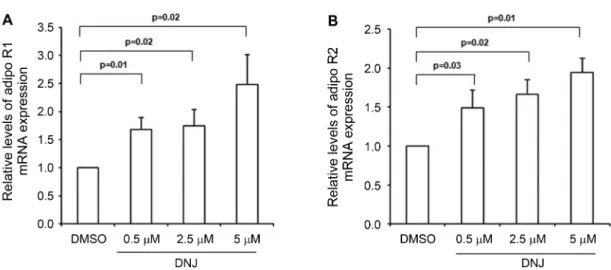
We subsequently determined the expression levels of the AdipoR1 and AdipoR2 genes in differentiated 3T3-L1 adipocytes. There were approximately 2-fold increases in AdipoR1 and AdipoR2 mRNA levels in the adipocytes treated with DNJ in a concentration-dependent manner (Figs. 2A and 2B). These results demonstrated that DNJ up-regulates AdipoR1 and AdipoR2 gene expression. Activation of AMPK by DNJ
In addition to the effect of DNJ on the expression of adiponectin and AdipoR1 and AdipoR2, we investigated whether DNJ influences the activation of AMPK in differentiated 3T3-L1 adipocytes. AMPK has been implicated in glucose utilization and in fatty acid oxidation [15]. Since the activation of adiponectin triggers AMPK signaling [32], AMPK-mediated activities of adiponectin are suggested to enhance insulin sensitivity [17]. We added varying amounts of DNJ to the differentiated 3T3-L1 cells for 24 h. We observed an increasing trend in the phosphorylated form of
AMPK protein levels upon treatment with DNJ, as low as 0.5µM (Fig. 3). DNJ significantly raised the levels of phosphorylated AMPK. This demonstrates that DNJ phosphorylates and activates AMPK in 3T3-L1 adipocytes. Fig. 2. Effect of DNJ on the expression of AdipoR1 and AdipoR2 in 3T3-L1 adipocytes.
Differentiated 3T3-L1 cells were treated with DNJ for 24 h. Total RNA was purified from cells and subjected to RT-PCR analyses using primers specific for AdipoR1 (A) and AdipoR2 (B). The results were expressed as the mean ± SE of at least five independent experimental results. p < 0.05 by the Student t-test.
Fig. 3. Effect of DNJ on phosphorylation of AMPK in 3T3-L1 adipocytes.
Differentiated 3T3-L1 cells were treated with DNJ for 24 h. Cell lysates were subjected to immunoblot analysis using anti-phospho-AMPK antibody. A representative blot is shown in the upper panel. The levels of phospho-AMPK were normalized to total phospho-AMPK for each sample in the graph on the lower panel. The results were expressed as the mean ± SE of at least five independent experimental results. p < 0.05 by the Student t-test.
DNJ Enhanced GLUT4 Transcript Levels and Glucose Uptake into Adipocytes
We also observed the changes in GLUT4 transcript levels after 24 h incubation with DNJ in fully differentiated 3T3-L1 adipocytes. DNJ treatment of 0.5 µM induced a 1.8-fold increase in GLUT4 mRNA levels (Fig. 4A). Because 0.5 µM of DNJ was the lowest effective concentration to induce expressions of GLUT4, adiponectin, and adipoR1 and R2, we chose to use this concentration to investigate whether fully differentiated adipocytes increase glucose uptake in response to DNJ. Upon the addition of 0.5 µM of DNJ, an approximately 2.1-fold induction of glucose uptake was observed in adipocytes compared with that of DMSO-treated cells (Fig. 4B). These results demonstrated that DNJ indeed was effective in increasing the expression of GLUT4 as well as glucose uptake into adipocytes with as low as 0.5 µM concentration.
D
ISCUSSIONThere has been increasing efforts in developing ways to increase systemic insulin sensitivity using dietary components from natural products. In this study, we showed that DNJ isolated from Bacillus subtilis MORI increased the mRNA and protein levels of the adiponectin gene in 3T3-L1 adipocytes. It was previously reported that circulating adiponectin levels was positively associated with insulin sensitivity. In addition, a positive correlation between adiponectin levels in 3T3-L1 adipocytes and insulin
sensitivity was reported in a study using a PPARγ agonist, a drug that improves insulin sensitivity [28]. Therefore, our findings suggest that DNJ may greatly enhance adiponectin signaling in adipocytes by increasing the amounts of serum adiponectin. The positive effect of DNJ in elevating adiponectin levels had been previously demonstrated in a study in which a DNJ-containing mulberry leaf extract up-regulated adiponectin gene expression [22].
We also demonstrated that DNJ increased transcript levels of adiponectin receptor genes. Insulin has been shown to modulate AdipoR gene expression [23]. As the blood insulin levels fluctuated depending on the fed/fasting states, AdipoR expression also changed accordingly [23]. AdipoR levels decreased as insulin levels were elevated. AdipoR may play a crucial role in glucose uptake into the tissues when the insulin level is low. Therefore, it appears that regulation of AdipoR gene expression may be an additional exerting effect of insulin on target tissues. In addition, a marked decrease in AdipoR mRNA levels was reported in an obese mouse model with insulin resistance [23], which suggested that adequate amounts of AdipoR gene expression may help maintain insulin sensitivity. The types of AdipoR expressed in different tissues may affect the function of adiponectin in those tissues. For instance, adiponectin receptors are suggested to play a role in insulin secretion in pancreatic β cells [11]. In our study, we suggest that AdipoR expression in 3T3-L1 adipocytes increases insulin sensitivity in response to DNJ. Wu X et al. [26] reported that adiponectin increased glucose uptake into primary rat adipocytes via AMPK activation, without Fig. 4. Effect of DNJ on the mRNA level of the GLUT4 gene and on glucose uptake in 3T3-L1 adipocytes.
(A) Differentiated 3T3-L1 cells were treated with DNJ for 24 h and then harvested for RNA extraction. GLUT4 mRNA levels were measured using semi-quantitative RT-PCR. The results were expressed as the mean ± SE of at least five independent experimental results. p < 0.05 by the Student t-test. (B) Differentiated 3T3-L1 cells were treated with 0.5 µM of DNJ for 24 h. After being washed with PBS, the cells were then incubated with 1 µCi/ml 2-deoxy-D-[3H] glucose and 0.1 mM 2-deoxy-D-glucose for 10 min. The cells were washed in PBS and lysed with 1% SDS in PBS. The glucose uptake was determined by the measurement of 3H-glucose content using a liquid scintillation counter. Relative fold of glucose uptake is shown in the graph. The results were expressed as the mean ± SE of at least five independent experimental results. p < 0.05 by the Student t-test.
translocation of GLUT4 to the plasma membrane to mediate glucose transport. However, AMPK activation in skeletal muscle cells can also induce the translocation of GLUT4 protein to the plasma membrane, which is insulin-independent [18]. The insulin-sensitizing effect of adiponectin was previously shown to be mediated by the activation of AMPK [29]. In our study, DNJ-mediated activation of AMPK in 3T3-L1 adipocytes was detected by a significant increase in phosphorylation of AMPK. Therefore, it is likely that DNJ can exert glucose-lowering effects through the activation of the AMPK pathway and translocation of the GLUT4 gene. In skeletal muscle cells, activation of AMPK by AICAR, an activator of AMP kinase, was able to drive GLUT4 transcription [31]. Therefore, it is possible that DNJ-mediated activation of AMPK triggers GLUT4 transcription in addition to its translocation to the plasma membrane. An increase in the production of GLUT4 by DNJ can lead to an increase in GLUT4 protein levels in the plasma membrane for glucose uptake upon the right stimuli. Although we did not determine whether direct DNJ treatment increased the expression of GLUT4 at the plasma membrane in 3T3-L1 adipocytes, DNJ-containing mulberry leaf extracts have been shown to enhance GLUT4 translocation in adipocytes [20]. DNJ may play an essential role in lowering blood glucose levels by increasing GLUT4 protein expression translocated to the plasma membrane, steps that may involve AMPK activation. In our assay using 2-deoxy-D-[3H] glucose in DNJ-treated adipocytes, we noticed a significant increase in glucose uptake into the cells. Our results are consistent with a recent report showing that mulberry leaf extract containing DNJ enhanced glucose uptake to adipocytes [20]. Therefore, it is likely that an increase in glucose uptake upon DNJ treatment may be partly attributable to an increased expression of GLUT4 and phosphorylation of AMPK in adipocytes.
Taken together, we propose that DNJ can be used as a dietary supplement and/or therapeutic agent to prevent or ameliorate insulin resistance, respectively. DNJ can be used in combination with insulin-sensitizing drugs to
1. Bauer, S., J. Weigert, M. Neumeier, J. Wanninger, A. Schäffler, A. Luchner, A. A. Schnitzbauer, C. Aslanidis, and C. Buechler. 2010. Low-abundant adiponectin receptors in visceral adipose tissue of humans and rats are further reduced in diabetic animals. Arch. Med. Res. 41: 75-82.
2. Bays, H. E. 2009. “Sick fat,” metabolic disease, and atherosclerosis. Am. J. Med. 122: 26-37.
3. Berg, A. H., T. P. Combs, and P. E. Scherer. 2002. ACRP30/ adiponectin: An adipokine regulating glucose and lipid metabolism. Trends Endocrinol. Metab. 13: 84-89.
4. Cho, Y. S., Y. S. Park, J. Y. Lee, K. D. Kang, K. Y. Hwang, and S. I. Seong. 2008. Hypoglycemic effect of culture broth of Bacillus subtilis S10 producing 1-deoxynojirimycin. J. Korean Soc. Food Sci. Nutr. 37: 1401-1407.
5. Goldstein, B. J. and R. Scalia. 2004. Adiponectin: A novel adipokine linking adipocytes and vascular function. J. Clin. Endocrinol. Metab. 89: 2563-2568.
6. Hardick, D. J., D. W. Hutchinson, S. J. Trew, and E. M. H. Wellington. 1991. The biosynthesis of deoxynojirimycin and deoxymannonojirimycin in Streptomyces subrutilus. J. Chem. Soc. Chem. Commun. 10: 729-730.
7. Hardick, D. J. and D. W. Hutchinson. 1993. The biosynthesis of 1-deoxynojirimycin in Bacillus subtilis var niger. Tetrahedron 49: 6707-6716.
8. Holland, W. L., J. T. Brozinick, L. P. Wang, E. D. Hawkins, K. M. Sargent, Y. Liu, et al. 2007. Inhibition of ceramide synthesis ameliorates glucocorticoid-, saturated-fat-, and obesity-induced insulin resistance. Cell Metab. 5: 167-179.
9. Kadowaki, T., T. Yamauchi, N. Kubota, K. Hara, K. Ueki, and K. Tobe. 2006. Adiponectin and adiponectin receptors in insulin resistance, diabetes, and the metabolic syndrome. J. Clin. Invest. 116: 1784-1792.
10. Kang, K. D., Y. S. Cho, J. H. Song, Y. S. Park, J. Y. Lee, K. Y. Hwang, et al. 2011. Identification of the genes involved in 1-deoxynojirimycin synthesis in Bacillus subtilis MORI 3K-85. J. Microbiol. 49: 431-440.
11. Kharroubi, I., J. Rasschaert, D. L. Eizirik, and M. Cnop. 2003. Expression of adiponectin receptors in pancreatic beta cells. Biochem. Biophys. Res. Commun. 312: 1118-1122.
12. Kojima, Y., T. Kimura, K. Nakagawa, A. Asai, K. Hasumi, S. Oikawa, and T. Miyazawa. 2010. Effects of mulberry leaf extract rich in 1-deoxynojirimycin on blood lipid profiles in humans. J. Clin. Biochem. Nutr. 47: 155-161.
13. Kong, W. H., S. H. Oh, Y. R. Ahn, K. W. Kim, J. H. Kim, and S. W. Seo. 2008. Antiobesity effects and improvement of insulin sensitivity by 1-deoxynojirimycin in animal models. J. Agric. Food Chem. 56: 2613-2619.
14. Kwon, H. J., J. Y. Chung, J. Y. Kim, and O. Kwon. 2011. Comparison of 1-deoxynojirimycin and aqueous mulberry leaf extract with emphasis on postprandial hypoglycemic effects: In vivo and in vitro studies. J. Agric. Food Chem. 59: 3014-3019. 15. Luo, Z., A. K. Saha, X. Xiang, and N. B. Ruderman. 2005.
AMPK, the metabolic syndrome and cancer. Trends Pharmacol. Sci. 26: 69-76.
16. Mantzoros, C. S., T. Li, J. E. Manson, J. B. Meigs, and F. B. Hu. 2005. Circulating adiponectin levels are associated with better glycemic control, more favorable lipid profile, and reduced inflammation in women with type 2 diabetes. J. Clin. Endocrinol. Metab. 90: 4542-4548.
17. Miyazaki, T., J. D. Bub, M. Uzuki, and Y. Iwamoto. 2005. Adiponectin activates c-Jun NH2-terminal kinase and inhibits signal transducer and activator of transcription 3. Biochem. Biophys. Res. Commun. 333: 79-87.
18. Mu, J., J. T. Jr. Brozinick, O. Valladares, M. Bucan, and M. J. Birnbaum. 2001. A role for AMP-activated protein kinase in contraction- and hypoxia-regulated glucose transport in skeletal muscle. Mol. Cell 7: 1085-1094.
19. Muniyappa, R., M. Iantorno, and M. J. Quon. 2008. An integrated view of insulin resistance and endothelial dysfunction. Endocrinol. Metab. Clin. North Am. 37: 685-711.
20. Naowaboot, J., P. Pannangpetch, V. Kukongviriyapan, A. Prawan, U. Kukongviriyapan, and A. Itharat. 2012. Mulberry leaf extract stimulates glucose uptake and GLUT4 translocation in rat adipocytes. Am. J. Chin. Med. 40: 163-175.
21. Spiegelman, B. M. and J. S. Flier. 2001. Obesity and the regulation of energy balance. Cell 104: 531-543.
22. Sugimoto, M., H. Arai, Y. Tamura, T. Murayama, P. Khaengkhan, T. Nishio, et al. 2009. Mulberry leaf ameliorates the expression profile of adipocytokines by inhibiting oxidative stress in white adipose tissue in db/db mice. Atherosclerosis 204: 388-394. 23. Tsuchida, A., T. Yamauchi, Y. Ito, Y. Hada, T. Maki, S.
Takekawa, et al. 2004. Insulin/Foxo1 pathway regulates expression
levels of adiponectin receptors and adiponectin sensitivity. J. Biol. Chem. 279: 30817-30822.
24. Tsuduki, T., Y. Nakamura, T. Honma, K. Nakagawa, T. Kimura, I. Ikeda, and T. Miyazawa. 2009. Intake of 1-deoxynojirimycin suppresses lipid accumulation through activation of the beta-oxidation system in rat liver. J. Agric. Food Chem. 57: 11024-11029.
25. van Eijk, M., J. Aten, N. Bijl, R. Ottenhoff, C. P. van Roomen, P. F. Dubbelhuis, et al. 2009. Reducing glycosphingolipid content in adipose tissue of obese mice restores insulin sensitivity, adipogenesis and reduces inflammation. PLoS One 4: e4723. 26. Wu, X., H. Motoshima, K. Mahadev, T. J. Stalker, R. Scalia,
and B. J. Goldstein. 2003. Involvement of AMP-activated protein kinase in glucose uptake stimulated by the globular domain of adiponectin in primary rat adipocytes. Diabetes 52: 1355-1363. 27. Yagi, M., T. Kouno, Y. Aoyagi, and H. Murai. 1976. The structure of Moraoline, a piperidine alkaloid from Morus species. Nippon Nougei Kagaku Kaishi 50: 571-572.
28. Yamauchi, T., J. Kamon, H. Waki, Y. Terauchi, N. Kubota, K. Hara, et al. 2001. The fat-derived hormone adiponectin reverses insulin resistance associated with both lipoatrophy and obesity. Nat. Med. 7: 941-946.
29. Yamauchi, T., J. Kamon, Y. Minokoshi, Y. Ito, H. Waki, S. Uchida, et al. 2002. Adiponectin stimulates glucose utilization and fatty-acid oxidation by activating AMP-activated protein kinase. Nat. Med. 8: 1288-1295.
30. Yin, J., Z. Gao, D. Liu, Z. Liu, and J. Ye. 2008. Berberine improves glucose metabolism through induction of glycolysis. Am. J. Physiol. Endocrinol. Metab. 294: E148-E156.
31. Zheng, D., P. S. MacLean, S. C. Pohnert, J. B. Knight, A. L. Olson, W. W. Winder, and G. L. Dohm. 2001. Regulation of muscle GLUT-4 transcription by AMP-activated protein kinase. J. Appl. Physiol. 91: 1073-1083.
32. Ziemke, F. and C. S. Mantzoros. 2010. Adiponectin in insulin resistance: Lessons from translational research. Am. J. Clin. Nutr. 91: 258S-261S.