Excess Maternal Transmission of Markers in TCOF1 Among Cleft
Palate Case-Parent Trios From Three Populations
Jae Woong Sull1,2, Kung-Yee Liang1, Jacqueline B. Hetmanski1, M. Daniele Fallin1, Roxanne G. Ingersoll1,3, Ji Wan Park4, Yah-Huei Wu-Chou5, Philip K. Chen5, Samuel S. Chong6, Felicia Cheah6, Vincent Yeow7, Beyoung Yun Park8, Sun Ha Jee1,2, Ethylin W. Jabs3, Richard Redett3, Alan F. Scott3, and Terri H. Beaty1,*
1 Johns Hopkins Bloomberg School of Public Health, Baltimore, MD
2 Institute for Health Promotion, Graduate School of Public Health, Yonsei University, Seoul, Korea 3 Johns Hopkins School of Medicine, Baltimore, MD
4 Department of Molecular and Cellular Biology, Sungkyunkwan University School of Medicine,
Suwon, Korea
5 Chang Gung Memorial Hospital, Taoyuan, Taiwan
6 Department of Pediatrics, National University of Singapore, Singapore 7 KK Women’s & Children’s Hospital, Singapore
8 Yonsei University College of Medicine, Seoul, Korea
Abstract
Isolated cleft palate is among the most common human birth defects. The TCOF1 gene has been suggested as a candidate gene for cleft palate based on animal models. This study tests for association between markers in TCOF1 and isolated, nonsyndromic cleft palate using a case-parent trio design considering parent-of-origin effects. Case-parent trios from three populations (comprising a total of 81 case-parent trios) were genotyped for single nucleotide polymorphisms (SNPs) in the TCOF1 gene. We used the transmission disequilibrium test and the transmission asymmetry test on individual SNPs. When all trios were combined, the odds ratio for transmission of the minor allele, OR (transmission), was significant for SNP rs15251 (OR = 2.88, P = 0.007), as well as rs2255796 and rs2569062 (OR = 2.08, P = 0.03; OR = 2.43, P = 0.041; respectively) when parent of origin was not considered. The transmission asymmetry test also revealed one SNP (rs15251) showing excess maternal transmission significant at the P = 0.005 level (OR = 6.50). Parent-of-origin effects were assessed using the parent-of-origin likelihood ratio test on both SNPs and haplotypes. While the parent-of-origin likelihood ratio test was only marginally significant for this SNP (P = 0.136), analysis of haplotypes of rs2255796 and rs15251 suggested excess maternal transmission. Therefore, these data suggest TCOF1 may influence risk of cleft palate through a parent-of-origin effect.
Keywords
TCOF1; oral cleft palate; maternal transmission effects; parent-of-origin
Author Manuscript
Am J Med Genet A. Author manuscript; available in PMC 2009 November 25.
Published in final edited form as:
Am J Med Genet A. 2008 September 15; 146A(18): 2327–2331. doi:10.1002/ajmg.a.32302.
NIH-PA Author Manuscript
NIH-PA Author Manuscript
INTRODUCTION
Oral clefts are among the most common birth defects in humans and represent a significant public health problem both in terms of the medical and economic burden for affected individuals and their families. Nonsyndromic cleft palate (CP) is complex or multifactorial in its etiology, in that both genes and environmental factors control risk [Wyszynski et al., 1997; Cobourne, 2004]. Recently, several studies have reported that syndromic genes such as
IRF6 may be associated with nonsyndromic clefts [Stanier and Moore, 2004; Zucchero et al.,
2004].
The Treacher Collins-Franceschetti syndrome 1 (TCOF1 [OMIM 606847]) gene has been shown to cause Treacher Collins syndrome (TCS, OMIM 154500), an autosomal dominant craniofacial disorder [The Treacher Collins Syndrome Collaborative Group, 1996]. Treacher Collins syndrome is characterized by hypoplasia of the facial bones, cleft palate, and middle and external ear defects. TCOF1 is a unique spatiotemporal regulator of ribosome biogenesis, a deficiency that disrupts neural crest cell formation and proliferation, causing the hypoplasia characteristic of TCS craniofacial anomalies [Dixon et al., 2006]. However, to date no study has focused on whether the TCOF1 gene is a risk factor for CP in humans.
It is important to consider parental effects when studying birth defects because maternal genotype controls the in utero environment of the developing fetus, and separating maternal genotypic effects from imprinting effects remains an important scientific question [Wilkins and Haig, 2003; Weinberg and Umbach, 2005]. The functional activity of some genes or chromosomal regions depends on whether they have been inherited maternally or paternally. This epigenetic phenomenon is termed genomic imprinting [Infante-Rivard and Weinberg, 2005]. In this paper, we tested for association between markers in TCOF1 and risk of CP in 81 case-parent trios while specifically considering parent-of-origin effects.
MATERIALS AND METHODS
Sample DescriptionAs part of an international study of oral clefts, we collected data on case-parent trios recruited through treatment centers in Maryland (MD) (Johns Hopkins and University of Maryland), the Chang Gung Memorial Hospital in Taiwan (TW), and KK Women’s and Children’s Hospital in Singapore (SP). Research protocols were reviewed and approved by institutional review boards (IRB) at each institution. A total of 81 case-parent trios from three populations (26 Taiwanese, 31 Singaporean, and 24 Maryland) were available. Among the 81 cases, 52 were female and 29 were male, and all underwent a genetics evaluation (including assessing other congenital anomalies or major developmental delays) and were classified as having an isolated, nonsyndromic CP.
SNP Selection, DNA and Genotyping
Single nucleotide polymorphisms (SNP) were selected in a region surrounding TCOF1 on chromosome 5q32–q33.1, with a goal of identifying one SNP per 5 kb of physical distance. Variants with SNP scores above 0.6 (SNP score is an assessment of design quality of the Illumina assay based on a proprietary algorithm), high validation levels in dbSNP (this included validation levels where the submitter had validated the SNP on multiple platforms), and high heterozygosity levels (particularly in multiple populations), were given higher priority during the selection process. Of nine SNPs selected, only five were polymorphic in all populations. Genomic DNA samples were prepared from peripheral blood by the protein precipitation method described previously [Bellus et al., 1995]. DNA concentration was determined using the PicoGreen® dsDNA Quantitation Kit (Molecular Probes, Inc., Eugene, OR) and all DNA
NIH-PA Author Manuscript
NIH-PA Author Manuscript
samples were stored at −20°C. A 4 mg aliquot of each genomic DNA sample was dispensed onto a bar-coded 96-well microtiter plate at a concentration of 100 ng/ml and genotyped for SNP markers using the Illumina Golden-Gate™ chemistry with Sentrix® Array Matrices [Oliphant et al., 2002] on a BeadLab 1000 system [Fan et al., 2003] at the SNP Center of the Genetic Resources Core Facility (GRCF), a part of the McKusick-Nathans Institute of Genetic Medicine, Johns Hopkins School of Medicine. Two duplicates and four CEPH controls were included on each plate to evaluate genotyping consistency within and between plates and to insure correct orientation. All genotypes were manually inspected and poorly performing SNPs or samples were discarded prior to analysis.
Statistical Analysis
Trios from all three populations were combined for analysis of individual SNPs. The standard transmission disequilibrium test (TDT) as described by Spielman et al. [1993] was used to test for excess transmission of individual alleles. Parent-of-origin analyses were conducted in several ways. Firstly, parent-of-origin effects were examined using Clayton’s extension of the TDT incorporated into STATA 8.2 (Stata Corporation, 2005) which stratifies the standard TDT into separate allelic tests for fathers and mothers [Cordell et al., 2004]. However, this approach can give spurious results in the presence of either maternal effects or skewed distribution of genotypes between parents [Weinberg et al., 1998]. Therefore, we performed the transmission asymmetry test (TAT) suggested by Weinberg [1999] which is similar to the TDT but excludes matings between two heterozygotes (where transmission can be ambiguous). Next, we used the log-linear model proposed by Weinberg [1999] to test for parent-of-origin effect while considering genotypes of both the mother and child. This method considers the three mating types in which the mother and father carry different numbers of variant alleles, with further stratification by the number of alleles inherited by the child. In this study, the minor allele served as the variant or target allele. Following Weinberg, we call this latter method the parent-of-origin likelihood ratio test (PO-LRT). This model accounts for maternally mediated in utero effects (where maternal genotype affects the phenotype of the fetus) which could otherwise confound assessment of parent-of-origin effects [Weinberg, 1999]. The LEM software was used to carry out this PO-LRT [van Den Oord and Vermunt, 2000].
The FAMHAP package was used to estimate haplotype frequencies and to test for excess transmission of multi-SNP haplotypes [Becker et al., 2006]. The FAMHAP package calculates maximum likelihood estimates (MLEs) of haplotype frequencies (for up to 20 SNPs) from nuclear families with varying numbers of children via the expectation-maximization algorithm and is robust when handling missing SNPs [Becker and Knapp, 2004]. This program provides a haplotype-based test for nuclear family data. This test statistic is based on Monte-Carlo simulations, in which the set of transmitted and non-transmitted genotypes/haplotypes is randomly permuted for each replicate [Zhao et al., 2000; Knapp and Becker, 2003]. In this analysis, the square statistic for marker combinations is replaced with the maximum chi-square over single haplotypes (maximum TDT statistic). The program gives an empiric P-value, corrected for the multiple haplotypes being considered. This haplotype analysis was also carried out separately for maternal and paternal transmission.
RESULTS
Two of the nine SNPs were monomorphic, two had allele frequencies too low to be informative, and one SNP had low call rates (only 68% complete trios), leaving only four SNPs with reasonable heterozygosity (Table I). Only trios with complete data were used for the TDT and TAT. When all markers were screened in the combined dataset using the TAT (i.e., where heterozygous x heterozygous matings were dropped), the odds ratio for transmission of the minor allele, OR(transmission), was statistically significant for SNP rs15251 (OR = 2.88, P =
NIH-PA Author Manuscript
NIH-PA Author Manuscript
0.007), as well as rs2255796 and rs2569062 (OR = 2.08, P = 0.03; OR = 2.43, P = 0.041) when parent of origin was ignored (Table II). Parent-of-origin effects were first investigated by stratifying informative transmissions (T) and non-transmissions (NT) by parental source for the four SNPs in the combined dataset (Table I). This analysis revealed SNP rs15251 showed excess maternal transmission significant at the P = 0.005 level (OR = 6.50), however, the PO-LRT was not significant at this SNP (P value = 0.136) perhaps due to the small sample sizes. Among 81 CP cases, 40 were homozygous for the common allele, 30 were heterozygous, six were homozygous for the minor allele, and four were missing for rs15251. Three mothers and three fathers also had missing genotype data for rs15251, leaving a total of 72 complete trios for this marker (rs15251).
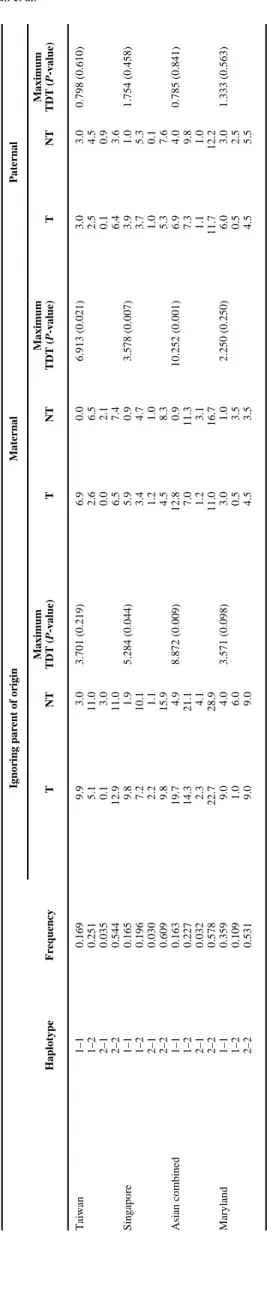
Table III shows results of analyzing haplotypes of rs2255796 and rs15251 in each population. Taiwan and Singapore parents had very similar haplotype frequencies, so all Asian trios were combined. In the combined Asian data, haplotypes showed strong evidence of excess transmission of the 1–1 haplotype to CP children (P = 0.009 for overall transmission). This can be largely attributed to excess maternal transmission (P = 0.001) among Asian trios, although the Maryland trios showed similar patterns. No haplotypes showed deviation from the expected Mendelian transmission when transmitted from fathers.
DISCUSSION
Our study of cleft palate (CP) case-parent trios showed significant evidence of linkage and disequilibrium for SNP rs15251 in the TCOF1 gene. SNP rs15251 is a nonsynonymous mutation located in exon 23 of TCOF1 gene. In screening for parent-of-origin effects, we found suggestive evidence of excess maternal transmission of this SNP. Analysis of haplotypes of rs2255796 and rs15251 also showed significant deviation from expected for maternal transmission, but not for paternal transmission.
TCOF1 gene was mapped in 1996 [The Treacher Collins Syndrome Collaborative Group, 1996] and subsequent studies have reported mutations throughout the 25 coding exons of this gene. Furthermore, most reported pathogenic mutations are clustered in mutational hot spots in five exons (10, 15, 16, 23, and 24) [Splendore et al., 2000]. Recently, in a study analyzing 22 sporadic Treacher Collins syndrome patients, Splendore et al. [2003] reported maternal mutations at the exon 24 hot spot in TCOF1 gene. The present study is part of a larger candidate gene study of oral clefts, and markers in TCOF1 were examined using family based association test statistics in case-parent trios. Here we present results of analysis of SNPs including the nonsynonymous SNP (rs15251) in exon 23.
Excess maternal transmission could reflect genomic imprinting or maternal genotype effects. Maternal genotypic effects for nonsyndromic cleft lip with/without palate (CL/P) have also been reported for several other candidate genes (MTHFR and CBS), but these have yet to be confirmed [van Rooij et al., 2003; Rubini et al., 2005]. Our results for rs15251 in TCOF1 (both analyzed alone and as a haplotype) showed evidence of excess maternal transmission, which could reflect an imprinting effect or a maternal genotype effect.
The case-parent trio design offers the advantage of testing directly for maternal versus paternal effects, and allows separating these from effects of the fetal genotype versus parental origin in a robust manner [Sinsheimer et al., 2003; Cordell et al., 2004; Starr et al., 2005]. In the present study, the PO-LRT for inequality between maternal and paternal transmission failed to distinguish between these two forces, but this may be due to the limited number of informative matings available here. Complete confirmation would require much larger samples of trios, with resulting larger numbers of informative heterozygotes. Another advantage of this study design is it minimizes issues of confounding that plague traditional case–control designs. This
NIH-PA Author Manuscript
NIH-PA Author Manuscript
feature permitted pooling trios from diverse populations into a combined test explicitly considering parent-of-origin effects. The present study suggests maternal transmission effects for markers in TCOF1 and risk of nonsyndromic CP. Further work will be needed to confirm this suggestion that maternal transmission of alleles in TCOF1 influence risk of CP and to determine its ultimate impact on risk.
WEB RESOURCES
Online Mendelian Inheritance in Man (OMIM): http://www.ncbi.nlm.nih.gov/omim/ (forTCOF1 and Treacher Collins Syndrome) SNP: GeneVew,
http://www.ncbi.nlm.nih.gov/snp/(for (for rs15251).
Acknowledgments
This research was supported by R21-DE-013707 and R01-DE-014581 from the National Institute of Dental & Craniofacial Research and Korean Research Foundation (2004-041-E00104 and 2005-214-E00042), and the Seoul City R&BD program (10526) in Korea. We wish to acknowledge Dr. Gerald Raymond for examining MD patients for this study, and we thank Katherine Zarfas for technical assistance. We thank all participants who donated samples for this multi-center study of oral clefts, as well as the staff at each participating site and institution. We also thank the Smile Train Foundation for supporting cleft research in China.
Grant sponsor: National Institute of Dental & Craniofacial Research; Grant number: R21-DE-013707 Grant number: R01-DE-014581
References
Becker T, Knapp M. Maximum-likelihood estimation of haplotype frequencies in nuclear families. Genet Epidemiol 2004;27:21–32. [PubMed: 15185400]
Becker T, Baur MP, Knapp M. Detection of parent-of-origin effects in nuclear families using haplotype analysis. Hum Hered 2006;62:64–76. [PubMed: 17047336]
Bellus GA, Hefferon TW, Ortiz de Luna RI, Hecht JT, Horton WA, Machado M, Kaitila I, McIntosh I, Francomano CA. Achondroplasia is defined by recurrent G380R mutations of FG FR3. Am J Hum Genet 1995;56:368–373. [PubMed: 7847369]
Cobourne MT. The complex genetics of cleft lip and palate. Eur J Orthod 2004;26:7–16. [PubMed: 14994877]
Cordell HJ, Barratt BJ, Clayton DG. Case/pseudocontrol analysis in genetic association studies: A unified framework for detection of genotype and haplotype associations, gene-gene and gene-environment interactions, and parent-of-origin effects. Genet Epidemiol 2004;26:167–185. [PubMed: 15022205] Dixon J, Jones NC, Sandell LL, Jayasinghe SM, Crane J, Rey JP, Dixon MJ, Trainor PA. Tcof1/Treacle
is required for neural crest cell formation and proliferation deficiencies that cause craniofacial abnormalities. Proc Natl Acad Sci USA 2006;103:13403–13408. [PubMed: 16938878]
Fan JB, Oliphant A, Shen R, Kermani BG, Garcia F, Gunderson KL, Hansen M, Steemers F, Butler SL, Deloukas P, Galver L, Hunt S, McBride C, Bibikova M, Rubano T, Chen J, Wickham E, Doucet D, Chang W, Campbell D, Zhang B, Kruglyak S, Bentley D, Haas J, Rigault P, Zhou L, Stuelpnagel J, Chee MS. Highly parallel SNP genotyping. Cold Spring Harb Symp Quant Biol 2003;68:69–78. [PubMed: 15338605]
Infante-Rivard C, Weinberg CR. Parent-of-origin transmission of thrombophilic alleles to intrauterine growth-restricted newborns and transmission-ratio distortion in unaffected newborns. Am J Epidemiol 2005;162:891–897. [PubMed: 16192348]
Knapp M, Becker T. Family-based association analysis with tightly linked markers. Hum Hered 2003;56:2–9. [PubMed: 14614233]
Oliphant A, Barker DL, Stuenlpnagel JR, Chee MS. BeadArray3Technology: Enabling an accurate, cost-efficient approach to high-throughput genotyping. Biotechniques 2002;32:S56–S61.
Rubini M, Brusati R, Garattini G, Magnani C, Liviero F, Bianchi F, Tarantino E, Massei A, Pollastri S, Carturan S, Amadori A, Bertagnin E, Cavallaro A, Fabiano A, Franchella A, Calzolari E.
NIH-PA Author Manuscript
NIH-PA Author Manuscript
Cystathionine beta-synthase c.844ins68 gene variant and nonsyndromic cleft lip and palate. Am J Med Genet Part A 2005;136A:368–372. [PubMed: 16007597]
Sinsheimer JS, Palmer CG, Woodward JA. Detecting genotype combinations that increase risk for disease: maternal-fetal genotype incompatibility test. Genet Epidemiol 2003;24:1–13. [PubMed: 12508251]
Spielman RS, McGinnis RE, Ewens WJ. Transmission test for linkage disequilibrium: the insulin gene region and insulin-dependent diabetes mellitus (IDDM). Am J Hum Genet 1993;52:506–516. [PubMed: 8447318]
Splendore A, Silva EO, Alonso LG, Richieri-Costa A, Alonso N, Rosa A, Carakushanky G, Cavalcanti DP, Brunoni D, Passos-Bueno MR. High mutation detection rate in TCOF1 among Treacher Collins syndrome patients reveals clustering of mutations and 16 novel pathogenic changes. Hum Mutat 2000;16:315–322. [PubMed: 11013442]
Splendore A, Jabs EW, Felix TM, Passos-Bueno MR. Parental origin of mutations in sporadic cases of Treacher Collins syndrome. Eur J Hum Genet 2003;11:718–722. [PubMed: 12939661]
Stanier P, Moore GE. Genetics of cleft lip and palate: syndromic genes contribute to the incidence of nonsyndromic clefts. Hum Mol Genet 2004;13:R73–R81. [PubMed: 14722155]
Starr JR, Hsu L, Schwartz SM. Assessing maternal genetic associations: a comparison of the log-linear approach to case-parent triad data and a case–control approach. Epidemiology 2005;16:294–303. [PubMed: 15824543]
Stata Corporation. Intercooled Stata for Mac, version 8.2. College Station, TX: Stata Corporation; 2005. The Treacher Collins Syndrome Collaborative Group. Positional cloning of a gene involved in the
pathogenesis of Treacher Collins syndrome. Nat Genet 1996;12:130–136. [PubMed: 8563749] van Den Oord EJ, Vermunt JK. Testing for linkage disequilibrium, maternal effects, and imprinting with
(in)complete case-parent triads, by use of the computer program LEM. Am J Hum Genet 2000;66:335–338. [PubMed: 10631165]
van Rooij IA, Vermeij-Keers C, Kluijtmans LA, Ocke MC, Zielhuis GA, Goorhuis-Brouwer SM, van der Biezen JJ, Kuijpers-Jagtman AM, Steegers-Theunissen RP. Does the interaction between maternal folate intake and the methylenetetrahydrofolate reductase polymorphisms affect the risk of cleft lip with or without cleft palate? Am J Epidemiol 2003;157:583–591. [PubMed: 12672677] Weinberg CR. Methods for detection of parent-of-origin effects in genetic studies of case-parents triads.
Am J Hum Genet 1999;65:229–235. [PubMed: 10364536]
Weinberg CR, Umbach DM. A hybrid design for studying genetic influences on risk of diseases with onset early in life. Am J Hum Genet 2005;77:627–636. [PubMed: 16175508]
Weinberg CR, Wilcox AJ, Lie RT. A log-linear approach to case-parent-triad data: assessing effects of disease genes that act either directly or through maternal effects and that may be subject to parental imprinting. Am J Hum Genet 1998;62:969–978. [PubMed: 9529360]
Wilkins JF, Haig D. What good is genomic imprinting: the function of parent-specific gene expression. Nat Rev Genet 2003;4:359–368. [PubMed: 12728278]
Wyszynski DF, Duffy DL, Beaty TH. Maternal cigarette smoking and oral clefts: a meta-analysis. Cleft Palate-Craniofac J 1997;34:206–210. [PubMed: 9167070]
Zhao H, Zhang S, Merikangas KR, Trixler M, Wildenauer DB, Sun F, Kidd KK. Transmission/ disequilibrium tests using multiple tightly linked markers. Am J Hum Genet 2000;67:936–946. [PubMed: 10968775]
Zucchero TM, Cooper ME, Maher BS, Daack-Hirsch S, Nepomuceno B, Ribeiro L, Caprau D, Christensen K, Suzuki Y, Machida J, Natsume N, Yoshiura K, Vieira AR, Orioli IM, Castilla EE, Moreno L, Arcos-Burgos M, Lidral AC, Field LL, Liu YE, Ray A, Goldstein TH, Schultz RE, Shi M, Johnson MK, Kondo S, Schutte BC, Marazita ML, Murray JC. Interferon regulatory factor 6 (IRF6) gene variants and the risk of isolated cleft lip or palate. N Engl J Med 2004;351:769–780. [PubMed: 15317890]
NIH-PA Author Manuscript
NIH-PA Author Manuscript
NIH-PA Author Manuscript
NIH-PA Author Manuscript
NIH-PA Author Manuscript
TABLE I
SNP Minor Allele Frequencies Among Parents of CP Cases From Three Populations
SNP
Minor allele frequency
No. Name Physical location a Minor allele Taiwanese Singapore Maryland 1 rs2255796 149731539 1 0.431 0.333 0.478 2 rs2748222 149745533 2 0.470 0.358 0.489 3 rs1864957 149747290 1 0.469 0.350 0.500 4 rs15251 149756425 1 0.204 0.175 0.340
NIH-PA Author Manuscript
NIH-PA Author Manuscript
NIH-PA Author Manuscript
TABLE II
Number of Transmitted (T) and Non-Transmitted (NT) Minor Alleles in 81 CP Case-Parent Trios (All Populations Combined)* for Four SNPs in TCOF1
SNP Overall Parent-of-origin No. Name Ignoring parent-of-origin Paternal Maternal TAT TAT TAT T NT OR P -value T NT OR P -value T NT OR P -value 1 rs2255796 25 12 2.08 0.033 12 6 2.00 0.157 13 6 2.17 0.108 2 rs2748222 23 13 1.77 0.096 11 7 1.57 0.346 12 6 2.00 0.157 3 rs1864957 21 11 1.91 0.077 10 5 2.00 0.197 11 6 1.83 0.225 4 rs15251 23 8 2.88 0.007 10 6 1.67 0.317 13 2 6.50 0.005
NIH-PA Author Manuscript
NIH-PA Author Manuscript
NIH-PA Author Manuscript
TABLE III
Testing for Excess Transmission of Haplotypes Using rs2255796 and rs15251 in TCOF1 in 81 CP Case-Parent Trios Based on the Program FAMHAP Where Parent of Origin Was Not Considered and Where Maternal and Paternal Transmission Were Considered Separately
Ignoring parent of origin
Maternal Paternal Haplotype Frequency T NT Maximum TDT ( P -value) T NT Maximum TDT ( P -value) T NT Maximum TDT ( P -value) Taiwan 1–1 0.169 9.9 3.0 3.701 (0.219) 6.9 0.0 6.913 (0.021) 3.0 3.0 0.798 (0.610) 1–2 0.251 5.1 11.0 2.6 6.5 2.5 4.5 2–1 0.035 0.1 3.0 0.0 2.1 0.1 0.9 2–2 0.544 12.9 11.0 6.5 7.4 6.4 3.6 Singapore 1–1 0.165 9.8 1.9 5.284 (0.044) 5.9 0.9 3.578 (0.007) 3.9 1.0 1.754 (0.458) 1–2 0.196 7.2 10.1 3.4 4.7 3.7 5.3 2–1 0.030 2.2 1.1 1.2 1.0 1.0 0.1 2–2 0.609 9.8 15.9 4.5 8.3 5.3 7.6 Asian combined 1–1 0.163 19.7 4.9 8.872 (0.009) 12.8 0.9 10.252 (0.001) 6.9 4.0 0.785 (0.841) 1–2 0.227 14.3 21.1 7.0 11.3 7.3 9.8 2–1 0.032 2.3 4.1 1.2 3.1 1.1 1.0 2–2 0.578 22.7 28.9 11.0 16.7 11.7 12.2 Maryland 1–1 0.359 9.0 4.0 3.571 (0.098) 3.0 1.0 2.250 (0.250) 6.0 3.0 1.333 (0.563) 1–2 0.109 1.0 6.0 0.5 3.5 0.5 2.5 2–2 0.531 9.0 9.0 4.5 3.5 4.5 5.5