Non-high-density Lipoprotein Cholesterol Is a Good
Indicator of Pulse Wave Velocity rather than Low-density
Lipoprotein Cholesterol in Asymptomatic Individuals
심혈관 질환이 없는 성인에서 비 고밀도지단백 콜레스테롤과
상완-발목 맥파속도의 관련성
Seon-Young Kwon1, You-Na Son1, Ji-Won Lee1, Jong-Koo Kim2
1
Department of Family Medicine, Yonsei University College of Medicine, Seoul, 2Department of Family Medicie, Yonsei University Wonju College of Medicine, Wonju, Korea
Although targeting low-density lipoprotein cholesterol (LDL-C) has been a primary goal of lipid lowering therapy, a few growing evidences show that non-high-density lipoprotein cholesterol (Non-HDL-C) is a strong, independent pre-dictor of cardiovascular disease nowadays. But few studies have assessed the association between conventional lip-oproteins and subclinical atherosclerosis. We analyzed the association of Non-HDL-C, LDL-C with brachial-ankle pulse wave velocity (baPWV), a marker of subclinical atherosclerosis. We studied 766 apparently healthy individuals who checked baPWV. We analyzed P for trend for the association between baPWV and quartiles of Non-HDL-C, LDL-C. Multivariate analysis was used between quartiles of each lipoprotein and baPWV after adjustment for confounding variables. BaPWV shows increased trend across increase quartiles of Non-HDL-C and LDL-C, with statistical sig-nificance only in Non-HDL-C. In a multiple regression model, pulse wave velocity was positively correlated with Non-HDL-C and LDL-C. The relationship remained in Non-HDL-C after adjustment of LDL-C. However, in LDL-C, the relationship was vanished after adjustment of Non-HDL-C. In this study Non-HDL-C was more strongly associated with baPWV than LDL-C. These data suggests that Non-HDL-C may be an important treatment target in the prevention of cardiovascular disease.
Key Words: Pulse wave velocity, Atherosclerosis, Lipoproteins, Non-high density lipoprotein cholesterol
Received: April 15, 2012, Accepted: May 15, 2012 Corresponding author: Jong-Koo Kim
Department of Family Medicine, Yonsei University Wonju College of Medicine, 162 Ilsan-dong, Wonju, Gangwon-do 220-701, Republic of Korea
Tel: 82-33-741-0681, Fax: 82-33-741-1154 E-mail: [email protected]
Original Article
Vol. 2, No. 1, 41-46서 론
저밀도지단백 콜레스테롤(low-density lipoprotein
cho-lesterol, LDL-C)은 대표적인 동맥경화의 위험인자로 알려 져 있고 심혈관 질환이 있는 사람들의 고지혈증을 치료하 는데 있어 오랫동안 치료의 지표로 이용되어 왔다[1]. TG(triglyceride, TG)이 낮은 경우에는 초저밀도지단백 (very low-density lipoprotein, VLDL)이 대개 30 mg/dl 이 하이기에 VLDL이 동맥경화에 미치는 영향이 미미하므로, 동맥경화를 일으키는 콜레스테롤의 대부분을 차지하는 지 단백은 LDL-C이지만 TG가 높은 사람들에서는 LDL-C이 외에 VLDL 및 중밀도지단백 콜레스테롤(intermediate-
density lipoprotein, IDL-C)이 상당부분을 차치하게 된다. 이 에 따라 미국 National Cholesterol Education Program, Adult Treatment Panel III (NCEP ATPIII) guidelines에서는 LDL-C 과 더불어 이들을 고려한 비 고밀도지단백 콜레스테롤 (non-high density lipoprotein cholesterol, Non-HDL-C)을 고지혈증 치료의 지침으로 삼을 것을 권장하고 있다[1]. Non-HDL-C는 총 콜레스테롤(total cholesterol, TC)에서 고밀도지단백(high-density lipoprotein cholesterol, HDL-C)을 뺀 것으로 동맥경화를 유발하는 아포지단백 B (apolipoprotein B; Apo B)를 포함하는 모든 지질들(VLDL, IDL-C, LDL-C, 킬로미크론 잔유물, lipoprotein [a])을 포함하는 개념이다 [2]. 여러 연구들에서 Non-HDL-C은 중요성은 부각되고 있는데 심혈관 질환이 있는 군[2]과 없는 군[3] 모두에서 심혈관질환의 발생을 예측할 수 있었으며, 말기 신부전 [4], 당뇨병이 있는 군[5]에서 심혈관 질환 발생과 유의한 연관성이 있었다. 최근 비만의 증가와 더불어 대사증후군, 당뇨병의 유병 률은 점차로 증가하며 이에 따라 심혈관 위험은 점차로 높 아지고 있다[6]. 심혈관 질환의 예방을 위해서는 위험인자 를 조기에 발견하여 규명하고 교정 가능한 인자들을 미리 예방하는 것이 중요하다. 비만, 대사증후군, 당뇨에서 심 혈관 위험은 증가하나 LDL-C은 정상군과 차이가 없었고 [7-9], 심혈관 질환이 있는 사람에서 상당수가 정상 LDL-C를 보였으며[10], 젊은 성인의 심근경색에서 LDL-C 이 정상인 경우가 68%에 달했다는 보고도 있다[11]. 따라 서 이런 경우 LDL-C 측정만으로는 심혈관 질환 위험을 잘 예측할 수 없으며 Non-HDL-C이나 Apo B 등의 측정이 필요하다.
동맥 맥파속도(pulse wave velocity, PWV)는 동맥의 경 직도(arterial stiffness)를 나타낼 뿐 아니라 혈관 손상의 심 각도를 반영하는 지표라고 알려져 있는데[12], 연령 및 다 른 보편적인 동맥경화의 위험인자와는 독립적으로 심혈관 질환의 강력한 예측인자이며[13], 사망률을 예측할 수 있 을 것[14-18]으로 보고되고 있다. 일반적으로 경동맥-대퇴 동맥 맥파속도(carotid-femoral PWV)가 동맥 경직도 측정 을 위해 많이 쓰이는 방법이지만 정확하게 동맥 위에 transducer를 위치해야 하는 어려움과 침습적인 방법 때문 에[19] 최근에는 이를 대치하여 간편하면서도 재현성이 뛰어나고 대동맥 동맥 맥파속도와 상관성이 좋은 상완-발 목 맥파속도(brachial ankle pulse wave velocity, baPWV)를 일반 인구집단 대상으로 심혈관 질환의 선별 목적으로 널 리 사용하고 있다[20,21]. 그러나 현재까지 우리나라 사람 을 대상으로 알려진 심혈관 질환이 없는 불현성 동맥경화 증과 각 지단백을 직접적으로 비교한 연구는 없었다. 따라 서 본 연구에서는 각 지단백과 상완-발목 맥파 속도와의 관련성을 확인하고, 이를 통해 불현성 동맥경화증을 예측 하는데 있어 이상지혈증 치료의 일차적 표적인 LDL-C과 비교하여 Non-HDL-C이 유용성을 알아보고자 하였다.
대상 및 방법
1. 연구대상 2007년 10월부터 2008년 2월까지 연세대학교 의과대학 세브란스 병원 건강 검진센터를 방문한 수검자 중 문진 및 설문 자료, 신체 계측, 혈액 검사를 실시한 만 20세 이상의 성인 남녀를 대상으로 하였다. 설문을 통해 인구학적 정 보, 질병의 과거력과 현재 병력을 조사하였으며 신체계측 및 혈액 검사를 시행한 후 i) 거동이 불편하거나 PWV 측 정이 불가능한 사람, ii) ankle-brachial pressure index (ABI) < 0.9이거나 PAOD가 있는 경우, iii) 과거력상 심혈 관 질환이 있었던 경우는 제외하였다. 제외 기준을 적용한 후 연구 대상자는 총 766명 이었으며 본 연구는 연구수행 기관의 윤리위원회(Institutional Review Board)의 승인을 받았다. 2. 연구 방법 1) 설문: 검사 시작 전 설문지를 미리 작성하도록 하여 환자의 현병력, 질병의 과거력, 약물 복용력, 흡연습관을 조사하였다. 당뇨병은 당뇨병 약물을 복용하거나 공복혈 당을 측정하였을 때 126 mg/dl 이상인 경우로 정의하였고 고혈압은 고혈압치료약물을 복용하거나 안정상태에서 측 정한 수축기 혈압이 140 이상이거나 이완기 혈압이 90 이 상인 경우로 정의하였다. 2) 신체 계측 및 혈압 측정: 가벼운 옷을 입고 신발을 벗은 상태에서 전자 저울과 전자 신장 계측기를 이용하여 몸무 게(kg) 및 신장(m)을 측정하였다. 체질량 지수(body mass index; BMI)는 몸무게(kg)를 신장(m)의 제곱으로 나누어 계산하였으며, 허리둘레(waist circumference)는 흉곽의 최 하단과 장골 능(iliac crest) 사이의 가장 가느다란 지점에 서 cm로 측정하는 세계보건기구 방법을 채택하여 1 cm 단 위로 측정하였다. 혈압은 앉은 자세에서 5분간의 휴식 후 에 우측 팔에서 기계 혈압계로 수축기/이완기 혈압 및 심 장 박동수를 측정하였다. 3) 혈액 검사: 8시간 이상 금식한 상태에서 검사 당일 오 전에 앉은 자세에서 혈액을 채취하여, 비색법(colorimetry) 을 이용한 ADVIA 1650 전자동 임상 화학분석기(Bayer,Table 1. Clinical characteristics of study population Characteristics N=766 Age (years) Men (%)* Smoking (%)* Waist circumference (cm)
Body mass index (kg/m2)
Hypertension (%)* Diabetes mellitus (%)* Total cholesterol (mg/dl) Triglyceride (mg/dl)† HDL-C (mg/dl)† LDL-C (mg/dl) Non-HDL-C (mg/dl) FBS (mg/dl) baPWV (cm/sec) 52.48 ± 9.28 527 (68.80) 357 (46.61) 82.34 ± 8.60 24.23 ± 2.87 227 (29.63) 51 (6.66) 203.08 ± 32.47 124.5 (90-178) 53 (44-62) 124.77 ± 28.52 148.94 ± 32.93 93.26 ± 18.14 1,403 (1,303-1,566) Data are presented as mean ± SD unless otherwise indicated. Non-HDL-C: non-high density lipoprotein cholesterol, FBS: fast-ing blood sugar, baPWV: brachial-ankle pulse wave velocity.
*data are presented as number (%), †data are presented as
me-dian (25-75%) because of irregular distribution.
Table 2. Clinical characteristics according to each quartiles of non-high density lipoprotein cholesterol
Variable Non-HDL-C LDL-C Q1 Q2 Q3 Q4 p Q1 Q2 Q3 Q4 p <126.0 126≤ <148.5 148.5≤ <171.0 ≥171 <106 106≤ <126 126≤ <143 ≥143 Subjects number (%) Age (y) Men* Smoking* WC (cm) BMI (kg/m2) HTN* DM* TC (mg/dl) TG (mg/dl) HDL-C (mg/dl) LDL-C (mg/dl) 186 (24.3) 51.3 ± 10.2 113 (60.8) 71 (38.2) 79.5 ± 9.2 23.3 ± 2.8 44 (23.7) 18 (9.7) 165.3 ± 20.1 105.1 ± 52.4 58.5 ± 15.1 90.9 ± 16.5 197 (25.7) 52.3 ± 9.1 133 (67.5) 96 (48.7) 81.4 ± 8.1 24.0 ± 2.8 52 (26.4) 9 (4.6) 192.5 ± 14.2 133.1 ± 74.2 54.6 ± 12.6 116.3 ± 12.2 190 (24.8) 53.1 ± 8.6 135 (71.0) 90 (47.4) 82.6 ± 8.0 24.4 ± 2.6 60 (31.6) 11 (5.8) 212.1 ± 13.7 148.7 ± 71.3 53.2 ± 12.5 133.5 ± 12.1 193 (25.2) 53.3 ± 9.1 146 (75.7) 100 (51.8) 85.9 ± 7.9 25.3 ± 3.0 71 (36.8) 13 (6.7) 241.5 ± 18.9 182.7 ± 79.5 50.5 ± 10.9 157.4 ± 18.8 NA 0.14 0.02 <0.05 <0.001 <0.001 0.03 0.24 <0.001 <0.001 <0.001 <0.001 187 (82.4) 51.4 ± 10.3 115 (61.5) 81 (43.3) 80.8 ± 9.1 23.7 ± 2.9 54 (28.9) 19 (10.2) 167.2 ± 21.6 134.7 ± 85.5 56.3 ± 16.0 88.1 ± 14.0 193 (85.0) 52.4 ± 9.0 140 (72.5) 94 (48.7) 81.5 ± 8.2 23.9 ± 2.8 45 (23.3) 12 (6.2) 193.4 ± 16.9 141.9 ± 83.4 53.5 ± 12.4 115.2 ± 5.9 190 (83.7) 52.7 ± 8.4 127 (66.8) 81 (42.6) 82.4 ± 8.3 24.4 ± 2.9 62 (32.6) 6 (3.2) 210.8 ± 18.1 139.4 ± 65.0 54.1 ± 12.8 134.0 ± 4.9 196 (86.3) 53.4 ± 9.3 145 (74.0) 101 (51.5) 84.6 ± 8.3 24.9 ± 2.8 66 (36.7) 14 (7.1) 239.4 ± 19.4 154.2 ± 65.1 52.8 ± 10.7 160.3 ± 14.7 NA 0.22 0.04 0.23 <0.001 <0.001 0.1 0.05 <0.001 0.07 <0.05 <0.001 Data are presented as mean ± SD unless otherwise indicated. WC: waist circumference, TC: total cholesterol, TG: triglyceride, Non-HDL-C: non-high density lipoprotein cholesterol, HTN: hypertension, high blood pressure (systolic blood pressure/diastolic blood pressure ≥ 140/90), DM: diabetes mellitus, high fasting blood sugar (fasting blood sugar ≥ 126 mg/dl). *data are presented as number (%). p-value by ANOVA for continuous variables or Fisher's exact test for categorical variables.
Terrytown, NY, USA)를 사용하여 TC, TG, HDL-C, LDL-C, 공복 혈당을 측정하였다. Non-HDL-C은 TC - HDL-C로 계산하였다.
4) 상완-발목 맥파 속도: BaPWV는 용적-체적 변동 기록방식으 로(form/ABI, Colin, Co. Ltd., Komaki, Japan) 측정하였다. 대상자가 앙와위 자세로 있는 동안 측정되었으며 측정 띠 를 양쪽 상완과 발목에 감았다. 맥박 용적파형이 반도체 센서를 이용하여 상완과 발목에서 기록되었으며 적어도 5 분 이상 휴식을 취한 후 측정하였다. 사지의 혈압은 진동 계 방법을 사용하여 측정하였으며 이를 통해 발목-상완 압 력지수 (ABI)가 자동으로 계산되었다. 우측 상완-발목 맥 파속도(Rt. baPWV), 좌측 상완-발목 맥파 속도(Lt. baPWV) 가 측정되었다. Rt. baPWV와 Lt. baPWV는 의미 있는 양의 상관관계가 있으므로(r = 0.91, p < 0.0001)[20,22] 분석 평 균 상완-발목 맥파 속도 [Rt/Lt baPWV{(Rt + Lt)/2}]를 이 용하였다. 이 방법의 타당도는 이미 검증되었고[20], 측정 자에 따른 변동계수(coefficient variation, CV), 측정자 간 변동계수는 각각 8.4%, 10.0%였다.
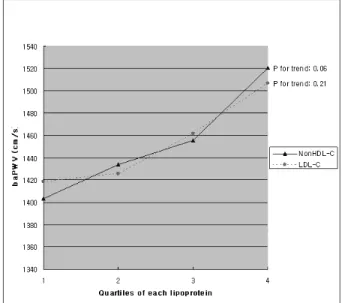
Fig. 1. Pulse Wave Velocity according to increasing quartiles of non-high density lipoprotein and low-density lipoprotein cholesterol. Pulse Wave Velocity increase across increasing quartiles of each lipoproteins (mean of Pulse Wave Velocity: 1,403.19 ± 209.31, 1,433.50 ± 214.11, 1,455.57 ± 206.46, 1,520.24 ± 257.84 in each quartiles of non-high density lipoprotein cholesterol, and 1,418.47 ± 212.16, 1,425.31 ± 206.25, 1,461.40 ± 219.56, 1,506.91 ± 255.36 in LDL-C, respectively). Only non-high density lipoprotein cholesterol correlate with Pulse Wave Velocity within statistical significance (p for trend: 0.06 for non-high density lipoprotein cholesterol, 0.21 for LDL-C). 3. 통계 분석 모든 통계학적 분석은 SPSS 12 software로 수행하였으며 연속형 변수는 mean ± SD, 중위수(median) (25-75%), 범주 형 변수는 백분율로 나타내었다. 연구 대상자를 Non- HDL-C과 LDL-C의 사분위 값을 기준으로 각각 네 집단으 로 분류하고 trend 검정을 시행하여 신체 계측치와 심혈관 위험인자의 차이를 비교하였다. Non-HDL-C 및 LDL-C와 baPWV의 독립적인 관련성을 알아보기 위해 혼란변수를 보정한 후 다중 선형 회귀 분석(multiple linear regression analyses)을 시행하였다. p-value는 0.05 미만일 때 통계적 으로 유의한 것으로 판단하였다.
결 과
1. 연구 대상자의 일반적인 특성 본 연구에 포함된 최종 인구는 766명의 심혈관 질환이 없는 성인남녀이다. 이들의 임상 특징은 다음과 같다. 남 자는 전체의 68.80%였고, 평균 나이는 52.48 ± 9.28세였 다. 각 지질 수치의 평균은 NCEP ATPIII guidelines의 권장 수치 범위 내이다. 참가자의 대부분(537명, 70.2%)은 LDL-C이 100-159 mg/dl였고, LDL-C < 100 mg/dl 인 경 우는 18.7%였다. LDL-C ≥ 190 mg/dl인 경우는 1.4%에 불 과하였다. HDL-C이 < 40 mg/dl인 경우는 11.7%였다. BaPWV의 평균값은 1,446.82 cm/sec 였다(Table 1).Non-HDL-C과 LDL-C의 사분위수에 따른 대상군의 일 반적인 특성에서는 흡연, 허리둘레, BMI, TC, TG, HDL-C, LDL-C, 고혈압 등 나이와 당뇨를 제외한 모든 심혈관 질 환의 위험 요소들이 Non-HDL-C의 사분위수가 증가할수 록 통계적으로 유의하게 증가하는 경향을 보였다. 그러나 LDL-C의 사분위 증가에 따라서 허리둘레, BMI, TC은 통 계적으로 유의하게 증가하였지만, 나이, 흡연, 고혈압, 당 뇨, TG의 증가는 통계적으로 유의하지 않았다(Table 2). 2. Non-HDL-C, LDL-C과 baPWV의 독립적인 관련성 LDL-C과 Non-HDL-C의 사분위가 증가함에 따라 baPWV 가 증가하는 경향을 보였으나, P for trend 검정을 하였을 때 Non-HDL-C에서만 통계적으로 유의하게 baPWV가 증 가하였다(Fig. 1). Non-HDL-C 및 LDL-C과 baPWV의 독 립적인 관련성을 비교하기 위해 나이, 성별, BMI, 허리둘 레, 흡연, 고혈압, 당뇨유무, 요산을 보정하여 다중 회귀 분 석을 시행하였을 때 각각 Non-HDL-C (PE 1.043, SE 0.22, p < 0.01)과 LDL-C (PE 1.01, SE 0.24, p < 0.01) 모두 baPWV와 독립적인 연관성을 나타내었다. 그러나 Non-HDL-C 과 LDL-C를 서로 보정하였을 때에는 Non-HDL-C만이 baPWV와 독립적인 양의 관련성을 나타냈다.
고 찰
최근 연구결과들은 LDL-C에 비하여 Non-HDL-C과 Apo B가 좀 더 심혈관 질환을 잘 예측할 수 있는 강력한 예측인자라고 보고하고 있으며, 이는 Non-HDL-C과 Apo B가 LDL-C을 대신하여 치료의 지표가 될 수 있음을 의미 한다[3,23-25]. 하지만 Apo B의 경우 기본 검사로 측정하는 데는 한계가 있으므로, LDL-C보다 Apo B와 더 잘 연관되는 Non-HDL-C 가 심혈관 질환의 위험 예측에 있어 유용한 지표가 될 수 있다. 기존의 연구들은 LDL-C 단독으로 심혈관 질환을 예측 할 수 없는 여러 증거들을 보여주었는데, Framingham co-hort 연구에서는, 대사증후군이 있을 때 작은 저밀도 지단백 입자가 많아지고 저밀도 지단백의 평균 크기가 더 작아 지며, Apo B는 더욱 증가하지만 LDL-C수치는 대사증후군 이 있는 남성과 없는 남성에서 차이가 없음을 보여 주었다 [8]. 특히 당뇨가 있는 이상지혈증 환자에서는 TG가 증가 하고 HDL-C이 저하되어 있지만 LDL-C은 당뇨가 없는 사 람과 비슷한 양상을 보였다[2]. 따라서 비만, 대사증후군, 당뇨환자가 증가할수록 LDL-C의 한계는 더욱 커짐을 알 수 있다. 또한 Non-HDL-C은 TG수치에 상관없이 심혈관 질환 발생을 예측할 수 있음이 알려졌는데, 5,794명을 대 상으로 한 Framingham study에서 TG가 200 mg/dl 이상인 군과 이하인 군 모두에서 Non-HDL-C이 LDL-C보다 더 우 수하게 심혈관질환을 예측함을 보여주었다[26]. Non-HDL-C은 공복에 상관없이 간단하게 TC에서 HDL-C을 빼서 계산한다. Friedwald 공식으로 얻는 LDL-C 의 경우 고중성지방혈증이 있을 때 계산할 수 없지만, Non-HDL-C은 TG가 400 mg/dl 이상인 경우도 측정할 수 있는 장점이 있다[27]. 또 Non-HDL-C은 당뇨병처럼 TG가 증가하는 경우에도 VLDL-C이 증가에 영향을 받지 않고 측정가능하며, 유전적으로 높은 VLDL-C, IDL-C, 낮은 HDL-C가 동맥경화의 고위험군을 진단하는데 도움이 된다. 대략 20%의 미국인들이 정상 LDL-C 수치를 가지는 동맥경 화의 고위험군으로 알려져 있는데[28,29], 향후 연구가 더 필요하지만 우리나라 인구집단을 대상으로 정상 LDL-C 수 치를 가지는 동맥경화의 고위험군에서도 Non-HDL-C의 측 정은 유용할 것으로 사료된다. 본 연구에서도 심혈관질환이 없는 성인을 대상으로 하 였을 때 고식적인 지단백중 Non-HDL-C이 LDL-C과 비교 하여 더 유의하게 불현성 동맥경화증의 지표인 baPWV와 잘 관련됨을 나타내었다. 이는 기존의 연구들과 일치하는 결과를 나타낸다. 예를 들면 Cui 등[3]의 연구에서도 심혈 관 질환으로 인한 사망과 여러 지단백의 관계를 19년 동안 추적 관찰하였을 때 남녀 모두에서 Non-HDL-C이 LDL-C 보다 강력한 심혈관 질환으로 인한 사망의 예측 인자임을 나타냈고, 당뇨병이 있는 사람을 대상으로 한 Lu 등[5]의 연구에서도 Non-HDL-C이 LDL-C보다 심혈관 질환 발생 예측에 우수함을 보여 주었다. 하지만 기존의 연구들은 당 뇨 및 심혈관 질환이 있는 고위험군을 대상으로 한 연구들 이 대부분이었으며, 불현성 심혈관 질환의 지표와 여러 지 단백과의 관련성을 연구한 것은 거의 없었다. PWV는 혈관의 탄력성과 유순도가 저하되는 조기의 기 능적 변화를 나타내는 동맥의 경직도(arterial stiffness)를 측정하고 혈관 손상의 심각도를 반영하여 불현성 동맥경 화증을 예측할 수 있는 유용한 지표로 알려져 있다[12]. 최근 연구들에 의하면 연령 및 다른 보편적인 동맥 경화의 위험 인자와는 독립적으로 심혈관 질환의 강력한 예측인 자이며[13], 사망률을 예측할 수 있을 것으로 보고되고 있 다[14]. 이에 본 연구에서는 심혈관 질환이 없는 무증상의 성인을 대상으로 하여 baPWV를 측정하고 여러 지단백과 의 관련성을 알아보았으며 Non-HDL-C은 baPWV와 독립 적인 관련성이 있었다. 본 연구는 단면연구이므로 Non-HDL-C및 LDL-C과 동 맥의 경직도 사이의 인과관계를 정확히 알 수 없고 다른 혼란변수를 배제하지 못하였을 가능성이 있다. 또한 한 병 원 건강검진 센터를 내원한 수검자를 대상으로 하였기에 일반 인구집단을 대변하지 못할 가능성이 있다. 앞으로 대 규모의 인구집단을 대상으로 한 전향적인 연구가 필요할 것으로 사료된다. 결론적으로, Non-HDL-C의 증가는 동맥경직도를 나타내 는 baPWV와 선형적인 증가관계를 나타내었으며 다른 혼란 변수를 보정한 후에도 baPWV와 독립적인 관련성이 있었으 며 이는 LDL-C을 보정한 후에도 변화가 없었다. 하지만 LDL-C은 baPWV와 증가에 따른 선형적인 증가관계를 나 타내지 못하였으며 baPWV와의 관련성은 Non-HDL-C을 보정한 후 사라지는 결과를 나타내었다. 이는 Non-HDL-C 이 LDL-C에 비해 baPWV와의 관련성이 높으며, 향후 LDL-C과 비교하여 심혈관질환을 예측할 수 있는 더 유용 한 표적 지질로써의 가능성을 나타낸다.
참 고 문 헌
1. Expert Panel on Detection, Evaluation, and Treatment of High Blood Cholesterol in Adults. Executive summary of the third report of the national cholesterol education pro-gram (NCEP) expert panel on detection, evaluation, and treatment of high blood cholesterol in adults (Adult Treatment Panel III). JAMA 2001;285:2486-97.
2. Bittner V, Hardison R, Kelsey SF, Weiner BH, Jacobs AK, Spoko G. Bypass angioplasty revascularization inves-tigation non-highdensity lipoprotein cholesterol levels pre-dict five-year outcome in the bypass angioplasty revascula-rization investigation (BARI). Circulation 2002;106:2537-42. 3. Cui Y, Blumenthal RS, Flaws JA, Whiteman MK,
Langenberg P, Bachorik PS, Bush TL. Non-high-density lipoprotein cholesterol level as a predictor of cardiovascular disease mortality. Arch Intern Med 2001;161:1413-9. 4. Nishizawa Y, Shoji T, Kakiya R, Tsujimoto Y, Tabata T,
Ishimura E , Nakatani T, Miki T, Inaba M. Non-high-den-sity lipoprotein cholesterol (Non-high denNon-high-den-sity lipoprotein cholesterol) as a predictor of cardiovascular mortality in patients with end-stage renal disease. Kidney Int Suppl
2003;84:S117-20.
5. Lu W, Resnick HE, Jablonski KA, Jones KL, Jain AK, Howard WJ, Robbins DC, Howard BV. Non-HDL cholester-ol as a predictor of cardiovascular disease in type 2 diabetes: the strong heart study. Diabetes Care 2003;26:16-23. 6. Ford ES, Giles WH, Dietz WH. Prevalence of the metabolic
syndrome among US adults: findings from the third National Health and Nutrition Examination Survey. JAMA 2002;287:356-9.
7. Yusuf S, Hawken S, Ounpuu S, Bautista L, Franzosi MG, Commerford P, Lang CC, Rumboldt Z, Onen CL, Lisheng L, Tanomsup S, Wangai P Jr, Razak F, Sharma AM, Anand SS; INTERHEART Study Investigators. Obesity and the risk of myocardial infarction in 27,000 participants from 52 countries: a case-control study. Lancet 2005;366:1640-9. 8. Kathiresan S, Otvos JD, Sullivan LM, Keyes MJ, Schaefer
EJ, Wilson PW, D'Agostino RB, Vasan RS, Robins SJ. Increased small low-density lipoprotein particle number: A prominent feature of the metabolic syndrome in the Framingham Heart Study. Circulation 2006;113:20-9. 9. Hsia SH. Non-HDL cholesterol: into the spotlight. Diabetes
Care 2003;26:240-2.
10. Vasisht S, Narula J, Awtade A, Tandon R, Srivastava LM. Lipids and Lipoproteins in normal controls and clinically documented coronary heart disease patients. Ann Natl Acad Med Sci (India) 1990;26:57-66.
11. Akosah KO, Cerniglia RM, Havlik P. Ana Schaper. Chest 2001;120;1953-8.
12. Van Popele NM, Grobbee DE, Bots ML. Association be-tween arterial stiffness and artherosclerosis: The rotter-dam study. Stroke 2001;32:454-60.
13. Laurent S, Boutouyrie P, Asmar R. Aortic stiffness is an independent predictor of all-cause and cardiovascular mortal-ity in hypertensive patients. Hypertension 2001;37:1236-41 14. Blacher J, Asmar R, Djane S, London GM, Safar ME. Aortic
pulse wave velocity as a marker of cardiovascular risk in hypertensive patients. Hypertension 1999;33:1111-7. 15. Blacher J, Guerin AP, Pannier B, Marchais SJ, Safar ME,
London GM. Impact of aortic stiffness on survival in end-stage renal disease. Circulation 1999;99:2434-9. 16. Guerin AP, Blacher J, Pannier B, Marchais SJ, Safar ME,
London GM. Impact of aortic stiffness attenuation on sur-vival of patients in end-stage renal failure. Circulation 2001;103:987-92.
17. Meaume S, Benetos A, Henry OF, Rudnichi A, Safar ME. Aortic pulse wave velocity predicts cardiovascular mortal-ity in subjects > 70 years of age. Arterioscler Thromb Vasc Biol 2001;21:2046-50.
18. Boutouyrie P, Tropeano AI, Asmar R, Gautier I, Benetos A, Lacolley P, Laurent S. Aortic stiffness is an independent
predictor of primary coronary events in hypertensive pa-tients: A longitudinal study. Hypertension 2002;39:10-5. 19. Sun K, Diamon M, Watanabe S, Komuro I, Masuda Y.
The relation of pulse wave velocities measured by oscillo-metric and tonooscillo-metric methods and clinical application studies. Japanese J Appl Physiol 2002;32:81-6.
20. Yamashina A, Tomiyama H, Takeda K, Tsuda H, Arai T, Hirose K, Koji Y, Hori S, Yamamoto Y. Validity, reproduci-bility, and clinical significance of noninvasive brachial-ankle pulse wave velocity measurement. Hypertension Res 2002; 25:359-64.
21. Tomiyama H, Yamashina A, Arai T, Hirose K, Koji Y, Chikamori T, Hori S, Yamamoto Y, Doba N, Hinohara S. Influences of age and gender on results of noninvasive brachial-ankle pulse wave velocity measurement: A survey of 12517 subjects. Atherosclerosis 2003;166:303-9. 22. Ohnishi H, Saitoh S, Takagi S, Ohata J, Isobe T, Kikuchi
Y, Takeuchi H, Shimamoto K. Pulse wave velocity as an indicator of atherosclerosis in impaired fasting glucose: The Tanno and Sobetsu study. Diabetes Care 2003;26:437-40. 23. Liu J, Sempos C, Donahue RP, Dorn J, Trevisan M, Grundy
SM. Joint distribution of non-HDL and LDL cholesterol and coronary heart disease risk prediction among in-dividuals with and without diabetes. Diabetes Care 2005;28:1916-21.
24. Kastelein JJ, van der Steeg WA, Holme I, Gaffney M, Cater NB, Barter P, Deedwania P, Olsson AG, Boekholdt SM, Demicco DA, Szarek M, LaRosa JC, Pedersen TR, Grundy SM; TNT Study Group; IDEAL Study Group. Lipids, apoli-poproteins, and their ratios in relation to cardiovascular events with statin treatment. Circulation 2008;117:3002-9. 25. Sniderman AD, Hogue JC, Bergeron J, Gagne C, Couture
P. Non-HDL cholesterol and apoB in dyslipidaemia. Clin Sci Lond 2008;114:149-55.
26. Liu J, Sempos CT, Donahue RP, Dorn J, Trevisan M, Grundy SM. 2006. Non-high-density lipoprotein and very-low-density lipoprotein cholesterol and their risk pre-dictive values in coronary heart disease. Am J Cardiol 2006;98:1363-8.
27. Frost PH, Havel RJ. Rationale for use of non-high-density lipoprotein cholesterol rather than low-density lipoprotein cholesterol as a tool for lipoprotein cholesterol screening and assessment of risk and therapy. Am J Cardiol 1998;81:26B-31B.
28. Havel RJ, Rapaport E. Management of primary hyperlipidemia. N Engl J Med 1995;332:1491-8.
29. Austin MA, King MC, Vranizan KM, Kraus RM. Atherogenic lipoprotein phenotype A proposed genetic marker for coro-nary heart disease. Circulation 1990;82:495-506.