Simple one-step synthesis of carbon nanoparticles from aliphatic
alcohols and n-hexane by stable solution plasma process
Choon-Sang Park
1,*, Dae Sub Kum
1,*, Jong Cheol Kim
2, Jun-Goo Shin
1, Hyun-Jin Kim
3, Eun Young Jung
1,
Dong Ha Kim
1, Daseulbi Kim
1, Gyu Tae Bae
1, Jae Young Kim
4, Bhum Jae Shin
5, and Heung-Sik Tae
1,♠1School of Electronics Engineering, College of IT Engineering, Kyungpook National University, Daegu 41566, Korea 2Department of Materials Science and Engineering, Korea University, Seoul 02841, Korea
3SEMES, Cheonan 31040, Korea
4Department of New Biology, Daegu Gyeongbuk Institute of Science & Technology, Daegu 42988, Korea 5Department of Electronics Engineering, Sejong University, Seoul 05006, Korea
Received 19 January 2018
Accepted 20 March 2018
♠Corresponding Author
E-mail: [email protected] Tel: +82-53-950-6563
*The authors have contributed equally in discussions of the work, performing the experiments, and writing the paper.
Open Access
pISSN: 1976-4251 eISSN: 2233-4998
Article Info
Copyright © Korean Carbon Society
http://carbonlett.org
Abstract
This paper examines a simple one-step and catalyst-free method for synthesizing carbon nanoparticles from aliphatic alcohols and n-hexane with linear molecule formations by us-ing a stable solution plasma process with a bipolar pulse and an external resistor. When the external resistor is adopted, it is observed that the current spikes are dramatically decreased, which induced production of a more stable discharge. Six aliphatic linear alcohols (metha-nol-hexanol) containing carbon with oxygen sources are studied as possible precursors for the massive production of carbon nanoparticles. Additional study is also carried out with the use of n-hexane containing many carbons without an oxygen source in order to enhance the formation of carbon nanoparticles and to eliminate unwanted oxygen effects. The obtained carbon nanoparticles are characterized with field emission-scanning electron microscopy, energy dispersive X-ray spectroscopy, and Raman spectroscopy. The results show that with increasing carbon ratios in alcohol content, the synthesis rate of carbon nanoparticles is in-creased, whereas the size of the carbon nanoparticles is decreased. Moreover, the degree of graphitization of the carbon nanoparticles synthesized from 1-hexanol and n-hexane with a high carbon (C)/oxygen (O) ratio and low or no oxygen is observed to be greater than that of the carbon nanoparticles synthesized from the corresponding materials with a low C/O ratio.
Key words: arc discharge, scanning electron microscopy, particle size, carbon precursor, car-bon composites
1. Introduction
Carbon nanomaterials, such as carbon particle [1], carbon nanotube [2,3], fullerene [4,5], carbon sheet [6], and graphene [7,8], have attracted extensive attention for both scientif-ic research and practscientif-ical industrial applscientif-ications due to their unique optscientif-ical, electrscientif-ical, and catalytic properties [9,10]. Among the various methods to synthesize carbon nanoparticles, the use of plasma has been developed progressively in the past few years [11-19]. Carbon nanoparticles have been synthesized using plasma enhanced chemical vapor deposition [20] or arc discharge methods due to the high yield provided by these approaches [21]. Although these methods produce carbon nanoparticles with good crystallinity and quality, they remain unattractive for practical industrial applications due to high manufacturing and maintenance costs. In this light, there is strong demand for a new fabrication method that achieves both lower processing costs and equipment costs with a much higher synthesis rate.
Recently, carbon nanoparticle synthesis in liquid-phase plasma with a low-cost process has been widely studied as a new branch of plasma research [22-27]. The plasma, solution DOI: http://dx.doi.org/
DOI:10.5714/CL.2018.28.031
This is an Open Access article distributed under the terms of the Creative Commons Attribution Non-Commercial License (http://creativecommons.org/licenses/ by-nc/3.0/) which permits unrestricted non-commercial use, distribution, and reproduction in any medium, provided the original work is properly cited.
A brief review on graphene applications in rechargeable lithium ion battery electrode materials
Sameen Akbar, Muhammad Rehan, Liu Haiyang, Iqra Rafique, and Hurria Akbar
KCS Korean Carbon Society
carbonlett.org
pISSN: 1976-4251 eISSN: 2233-4998
REVIEWS
2.2. Characteristics
A high-voltage probe (P6015A, Tektronix) and a current probe (4100, Pearson Electronics, USA) were connected between the power source via an inverter circuit and an oscilloscope (Wa-veRunner 64Xi, LeCroy, USA) to measure the applied voltage and total current, respectively. Using a high voltage probe and a current probe, voltage-current (V-I) variations in the plasma re-actor were recorded with processing times. The photographs of the device, solution plasmas, and samples of synthesized carbon nanoparticles were taken using a DSLR camera (D5300, Nikon, Japan) with a Macro 1:1 lens (SP AF 90mm F2.8 Di, Tamron, Japan). To analyze surface morphologies of the synthesized car-bon nanoparticles, we utilized field emission-scanning electron microscopy (FE-SEM; SU8220, Hitachi, Japan). Energy disper-sive X-ray spectroscopy (EDS; SU8220, Hitachi) was employed to validate the element composition and element spatial distribu-tion of the synthesized carbon nanoparticles [28,29]. A conduc-tive platinum coating was applied before imaging the samples to prevent charging from the substrate. Raman scattering was performed on a Renishaw (inVia reflex) Raman spectroscope us-ing the second harmonic (532 nm) to characterize structural and electronic properties of the synthesized carbon nanoparticles [30].
2.3. Materials
Six aliphatic n-alcohols (methanol-hexanol) containing dif-ferent carbon ratios in alcohol contents were used to compare the carbon nanoparticle characteristics. N-hexane was also ap-plied in order to eliminate unwanted oxygen byproducts.
3. Results and Discussion
The measured voltage and current waveforms of unstable dis-discharge in liquid to obtain uniform size carbon nanoparticles.
We therefore investigated the synthesis of carbon nanoparticles from various aliphatic alcohols containing oxygen compounds with linear molecule formations under a stable solution plasma discharge using bipolar pulses with an external resistor. An ex-ternal resistor of 1 kΩ was used to minimize the unstable dis-charge by decreasing the current spikes and voltage fluctuation in the SPP reactor, thus inducing a stable plasma to afford pre-cise control over carbon nanoparticle synthesis.
As a novel approach to a simple one-step and catalyst-free method with stable discharge by using an external resistor, this approach is to examine the solution plasma processing using a wide range of aliphatic alcohols without introducing a catalyst as a precursors of carbon nanoparticles because the presence of oxygen and various oxides has a strong influence on the synthe-sis of the carbon nanoparticles. Moreover, to eliminate unwant-ed oxygen effects in solution, additional characterization is also carried out with n-hexane containing a carbon source without oxygen.
2. Experimental
2.1. Solution plasma process
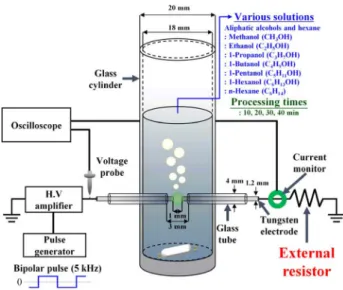
Carbon nanoparticle samples were prepared using a SPP. Fig. 1 shows a schematic diagram of the solution plasma reactor with an external resistor for synthesizing carbon nanoparticles. A function generator (AFG3102, Tektronix, Korea) and a bipo-lar pulsed high-voltage amplifier (20/20C-HS, Trek Inc., USA) were used to generate the solution plasma. In the driving circuit, a bipolar pulse with a frequency of 5 kHz was employed and the inverter amplified the low primary voltage to reach a high secondary voltage. A 1 kΩ external resistor was applied to ob-tain a stable discharge by reducing the discharge current flowing between two electrodes. A cylindrical glass tube (outer diam-eter=20 mm, inner diameter=18 mm, and height=150 mm) was used as the plasma reactor. To synthesize carbon nanoparticles using a SPP, two tungsten wires with a diameter of 1.2 mm, cov-ered with polytetrafluoroethylene (PTFE) and a glass tube, were applied as the electrodes, one on each side of the plasma reactor. The gap between the two electrodes was set to 1 mm in the solu-tion. To reduce particle aggregation, immiscible solutions were mixed by a magnetic stirring bar with a rotational speed of 1000 rpm in the reactor.
Fig. 1.
Schematic diagram of experimental setup employed in this study for solution plasma experiments and synthesis of carbon nanopar-ticles.n-hexane cases establish a similar discharge tendency for the voltages, currents, and related current spikes.
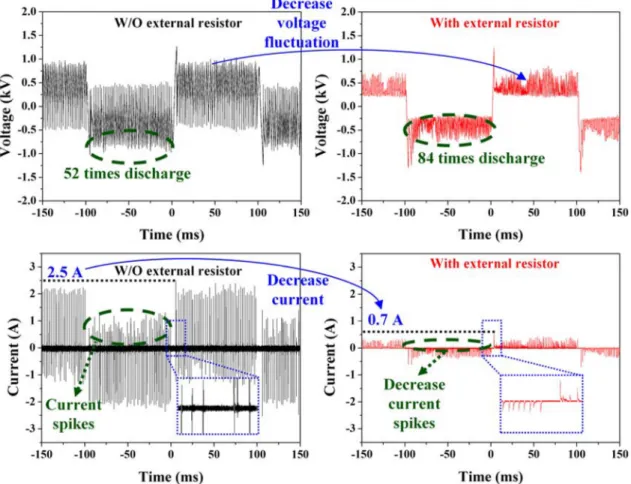
The measured voltages and currents of unstable discharge without the external resistor (black line) and stable discharge with the external resistor (red line) in an ethanol solution sam-ple are shown in Fig. 3. In the conventional experimental setup condition without an external resistor in the ethanol solution charge characteristics during the positive-half-cycle discharge
without the external resistor for various aliphatic alcohols and n-hexane cases using conventional SPP are shown in Fig. 2. From these results, large voltage fluctuation and current spikes were observed continuously after the initial discharge, imply-ing that the discharges were produced continually after the first discharge [31]. The discharge characteristics for all alcohols and
Fig. 2.
Measured voltage (a) and current waveforms (b) during positive-half-cycle discharge without external resistor from various aliphatic alcohols and n-hexane using solution plasma process.bon ratios in alcohol contents were increased from methanol to hexanol, the amount of dispersed carbon nanoparticles in the solutions increased for more than 24 h at room tempera-ture. The better dispersibility of carbon nanoparticles was due to the presence of oxygen functionality in the alcohol ma-terials [32-35]. The dispersion characteristics of the carbon nanoparticles were attributed to the presence of very small amounts of oxygen sources in the alcohols. In contrast, the carbon nanoparticles of n-hexane containing many carbons without an oxygen source precipitated quickly after 10 min due to the primary nanoparticle agglomeration.
Fig. 6 shows planar view FE-SEM images of the carbon-con-taining thin films deposited via the hot-plate method, after which 40 min plasma synthesis of carbon nanoparticles from the vari-ous aliphatic alcohols and n-hexane was carried out by advanced SPP with an external resistor. Samples of carbon nanoparticles from the synthesized suspensions were prepared by drying a sample, a stable discharge was not produced due to high current
spikes, as shown in Fig. 3. In other words, the voltage fluctua-tions significantly increased in the case without the external re-sistor, which means that an unstable discharge may be produced. When the external resistor was adopted, however, the voltage fluctuations and current spikes decreased dramatically, thereby producing a more stable discharge. As a result, when adopting the external resistor in the advanced SPP reactor, the voltage fluctuations and currents decreased, and the resulting stable dis-charge contributed to reducing unnecessary current spikes dur-ing plasma synthesis of carbon nanoparticles from the ethanol solution containing carbon sources in advanced SPP devices shown in Fig. 1. As we can see in Figs. 2 and 3, it is noteworthy that the discharge state of the solution plasma depends strongly on the electrical conditions for producing a stable plasma rather than the kinds of alcohol solutions.
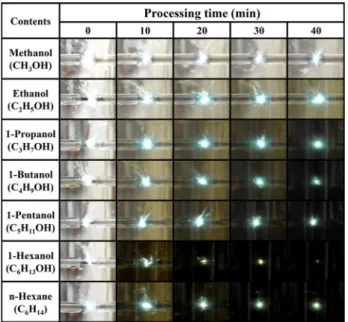
The plasma images and solution color variations of the vari-ous aliphatic alcohols and n-hexane during the processing time in the advanced SPP with the external resistor are shown in Fig. 4. The colors of the solutions for all cases changed from transparent to dark color during the processing time, indicating that some par-ticles were synthesized from the solutions. As we can see in Fig. 4, the color changes of the methanol and ethanol changed slowly. In contrast, the color of the other solutions changed rapidly with an increase in the carbon ratios in alcohol contents.
The precipitation and dispersion of carbon nanoparticle suspensions synthesized from various aliphatic alcohols and n-hexane under different processing times of the advanced SPP with an external resistor are shown in Fig. 5, where (a) is before (initial) and (b) is after 24 h at room temperature. 10, 20, 30, and 40 min SPP, the vials containing carbon nanopar-ticles were left at room temperature for 24 h to investigate their precipitation and dispersion characteristics. As shown in Fig. 5, a small amount of precipitated and dispersed particles was observed in the methanol case. However, when the
car-Fig. 4.
Plasma images and changes in solution colors of various aliphat-ic alcohols and n-hexane during process time in SPP with external resistor.Fig. 5.
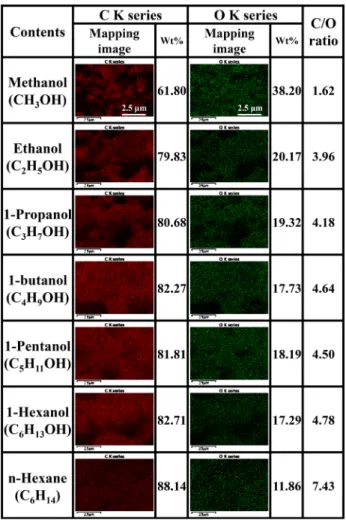
Changes in precipitation and dispersion of carbon nanoparticle suspensions synthesized from various aliphatic alcohols and n-hexane relative to various process times using solution plasma process: (a) before (initial) and (b) after 24 hours at room temperature.ous solutions via advanced SPP, the EDS chemical element compositions(wt%), elemental mapping images, and C/O ra-tio based on EDS composira-tions are presented in Fig. 7, and these results verify that the carbon nanoparticle composites cover the elements C and O and the homogeneous distribu-tion of these elements originates from the various aliphatic alcohols and n-hexane plated on the surface of the sample for SEM observation [36]. In addition, the element O could influence the element composition distributions of the carbon nanoparticles for all cases because of the absorption of H2O
and O2 in the ambient air during the SPP. The elements C and
O were observed to increase and decrease, respectively, with an increase in the C/O ratio of the solutions. In particular, small amounts of element O were observed in the n-hexane case due to the absorption of H2O and O2 in the ambient air.
To confirm the structural ordering of carbon and graphitic materials, we employed the Raman scattering technique. Fig. 8 shows Raman spectra of the carbon-containing thin films after 40 min plasma synthesis of carbon nanoparticles from various aliphatic alcohols and n-hexane via advanced SPP. In the Ra-man spectra of highly ordered graphite two absorption bands, small drop on a Si substrate. The carbon nanoparticles dropped
on the Si substrates were placed on a hot-plate set at 60°C and various solution mixtures were slowly evaporated to dryness. In each alcohol case, the products contained flakes and some carbon nanoparticles, whereas in the n-hexane case, the prod-ucts contained only spherical carbon nanoparticles. We postulate from this result that when the carbon ratios in alcohol contents were increased from methanol to hexanol, the fraction of flakes decreased, indicating that the relative content of carbon flakes decreased with an increase of the carbon (C)/oxygen (O) ratio. On the contrary, the particles sizes decreased with an increase in the C/O ratio of the solutions. In the n-hexane case containing many carbons without an oxygen source, the spherical carbon nanoparticles were semi-porous and their diameters ranged from 80 to 100 nm.
To further confirm the element composition and ele-ment spatial distribution of carbon nanoparticles from
vari-Fig. 6.
FE-SEM images with low and high magnifications of deposited carbon-containing thin films using hot-plate deposition method after 40 min plasma synthesis of carbon nanoparticles from various aliphatic alco-hols and n-hexane via solution plasma process.Fig. 7.
EDS elemental mapping images, detailed chemical element composition (wt%), and C/O ratio based on EDS composition of carbon and oxygen containing-thin films using hot-plate deposition method after 40 min plasma synthesis of carbon nanoparticles from various ali-phatic alcohols and n-hexane via solution plasma process.been found that the carbon to oxygen ratio is the key factor that controls the morphology, conversion yield, product formation yield, and degree of graphitization. The degrees of graphitiza-tion of the carbon nanoparticles synthesized from 1-hexanol and n-hexane with high C/O ratios and low or no oxygen are greater than those of the carbon nanoparticles synthesized from the cor-responding materials with low C/O ratios. It is expected that this advanced solution plasma with a catalyst-free method will lead to a breakthrough in high-speed synthesis and precise control of carbon nanoparticles.
Conflict of Interest
No potential conflict of interest relevant to this article was reported.
Acknowledgements
This work was supported by a National Research Foundation of Korea (NRF) grant funded by the Korean government (MSIP) (No. 2017R1A4A1015565).
References
[1] Tian L, Ghosh D, Chen W, Pradhan S, Chang X, Chen S. Nano-sized carbon particles from natural gas soot. Chem Mater, 21, 2803 (2009). https://doi.org/10.1021/cm900709w.
[2] Iijima S. Helical microtubules of graphitic carbon. Nature, 354, 56 (1991). https://doi.org/10.1038/354056a0.
[3] Ebbesen TW, Ajayan PM. Large-scale synthesis of carbon nano-tubes. Nature, 358, 220 (1992). https://doi.org/10.1038/358220a0. [4] Peters G, Jansen M. A new fullerene synthesis. Angew Chem Int
Ed Engl, 31, 223 (1992). https://doi.org/10.1002/anie.199202231. [5] Liu J, Rinzler AG, Dai H, Hafner JH, Bradley RK, Boul PJ, Lu A,
Iverson T, Shelimov K, Huffman CB, et al. Fullerene pipes. Science, 280, 1253 (1998). https://doi.org/10.1126/science.280.5367.1253. [6] Wang J, Zhu M, Outlaw RA, Zhao X, Manos DM, Holloway BC.
Synthesis of carbon nanosheets by inductively coupled radio-fre-quency plasma enhanced chemical vapor deposition. Carbon, 42, 2867 (2004). https://doi.org/10.1016/j.carbon.2004.06.035. [7] Geim AK, Novoselov KS. The rise of graphene. Nat Mater, 6, 183
(2007). https://doi.org/10.1038/nmat1849.
so called D and G bands, are observed at less than 2000 cm–1.
Raman spectra of the carbon nanoparticles prepared in this study showed two absorption signals at about 1350 and 1600 cm–1 for
the D and G bands, respectively. The G band is related to the stretching vibrations, whereas the D band is associated with stacking disorder and defects in the carbon layer structure. The ratio of D and G band intensities (ID/IG) indicates the degree of
graphitization and crystallinity. For example, a value of ID/IG = 0
means single-crystalline graphite [27]. Table 1 presents the ID/IG
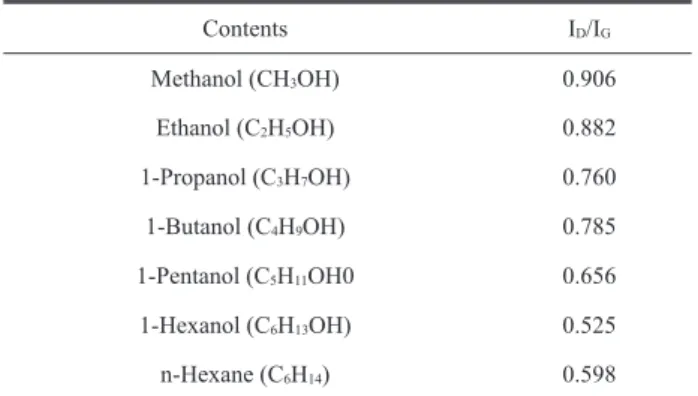
ratios for all samples calculated from the intensity of Fig. 8. As shown in Table 1 and Fig. 8, the ID/IG ratios decreased with an
in-crease in the C/O ratio of the solutions, reflecting that the degree of graphitization of the carbon nanoparticles was enhanced. The ID/IG ratios for the carbon nanoparticles prepared from
1-hexa-nol and n-hexane were 0.525 and 0.598, respectively. Thus, the crystallinity and graphitization of the carbon nanoparticles syn-thesized from linear molecules containing many carbons with few or no oxygen sources were greater than those of the car-bon nanoparticles synthesized from the corresponding materi-als with solutions have a low C/O ratio. This suggests that the products obtained at higher C/O ratios were more graphitic than those synthesized from lower alcohols.
Fig. 8.
Raman spectra of carbon-containing thin films using hot-plate deposition method after 40 min plasma synthesis of carbon nanoparticles from various aliphatic alcohols and n-hexane via solution plasma process.Table 1.
ID/IG ratio for obtained Raman spectra ofcarbon-con-taining thin films after 40-min plasma synthesis of carbon nanopar-ticles from various aliphatic alcohols and n-hexane via solution plasma process Contents ID/IG Methanol (CH3OH) 0.906 Ethanol (C2H5OH) 0.882 1-Propanol (C3H7OH) 0.760 1-Butanol (C4H9OH) 0.785 1-Pentanol (C5H11OH0 0.656 1-Hexanol (C6H13OH) 0.525 n-Hexane (C6H14) 0.598
synthesis of carbon spheres produced by dissociating individual hy-drocarbons at their autogenic pressure at low temperatures. Carbon, 44, 3285 (2006). https://doi.org/10.1016/j.carbon.2006.06.023. [22] Lieberman MA, Lichtenberg AJ, Principles of Plasma Discharges
and Materials Processing, Wiley, New York, 800 (2005). https:// doi.org/10.1002/0471724254.
[23] Langmuir I. Oscillations in ionized gases. Proc Natl Acad Sci, 14, 627 (1928). https://doi.org/10.1073/pnas.14.8.627.
[24] Gerhard-Multhaupt R, Gross B, Sessler GM. Recent Progress in Electret Research. In: Sessler GM, ed. Electrets, Springer, Berlin, 383 (2005).
[25] Chen Q, Li J, Li Y. A review of plasma–liquid interactions for nanomaterial synthesis. J Phys D Appl Phys, 48, 424005 (2015). https://doi.org/10.1088/0022-3727/48/42/424005.
[26] Hagino T, Kondo H, Ishikawa K, Kano H, Sekine M, Hori M. Ultrahigh-speed synthesis of nanographene using alcohol in-liquid plasma. Appl Phys Express, 5, 035101 (2012). https://doi. org/10.1143/apex.5.035101.
[27] Morishita T, Ueno T, Panomsuwan G, Hieda J, Yoshida A, Bra-tescu MA, Saito N. Fastest formation routes of nanocarbons in solution plasma processes. Sci Rep, 6, 36880 (2016). https://doi. org/10.1038/srep36880.
[28] Xu C, Wang X, Zhu J. Graphene−metal particle nanocompos-ites. J Phys Chem C, 112, 19841 (2008). https://doi.org/10.1021/ jp807989b.
[29] Hou B, Wang X, Wang J, Yao J, Zhang H, Yu W, Liu G, Dong X, Wang L. In situ synthesis of homogeneous Ce2S3/MoS2 composites
and their electrochemical performance for lithium ion batteries. RCS Adv, 7, 6309 (2017). https://doi.org/10.1039/c6ra28352g. [30] Ferrari AC, Meyer JC, Scardaci V, Casiraghi C, Lazzeri M, Mauri
F, Piscanec S, Jiang D, Novoselov KS, Roth S, et al. Raman spec-trum of graphene and graphene layers. Phys Rev Lett, 97, 187401 (2006). https://doi.org/10.1103/physrevlett.97.187401.
[31] Joshi RP, Kolb JF, Xiao S, Schoenbach KH. Aspects of plasma in water: streamer physics and applications. Plasma Processes Polym, 6, 763 (2009). https://doi.org/10.1002/ppap.200900022.
[32] Zhu C, Guo S, Fang Y, Dong S. Reducing sugar: new functional molecules for the green synthesis of graphene nanosheets. ACS Nano, 4, 2429 (2010). https://doi.org/10.1021/nn1002387. [33] Kuila T, Khanra P, Bose S, Kim NH, Ku BC, Moon B, Lee JH.
Preparation of water-dispersible graphene by facile surface modi-fication of graphite oxide. Nanotechnology, 22, 305710 (2011). https://doi.org/10.1088/0957-4484/22/30/305710.
[34] Moon IK, Lee J, Ruoff RS, Lee H. Reduced graphene oxide by chemical graphitization. Nat Commun, 1, 73 (2010). https://doi. org/10.1038/ncomms1067.
[35] Li D, Müller MB, Gilje S, Kaner RB, Wallace GG. Processable aqueous dispersions of graphene nanosheets. Nat Nanotechnol, 3, 101 (2008). https://doi.org/10.1038/nnano.2007.451.
[36] Xie Q, Zhao C, Hu Z, Huang Q, Chen C, Liu K. LaPO4-coated
Li1.2Mn0.56Ni0.16Co0.08O2 as a cathode material with enhanced
cou-lombic efficiency and rate capability for lithium ion batteries. RSC Adv, 5, 77324 (2015). https://doi.org/10.1039/c5ra13233a. [8] Neto AHC, Guinea F, Peres NMR, Novoselov KS, Geim AK. The
electronic properties of graphene. Rev Mod Phys, 81, 109 (2009). https://doi.org/10.1103/revmodphys.81.109.
[9] Upadhyayula VKK, Deng S, Mitchell MC, Smith GB. Applica-tion of carbon nanotube technology for removal of contaminants in drinking water: a review. Sci Total Environ, 408, 1 (2009). https:// doi.org/10.1016/j.scitotenv.2009.09.027.
[10] de las Casas C, Li W. A review of application of carbon nanotubes for lithium ion battery anode material. J Power Sources, 208, 74 (2012). https://doi.org/10.1016/j.jpowsour.2012.02.013.
[11] Bekyarova E, Hanzawa Y, Kaneko K, Silvestre-Albero J, Sepul-veda-Escribano A, Rodriguez-Reinoso F, Kasuya D, Yudasaka M, Iijima S. Cluster-mediated filling of water vapor in intratube and interstitial nanospaces of single-wall carbon nanohorns. Chem Phys Lett, 366, 463 (2002). https://doi.org/10.1016/s0009-2614(02)01476-8.
[12] Kim DH, Kim HJ, Park CS, Shin BJ, Seo JH, Tae HS. Atmospheric pressure plasma polymerization using double grounded electrodes with He/Ar mixture. AIP Adv, 5, 097137 (2015). https://doi. org/10.1063/1.4931036.
[13] Nishide D, Kataura H, Suzuki S, Okubo S, Achiba Y. Growth of single-wall carbon nanotubes from ethanol vapor on cobalt par-ticles produced by pulsed laser vaporization. Chem Phys Lett, 392, 309 (2004). https://doi.org/10.1016/j.cplett.2004.04.119.
[14] Park CS, Kim DH, Shin BJ, Kim DY, Lee HK, Tae HS. conduc-tive polymer synthesis with single-crystallinity via a novel plasma polymerization technique for gas sensor applications. Materials, 9, 812 (2016). https://doi.org/10.3390/ma9100812.
[15] Park SJ, Lee DG. Development of CNT-metal-filters by direct growth of carbon nanotubes. Curr Appl Phys, 6, e182 (2006). https://doi.org/10.1016/j.cap.2006.01.035.
[16] Park CS, Kim DY, Kim DH, Lee HK, Shin BJ, Tae HS. Humidity-independent conducting polyaniline films synthesized using ad-vanced atmospheric pressure plasma polymerization with in-situ iodine doping. Appl Phys Lett, 110, 033502 (2017).
[17] Fronczak M, Fazekas P, Károly Z, Hamankiewicz B, Bystrzejew-ski M. Continuous and catalyst free synthesis of graphene sheets in thermal plasma jet. Chem Eng J, 322, 385 (2017). https://doi. org/10.1016/j.cej.2017.04.051.
[18] Park CS, Jung EY, Kim DH, Kim DY, Lee HK, Shin BJ, Lee DH, Tae HS. Atmospheric pressure plasma polymerization synthesis and characterization of polyaniline films doped with and with-out iodine. Materials, 10, 1272 (2017). https://doi.org/10.3390/ ma10111272.
[19] Pol VG, Motiei M, Gedanken A, Calderon-Moreno J, Yoshimura M. Carbon spherules: synthesis, properties and mechanistic elu-cidation. Carbon, 42, 111 (2004). https://doi.org/10.1016/j.car-bon.2003.10.005.
[20] Park D, Kim YH, Lee JK. Synthesis of carbon nanotubes on metal-lic substrates by a sequential combination of PECVD and thermal CVD. Carbon, 41, 1025 (2003). https://doi.org/10.1016/s0008-6223(02)00432-3.