1379
ⓒ The Korean Society of Food Science and Technology
Effect of Storage Conditions of Whole Fruits on Quality of Fresh-cut
‘Niitaka’ Asian Pears
Hun-Sik Chung1, Kwang-Sup Youn2, and Kwang-Deog Moon*
Department of Food Science and Technology, Kyungpook National University, Daegu 702-701, Korea 1Food & Bio-Industry Research Institute, Kyungpook National University, Daegu 702-701, Korea
2Department of Food Science and Technology, Catholic University of Daegu, Hayang, Gyeongbuk 712-702, Korea
Abstract Quality changes of the slices processed from ‘Niitaka’ Asian pears (Pyrus pyrifolia) stored at 0oC for up to 4 months under controlled atmosphere (CA, 1% O2+1% CO2) and normal air have been investigated for 4 days at 10oC. Respiration rate of the slices was retarded by pre-slicing storage for 4 months in CA. Electrolyte leakage was lower in the slices from pears stored for short-term than long-term and under CA than air. L and a values of the slices from whole pears stored under CA were maintained higher and lower, respectively as compared to the other. Levels of acetaldehyde and ethanol in the slices were increased by CA and long-term storage of whole pears. Content of ascorbic acid and counts of total aerobic microbes in the slices were not affected by storage conditions of whole pears. These results show that storage atmospheres and durations of whole pears affected quality changes of the slices and the conditions of pre-slicing storage should be considered as an important factor for optimizing fresh-cut procedures.
Keywords:Pyrus pyrifolia, fresh-cut, controlled atmosphere, storage, quality Introduction
Pear fruit can be classified to two groups according to plant taxonomy, European pear (Pyrus communis) and Asian pear (Pyrus pyrifolia). Among the Asian pear species, ‘Niitaka’ variety is mainly grown in South Korea and consumed as fresh fruit, processed products, and cooking ingredients (1). The physicochemical changes throughout long-term storage of the fresh pears after harvest are an important concern for both food researchers and processors. The industry of minimally processed fruits and vegetables is continuously growing due to consumers demand for fresh, convenient, and healthy foods (2). Minimal processing operations have been defined as those procedures, such as washing, sorting, trimming, peeling, slicing, or chopping, that do not affect the fresh-like quality of the fruits or vegetables (3). Shelf-life of fresh-cut products is greatly shortened as compared with the intact fruits and vegetables because fresh-cut means the tissues are wounded (3). Usually, wounding of plant tissues induces elevated respiration and ethylene production, enzymatic browning, membrane lipid degradation, production of secondary metabolites, and water loss (4). Minimizing the negative consequences of wounding in minimally processed products will result in increased shelf-life (5). For this purpose, combined technologies of chemical and physical treatments, packaging, and control of temperature and atmosphere have been commercially used (6,7). However, the effects of these technologies on maintaining quality of minimally processed products depend upon species, variety, region and conditions of cultivation, and physiological
maturity stage of raw materials (8-10). Among these affect factors, only physiological maturity may be changed by storage conditions such as duration, atmosphere, and temperature after harvest of whole fruits and vegetables.
In previous study on minimal processing of pear fruits, it was found that the overall quality of ‘Niitaka’ pear slices was maintained by a vacuum packaging and surface browning of sliced pears was retarded by a combination of 0.2% L-cysteine and 1% NaCl, and flesh softening was
prevented by 1% CaCl2 (11). A shelf-life of 15 to 30 days
for fresh-cut ‘Anjou’, ‘Bartlett’, and ‘Bosc’ pears was obtained with a combination of 0.5% ascorbic acid, 1.0% calcium lactate, and 0.01% 4-hexylresorcinol and partial vacuum packaging (12). In case of fresh-cut ‘Bartlett’ pear slices, low O2 (0.25 or 0.5 kPa), elevated CO2 (air+5, 10,
or 20 kPa CO2), or superatmospheric O2 (40, 60, or 80 kPa)
atmospheres alone did not effectively prevented cut surface browning or firmness loss in the slices (13). In addition, it is reported that mild heat pretreatments (35-45oC for
40-150 min) were effective in retarding the browning and softening of ‘Rocha’ pear quarters (14). As reported above, much research has focused on the use of post-slice treatments. However, little has been known about the effect of pre-slicing storage conditions on minimal processing response of Asian pear fruits, which can be use as fundamental information for minimal processing.
The objective of this study was to determine the effects of pre-slicing storage duration and atmosphere on the changes of respiration rate, electrolyte leakage percent, levels of color change, content of ascorbic acid, acetaldehyde, and ethanol, and growth of total aerobic microbials in sliced Asian ‘Niitaka’ pears.
Materials and Methods
Materials Asian pears (Pyrus pyrifolia Nakai cv. Niitaka)
*Corresponding author: Tel: +82-53-950-5773; Fax: +82-53-950-6772 E-mail: [email protected]
Received April 28, 2009; Revised August 6, 2009; Accepted August 7, 2009
1380 H. -S. Chung et al. were harvested at commercial maturity from a commercial
orchard in the Sangju region of South Korea. Fruits of sound and uniform size (600±50 g) were stored under controlled atmosphere (CA, 1% O2+1% CO2) and normal
air for up to 4 months at 0oC. CA condition used in the
storage of whole pears was obtained from previous study (1) for the investigation of storage atmosphere for pears’ quality during preservation. L-Ascorbic acid and
2,4-dinitrophenylhydrazine were purchased from Sigma-Aldrich (St. Louis, MO, USA). Acetaldehyde and ethanol were obtained from Junsei Chemical Co. (Tokyo, Japan). Plate count agar (PCA) was purchased from Difco (Detroit, MI, USA). Other chemicals used for analyses were high purity grade.
Preparation of pear slices The pears stored at different conditions were peeled using a sharp stainless steel knife. Individually peeled pears were cored and sliced into 8 wedges using a hand corer and slicer. Nine 500 g lots of the slices from each treatment were immediately placed in plastic trays, covered with unsealed individual polyethylene film bags, and kept for up to 4 days at 10oC. Three
replicates from each treatment for analyses were taken at 2 days intervals.
Measurement of respiration rate Pear slices were put into a 1.4 L-glass jar and sealed with a cap. After standing for 1 hr at 10oC, headspace gas (0.5 mL) was withdrawn
using a gas-tight syringe. CO2 concentration was determined
using a gas chromatograph (5890A; Hewlett Packard, Palo Alto, CA, USA) equipped with a thermal conductivity detector and a 1.7 m glass column (4.0 mm i.d.) packed with 80/100 mesh Porapak Q (Alletech Associates Inc., Deerfield, IL, USA). Flow of He gas was 40 mL/min, and oven, injector, and detector temperatures were 70, 100, and 140oC, respectively. Respiration rate was calculated in mg
CO2/kg/hr.
Measurement of electrolyte leakage Pear tissue disc (2 mm thick, 15 mm diameter) was prepared from the fruit slice using a cork borer. Five discs were rinsed with deionized water and placed in 50 mL of 0.5 M mannitol solution, and incubated for 3 hr at 20oC in a shaking water
bath (KMC8480SF; Vision Scientific Co., Bucheon, Gyeonggi, Korea). Conductivity of the surrounding solution was determined with a conductivity/TDS meter (CDS 5000; Lamotte Co., Chestertown, MD, USA). The tissue was then boiled for 30 min and the total conductivity was measured. Electrolyte leakage was expressed as a percentage of total electrolytes from the tissue.
Measurement of vitamin C content Vitamin C content of pears slices was determined according to 2,4-dinitrophenylhydrazine colorimetric methods (15). Ten g of pear slices were homogenized in 50 mL of 5% metaphosphoric acid using a homogenizer (T25 Basic; IKA, Staufen, Germany), the homogenate was filtered through filter paper (Toyo No. 2), and then the filtrate was used as a sample for the analysis of vitamin C content.
Measurement of surface color Color (L, a, and b value) of pear slices was measured with a chromameter (CR-200;
Minolta Co., Osaka, Japan), which had been calibrated with a standard white plate (L=97.79, a=−0.38, and b=2.05).
Measurements of acetaldehyde and ethanol contents
Acetaldehyde and ethanol contents were analyzed using a modification of the procedure described by Echeverria et al. (16). Pear slices were homogenized using a homogenizer (T25 Basic; IKA), the homogenate was filtered through filter paper (Toyo No. 2), and then 5 mL of the filtrate was placed in a 10-mL test tube, which was closed with a silicone cap and incubated at 60oC for 1 hr. A 1 mL
headspace gas sample was taken with a gas-tight syringe and injected onto gas chromatograph (5890A; Hewlett Packard), equipped with a 10% Carbowax 20M column (60/80, 2 m×2 mm i.d.) and flame ionization detector. Flow of N2 gas was 30 mL/min, and the temperature of
oven, injector, and detector were 110, 180, and 220oC,
respectively. Results of acetaldehyde and ethanol were expressed as µg/L and mg/L, respectively.
Measurement of total aerobic colony count Twenty-five g of pear slices were homogenized with 225 mL of 0.1% peptone for 1 min. Aliquots (1 mL) of diluted sample were plated onto PCA and incubated at 37oC for 24 hr. The
number of colony was counted, expressed as colony forming unit (log CFU/mL).
Statistical analysis Values are presented as mean± standard deviation (SD). Mean separation was determined using the t-test (p<0.05) of the SAS statistical package (Statistical Analysis System, SAS Institute, Cary, NC, USA).
Results and Discussion
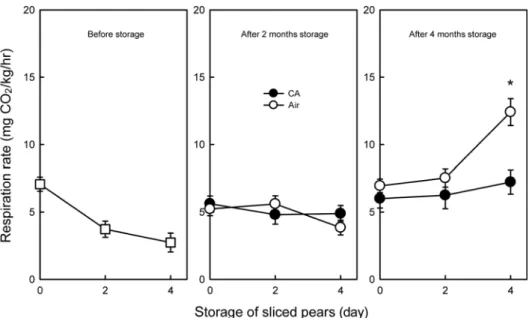
Effects of pre-slicing storage conditionson respiration rate Respiration is a fundamental process in all living tissues (17). Higher respiration rate means a faster overall metabolism and deterioration. It is known that wounding fruit tissue induces elevated respiration (4). Changes in respiration rate of ‘Niitaka’ Asian pear slices during storage at 10oC in relation to pre-slicing storage conditions
are shown in Fig. 1. Respiration rate of the slices processed from 0 or 2 months stored pears decreased during post-slice storage, and there was no difference in respiration rate between CA and air conditions after 2 months of pre-slicing storage. However, respiration rate of the pear slices processed from pears stored for 4 months increased during post-slice storage at 10oC, and that of the slices after 4 days
of storage was significantly higher in air than CA (p<0.05). This is probably due to an increase in metabolic activity related to CO2 production. Above results suggest that
respiration rate of the pear slices was dependent upon duration and atmosphere of pre-slicing storage, especially CA storage for long-term had inhibitory effect on the respiration of the pear slices. It is reported that the respiration rate of whole ‘Niitaka’ pears during storage was not changed regardless of maturity and storage temperature (18). But in this study, respiration rate of sliced pears was affected by the storage duration and atmosphere.
Effects of pre-slicing storage conditions on electrolyte leakage Electrolyte leakage is considered an indirect index of cell membrane damage (19). Change in electrolyte leakage of the pear slices in relation to the conditions of pre-slicing storage is presented in Fig. 2. In general, electrolyte leakage of the pear slices was increased with the increase of storage periods of whole fruits and slices. The electrolyte leakage was higher in the pear slices produced from pears stored under air than CA. The difference in electrolyte leakage between the 2 slices was increased as the storage period of whole pears increased. These results show that the electrolyte leakage in the sliced pears was accelerated by long-term and air storage of whole pears due to the increased loss of membrane integrity (19). It is reported that electrolyte leakage of stored whole ‘Niitaka’ pears is retarded by low O2 CA conditions (20). In case of
apple slices, Lu and Toivonen (21) reported that the low electrolyte leakage rate is associated with the low degree of cut surface browning of slices. On fresh-cut potatoes, previous study (22) had shown that membrane stability was a major potential factor controlling the rate of browning. In addition, it is suggested that pre-slicing treatment of ‘Rocha’ pears at temperatures higher than 45oC enhanced
cut surface discoloration due to increased tissue damage (14). Therefore, result of this study about electrolyte leakage of ‘Niitaka’ Asian pears may be related to browning degree of slices.
Effects of pre-slicing storage conditions on vitamin C content Vitamin C is one of the most important nutritional attributes in fruits and vegetables and, has many biological activities in the human body (23). It is widely used as an
Fig. 1. Respiration rate of sliced pears as affected by duration and atmosphere of pre-slicing storage. Values are mean±SD (n=3);
*p<0.05.
Fig. 2. Electrolyte leakage percentage of sliced pears as affected by duration and atmosphere of pre-slicing storage. Values are mean±SD (n=3); *p<0.05.
1382 H. -S. Chung et al.
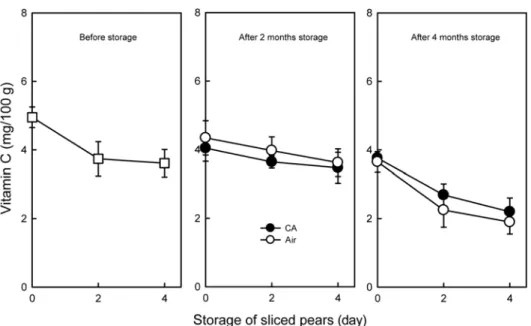
antioxidant for preventing enzymatic browning in fresh-cut processing (24). Change in vitamin C content of ‘Niitaka’ pear slices during storage at 10oC as affected by the
conditions of pre-slicing storage is shown in Fig. 3. Vitamin C content of the slices processed from whole pear stored for periods of all pre-slicing storage was decreased as duration of post-slicing storage increased. There was no difference in vitamin C level between CA and air. On the other hand, the level of ascorbic acid in both ‘Rocha’ and ‘Conference’ pears was lost more quickly in CA of lowered O2 and elevated CO2 concentrations than in
normal air (25). From above results, it seems that the loss of vitamin C in sliced pears did not depend on the pre-slicing storage conditions of ‘Niitaka’ pears. However, when exogenous ascorbic acid is treated as a reducing agent to prevent enzymatic browning (12,13), the endogenous content of fruits should be considered.
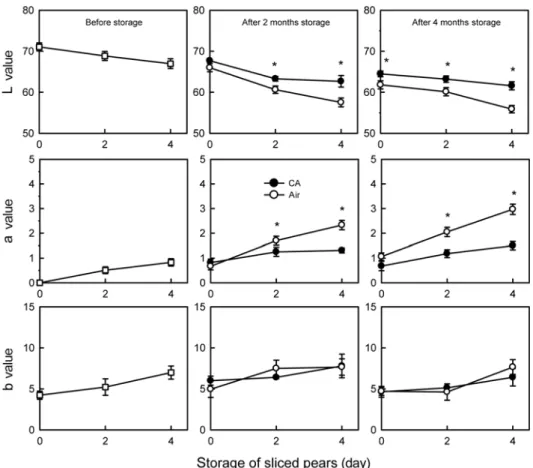
Effects of pre-slicing storage conditions on surface color Surface browning is the major quality deterioration of minimally processed produces. It is well known that the measurement of L and a values can be used as a suitable method for the evaluation of browning degree in fruits and vegetables (26). Lower L and higher a value indicates that the produces are more brownish. Changes in surface color, L, a, and b values of the pear slices processed from different condition of pre-slicing storage during storage at 10oC are presented in Fig. 4. A decrease in L value of the
pear slices was observed when the storage periods of whole and sliced pears increased. The decreasing rate of L value was significantly higher in the sliced pears processed from intact fruits stored under air than CA (p<0.05). This result shows that atmosphere of pre-slicing storage had a significant effect on maintaining lightness of the sliced pears. The a value of the sliced pears increased with increase in pre-slicing storage periods and the increase rate was significantly higher in the slice processed from whole pears stored under air than CA (p<0.05). From above results, the browning susceptibility of ‘Niitaka’ pear slices
was found to be correlated with the atmosphere and duration of pre-slicing storage of intact pears. Otherwise, Larrigaudiere et al. (27) reported that browning potential of ‘Conference’ pears decline steadily during storage. This may be due to a difference of fruits variety. Browning development in ‘Niitaka’ pear slices may be related to a difference in the electrolyte leakage rate (Fig. 2) induced by durations and atmospheres of pre-slicing storage and a difference in vitamin C content (Fig. 3) induced by only durations of pre-slicing storage. The b value of the sliced pears tended to increase during storage at 10oC, but
conditions of pre-slicing storage had no effect on the increase rate of bvalue. Park et al. (28) reported that flesh L and a values of ‘Shinsui’ and ‘Niitaka’ pears during CA and air storage decreased and increased, respectively, but flesh b value did not changes. On the other hand, L and b values of pear slices during MA storage decreased and increased, respectively, but flesh a value did not changes (11). It is known that decrease in L value of pear slices is retarded by anti-browning agents (12,13), heat treatment (14), and packaging treatment (11).
Effects of pre-slicing storage conditions on contents of acetaldehyde and ethanol Acetaldehyde and ethanol are present in almost every fruits and are accumulated during ripening even under aerobic conditions as well as anaerobic conditions such as coating and CA storage (29). Excessive accumulation of acetaldehyde and ethanol can lead to the development of off-flavors (30). Effects of the duration and atmosphere of pre-slicing storage on acetaldehyde and ethanol contents of ‘Niitaka’ pear slices are shown in Fig. 5. There was no significant differences in acetaldehyde content between the slices from pears stored under CA and air conditions for 0 and 2 months, and acetaldehyde content of 2 slices did not change during storage at 10oC (p>0.05). However, after 4 months of
pre-slicing storage, acetaldehyde content was significantly higher in the slices from CA stored pears compared to the slices from air stored pears (p<0.05). Ethanol content was
Fig. 3. Ascorbic acid content of sliced pears as affected by duration and atmosphere of pre-slicing storage. Values are mean±SD (n=3).
Fig. 4. Color values of sliced pears as affected by duration and atmosphere of pre-slicing storage. Values are mean±SD (n=3);
*p<0.05.
Fig. 5. Acetaldehyde and ethanol contents of sliced pears as affected by duration and atmosphere of pre-slicing storage. Values are mean±SD (n=3); *p<0.05.
1384 H. -S. Chung et al.
significantly higher in the slices processed from CA stored pears than from air stored pears after 2 and 4 months of pre-slicing storage (p<0.05). During storage of the slices, the content of ethanol did not change until 2 months of pre-slicing storage and then increased. These results suggest that pre-slicing storage under CA of low O2 caused higher
ethanol level in whole pears when compared to air storage, and this effect persisted during storage of the slices.
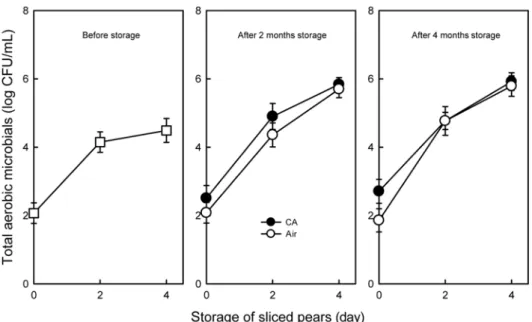
Effects of pre-slicing storage conditions on total aerobic microbials Total numbers of microorganism may be used as an indicator of the relative cleanliness of minimal processing steps. Microorganisms impact the economic value of fresh-cut produces by shortening product shelf-life, through spoilage, and by posing a risk to public health via foodborne disease (31). The growth of total aerobic microbials in the pear slices stored at 10oC as affected by
pre-slicing storage conditions is presented in Fig. 6. Initial counts of total aerobic microbials in the sliced pears were approximately 2 log CFU/mL. In case of apple slices, microbiological stability does not depend on the ripeness stage of whole fruits (32). During storage of the pear slices, the counts of total aerobic microbials sharply increased during 2 days of storage, and then slowly increased. However, there was no significant difference in the counts of total aerobic microbials between CA and air conditions (p>0.05). In general, the growth of microbials in minimally processed fruits and vegetables during storage is controlled by low temperature, low O2 or high CO2 (31). Whereas, in
this study, the storage atmosphere of whole pears before slicing did not affect the growth of total aerobic microbials in the pear slices.
In conclusion, the atmosphere and duration of pre-slicing storage affected the respiration rate, electrolyte leakage, browning, content of acetaldehyde, and ethanol of the sliced pears. However, content of ascorbic acid and growth of total aerobic microbials in the sliced pears were not affected by pre-slicing storage conditions. Short-term and CA storage were found to be a suitable pre-slicing storage
methods for ‘Niitaka’ Asian pears. Therefore, this study provides that the duration and atmosphere of pre-slicing storage should be considered as an important factor for optimizing fresh-cut procedures.
References
1. Chung HS, Kim SH, Chang EH, Youn KS, Seong JH, Choi JU. Changes in physicochemical and organoleptic qualities of ‘Niitaka’ pears during controlled atmosphere storage. Korean J. Food Sci. Technol. 35: 865-870 (2003)
2. Allende A, Tomas-Barberan FA, Gil MI. Minimal processing for healthy traditional foods. Trends Food Sci. Tech. 17: 513-519 (2006)
3. Cantwell M. Minimally processed fruits and vegetables. pp. 277-281. In: Postharvest Technology of Horticultural Crops. Kader A (ed). Publ. 3311, Univ. California, CA, USA (1992)
4. Watada AE, Abe K, Yamauchi N. Physiological activities of partially processed fruits and vegetables. Food Technol. -Chicago 44: 116-122 (1990)
5. Brecht JK. Physiology of lightly processed fruits and vegetables. Hortscience 30: 18-22 (1995)
6. Soliva-Fortuny RC, Martin-Belloso O. New advances in extending the shelf-life of fresh-cut fruits. Trends Food Sci. Tech. 14: 341-353 (2003)
7. Rico D, Martin-Diana AB, Barat JM, Barry-Ryan C. Extending the quality of fresh-cut fruit and vegetables. Trends Food Sci. Tech. 18: 373-386 (2007)
8. Roming WR. Selection of cultivars for lightly processed fruits and vegetables. Hortscience 30: 38-40 (1995)
9. Kim DM, Smith NL, Lee CY. Quality of minimally processed apple slices from selected cultivars. J. Food Sci. 58: 1115-1117 (1993) 10. Lana MM, Tijskens LMM, van Kooten O. Effects of storage
temperature and fruit ripening on firmness of fresh cut tomatoes. Postharvest Biol. Tec. 35: 87-95 (2005)
11. Kim GH, Cho SD, Kim DM. Quality evaluation of minimally processed Asian pears. Korean J. Food Sci. Technol. 31: 1523-1528 (1999)
12. Dong X, Wrolstad RE, Sugar D. Extending shelf life of fresh-cut pears. J. Food Sci. 65: 181-186 (2000)
13. Gorny JR, Hess-Pierce B, Cifuentes RA, Kader AA. Quality changes in fresh-cut pear slices as affected by controlled atmospheres and chemical preservatives. Postharvest Biol. Tec. 24: 271-278 (2002)
Fig. 6. Colony count of total aerobic microbials of sliced pears as affected by duration and atmosphere of pre-slicing storage. Values are mean±SD (n=3).
14. Abreu M, Beirao-da-Costa S, Goncalves EM, Beirao-da-Costa ML, Moldao-Martins M. Use of mild heat pre-treatments for quality retention of fresh-cut ‘Rocha’ pear. Postharvest Biol. Tec. 30: 153-160 (2003)
15. Roe HJ, Osterling MJ. The determination of dehydroascorbic acid and ascorbic acid in plant tissues by the 2,4-dinitrophenylhydrazine method. J. Biol. Chem. 152: 511-517 (1944)
16. Echeverria G, Graell J, Lopez ML, Lara I. Volatile production, quality, and aroma-related enzyme activities during maturation of ‘Fuji’ apples. Postharvest Biol. Tec. 31: 217-227 (2004)
17. Brady CJ. Fruit ripening. Ann. Rev. Plant Physio. 38: 155-178 (1987)
18. Jeong ST, Kim JG, Hong SS, Jang HS, Kim YB. Influence of maturity and storage temperature on the respiration rate and ethylene production in ‘Kosui’, ‘Chojuro’, and ‘Niitaka’ pears. J. Korean Soc. Hort. Sci. 39: 446-448 (1998)
19. Jiang Y, Shina T, Nakamura N, Nakahara A. Electrical conductivity evaluation of postharvest strawberry damage. J. Food Sci. 66: 1392-1395 (2001)
20. Yang YJ. Effect of controlled atmospheres on storage life in ‘Niitaka’ pear fruits. J. Korean Soc. Hort. Sci. 38: 734-738 (1997) 21. Lu C, Toivonen PMA. Effect of 1 and 100 kPa O2 atmospheric
pretreatments of whole ‘Spartan’ apples on subsequent quality and shelf life of slices stored in modified atmosphere packages. Postharvest Biol. Tec. 18: 99-107 (2000)
22. Cantos E, Tudela JA, Gil MI, Espin JC. Phenolic compounds and related enzymes are not rate-limiting in browning development of fresh-cut potatoes. J. Agr. Food Chem. 50: 3015-3023 (2002) 23. Lee SK, Kader AA. Preharvest and postharvest factors influencing
vitamin C content of horticultural crops. Postharvest Biol. Tec. 20:
207-220 (2000)
24. Hwang TY, Son SM, Moon KD. Screening of effective browning inhibitors on fresh-cut potatoes. Food Sci. Biotechnol. 11: 397-400 (2002)
25. Veltman RH, Kho RM, van Schaik ACR, Sanders MG, Oosterhaven J. Ascorbic acid and tissue browning in pears (Pyrus communis L. cvs Rocha and Conference) under controlled atmosphere conditions. Postharvest Biol. Tec. 19: 129-137 (2000)
26. Castaner M, Gil MI, Ruiz MV, Artes F. Browning susceptibility of minimally processed baby and Romaine lettuces. Eur. Food Res. Technol. 209: 52-56 (1999)
27. Larrigaudiere C, Lentheric I, Vendrell M. Relationship between enzymatic browning and internal disorders in controlled-atmosphere stored pears. J. Sci. Food Agr. 78: 232-236 (1998)
28. Park YS, Clara P, Tayfun A. Effects of storage temperatures and CA conditions on physiological disorders and volatile production of Asian pears during storage. J. Korean Soc. Hort. Sci. 40: 563-566 (1999)
29. Pesis E. The role of the anaerobic metabolites, acetaldehyde and ethanol, in fruit ripening, enhancement of fruit quality, and fruit deterioration. Postharvest Biol. Tec. 37: 1-19 (2005)
30. Gunes G, Watkins CB, Hotchkiss JH. Physiological responses of fresh-cut apple slices under high CO2 and low O2 partial pressures.
Postharvest Biol. Tec. 22: 197-204 (2001)
31. Nguyen C, Carlin F. The microbiology of minimally processed fresh fruits and vegetables. Crit. Rev. Food Sci. 34: 371-401 (1994) 32. Raybaudi-Massilia R, Mosqueda-Melgar J, Sobrino-Lopez A,
Soliva-Fortuny R, Martin-Belloso O. Shelf-life extension of fresh-cut ‘Fuji’ apples at different ripeness stages using natural substances. Postharvest Biol. Tec. 45: 265-275 (2007)