P1-31 / K.-S. Kim
IMID 2009 DIGEST •
Abstract
Here we report a photo polymerization-induced hybrid alignment of a nematic liquid crystal cell which can be applied for a roll to roll fabrication process. Predominant polymerization in the vicinity of UV incident front induced a diffusion of monomers toward front slide and anisotropic polymer network was formed parallel to the polarization direction of the UV light. This induced planar alignment of liquid crystals at the front slide. Simultaneously, homeotropic alignment was induced at the bottom slide as the polymers are phase-separated from a bottom slide.
1. Introduction
Flexible display is regarded as a next generation display and has been developed in recent days. Typical applications of early flexible display such as electronic paper, electronic shelf label, price tag are for mobile devices and need to be operated low voltage [1]. In particular, hybrid aligned nematic (HAN) cell where the liquid crystal (LC) molecules are homeotropically aligned at the bottom slide and planar aligned at the upper slide has been regarded as a good candidate, because the coupling of flexoelectric effect and dielectric effect in HAN cell easily switch LC molecules with relatively small voltage [2]. In the mean time, the flexible display also needs to be fabricated by a roll to roll process to reduce a production cost [1]. Conventional batch type fabrication process is not adequate for plastic LCD panels with high yield.
In this report, we suggested a method to fabricate a HAN cell which can be applied for a roll to roll fabrication process. We photo polymerized a cell mixed with nematic LC and reactive mesogens [3]. Predominant polymerization in the vicinity of UV incident front induced a diffusion of reactive monomers toward front slide and anisotropic polymer
network on the front azimuthal plane was formed parallel to the UV polarization direction. Simultaneously, homeotropic alignment was induced at the bottom slide as the polymers are phse-separated from a bottom slide. This method doesn’t need a surface treatment such as rubbing process and can be adapted for roll to roll fabrication process. Dependence of the ordering of liquid crystal molecules on the several cell parameters and UV curing conditions was investigated. The photo polymerized sample also has a good mechanical stability from bending or pressing by the help of the polymer networks in the cell.
2. Experimental
A nematic LC BL087 (Merck Ltd.) was mixed with a UV reactive mesogen UCL-001 (DIC Corp.) The mixture was dropped and laminated between two substrates and uniformly spread on the surface. Then, linearly polarized UV light was exposed to the cell. Because the photo polymerization is predominant on the front slide, the monomers diffuses toward the front slide and relatively very small amount of monomers remained on the bottom surface. Consequently, the orientation of LC on the bottom surface is not disturbed by polymers and hold homeotropic alignment. In the mean time, the linearly polarized UV light imprints dense polymer network parallel to the UV polarization direction on the front plane, and LCs were aligned parallel to the polymer network. We investigated the dependence of LC ordering on the parameters such as cell gap, UV curing conditions.
3. Results and discussion
Figure 1(a) shows the transmittance of the sample as a
Photo polymerization-induced Hybrid Alignment of Nematic
Liquid Crystal for Roll to Roll Fabrication
Kyoung-Sun Kim
1, Soon-Bum Kwon
1, and Ji-Hoon Lee
2*
1Dept. of Display Engineering, Hoseo University, Chungnam 336-795, Korea
Tel.:82-41-540-5922, E-mail: [email protected] 2
Next Display Laboratory, NDIS Corporation, Chungnam 336-795, Korea
Tel: 82-41-549-9440, E-mail: [email protected]
P1-31 / K.-S. Kim
• IMID 2009 DIGEST
function of the angle between polarization direction of probe beam and polarization direction of exposed UV light. The cell with 30wt% and 20wt% polymer showed intensity whereas the pure LC (0wt%) did not. This means the UV polymerized cells have an optical birefringence on the surface plane. The optical anisotropy of the polymer doped cells reduced to the obliquely incident probe beam [Figure 1(b)]. From these data, the hybrid alignment of LC molecules is confirmed. Both the 30wt% and 20wt% polymer cell showed the minimum intensity when the polarization of probe beam is parallel to the polarization of UV [0 degree in Figure 1(a)]. Therefore, the LC molecules are confirmed to align parallel to the UV polarization due to the anchoring of polymer network. The 30wt% polymer cell shows larger optical anisotropy than 20wt% cell. Denser polymer networks enhance more planar alignment of liquid crystal molecules.
0 60 120 180 240 300 360 0.00 0.25 0.50 0.75 1.00 1.25 0wt% 15wt% T r. (ar b . units )
Angel between polarizaton of probe beam and UV light (deg.) 30wt% (a) -30 -20 -10 0 10 20 30 0 2 4 6 8 10 0wt% Polymer (Pure LC) 15wt% Polymer Tr . (ar b . u n it s)
Incident angle (deg.) (b)
Fig. 1. Transmittance of the HAN cell vs. relative angle between polarization direction of UV and probe beam (532 nm) (a), transmittance of the HAN and pure LC vs. incident angle (b).
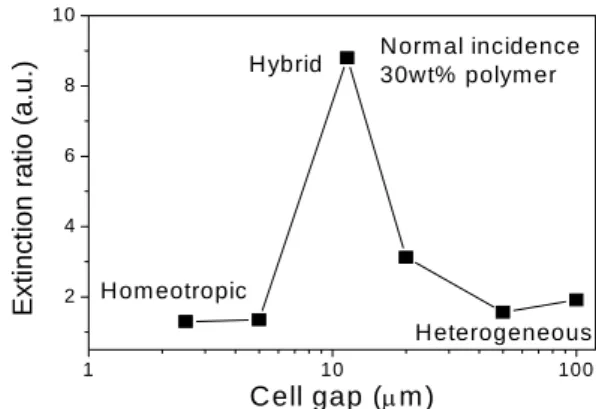
Figure 1(b) shows the extinction ratio of the 30wt% polymer cell vs. cell gap. The maximum was obtained at ~ 11 ㎛. If the cell gap is smaller than 11 ㎛, the cell was homeotropic whereas heterogeneous if the gap is
larger than it. There is an optimum gap where the surface anchoring is effective and elastic distortion could be made up.
1 10 100 2 4 6 8 10 Heterogeneous Hybrid Extinction ratio (a.u. ) Cell gap (μm ) Norm al incidence 30wt% polym er Hom eotropic
Fig. 2. Extinction ratio of the 30wt% polymer cell vs. cell gap.
4. Summary
We report a method to fabricate a HAN cell which can be used as flexible display devices. This method can enable a roll to roll production of HAN cell without a rubbing process. We investigated the dependence of the optical anisotropy on the polymer concentration, cell gap, and UV curing conditions. This result also can be used as a method to make an optical O-plate film. The conventional fabrication process of O-plate needs surface rubbing or stretching and this makes difficult roll process for reliable mass production. The method suggested in this paper can replace those processes simply by UV curing.
Acknowledgement
This research was supported by a grant (F0004052-2008-31) from Information Display R&D Center, one of the 21st Century Frontier R&D Program funded by the Ministry of Knowledge Economy of Korean government.
5. References
1. G. P. Crawford, “Flexible Flat Panel Displays”, John Wiley & Sons, Ltd, pp356-445, 2004.
2. A. J. Davidson and N. J. Mottram, Phys. Rev. E, 65, pp051710 (2002).
3. M. Schadt, K. Schmitt, V. Kozinkov, and V. Chigrinov, Jpn. J. Appl. Phys. 31, pp2155-2164 (1992).