INTRODUCTION
With maize and wheat, Rice (Oryza sativa L.) has been cultivated for 11,500 years as a major crop in world wide, and it presently feeds about half of the world population (Wu et al. 2004; Joseph et al. 2010).
So, rice recently has been the significant resource of gen-etic research for development of high yield, functional and nutrient food. Until 2000, 5132 varieties of rice had been collected and more than about 300 useful cultivars were created to national plot testing every year (Yongwen 2006). Although much variety was released, there is a lot of restric-tion in tillage by some environmental condirestric-tion such as salt
stress. Unlike some halophytes having the capacity to accom-modate extreme salinity, rice is salt sensitive crop (Flowers et al. 1986; Yokoi et al. 2002; Sahi 2006).
Soil salinity is a principal constraint factor to food produc-tion because it reduces crop yield and limits use of land to cultivate many crops (Yokoi et al. 2002). Recently, 20% of the irrigated land in the world remains affected by salinity (Yeo 1999; Yamaguchi and Blumwald 2005), and the fields affected by salinity in the world are estimated as 800 million ha, out of them 437 being suffered from sodicity (FAO 2005). In order to solve this problem, many studies have been tried to identify phenotypic and physiological responses to salinity under controlled conditions using soil, potting soil, or hydro-ponics (Sarah et al. 2010). Even though research resources that solve this solution related to salt stress were reported untiringly, it has not been solved clearly and more study was needed.
─ ─ 259 ──
Different Physiological Response to Salt in Salt Tolerant Rice
Mutants Induced by Gamma-Mutagenesis
Duk-Soo Jang1,2, Mira Song1, Sun-hee Kim1, Jin-Baek Kim1, Sang Hoon Kim1,
Bo-Keun Ha1, Si-Yong Kang1, Wook Kim2and Dong Sub Kim1,*
1Advanced Radiation Technology Institute (ARTI), Korea Atomic Energy Research Institute (KAERI), Jeongeup 580-180, Korea
2Division of Biotechnology and Genetic Engineering, Korea University, Seoul 136-701, Korea
Abstract -- When plants undergo stress, Reactive oxygen species (ROS) which remove bad elements
such as mildew and virus is activated in plant body. However, if ROS is excessively increased, plant will be harmed itself by destruction of cell and signal system and phenomenon of lipid per-oxidation. In order to identify content of lipid peroxidation and activity of some enzymes scav-enging ROS, phenotypical and physiological analysis was performed with two mutant lines, Till-II-877 and Till-II-894, comparing with cv. Dongan (WT). In phenotype analysis, two mutant lines give to well-conditioned growth better than WT in since 5 days after salt treatment. In enzyme activities, there was a modest difference in the content of catalase (CAT) and peroxidase (POD) between Till-II-877 and Till-II-894, two mutant lines showed high levels in CAT contents than WT. However, they express low levels in POD contents. In MDA analysis, the content of Till-II-877 was higher than that of WT, but Till-II-894 was lower. This result indicates that two mutants have different mechanism against salt stress.
Key words : Salt tolerance, Mutant, Rice, Physiological analysis, Gamma-ray
* Corresponding author: Dong Sub Kim, Tel. +82-63-570-3311, Fax. +82-63-570-3319, E-mail. [email protected]
In terms of plant physiology, Soil salinity gives two neg-ative effects on plant, osmotic stress and ion toxicity (Wan
et al. 2011). Too much high salt concentrations make it
hard-er for roots to absorb wathard-er, so the plant is exphard-erienced to osmotic stress (Munns 2008). Usually, the plants can get energy and respire through ATP. If oxygen in cell of plant is sufficient, much ATP will be released and plant growth is well. However, in salinity soil, less ATP result from less supply of oxygen melted in water stresses the plant because of the constrict respiration. Plants are also harmed from ion toxicity by Na++; toxicity effects are the result from reshuffle
of K++
by Na++
as biochemical mechanism, and Na++
and Cl
-induced conformational changes in case of the plant in high salinity concentration. K++acts as cofactor and cannot be
re-placed by Na++for some enzymes. High K++concentration is
also required for binding tRNA to ribosome and thus protein synthesis. These mechanisms are interrupted by replacement of Na++ with K++ and toxicity was released in plant body
(Chinnusamy and Zhu 2006). Then, plants undergo some stresses such as salt damage, and Reactive oxygen species (ROS). Although it have a positive effect to protect prolifera-tion of pathogenic organism (Zhu 2011), plant can be harmed itself from destruction of cell or signal system and phenome-non of peroxidation in lipid if ROS is excessively increased. Plants generally has an anti-oxidant system, such as super-oxide dismutase (SOD), catalase (CAT), peroxidase (POD) and ascorbate peroxidase (APX) to prevent plant harm from excessive activation of ROS (Apel and Hirt 2004). That kind of enzymes were secreted sufficiently in salt tolerant plant so plant can be stable from stress.
Understanding physiological mechanism of plant in abiotic stress condition is important because it can be key role for identification of genes related to the signaling pathway. To recognize genes, generally, microarrays have been used as powerful tools. By using it, transcriptomes in responsive to salt stress can be screened, and change of gene expression pattern responsive to salt stress is also able to be identified in a genome-wide scale conveniently and quickly. These salt-responsive genes grouped as specific putative function indicate result of analysis which the genes were responsive to salt stress by signal system of plant (Jiang and Deyholos 2006; Kim et al. 2010).
In this study, physiological and phenotype analysis were performed with two gamma-irradiated mutation lines that are named as Till-II-877 and Till-II-894 comparing with cv.
Dong-an as control. In order to identify anti-oxidant enzyme activation and mechanism related to salt stress signal pathway and expression of regulation factor against ROS.
MATERIALS AND METHODS
1. Screening between two mutant lines andoriginal cultivar
The 10,000 seeds of cv. Dongan were irradiated with the doses of gamma-ray (200 and 300 Gy) and 2,961 M2plants were generated as growth, harvest, and plant from the seeds. The individuals of M2generation were treated in water added to NaCl of 170 mM (1%) during 2 weeks, and those survived in salt treated water were selected. Total 192 lines were screened, and two plants (Till-II-877 and Till-II-894) that were well grown were finally selected for physiological analysis. After selection, those grown as non-treatment for 14 days were treated to salinity again and reanalyzed to survey change of phenotype according time lapses.
2. Physiological assay MDA content
Method designed by Dhindsa can provide measuring re-sults about malondialdehyde (MDA) contents as trichloroa-cetic acid (TBA) test that measure Lipid peroxidation indi-rectly (Dhindsa et al. 1981). To measure MDA contents, first, sample (fresh leaf of 0.5 g) was ground with 5 ml of 0.1% TCA and centrifuged at 13,000 rpm for 5 min. After transferring the supernatant of 1 ml into a new column, the product was blended with 20% TCA buffer added to 0.5% TBA of 4 ml. The mixture was heated at 95�C for 30 min, immediately taken to ice for cooling. It was recentreifuged at 13,000 rpm for 10 min. After supernatant of 1 ml was transferred into a new tube, Malondialdehyde (MDA) content was measured by using spectrophotometrically at 532 nm and corrected for nonspecific abs. value at 600 nm.
Chlorophyll content
Chlorophyll determination has been efficient practices to observe phenotype of the plant in stress condition; Lichten-thaler (1987) method was used in this experiment. To mea-sure total chlorophyll, 0.5 g of leaf samples stored at -80�C were ground with 5 ml of extraction buffer, acetone (100%). After grinding, the samples were placed in a 15 ml tube,
stor-ed at 4�C for 24 hours in darkness, and centrifuged in 13,000 rpm at 4C for 10 min twice to acquire pure supernatant. The supernatant was transferred to new 2 ml tube and diluted by 100% acetone as 1 : 20 ratio. At 470,644.8 and 661.6 nm, the absorption spectrum in the extracted liquid (1 ml) was mea-sured with a spectrophotometer by using a quartz cuvette. Through use of extinction coefficients by Lichtenthaler (1987), chlorophyll content was calculated.
Catalase and peroxidase contents
Total processing CAT and POD was composed to 3 steps. 0.5 g leaf samples were grinded and added to KPi buffer consists of 0.05 M K2HPO4, 0.05 M KH2PO4and pH 7.0. For reaction, the mixture was replaced on ice for 10 min. After it was centrifuged in 13,000 rpm at 4�C for 10 min, super-natant of 500μl was transferred to new microtube. To con-firm reduction of H2O2, CAT activity at 25�C as 240 nm was measured per 1 min after samples were mixed with substrate solution (0.05 M KPi buffer, 10 mM H2O2). For ascertain-ment of dehydrogenation, POD contents were measured at 25�C as 420 nm per 20 sec in a similar manner with measure of CAT activity.
RESULTS AND DISCUSSION
1. Screening between two mutant lines andoriginal cultivar
When plants exposed to high concentration of salt, it is caused to reduction of plant growth, death of older leaves
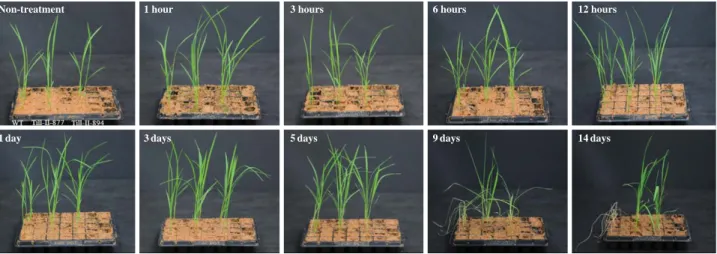
and lower numbers of tillers (Kim et al. 2010). In an attempt to demonstrate the salt-tolerant characters of two different mutants, the phenotypes of two mutant lines selected by salt treatment (Till-II-877 and Till-II-894) were compared with their original cultivar. They were treated with 170 mM salt for two weeks, and changes in salt damage were monitored with ten stages divided by time and date including non-treatment (Fig. 1). Both the original cultivar and its mutants showed no change until day 3, but at day 5, chlorophyll loss -or the yellowing of all leaves- was observed at their tips. At day 9, the original cultivar had more than half its leaves turning yellow and showed severe leaf rolling. There was also an increased damage to the two mutant varieties which exhibited severe leaf yellowing and partial leaf rolling. Inter-esting remarkable events were observed after day 9. The original cultivar withered as leaf yellowing and rolling became increasingly severe, while the mutant varieties were gradually recovering their leaf colors and shapes. As a result, at day 14, a distinct difference in appearance was seen bet-ween the original cultivar and two mutants. If a plant is exposed to too much salt, Na++and Cl-ions easily combine
with each other in old leaves with a relatively low content of K++
and thus salt damage is caused (Wolf et al. 1991). The plant was defoliated as a result of progressive yellowing from the tips of old leaves, but in this study the two mutant lines were found to overcome salt stress through a complex mechanism without further damage at this stage (Kehlil et al. 2007). In addition to stress resulting from Na++toxicity,
the osmotic stress due to lack of water greatly affects plant growth, and the leaf rolling in the original cultivar is also
Fig. 1. The comparison of phenotype between wild type and two mutation lines according time lapse for 14 days after salt treatment. 5
repeat-individuals were treated for the exact experiment.
Non-treatment 1 hour 3 hours 6 hours 12 hours
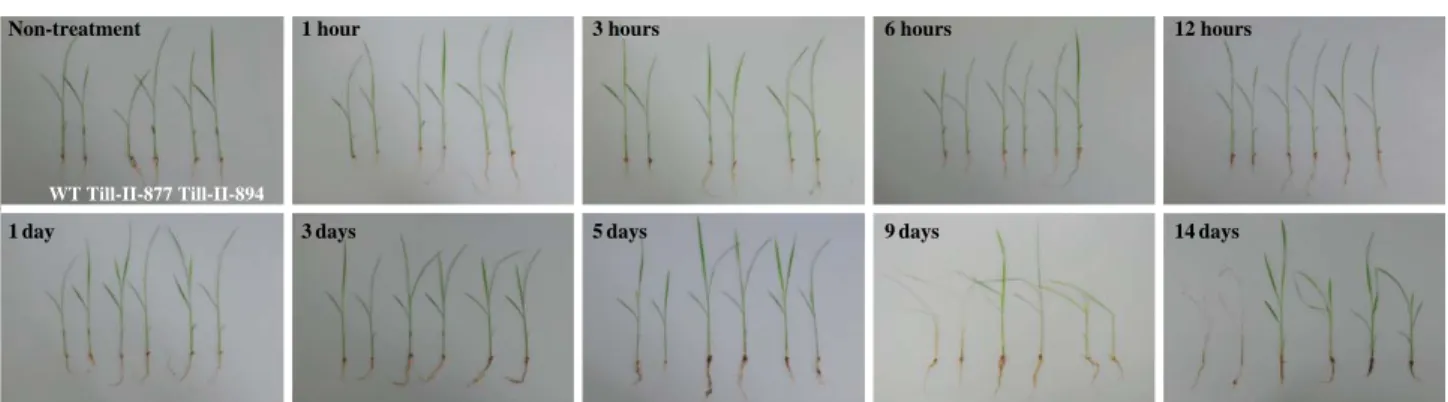
known as a cause of such stress (Kadioglu and Terzi 2007). Due to the lack of water, plants reduce energy consumption and transpiration so as not to lose water but fail to absorb water, so they use water in vacuoles. As the plants become short of water, leaf rolling occurs and progresses in them. In this process, they suffer from stress and may wither if it is severe. Consequently, plants can grow properly when they gain more water than they lose. The water absorption of a plant and its normal growth and development are influenced by the length of its roots or the ratio of roots to stems. In order to examine what makes salt-tolerant plants overcome the osmotic stress, we compared the original cultivar and mutant lines in terms of their root and stem lengths (Fig. 2). In the comparison, the original cultivar was found to have a root length range of 4~8 cm, while the mutant line
Till-II-877 showed an average root length of more than 9 cm at every stage, and Till-II-894 had roots as long as 15.6 cm even though their mean length somewhat varied with growth stages (Table 1). However, there was no significant
differ-ence in leaf size between the original cultivar and its mutant varieties. In some cases, the difference in root length was twice or greater between the original cultivar and mutant lines, but the difference in leaf length was only 2~4 cm on
average. These morphological difference observed in the mutants before salt treatment account for a damage to their original cultivar after salt treatment. After day 9, the damaged leaves of two mutants gradually returned to their normal state, but the original cultivar’s leaves were further damaged and completely withered at day 14. Consequently, we found that salt damage could involve leaf rolling, steam thinning, yellowing of plant tissues (due to chlorophyll destruction), and defoliation of older leaves or even the whole plant.
2. Physiological assay
When under osmotic or toxic stress due to excessively high salt concentrations, plants defend themselves not to lose water for respiration, reducing CO2levels in them. This res-Fig. 2. The phenotype of wild type and two mutation lines according time lapse for 14 days after salt treatment to compare the length of root
and shoot. Total 5 repeat-individuals were treated and analyzed, 2-individual among them were posted in this figure.
Table 1. The phase of salt stress in wild type and two mutation lines according time
Leaf length (mm) Root length (mm) Plant height (mm) Stem thickness (mm) Damage leaf ratio (mm) Wild Till-II- Till-II- Wild Till-II- Till-II- Wild Till-II- Till-II- Wild Till-II- Till-II- Wild
Till-II-type 877 894 type 877 894 type 877 894 type 877 894 type 877 894
Nontreat 12.2 13.9 14.15 5.2 11.45 10.5 17.4 25.35 24.65 0.15 0.15 0.15 0% 0% 0% 1 hour 15 15.2 16.9 3.3 10.7 13.55 18.3 25.9 30.45 0.2 0.2 0.2 0% 0% 0% 3 hours 14.95 14.45 16.25 3.9 9.8 6.7 18.85 24.25 22.95 0.2 0.2 0.25 0% 0% 0% 6 hours 11.8 16.5 16.85 4.6 8.4 12.85 16.4 24.9 29.7 0.2 0.25 0.2 0% 0% 0% 12 hours 13.5 16.5 15.3 4.5 9.4 14.25 18 25.9 29.55 0.2 0.2 0.2 0% 0% 0% 24 hours 13.9 16.6 17.9 4.65 9.85 15.6 18.55 26.45 33.5 0.125 0.2 0.3 0% 0% 0% 3 days 17.4 18.6 13.4 7.05 11.4 9.85 24.45 30 23.25 0.175 0.225 0.2 0% 0% 0% 5 days 23.4 29.5 26.3 4.65 11.5 8.25 28.05 41 34.55 0.175 0.225 0.2 0% 0% 0% 9 days 25.65 28.45 24.05 8.25 9.2 7.7 33.9 37.65 31.75 0.2 0.3 0.2 19% 29% 40% 14 days 23.75 29.6 27.1 7 9.4 7.7 30.75 39 34.8 0.15 0.3 0.35 100% 29% 36%
Non-treatment 1 hour 3 hours 6 hours 12 hours
1 day 3 days 5 days 9 days 14 days
ponse leads to depletion of the oxidized NADP++, which acts as a final acceptor of electrons in PSI, and alternatively increases the leakage of electrons to O2forming O-2. Gradual oxygen reduction takes place due to extra energy or electrons and structurally transformed substances such as H2O2, O-2 and OH-are produced as ROS affecting plant growth and
development (Abogadallah 2010).
In order to identify how the ROS is controlled in
salt-tol-erant plants, we measured the changing content of ROS-related enzymes in two salt-tolerant mutant lines (Till-II-877 and 894) from the original cultivar.
MDA content
The MDA content, a measure of lipid peroxidation, was significantly different between Till-II-877 and Till-II-894 (Fig. 3). In general, the salt-tolerant lines have a relatively low level of MDA content compared to their original cultivar (Ashraf et al. 2010).
Because the MDA is a measure that indicates the extent to which fatty acids are lost by salt stress or toxicity. However, it was unusual that Till-II-877 showed similar leaf colors and growth patterns to the original cultivar, despite its higher MDA content. This suggests that Till-II-877 has a different mechanism that enables its normal growth against salt dam-age, though it experienced a loss of fatty acid due to salt stress. Therefore, the tolerance to salt stress in two mutant lines can be considered to have occurred via different kinds of mechanisms (Horner et al. 2011).
Chlorophyll content
Higher and lower concentrations of NaCl adversely affect-Fig. 3. The change of malondialdehyde (MDA) contents in salt
tolerance line of rice derived from three repeated.
Fig. 4. The graph consist of A: chlorophyll a content (Ca), B: chlorophyll b content (Cb), C: total chlorophyll (Ca++b) and D: carotenoid
content in salt torence line of rice derived from three repeated.
60 45 30 15 0 WT Till-II-877 Till-II-894
MDA nmol/g fresh wt
0.5 0.475 0.45 0.425 0.4 0.23 0.22 0.21 0.2 0.19 0.18 0.17 0.088 0.084 0.08 0.076 0.072 0.068 mg/g fresh wt mg/g fresh wt mg/g fresh wt WT Till-II-877 Till-II-894
WT Till-II-877 Till-II-894 WT Till-II-877 Till-II-894
WT Till-II-877 Till-II-894 (A) (B) (C) (D) 0.3 0.28 0.26 0.24 0.22 mg/g fresh wt
ed the amount of chlorophyll a and b (Tammam et al. 2011). The generation of ROS due to salt stress occurs because it prevents NADPH synthesis in the Calvin cycle which is involved in photosynthesis (Chaves et al. 2009). When the chlorophyll a and b contents of two mutant lines were com-pared with those of the original cultivar (Fig. 4), Till-II-894 was found to have chlorophyll levels similar to or lower than the original cultivar. In view of this finding, it is thought that salt stress caused some damage to photosynthesis. The photosynthetic damage due to salt stress is supported by delayed growth of Till-II-894 and its shorter leaf lengths and smaller plant size than the original cultivar. On the contrary to 894-3, the higher chlorophyll contents of Till-II-877 as compared to the original cultivar indicate that it suf-fered less damage to photosynthesis.
Catalase and peroxidase contents
CAT and POD are ROS scavenging enzymes. In this paper, the activities of the two enzymes are plotted on the same graph (Fig. 5). The salt tolerance of plants increases as they contain more CAT and POD, and in this sense the two en-zymes can be deemed as the same type. However, they have different characteristics in gene expression; CAT shows a gradual decrease in enzyme expression when damaged by salt, while POD has a higher level of expression under salt damage (Abogadallah 2010). In other words, the CAT en-zyme is more common in the salt-tolerant lines than the orig-inal cultivar under normal conditions and thus able to effec-tively scavenge ROS produced by salt stress, even if CAT expression is hindered by salt damage. On the contrary, although there is little difference in POD between the
salt-tolerant lines and original cultivar under normal conditions, the salt-tolerant line exhibits highly increased POD expres-sion under salt damage compared to the original cultivar and thus is able to scavenge ROS efficiently. Our experiment showed that both the two salt-tolerant lines had higher levels of CAT content than the original cultivar. From this result, we can conclude (i) that CAT has much influence on the salt-tolerant characters of mutant lines and (ii) that CAT is highly expressed in plants or salt toxicity does not hinder CAT expression. In a comparison between two mutant lines, Till-II-877 was higher by 0.03 mg per unit in CAT content and showed better ROS scavenging activity than Till-II-894. Interestingly, POD produced the opposite effect to CAT. This probably occurred because the plant under salt stress had no influence on increasing POD expression. However, even if the mutant lines had contained a lower level of POD than the original cultivar, it is clear that they are salt-tolerant because they overcame 1% (170 mM) salt damage for two weeks and showed a good growth and development state. In fact, they might be affected by other enzymes or mecha-nisms, and it is thought that an increased CAT content acti-vely contributed to the salt tolerance of mutant lines. How-ever, the CAT enzyme will not be the only contributor to their acquisition of salt tolerance, and there are other enzymes or mechanisms (e.g., pathways such as membrane transport or proline rich families) that are more likely to have also contributed to salt tolerance. The reason is that such other mechanisms are expected to act in abiotic stress pathways which are highly complex and involve many genes. In addi-tion, a variety of ROS scavenging enzymes contribute to each other for overcoming salt damage. It is true that each Fig. 5. The change of catalase activity (CAT, A) and peroxidase activity (POD, B) contents in salt tolerance line of rice derived from three
repeated. 75 50 25 0 0.3 0.25 0.2 0.15 0.1 0.05 0
WT Till-II-877 Till-II-894 WT Till-II-877 Till-II-894
POD unit/mg ∙ protein CAT unit/mg ∙ protein (A) (B)
of the enzymes serves to scavenge ROS, but their characters and roles are specific and thus all the enzymes are evenly accumulated in a plant so that it has salt tolerance and scav-enges ROS effectively. Another difference between CAT and POD lies in the affinity to ROS. CAT has a relatively low level of affinity to H2O2, compared to POD, and there-fore is not able to scavenge antioxidants elaborately. How-ever, CAT is able to detoxify antioxidants in a wide manner (Abogadallah 2010). Since, in the two mutant lines, salt tol-erance was demonstrated by CAT rather than POD, they are likely to overcome salt stress or injury with a large amount of ROS being scavenged.
CONCLUSION
We screened two different salt-tolerant mutants which showed normal growth and development at 1% NaCl2(170 mM) and analyzed their morphological characteristics, MDA chlorophyll contents, and ROS scavenging enzyme activities. We found that the mutant lines’ salt-tolerant traits were mainly dominated by the CAT enzyme. However, it should be noted that salt tolerance mechanisms are very diverse and complex. Therefore it is difficult to identify all elements related to salt tolerance and it does not seem reasonable to believe that CAT is involved alone in salt tolerance. From the study results, we inferred that in addition to ROS scav-enging enzymes, other mechanisms such as ion transport systems are involved in salt tolerance of mutant lines. In further study we need to examine and clarify those mecha-nisms, as part of our contributions to varietal improvement and agricultural development.
ACKNOWLEDGMENT
This work was supported by a grant from Agricultural R&D Promotion Center, Ministry for Food, Agriculture, Forestry & Fisheries and a grant from Nuclear R&D Pro-gram through the Korea Science and Engineering Founda-tion funded by Ministry of EducaFounda-tion Science and Techno-logy, Republic of Korea.
REFERENCES
Abogadallah GM. 2010. Antioxidative defense under salt stress.
Plant Signal Behav. 5(4):369-374.
Apel K and Hirt H. 2004. Reactive oxygen species: Metabolism, oxidative stress and signal transduction. Annu. Rev. Plant Biol. 55:373-399.
Ashraf MA, Ashraf M and Ali Q. 2010. Response of two genet-ically diverse wheat cultivars to salt stress at different growth stages: leaf lipid peroxidation and phenolic contents. Pak. J. Bot. 42(1):559-565.
Chaves MM, Flexas J and Pinheiro C. 2009. Photosynthesis under drought and salt stress: regulation mechanisms from whole plant to cell. Ann. Bot. 103:551-560.
Chinnusamy V and Zhu JK. 2006. Salt stress signaling and mechanisms of plant salt tolerance. Genet. Eng. 27:141-77. Dhindsa RS and Matowe W. 1981. Drought tolerance in two mosses correlated with enzymatic defense against lipid per-oxiadtion. J. Exp. Bot. 32:79-91.
FAO. 2005. World Agicaultural Center, FAOSTAT Agricultural statistic Data - Base Gateway.
Flowers TJ, Hajibagheri MA and Clipson NJW. 1986. Haloph-ytes. Q. Rev. Biol. 61:313-337.
Horner KA, Gilbert YE and Cline SD. 2011. Widespread in-creases in malondialdehyde immunoreactivity in dopamine-rich and dopamine-poor regions of rat brain following mul-tiple, high doses of methamphetamine. Front. Syst. Neurosci.
5:27.
Jiang Y and Michael KD. 2006. Comprehensive transcriptional profiling of NaCl-stressed Arabidopsis roots reveals novel classes of responsive genes. BMC Plant Biol. 6(25):1-20. Joseph B, Jini D and Sujatha S. 2010. Biological and
physiolog-ical perspectives of specificity in abiotic salt stress response from various rice plants. Asian J. Agric. Sci. 2:99-105. Kadioglu A and Terzi R. 2007. A dehydration avoidance
mech-anism: Leaf rolling. Bot. Rev. 73(4):290-302.
Kehlil A, Menu T and Ricard B. 2007. Adaptive response to salt involving carbohydrate metabolism in leaves of a salt-sensi-tive tomato cultivar. Plant Physiol. Biochem. 45(8):551-559. Kim DS, Song JY, Chun JB, Lee KJ, Kim JB, Kim SH, Yun SJ and Kang SY. 2010. Selection of gamma-ray induced salt tolerant rice mutants by in vitro mutagenesis. J. Radiation Industry 4(2):179-184.
Lichtenthaler HK. 1987. Chlorophylls and carotenoids: Pigments of photosynthetic biomembranes. Methods Enzymol. 148: 350-382.
Munns R. 2008. Strategies for crop improvement in saline soils. pp. 99-110. In: Tasks for Vegetation Science (Asgraf M and Ozturk M, Athar HR eds.), Springer Science++Business
Media B.V.
Sahi C, Singh A, Kumar K, Blumwald E and Grover A. 2006. Salt stress response in rice: genetics, molecular biology, and comparative genomics. Funct. Integr. Genomic.
6(4):263-284.
Sarah MH, Wang F, Stewart JM, Tracy MS, William CL, Hughs E and Zhang J. 2010. Physiological response to salt (NaCl) stress in selected cultivated tetraploid cottons. Journal of Agronomy 1-12.
Tammam AA, Fakhry EM and Sheekh ME. 2011. Effect of salt stress on antioxidant system and the metabolism of the reac-tive oxygen species in Dunaliella salina and Dunaliella ter-tiolecta. Afr. J. Biotechnol. 10(19):3795-3808.
Wan X, Mo A, Yang LL and Li L. 2010. Constiutive expression of a peanut ubiquitin-conjugating enzyme gene in Arabidop-sis confers improved water-stress tolerance through regula-tion of stress-responsive gene expression. J. Biosci. Bioeng.
111:478-484.
Wolf O, Munns R, Tonnet ML and Jeschke WD. 1991. The role of the stem in the paritioning of Na++
and K++
in salt-treated barley. J. Exp. Bot. 42(6):697-704.
Wu CA, Yang GD, Meng QW and Zheng CC. 2004. The cotton GhNHX1 gene encoding a novel putative tonoplast Na++
/H++
antiporter plays an important role in salt stress. Plant Cell Physiol. 45:600-607.
Yamaguchi T and Blumwald E. 2005. Developing salttolerant crop plants: challenges and opportunities. Trends Plant Sci.
10(12):615-620.
Yeo AR. 1999. Predicting the interaction between the effects of salinity and climate change on crop plants. Sci. Hortic.
78:159-174.
Yokoi S, Bressan RA and Hasegawa PM. 2002. Salt stress tol-erance of plants. JIRCAS Working Report 23:25-33. Yongwen Q, Dongling Z, Hongliang Z, Meixing W, Junli S,
Xinghua W, Zongen Q, Shengxiang T, Yongsheng C, Xiangkun W and Zichao L. 2006. Genetic diversity of rice cultivars (Oryza sativa L.) in China and the temporal trends in recent fifty years. Chin. Sci. Bull. 51(6):681-688. Zhu TH, Yang HY, Wang WX, Wang K and Cui ZF. 2011. Role
of small GTPase in plant disease resistance: Rice as a model. Chin. J. Cell Biol. 33(3):288-296.
Manuscript Received: August 26, 2011 Revised: August 30, 2011 Revision Accepted: September 9, 2011