INTRODUCTION
The development of biodegradable polymers has attracted significant attention due to the growing cognition of the need to minimize the environmental pollution brought about by non-biodegradable polymer wastes (Gross and Kalar 2002; Vroman and Tighzert 2009). During the past decade, signifi-cant advances have been made in the development of bio-degradable polymers with excellent properties comparable to those of petroleum-based polymers (Song et al. 2009). A variety of biodegradable polymers including polylactide, poly(butylene succinate), poly(3-hydroxybutyrate), and polycaprolactone(PCL) have been developed as alternatives for non-biodegradable polymers (Sodergard 2004).
Among these biodegradable polymers, PCL has recently gained significant attention due to its diversity, biocompati-biltiy, and good biodegradability. However, diverse applica-tions of PCL have been restricted due to its low heat stabili-ty, low processabilistabili-ty, and poor mechanical properties (Darwis 1998). Thus, various techniques including crosslinking, composites with inorganic fillers, and blending with other polymers have been developed to make up for those draw-backs of PCL (Averous et al. 2000; Wu 2004; Wang et al. 2008). Among these techniques, crosslinking has been pre-ferred since it is a facile and effective method to improve thermal and mechanical stability (Huang et al. 2009).
The crossinking of PCL has been carried out mainly by radiation and peroxide techniques. The radiation-induced crosslinking technique is quite fascinating in terms of the crosslinking of PCL because it offers several advantages such as an eco-friendly process, precise controllability,
tem-─ ─ 107 ──
Electron Beam-induced Crosslinking and
Characterization of Polycaprolactone Films
in the Presence of Various Crosslinking Agents
Dong-Woo Kang, Chan-Hee Jung, In-Tae Hwang, Jae-Hak Choi* and Young-Chang Nho Radiation Research Division for Industry and Environment, Advanced Radiation Technology Institute,
Korea Atomic Energy Research Institute, Jeongeup 580-185, Korea
Abstract-- Electron beam-induced crosslinking of polycaprolactone (PCL) films containing various crosslinking agents (CAs) was investigated in this study. PCL films containing various CAs prepared by a solution casting method were irradiated by electron beams at various absorption doses and the irradiated PCL films were investigated in terms of their crosslinking degree, thermal and mechanical properties, and biodegradability. Based on the results of the crosslinking degree mea-surement, triallyl isocyanurate was found to be most effective for the electron-beam induced cross-linking of PCL films. The results of the UTM, DMA, and TMA revealed that the thermal and mechanical properties of the crosslinked PCL films were greatly improved in comparison to those of the pure PCL. The results of the enzymatic degradation test revealed that the biodegradability of the crosslinked PCL films was reduced in comparison to that of the pure PCL.
Key words : Electron beam, Crosslinking agent, Crosslinking, Polycaprolactone, Thermal and mechanical properties, Biodegradability
* Corresponding author: Jae-Hak Choi, Tel. +82-63-570-3062, Fax. +82-63-570-3090, E-mail. [email protected]
perature-independence, and low energy consumption (Clen-land et al. 2003; Chmielewski et al. 2005). Thus, the cross-linking of PCL by using high energy radiation in the pres-ence or abspres-ence of crosslinking agents has been carried out to improve its thermal and mechanical properties (Yoshii et
al. 2000; Zhu et al. 2003; Abdel-Rehim et al. 2004).
How-ever, the electron beam-induced crosslinking of PCL films in the presence of various kinds of crosslinking agents (CAs) and the characterization of the crossinked PCL in multilater-al aspects have been little studied.
In this article, the electron beam-induced crosslinking of polycaprolactone (PCL) films in the presence of various CAs was performed. The effects of the type and concentration of CA on the electron beam-induced crosslinking of PCL films was investigated. Moreover, the physical properties and biodegradation of crosslinked PCL films were examined.
MATERIALS AND METHODS
1. Preparation of polycaprolactone films containing crosslinking agents
Polycaprolactone (PCL, MW: 80000) and chloroform were purchased from Aldrich and Showa chemical companies, respectively. Triallyl isocyanurate (TAIC), trimethylolpropane triacrylate (TMPTA), and 1,6-hexanediol diacrylate (HDDA) purchased from Aldrich were used as crosslinking agents (CAs). All the chemicals were utilized without further puri-fication. PCL films containing various CAs were fabricated using a solvent casting method. The content of CA in the final composition was defined as the ratio of the CA mass to the total mass of the PCL films. Briefly, 10 wt% PCL solutions with or without CA were prepared by dissolving PCL and CA in chloroform. The prepared solutions were cast on well-cleaned glasses and then placed in a fume hood at room temperature for 4 h. Afterwards, to remove the remaining solvent and moisture, the films were further dried
in a vacuum oven at 30�C for 24 h. The thickness of the
result-ing films was around 130μm. 2. Electron beam irradiation
The prepared PCL films with or without CA were put into aluminum pouches and thermally sealed after purging with nitrogen gas. The samples were irradiated at room tempera-ture with an ELV-3 e-beam accelerator installed at EB-Tech
(Daejeon, Korea). The energy and current density of the electron beams were 2 MeV and 1 mA cm-2, respectively. The total absorption dose ranged from 10 to 200 kGy.
3. Characterization
The crosslinking degree of the irradiated PCL films with or without CA was estimated by measuring their insoluble part in the dried sample after extraction in chloroform for 24 h. The crosslinking degree was calculated from the follow-ing equation:
Crosslinking degree (%)==W2/W1×100,
where W1and W2are the weights of the dried sample before and after extraction in chloroform, respectively.
The tensile strength and elongation-at-break were measured using a universal testing machine (Model 4210, Instron Engineering Co., USA) according to the ASTM Standard D638. The dynamic mechanical analysis was carried out by using a dynamic mechanical analyzer (DMA, Q800 model, TA Instrument) under film-tension mode in a temperature range of -80 to 200�C at a heating rate of 5�C min-1and a frequency of 1 Hz. The thermomechanical analysis (TMA) was performed on a TMA Q400 system (TA Instrument, USA) using an extension probe between 20 and 200�C at a heating rate of 5�C min-1under a nitrogen atmosphere. The enzymatic degradation test was carried out using lipase enzymes that were extracted from Pseudomonas fluorescens and their activity was about 300 units mg-1. The samples (2 ×2 cm square shaped films) were immersed in 2 ml of a phosphate buffer solution containing 100μg ml-1of lipase enzymes at 37�C. After incubation for a certain time, the resulting films were removed from the enzymatic solution, washed with distilled water several times, and dried under a vacuum at room temperature to a constant weight. The bio-degradation was estimated by measuring the ratio of weight loss to the initial weight of the films. The weight loss was measured based on a decrease of the weight of the films before and after the enzymatic degradation. The experiment was repeated three times to minimize the experimental error.
RESULTS AND DISCUSSION
To investigate the electron beam-induced crosslinking behavior of PCL films in the presence of various CAs, the
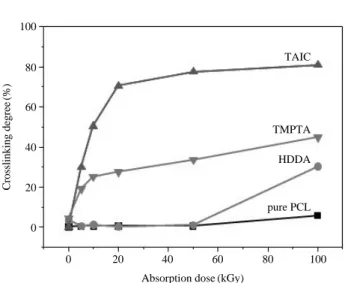
crosslinking degrees of the pure PCL and PCL containing different types of CAs irradiated at various doses were mea-sured and the results are shown in Fig. 1. The crosslinking degree of the irradiated pure PCL was only 5.7% even at an absorption dose of 100 kGy. On the other hand, the cross-linking degree of PCL films containing various CAs exhibit-ed a much higher crosslinking degree in comparison of that of pure PCL. Among PCL films with various CAs, those containing TAIC exhibited the highest crosslinking degree up to 80.9% at 100 kGy. Moreover, to find the optimal con-tent of TAIC for the electron beam-induced crosslinking of PCL films, the PCL films containing different contents of TAIC were irradiated and their crosslinking degrees were measured. Fig. 2 shows the crosslinking degree of PCL films containing different contents of TAIC as a function of the absorption dose. At an absorption dose of less than 50 kGy, the PCL films containing 1 wt% TAIC had a slightly higher crosslinking degree than the other PCL films containing 3, 5, and 7 wt% TAIC. However, at an absorption dose of more than 50 kGy, the crosslinking degrees of all the PCL films containing different contents of TAIC were almost similar. These results indicate that an increase in the TAIC contents can not further enhance the electron beam-induced crosslink-ing efficiency of PCL. Therefore, among crosslinkcrosslink-ing agents, TAIC was found to be the most effective for the radiation-induced crosslinking of PCL, and the optimal concentration of TAIC was considered as to be 3 wt% in this system. In this study, the crosslinked PCL films containing 3 wt% TAIC were further used to investigate their properties and biode-gradability .
The changes in the tensile strength and elongation-at-break of the pure PCL and PCL films containing 3 wt% TAIC after electron beam irradiation at various absorption doses were investigated and the results are shown in Fig. 3. As shown in Fig. 3(a), the tensile strength of the irradiated pure PCL film was slightly increased to 16.89 MPa with an increasing absorption dose. On the other hand, the tensile strength of the irradiated PCL containing 3 wt% TAIC was gradually increased up to 19.2 MPa with an increasing dose of up to 150 kGy, over which it seemed to level off. As shown in Fig. 3(b), the elongation-at-break of the pure PCL film was sig-nificantly reduced with an increasing absorption dose. Like-wise, in the case of the PCL film containing 3 wt% TAIC, the elongation-at-break was diminished, but the extent of diminution was much smaller in comparison to that in the
pure PCL. These changes in properties could be due to the more effective formation of the crosslinked structure in the PCL film induced by electron beam irradiation in the pres-ence of TAIC (Jin et al. 2002).
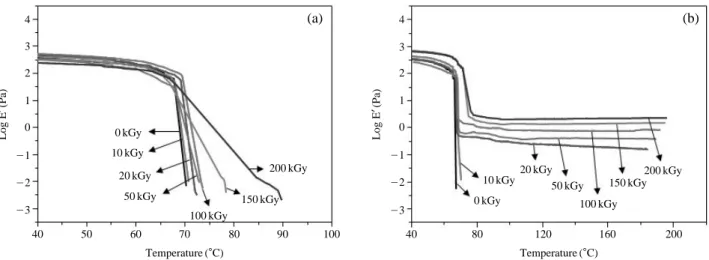
The dynamic viscoelastic properties of the pure PCL and PCL films containing 3 wt% TAIC irradiated at various absorption doses was investigated by DMA. Fig. 4(a) shows the storage modulus of the pure PCL films irradiated at vari-ous absorption doses. The non-irradiated pure PCL film
exhibited a sharp drop in the storage modulus (E′) above its
melting temperature due to the melting of the crystalline domains. In the case of the irradiated pure PCL films, the
Fig. 1. Crosslinking degree of the pure PCL and PCL films
contain-ing 1 wt% of various crosslinkcontain-ing agents as a function of the absorption dose.
Crosslinking degree (%) 100 80 60 40 20 0 0 20 40 60 80 100
Absorption dose (kGy)
TAIC
TMPTA HDDA
pure PCL
Fig. 2. Crosslinking degree of the pure PCL and PCL films
contain-ing various amounts of TAIC as a function of the absorption dose. Crosslinking degree (%) 100 80 60 40 20 0 0 50 100 150 200
Absorption dose (kGy) 1 wt% TAIC
3 wt% TAIC
5 wt% TAIC
7 wt% TAIC
temperature for a sharp transition in E′ was slightly increas-ed with an increasing absorption dose. On the other hand, as shown in the Fig. 3(b), the irradiated PCL films containing 3 wt% TAIC exhibited a higher temperature for the sharp
transition in E′ at the same dose in comparison to that of the
pure PCL film, which was dependent on the absorption dose. This result can be ascribed to the greater formation of the crosslinked structure in the PCL films containing 3 wt% TAIC (Nugroho et al. 2001).
To investigate the crosslinking effect on the thermal stabi-lity of PCL film that is generally required in polymer pro-cessing at a high temperature, the pure PCL and PCL films containing 3 wt% TAIC irradiated at an absorption dose of 100 kGy were analyzed by TMA and the results are present
in Fig. 5. The pure PCL film revealed a high deformation near its melting temperature. After irradiation, the deforma-tion temperature of the pure PCL film was slightly shifted to a lower temperature. In the case of the non-irradiated PCL film containing 3 wt% TAIC, the deformation tempera-ture was shifted to a lower temperatempera-ture in comparison to that of the pure PCL. On the other hand, the irradiated PCL film containing 3 wt% TAIC showed a much lower deformation at higher temperature. Thus, this improved heat stability of PCL films can be attributed to the formation of network structures in the PCL (Suhartini et al. 2003).
To examine the crosslinking effect on the biodegradability of PCL films, an enzymatic degradation test was performed and the results are shown in Fig. 6. The non-irradiated PCL
Fig. 4. Storage modulus of the pure PCL and PCL films containing 3 wt% TAIC at various absorption doses.
Log E ′(Pa) Log E ′(Pa) 4 3 2 1 0 -1 -2 -3 4 3 2 1 0 -1 -2 -3 40 50 60 70 80 90 100 Temperature (�C) 40 80 120 160 200 Temperature (�C) 0 kGy 10 kGy 20 kGy 50 kGy 100 kGy 150 kGy 200 kGy 200 kGy 150 kGy 100 kGy 50 kGy 20 kGy 10 kGy 0 kGy (a) (b)
Fig. 3. Tensile strength (a), and elongation-at-break (b) of the pure PCL and PCL films containing 3 wt% TAIC as a function of the absorption
dose. Tensile strength (MPa) Elongation at break (%) 20 19 18 17 16 15 14 1000 800 600 400 200 0 0 50 100 150 200
Absorption dose (kGy)
0 50 100 150 200
Absorption dose (kGy) 3 wt% TAIC
3 wt% TAIC
pure PCL
pure PCL
film containing 3 wt% TAIC was degraded up to almost more than 95% after an enzymatic degradation reaction for 120 h. However, for the irradiated PCL films containing 3 wt% TAIC, a degradation of less than 50% was achieved even after a reaction for 1,320 h, which was dependant on the absorption dose. This result indicates that the formation of crosslinked structures in the PCL film caused by electron beam irradiation in the presence of TAIC diminished its biodegradability.
CONCLUSION
The electron beam-induced crosslinking behavior of PCL
films in the presence of CAs was investigated in this study. Based on the results of the crosskining degree measurement, PCL was more effectively crosslinked in the presence of CA by electron beam irradiation than in the absence of CA. Among the CAs, triallyl isocyanurate (TAIC) was found to be most effective for the radiation-induced crosslinking of PCL, and the optimal concentration of TAIC was considered to 3 wt% in this system. The tensile strength of the irradiated PCL films containing 3 wt% TAIC was increased with an increasing absorption dose, whereas the elongation-at-break was relatively reduced in comparison of that of the pure PCL. The DMA results showed that the irradiated PCL films containing 3 wt% TAIC had a much higher and wider rubbery state plateau in comparison with the pure PCL. The TMA results revealed that the irradiated PCL films containing 3 wt% TAIC had a much higher heat stability than that of the pure PCL. The biodegradability of the irradiated PCL films containing 3 wt% TAIC was much reduced with an increas-ing absorption dose. These changes in the physical properties and biodegradability can be ascribed to the formation of crosslinked structures in the PCL films caused by electron beam irradiation in the presence of TAIC.
ACKNOWLEDGMENTS
This research was supported by Nuclear R&D program through the National Research Foundation funded by the Ministry of Education, Science and Technology, Korea.
REFERENCES
Abdel-Rehim HA, Yoshii F and Kume T. 2004. Modification of polycaprolactone in the presence of polyfunctional mono-mers by radiation and its biodegradability. Polym. Degrad.
Stab. 85:689-695.
Averous L, Moro L, Dole P and Fringant C. 2000. Properties of thermoplastic blends: starch-polycaprolactone. Polymer
41:4157-4167.
Chmielewski AG, Haji-Saeid M and Ahmed S. 2005. Progress in radiation processing of polymers. Nucl. Instrum. Meth.
B 236:44-54.
Cleland MR, Parks LA and Cheng S. 2003. Applications for radiation processing of materials. Nucl. Instrum. Meth. B
208:66-73.
Darwis D, Mitomo H, Enjoji T, Yoshii F and Makuuchi K. 1998.
Fig. 5. TMA heating curves of the pure PCL, irradiated pure PCL,
and irradiated PCL films containing 3 wt% TAIC at an absorption dose of 100 kGy.
Fig. 6. Weight loss of PCL films containing 3 wt% TAIC irradiated
at various absorption doses in enzymatic degradation test.
Dimension change (μ m) 3500 3000 2500 2000 1500 1000 500 0 -500 30 40 50 60 70 80 90 100 Temperature (�C) pure PCL at 0 kGy pure PCL at 100 kGy 3 wt% TAIC at 0 kGy 3 wt% TAIC at 100 kGy Weight loss (%) 100 80 60 40 20 0 0 200 400 600 800 1000 1200 1400 Time (h) 0 kGy 10 kGy
20 kGy 50 kGy 100 kGy
Heat resistance of radiation crosslinked poly( ε-caprolac-tone). J. Appl. Polym. Sci. 68:581-588.
Gross RA and Kalra B. 2002. Biodegradable polymers for the envrionment. Science 297:803-807.
Huang X, Li C, Zhu W, Zhang D, Guan G and Xiao Y. 2009. Ultraviolet-induced crosslinking of poly(butylene succinate) and its thermal property, dynamic mechnical property, and biodegradability. Polym. Adv. Technol. in press.
Jin F, Hyon S-H, Iwata H and Tsutsumi S. 2002. Crosslinking of poly(L-lactic acid) by γ-irradiation. Macromol. Rapid Commun. 23:909-912.
Nugroho P, Mitomo H, Yoshii F, Kume T and Nishimura K. 2001. Improvement of processability of PCL and PBS blend.
Macromol. Mater. Eng. 286:316-323.
Sodergard A. 2004. Perspectives on modification of aliphatic polyesters by radiation processing. J. Bioact. Compat.
Polym. 19:511-525.
Song JH, Murphy RJ, Narayan R and Davies GBH. 2009. Bio-degradable and compostable alternatives to conventional plastics. Phil. Trans. R. Soc. B 364:2127-2139.
Suhartini M, Mitomo H, Nagasawa N, Yoshii F and Kume T.
2003. Raidition crosslinking of poly(butylene succinate) in the presence of low concentrations of trimethallyl isocyanu-rate and its properties. J. Appl. Polym. Sci. 88:2238-2246. Vroman I and Tighzert L. 2009. Biodegradable polymers.
Ma-terials 2:307-344.
Wang S, Yaszemski MJ, Gruetzmacher JA and Lu L. 2008. Photo-crosslinked poly(ε-caprolactone fumarate) networks: roles of crystallinity and crosslinking density in determining mechanincal properties. Polymer 49:5692-5699.
Wu C-S. 2004. In situ polymerization of titanium isopropoxide in polycaprolactone: properties and characterization of the hybrid nanocomposites. J. Appl. Polym. Sci. 92:1749-1757. Yoshii F, Darwis D, Mitomo H and Makuuchi K. 2000. Cross-linking of poly(ε-caprolactone) by radiation technique and its biodegradability. Rad. Phys. Chem. 57:417-420. Zhu G, Liang G and Yu Q. 2003. Shape-memory effects of
radiation crossliked poly(ε-caprolactone). J. Appl. Polym.
Sci. 90:1589-1595.
Manuscript Received: April 29, 2011 Revision Accepted: May 27, 2011