결정요인
윤성보1․김영우1․정은형1․이남호2․이상학3․장양수3
홍익병원 심장센터1, 한림의대 강남성심병원 심장내과2, 연세의대 내과학교실 심장내과3
Determinants of Exaggerated Hypertensive Response to Exercise
in Elderly Hypertensive Patients
Seong-Bo Yoon1, Youngwoo Kim1, Eun-Hyoung Jeong1 , Namho Lee2, Sang-Hak Lee3, Yangsoo Jang3
Cardiovascular Center, Hongik Hospital, Seoul, Korea1;
Cardiology Division, Kangnam Sacred Heart Hospital, Hallym University College of Medicine Seoul, Korea2; and
Cardiology Division, Department of Internal Medicine, Yonsei University College of Medicine3, Seoul, Korea
Abstract
Objective: The elderly patients who have hypertension and consequently high cardiovascular risk are increasing
and require an appropriate medical management. An exaggerated elevation of blood pressure (BP) during exercise, which is related to arterial stiffness and aging, has been reported to predict clinical outcome. This study was conducted to identify the determinants of exaggerated hypertensive response during exercise in elderly hypertensive patients.
Methods: One hundred and five hypertensive patients above 65 year-old, who took antihypertensive medications
more than 2 weeks and with controlled resting BP (≤140/90 mmHg), were included. Demographic data and medications were obtained from interview and medical records. The patients then underwent a symptom-limited treadmill exercise testing. Clinical determinants for exaggerated hypertensive response (systolic BP ≥210 mmHg in male, ≥190 mmHg in female) at 5~7 METS exercise were identified by multiple logistic regression analysis.
Results: Eighteen patients (17%) showed exaggerated hypertensive response during exercise. Female gender, diabetes
mellitus, higher resting pulse rate, number of anti-hypertensive drugs, calcium channel blocker use and diuretic use were significantly associated with exaggerated hypertensive response. After adjusting for confounding variables, female gender (P=0.04), diabetes mellitus (P=0.01), calcium channel blocker use (P=0.01) and diuretic use (P=0.01) remained as independent determinants for the exaggerated response.
책임저자 : 이상학
서울시 서대문구 신촌동 134, 세브란스 심장혈관병원 심장내과
서 론
고혈압은 나이에 따라 점차 증가하며, 심혈관 계 합병증의 주요 원인으로서 심부전, 협심증, 심근경색증, 뇌졸중 발생과 밀접한 관련이 있다.1 고혈압 치료에 따른 혈압하강 효과를 평가하기 위해 안정 시 혈압이 사용되어 왔으나, 일상생활 의 스트레스에서 나타날 수 있는 이상 혈압반응 을 주기적인 혈압 측정만으로 발견하기는 어렵 다. 최근 연구에서 운동부하 검사 중에 혈압상승 이 과도한 경우 심비대 또는 심혈관 질환 발생과 관련된 것으로 보고하고 있다.2,3 이런 과도한 혈 압상승 반응은 좌심실 비대 및 동맥 경직도 상승 과 상관관계가 있다고 한다.4,5 좌심실 비대 및 동맥 경직도는 고령에서 더 두 드러지며, 따라서 고령인 고혈압 환자에서 일상 생활 중 혈압의 변동성이 심혈관계 위험도를 잘 반영하리라 생각된다.6 일상생활 및 여가생활을 하는데 필요한 대사량은 약 5~7 METS로 알려져 있다.7 따라서 운동부하 검사 중에 5~7 METS 정 도의 운동량에서 혈압 상승을 조사하면 이 환자 에서 일상생활 중의 혈압상승을 반영하리라 가 정할 수 있다. 그러므로 본 연구에서는 65세 이 상인 고혈압 환자를 대상으로 운동부하검사를 통하여 일상생활에서 발생하는 과도한 혈압상승 반응에 대한 결정 요인을 밝히려고 하였다.대상 및 방법
1. 연구 대상
고혈압으로 진단받은 뒤에 운동부하 검사를 실시한 65세 이상 노인 환자 175명을 스크리닝 하였다. 환자들은 2주 이상 한 가지 이상의 항고 혈압 약물을 교체 없이 지속적으로 투여 중이었 으며 약물의 병합요법은 허용하였다. 두 종류의 혈압약이 결합된 복합제재의 경우에는 두가지의 혈압약 제재를 복용하는 것으로 간주하였다. 검 사 전 안정 시 혈압은 140/90 mmHg 이하였다. 운동부하검사에서 심근 허혈의 증거가 있는 환 자, 조절되지 않는 고혈압이나 당뇨병, 신부전, 심부전, 증명된 관상동맥 질환, 폐질환, 심박동기 삽입, 선천성 심질환 및 심한 판막 질환이 있는 환자를 제외한 105명을 연구대상으로 하였다. 이 들에 대한 의무기록을 검토하여 기본적인 임상 특징, 과거력, 신체 계측, 항고혈압 약물을 파악 하였다. 신장과 체중은 2회 모두 공복 상태로 신 발을 벗고 가벼운 가운만을 입은 상태에서 측정 하였다. 체중(kg)/신장(m)2의 공식에 의해 체질량 지수 (Body Mass Index, BMI)를 산출하였다.2. 운동부하 검사 및 주요변수의 정의
안정 시 심전도, 수축기 및 이완기 혈압을 먼 저 얻은 후에 Bruce protocol에 따라 답차에서 증 상 제한성 운동부하 검사를 시행하였다. 운동 중 지 후 30초의 서행기간을 두었으며 이후에 즉시 앙와위를 취하게 하였다. 운동부하 검사에서 운 Conclusion: In elderly hypertensive patients, exaggerated hypertensive response during exercise is associated withfemale gender, diabetes mellitus, calcium channel blocker or diuretic use. These results can be applicable to more appropriate management for this high risk population.
ꠏꠏꠏꠏꠏꠏꠏꠏꠏꠏꠏꠏꠏꠏꠏꠏꠏꠏꠏꠏꠏꠏꠏꠏꠏꠏꠏꠏꠏꠏꠏꠏꠏꠏꠏꠏꠏꠏꠏꠏꠏꠏꠏꠏꠏꠏꠏꠏꠏ
동 중 각 단계마다 심전도, 수축기 혈압, 이완기 혈압 및 심박수를 측정하였다. 회복기 1분, 3분, 5분에 각각 심전도, 수축기 혈압, 이완기 혈압 및 심박수를 측정하였다. 운동량은 METS로 표현 하였고8 최대 운동 부하량을 기록하였다. 운동부 하 검사 중에 5~7 METS 사이에 측정되는 과도 한 혈압상승반응을 확인하기 위하여 7 METS 시 에 수축기 혈압 및 이완기 혈압, 심박수를 측정 하여서 과도한 혈압상승 반응의 지표로 삼았다. 과도한 혈압상승 반응은 과거의 여러 연구를9,10 바탕으로 하여 7 MET에서 수축기 혈압이 남자 환자에서는 210 mmHg, 여자 환자에서는 190 mmHg 이상인 경우로 정의하였다.
3. 통 계
모든 자료는 SPSS 12.0 (SPSS inc., Chicago, Illinois, USA)을 이용하였다. 연속형 변수는 평균 값±표준편차로, 범주형 변수는 빈도 및 퍼센트로 기술하였다. 연속형 변수는 independent samples t-test를 이용하여 비교하였고 범주형 범수는 Chi-square test를 이용하여 비교하였다. 과도한 혈압상승 반응과 관계가 있는 유의한 결정요인 을 알아보기 위하여 다중회귀분석을 시행하였으 며 모든 분석에서 P 값이 0.05 미만일 경우에 통 계적으로 유의하다고 판정하였다.결 과
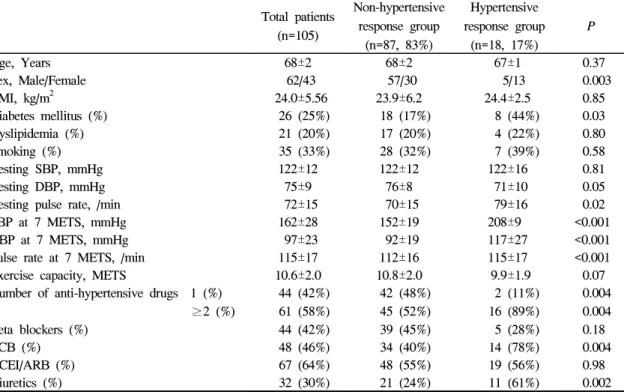
전체 105명 환자의 연령은 최소 65세, 최고 77 세로 평균 68±2세이었다. 남자 환자는 62명 (59%), 여자 환자는 43명 (41%)이었다. 당뇨병은Table 1. Baseline characteristics in non-hypertensive and hypertensive response group
Total patients (n=105) Non-hypertensive response group (n=87, 83%) Hypertensive response group (n=18, 17%) P Age, Years 68±2 68±2 67±1 0.37 Sex, Male/Female 62/43 57/30 5/13 0.003 BMI, kg/m2 24.0±5.56 23.9±6.2 24.4±2.5 0.85 Diabetes mellitus (%) 26 (25%) 18 (17%) 8 (44%) 0.03 Dyslipidemia (%) 21 (20%) 17 (20%) 4 (22%) 0.80 Smoking (%) 35 (33%) 28 (32%) 7 (39%) 0.58 Resting SBP, mmHg 122±12 122±12 122±16 0.81 Resting DBP, mmHg 75±9 76±8 71±10 0.05
Resting pulse rate, /min 72±15 70±15 79±16 0.02 SBP at 7 METS, mmHg 162±28 152±19 208±9 <0.001 DBP at 7 METS, mmHg 97±23 92±19 117±27 <0.001 Pulse rate at 7 METS, /min 115±17 112±16 115±17 <0.001 Exercise capacity, METS 10.6±2.0 10.8±2.0 9.9±1.9 0.07 Number of anti-hypertensive drugs 1 (%) 44 (42%) 42 (48%) 2 (11%) 0.004
≥2 (%) 61 (58%) 45 (52%) 16 (89%) 0.004 Beta blockers (%) 44 (42%) 39 (45%) 5 (28%) 0.18 CCB (%) 48 (46%) 34 (40%) 14 (78%) 0.004 ACEI/ARB (%) 67 (64%) 48 (55%) 19 (56%) 0.98 Diuretics (%) 32 (30%) 21 (24%) 11 (61%) 0.002 BMI, body mass index; SBP, systolic blood pressure; DBP, diastolic blood pressure; METS, metabolic equivalents for oxygen consumption; CCB, calcium channel blocker; ACEI, angiotensin converting enzyme inhibitor; ARB, angiotensin receptor bloker.
26명 (25%), 고지혈증은 21명 (20%), 흡연은 35명 (33%)에서 조사되었다. 1가지 종류의 혈압약을 복용하는 환자는 44명 (42%)이었으며 복합제재 를 포함하여 2가지 종류 이상의 혈압약을 복용 하는 환자는 61명 (58%)이였다. 안정 시 수축기/ 이완기 혈압은 122±12/75±9 mmHg이었으며, 7 METS 도달했을 때의 수축기/이완기 혈압은 162 ±28/97±23 mmHg이었다. 18명 (17%)에서 과도한 혈압상승 반응이 있었는데, 이중 남자가 5명, 여 자 환자가 13명이었다. 과도한 혈압상승 반응이 있던 환자에서 여자 와 당뇨병이 유의하게 많았으며 두 가지 이상의 혈압약을 복용하는 환자가 많았다. 또한 과도한 혈압상승 반응이 있던 환자에서 칼슘통로 차단 제와 이뇨제 투여가 더 흔한 것으로 나타났다. 과도한 혈압상승이 있던 환자에서 안정 시 수축 기 혈압은 차이가 없었으나 이완기 혈압은 더 낮 은 경향이 있었으며, 안정 시 맥박수는 유의하게 높았다. 최대 운동량은 과도한 혈압상승이 있던 환자에서 다소 적었으나 통계적인 차이는 없었 다 (Table 1). 단변량 선형회귀분석에서 여자, 당 뇨병, 안정 시 맥박수, 두 가지 이상의 혈압약 투 약, 칼슘통로 차단제 및 이뇨제 투여가 과도한 혈압상승 반응에 대한 의미 있는 결정요인으로 나타났다. 다변량 분석에서는 여자 (P=0.04), 당 뇨병 (P=0.01), 칼슘통로 차단제 투여 (P=0.01), 이뇨제 투여 (P=0.01)가 과도한 혈압상승 반응에 대한 독립적인 결정요인이었다 (Table 2).
고 찰
본 연구의 결과에서 노인 고혈압 환자에서 운 동 중의 과도한 혈압상승 반응은 여자 환자, 당 뇨병 환자, 칼슘통로 차단제나 이뇨제를 투여하 는 환자에게서 더 많이 발생하는 것을 알 수 있 었다. 이제까지의 연구에서 운동부하 검사 중 이 완기 혈압보다는 수축기 혈압에 대해 더 많은 연 구가 이루어졌다.11,12 운동으로 인해 심박출량이 증가하고 그로 인해 수축기 혈압이 증가하기 때 문이다. 대조적으로 말초혈관의 확장으로 인해 이완기혈압은 거의 변화가 없거나 소폭 증가한 다.12 따라서 이번 연구에서도 과도한 혈압상승 의 정의를 수축기 혈압을 기준으로 하였으며, 과 Table 2. Univariate and multivariate determinants of exaggerated hypertensive responseUnivariate analysis Multivariate analysis
β S.E. 95% CI P β S.E. 95% CI P Age -0.06 0.07 0.83~1.07 0.37 - - - -Female 1.60 0.57 0.07~0.62 0.01 1.44 0.69 0.06~0.92 0.04 Diabetes 1.12 0.54 1.06~8.89 0.04 1.75 0.70 1.46~22.5 0.01 Smoking 0.29 0.54 0.47~3.83 0.58 - - - -Dyslipidemia 0.16 0.63 0.34~4.03 0.80 - - - -Resting SBP 0.01 0.02 0.96~1.05 0.81 - - - -Resting DBP -0.06 0.03 0.89~1.00 0.06 - - -
-Resting pulse rate 0.01 0.02 1.00~1.07 0.03 - - - -Number of hypertensive drugs 2.01 0.78 1.62~34.4 0.01 - - - -Beta blockers -0.75 0.57 0.16~1.44 0.19 - - - -CCB 1.65 0.61 1.58~17.1 0.01 1.89 0.74 1.56~27.9 0.01 ACEI/ARB 0.02 0.52 0.37~2.82 0.98 - - - -Diuretics 1.60 0.55 1.70~14.4 0.003 1.86 0.70 1.64~25.1 0.01 SBP, systolic blood pressure; DBP, diastolic blood pressure; CCB, calcium channel blocker; ACEI, angiotensin converting enzyme inhibitor; ARB, angiotensin receptor blocker; S.E., standardized error; CI, confidence interval.
거의 여러 연구를9,10 바탕으로 하여서 7 MET에 서 최대 수축기 혈압이 남자환자에서는 210 mmHg, 여자 환자에서는 190 mmHg 이상으로 하 였다. 운동부하 검사 중의 과도한 혈압상승이 고혈 압 발생의 예측 요인이라는 연구가11,13,14 있었으 며 따라서 표적장기 손상발생과도 관련될 것이 라고 생각된다.3 과거의 몇몇 연구에서 운동부하 검사중 과도한 혈압 상승을 보이는 군은 대조군 과 비교하여 좌심실 비대와2,15 심혈관 질환 발생 위험도가 높다는 연구가 있다.2,3,14,15 Kohl 등16은 고혈압이 없는 건강한 26,000명의 환자를 8.1년 동안 추적 관찰하였으며, 운동부하 검사에서 최 대 수축기 혈압이 200 mmHg 이상으로 상승하는 환자에서 전체 사망률 및 심혈관 사망률이 높다 고 보고하였다. Allison 등17은 정상인에게 있어서 운동부하 검사에서의 과도한 혈압상승 반응이 주요한 심혈관계 질환의 발생과 (odds ratio=3.62, P=0.03) 고혈압의 발병도 예측하게 해준다고 (odds ratio=2.41, P=0.02) 하였으며 심혈관 질환의 발생을 촉진할 수 있는 몇 가지 기전을 제시하였 는데 운동부하 검사에서의 과도한 혈압상승 반 응이 혈관벽의 저항과 내피세포의 손상을 유발 하여 동맥경화를 촉진하는 것, 심근의 산소 요구 량을 증가시키거나 혈관벽 두께를 증가시켜 동 맥경화를 촉진하는 것이다. 이외에도 고령의 이 완성 심기능 저하가 동반된 환자에서는 심박동 의 변화에 다른 대동맥의 이완성이 부족하며 따 라서 운동 시 혈압의 상승 및 운동능력의 저하가 동반되게 된다는 주장도 있다.14 언급한 바와 같이 운동 중 과도한 혈압상승 반 응의 결정요인에 대한 기존의 연구는 충분하지 않 다. Scott 등18은 안정시의 수축기 혈압 (P=0.003), 당뇨병 (P=0.02) 및 성별 (남자, P=0.003)이 혈압 상승 반응에 영향을 미치고, 좌심실 비대가 더 많이 관찰되지만, 투약 중인 약물과는 연관성이 없었다고 하였다. 그러나 대부분 50대 전후의 비 교적 젊은 환자로 남자 환자의 비율이 높았으며 (나이 54±10, 남:여=112:55), 고혈압 약제는 단지 20%에서만 복용 중이었기 때문에 고혈압 약제와 의 연관성에 대한 설명으로는 부족하였다. Kokkinos 등10은 2,318명의 남자 고혈압 환자에 대한 연구에서 베타차단제를 복용한 환자군이 다른 고혈압 약제를 복용한 군에 비하여 68% 더 낮은 과도한 혈압상승 반응을 보였다고 보였으 며 (odds ratio=0.32, P<0.05) 운동 시 심박동수 및 심근산소소비량도 더 낮았다고 보고하였다. 이외 에 Warner 등19은 20명의 고혈압 환자에 대한 무 작위 이중맹검 위약대조 임상시험에서 이완기 심부전 환자에서 안지오텐신 수용체 차단제를 2 주간 투여한 결과 운동 시 과도한 혈압상승을 억 제하고 (P<0.05) 운동능력이 향상되었고 (P<0.05) 삷의 질이 향상된 것을 보고하였다 (P<0.05). 본 연구에서도 칼슘채널 차단제나 이뇨제를 투여한 환자에서 과도한 혈압상승 반응이 더 잘 나타났 으며 베타차단제나 레닌-안지오텐신 경로에 대 한 차단약물은 이 반응을 억제하였으므로 기존 의 연구결과를 어느 정도 설명해 준다고 할 수 있다. 이는 고령의 환자일수록 이완기 심기능 장 애가 동반되어 있거나 운동에 따른 자율신경계 의 과도한 활성화 가능성이 많으며 이에 따라서 베타차단제나 레닌-안지오텐신 경로에 대한 차 단약물이 운동 시 과도한 혈압상승 반응을 억제 하였을 가능성이 높다고 생각된다. 이번 연구는 대상 환자가 105명으로 적으며 후 향적 연구라는 제한점이 있다. 또한 2가지 이상 의 약물 병합요법이 포함되었지만 병합요법이나 약물 간 상호작용에 의한 영향을 제거하거나 분 석하지 못하였으며, 심기능의 측정 및 동맥경직 도에 대한 평가를 함께 하였더라면 이러한 결과 가 나오게 된 원인까지 어느 정도 추가적인 설명 이 가능했으리라 생각된다. 결론적으로, 노인 고 혈압 환자에서 여자, 당뇨병, 칼슘통로 차단제 및 이뇨제 투여가 운동 중의 과도한 혈압상승 반 응에 대한 독립적인 결정요인임을 알 수 있었다. 이 결과는 심혈관계 위험도가 높은 노인 고혈압
환자에서 보다 적절한 개인별 치료에 참고가 되 리라 생각된다.
감사의 글
본 연구는 보건복지가족부 보건의료기술진흥 사업의 지원 (A000385)과 서울시 산학연 협력사 업의 지원에 의하여 이루어진 것임 (10526).참 고 문 헌
1. Trenkwalder P, Hendricks P, Schoniger R, Rossberg J, Lydtin H, Hense HW. Hypertension as a risk factor for cardiovascular morbidity and mortality in an elderly German population; the prospective STEPHY II study. Eur Heart J 1999;20:1752-6.
2. Kim HJ, Lee WS, Kwon JH, Song YB, Ahn JH, Lee SY, Lee JJ, Kim SW, Kim TH, Ryu WS. Relationship between exercise-induced blood pressure response and left ventricular hypertrophy in patients with hypertension. Korean Circ J 2001;31:809-14.
3. Sharabi Y, Ben-Cnaan R, Hanin A, Martonovitch G, Grossman E. The significance of hypertensive response to exercise as a predictor of hypertension and cardiovascular disease. J Hum Hypertens 2001;15:353-6.
4. Fleg JL, O'Connor F, Gerstenblith G, Becker LC, Clulow J, Schulman SP, Lakatta EG. Impact of age on the cardiovascular response to dynamic upright exercise in healthy men and women. J Appl Physiol 1995;78:890-900. 5. Fagard R, Staessen J, Thijs L, Amery A.
Prognostic significance of exercise versus resting blood pressure in hypertensive men.
Hypertension 1991;17:574-8.
6. Amery A, Birkenhager W, Bulpitt CJ, Clement D, De Leeuw P, Dollery CT, Fagard R, Fletcher A, Forette F, Leonetti G. Syst-Eur: a multicentre trial on the treatment of isolated systolic hypertension in the elderly: objectives, protocol, and organisation. Aging Clin Exp Res 1991;3:287-302.
7. American College of Sports Medicine. ACSM’s Guidelines for Exercise Testing and Prescription. 6th edition. Baltimore, MD: Lippincott Williams & Wilkins; 2000.
8. Fletcher GF, Balady G, Froelicher VF, Hartley LH, Haskell WL, Pollock ML. Exercise standards: a statement for healthcare professionals from the American Heart Association. Circulation 1995;91:580-615.
9. Smelley MP, Virnich DE, Williams KA, Ward RP. A hypertensive response to exercise is associated with transient ischemic dilation on myocardial perfusion SPECT imaging. J Nucl Cardiol 2007;14:537-43.
10. Kokkinos P, Chrysohoou C, Panagiotakos D, Narayan P, Greenberg M, Singh S. Beta-blockade mitigates exercise blood pressure in hypertensive male patients. J Am Coll Cardiol 2006;47:794-8. 11. Wilson MF, Sung BH, Pincomb GA, Lovallo WR. Exaggerated pressure response to exercise in men at risk for systemic hypertension. Am J Cardiol 1990;66:731-6.
12. Franz IW. Ergometry in the assessment of arterial hypertension. Cardiology 1985;72:147-59. 13. Lee SH, Park WH, Bae MW, Lee SH, Jang SY,
Yang DH, Park HS, Cho YK, Chae SC, Jun JE. Blood pressure response during the exercise treadmill test and the risk of future hypertension and cardiovascular disease. Korean Circulation J 2007;37:277-82.
14. Hundley WG, Kitzman DW, Morgan TM, Hamilton CA, Darty SN, Stewart KP, Herrington DM, Link KM, Little WC. Cardiac cycle-dependent changes in aortic area and distensibility are reduced in older patients with isolated diastolic heart failure and correlate with exercise intolerance. J Am Coll Cardiol 2001;38:796-802.
15. Gottdiener JS, Brown J, Zoltick J, Fletcher RD. Left ventricular hypertrophy in men with normal blood pressure: relation to exaggerated blood pressure response to exercise. Ann Intern Med 1990;112:161-6.
16. Kohl HW 3rd, Nichaman MZ, Frankowski RF, Blair SN. Maximal exercise hemodynamics and risk of mortality in apparently healthy men and women. Med Sci Sports Exerc 1996;28:601-9.
17. Allison TG, Cordeiro MA, Miller TD, Daida H, Squires RW, Gau TG. Prognostic significance of exercise-induced systemic hypertension in healthy subjects. Am J Cardiol 1999;83:371-5. 18. Scott JA, Coombes JS, Prins JB, Leano RL,
Marwick TH, Sharman JE. Patients with type 2 diabetes have exaggerated brachial and central exercise blood pressure: relation to left ventricular relative wall thickness. Am J Hypertens 2008;21:715-21.
19. Warner JG Jr, Metzger DC, Kitzman DW, Wesley DJ, Little WC. Losartan improves exercise tolerance in patients with diastolic dysfunction and a hypertensive response to exercise. J Am Coll Cardiol 1999;33:1567-72.