“Phase Transformation in Materials”
Eun Soo Park
Office: 33-313
Telephone: 880-7221 Email: [email protected]
Office hours: by an appointment
2015 Fall
10. 07. 2015
1
2
Contents in Phase Transformation
(Ch1) Thermodynamics and Phase Diagrams (Ch2) Diffusion: Kinetics
(Ch3) Crystal Interface and Microstructure
(Ch4) Solidification: Liquid → Solid
(Ch5) Diffusional Transformations in Solid: Solid → Solid (Ch6) Diffusionless Transformations: Solid → Solid
Background to understand phase
transformation
Representative Phase
transformation
3
• Diffusion
• Interstitial Diffusion / Substitution Diffusion
- Steady-state diffusion – Fick’s First Law
- Nonsteady-state diffusion – Fick’s Second Law
- For random walk in 3 dimensions,
after n steps of length α
• Effect of Temperature on Diffusivity
: Movement of atoms to reduce its chemical potential μ . driving force: Reduction of G
Down-hill diffusion movement of atoms from a high C
Bregion to low C
Bregion.
Up-hill diffusion movement of atoms from a low C
Bregion to high C
Bregion.
(atoms m
-2s
-1)
( ) α ∂ ∂
= Γ − = − Γ ∂ = − ∂
2
1 2
1 1
6 6
B B
B B B B
C C
J n n D
x x
Concentration varies with position.
∂ ∂
∂ = ∂
2 2
B B
B
C C
t D x
Concentration varies with time and position .
−
= . R T
D Q log D
log 1
3
0
2
Contents for previous class
4
Contents for today’s class
• Interstitial Diffusion / Substitutional Diffusion
• Atomic Mobility
• Tracer Diffusion in Binary Alloys
• High-Diffusivity Paths
1. Diffusion along Grain Boundaries and Free Surface
2. Diffusion Along Dislocation
• Diffusion in Multiphase Binary Systems
1. Self diffusion in pure material 2. Vacancy diffusion
3. Diffusion in substitutional alloys - Steady-state diffusion– Fick’s First Law
- Non-steady-state diffusion: Fick’s Second Law Concentration varies with position.
Concentration varies with time and position .
5
Q. How to solve the diffusion equations?
: Application of Fick’s 2 nd law
homogenization, carburization, decarburization, diffusion across a couple
6
Solutions to the diffusion equations (Application of Fick’s 2
ndlaw)
Ex1. Homogenization
of sinusoidal varying composition
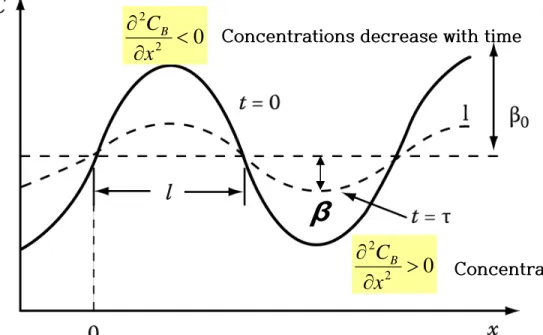
in the elimination of segregation in casting
l : half wavelength
l C x
C = + β
0sin π
: the mean composition C
0
: the amplitude of the initial concentration profile β
Initial or Boundary Cond.?
at t=0
2 0
2 >
∂
∂ x CB
2 0
2 <
∂
∂ x CB
Fig. 2.10 The effect of diffusion on a sinusoidal variation of composition.
Concentrations decrease with time
Concentrations increase with time.
∂ = ∂
∂ ∂
2 2
B B
B
C C
t D x
7
Rigorous solution of for
2 2
x D C t
C
∂
= ∂
∂
∂ ( )
l C x
x
C , 0 = + β
0sin π
( )
( )
D l
t n
n
n n
n n
Dt
l e C x
C
A B
C A
l C x
C t
x B
x A
A C
e x B
x A
C
2 2
2
/ 0
0 1
0
0 1
0
sin , 0 ,
;
sin 0
cos sin
sin cos
π
λ
β π
β β π
λ λ
λ λ
−
∞
=
−
+
≡
∴
=
=
=
+
≡
→
=
+ +
=
∴
+
=
∴
∑
(A
n= 0 for all others)
τ : relaxation time
+ −
= τ
β π t
l C x
C
0sin exp
D l
2 2
τ = π
) 2 /
0
exp(
x l at
t =
−
= β τ
β
2 2
2 2 2
1 1
Let
λ
−
≡
=
=
=
dx X d X dt
dT DT
dx X DT d
dt X dT
XT C
x B
x A
X dx X
X d
λ λ
λ
sin cos
2
0
2 2
+ ′
= ′
= +
Using a method of variable separation
l C β sin π x X(x,0) ≡ +
0e
DtT T
dt D T d
dt D dT T
2
0
2 2
ln 1
λ
λ λ
=
−−
=
−
=
l λ =π
8
Solutions to the diffusion equations
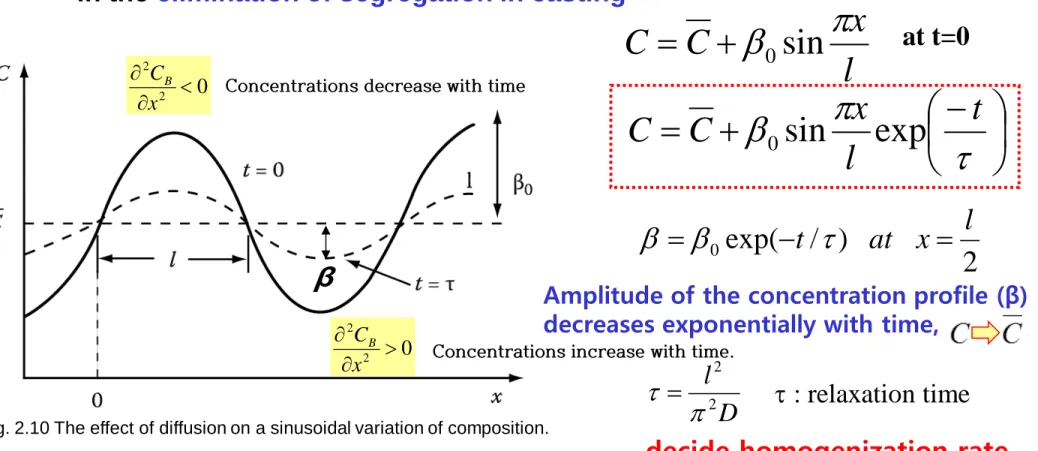
Ex1. Homogenization of sinusoidal varying composition in the elimination of segregation in casting
l C x
C = + β
0sin π at t=0
τ : relaxation time
+ −
= τ
β π t
l C x
C
0sin exp
D l
2 2
τ = π
) 2 /
0
exp(
x l at
t =
−
= β τ
β
The initial concentration profile will not usually be sinusoidal, but in general any con- centration profile can be considered as the sum of an infinite series of sine waves of varying wavelength and amplitude, and each wave decays at a rate determined by its
own “τ”. Thus, the short wavelength terms die away very rapidly and the homogenization will ultimately be determined by τ for the longest wavelength component.
decide homogenization rate
Fig. 2.10 The effect of diffusion on a sinusoidal variation of composition.
Amplitude of the concentration profile (β) decreases exponentially with time,
2 0
2 >
∂
∂ x CB
2 0
2 <
∂
∂ x CB
Concentrations decrease with time
Concentrations increase with time.
9
Solutions to the diffusion equations
Ex2. Carburization of Steel
The aim of carburization is to increase the carbon concentration in the surface layers of a steel product in order to achiever a harder wear-resistant surface.
1. Holding the steel in CH
4and/or Co at an austenitic temperature.
2. By controlling gases the concentration of C at the surface of the steel can be maintained at a suitable constant value.
3. At the same time carbon continually
diffuses from the surface into the steel.
10
Carburizing of steel
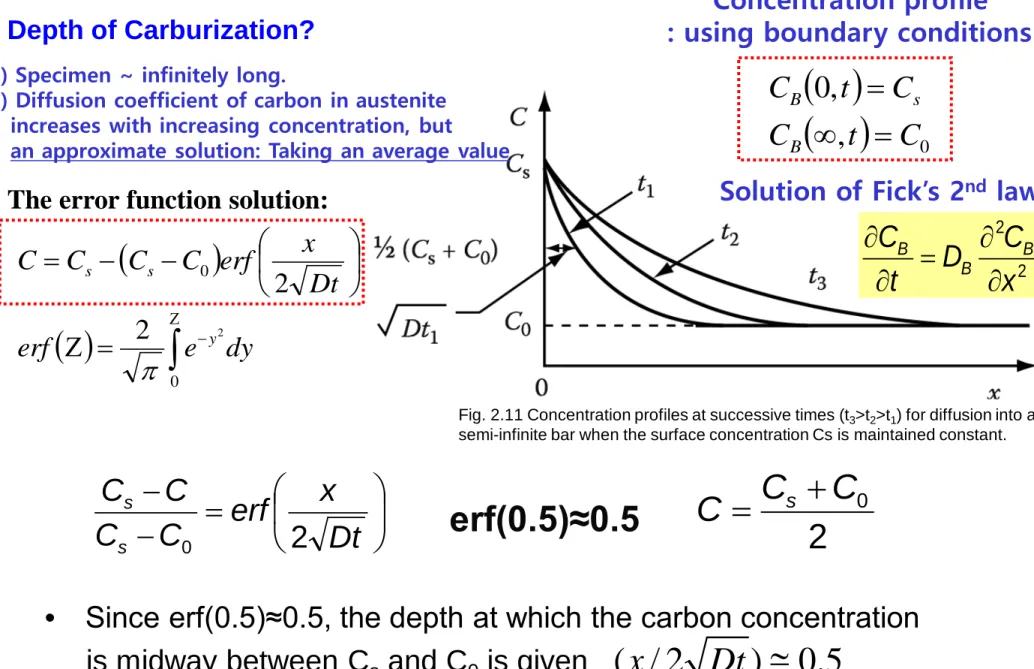
The error function solution:
( ) ( ) 0 , , t C
0C
C t
C
B
s B
=
∞
=
( )
( ) Ζ = ∫
Ζ −
−
−
=
0 0
2
22 dy e
erf
Dt erf x
C C
C C
y s
s
π
Depth of Carburization?
• Since erf(0.5)≈0.5, the depth at which the carbon concentration is midway between C
sand C
0is given
that is
( / 2 x Dt ) ≅ 0.5 x ≅ Dt
erf(0.5)≈0.5
=
−
−
Dt erf x
C C
C C
s s
0
2
0
2 C
sC
C +
=
→ Depth of Carburization
* Concentration profile : using boundary conditions
Solution of Fick’s 2
ndlaw
1) Specimen ~ infinitely long.
2) Diffusion coefficient of carbon in austenite increases with increasing concentration, but
an approximate solution: Taking an average value
Fig. 2.11 Concentration profiles at successive times (t3>t2>t1) for diffusion into a semi-infinite bar when the surface concentration Cs is maintained constant.
∂ ∂
∂ = ∂
2 2
B B
B
C C
t D x
11
Error function
In mathematics, the error function (also called the Gauss error
function) is a non-elementary function which occurs in probability, statistics and partial differential equations.
It is defined as:
By expanding the right-hand side in a Taylor series and integrating, one can express it in the form
for every real number x. ( From Wikipedia, the free encyclopedia )
12
Error function = −
π ∫ O Z 2
erf(z) 2 exp( y )dy
Schematic diagram illustrating the main features of the error function.
13
Carburizing of steel
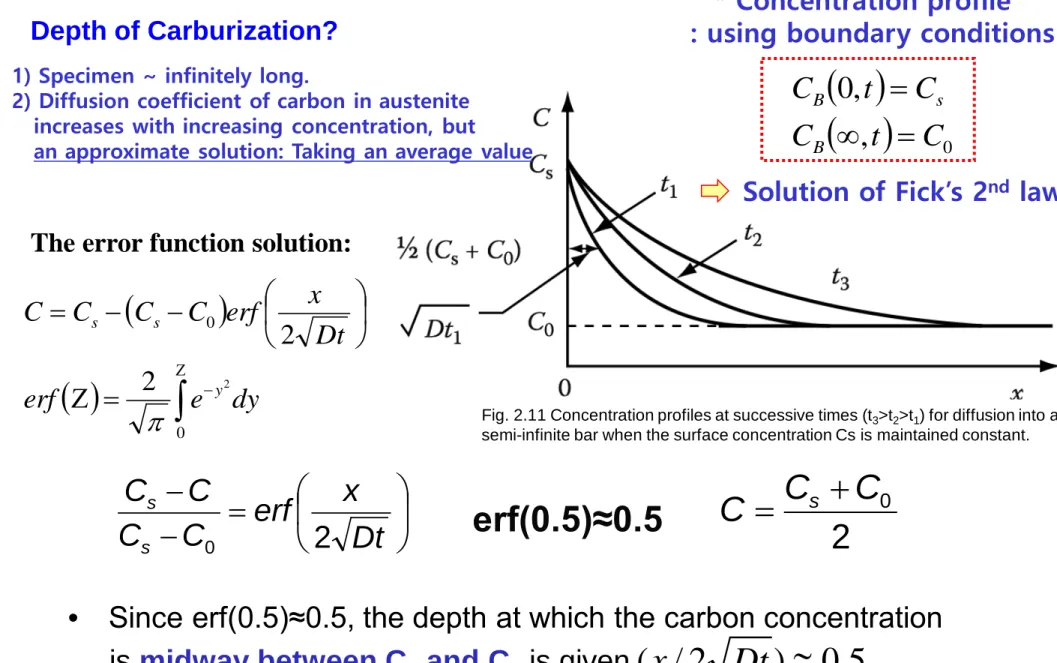
The error function solution:
( ) ( ) 0 , , t C
0C
C t
C
B
s B
=
∞
=
( )
( ) Ζ = ∫
Ζ −
−
−
=
0 0
2
22 dy e
erf
Dt erf x
C C
C C
y s
s
π
Depth of Carburization?
• Since erf(0.5)≈0.5, the depth at which the carbon concentration is midway between C
sand C
0is given
that is
( / 2 x Dt ) ≅ 0.5 x ≅ Dt
erf(0.5)≈0.5
=
−
−
Dt erf x
C C
C C
s s
0
2
0
2 C
sC
C +
=
→ Depth of Carburization
* Concentration profile : using boundary conditions
Solution of Fick’s 2
ndlaw
1) Specimen ~ infinitely long.
2) Diffusion coefficient of carbon in austenite increases with increasing concentration, but
an approximate solution: Taking an average value
Fig. 2.11 Concentration profiles at successive times (t3>t2>t1) for diffusion into a semi-infinite bar when the surface concentration Cs is maintained constant.
14
Carburizing of steel
=
Dt erf x
C
C
02
≅ Dt
Dt
Thus the thickness of the carburized layer is .
Note also that the depth of any is concentration line is directly proportion to , i.e. to obtain a twofold increase
in penetration requires a fourfold increase in time.
(2배의 침투 깊이 → 4배의 시간)
Ex.3 Decarburization of Steel?
( )
( ) Ζ = ∫
Ζ −
−
−
=
0 0
2
22 dy e
erf
Dt erf x
C C
C C
y s
s
π
C
S= Surface concentration C
0= Initial bulk concentration
Carburization
15
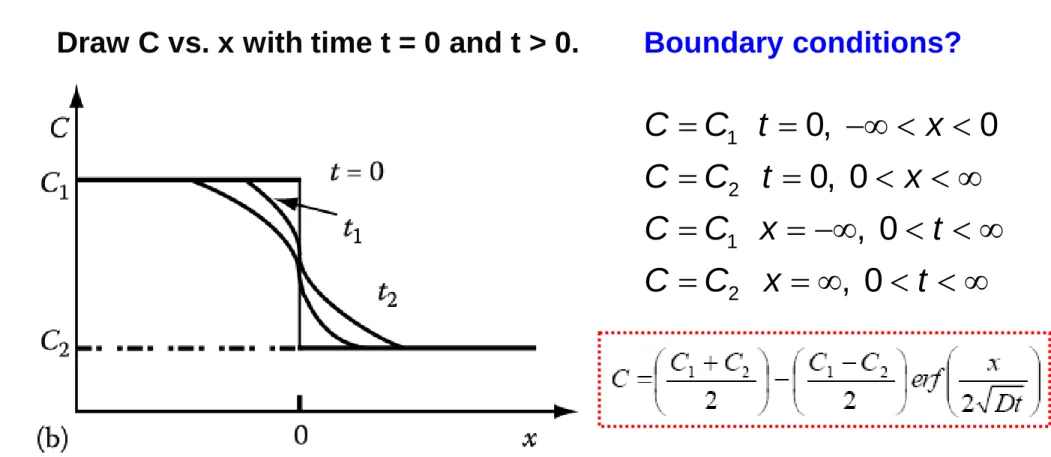
= = −∞ < <
= = < < ∞
= = −∞ < < ∞
= = ∞ < < ∞
1 2 1 2
0, 0
0, 0 , 0 , 0
C C t x
C C t x
C C x t
C C x t
Joining of two semi-infinite specimens of compositions C
1and C
2(C
1> C
2) Draw C vs. x with time t = 0 and t > 0. Boundary conditions?
Solutions to the diffusion equations
Ex4. Diffusion Couple
Fig. 2.12 (b) concentration profiles at successive times (t2>t1>0)
when two semi-infinite bars of different composition are annealed after welding.
16
The section is completed with 4 example solutions to Fick's 2nd law:
carburisation, decarburisation, diffusion across a couple and homogenisation.
The solutions given are as follows:
l
Process Solution
Homogenization
Cmean = Mean concentration
b0 = Initial concentration amplitude l = half-wavelength of cells
t = relaxation time
Carburization
CS = Surface concentration C0 = Initial bulk concentration
Decarburization
C0 = Initial bulk concentration
Diffusion Couple
C1 = Concentration of steel 1 C2 = Concentration of steel 2
17
Q. Interstitial diffusion vs Substitutional diffusion
1. Self diffusion in pure material 2. Vacancy diffusion
3. Diffusion in substitutional alloys
1. Self diffusion in pure material
Probability of vacancy x probability of jump
• Interstitial Diffusion / Substitutional Diffusion
- Diffusion in dilute interstitial alloys ~ relatively simple
because the diffusing atoms are always surrounded by vacant sites to which they can jump whenever they have enough to overcome the energy barrier for migration.
- In substitutional diffusion,
An atom can only jump if there happens to be vacant site at one of the adjacent lattice positions
The rate of self-diffusion can be measured experimentally by intro- ducing a few radioactive A atoms (A*) into pure A and measuring the rate at which penetration occurs at various temperatures.
Since A* and A atoms are chemically identical their jump frequencies are almost identical.
1
2A
6
AD = Γ α
amenable to a simple atomic model: self-diffusion (순금속의 자기확산)
D
A* =
Assumption
: unrelated to the previous jump
most likely to occur back into the same vacancy
D
A* = f D
A (f
: correlation factor ) close to unity Diffusion coefficientThe next jump is not equally probable in all directions.
19
Q. Interstitial diffusion vs Substitutional diffusion
1. Self diffusion in pure material 2. Vacancy diffusion
3. Diffusion in substitutional alloys
20
Substitutional diffusion
1. Self diffusion in pure material
What would be the jump frequency in substitutional diffusion?
An atom next to a vacancy can make a jump provided it has enough thermal energy to overcome ∆G
m.
The probability that an adjacent site is vacant → zX
v→ exp( -∆G
m/kT) Probability of vacancy x probability of jump
→ Γ = ν
V−∆ G
mzX exp
RT
V=
eV= −∆ G
VX X exp
RT
1
2A
6
AD = Γ α
A= α ν 1
2− ∆ ( G
m+ ∆ G )
VD z exp
6 RT
For most metals: ν ~ 10
13, fcc metals : z = 12, α = a 2
G
mcf ) z exp for int erstitials RT
Γ = ν −∆
Z=number of nearest neighbors/ ν= temperature independent frequency Jump frequency
In thermodynamic equilibrium, Z= # of nearest neighbours
21
)
0
exp(
RT D Q
D
A= −
SD− ∆ + ∆
= α ν
2 m VA
1 ( G G )
D z exp
6 RT
For most metals: ν ~ 10
13, fcc metals : z = 12, α = a 2 S T H
G = ∆ − ∆
∆
) exp(
6 exp 1
2RT H H
R S z S
D
A m V∆
m+ ∆
V∆ − +
= α ν ∆
R S z S
D ∆
m+ ∆
V= exp
6 1
20
α ν
V m
SD
H H
Q = ∆ + ∆
Z=number of nearest neighbors/ ν= temperature independent frequency
~Same with interstitial diffusion except that the activation energy for self-diffusion has an extra term
∵ self-diffusion requires the presence of vacancies
22
0 exp ID
B B
D D Q
RT
= −
m m m
G H T S
∆ = ∆ − ∆ 1
2B
6
BD = Γ α
B
? jump frequency Γ
Thermally activated process
Ζ : nearest neighbor sites ν : vibration frequency
∆G
m: activation energy for moving
( ) ( )
ID m
m m
B
Q H
RT H
R S
D
≡
∆
∆
−
Ζ ∆
= exp / exp /
6
1 α
2ν
( G
mRT )
B
= Ζ exp − ∆ /
Γ ν
* interstitial diffusion
23
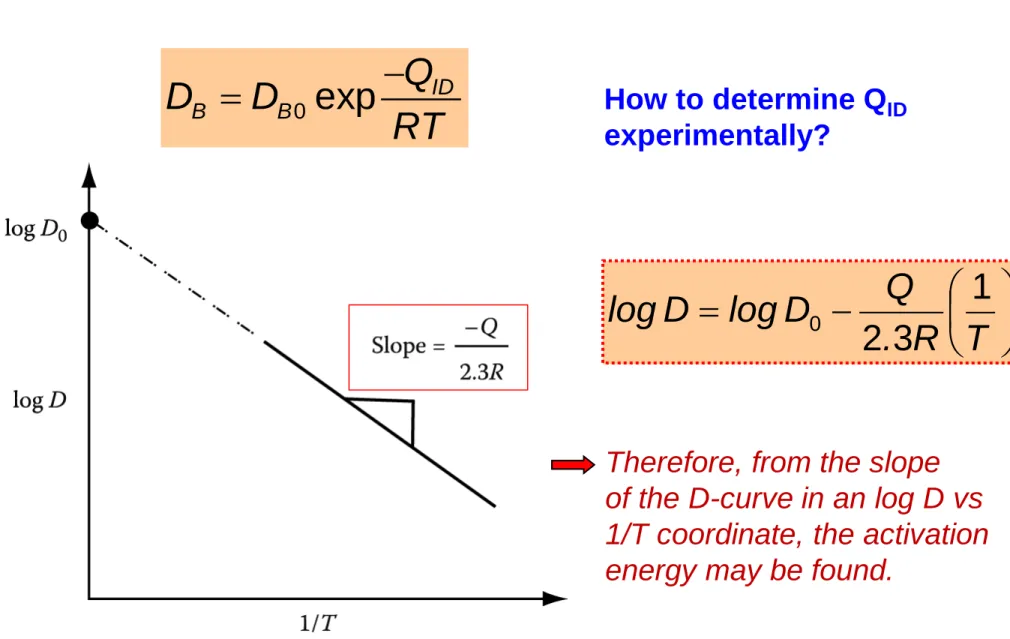
−
= . R T
D Q log D
log 1
3
0
2
Temperature Dependence of Diffusion
=
0exp −
IDB B
D D Q
RT
Therefore, from the slope of the D-curve in an log D vs 1/T coordinate, the activation energy may be found.
How to determine Q
IDexperimentally?
Fig. 2.7 The slope of log D v. 1/T gives the activation energy for diffusion Q.
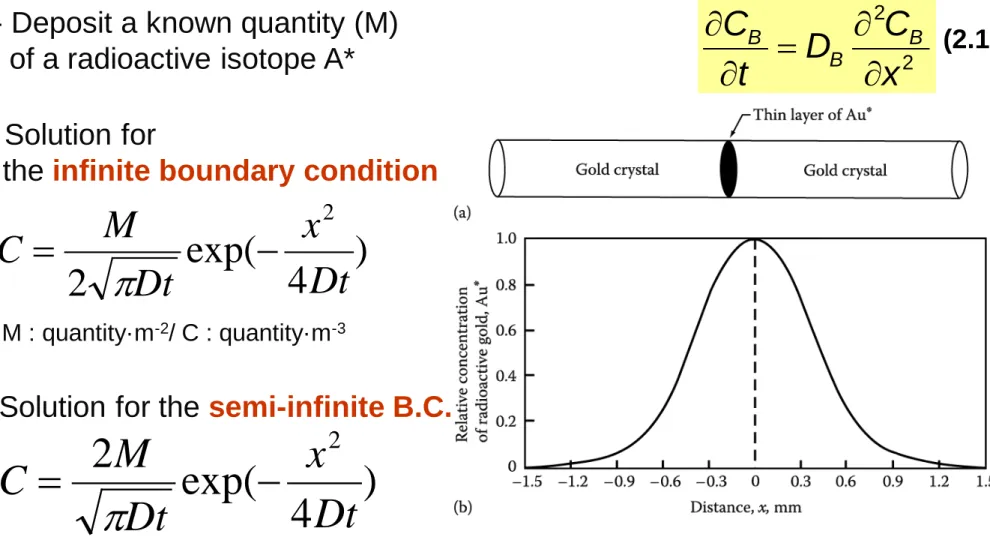
Fig. 2.14 Illustration of the principle of tracer diffusion and of the planar source method for determining the self-diffusion coefficient of gold. (a) Initial diffusion couple with planar source of radioactive gold Au*.
(b) Distribution of Au* after diffusion for 100h at 920℃
Experimental Determination of D
∂ ∂
∂ = ∂
2 2
B B
B
C C
t D x
1) Solution for
the infinite boundary condition
M : quantity·m
-2/ C : quantity·m
-3- Deposit a known quantity (M) of a radioactive isotope A*
4 ) 2 exp(
2
Dt x Dt
C = M −
π
4 )
2 exp( 2
Dt x Dt
C = M −
π
2) Solution for the semi-infinite B.C.
24
(2.18)
25
For a given structure and bond type, Q/RT
mis roughly constant;
Q is roughly proportional to T
m.
ex) for fcc and hcp, Q/RT
m~ 18 and D(T
m) ~ 1 µm
2s
-1(10
-12m
2s
-1)
For a given structure and bond type, D(T/T
m) ~ constant
T/T
m: homologous temperature
Within each class, D(T
m) and D
0are approximately constants.
Most close-packed metals Table 2.2 Experimental Data for Substitutional Self-Diffusion
in Pure Metals at Atmospheric Pressure
26
* Melting point diffusivities for various classes of materials:
: The diffusion coefficients of all materials with a given crystal structure and bond type will be approximately the same at the same fraction of their melting temperature, i.e. D(T/Tm) = const.
: Since volume usually increases on melting (Tm), raising the pressure increases Tm and thereby lowers the diffusivity at a given temperature.
1. Within each class, D(T
m) ~ approximately constants.
27 : Q and Tm exhibit rough linear correlation because increasing the interatomic bond strength makes the process of melting more difficult; that is, Tm is raised.
It also makes diffusion more difficult by increasing ΔHm & ΔHv.
For a given structure and bond type, Q/RT
mis roughly constant;
< Relationship between latent heat and melting point>
28b) A
M~ 1 for all liquid, A
Fdepends on crystal structure
- Metallic structure (FCC, C.P.H, and BCC, “less localized bonding”) ~ good relationship compared with the structures which are covalently bonded (“specific directional bonds”) . - Molecular liquid such as F
2, Cl
2~ extra condition for A
F( molecule must be correctly oriented in order to be accommodated.)
29
ex) At 800
oC, D
Cu= 5 × 10
-9mm
2s
-1, α = 0.25 nm
2
6
1
Bα
D
B= Γ Γ
Cu= 5 × 10
5jumps s
−1After an hour, diffusion distance (x)? Dt ~ 4 µ m
Cu : ? Γ
At 20
oC, D
Cu~ 10
-34mm
2s
-1Γ
Cu~ 10
−20jumps s
−1→ Each atom would make one jump every 10
12years!
Hint) From the data in Table 2.2, how do we estimate D
Cuat 20
oC?
How do we determine D
Cuat low temperature such as 20
oC?
Consider the effect of temperature on self-diffusion in Cu:
Fig. 2.7 The slope of log D v. 1/T gives the activation energy for diffusion Q.
30
Q. Interstitial diffusion vs Substitutional diffusion
1. Self diffusion in pure material 2. Vacancy diffusion
3. Diffusion in substitutional alloys
31
All the surrounding atoms are possible
jump sites of a vacancy, which is analogous to interstitial diffusion.
) /
exp(
) / 6 exp(
1 6 1
2 2
RT H
R S
zv D
m m
v v
∆
−
∆
=
Γ
=
α α
Comparing D
vwith the self-diffusion coefficient of A, D
A, 2. Vacancy diffusion
e v A
v
D X
D = /
This shows in fact that the diffusivity of vacancy (D
v) is many orders
of magnitude greater than the diffusivity of substitutional atoms (D
A).
32
3. Diffusion in substitutional alloys
J
AJ
BJ
VAt t = 0 ,
At t = t
1,
J
AJ
VAJ
A’
J
BJ
VBJ
B’ x D C J
J
J
A A Av A∂
− ∂
= +
′ = ~
x D C J
J
J
B B Bv B∂
− ∂
= +
′ = ~
B A A
B
D X D
X
D ~ = +
∂
∂
∂
= ∂
∂
∂
x D C x t
C
A~
AA
B
J
J ′ = − ′
∴
* During self-diffusion, all atoms are chemically identical
.: probability of finding a vacancy and jumping into the vacancy ~ equal
* In binary substitutional alloys, each atomic species must be
given its own intrinsic diffusion coefficient D
Aor D
B.
33
3. Diffusion in substitutional alloys
J
AJ
BJ
VAt t = 0 ,
At t = t
1,
J
AJ
VAJ
A’
J
BJ
VBJ
B’ x D C vC
J J
J
J
A A vA A A A∂
− ∂
= +
= +
′ = ~
x D C vC
J J
J
J
B B Bv B B B∂
− ∂
= +
= +
′ = ~
B A A
B
D X D
X
D ~ = +
∂
∂
∂
= ∂
∂
∂
x D C x t
C
A~
AA
B
J
J ′ = − ′
A원자와 B원자가 서로 다른 속도로 도약 → ∴
농도 구배에 의한 속도 + 격자면 이동에 의한 속도
A-rich AB B-rich AB 확산이 일어나는 격자이동에 의한 A 유속
공공의 net flux
침입형 확산에서 Fick의 법칙 고정된 격자면을 통한 이동 : A원자/B원자의 상호확산을 통한 격자면의 이동 고려
확산이 일어나는 격자이동에 의한 B 유속 고정된 격자 내에서 확산에 의한 유속
고정된 격자 내에서 확산에 의한 유속