Introduction to Introduction to
Materials Science and Engineering g g
Chapter 5 Diffusion in Solids Chapter 5. Diffusion in Solids
¾ How does diffusion occur?
¾ Why is it important for synthesis?y p y
¾ How can the rate of diffusion be predicted?
¾ How does the diffusivity depend on the
¾ How does the diffusivity depend on the structure and temperature?
1
Activation Energy for Diffusion
In basketball, smaller players can ‘‘diffuse’’
through the open spaces between bigger
2
through the open spaces between bigger players. (Courtesy of Getty Images)
Introduction
¾ Diffusion demo (in liquid and gas)
3 http://www.class1air.com/facts.htm
Contents
1
Introduction Introduction
Diffusion Mechanisms Diffusion Mechanisms
1 2
Introduction Introduction
Diffusion Mechanisms Diffusion Mechanisms St d St t Diff i St d St t Diff i
3 2
Steady-State Diffusion Steady-State Diffusion
3
Nonsteady-State Diffusion Nonsteady-State Diffusion
4
5
Factors That Influence Diffusion Factors That Influence Diffusion
4
Introduction
d l l b b l b h l d
¾ Atoms and molecules can be quite mobile in both liquids and solids, especially at high temperature.
√ Drop of ink in a beaker of water Æ spread, water evenly colored.p , y
√ Intermixing at molecular level Æ Diffusion
¾ Continuous motion of H O molecules in water at R T
¾ Continuous motion of H2O molecules in water at R.T.
Æ Self diffusion
¾ Atomic-scale motion (diffusion) in liquids is relatively rapid and easy to visualize.
¾ More difficult to visualize diffusion in rigid solids, but it does occur.
5
.
¾ Diffusi n is l t d t th int n l t m m m nts
Diffusion
¾ Diffusion is related to the internal atom movements.
¾ Heat treatments alter the properties of materials.
I t l t t f Only possible by Internal structure of
material changes Only possible by
atom movement
¾ Diffusion required for:
√ Synthesis of transistors and solar cells
√ Synthesis of transistors and solar cells
√ Heat treatment of metals
√ Manufacture of ceramics
√ Solidification of materials
6 √ Electrical conductivity of ceramic materials
Diffusion-Phenomenon (1)
d ff
¾ Interdiffusion
in diffusion couple- Atoms migrate from high to low-concentration regions
Initially After some
time time
(Fig. 5-2) (Fig. 5-1)
( g )
7
Diffusion-Phenomenon (2)
¾ Self diffusion:
All atoms exchanging positions are of the same type All atoms exchanging positions are of the same type Label some atoms After some time
C C C
A
D A D
B
D B
8 * Labeling by isotope (tracer diffusion)
Contents
1
Introduction Introduction
Diffusion Mechanisms Diffusion Mechanisms
1 2
Introduction Introduction
Diffusion Mechanisms Diffusion Mechanisms St d St t Diff i St d St t Diff i
3 2
Steady State Diffusion Steady State Diffusion
3
Nonsteady State Diffusion Nonsteady State Diffusion
4
5
Factors That Influence Diffusion Factors That Influence Diffusion
9
Diffusion
h l d ff h l d h
¾ The slower diffusion rate in the solid state than in the liquid state.
¾ Tight atomic structure of atoms has an impact on the diffusion of atoms or ions within the solid.
the diffusion of atoms or ions within the solid.
¾ The energy required to squeeze most atoms or
i th h f t t l t t
ions through a perfect crystal structure are so high that diffusion is nearly impossible.
(Fig. 5-3)
10
Substitutional Diffusion (Vacancy Diffusion)
(Vacancy Diffusion)
¾ What is needed to make solid-state diffusion practical? Æ
POINT DEFECTS
(Fig 5 3) (Fig. 5-3)
V
11
Vacancy vs. Interstitial Diffusion
- Atom interchange from a normal lattice position to an adjacent vacant lattice site
(Fig. 5-3)
adjacent vacant lattice site.
- The extent of vacancy diffusion is controlled by the concentration of these defects
defects.
- The direction of vacancy i i i h motion is opposite to the direction of diffusing atoms.
atoms.
- Both self-diffusion and i t diff si b this
12
interdiffusion occur by this mechanism.
12
Vacancy Diffusion
S b tit ti l Diff i
Substitutional Diffusion
¾ Applies to substitutional solutes (impurities)pp ( p )
¾ Atoms exchange with vacancies
¾ Rate depends on:
¾ Rate depends on:
√ number of vacancies
√ activation energy to migrate
13 increasing elapsed time
Self Diffusion
¾ In an elemental solid, atoms also migrate.
L b l Aft ti
Label some atomsLabel some atoms After some timeAfter some time
C
C C C
A C A C
D D D
D A
B A
B B
B B B
14
Interdiffusion
¾ In an alloy, atoms tend to migrate from regions of large concentration.
large concentration.
Initially After some time
100% Cu Ni
100%
C t ti P fil
0 0
15
Concentration Profiles Concentration Profiles
Interstitial Diffusion
¾ Migration of interstitial atoms from an interstitial position to an
adjacent empty site adjacent empty site.
¾ Typical interstitial atoms: yp hydrogen, y g carbon, nitrogen, or oxygen.
¾ In most solids, interstitial diffusion occurs much more rapidly than
occurs much more rapidly than vacancy diffusion.
16
Activation Energy for Diffusion
¾ Conditions for atom migrationond t ons for atom m grat on
:
- empty adjacent site
- atom must have enough energy to break bonds and atom must have enough energy to break bonds and cause lattice distortion during displacement.
¾ Diffusive motion influenced by
¾ Diffusive motion influenced by
atom vibrational energies (
k
BT
) or phonon.(Eq. 5-8)
Please check page 38.
17
Diffusion
¾ S b tit ti l Diff i
¾ Substitutional Diffusion (Vacancy Diffusion)
(Vacancy Diffusion)
√
Self diffusion
√
Interdiffusion
¾ Interstitial Diffusion
18
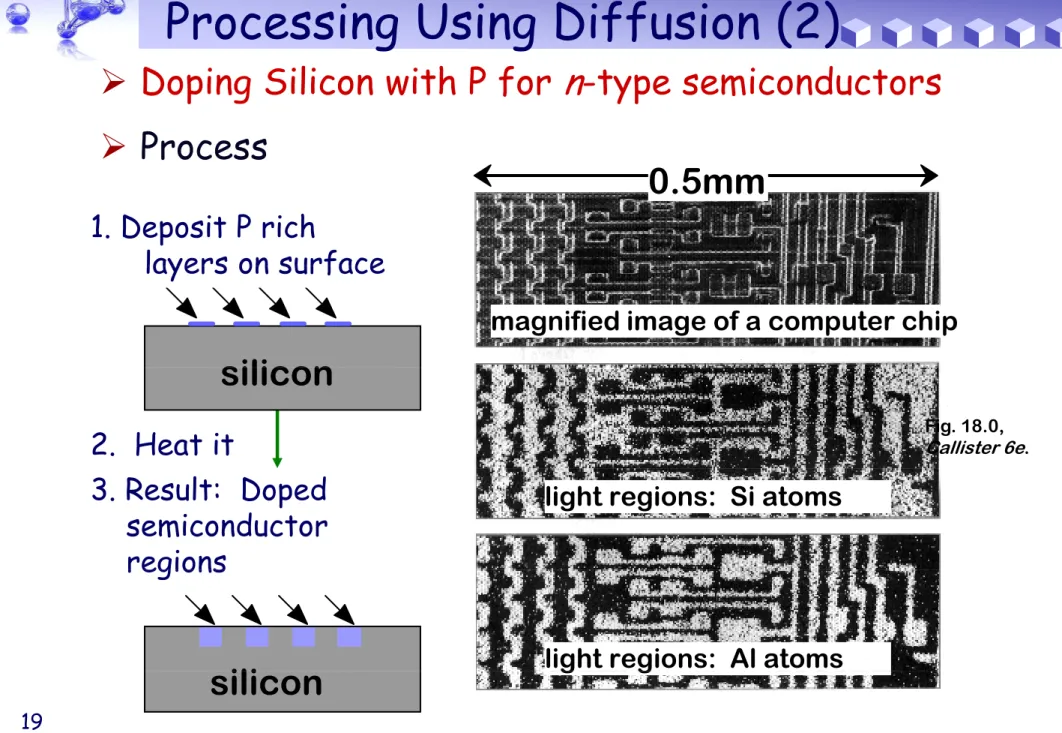
Processing Using Diffusion (2)
¾ Doping Silicon with P for n-type semiconductors
¾ Process
1. Deposit P rich
layers on surface
0.5mm
layers on surface
silicon
magnified image of a computer chip
2. Heat it
silicon
Fig. 18.0, Callister 6e.
3. Result: Doped semiconductor regions
light regions: Si atoms
regions
ili light regions: Al atoms
19
silicon g g
Contents
1
Introduction Introduction
Diffusion Mechanisms Diffusion Mechanisms
1 2
Introduction Introduction
Diffusion Mechanisms Diffusion Mechanisms St d St t Diff i St d St t Diff i
3 2
Steady-State Diffusion Steady-State Diffusion
3
Nonsteady-State Diffusion Nonsteady-State Diffusion
4
5
Factors That Influence Diffusion Factors That Influence Diffusion
20
Steady State Diffusion
¾ Concentration Profile, C(x): [atoms/cm3]
100%
100%
0Concentration Profiles 0
¾ Fick's First Law
J
x= − D dC d
¾ The steeper the concentration profile
x
dx
21
¾ The steeper the concentration profile, the greater the flux!
Steady State Diffusion
(Fig 5-4) (Fig. 5 4)
22
Contents
1
Introduction Introduction
Diffusion Mechanisms Diffusion Mechanisms
1 2
Introduction Introduction
Diffusion Mechanisms Diffusion Mechanisms St d St t Diff i St d St t Diff i
3 2
Steady-State Diffusion Steady-State Diffusion
3
Nonsteady-State Diffusion Nonsteady-State Diffusion
4
5
Factors That Influence Diffusion Factors That Influence Diffusion
23
Nonsteady-State Diffusion
¾ Steady-state diffusion not commonly encountered in engineering materials
materials.
¾ In most cases the concentration of solute atoms at any point in th t i l h ith ti Î N t d t t diff i the material changes with time Î Nonsteady-state diffusion
t
(Fig. 5-5)
t
224
t
0t
1Fick ’ s Second Law
Fick ’ s 2
ndlaw applies for nonsteady-state cases.
(skip)
Cs
C Co
x
25
Diffusion Demo: Analysis
¾ The experiment: combinations of t and x that kept C constant, were recorded.
to t1 t2 t3
xo x1 x2 x3
¾(Diffusion Length) ( _____________________ g ) 2 = Dt
26
Diffusion Coefficient
(Fig. 5-7)
27
- 2009-10-07
Contents
1
Introduction Introduction
Diffusion Mechanisms Diffusion Mechanisms
1 2
Introduction Introduction
Diffusion Mechanisms Diffusion Mechanisms St d St t Diff i St d St t Diff i
3 2
Steady State Diffusion Steady State Diffusion
3
Nonsteady State Diffusion Nonsteady State Diffusion
4
5
Factors That Influence Diffusion Factors That Influence Diffusion
28
Factors influencing diffusion
¾ Temperature
- Diffusion is thermally activated processesDiffusion is thermally activated processes.
(Eq. 5-8)
) exp( Q D
D = exp(
d)
( q )T
D k D
B
o
−
__________ =
( V/ t ) diff i
f ti ti
/s) (cm
tial preexponen t
independen re
temperatu
: 2
Q Do
eV/K 10
8.617
constant s
Boltzman' :
(eV/atom) diffusion
for energy
activation :
k 5
Q
B d
× −
= (K) re
temperatu absolute
: T
29
Factors influencing diffusion
¾ Diffusing Species
(Table. 5-2)30
Diffusion
Example: Determine D
cuin Ni at 500 ° C.
Q
d= 2.5 eV/atom
D = 2 7 x 10
-1cm
2/sec D
O= 2.7 x 10
1cm
2/sec T = 500 + 273 = 773 K
k
B= 8.617 x 10
-5eV/atom·K
D = 1.33 x 10
-18cm
2/sec
31
Factors influencing diffusion
¾ Temperature
lnDo
ln D -Qd/R
ln D
¾Arrhenius plot of relationship between diffusion coefficient and reciprocal of
32
p
temperature for different elements.
Factors influencing diffusion
¾ Determination of activation energy
(Fig. 5-8)
33
Factors influencing diffusion
¾ Crystal structure
34
Factors influencing diffusion
¾ Grain boundary
- Diffusion is faster along the grain boundaries than through the grain:√ More open structure at grain boundaries than the interior grain.
√ Much lower activation
energy for diffusion along i b d
energy for diffusion along
the grain boundaries grain boundary
bulk
35
Diffusion Concepts
¾ Stepwise migration of atoms from a lattice p int t n th
point to another.
¾ Diffusive motion: influenced by y
atom vibrational energies (temperature).
¾ Conditions for atomic migration:
√ Empty adjacent site
√ Empty adjacent site.
√ Atom must have enough energy to break bonds, and cause lattice distortion at the activated state.
36
SUMMARY: Structure & Diffusion
Diffusion FASTER for... Diffusion SLOWER for...
Open crystal structures Close-packed structures
L l i T i l Hi h l i T i l
Lower melting T materials Higher melting T materials Materials with metallic or Materials with covalent
secondary bonding bonding
Smaller diffusing atoms Larger diffusing atoms
37
Substitutional vs. Interstitial Diffusion
Activation energy for substitutional diffusion
>
>
Activation energy for interstitial diffusion
Migration energy for Vacancy
=
Migration energy for Interstitial
~
g gy
38
Activation Energy for Diffusion
Problems from Chap. 5 http://bp.snu.ac.kr
Prob. 5-1 Prob. 5-2 Prob. 5-3 Prob. 5-5 Prob. 5-10 Prob 5 17 Prob 5 19 Prob 5 22 Prob 5 23
39
Prob. 5-17 Prob. 5-19 Prob. 5-22 Prob. 5-23