“Phase Equilibria in Materials”
Eun Soo Park
Office: 33-313
Telephone: 880-7221 Email: [email protected]
Office hours: by an appointment
2015 Fall
09. 09. 2015
1
Gibbs Free Energy as a Function of Temp. and Pressure
- Single component system
Chapter 1
= 0 dG
P V S G
T G
T P
=
∂
− ∂
=
∂
∂ ,
Thermondynamics and Phase Diagrams
- Equilibrium
2 1
0
G G G
∆ = − <
- Phase Transformation
Contents for previous class
Lowest possible value of G
No desire to change ad infinitum
V T
H dT
dP
eq
eq ∆
= ∆ ) (
Clausius-Clapeyron Relation
- Classification of phase transition
First order transition:
CDD/Second order transition: CCDThe First-Order Transitions
G
T S
T
∆S = L/T
T CP
N P
P T
T S C
,
∂
= ∂ Latent heat
Energy barrier
Discontinuous entropy, heat capacity
The Second Order Transition
G
T S
T
∆S=0
Second-order transition
T CP
No Latent heat
Continuous entropy
∞
→
∂
= ∂
N P
P T
T S C
,
Liquid Undercooled Liquid Solid
<Thermodynamic>
Solidification:
Liquid Solid• Interfacial energy ΔTN
Melting:
Liquid Solid• Interfacial energy
SV LV
SL
γ γ
γ + <
No superheating required!
No ΔTN Tm
vapor
Melting and Crystallization are Thermodynamic Transitions
6 NANO STRUCTURED MATERIALS LAB.
T
mContents for today’s class
- Chemical potential and Activity
- Gibbs Free Energy in Binary System
Ideal solution and Regular solution
- Binary System mixture/ solution / compound
Hume-Rothery Rules for Alloys
8
Q1: What are binary systems?
“Mixture vs. Solution vs. Compound”
Multi-component system:
* Binary system (two components) A, B
- Mixture ; A – A, B – B ; the physical combination of two or
more substances on which the identities and boundaries are retained. A B
* Single component system One element (Al, Fe), One type of molecule (H2O)
: Equilibrium depends on pressure and temperature.
: Equilibrium depends on not only pressure and temperature but also composition.
Alluvial mining
Winnowing
wash rice Select egg
10
- Solution ; A – A – A ; atomic scale mixture/ Random distribution
A – B – A Solid solution : substitutional or interstitial
- Compound ; A – B – A – B ; fixed A, B positions/ Ordered state
B – A – B – A
MgCNi3
Q2: What is “Alloying”?
Ordered Compounds or Solid Solutions
12 12
Ordered Substitutional and Interstititials Compounds
Substitutional Interstitial
element replaces host atoms element goes into holes in an orderly arrangement in an orderly arrangement
e.g., Ni3Al (hi-T yield strength),
Al3(Li,Zr) (strengthening) e.g., small impurities, clays ionic crystals, ceramics.
“Alloying” : atoms mixed on a lattice
Ordered Compounds and Solid Solutions
Intermetallic Compounds
Mg2Pb
Intermetallic compounds form lines - not areas - because stoichiometry (i.e.
composition) is exact.
Antifluorite Structure:
• FCC unit cell with anions occupying FCC sites
• Cations occupying 8
octahedral interstitial sites
14
- Solution ; A – A – A ; atomic scale mixing, Random distribution
A – B – A
Two Possibilities for Solid Solutions: B atoms in A atoms Substitutional Interstitials
‘new element replaces host atoms’ ‘new element goes in holes’
Q3: “Solution vs. Intermetallic compound”?
ruthenium 루테늄 《백금류의 금속 원소;기호 Ru, 번호 44》 16
Solid Solution vs. Intermetallic Compound
Crystal structure
Surface
Pt0.5Ru0.5 – Pt structure (fcc) PtPb – NiAS structure
solid solution and ordered compound Alloying: atoms mixed on a lattice
Solid Solution vs. Intermetallic Compounds
Pt0.5Ru0.5 – Pt structure (fcc) PbPt – NiAS structure
: in order to introduce some of the basic concepts of the thermodynamics of alloys
Assumption:
a simple physical model for “binary solid solutions”
18
• Solid solution of B in A plus particles of a new phase (usually for a larger amount of B)
Second phase particle --different composition --often different structure.
Particles of New Phase in Solid-Solution Alloys
Solid Solution phase: B atoms in A
19
c. Mechanism of Precipitation
(1) (2) (3)
(1)
(2)
(3)
(1) (2) (3)
Atomic diffusion Precipitate
Matrix atom
Composition
Temperature
5) Microstructure control : ② Secondary phase control
20
Q4: How can we classify “Solubility”?
Solubility
• Unlimited Solubility
– Hume Rothery’ Conditions
• Similar Size
• Same Crystal Structure
• Same Valance
• Similar Electronegativity
– Implies single phase
• Limited Solubility
– Implies multiple phases
• No Solubility
- oil and water region
22
Cu-Ag Alloys Cu-Ni Alloys
complete solid solution limited solid solution
* Complete immiscibility of two metals does not exist.
: The solubility of one metal in another may be so low (e.g. Cu in Ge <10-7 at%.)
that it is difficult to detect experimentally, but there will always be a measure of solubility.
24
26
Q5: Can we roughly estimate
what atoms will form solid solutions?
“Hume-Rothery Rules”
28
Hume-Rothery Rules for Alloys (atoms mixing on a lattice)
Will mixing 2 (or more) different types of atoms lead to a solid-solution phase?
Empirical observations have identified 4 major contributors through : +1 +2
Atomic Size Factor , Crystal Structure, Electronegativity, Valences
Hume-Rothery Rules for Mixing
Empirical rules for substitutional solid-solution formation were identified from experiment that are not exact, but give an expectation of formation.
Briefly,
1) Atomic Size Factor The 15% Rule
If "size difference" of elements are greater than ±15%, the lattice distortions (i.e. local lattice strain) are too big and solid-solution will not be favored.
DR%= < ±15% will not disallow formation.
2) Crystal Structure Like elemental crystal structures are better
For appreciable solubility, the crystal structure for metals must be the same.
3) Electronegativity DE ~ 0 favors solid-solution.
The more electropositive one element and the more electronegative the other, then "intermetallic compounds" (order alloys) are more likely.
4) Valences Higher in lower alright. Lower in higher, it’s a fight.
A metal will dissolve another metal of higher valency more than one of lower valency.
rsolute − rsolvent
rsolvent x100%
30
Is solid-solution favorable, or not?
• Cu-Ni Alloys
Rule 1: rCu = 0.128 nm and rNi= 0.125 nm.
DR%= = 2.3% favorable √
Rule 2: Ni and Cu have the FCC crystal structure. favorable √ Rule 3: ECu = 1.90 and ENi= 1.80. Thus, DE%= -5.2% favorable √ Rule 4: Valency of Ni and Cu are both +2. favorable √
Expect Ni and Cu forms S.S. over wide composition range.
At high T, it does (helpful processing info), but actually phase separates at low T due to energetics (quantum mechanics).
Hume-Rothery Empirical Rules in Action
rsolute − rsolvent
rsolvent x100%
Is solid-solution favorable, or not?
• Cu-Ag Alloys
Rule 1: rCu = 0.128 nm and rAg= 0.144 nm.
DR%= = 9.4% favorable √
Rule 2: Ag and Cu have the FCC crystal structure. favorable √ Rule 3: ECu = 1.90 and ENi= 1.80. Thus, DE%= -5.2% favorable √ Rule 4: Valency of Cu is +2 and Ag is +1. NOT favorable
Expect Ag and Cu have limited solubility.
In fact, the Cu-Ag phase diagram (T vs. c) shows that a solubility of only 18% Ag can be achieved at high T in the Cu-rich alloys.
rsolute − rsolvent
rsolvent x100%
Hume-Rothery Empirical Rules in Action
32
Cu-Ag Alloys Cu-Ni Alloys
complete solid solution limited solid solution
(1) Thermodynamic : high entropy effect (2) Kinetics : sluggish diffusion effect (3) Structure : severe lattice distortion effect (4) Property : cocktail effect
Major element 2
Major element 3 Major
element 4, 5..
Major element 1
Minor element 2 Minor element 3
Major element
Traditional alloys
Minor element 1
Conventional alloy system High entropy alloy system
Yong Zhang et al., Adv. Eng. Mat. P534-538, 2008
Ex) 304 steel - Fe74Cr18Ni8 Ex) Al20Co20Cr20Fe20Ni20
Severe lattice distortion → Sluggish diffusion & Thermal stability
High entropy alloy (HEA)
34
Q6: How to calculate
“Gibbs Free Energy of Binary Solutions”?
G
2= G
1+ ΔG
mixJ/mol
* Composition in mole fraction XA, XB XA + XB = 1
Step 1. bring together XA mole of pure A and XB mole of pure B
Step 2. allow the A and B atoms to mix together to make a homogeneous solid solution.
2) Gibbs Free Energy of Binary Solutions
: binary solid solution/ a fixed pressure of 1 atm Binary Solutions
36
Gibbs Free Energy of The System
In Step 1
-
The molar free energies of pure A and pure B pure A;
pure B;
;X
A, X
B(mole fraction
) ), (T P GA
) , (T P GB
G
1= X
AG
A+ X
BG
BJ/mol
Free energy of mixture
1.3 Binary Solutions
Gibbs Free Energy of The System
In Step 2
G
2= G
1+ ΔG
mixJ/mol
Since G
1= H
1– TS
1and G
2= H
2– TS
2And putting ∆H
mix= H
2- H
1∆S
mix= S
2- S
1
∆G
mix= ∆H
mix- T∆S
mix∆Hmix : Heat of Solution i.e. heat absorbed or evolved during step 2
∆Smix : difference in entropy between the mixed and unmixed state.
How can you estimate ΔH
mixand ΔS
mix?
1.3 Binary Solutions
38
Q7: How can you estimate
“ΔG mix of ideal solid solution”?
Gibbs Free Energy of Binary Solutions
) ln
ln
(
A A B Bmix
RT X X X X
G = +
∆
ΔG
mix= -T ΔS
mixMixing free energy, Δ G
mixAssumption 1; ∆ H
mix=0 :
; A & B = complete solid solution ( A,B ; same crystal structure) ; no volume change
- Ideal solution
w k
S = ln
w : degree of randomness, k: Boltzman constant thermal; vibration ( no volume change )
Configuration; number of distinguishable ways of arranging the atoms
ΔG
mix= -T ΔS
mixJ/mol
∆G
mix= ∆ H
mix- T ∆ S
mixEntropy can be computed from randomness by Boltzmann equation, i.e.,
=
th+
configS S S
1.3 Binary Solutions
40
)]
ln (
) ln
( ) ln
[(
,
,
1
! ln
!
)!
ln (
0 0
0
o B o
B o
B o
A o
A o
A o
o o
B A
B B
A A
B A
B before A
after mix
N X N
X N
X N
X N
X N
X N
N N
k
N N
N N
X N
N X N
N k N
N k N
S S
S
−
−
−
−
−
=
= +
=
=
→
+ −
=
−
=
∆
N N
N
N ! ≈ ln − ln
Excess mixing Entropy
) , _(
_
!
!
)!
(
) _
_(
_
1
B A B
A B A
config config
N N solution after
N N
N w N
pureB pureA
solution before
w
+ →
=
→
=
If there is no volume change or heat change,
Number of distinguishable way of atomic arrangement
kN
0R =
using Stirling’s approximation and
1.3 Binary Solutions
Ideal solutionSince we are dealing with 1 mol of solution,
) ln
ln
( X
AX
AX
BX
BR +
−
=
(the universal gas constant)
41
Excess mixing Entropy
) ln
ln
(
A A B Bmix
R X X X X
S = − +
∆
) ln
ln
(
A A B Bmix
RT X X X X
G = +
∆
ΔG
mix= -T ΔS
mix1.3 Binary Solutions
Ideal solution42
Q8: How can you estimate
“Molar Free energy for ideal solid solution”?
Gibbs Free Energy of Binary Solutions
G
2= G
1+ ΔG
mixG = X
AG
A+ X
BG
B+ RT(X
AlnX
A+ X
BlnX
B)
44
Since ΔHmix = 0 for ideal solution,
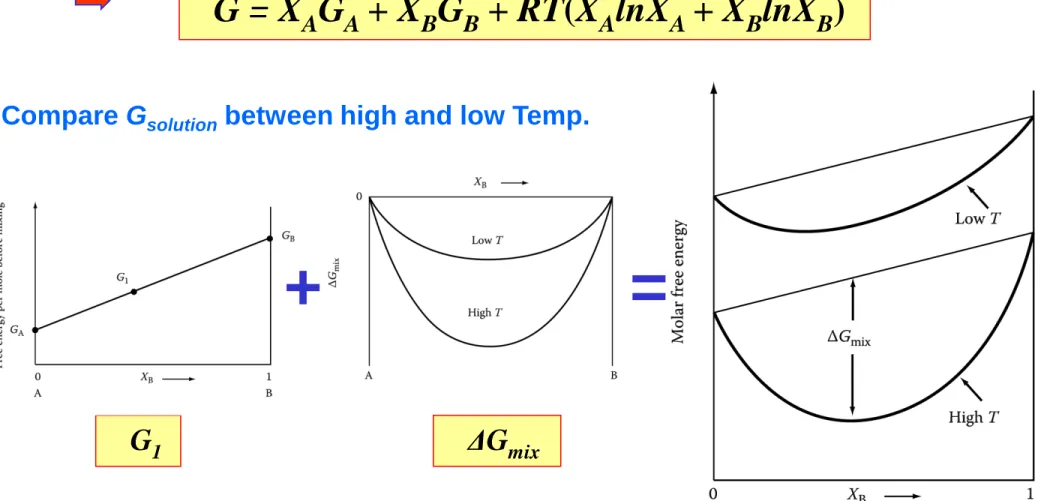
Compare Gsolution between high and low Temp.
G
2= G
1+ ΔG
mixG
1ΔG
mix1) Ideal solution
1.3 Binary Solutions
Fig. 1.10 The molar free energy (free energy per mole of solution) for an ideal solid solution.
A combination of Figs. 1.8 and 1.9.
+ =
G = X
AG
A+ X
BG
B+ RT(X
AlnX
A+ X
BlnX
B)
Q9: How the free energy of a given phase will change when atoms are added or removed?
“ Chemical potential ”
Gibbs Free Energy of Binary Solutions
46
Chemical potential
= µ
A AdG' dn
The increase of the total free energy of the system by the increase of very small quantity of A, dn
A, will be proportional to
μA.
dnA~ small enough
(∵ µA depends on the composition of phase)
(T, P, n
B: constant )
G =
H-TS = E+PV-TS
For A-B binary solution, dG' = µ
Adn
A+ µ
Bdn
B= − + + µ
A A+ µ
B BdG' SdT VdP dn dn
For variable T and P
1) Ideal solution
1.3 Binary Solutions
µ
A:
partial molar free energy of A or chemical potential of A ∂
µ = A ∂ A T, P, nB
G' n
∂
µ = B ∂ B T, P, nA
G' n
48
Chemical potential
= µ
A AdG' dn
The increase of the total free energy of the system by the increase of very small quantity of A, dn
A, will be proportional to
μA.
dnA~ small enough
(∵ µA depends on the composition of phase)
(T, P, n
B: constant )
G =
H-TS = E+PV-TS
For A-B binary solution, dG' = µ
Adn
A+ µ
Bdn
B= − + + µ
A A+ µ
B BdG' SdT VdP dn dn
For variable T and P
1) Ideal solution
1.3 Binary Solutions
µ
A:
partial molar free energy of A or chemical potential of A ∂
µ = A ∂ A T, P, nB
G' n
∂
µ = B ∂ B T, P, nA
G' n
Q10: “Correlation between chemical potential and free energy”?
Gibbs Free Energy of Binary Solutions
50
−1
= µ
A A+ µ
B BG X X Jmol
A A B B
dG = µ dX + µ dX
B A
B
dG
dX = µ − µ
A B
B
dG µ = µ − dX
( 1 )
B A B B
B
B A A B B
B
B A
B
B B
B
G dG X X
dX
X dG X X dX
dG X dX
dG X dX
= µ − + µ
= µ − + µ
= µ −
= µ − −
B A
B
G dG X µ = + dX
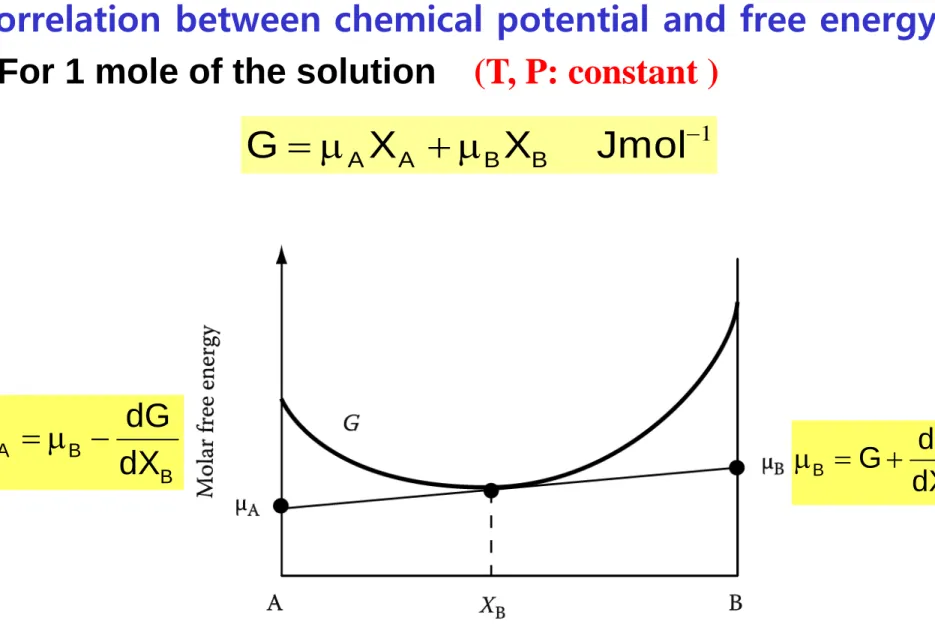
For 1 mole of the solution (T, P: constant )
1) Ideal solution
Correlation between chemical potential and free energy
−1
= µ
A A+ µ
B BG X X Jmol
1) Ideal solution For 1 mole of the solution (T, P: constant )
Correlation between chemical potential and free energy
GA GB
μA
μB
XA XB XB
B A
B
G dG X µ = + dX
) 1
(
BB
B
X
dX
G + dG − µ =
B B
A
B
dX
X dG
X )
( +
−
= µ
G
A B C
X
AA B
B
dG µ = µ − dX
CB DC
DA − −
=
D
X
BDC DA +
=
52
A B
B
dG µ = µ − dX
−1
= µ
A A+ µ
B BG X X Jmol
B A
B
G dG X
µ = +
dX
For 1 mole of the solution (T, P: constant )
Correlation between chemical potential and free energy
1) Ideal solution
Fig. 1.11 The relationship between the free energy curve for a solution and the chemical potentials of the components.
53
1) Ideal solution
1.3 Binary Solutions
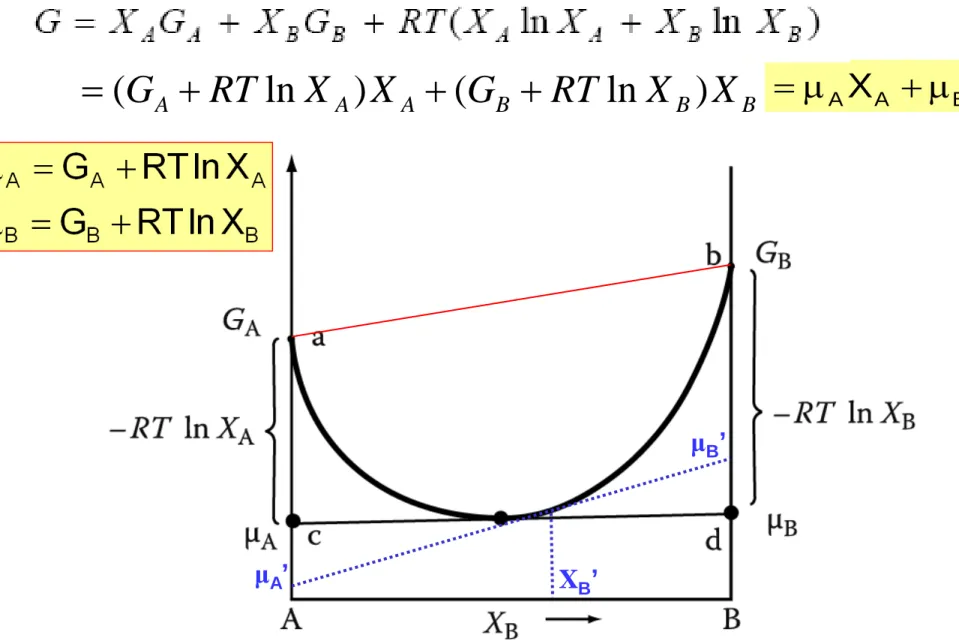
μB’
μA’ XB’
Fig. 1.12 The relationship between the free energy curve and
= µ
A A+ µ
B BG X X
B B
B A
A
A
RT X X G RT X X
G ln ) ( ln )
( + + +
=
54
Contents for today’s class
- Chemical potential and Activity
- Gibbs Free Energy in Binary System - Binary System
Ideal solution
Regular solution
mixture/ solution / compound
G
2= G
1+ ΔG
mixJ/mol G
1= X
AG
A+ X
BG
BJ/mol
( ∆ H
mix=0) ∆ G
mix= RT ( X
Aln X
A+ X
Bln X
B)
∆
mix=
ABε ε = ε −
AB1 ε + ε
AA BBH P where ( )
2
) ln
ln
(
A A B BB A B
B A
A
G X G X X RT X X X X
X
G = + + Ω + +
∂
µ = A ∂ A T, P, nB
G' n
• μA = GA + RTlnaA
μ는 조성에 의해 결정되기 때문에 dnA가 매우 작아서 조성변화 없어야