https://doi.org/10.9721/KJFST.2017.49.3.258
258
©The Korean Society of Food Science and Technology
쓴메밀 종자의 추출방법에 따른 루틴 및 퀘세틴 함량 비교
김수정
†·손황배
†·김금희·이유영
1·홍수영·김기덕·남정환·장동칠·서종택·구본철·김율호*
국립식량과학원 고령지농업연구소, 1국립식량과학원 중부작물부
Comparison and validation of rutin and quercetin contents according to the
extraction method of tartary Buckwheat (Fagopyrum tataricum Gaertn.)
Su Jeong Kim†, Hwang Bae Sohn†, Geum Hee Kim, Yu Young Lee1, Su Young Hong, Ki Deog Kim, Jeong Hwan Nam, Dong Chil Chang, Jong Taek Suh, Bon Cheol Koo, and Yul Ho Kim* Highland Agriculture Research Institute, National Institute of Crop Science, Rural Development Administration
1Department of Central Area, National Institute of Crop Science, Rural Development Administration
Abstract The stability and accuracy of ultra-performance liquid chromatography (UPLC) used for evaluating the contents of rutin and quercetin in tartary buckwheat (Fagopyrum tataricum Gaertn.) seeds extracted by seven different extraction methods were determined. The seven extraction methods were reflux extraction (RE), ultra-sonification extraction (UE), stirrer extraction (SE), RE after UE (UE+RE), RE after SE (SE+RE), UE after SE (SE+UE), and RE with UE after SE (SE+UE+RE). Among the seven extraction methods used, RE yielded comparatively higher contents of rutin (2,277 mg/ 100 g) and quercetin (158 mg/100 g) than those yielded by other six extraction methods. The intra-day repeatability and inter-day precision of RE was 0.4-3.2% considering relative standard deviation (RSD), while accuracy was 88.8-102.4%. Therefore, RE with UPLC would be a rapid, accurate, and stable method for analyzing rutin and quercetin contents in tartary buckwheat.
Keywords: reflux extraction; rutin; quercetin; tartary buckwheat
서
론
메밀은 우리나라를 비롯하여 중국, 인도, 네팔, 슬로베니아, 캐 나다 등에서 재배되고 있으며, 대표적인 재배종으로 보통메밀 (common buckwheat, sweet buckwheat, Fagopyrum esculentum Moench)과 쓴메밀(tartary buckwheat, bitter buckwheat, Fagopy-rum tataricum L. Gaertn.)로 구분할 수 있다(1).
쓴메밀은 풍부한 아미노산, 식이섬유, 미네랄, 그리고 페놀화합 물을 가지고 있어 식품영양학적 및 약리학적 가치가 높아 차, 국 수 및 빵과 같은 식품뿐만 아니라 성인병의 예방과 치료를 위한 식의약소재로의 활용성이 증가하는 추세이다(2,3). 쓴메밀이 식의 약소재로 수요가 증가하는 이유는 생리활성 물질로 알려진 루틴 (rutin), 퀘세틴(quercetin)과 같은 기능성 물질을 다량 함유하기 때 문이다(4). 퀘세틴에 루티노사이드를 붙인 담황색 물질이 루틴이 며, 메밀속 재배종에서 0.05-2.14% 범위의 루틴과 0.01-0.17% 범 위의 퀘세틴이 분포하였다(5,6). 이런 기능성 물질을 다량 함유하 고 있는 쓴메밀의 인체내 주요 효과는 항당뇨(7), 항비만(8), 항 염증(9), 심혈관 질환개선(10), 항산화(11) 등이 보고되었다. 다양한 생리활성을 지닌 쓴메밀을 식품 및 식의약 소재로 활 용하기 위한 효율적인 기능성 성분 추출방법의 확립은 산업적으 로 중요하다. 메밀을 에탄올 또는 메탄올로 추출하였을 때 루틴 의 추출효율이 높은 것으로 보고되었다(12,13). 현재까지 식물체 로부터 유용성분의 추출방법은 열수추출법, 상온교반추출법, 환 류냉각추출법, 초음파추출법, 고온가압추출법 그리고 저온고압추 출법 등이 사용되고 있으며(14-17), 메밀에서의 루틴 분석을 위한 추출 방법으로 환류냉각추출(18), 초음파추출(19), 상온교반추출법 (13,14) 등이 보고되었다. 루틴이나 퀘세틴 성분의 정량 또는 정성분석은 주로 HPLC 시 스템이 활용되고 있으며, 최근 UPLC의 도입으로 HPLC에 비해 더욱 진보된 분리능과 더 많은 샘플들을 빠르고 효과적으로 분 석하는 것이 가능하다(20). 그러나 현재까지 UPLC를 이용한 분 석방법은 다양한 추출방법을 대상으로 정밀성과 정확도 등 분석 의 유효성을 입증하는 연구결과가 충분하지 않은 실정이다(18,20). 따라서, 본 연구에서는 쓴메밀 종자의 추출방법에 따른 추출물 의 루틴과 퀘세틴 함량을 분석하여 정밀성, 재현성, 정확도 및 안 정성을 비교 검토하였다. 이를 통해 분석의 안정성이 검정된 효 율적인 추출방법을 제시하여 식물체내 성분 함량 및 루틴 고함 유 계통 선발 등에 기반기술로 활용하고자 하였다.
재료 및 방법
실험 시약 본 연구에 사용한 표준물질로 루틴(rutin, 순도 99%)과 퀘세틴†These authors contributed equally to this work.
*Corresponding author: Yul Ho Kim, Highland Agriculture Research Institute, National Institute of Crop Science, Pyeongchang 25342, Korea
Tel: 82-33-330-1840 Fax: 82-33-330-1519 E-mail: [email protected]
Received February 15, 2017; revised March 17, 2017; accepted March 28, 2017
(quercetin, 순도 99%)은 Extrasynthese (Genay, France)에서 구입하 였다. 분석에 사용된 모든 시약은 HPLC 순도로 아세토나이트릴 과 메탄올은 Tedia Company (Cincinnati, OH, USA), 포름산(for-mic acid)은 Sigma-Aldrich Company (St. Louis, MO, USA)에서 구입하였다. 증류수는 초순수증류수제조기(Milli-Q system, Millipore, Bedford, MO, USA)의 정제 시스템에서 초순수를 받아 사용하였다. 실험 재료
본 연구에서 사용한 쓴메밀 종자 시료는 강원도 평창군 진부 면(북위 37.615o, 동경 128.551o, 560 masl) 실험포장에서 2015년
5월에 파종하여 8월에 수확하여 20±5oC 조건에서 한달간 자연건 조한 후 분쇄기(Grinder SFM-555 SP, Shinil Co., Seoul, Korea) 를 이용하여 마쇄한 후 40 mesh 체로 거른 후 분말을 분석에 사 용하였다. 추출 방법 효율적인 쓴메밀 추출방법을 찾고자 논문으로 보고된 메밀 추 출방법을 참고하여(13,14,18,19) 7가지 추출방법을 1차 실험에서 9반복으로 하여 4차 실험까지 총 36반복으로 수행하였다. 쓴메밀 종자 분쇄시료 1 g에 100% 메탄올을 가한 후 환류냉각추출(reflux extraction, RE), 초음파추출(ultrasonification, UE), 상온교반추출 (stirrer extraction, SE), 초음파 후 환류냉각추출(reflux extraction after ultrasonification, URE), 상온교반 후 환류냉각추출(reflux extraction after stirrer extraction, SRE), 상온교반후 초음파추출 (ultrasonification after stirrer extraction, SUE), 상온교반과 초음파 후 환류냉각추출(reflux extraction with ultrasonification after stir-rer extraction, SURE)로 단독 또는 혼용으로 추출하는 방법으로 수행하였다(Table 1).
환류냉각추출은 분쇄시료와 용매를 넣은 둥근 플라스크에 냉 각관 속슬렛추출기(Soxhlet heater DH-43, Jisico Sci., Seoul, Korea)를 부착하여 80oC 항온수조에 1시간 추출하였다. 초음파추 출은 물을 채운 40 kHz (±6%)의 초음파 수조(Bransonic US/2415-U, Branson Ultrasonics Corporation, Banbury, MO, USA)에서 시 료와 용매를 넣은 유리병이 바닥에 닿지 않도록 하여 50oC 1시
간 초음파 처리하여 추출하였다. 상온교반추출은 25±2oC의 실온
에서 교반기(VS-201D, Vision bionex Co., Bucheon, Korea)를 이 용하여 280 rpm으로 교반하면서 24시간 추출하였다. 복합처리는 상온교반, 초음파추출, 환류냉각추출 순서대로 2가지 또는 3가지 연속으로 처리하였다.
각각의 추출물은 거름종이(No. 6, Whatman, Maidstone, UK) 1 장을 깔고 진공펌프(Vacuum Pump, GAST, Benton Harbor, MI, USA)로 여과한 후 볼륨 플라스크로 옮겨 100 mL로 정용하였다. 각각의 여과된 추출물은 초고속액체크로마토그래프(Ultra
Perfor-mance Liquid Chromatograph, UPLC, Waters Corporation, Mil-ford, MA, USA) 분석을 위해 시린지 필터(PTFE 13 mm 0.20 μm, PALL Life Sciences, Ann Arbor, MI, USA)로 다시 여과한 후 분석전까지 −20oC 냉동고에 보관하였다.
루틴 및 퀘세틴 분석
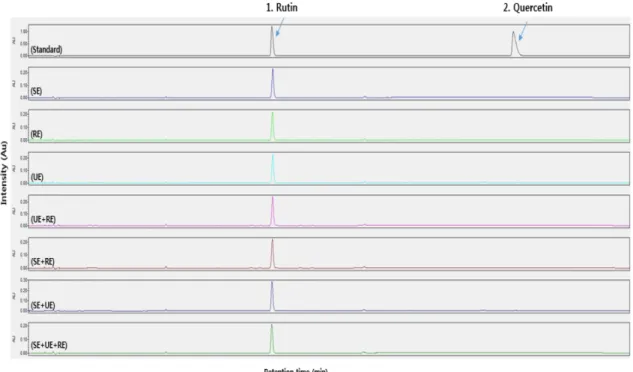
UPLC분석은 Shin et al.(20) 방법을 응용하였다. 플라보노이드 정량 분석을 위해 UV 검출기(detector)를 장착한 UPLC (Acquity UPLC I-Class, Waters Corporation) 기기와 분석칼럼(Acquity UPLC CSH C18, 2.1 mm i,d, 100 mm length, 1.7μm particle size)을 사용하였다. 이동상으로는 용매 A (1% formic acid in water, v/v)와 용매 B (0.1% formic acid in acetonitrile, v/v)를 사 용하여 유속은 0.25 mL/min으로 일정하게 흘려주었다. 용매 이송 은 기울기(gradient) 방식으로, 용매 B를 7%로 시작하여 2분에서 11분까지 7%에서 17%로 증가시켰다. 이후 11분에서 13분까지 용 매 B를 17%에서 25%로 증가시킨 후 19분까지 그 농도를 유지 시켰다. 이 후 용매 B를 19분에서 21분까지 25%에서 7%로 감 소시켰으며 23분까지 초기농도 유지하기 위해 B를 2분간 7%로 하여 안정화 시켰다. 기기내 칼럼 온도를 30oC로 설정하였고, 샘 플 온도를 20oC로 각각 설정하였다. 관측에 사용된 검출파장 (detection wavelength)은 259 nm이고, 시료주입량은 1 μL로 하였 다. 본 분석에 사용된 표준물질 루틴과 퀘르세튼의 피크와 추출 물 샘플의 각 피크는 표준물질의 머무름 시간(retention time, RT) 과 비교하여 크로마토그램으로 나타내었다(Fig 1.). 표준물질의 루 틴과 퀘세틴 RT는 각각 9.23와 18.51분이었다. 루틴과 퀘세틴 함 량(mg/100 g, 자연건조한 종실 기준, 수분함량 11.6%)을 표준물질 의 UPLC 피크 면적을 이용하여 계산하였다. 유효성 검증 본 연구에서는 ICH Q2B 유효성 검증방법에 따라 선형성 (linearity), 정밀성(precision), 정확도(accuracy)를 확인하였다(21,22). 루틴과 퀘세틴 보정선의 선형성을 검증하기 위하여 표준물질 농도별(0.10, 0.20, 0.40, 0.60, 0.80 mg/mL)로 15반복으로 UPLC로 분석하여 검량곡선을 작성하고, 회귀식과 결정계수(coefficient of determination, r)를 하였다. 회귀식의 y를 피크 면적, x를 표준물 질 농도로 하고, a를 기울기(slope), b를 절편(intercept)으로 하여 y=ax+b값을 계산하였다.
UPLC 분석방법을 위해 검출할 수 있는 최소량을 알기 위한 검출한계(limits of detection, LOD)와 UPLC방법으로 루틴과 퀘세 틴의 정량 분석이 가능한 최소한의 농도를 알기 위한 정량한계 (limits of quantification, LOQ)를 구하였다. 표준물질의 LOD와 LOQ는 계산식은 표준편차(SD) 값에 각각 3.3과 10.0을 곱한 후 선형 회귀식에서 구한 평균 기울기값(Sa)으로 나누어서 구하였다. Table 1. The extraction conditions of tartary buckwheat seed for pre-treatment procedures of UPLC analysis
Extractiona Abbreviation Number of extraction step Extraction temperature (oC) Extraction time (h) Stirrer extraction SE 1 25 24 Reflux extraction RE 1 80 1 Ultrasonification UE 1 50 1
Reflux extraction after ultrasonification UE+RE 2 50→80 2
Reflux extraction after stirrer extraction SE+RE 2 25→80 25
Ultrasonification after stirrer extraction SE+UE 2 25→80 25
Reflux extraction with ultrasonification after stirrer extraction SE+UE+RE 3 25→50→80 26 aSolvent for extraction was methanol as ratio of sample weight/solvent (1 g/100 mL).
LOD=(3.3×SD)/Sa, LOQ=(10.0×SD)/Sa
각 수준에 대한 분석 정밀성은 측정된 농도의 상대적 표준편차 (relative standard deviation, RSD)로 판단하였는데, 표준편차(SD)에 평균값(mean of calculated concentration, Cm)으로 나누어 준 후 퍼 센트(%)로 나타내었다. 표준물질 정밀성 검증을 위해 일일 5반복 으로 일내 반복성(intra-day repeatability)을 실시하고, 같은 추출물 을 3일 동안 연속적으로 3반복으로 분석하여 일간 정밀성(inter-day precision)을 비교하여 RSD를 계산하여 안정성을 검토하였다. RSD (%)=(SD/Cm)×100 정확도를 위한 회수율(recovery)은 분석한 표준물질과 샘플의 총 농도(Ct)에서 쓴메밀 샘플 농도(Cu)를 뺀 후 표준물질 농도 (Cs)로 나눈 후 퍼센트로 나타내었다. Recovery (%)=[(Ct-Cu)/Cs]×100 통계분석 각 시료에 대한 실험결과는 평균값과 표준편차로 나타내었으 며, 통계패키지 SAS(Ver. 9.2 for Windows, SAS Institute, Cary, NC, USA)를 이용하여 분산분석을 실시하고 실험군 간의 유의적 차이검증은 Duncan’s multiple range test를 이용해서 p<0.05 수준 에서 분석하였다. 또한, 통계패키지 R analysis (R i386 3.3.2)를 사용하여 정보를 시각화하여 쉽게 알 수 있게 하여 효과적으로 데이터를 파악하고자 상자그림(box and whisker plot)으로 표현하 였으며, 최대값(maximum), 최소값(minimum), 중앙값(median), 평 균값(mean), 사분위수범위(interquartile range, IQR), 및 이상치(out-lier) 등의 기초통계량을 나타내었다(Fig. 2). 하위 1사분위수(제 1 사분위수, 아래에서 25% 백분위 점에 위치하는 수, Q1), 상위 3 분위(제 3사분위수, 아래에서 75% 백분위 점에 위치하는 수, Q3) 을 상자로 나타내었다. 평균값과 중앙값은 상자 가운데 검은 점 (●, close dot)과 가로선(―)으로 각각 나타내었다. 이상치를 제외 한 최대값과 최소값은 각각 위와 아래 수염(whiskers, T)으로 나 타내었다. 또한, 이상치는 하위 1사분위수 및 상위 3사분위수에 거리보다 1.5배 더 멀리 떨어진 데이터로 하얀 점(○, open dot) 으로 표시하였다.
결과 및 고찰
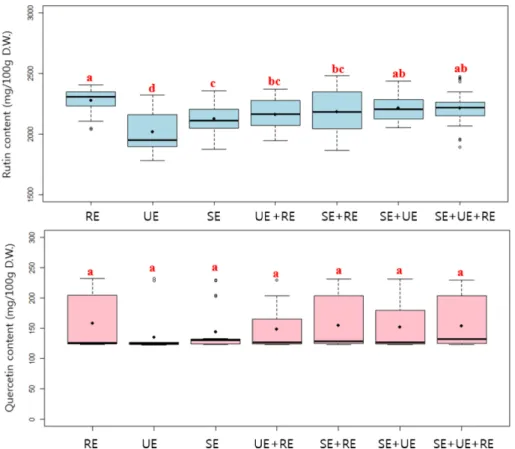
추출방법 비교 메밀에서 루틴 추출방법으로 상온교반추출이 널리 사용되고 있 으나(15,16), 침출하는 소요시간(3-24시간)이 길고 실내온도조건에 따라 추출효율이 달라질 수 있다는 단점이 있다(13,23,24). 본 연 구에서는 이러한 문제를 해결하기 위해서 환류냉각추출, 초음파 추출, 상온교반추출을 단독 또는 혼용하여 쓴메밀 종자에서 7가 지 방법으로 추출한 루틴과 퀘세틴 함량을 비교·분석하였다. 7가지 추출방법별 쓴메밀 종자의 루틴과 퀘세틴 함량을 통계 패키지 ‘R analysis’를 사용하여 상자그림으로 나타내었다(Fig. 3). 추출방법 간 통계적 유의성 검정에서 루틴함량은 유의한 차이를 보였으나, 반면, 퀘세틴 함량에서 추출방법간 유의차가 보이지 않 았다. 추출방법 중 환류냉각추출의 루틴과 퀘세틴 함량의 평균값 은 각각 2,277, 158 mg/100 g으로 추출수율이 높았으며 퀘세틴 검 출횟수도 36회 중 28회로 가장 많았다. 환류냉각추출의 루틴 함 량에 대한 중앙값은 2,306 mg/100 g으로 다른 추출방법에 의한 값 들보다 높았으며, 사분위범위수도 2,232-2,347 mg/100 g으로 좁게 나타났다. 따라서, 환류냉각추출방법은 안정적으로 분석되어 높 은 효율을 나타내는 최적 추출법으로 판단되었다.Fig. 1. UPLC profiles of rutin and quercetin contents in a standard mixture solution (standard) and extracts in tartary buckwheat seeds using reflux extraction (RE), ultrasonification (UE), stirrer extraction (SE), reflux extraction after ultrasonification (UE+RE), reflux extraction after stirrer extraction (SE+RE), ultrasonification after stirrer extraction (SE+UE), and reflux extraction with ultrasonification after stirrer extraction (SE+UE+RE). All chromatograms passed through spectrofluorometric detector at 259 nm. (1) Rutin standard (1.00 mg/mL); and (2) quercetin standard (1.00 mg/mL). Retention time of all chromatograms were as follows: (1), Rutin (9.230 min); and (2) quercetin (18.510 min).
반면, 초음파 추출의 경우 루틴과 퀘세틴 함량 평균값은 각각 2,015, 135 mg/100 g으로 처리구 중 가장 낮았으며, 퀘세틴 검출 회수도 36회 중 20회로 가장 적었다. 또한 초음파추출의 루틴 함 량에 대한 최소값이 1,782 mg/100 g로 낮았으며, 중앙값도 1,952 mg/100 g로 가장 낮았다. 상온교반 후 환류추출이나 초음파 추출과 같은 혼용처리의 경우 루틴 함량 범위는 2,016-2,184 mg/ 100 g, 퀘세틴 함량 범위는 148-154 mg/100 g로 나타났으며, 퀘세 틴 검출회수 범위는 36회 중 24-25회로 나타났다. 상온교반 후 환류추출방법은 환류추출보다 성분 함량에서 다소 적었으나, 초 음파나 상온교반추출보다는 함량이 많아 이들 두 단독처리보다 는 효과적인 것으로 나타났다. 상온교반과 초음파 후 환류냉각추 출법 즉, 3가지를 혼용한 추출은 이상치(outlier)가 7개로 가장 많 아 안정적인 추출법으로 적합하지 않았다. 쓴메밀의 루틴을 추출할 수 있는 최적의 추출방법을 설정하기 위하여 이미 보고된 논문을 바탕으로 비교 분석한 결과, 알코올 을 이용한 환류냉각추출, 초음파추출, 상온교반추출이 이용되어 왔다(13,14,18,19). 상온교반추출의 경우 일반 실험실에 널리 사용 하고 있는 교반기를 활용해서 추출할 수 있는 장점이 있지만, 추 출소요시간이 길어진다(24시간)는 단점이 있다. 환류냉각추출과 초음파추출은 추출을 위한 별도의 기기를 구입해야 한다는 단점 이 있지만, 일단 구입한 후에 단시간(1시간)에 많은 양을 추출할 수 있다는 장점이 있다. 본 연구에서는 가장 널리 사용되고 있는 상온교반추출(13,15,23,24)의 단점을 개선하기 위해 환류냉각추출 방법의 추출시간을 1시간으로 단축하고, 추출효율을 높이기 위해 Fig. 2. The box-and-whisker plot (or boxplot) of an exploratory
graphic showing the distribution of a dataset. Box plots are expressed by lines (whiskers) extending vertically from the boxes indicating variability outside the upper and lower quartiles. The horizontal line (—) and point (●) within the gray box represents the median and mean sample value, respectively. The ends of the box represent the 25th and 75th quantiles. Whiskers that extend from the ends of the box are computed as third quartile +1.5*(interquartile range) and first quartile -1.5*(interquartile range). The whiskers of upper and down fences defines the greatest value (maximum) and the least value (minimum) excluding outliers. Open dots (○) beyond the whiskers are possible outliers that were placed more than 3/2 times of upper or lower quartile.
Fig. 3. Box and whisker plot of rutin and quercetin contents according to seven extraction methods of tartary buckwheat seeds through UPLC. The horizontal line with the box indicates a median value. The whiskers of upper and down fences indicate greatest value (maximum) and least value (minimum) excluding outliers. Close dots within box indicate mean value (n=36) and open dots were placed more than 3/2 times of upper or lower quartile. Significant differences were analyzed by Duncan’s multiple range test at p<0.05 for each seven extraction methods: reflux extraction (RE), ultra-sonification (UE), stirrer extraction (SE), reflux extraction after ultra-sonification (UE+RE), reflux extraction after stirrer extraction (SE+RE), ultra-sonification after stirrer extraction (SE+UE), and reflux extraction with ultra-sonification after stirrer extraction (SE+UE+RE).
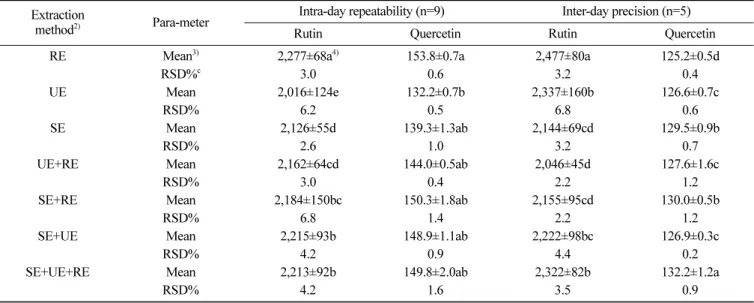
추출온도를 80oC로 높게 재설정하였다. 또한 UPLC 방법을 사용 함으로써 분석시간을 HPLC 분석의 37-61분(11,17)에서 23분으로 대폭 단축하였다. 그 결과, 소량의 퀘세틴도 효과적으로 검출할 수 있는 수준으로 추출효율이 크게 향상되었으며 분석시간도 대 폭 단축되었다. 쓴메밀 종자의 7가지 추출방법에 따라 처리된 시험용액을 UPLC 를 이용하여 일내 반복성과 일간 정밀성을 분석하였다(Table 2). 즉, 하루동안 7가지 추출방법을 9반복으로 수행하여 총 4회 분석 하여 일내 반복성을 구하였고, 1일 1구간으로 하여 같은 샘플을 5일동안 연속적으로 UPLC를 이용하여 일간정밀성을 분석하였다. 분석을 통해 얻어진 면적은 보정선에 의해 정량한 농도별 검출 농도의 표준편차를 검출농도 평균으로 나눈 비율의 백분율(RSD, %)로 나타내었다. 그 결과, 모든 처리에서 루틴과 퀘세틴의 RSD 는 10%이하를 나타내었다. 환류냉각추출의 루틴 함량의 일내와 일간 RSD는 각각 3.0, 3.2%였으며, 퀘세틴의 일내와 일간 RSD 는 각각 0.6, 0.4%로 낮아 반복성과 재현성이 우수함을 확인하였다. 한편 초음파추출의 경우 루틴의 일내와 일간 RSD는 각각 6.2, 6.8%였으며, 퀘세틴의 일내와 일간 측정 RSD는 각각 0.5, 0.6% 로 가장 높아 안정적인지 못한 것으로 판단되었다. 상온교반추출 의 일내 및 일간의 루틴 함량에 대한 RSD는 각각 2.6, 3.2%로 안정적이었으나 다른 추출방법에 비해 함량이 낮아 고효율 추출 법으로 적합하지 않은 것으로 판단되었다. 루틴과 퀘세틴은 수용성 식물성 폴리페놀화합물로 추출되는 조 건에 따라 그 성분들이 달라지기 때문에 추출수율에 있어서도 많 은 차이를 나타내었다(17). 열처리 시 열에 민감한 성분이 손실 이 발생할 수 있지만 다양한 화학적 변화에 의해 세포막이 비가 역적으로 분해되어 막 투과성이 증가됨에 따라 식물체의 글리코 사이드로 존재하는 페놀화합물을 비롯하여 보다 많은 성분이 용 출된다고 하였다(16,17). 예를 들면, 80oC 고온에서 환류냉각추출 을 짧은 시간 실시하여도 25oC 상온 및 5oC 저온에서 장기간(24 시간) 추출하는 것보다 루틴 추출이 용이하다고 하였다(18). 본 연구에서 환류냉각추출시 추출 수율이 높은 것은 열에 의하여 불 용성 성분들이 가용성화 됨에 따라 용출이 용이하게 된 결과라 판단되며, 25oC 상온교반추출에서 추출시간 대비 높은 수율을 나 타내는 점으로 볼 때 적정 고온의 온도 처리에 의한 추출법이 효 과적일 것으로 판단된다. 결론적으로, 환류냉각추출은 루틴과 퀘세틴을 분석하는데 빠르 고 안정적이면서도 효율적임이 확인되었다. 따라서 이 방법은 식 품의 함량 분석뿐만 아니라 육종 프로그램에서 요구되는 대규모 계통을 스크리닝하는데 유용할 것으로 기대된다.
Table 2. Intra-day and inter-day precision for the determination of rutin and quercetin in tartary buckwheat seeds contents using seven extraction methods1) (unit: mg/100 g)
Extraction
method2) Para-meter
Intra-day repeatability (n=9) Inter-day precision (n=5)
Rutin Quercetin Rutin Quercetin
RE UE SE UE+RE SE+RE SE+UE SE+UE+RE Mean3) RSD%c Mean RSD% Mean RSD% Mean RSD% Mean RSD% Mean RSD% Mean RSD% 2,277±68a4) 3.0 2,016±124e 6.2 2,126±55d 2.6 2,162±64cd 3.0 2,184±150bc 6.8 2,215±93b 4.2 2,213±92b 4.2 153.8±0.7a 0.6 132.2±0.7b 0.5 139.3±1.3ab 1.0 144.0±0.5ab 0.4 150.3±1.8ab 1.4 148.9±1.1ab 0.9 149.8±2.0ab 1.6 2,477±80a 3.2 2,337±160b 6.8 2,144±69cd 3.2 2,046±45d 2.2 2,155±95cd 2.2 2,222±98bc 4.4 2,322±82b 3.5 125.2±0.5d 0.4 126.6±0.7c 0.6 129.5±0.9b 0.7 127.6±1.6c 1.2 130.0±0.5b 1.2 126.9±0.3c 0.2 132.2±1.2a 0.9
1)Precision was determined in tartary buckwheat seeds on the same day (intra-day repeatability) and daily for 9 times over a period of 5 days
(inter-day precision). The results were expressed as mean and relative standard deviation (RSD).
2)Extraction were represented on Table 1.: reflux extraction (RE), ultrasonification (UE), stirrer extraction (SE), reflux extraction after
ultrasonification (UE+RE), reflux extraction after stirrer extraction (SE+RE), ultrasonification after stirrer extraction (SE+UE), and reflux extraction with ultrasonification after stirrer extraction (SE+UE+RE).
3)Data represent the means of nine replicates±SD mg/mL sample on dry weight basis.
4)Significant differences were analyzed by Duncan’s multiple range test at p<0.05 for seven extraction methods.
Table 3. Statistical data of the regression equations and parameters validation for rutin and quercetin contents
Parameter Range (mg/mL) Linearity1) R2 2) LOD 3) (mg/mL) LOQ4) (mg/mL) Rutin Quercetin 0.10-0.80 0.10-0.80 y=4,134,067x+12,519 y=6,619,089x-54,279 0.9993 0.9993 0.0210 0.0205 0.0635 0.0621 1)y=peak area, x=standard volume (mg/mL).
2)Linear correlation coefficient.
3)Limits of detection (LOD) was estimated based on the lowest concentration giving signal intensity equal to or greater than the sum of the blank
signal plus three times.
4)Limits of quantitation (LOQ) was estimated based on the lowest quantitation giving signal intensity equal to or greater than the sum of the blank
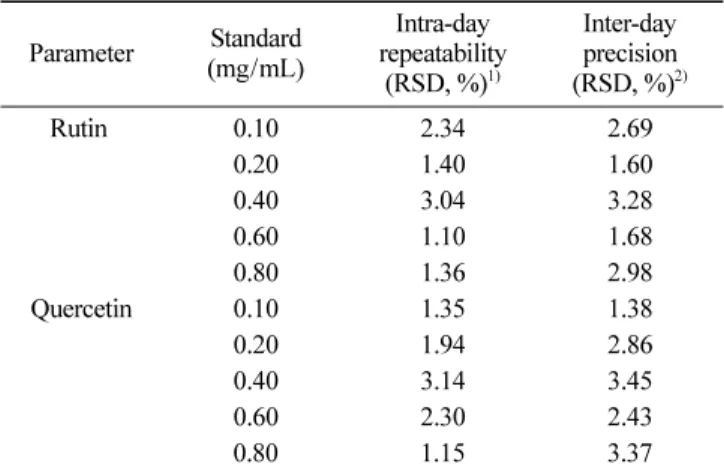
환류냉각추출법의 유효성검증 쓴메밀의 루틴 및 퀘세틴 추출법을 향상시키기 위하여 개선된 환류냉각 추출법의 유효성 검증을 위하여 선형성, 정밀성, 정확 도를 확인하였다. 루틴과 퀘세틴의 선형성을 결정하기 위해 표준 용액을 농도별로 분석하여 y=4,134,067x+12.519와 y=6,619,089x− 54,279로 나타내었고 결정계수는 모두 0.9993으로 선형관계를 나 타내었다(Table 3). 또한 모든 분석결과에서 검출한계(LOD)와 검 량한계(LOQ)값은 0.07 mg/mL 미만이었다. 루틴의 LOD와 LOQ 값은 0.0210, 0.0635 mg/mL이었고, 퀘세틴의 LOD와 LOQ 값은 0.0205, 0.0621 mg/mL이었다. 이상의 검증 결과는 쓴메밀 종자의 루틴과 퀘세틴의 분석에 선발된 환류냉각추출방법이 안정적으로 적용가능함을 알 수 있었다. 루틴과 퀘세틴 함량 분석의 정밀성을 확인하기 위하여 루틴과 퀘세틴의 표준물질 농도별(0.10, 0.20, 0.40, 0.60, 0.80 mg/mL)로 제조하여 하루 동안 5반복으로 분석하여 일내 반복성(intra-day repeatability)을 구하였고, 농도별로 조성된 동일한 추출물을 3일 동안 연속적으로 분석하여 RSD를 계산하여 일간 정밀성(inter-day precision)을 비교하였다(Table 4). 루틴의 일내 반복성은 1.10-3.04%의 재현성을 나타내었고, 일간 정밀도는 1.60-3.28%의 정밀 도를 나타내었다. 퀘세틴의 일내 반복성은 1.15-3.14%를 나타내 었고, 일간 정밀성은 1.38-3.45%를 나타내었다. 이는 Kim과 Shin (22)가 메밀 루틴 분석시 일내 및 일간 정밀성이 각각 3.87-5.73%, 3.36-12.07%로 보고하여 본 연구결과에서 더 정밀성을 보여 매우 안정적인 분석임이 검증되었다. 또한, 양파 퀘세틴의 일내 반복 성의 RSD는 0.10-3.28%의 범위를 나타내었고, 일간 정밀성의 RSD는 0.96-5.79%의 범위를 나타내어 본 연구결과와 유사한 경 향이었다(25). 따라서, 본 연구에서 루틴과 퀘세틴의 정밀성은 3.5% 이내로 일내와 일간의 반복성과 재현성이 우수함을 확인하 였다. 또한, 각 수준에 대한 분석 정밀성은 일간 및 일내 RSD로 결정되는데, 정밀성이 15 % 미만이어야 한다는 기존의 연구 보 고(26)와도 부합되었다. 쓴메밀 환류냉각추출에 대한 루틴과 퀘세틴 분석의 정확도를 평가하기 위해 표준물질을 저농도(0.1), 중간농도(0.4), 고농도(1.0 mg/mL)로 준비한 후 환류냉각추출한 샘플을 혼합하여 3반복으로 분석하였으며, 이론적 농도과 실제 측정농도를 구하여 회수율을 계산하였다(Table 5). 루틴과 퀘세틴의 회수율은 각각 98.2-102.7%, 87.4-91.6%의 범위를 보였으며, 오차는 15% 이내를 만족하였다. Jeon 등(25)은 양파 퀘세틴 분석시 82.36-98.24%의 회수율을 나 타내었고, Bai 등(5)은 메밀에서 98.79-102.74% 회수율(루틴 94.53-95.28, 퀘세틴 98.79-102.74%)을 보고하였고, Kim과 Shin(22)는 메 밀에서 96.27-105.02%의 회수율(루틴 96.27-100.84%, 퀘세틴 102.33-105.02%)을 얻었다고 보고하였다. 루틴 및 퀘세틴의 평균 회수율은 국제적 수준의 회수율 권고치 85-115%임을 감안할 때 각각 102.4, 88.8%를 나타내어 국제기준을 충족하였다(26,27). 또 한, 정확도 분석을 위한 RSD도 2.7-4.0%의 범위를 보여 생물분 석 유효성 검정 기준이 15% 이하인 점을 감안할 때 FDA 지침 과 부합되었다(28,29). 이상의 결과, 본 연구에서의 유효성 검정 결과를 요약하면 다 음과 같다. 선형성은 본문에서 제시한 측정농도 범위에서 모두 0.999 이상의 감응 상관관계를 나타내었으며, 최대검출한계(LOD) 와 정량한계(LOQ)는 각각 0.0210, 0.6350 mg/mL이었다. 일내반복 성과 일간정밀성에서 RSD는 4% 이하였으며 회수율은 89-102% 으로 매우 우수하였다. 이러한 결과는 본 연구에서 제시한 분석 방법이 루틴과 퀘세틴 분석에 있어 유용하다는 것을 의미한다. 또한, 본 연구에서는 다양한 추출방법을 대상으로 정밀성을 분석 하고, 유효성 검정을 실시하여 쓴메밀의 루틴과 퀘세틴 함량을 분석하는데 적합한 추출방법인 환류냉각추출방법을 선발하였다.
요
약
본 연구는 초고성능액체크로마토그래피(Ultra Performance Liquid Chromatography, UPLC)를 이용하여 쓴메밀 종자에서 루틴 및 퀘 세틴 함량을 신속 정확히 평가하기 위한 효율적인 추출방법을 구 명하고자 수행하였다. 추출방법으로 환류냉각추출, 초음파추출, 상온교반추출, 초음파후 환류냉각추출, 상온교반 후 환류냉각추 출, 상온교반후 초음파추출, 상온교반과 초음파 후 환류냉각추출 등 7가지 방법을 비교하였다. 루틴 함량에서 7가지 추출방법은 통계적으로 유의한 차이를 보였으나, 퀘세틴 함량에서 추출방법 Table 4. The precision for the analyses of rutin and quercetin
contents in buckwheat samples Parameter Standard (mg/mL) Intra-day repeatability (RSD, %)1) Inter-day precision (RSD, %)2) Rutin Quercetin 0.10 0.20 0.40 0.60 0.80 0.10 0.20 0.40 0.60 0.80 2.34 1.40 3.04 1.10 1.36 1.35 1.94 3.14 2.30 1.15 2.69 1.60 3.28 1.68 2.98 1.38 2.86 3.45 2.43 3.37 1)Intra-day repeatability was evaluated using five independent analyses
of replicate samples for one day.
2)Inter-day precision was evaluated using three independent analyses of
replicate samples performed for three days.
Table 5. The accuracy for the analyses of rutin and quercetin contents in buckwheat samples Parameter Standard (mg/mL) Sample (mg/mL) Theoretical (mg/mL) Found (mg/mL) Recovery (%) Mean recovery (%) RSD1) (%) Rutin Quercetin 0.1 0.4 1.0 0.1 0.4 1.0 0.311 0.311 0.311 0.006 0.006 0.006 0.411 0.711 1.111 0.106 0.406 0.806 0.414 0.737 1.097 0.097 0.354 0.704 102.7 106.3 98.2 91.6 87.4 87.4 102.4 88.8 4.0 2.7
간 유의차가 없었다. 환류냉각추출의 루틴과 퀘세틴 함량은 각각 2,277, 158 mg/100 g으로 추출방법 중 함량이 가장 많아 추출수율 이 높았으며 검출횟수도 가장 높았다. 반면, 초음파 추출의 루틴 과 퀘세틴의 함량이 처리구 중 가장 낮았으며, 검출횟수도 가장 적었다. 환류냉각추출에서 일내 반복성(intra-day repeatablility)과 일간 정밀성(inter-day precision)은 상대적표준편차(relative standard deviation, RSD)가 0.4-3.2%로 안정적으로 추출되었고, 정확도는 88.8-102.4%로 국제적 회수율 권고치 기준에 부합하였다. 따라서, 쓴메밀 루틴 추출방법으로는 추출 소요시간이 1시간 이내로 짧 으면서 루틴 함량이 가장 안정적으로 많이 추출되는 환류냉각추 출이 가장 적합하였다.
감사의 글
본 논문은 농촌진흥청 시험연구사업(과제번호: PJ01038902와 PJ01189403)의 지원에 의해 이루어진 것임.References
1. Kreft I, Bonafacci G, Zigo A. Secondary metabolites of buck-wheat and their importance in human nutrition. Food Technol. Biotech. 32: 195-197 (1994)
2. Wang L, Yang X, Qin P, Shan F, Ren G. Flavonoid composition, antibacterial and antioxidant properties of tartary buckwheat bran extract. Ind. Crop. Prod. 49: 312-317 (2013)
3. Merendino N, Molinari R, Costantini L, Mazzucato A, Pucci A, Bonafaccia G. A new ‘functional’ pasta containing tartary buck-wheat sprouts as an ingredient improves the oxidative status and normalizes some blood pressure parameters in spontaneously hypertensive rats. Food Function. 5: 1017-1026 (2014)
4. Li X, Park NI, Kim YB, Kim HH, Park CH, Wu Q, Park SU. Accumulation of flavonoids and expression of flavonoid biosyn-thetic genes in tartary and rice-tartary buckwheat. Process Bio-chem. 47: 2306-2310 (2012)
5. Bai XZ, Feng ML, Hao XL, Zhong QM, Tong LG, Wang ZH. Rutin, quercetin, and free amino acid analysis in buckwheat (Fagopyrum) seeds from different locations. Genet. Mol. Res. 14: 19040-19048 (2015)
6. Kim YS, Kim JG, Lee YS, Kang IJ. Comparison of the chemical components of buckwheat seed and sprout. J. Korean Soc. Food Sci. Nutr. 34: 81-86 (2005)
7. Chang KJ, Seo GS, Kim YS, Huang DS, Park JI, Park JJ, Lim YS, Park BJ, Park CH, Lee MH. Components and biological effects of fermented extract from tartary buckwheat sprouts. Korean J. Plant Res. 23: 131-137 (2010)
8. Kim JA. Study on the anti-obesity effects of germinated-buck-wheat. Ms theses, Kangwon National University, Chuncheon, Korea (2006)
9. Fukushima T, Tokuji Y, Kinoshita M, Ohnishi M, Kawahara M, Ohba K. Anti-inflammatory effect of buckwheat sprouts in lipopolysaccharide-activated human colon cancer cells and mice. Biosci. Biotech. Biochem. 72: 3148-3157 (2008)
10. He J, Klag MJ, Whelton PK, Mo JP, Chen JY, Qian, MC, Mo PS, He GQ. Oats and buckwheat intakes and cardiovascular dis-ease risk factors in an ethnic minority of China. Am. J. Clin. Nutr. 61: 366-372 (1995)
11. Holasova M, Fiedlerava V, Smrcinova H, Orsak M, Lachman J, Vavreinova S. Buckwheat-the source of antioxidant activity in functional foods. Food Res. Int. 35: 207-211 (2002)
12. Sun T1, Ho CT. Antioxidant activities of buckwheat extracts.
Food Chem. 90: 743-749 (2005)
13. Przybylski, R, Lee Y.C., Eskin NAM. Antioxidant and radical-scavenging activities of buckwheat seed components. J. Am. Oil Chem. Soc. 75: 1595-1601(1998)
14. Shin SL, Lee CH. Antioxidant activities of ostrich fern by differ-ent extraction methods and solvdiffer-ents. J. Life Sci. 21: 56-61 (2011) 15. Kim JH, Sung NY, Kwon SK, Jung PM, Choi JI, Yoon YH,
Song BS, Yoon TY, Kee HJ, Lee JW. Antioxidant activity of ste-via leaf extracts prepared by various extraction methods. J. Korean Soc. Food Sci. Nutr. 39: 313-318 (2010)
16. Kim JW, Kim JK, Song IS, Kwon ES, Youn KS. Comparison of antioxidant and physiological properties of Jerusalem artichoke leaves with different extraction processes. J. Korean Soc. Food Sci. Nutr. 42: 68-75 (2013)
17. Kang KM, Lee SH. Effects of extraction methods on the antioxi-dative activity of Artemisia sp. J. Korean Soc. Food Sci. Nutr. 42: 1249-1254 (2013)
18. Choung MG. Development of analytical method for rutin in buck-wheat plant using high performance liquid chromatography. Korean J. Crop Sci. 50:181-186 (2005)
19. Jeon AY, Kim KH, Kwon SJ, Roy SK, Cho SW, Woo SH. Effects of LED light conditions on growth and analysis of func-tional components in buckwheat sprout. Korean J. Crop Sci. 60: 388-393 (2015)
20. Shin JH, Kim HW, Lee MK, Lee SH, Lee YM, Jang HH, Hwang KA, Cho YS, Kim JB. Content and distribution of flavanols, fla-vonols and flavanones on the common vegetables in Korea. Korean J. Environ. Agric. 33: 205-212 (2014)
21. ICH. Guidance for Industry, Q2B Validation of Analytical Proce-dures: Methodology. ICH-Q2B, Kuala Lumpur, Malaysia. pp.71-76 (1996)
22. Kim JC, Shim YS. Method validation of analytical method for 12 flavonol glycosides in foods using ultra high-performance liquid chromatography coupled with photodiode array detection. Food Sci. Biotech. 25: 659-664 (2016)
23. Sharma P, Lee K, Park CH. 2014. Evaluation of chlorophyll con-tent, antioxidant activity and phenolic compounds in the seedlings of rice-type tartary buckwheat. Korean J. Plant Res. 27: 629-634 (2014)
24. Quettier-Deleu C, Gressier B, Vasseur J, Dine T, Brunet C, Luy-ckx M, Cazin M, Cazin J, Bailleu F, Trotin F. Phenolic com-pounds and antioxidant activities of buckwheat (Fagopyrum esculentum Moench) hulls and flour. J. Ethnopharmacol. 72: 35-42 (2000)
25. Chen SY, Jeong EJ, Baek JH, Cha YJ. Analytical method valida-tion of quercetin in changnyeong onion extract as a funcvalida-tional ingredient for functional health food. J. Korean Soc. Food Sci. Nutr. 40: 565-569 (2011)
26. Lee YY, Park HM, Lee CK, Kim SL, Hwang TY, Cho MS, Kwon YU, Kim WH, Kim SJ, Lee SC, Kim YH. Comparing extraction methods for the determination of tocopherols and tocotrienols in seeds and germinating seeds of soybean trans-formed with OsHGGT. J. Food Compos. Anal. 27: 70-80 (2012) 27. Savic IM, Nikolic GS, Bankovic VM. Quantitative estimation of
trimazolin hydrochloride in pharmaceutical preparation by RP-HPLC method. Hemijska Industrija 63: 87-93 (2009)
28. Chen C, Xu XM, Chen Y, Yu MY, Wen FY, Zhang H. Identifica-tion, quantification and antioxidant activity of acylated flavonol glycosides from sea buckthorn (Hippophae rhamnoides ssp. sin-ensis). Food Chem. 141: 1573-1579 (2013)
29. US Department of Health and Human Services (DHHS). Center for Veterinary Medicine (CVM): Guidance for Industry, Bioana-lytical Method. Center for Drug Evaluation and Research (CDER). Food and Drug Administration, US department of Health and Human Services, Washington, USA (2001)