Trees
Introduction to Data Structures Kyuseok Shim
ECE, SNU.
Terminology
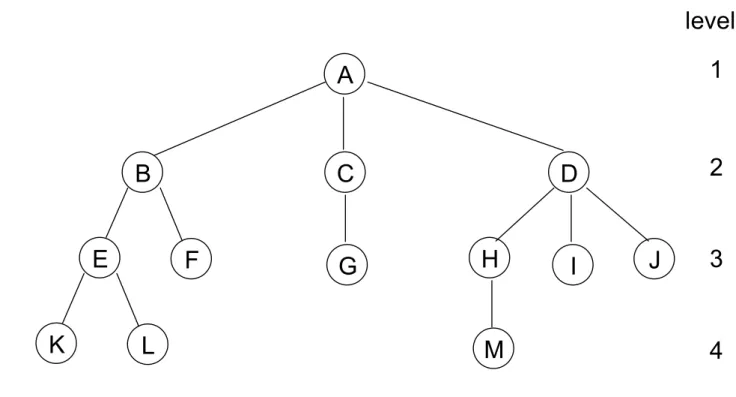
Tree : A finite set of one or more nodes such that
There is a specially designated node called the root
The remaining nodes are partitioned into n≥0 disjoint sets T
1, ..., T
n, where each of these sets is a tree. T
1, ..., T
nare called the subtrees of the root.
Degree of a node : the number of subtrees of a node
Leaf (terminal node) : a node that has degree zero
Internal node (nonterminal node) : the other nodes
Children, parent, siblings
2
Terminology
Degree of a tree : the maximum of degree of the nodes in the tree
Ancestors of a node : all the nodes along the path from the root to that node
Level of a node : the distance from the root+1
Height (or depth) of a tree : the maximum level of any node in the tree
3
Dusty
Honey Bear
Brungilde
Gill Tansey
Terry
Tweed Zoe
Brandy
Coyote
Crocus Primrose
Nugget
Nous Belle
Terminology
Proto Indo-European
Italic
Osco- Umbrian
Oscan Umbrian
Latin
Spanish French Italian
Hellenic
Greek
Germanic
North
Iceland Norwegian Swedish
West
Low High Yiddish
(a) Pedigree
(b) Lineal 4
Terminology
A
B
E F
D
H J
K L
level 1
2
3
4 C
G I
M
Figure 5.2 : A sample tree
5
(A(B(E(K,L),F),C(G),D(H(M),I,J)))
Representation of Trees
List representation
The tree of Figure 5.2
(A(B(E(K,L),F),C(G),D(H(M),I,J)))
The degree of each node may be different
Possible to use memory nodes with a varying number of pointer fields
Easier to write algorithms when the node size is fixed
6
Representation of Trees
List representation
nodes of a fixed size
for a tree of degree k
Lemma 5.1: If T is a k-ary tree with n nodes, each
having a fixed size, then n(k-1)+1 of the nk child fields are 0, n≥1.
Proof: Since each non-zero child field points to a node and there is exactly one pointer to each node other than the root, the number of child fields in a k-ary tree with n nodes is nk. Hence, the number of zero fields is nk – (n-1) = n(k-1)+1
DATA CHILD1 CHILD2 ⋯ CHILDk
7
Representation of Trees
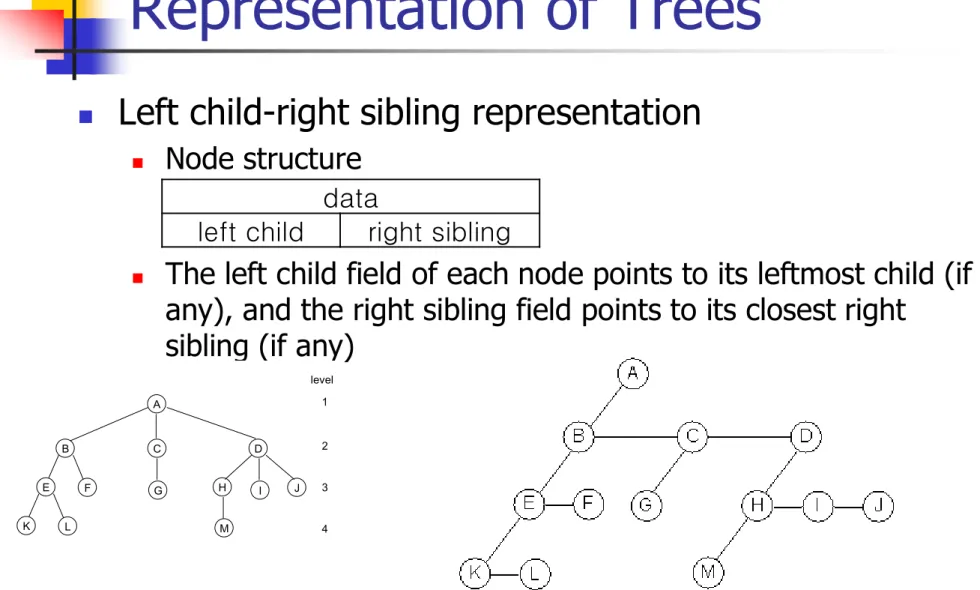
Left child-right sibling representation
Node structure
The left child field of each node points to its leftmost child (if any), and the right sibling field points to its closest right
sibling (if any)
data
left child right sibling
Figure 5.6 : Left child-right sibling representation of the tree of Figure 5.2
8
A
B
E F
D
H J
K L
level 1
2
3
4 C
G I
M
Representation of Trees
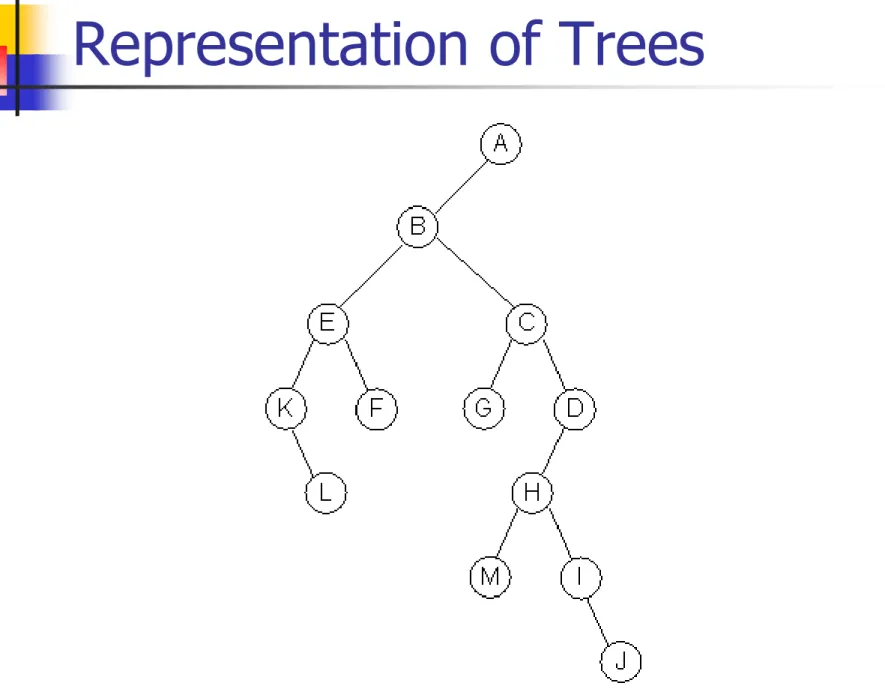
Representation as a degree-two tree
Rotate the right-sibling pointers clockwise by 45 degrees
The two children of a node are referred to as the left and right children
9
Representation of Trees
Figure 5.7 : Left child-right child tree representation 10
Representation of Trees
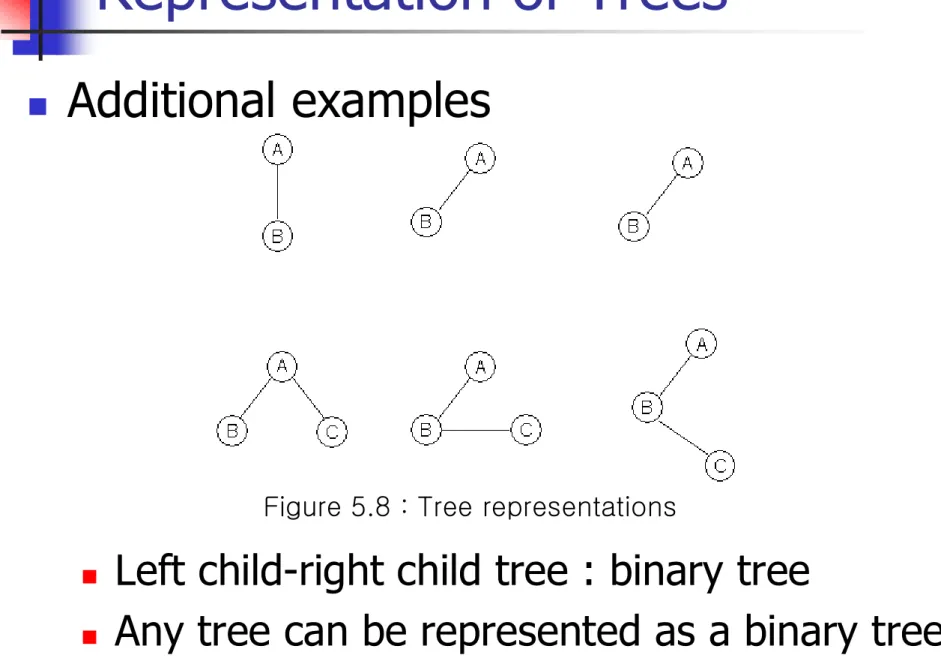
Additional examples
Left child-right child tree : binary tree
Any tree can be represented as a binary tree
Figure 5.8 : Tree representations
11
Binary Trees
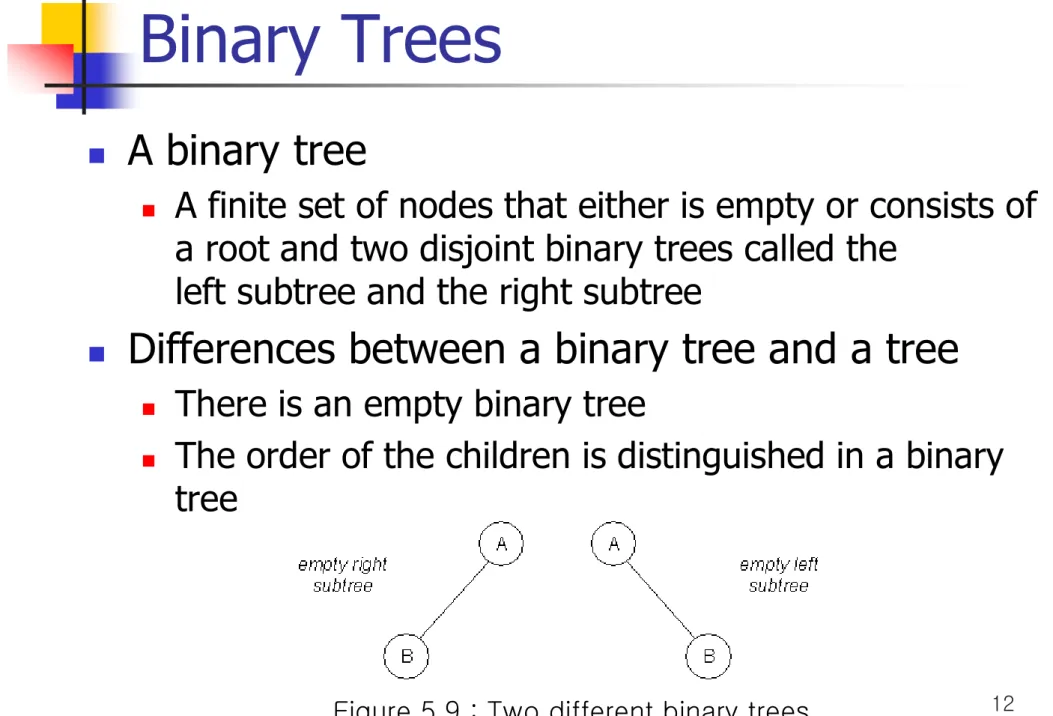
A binary tree
A finite set of nodes that either is empty or consists of a root and two disjoint binary trees called the
left subtree and the right subtree
Differences between a binary tree and a tree
There is an empty binary tree
The order of the children is distinguished in a binary tree
Figure 5.9 : Two different binary trees 12
Binary Trees
template <class T>
class BinaryTree
{ // objects: A finite set of nodes either empty or consisting of a // root node, left BinaryTree and right BinaryTree.
public:
BinaryTree();
// creates an empty binary tree bool IsEmpty();
// return true if the binary tree is empty
BinaryTree(BinaryTree<T>& bt1, T& item, BinaryTree<T>& bt2);
// creates a binary tree whose left subtree is bt 1, whose right // subtree is bt 2, and whose root node contains item
BinaryTree<T> LeftSubtree();
// return the left subtree of *this BinaryTree<T> RightSubtree();
// return the right subtree of *this T RootData();
// return the data in root node of *this };
---
ADT 5.1 : Abstract data type BinaryTree 13
Binary Trees
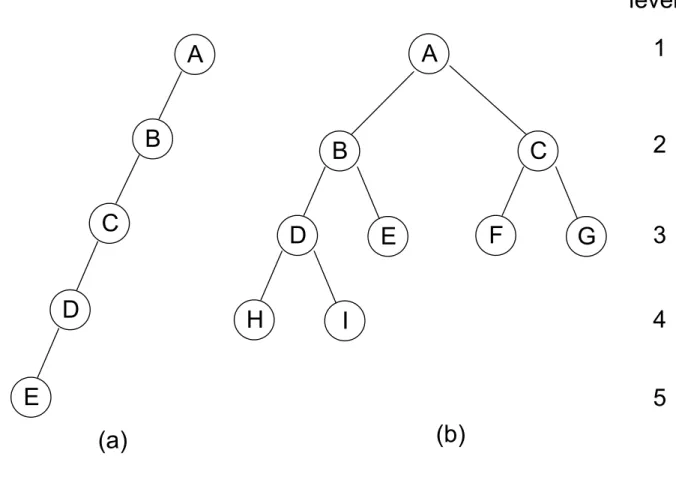
A
B
D E
C
F G
H I
A B C
D
E
level 1
2
3
4 5
(a) (b)
Figure 5.10 : Skewed and complete binary trees
14
Properties of Binary Trees
Lemma 5.2 [Maximum number of nodes]:
(1) The max number of nodes on level i of a binary tree is 2
i-1, i≥1
(2) The max number of nodes in a binary tree of depth k is 2
k-1, k≥1
15
Properties of Binary Trees
Proof:
(1) The proof is by induction on i.
Induction Base : The root is the only node on level i = 1.
Hence, the maximum number of nodes on level i = 1 is 2i-1=20=1
Induction Hypothesis : Let i be an arbitrary positive integer greater than 1.
Assume that the maximum number of nodes on level i-1 is 2i-2
Induction Step : The maximum number of nodes on level i-1 is 2i-2
by the induction hypothesis. Since each node in a binary tree has a maximum degree of 2, the maximum number of nodes on level i is two times the maximum number of nodes on level i-1, or 2i-1
(2) The maximum number of nodes in a binary tree of depth k is
1 2 2
) (max
1 1
1
k
k i
k i
i i
level on
nodes of
number imum
16
Properties of Binary Trees
Lemma 5.3 [Relation between number of leaf nodes and degree-2 nodes]:
For any non-empty binary tree, T,
if n
0is the number of leaf nodes and n
2the number of nodes of degree 2, then n
0=n
2+1
17
Properties of Binary Trees
Proof : Let n
1be the number of nodes of degree one and n the total number of nodes. Since all nodes in T are at most of degree two, we have n=n
0+n
1+n
2If we count the number of branches in a binary tree, we see that every node except the root has a branch leading into it. If B is the number of branches, then n=B+1. All branches stem from a node of degree one or two. Thus, B=n
1+2n
2. Hence,
we obtain n = B+1 = n
1+2n
2+1. We get n
0= n
2+ 1
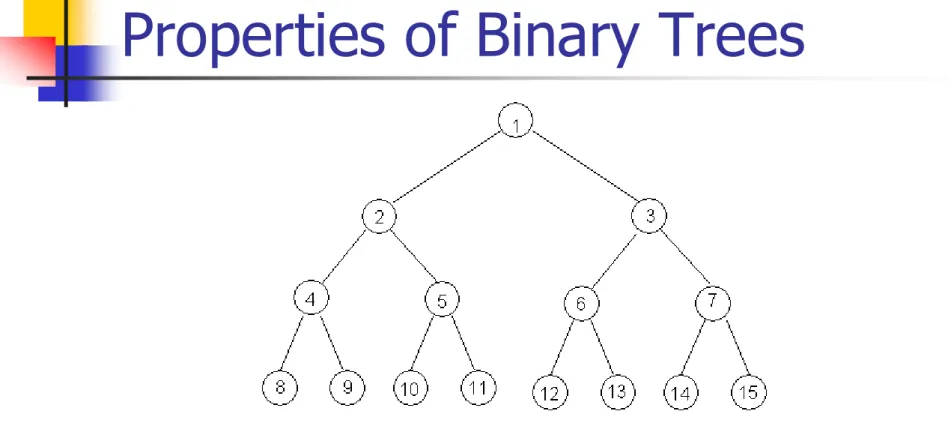
Def : A full binary tree of depth k
A binary tree of depth k having 2
k-1 nodes, k≥0
18
Properties of Binary Trees
A binary tree with n nodes and depth k is complete
Its nodes correspond to the nodes numbered from 1 to n in the full binary tree of depth k
The height of a complete binary tree with n nodes is
Figure 5.11 : Full binary tree of depth 4 with sequential node numbers
log2(n1)
19Binary Tree Representation: Array Re presentations
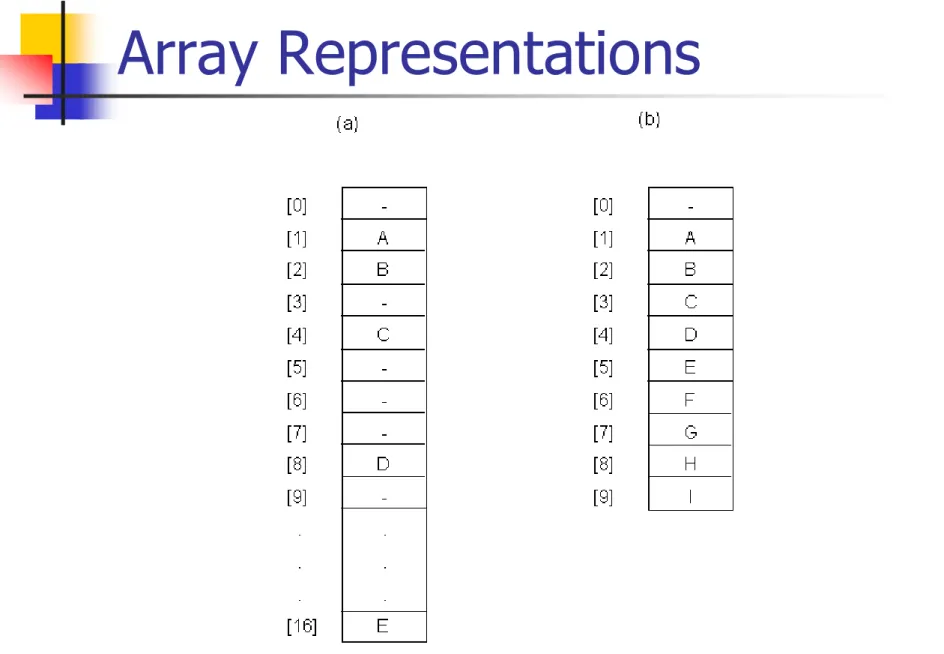
Lemma 5.4 : If a complete binary tree
with n nodes is represented sequentially, then for any node with index i, 1≤i≤n,
we have
(1) parent(i) is at i/2 if i≠1. If i=1, i is at the root and has no parent
(2) leftChild(i) is at 2i if 2i≤n. If 2i>n, then i has no left child
(3) rightChild(i) is at 2i+1 if 2i+1≤n. If 2i+1>n, then i has no right child
20
Binary Tree Representation: Array Representations
Proof : We prove (2). (3) is an immediate consequence of (2) and the numbering of nodes on the same level from left to right. (1) follows from (2) and (3). We prove (2) by
induction on i.
For i=1, clearly the left child is at 2 unless 2>n, in which chase i has no left child. Now assume that for all j, 1≤j≤i, leftChild(j) is at 2j.
Then the two nodes immediately preceding leftChild(i+1) are the right and left children of i. The left child is at 2i.
Hence, the left child of i+1 is at 2i+2=2(i+1) unless 2(i+1)>n, in which case i+1 has no left child
21
Array Representations
Figure 5.12 : Array representation of the binary trees of Figure 5.10
22
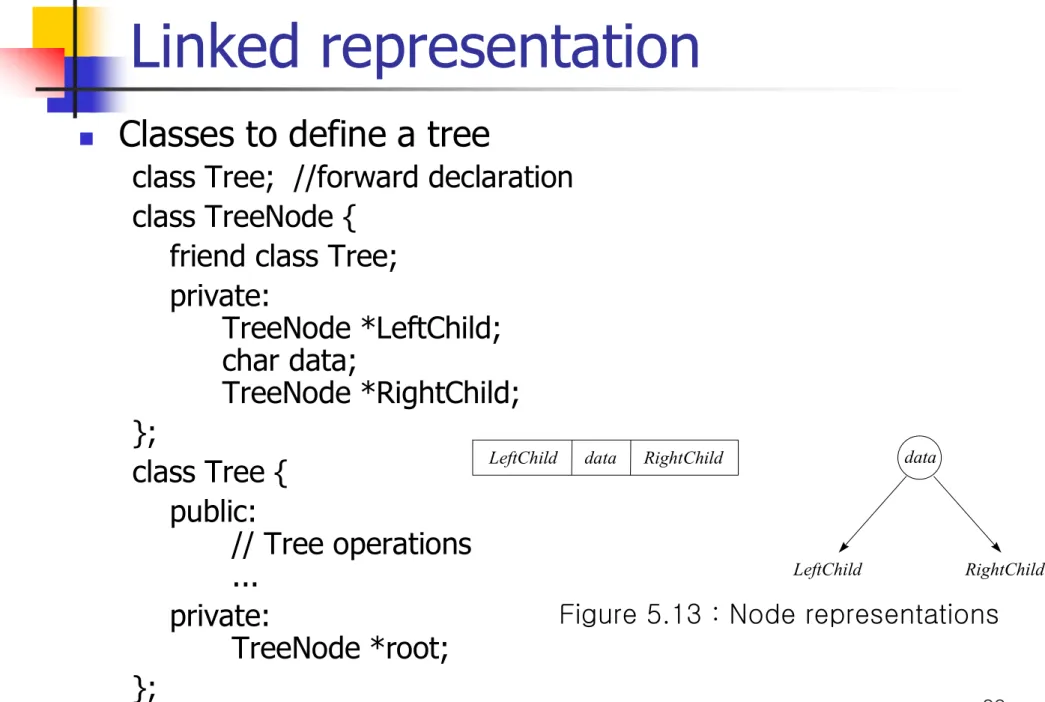
data
LeftChild RightChild
LeftChild data RightChild
Linked representation
Classes to define a tree
class Tree; //forward declaration class TreeNode {
friend class Tree;
private:
TreeNode *LeftChild;
char data;
TreeNode *RightChild;
};
class Tree { public:
// Tree operations ...
private:
TreeNode *root;
};
Figure 5.13 : Node representations
23
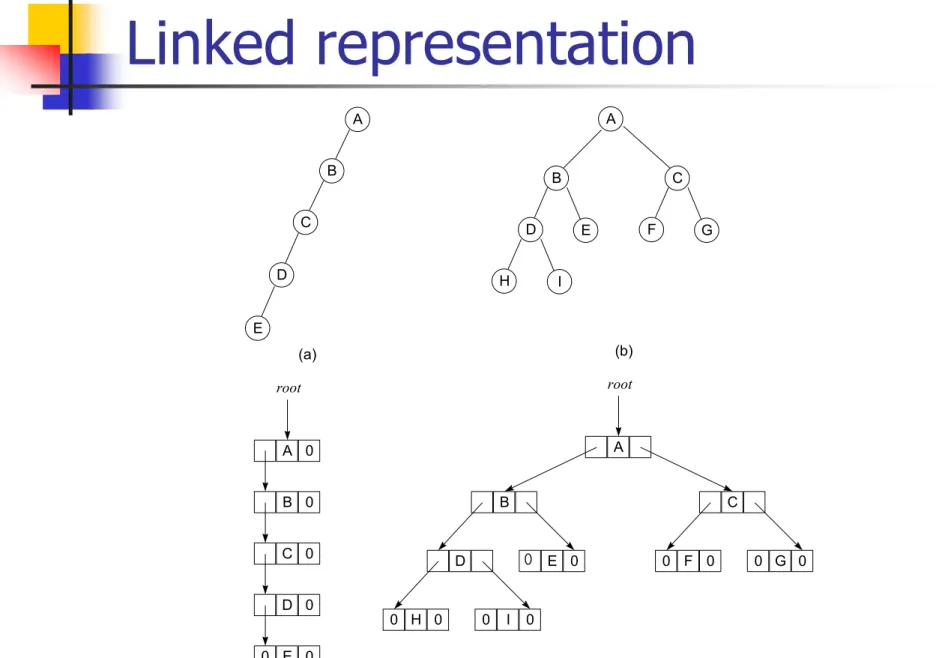
Linked representation
A
B
D E
C
F G
H I
A B C D
E
(a) (b)
A 0 B 0 C 0 D 0 0 E 0
root
A root
B
E 0 D
0 H 0 0 I 0
C
0 G 0 0 F 0
Figure 5.14 : Linked representation for the binary trees of Figure 5.10 24
0
Binary Tree Traversal and Tree Iterators
Tree traversal
Visiting each node in the tree exactly once
A full traversal produces a linear order for the nodes
Order of node visit
L : move left V : visit node R : move right
Possible combinations : LVR, LRV, VLR, VRL, RVL, RLV
Traverse left before right
LVR : Inorder
LRV : Postorder
VLR : Preorder
25Introduction
+
/
B
C A
D
E
Figure 5.16 : Binary tree with arithmetic expression
26
Inorder Traversal
LVR
template<class T>
void Tree::inorder()
{ // Driver call workhorse for traversal of entire tree. The driver is // declared as a public member function of Tree.
inorder(root);
}
template<class T>
void Tree<T>::inorder(TreeNode<T> *CurrentNode)
{ // Workhorse traverses the subtree rooted at CurrentNode
// The workhorse is declared as a private member function of Tree.
if (CurrentNode) {
inorder(CurrentNode->leftChild);
Visit(currentNode);
inorder(CurrentNode->rightChild);
} }
--- Program 5.1 : Inorder traversal of a binary tree
※ Visit(TreeNode<T> *CurrentNode) { cout << currentNode->data
}
27
Inorder Traversal
Call of inorder
Value in
CurrentNode Action
Call of inorder
Value in
CurrentNode Action
Driver + 10 C
1 * 11 0
2 * 10 C cout<<'C'
3 / 12 0
4 A 1 * cout<<'*'
5 0 13 D
4 A cout<<'A' 14 0
6 0 13 D cout<<'D'
3 / cout<<'/' 15 0
7 B Driver + cout<<'+'
8 0 16 E
7 B cout<<'B' 17 0
9 0 16 E cout<<'E'
2 * cout<<'*' 18 0
Figure 5.17 : Trace of Program 5.1
Output : A/B*C*D+E
Infix form of the expression
28Preorder Traversal
VLR
template <class T>void Tree<T>::preorder() { // Driver
preorder(root);
}
template <class T>
void Tree<T>::preorder(TreeNode<T> *CurrentNode) { // Workhorse
if (CurrentNode) {
Visit(CurrentNode);
preorder(CurrentNode->leftChild);
preorder(CurrentNode->rightChild);
} }
--- Program 5.2 : Preorder traversal of a binary tree
∙ Output : +**/ABCDE
- Prefix form of the expression
29Postorder Traversal
LRV
template <class T>
void Tree<T>::Postorder() { // Driver
postorder(root);
}
template <class T>
void Tree::postorder(TreeNode *CurrentNode) { // Workhorse
if (CurrentNode) {
postorder(CurrentNode->LeftChild);
postorder(CurrentNode->RightChild);
Visit(currentNode);
} }
--- Program 5.3 : Postorder traversal of a binary tree
∙ Output : AB/C*D*E+
- Postfix form of the expression
30Binary Search Trees: Definition
Binary tree which may be empty
If not empty
(1) every element has a distinct key
(2) keys in left subtree < root key
(3) keys in right subtree > root key
(4) left and right subtrees are also binary search trees
20 15
12 10
25
30
5 40
2
60
(a) (b) (c)
22
70
65 80
Figure 5.28 : Binary trees
1
Dictionary
template <class K, class E>
Class Dictionary { public:
virtual bool IsEmpty() const = 0;
// return true iff the dictionary is empty virtual pair<K, E> *Get(const K&) const =0;
// return pointer to the pair with specified key; return 0 if no such pair virtual void Insert(const pari<K, E> &) = 0;
// insert the given pair; if key is a duplicate update associated element virtual void Delete(const K&) = 0;
// delete pair with specified key
}
--- ADT 5.3 : A dictionary
Tree Structure
template <class T> class Tree; // forward declaration template <class T>
class TreeNode { friend class Tree<T>;
private:
T data;
TreeNode<T> *leftChild;
TreeNode<T> *rightChild;
};
template <class T>
class Tree{
public:
// Tree operation private:
TreeNode<T> *root;
};
Searching Binary Search Tree
Recursive search by key value
definition of binary search tree is recursive
key(element) = x
x=root key : element=root
x<root key : search left subtree
x>root key : search right subtree
4
Searching Binary Search Tree
template <class K, class E> // Driver pair<K, E>* BST<K, E>::Get(const K& k)
{ // Search the binary search tree (*this) for a pair with key k
// If such a pair is found, return a pointer to this pair; otherwise, return 0 return Get(root, k);
}
template <class K, class E> // Workhorse
pair<K, E>* BST<K, E>::Get(TreeNode<pair<K, E> >* p, const K& k) {
if(!p) return 0;
if(k<p->data.first) return Get(p->leftChild, k);
if(k>p->data.first) return Get(p->rightChild, k);
return &p->data;
}
--- Program 5.18 : Recursive search of a binary search tree
5
Searching Binary Search Tree
template <class K, class E> // Driver pair<K, E>* BST<K, E>::Get(const K& k) {
TreeNode<pair<K,E> > *currentNode = root;
while(currentNode) {
if (k<currentNode->data.first)
currentNode = currentNode->leftChild;
else if ( k>currentNode->data.first)
currentNode = currentNode->rightChild;
else return ¤tNode->data;
}
//no matching pair return 0;
}
--- Program 5.19 : Iterative search of a binary search tree
6
Searching Binary Search Tree
Search by rank
node needs LeftSize field
LeftSize=1 + #elements in left subtree
30
5 40
2 3 2 1
1
7
Searching Binary Search Tree
template <class K, class E> // search by rank pair<K,E>* BST<K,E>::RankGet(int r)
{ // Search the binary search tree for the rth smallest pair TreeNode<pair<K,E> > *currentNode = root;
while (currentNode)
if(r<currentNode->leftSize)
currentNode = currentNode->leftChild;
else if (r>currentNode->leftSize) {
r -= currentNode->leftSize;
currentNode = currentNode->rightChild;
}
else return ¤tNode->data;
return 0;
}
--- Program 5.20 : Searching a binary search tree by rank
8
Insertion into Binary Search Tree
New element x
Search x in the tree
success : x is in the tree
fail : insert x at the point the search terminated
30 5
2
40
(a) Insert 80 (b) Insert 35 80
30 5
2
40 35 80
Figure 5.29 : Inserting into a binary search tree
9
Insertion into Binary Search Tree
template <class K, class E>
void BST<K, E>::Insert(const pair<K, E>& thePair) { // Insert thePair into the binary search tree.
// search for thePair.first, pp is parent of p TreeNode<pair<K, E> > *p = root, *pp = 0;
while(p) {
pp = p;
if (thePair.first < p->data.first) p = p->leftChild;
else if(thePair.first > p->data.first) p = p->rightChild;
else // duplicate, update associated element
{ p->data.second = thePair.second; return; } }
//perform insertion
p = new TreeNode<pair<K, E> >(thePair);
if(root) // tree not empty
if (thePair.first<pp->data.first) pp->leftChild=p;
else pp->rightChild = p;
else root = p;
}
---
Program 5.21 : Insertion into a binary search tree 10
Deletion from Binary Search Tree
Leaf node
Corresponding child field of its parent is set to 0
The node is disposed
Nonleaf node with one child
The node is disposed
Child takes the place of the node
Nonleaf node with two children
Node is replaced by either
The largest node in its left subtree
The smallest node in its right subtree
Delete the replacing node from the subtree
11
Deletion from Binary Search Tree
5 5
2
40
(a) (b)
80
5
2 40
80
Figure 5.30 : Deletion from a binary search tree
12
Height of Binary Search Tree
Height of BST with n nodes
Worst-case : n
Average : O(log n)
Balanced search trees
Worst-case height : O(log n)
Some perform search, insert, delete in O(h)
13