Activity in China’s Private Economy
1
Sungho Rho * and Jian Gao
This paper presents an extension to the empirical research of Fritsch and Mueller (2008) investigating how entrepreneurial activity affects employment in China’s private economy. Both static and dynamic effects are analyzed using data from 31 Chinese provinces during the 2000 to 2008 period. The main findings are as follows: (1) entrepre- neurial activity makes a considerable contribution to job creation, (2) an S-shaped dynamic pattern of job creation effect due to entrepre- neurial activity is observed to be similar to that found by previous research, and (3) the employment effect of entrepreneurial activity differs according to business type and region.
Keywords: Employment effect, Entrepreneurial activity, China, Almon Distributed Model
JEL Classification: R11, R12
* Corresponding Author, Ph.D. Candidate, Department of Innovation and Entrepreneurship, School of Economics and Management, Tsinghua University, Weilun Building 413, Beijing 100084, China, (Tel) +86-13366139140, (Fax) +86- 10-62784544, (E-mail) [email protected]; Professor, Department of Innovation and Entrepreneurship, Tsinghua University, Weilun Building 375, Beijing 100084, China, (Tel) +86-10-62789932, (Fax) +86-10-62784544, (E-mail) [email protected].
edu.cn, respectively. An earlier version of this paper was presented at the 12th International Convention of the East Asian Economic Association, held at Ewha Womans University, Seoul, Korea, Oct 2010. We would like to thank comments by, or discussion with, Dararatt Anantanasuwong, Isao Horino, and other parti- cipants at the meeting. And we are grateful to Prof. Lee, Yoon Jai, Prof. Lee, Zi Nai, and two anonymous referees for useful suggestions and comments on earlier draft.
[Seoul Journal of Economics 2012, Vol. 25, No. 2]
I. Introduction
A growing body of research argues that economies associated with high entrepreneurial activities enjoy high growth and increased job opportun- ities (Acs et al. 2004, 2005; Lee 2009). Representatively, research based on GEM ( global entrepreneurship monitoring ) report data shows that entrepreneurial activities enhance economic growth and create jobs in many countries ( Wong et al. 2005; Valliere and Peterson 2009 ). Recently, these studies have expanded into the comprehensive analysis of economic effects arising from detailed and specific entrepreneurial activities (Acs and Armington 2004; Falck 2007; Mueller 2007).
These entrepreneurship studies are especially important in the Chinese context, because in transition economies such as China, the entrepre- neurial activities of private firms can mitigate the market monopoly of existing state-owned firms and secure maximum social efficiency through competition (Baumol 1990). In a transition economy, entrepreneurial activity is economic development and economic reform itself (MacMillan and Woodruff 2002). Accordingly, Chinese scholars unceasingly make enormous efforts to investigate the role of entrepreneurs in economic reformation with their remarkable results from the past. Early scholar Pei Gang Zhang stresses the importance of entrepreneurship and eco- nomic freedom from oppressive institutional restrictions.
Recent empirical studies have examined the economic impact of entre- preneurial activity (Yang and Xu 2006; Li et al. 2009). These studies, however, need to be supplemented further, because many of them sim- plistically conclude that high entrepreneurial activities accelerate eco- nomic growth, when in reality, the economic effects of entrepreneurial activities are not limited to such a simple, positive, one-way relationship (Fritsch 2008).
Newly founded businesses intensify competition by exerting pressure on existing enterprises. These new businesses also offer another positive indirect effect in the long run by developing new markets. In other words, the economic effects of entrepreneurial activities create complicated, dy- namic patterns in reality, aside from the existing theory. Nevertheless, none of the past studies have analyzed these dynamic effects in China.
In addition, the empirical investigation of the relationship between entre- preneurial activity and employment has been rarely reported in China’s studies. Most studies on entrepreneurial activity focus on GDP growth effects.
This paper investigates how entrepreneurial activity influences employ- ment in China’s private economy. This paper employs an empirical ap- proach, which is distinct from previous empirical works in several ways.
Our empirical model follows the dynamic model of Fritsch and Mueller (2008), which focuses on the indirect effects of new business creation.
In our dynamic analysis, entrepreneurial activity is classified into em- ployers (Siying Qiye) and the self-employed (Getihu). In addition, the paper separately conducts analysis for 11 east coast regions and 19 midwest inland regions. Through this procedure, we can clearly see the differences in the employment effects of entrepreneurial activity accord- ing to region and business type.
The rest of the paper is organized as follows. Chapter II discusses the background of the paper. Chapter III constructs empirical equations with data description. Chapter IV offers an analysis of the estimation results.
Chapter V draws conclusions.
II. Employment Effect of Entrepreneurial Activity
A. Static and Dynamic Analyses
Many studies have been made on the employment effects of entrepre- neurial activities (Ashcroft and Love 1996; Acs and Armington 2004;
Fritsch and Weyh 2006; Arauzo, Solis, and Bofarull 2008; Baptista, Escária, and Madrugo 2008). Studies were initiated by developed coun- tries with unemployment problems due to jobless economic growth re- sulting from high productivity. Empirical researches triggered by Birch (1987) focus on the paradox observed in Japan and Sweden, where eco- nomic outputs were inadequate despite large investments in R&D. This condition proves that the effects of entrepreneurial activities expand the economic scale and consequently increase employment. Based on these studies, concepts such as entrepreneurial capital (Audretsch and Keilbach 2004) and knowledge spillover effect (Acs et al. 2004, 2005) are intro- duced, and the positive economic effects of entrepreneurial activities in individual areas are theorized (Carree and Thurik 2003).
Recently, studies have focused their analysis of the economic effects of entrepreneurial activity on more detailed and specific areas. The most remarkable trend is the analysis of the dynamic effects of entrepreneurial activities. These studies begin their discussion with the fact that the effects of entrepreneurial activities are not limited to positive economic outcomes in the real world. Audretsch and Fritsch (1996) find that a
high rate of entrepreneurial turbulence in a German region during the 1980s led to lower growth. They insist on the negative relationship be- tween entrepreneurial activity and economic performance as new, innova- tive firms displace many incumbent enterprises (Carree and Thurik 2003).
In other words, the relationship between entrepreneurial activities and job creation is not a simple connection that produces a one-way positive effect, but is a process involving complicated economic mechanisms.
Therefore, entrepreneurship researchers need to formulate an extensive theory for explaining the job creation effect of entrepreneurial activities.
Through the aforementioned theory, the employment effects of entrepre- neurial activities are analyzed more systematically. Van Stel and Storey (2004) and Fritsch and Mueller (2008) are representative studies. They analyze entrepreneurial effects in the short-, mid-, and long-term aspects.
For the short run, entrepreneurial activities generate new jobs directly through production capacity expansion (“direct effect”). However, many new enterprises are dismissed from the competitive market, with a large number of them within the first five years of establishment (Carree and Thurik 2003). With their dismissal from the market, the early direct effect also fades away.
Moreover, new enterprises apply pressure on incumbent enterprises and produce negative employment effect, which is opposite to the direct effect. As they encroach on the market share of existing companies, they discourage competitors from employing new labor. We call this negative effect the “indirect crowding out effect.” Assuming that production is con- stant and output is fixed, this negative effect can be explained clearly.
If output is fixed, new production methods will achieve higher labor productivity; hence, labor is replaced by capital for the new production methods. Therefore, given this indirect mid-term crowding out effect, we cannot guarantee that entrepreneurial activities cause an overall positive effect on job creation.
In the long run, however, we suggest another indirect effect of entre- preneurial activities. We should not limit our analysis to the industries and markets where the individual entrepreneurial activities take place, but should consider the effects of specific entrepreneurial activities on other markets and industries. We can then assume a number of positive effects, including the spillover of knowledge capital (Acs et al. 2004, 2005), accumulation of business know-how (Audretsch and Keilbach 2004, 2005), social capital, the birth of new products and services (Schumpeter 1934), and high competition (Baumol 1990; Baumol et al.
1998). We define this effect as the “indirect supply-side effect.” Many
studies confirm this dynamic pattern through empirical estimation (Baptista, Escária, and Madrugo 2008; Fritsch and Mueller 2008; Mueller et al. 2008). We discuss the theory in detail in Appendix A.
The analysis of the dynamic, complex, and diverse effects of entrepre- neurial activities is particularly necessary in China, where the importance of individual entrepreneurial activities for economic growth has long been emphasized. Indeed, successful economic reforms resulting from the ex- pansion of individuals’ economic freedom has effectively proven the impor- tance of entrepreneurial activities.
As a newly emerging economy, China has relatively limited techno- logies, resources, and entrepreneurship opportunities. Thus, we see a number of economic entities with accumulated capital making excessive investments in the same business opportunities, and this undertaking often brings about fierce competition and inefficient resource allocation (Huang 1996). In other words, China is beyond the early stage of eco- nomic development, which emphasizes only the positive aspects of entre- preneurial activities. Hence, we need to analyze dynamically and system- atically how the diverse aspects of entrepreneurial activities influence economy. Although numerous previous studies have been conducted in China, a few of them applied dynamic empirical estimation. In this back- ground, we attempt to identify the peculiar characteristics of the Chinese situation through both static and dynamic studies on the employment effect of entrepreneurial activities. Finally, it is quite meaningful to ana- lyze the employment effect caused by entrepreneurial activities given the current situation in China, where unemployment is a growing concern.
B. Employer Entrepreneurship and Self-Employment Entrepreneurship In this analysis, we hypothesize that the dynamic employment effect of entrepreneurial activity appears differently according to the business type of entrepreneurial activity. In relation to this hypothesis, we initially discuss the definition of entrepreneurial activity.
In the economic tradition, entrepreneurship is often equated with self- employment. This is the definition generally adopted by labor economists in their empirical research. It is a reasonable definition because self- employers bear their own risks (Parker 2004).
However, others argue that this definition is too broad because in their opinion, only business owners who employ labor and coordinate other factors of production can be regarded as innovative entrepreneurs. If entrepreneurial activity is defined based on the meaning of innovation
emphasized by Schumpeter (1934), employer entrepreneurship can be considered an entrepreneurial activity in the sense that it is highly likely to introduce a combination of new organizations and new manufacturing methods. A high degree of long-term indirect supply-side effect is also expected in this type of entrepreneurial activity.
In line with this perspective, Lee (2009) makes a distinction between employer entrepreneurship and self-employment entrepreneurship, and analyzes their respective employment effects. According to his report, the sum of the dynamic coefficients of employer entrepreneurship is far larger than that of self-employment entrepreneurship. That is, employer entrepreneurship is found to be more meaningful than self-employment entrepreneurship in terms of employment effect. Moreover, the long-term effects of self-employment entrepreneurship in rural areas show a pattern different from the general S-shaped wave effects. This is a good example demonstrating that the dynamic pattern of employment effect for entre- preneurial activities differ by business type.
The above distinction between entrepreneurial activity types is parti- cularly meaningful in China because of its unique historical experience in the development of the market system. The country’s current market economic system was established through a rapid transition (Lin and Tsai 2004). Consequently, the overall economic structure has been changed through the progress of different types of entrepreneurial activities at each stage of market economy development. New innovative business types emerging at each transition phase have played crucial roles in the development of the Chinese economy.
China has promoted the private sector while reducing the state-owned sector under the planned economy system, which guarantees full employ- ment. In this process, newly established enterprises sustained job op- portunity losses in the state-owned sector. It can thus be inferred that the effects on employment vary among different types of businesses with different institutional restrictions.
Our review of the institutional background will discuss several types of entrepreneurial activity emerging in China’s rapid transition economy.
The first group consists of self-employed individuals (Getihu). When the contract system was introduced in December 1978, many individuals began opening their own businesses (Lin and Tsai 2004). Self-employed individuals as new institutional business organizations began to rapidly grow in number as the Amendments in 1982 guaranteed their interests and rights. However, as shown in Table 1, the number decreased tem- porarily in 1989 for politico-economic reasons.1 After Deng’s Southern
Tour, the number of self-employed individuals increased rapidly again.
The upward trend continued until 1999 and turned downward again in 2000. With the promulgation of the Sole Proprietorship Enterprise Law and the Joint Venture Law, successful self-employed businesses were given the opportunity to transform into an advanced form of organization, and many self-employed businesses became private enterprises. At the same time, a large number of self-employed individuals were dismissed from their jobs due to intensified market competition. This trend accel- erated further as China joined the WTO in 2001, and the number of self-employed businesses did not increase again until 2004. Afterward, however, their number has risen steadily with economic growth (Chen et al. 2009).
The next group is composed of private enterprises (Siying Qiye). The clearest distinction between private enterprises and self-employed indi- viduals is the number of employees limited by law. Self-employed indi- viduals are not allowed to have seven or more employees, whereas private enterprises should employ eight or more.2 In response to the expanding market, some self-employed individuals began to increase their organi- zational size. These organizations were called “large self-employed indivi- duals” (Dagetihu), and as such organizations grew in number, acknow- ledging and supervising them became necessary.3
The government allowed private enterprises by publishing the Decision for Rural Area Development in 1987. By 1989, when statistics first began to be collected, private enterprises numbered 90,000 and kept growing.
This number temporarily dropped to 88,000 in June 1990 due to political and economic reasons, but it soon recovered and grew even faster.
Limited company-type private enterprises multiplied at a very high rate particularly due to the Company Law. The proportion of tertiary industry was larger among private enterprises than among other types of enter- prises. Filling the gaps in market demand overlooked by existing state- owned enterprises, private enterprises expanded their contribution to the economic development of China. As shown in the Table 1, private enterprises have rapidly increased in number, and they have emerged as the mainstream of entrepreneurial activities (Chen et al. 2009).
1Naughton (2007) suggests a comprehensive explanation of the political crisis (Tiananemen Interlude) from the macroeconomic imbalance in 1988 to 1989.
2In contrast, self-employed individuals have an incentive to register their busi- ness as self-employed because of low tax rates (Chen et al. 2009).
3It was only after 1984 that private enterprises with more than seven employees were allowed (Chen et al. 2009).
Year (unit 10,000)
Self-employment Business
Private Enterprises
Township and Village Enterprises 1978
1979 1980 1981 1982 1983 1984 1985 1986 1987 1988 1989 1990 1991 1992 1993 1994 1995 1996 1997 1998 1999 2000 2001 2002 2003 2004 2005 2006 2007 2008 2009
14 31 47.3 182.9 261 590 933 1171 1211 1373 1453 1247 1328.3055 1416.8386 1533.9113 1766.8669 2186.5978 2528.4968 2703.6798 2850.8641 3120.2038 3160.0615 2571.3618 2432.9997 2377.4851 2353.1857 2350.49 2463.89 2595.601 2741.53 2917.33 3197.37
9.06 9.81 10.78 13.96 23.79 43.22 65.45 81.93 96.07 120.09 150.88 176.17 202.85 243.5 300.6 365.1 430.1 498.1 551.3 657.4 740.2
152.42 148.04 142.46 133.75 136.17 134.64 606.52 1222.45 1515.3 1750.24 1888.16 1868.63 1850.4 1908.88 2091.62 2452.9 2494.47 2202.67 2336.33 907.5 2004 2070.9 2084.66 2115.54 2132.69 2185.08 2213.22 2249.59 2314.47 2390.89 2599.21
Sources: Yearbook of Industry and Commerce Administration of China.
China Development Research Center Net, www.drcnet.com.cn.
Notes: 1. Figures for 1978 to 1983 township and village enterprises include only township and village-level enterprises. Since 1984, the figures have covered all township and village enterprises (the same below).
2. In 1997, the statistical coverage of township and village enter- prises was adjusted (the same below).
TABLE 1
ANNUAL REPORTS ON ESTABLISHMENTS OF ENTERPRISES
The third group consists of township and village enterprises (Xiangzhen Qiye). Chinese economic development during the early transition period was highly dependent on active entrepreneurial activities by township and village enterprises in rural areas (Lin and Tsai 2004). Township and vil- lage enterprises originated from “people’s commune enterprises” (Renmin Gongsi) collectively founded, owned, and run by local communes. Incen- tive mechanism changes introduced by the contract system in December 1978 gave local people’s commune enterprises a high degree of indepen- dence, flexibility, and competitiveness. In 1984, people’s commune enter- prises were renamed township and village enterprises and, with the support of new and encouraging government policies, these enterprises aggressively engaged in entrepreneurial activities in rural areas. As a result, they rapidly increased in number and size, and became a major driving force for Chinese economic development (Chang and Wang 1994;
Naughton 1994). In 1994, however, the number of establishments de- creased, and the mainstream of entrepreneurial activities shifted from township and village enterprises to private enterprises (Lu et al. 2010).
One reason for this change was the austerity program designed by the government to fight inflation; another reason is the development of the Chinese business system.4
Our analysis employs only private enterprises and self-employed house- holds as the proxy variables of entrepreneurial activities. In addition, only the “registered private economy” as defined by Huang (2008) (i.e., the private enterprise economy and self-employment household economy) is covered in our analysis. Township and village enterprises had already lost their status as the leaders of economic growth during the 2000 to 2008 period. Moreover, as shown in Table 1, even the number of enter- prises counted in statistics is inconsistent. The reason is that the con- cept of township and village enterprises has been ambiguous from the beginning, and its denotation has changed over time (Weitzman and Xu 1994). Thus, the township and village economy is excluded in our ana- lysis.
4During this period, many private enterprises were developed, the stock com- pany system was improved, and many collectively owned township and village enterprises were transformed into different forms of business organizations. The ownership over debts and assets was clear in private enterprises; thus, there was little room for dispute (Chen et al. 2009).
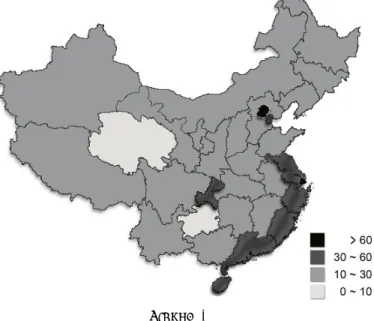
FIGURE 1
ENTREPRENEURIAL ACTIVITY IN CHINA (CPEA INDEX IN 2009) C. East Coastal Region and Midwest Inland Region in China
Studies conducted in other countries show that the dynamic employ- ment effect of entrepreneurial activities appears differently across regions.
Research done in European countries demonstrate that the patterns of dynamic effect were quite different between economically lagged coun- tries such as Portugal and developed countries such as Germany (Baptista, Escária, and Madrugo 2008; Fritsch and Mueller 2008; Mueller et al.
2008). Even in the analysis of different regions within the same country, the patterns differed among the regions (Mueller 2007). The employment effect of entrepreneurial activity was quite different between urban and rural areas in Korea as well (Lee 2009).
In China, a similar distinction is clearly seen between the eastern coastal region that currently enjoys rapid economic development and the central and western inland regions. As shown in the figure, entrepre- neurial activities are highest in metropolitan areas and in a number of provinces in the eastern coastal region of China.
Figure 1 describes the regional distribution of entrepreneurial activity index rank. The CPEA index,5 which is generally used as a proxy for
5China Private Entrepreneurship Activity Index.
entrepreneurial activity in China, is measured by the three-year net increase of private enterprises for 10,000 available labor persons. China’s GEM6 report employs this index for regional comparison of entrepre- neurship. Beijing and Shanghai rank overwhelmingly in the highest posi- tions, along with east coastal provinces such as Jiangsu, Hainan, Zhejiang, and so on. Megacities such as Tianjin and Chongqing follow. In contrast, Guizhou and Qinghai can be regarded as the worst entrepreneurial en- vironments.
Employment effects differ as the entrepreneurial activity pattern varies among the regions. This outcome is due to varied levels of economic development. Foreign direct investment poured into the eastern coastal region at the beginning of transition due to the installation of Special Economic Zones (Jin 2009). With the development of export-oriented manu- facturing businesses, new technologies and knowledge were introduced and spread rapidly (Hu and Jefferson 2002). These factors accelerated economic growth and continuously expanded new market opportunities.
Therefore, entrepreneurial activities in this region induced the innovation of other industries, produced indirect effects on demand, and increased employment.
In the midwestern inland region, however, the level of economic devel- opment is quite low, and therefore such indirect effects are hardly expect- ed (Lau 2010). Moreover, knowledge spillover effect from east-coastal pro- vinces cannot be expected to reach distant regions: many studies report that the knowledge spillover effect occurs within a limited geographical scope ( Ying 2000; Brun et al. 2002).
For the above reasons, we divide China into 11 eastern provinces and 19 midwestern inland provinces and conduct regression analysis. Ac- cording to data in the Yearbook of Industry and Commerce Administration of China 2009, the number of private enterprises in the 11 eastern provinces comprised 65.82% of the total number of private enterprises in China, much larger than the western region’s 14.40% and the central region’s 19.78%. The eastern region also registered a 50.58% proportion of self-employment businesses, which is higher than the sum of the western (20.21%) and central (29.21%) regions. This result confirms that in terms of entrepreneurial activities, the eastern region is clearly distinguishable from the central and western regions.
6Global Entrepreneurship Monitoring.
III. Empirical Model
A. Static Model
Our proposed empirical model is initially based on the labor demand function derived by Lee (2009). We construct the following empirical equation to estimate short-term effect (see Appendix A):
lnLit=α+β1ln wit+β2lnEit+β3lnR1it+β4lnR2it
+β5lnDit+β6lnCit+μit (1) i=provinces
t=years
where “ln” means natural log. All variables are used after log transfor- mation. A set of data employed in the empirical model is summarized as follows. As an employment indicator, private enterprises employment (Siying Qiye Jiuyeshu) and self-employment persons (Getihu Jiuyeshu) of a specific region and time are used. As stated previously, township and village economy is excluded.
As a proxy for regional entrepreneurial activities, we use two different indices, namely, establishment of private enterprises and establishment of self-employment households of region per year. Thus, we can compare the different effects of two entrepreneurial activities on employment.
Divided by available labor persons in specific province and year, these proxy indices construct variables E1 and E2, respectively. This index construction method is called the labor market approach (Audretsch and Fritsch 1994), and is utilized by various earlier works.
Wage w is measured by the average wage of region and time. Know- ledge capital is substantiated by two different variables, human capital and R&D capital. These two indicators have different effects on labor demand. Higher numbers of educated population increase labor demand, whereas R&D capital replaces labor input. Human capital H is measured by the number of graduates of junior college and higher in a specific region and time. R&D capital R is measured by the number of patents granted per 10,000 regional population in a specific region and time.
These two variables are used as independent variables. Market demand D is taken from the gross domestic product by region (GRDP ) per capita.
To control other factors that could affect labor demand, we add control variable C, which is measured by population density. Population density in a region is highly correlated with a number of factors, such as wage
Variable Unit Mean Standard
Deviation Min/Max Obs L (Employment) 10,000 persons 162.7703 183.2981 0.8/
1287.2 276
E1 (Employer entrepreneurial activity)
E2 (Self-employed entrepreneurial activity)
enterprises/
10,000 persons
enterprises/
10,000 persons
47.594
277.864
58.56902
91.42398
5.400661/
393.9524
135.375/
623.0848 279
279
w (Average wage) yuan/year 17507.98 8611.545 6918/56565 279 H (Human capital) 10,000 persons/
10,000 persons
212.87 133.4126 0.6337349/
631.0037 279 R (R&D capital) patent/
10,000 persons
1.38421 2.11926 0.0262172/
13.176 279
D (Market demand) yuan/person 5922.802 5861.063 117.46/
35696.46 279
C (Population density)
person/
km square
381.4454 498.9675 2.100977/
2996.825 279 Notes: 1. Employment (L) data for Shandong 2004, Fujian 2006, and Yunnan
2006 are unavailable.
2. See Appendix B for the definition of this variable.
TABLE 2
BASIC STATISTICS OF DATA
level, real estate prices, quality of communication infrastructure, and so on.7 Hence, we expect that population density can catch all region-specific characteristics. The database used includes 31 provinces and megacities during the 2000 to 2008 period. Table 2 summarizes the basic statistics of data used.
For model specification, we need to conduct the F-test and the Haus- man test.
Employing the F-test for our static empirical model (Equation 1), we cannot reject H1: βi=βi for all i at 1% significance level, and can reject
7We check the correlation between population density and three variables (wage level, real estate prices, and quality of communication infrastructure) with three proxies (average wage, average real estate price, and mobile-phone exchange ca- pacity) using data covering 31 Chinese provinces over 2003 to 2009. Achieved Pearson correlation coefficients are 0.6470 [0.0000], 0.1812 [0.0076], and 0.5045 [0.0000], respectively. The numbers in parentheses are p-values.
H2: αi=αi, βi=βi for all i at 1% significance level. Thus, we select Case:
αi≠αi, βi=βi. The selection of this assumption coincides with our objective, which is to investigate the effect of entrepreneurial activity on employment promotion at the national level.
Next, we use the Hausman method to test for the orthogonality of the random effects and the regressors. Under null hypothesis, the random effect estimates and fixed effect estimates should not be different system- atically (Green 2001). The test statistics χ2 (6) are 82.46 and 464.98, respectively, for employer entrepreneurship and self-employment entre- preneurship. Hence, the hypothesis that the individual effects are uncor- related with the other regressors in the model can be rejected. We con- clude that the fixed effect model is the better choice than the random effect model.
Lastly, given that we can detect the existence of heteroskedascity using the Wald test, we employ robust estimation for our fixed effect model.
B. Dynamic Model
Based on earlier studies (Fritsch and Mueller 2008), we construct the following empirical equation for long-term effect estimation (see the Ap- pendix A):
ΔLjt=α+
Σ
in=0βiΔ(Et-i)+Cjt+μjt (2-1) j=provinces
t=years
To obtain smoothed distribution lag by the Almon method, the model imposes the following restriction:
βi=γ0i0+γ1i1+γ2i2+…+γsis (2-2) i=lags
s=orders of polynomial
As an employment indicator, private enterprise employment plus the number of self-employment persons in a specific region and time is used.
This regional employment measure is used as the dependent variable dL after differentiation. As a proxy for regional entrepreneurial activities, the establishment of private enterprises and self-employed households of a region in a year is used separately. After explanatory variables are divided by available labor persons in a specific province and year, these
dE1 t t-1 t-2 t-3 t-4 t-5 t-6 t-7 t-8 t
t-1 t-2 t-3 t-4 t-5 t-6 t-7 t-8
1 0.7696 0.6532 0.6399 0.6489 0.6128 0.5606 0.5660 0.4453
1 0.8036 0.6512 0.5756 0.5780 0.5233 0.4850 0.5012
1 0.6969 0.6339 0.6025 0.5861 0.5179 0.4655
1 0.7062 0.6531 0.6006 0.5670 0.4935
1 0.6441 0.5766 0.5283 0.5020
1 0.5499 0.4779 0.4429
1 0.4575 0.3863
1 0.3740 1
dE2 t t-1 t-2 t-3 t-4 t-5 t-6 t-7 t-8
t t-1 t-2 t-3 t-4 t-5 t-6 t-7 t-8
1 0.3532 0.1866 -0.0475 -0.0896 -0.2074 -0.3033 -0.3060 -0.2420
1 0.2685 0.0216 -0.0882 -0.1452 -0.2739 -0.3756 -0.3027
1 0.2544 0.0052 -0.0911 -0.1491 -0.2653 -0.3941
1 0.2538 0.0285 -0.0139 -0.0582 -0.2392
1 0.2572 0.0560 0.0175 -0.0406
1 0.2759 0.0957 0.0293
1 0.3419 0.1162
1 0.3097 1 Notes: 1. 270 observations of dE1, dE2 in 30 provinces.
2. See Appendix B for the definition of this variable.
TABLE 3
CORRELATION MATRIX OF NET FIRM INCREASES FOR
SUBSEQUENT TIME PERIODS
indices construct explanatory variables dE1 and dE2, respectively, after differentiation. To control for all regional characteristics, population den- sity is used as an independent variable. The database used includes the 2001 to 2008 period and 30 provinces and megacities. Chongqing city is excluded because earlier lagged data are unavailable.
Correlations between private enterprise net increases (dE1, dE2) of suc- cessive years are presented in Table 3. Such correlations lead to multi- collinearity that makes the interpretation of coefficients in the models difficult (Van Stel and Storey 2004). To deal with this problem, we esti- mate the equation using the Almon method. To do this, we first need to determine the number of time lags and the orders of polynomials.
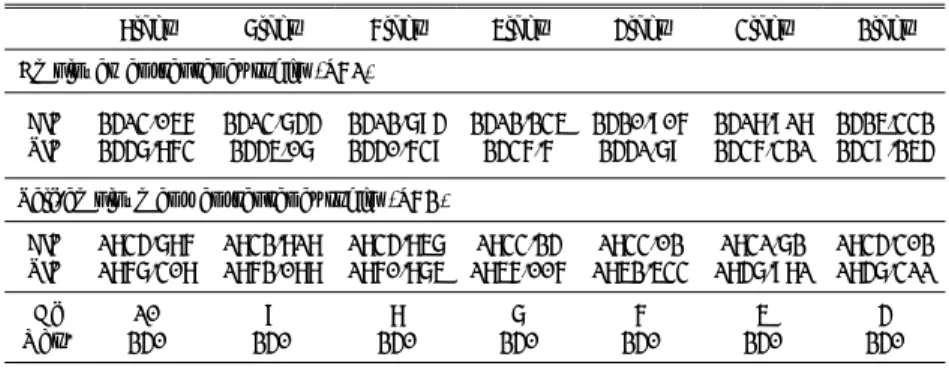
First, the Akaike Information Criterion and Schwartz Information Criterion are estimated using unrestricted fixed effect panel regression for each time lag. Results are presented in Table 4.
From the results, it can be concluded that the 5 lags model would be the best fit. This unique result is different from that of developed coun- tries. From this result, we can conjecture that in a rapidly changing
8lags 7lags 6lags 5lags 4lags 3lags 2lags Employer entrepreneurship (dE1)
AIC SIC
2413.056 2447.863
2413.744 2445.07
2412.794 2440.639
2412.235 2436.6
2420.906 2441.79
2418.918 2436.321
2425.332 2439.254 Self-employment entrepreneurship (dE2)
AIC SIC
1834.786 1867.308
1832.818 1862.088
1834.857 1860.875
1833.24 1856.006
1833.02 1852.533
1831.72 1847.981
1834.302 1847.311 Df
Obs.
10 240
9 240
8 240
7 240
6 240
5 240
4 240 Notes: 1. Regressions for 240 observations in 30 provinces and eight lagged
years.
2. See Appendix B for the definition of this variable.
TABLE 4
AIC AND SIC FOR EACH TIME LAG REGRESSION
transition economy such as China, the effect cycle of entrepreneurial activity on employment promotion is relatively shorter than in developed countries.
Another critical issue in applying the Almon method is determining which order of polynomial to consider. For this practical problem, the LR (Likelihood Ratio) test can be used. In the LR test for 2nd and 3rd order models, most Chi-square values are high enough to conclude that the 3rd order model is statistically significant. In the LR test for the 3rd and 4th order models, many Chi-square values are not larger enough than the critical. Hence, we can argue that 4th order polynomial can be regarded as statistically insignificant.
IV. Estimation Results
A. Static Model
Table 5 presents the results of our analysis using the static model.
According to the results, empirical model estimation equations show rela- tively high explanatory power. What is remarkable is that entrepreneurial activities by both employers and the self-employed have a significant positive effect on job creation. The average result means that a 10% in- crease in entrepreneurial activities by employers brings forth a 9.7% in- crease in employment in the private economy sector. Even when consi- dering the size of state-owned sectors and the township and village eco-
Employment (lnL) effect Employer
entrepreneurship (lnE1)
Self-employment entrepreneurship (lnE2) Average wage (lnw)
Entrepreneurial activity (lnE)
Human capital (lnH) R&D (lnR)
Market demand (lnD) Population density (lnC) region dummies adj. R2
Observations
0.2240135 (0.85)***
0.9751764 (13.39)***
0.0071002 (0.07)***
-0.0461786 (-0.96)***
-0.2240249 (-1.01)***
2.948467 (2.76)***
used 0.9532
276
1.211571 (4.40)***
0.6917967 (3.18)***
0.1427853 (1.61)***
-0.0154858 (-0.24)***
-0.246799 (-1.05)***
1.555507 (1.89)***
used 0.9483
276
Notes: 1. The symbols “*, **, ***” stand for the significance level of 10%, 5%, and 1%, respectively.
2. See Appendix B for the definition of this variable.
TABLE 5
EMPIRICAL RESULTS OF FIXED EFFECT ROBUST ESTIMATION FOR
STATIC MODEL
nomy, this effect is remarkably large compared to reports in other coun- tries. The effect is also large when estimated based on entrepreneurial activities by self-employment households. Comparing the job creation effects of employer entrepreneurs and the self-employed, the effect of the former is larger, and the difference is statistically significant. This shows that in the short run, the economic effect of entrepreneurial acti- vities by employers is much more significant. Another notable point is that the sign of the estimated parameter coefficients is generally as ex- pected in the model. Although not statistically significant, human capital shows a positive sign as expected in the model, and R&D shows a nega- tive effect because investment in R&D substitutes labor force.
B. Dynamic Model
In dynamic analysis, two comparisons are made. First, we perform regression analysis using different proxy variables on employer and self- employed entrepreneurs, and compare the results. In addition, we divide the 30 provinces and metropolitan cities in China (except Chongqing) into 11 economically fast-growing and developed regions in the east coast and 19 underdeveloped regions in the midwest inland, and perform re- gression analysis with interaction region dummy. The 11 regions in the east coast are Beijing, Tianjin, Hebei, Liaoning, Shanghai, Jiangsu,
Almon method (the 3rd orders)
Employment (dL) effect Employer entrepreneurship
(dE1)
Self-employment entrepreneurship (dE2) 11 east coast regions
γ0*dum1 t-0 2.182911 (4.45)**
2.182911 0.9597775 (9.53)**
0.9597775
γ1*dum1 t-1 -3.471163 (-3.94)**
0.2984908 -1.255199 (-8.03)**
0.0916148
γ2*dum1 t-2 1.841052 (4.13)**
0.5703194 0.4319142 (6.00)**
-0.1819869
γ3*dum1 t-3 -0.254309 (-4.22)**
1.4725416 -0.044877 (-4.93)**
-0.130295
t-4 1.4793022 -0.0225769
t-5 -0.935254 -0.1281
Sum of coefficient 5.068311 0.5884335
19 midwest regions
γ0*dum2 t-0 2.80423 (1.74)*
2.80423 0.3518658 (3.66)**
0.3518658
γ1*dum2 t-1 -2.039096 (-0.52)
1.4496632 -0.2849834 (-1.76)*
0.1298413
γ2*dum2 t-2 0.8086775 (0.39)
0.9675616 0.0675477 (0.92)
0.0153794
γ3*dum2 t-3 -0.1241483 (-0.44)
0.6130354 -0.0045888 (-0.50)
-0.0190527
t-4 -0.3588052 -0.0009878
t-5 -2.69285 0.0420413
Sum of coefficient 2.782835 0.5190873
Population density -0.293071 (-1.86)* 0.0144528 (0.22)
Constant 105.4557 (1.93)* 15.95175 (0.65)
R2-within/F 0.1518/ 4.00 0.4610/ 19.10
Observations 240 240
Notes: 1. t-values in parentheses.
2. The symbols “*, **” stand for t-statistics at the significance level of 5% and 1%, respectively.
3. See Appendix B for the definition of this variable.
TABLE 7
REGIONAL DIFFERENCE OF DYNAMIC REGRESSION RESULTS
FIGURE 2
DYNAMIC IMPACT OF ENTREPRENEURIAL ACTIVITY ON EMPLOYMENT
Zhejiang, Fujian, Shandong, Guangdong, and Hainan, and the 19 eco- nomically underdeveloped regions in the midwest inland are Shanxi, Inner Mongolia, Jilin, Heilongjiang, Anhui, Jiangxi, Henan, Hubei, Hunan, Guangxi, Sichuan, Guizhou, Yunnan, Tibet, Shaanxi, Gansu, Qinghai, Ningxia, and Xinjiang.
Tables 6 and 7 summarize the results of regression analysis. In gen- eral, coefficients are significant, and the coefficient of determination and F-value show that the results of regression are acceptable. As shown in Figure 2, the dynamic effect forms an S-shaped curve, which is consist- ent with the results of previous empirical studies, such as those on Germany and the United Kingdom by Fritsch and Mueller (2008) and Mueller (2007), respectively. As previous studies were organized well by Fritsch (2008), they are readily comparable.
The following is an explanation of the figure below. The left graph shows the employment effect of employer entrepreneurship, the right one shows the employment effect of self-employment entrepreneurship.
According to the graphs, the two groups have different employment effects. First, the size of employment effect is different. Second, the sum of coefficients from t-0 to t-5 estimated by the Almon method are 4.5945395 and 0.398713, respectively. Third, the effect of employer entrepreneurship is much larger.
When the effects are divided into short-term, mid-term, and long-term, the difference from dynamic employment becomes clear. First, in em- ployer entrepreneurship, the short-term direct effect is quite large. For the mid-term indirect crowding out effect, the S-shaped pattern takes place but the effect is not negative,8 suggesting that the crowding out
8According to the results in Table 6, the calculated coefficients of t-1 and t
effect is limited. These results are quite unusual, rarely found in other countries. The reason for this unusual result in China can be explained in two ways. One is the characteristics of a fast-growing developing coun- try. Demand growth is rapid, and emerging demand is being created far faster than the disappearance of traditional markets. The other is the unique policies and institutions of China. By keeping the prices of labor force, resources, energies, and so on, low by force, the government pro- vides an economic environment for marginal firms to survive. According to research, China constantly maintains a high return on investment (Bai et al. 2006). Considering these reasons that are unique to China, the dismissal of established marginal firms from the Chinese private eco- nomy is delayed, and the indirect crowding out effect is controlled des- pite the emergence of new enterprises.
The effects on long-term supply are also clearly observed. These effects have a short cycle, different from those seen in other countries. This factor is attributed to the unusual economic characteristics of China under rapid growth and radical change in the market structure.
As to the dynamic employment effect of self-employed entrepreneurship, an obvious short-term direct effect is observed. However, the mid- and long-term effects are insignificant. The mid-term indirect crowding out effect is negative and reveals a pattern, but it is not large. The long-term indirect effect is negative, suggesting that the employment effect is mean- ingless. Thus, small-size start-up businesses are found to have only a limited effect on the expansion of economic scale in terms of supply.
The employment effect of employer entrepreneurship and self- employment entrepreneurship is next analyzed by region (see Figure 3).
The graph on the left shows the employment effect of employer entre- preneurship, and the one on the right shows the employment effect of self-employment entrepreneurship. The solid line indicates the employ- ment effect in the 11 east coast regions, whereas the dotted line signifies the employment effect in the 19 underdeveloped midwest inland regions.
In the east coast regions and megacities where economic growth is fast and economic activities are high, the employment effect of both employer and self-employed entrepreneurship is remarkable. The employment effect in these regions is marked with a solid line in both graphs. Particularly for employer entrepreneurship, the patterns of the mid- and long-term employment effects are revealed clearly, and the long-term positive em- ployment effect in terms of supply is obvious. In the case of self-
-2 are 0.2927955 and 0.513808, respectively.
FIGURE 3
REGIONAL DIFFERENCES IN THE DYNAMIC IMPACT OF ENTREPRENEURIAL
ACTIVITY ON EMPLOYMENT (― EASTERN CHINA, --- MIDWESTERN CHINA) employment entrepreneurship, the short-term direct employment effect is relatively large. These results are similar to the reports of Acs and Mueller (2008) and Audretsch and Keilbach (2005). They explain that the job creation effect is relatively large in urban areas because of the high agglomeration effect in such areas.
The results of the regression analysis on the 19 economically under- developed midwestern inland regions are different. The dynamic employ- ment effect of employer and self-employed entrepreneurship is marked with a dotted line in both graphs. Employer entrepreneurship has an obvious short-term direct employment effect, but its effect in terms of long-term supply is limited. According to Table 7, the calculated coef- ficients for the effect of employer entrepreneurship in the midwest region are -0.0225769 for t-4 and -0.1281 for t-5. This result means that new enterprises do not grow steadily in underdeveloped regions, and consequently, their economic effects are insignificant. The employment effect of self-employment entrepreneurship is quite immaterial in the underdeveloped regions. Both the short-term direct employment effect and the crowding out effect are small. On the contrary, the effect in terms of long-term supply shows a positive trend, and this finding is consis- tent with the report of Lee (2009). In Korean rural regions, although the region classification method is somewhat different, the employment effect of self-employment entrepreneurship appears larger in the long run.
In sum, the results and patterns of regional differences in employment effect are similar to those seen in previous reports. In these previous studies, the employment effect of employer entrepreneurship is large and shows an S-shaped dynamic pattern in urban areas. In China as in other countries, the employment effect of entrepreneurial activity by em-
ployer start-ups is more significant in economically active regions, and its dynamic pattern is similar to theoretical explanations.
V. Conclusion
As presented above, we have conducted empirical analysis on the em- ployment effect of entrepreneurial activities in the Chinese private eco- nomy. Both static and dynamic effects are analyzed using data on 31 Chinese provinces over 2000 to 2008. In regression analysis, entrepre- neurial activities are divided into employers and self-employed, and the effect of each type of entrepreneurial activity is analyzed using different variables. To enrich the discussion, we have employed dynamic analysis for 11 economically developed regions and 19 underdeveloped ones. Then, employment effects are compared.
Conclusions drawn from the empirical analysis are as follows.
First, as seen in previous research in other countries, entrepreneurial activities by entrepreneurs make a considerable contribution to job cre- ation. This conclusion was confirmed through a static model. In the dy- namic aspect, however, the short-term, mid-term, and long-term job creation effects in China are different from the patterns observed in other developed countries, despite the fact that the basic pattern of the job creation effect is S-shaped as in previous studies such as those by Fritsch and Mueller (2008) and Mueller (2007). The most important dif- ference is that the cycle of dynamic effect is markedly short.
Second, employer entrepreneurship and self-employment entrepreneur- ship have different employment effects. In the static model, employer entrepreneurship has a far larger short-term job creation effect. In the dynamic model, the mid- and long-term effects of entrepreneurial activi- ties by employers agree with the theoretical model, and are much more evident. Compared to other countries, the mid-term indirect crowding effect is quite limited. Meanwhile, the short-term effect of self-employment entrepreneurship is relatively obvious, but the mid- and long-term effects are insignificant. This result is consistent with the report on Korea by Lee (2009).
Third, the job creation effect differs by region. In the economically active east coast regions and metropolitan cities, the employment effect of employer and self-employed entrepreneurship is clear, and the trend agrees with the dynamic pattern of the theoretical model. In the 19 underdeveloped western inland regions, however, the short-term effect is
clear, and the mid- and long-term crowding out effects are even clearer, but the positive job creation effect in the terms of long-term supply is insignificant. This finding is consistent with the reports of Acs and Mueller (2008), Audretsch and Keilbach (2005), and Lee (2009).
Although we obtained these meaningful results, this study has a num- ber of limitations. First, the data are not based on micro data, but were extracted from statistical yearbooks. With these data, making an ac- curate analysis is difficult. For example, demand for labor force in each region was calculated simply by counting the number of registered wor- kers without considering working hours. Moreover, only private enter- prises and self-employed households are included in our analysis. This private economy accounts for a large percentage of the total economy in metropolitan cities and economically developed regions. In underdevel- oped regions, however, state-owned economy and township and village economy still occupy a large part of the total economy.9 Therefore, the difference in economic structure has been neglected in our analysis.
Despite these limitations, the results of this study suggest several policy implications. Basically, as supported by established theories, in- vestment in innovations alone does not have a direct employment effect, but the employment effect from entrepreneurial activities takes place.
Therefore, we can raise the proposition that entrepreneurial activities should be encouraged and institutionally supported to improve the local economy. In addition, entrepreneurial activities by employers influence the supply side by stimulating long-term economic development, and ultimately induce indirect employment effects. Therefore, such types of entrepreneurial activities should be promoted actively. Furthermore, busi- ness infrastructure in midwest inland underdeveloped regions has to be improved further to provide more stable growth to entrepreneurial enter- prises.
(Received 29 July 2011; Revised 12 December 2011; Accepted 19 December 2011)
9For example, in 2009, non-state owned or non-collective owned economy (Feigongyou Jingji) occupied only 46.5% of total employment in Jiangxi province (Yearbook of China Small and Medium Enterprise 2010).
Appendix A
We restate the comparative static analysis of Lee (2009), assuming the profit function of representative firm:
π=P(Y, E) F(L, K, R, E)-wL-rK
where Y=F(L, K; R, E) is output. L and K are homogeneous labor and capital input, respectively. R and E are knowledge capital and entrepre- neurial activity, respectively. We consider R and E as complementary factor inputs of labor and physical capital. We designate inverse demand function by P(Y, E). As we can see in the function, entrepreneurial activity E can affect demand side as well as supply side. w is the exogenous price of labor (i.e., wages), whereas r is the price of capital (i.e., interest rate). We assume that the costs for R and E are charged by other economic entities in the social and regional contexts.
Then, given R and E, the 1st order conditions for profit maximization can give the following labor demand:
L=L*(w, r, R, E, Y) and we can find
− −
⎛ ⎞
= ⎜ ⎟
− −
⎝ ⎠
| |
LE L E LK
KE K E KK
PY Y P Y dL P
PY Y P Y dE H
where |H|=(YLLYKK-YL2K)P2>0, and we assume that YLE>0,YKE>0.
Hence, following Lee (2009), we conclude that dL/dE>0 if dP/dE=0.
If there is no short-term price change (dP/dE=0), there is no demand change. Moreover, the increase in entrepreneurial activities can directly promote labor demand increase (short-term direct effect). In addition, we cannot determine the sign of dL/dE if dP/dE<0, for mid-term trend analysis. In the mid-term market, entries from entrepreneurial activities can increase market competition and bring about a downward demand function (dP/dE<0). Then, the labor demand change from entrepreneurial activities cannot be determined (mid-term indirect crowding effect). Final- ly, we archive dL/dE>0 if dP/dE>0 for the long-term effect. The firms that survived the competition not only create jobs by themselves, but also promote employment indirectly by increasing market demand (dP/
dE>0). In this case, the labor demand change from entrepreneurial activities can be positive (long-term indirect supply-side effect).
Appendix B
Empirical estimations of this paper are based on annual data cover- ing 31 provinces over the 2000 to 2008 period. Data sources are from various years of the China Statistics Yearbook, China Population &
Employment Statistics Yearbook, and China Statistics Yearbook on High- tech Industry.
(1) L=Employment. Private enterprise employments plus self employed persons.
(2) E1=Employer entrepreneurial activity. Establishment of private enterprises with more than eight employees, divided by labor avail- able population.
(3) E2=Self-employed entrepreneurial activity. Establishment of self- employed households with less than eight employees, divided by labor available population.
(4) w=Average wage measured by regional average wage.
(5) H=Human capital. Graduates of junior college and higher popula- tion total population.
(6) R=R&D capital. Number of patents application granted per 10,000 capita.
(7) D=Market demand measured by GRDP.
(8) C=Control variable measured by population density.
(9) dL=Employment index for dynamic analysis. It is defined by the net increase of private enterprise employment and self-employed persons.
(10) dE1=Employer entrepreneurial activity index for dynamic ana- lysis. Net increase of establishment of private enterprises, divided by labor available population.
(11) dE2=Self-employed entrepreneurial activity index for dynamic ana- lysis. Net increase of establishment of private enterprises, divided by labor available population.
(12) t-n=n-year lagged variable of dE1 and dE2.
(13) γn=Almon method 3rd order polynomial coefficients.
(14) AIC=Akaike information criterion calculated after regression.
(15) SIC=Schwartz information criterion calculated after regression.
References
Acs, Z. J., Audretsch, D. B., Braunerhjelm, P., and Carlsson, B. The Missing Link: Knowledge Filter and Entrepreneurship in Endo- genous Growth. CEPR Discussion Paper 4783, 2004.
. Growth and Entrepreneurship: An Empirical Assesment. CEPR Discussion Paper ISSN 5409, 2005.
Acs, Z. J., and Armington, C. “Employment Growth and Entrepreneurial Activity in Cities.” Regional Studies 38 (No. 8 2004): 911-27.
Acs, Z. J., and Mueller, P. “Employment Effects of Business Dynamics:
Mice, Gazelles and Elephants.” Small Business Economics 30 (No.
1 2008): 85-100.
Arauzo, Carod, Solis, Liviano, and Bofarull, Marino. “New Business For- mation and Employment Growth: Some Evidence for the Spanish Manufacturing Industry.” Small Business Economics 30 (No. 1 2008): 73-84.
Audretsch, D. B., and Fritsch, M. “On the Measurement of Entry Rate.”
Empirica 21 (1994): 105-13.
. “Creative Destruction: Turbulence and Economic Growth in Germany.” In Helmastadter and M. Perlman (eds.), Behavior Norms, Technological Progress, and Economic Dynamics: Studies in Schumpeterian Economics. Ann Arbor: University of Michigan Press, pp. 137-150, 1996.
Audretsch, D. B., and Keilbach, M. “Entrepreneurship Capital and Eco- nomic Performance.” Regional Studies 38 (No. 8 2004): 949-59.
. “Entrepreneurial Capital and Regional Growth.” The Annals of Regional Science 39 (No. 3 2005): 457-69.
Ashcroft, B., and Love, J. H. “Firm Births and Employment Change in the British Counties: 1981-1989.” Papers in Regional Science 75 (No. 4 1996): 483-500.
Bai, Chong En, Hsieh, Chang-Tai, and Qian, Yingyi. The Return to Capital in China. NBER Working Paper 12755, 2006.
Baptista, Rui, Escária, Vítor, and Madruga, Paulo. “Entrepreneurship, Regional Development and Job Creation: the Case of Portugal.”
Small Business Economics 30 (No. 1 2008): 49-58.
Baumol, W. J. “Entrepreneurship: Productive, Unproductive and Destruc- tive.” Journal of Political Economy 98 (No. 5 1990): 893-921.
Baumol, W. J., Panzar, J. C., and Willig, R. D. Contestable Markets and the Theory of Industry Structure. San Diego: Harcourt Brace