On the other hand, chirality, one of the most interesting concepts, has been shown to govern many key biological processes. Therefore, the aim of this thesis is to study the effect of chirality on poly(azidohexyl glycidyl ether) (PAHGE). Finally, we also prepared chiral hexyl glycidyl ether (HGE) monomer and the resulting polymers, poly(hexyl glycidyl ether) (PHGE) for comparative analysis of the effect of azide moieties.
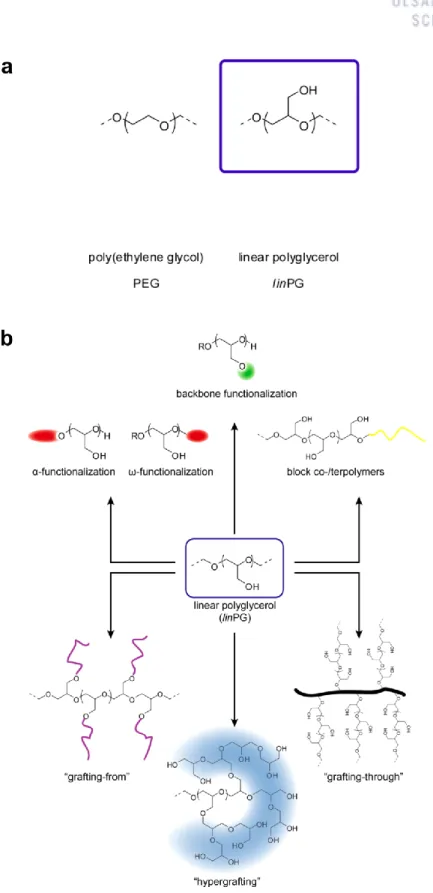
The effect of backbone chiralities was much more significant in crystallizable PHGEs than in amorphous PAHGEs, but neither formed a stereocomplex. a) Chemical structures of PEG and linear PG. Representative 1H NMR spectra (a) of the (S)-AHGE monomer, (b) taken after the complete monomer conversion, (c) taken after t-Bu-P4 filtration and (d) of the final PAHGE (entry 1 in table 1). GPC traces of the block copolymer PAHGE27 (entry 4 in Table 2) after the first polymerization (dashed) and the second polymerization (solid).
Introduction
Polyether
- Poly(ethylene glycol)
- Polyglycerol
- Functionalized PG
When different amine pendant groups were introduced to the copolymer of EO and AGE, cloud points were tuned over a wide range of temperatures.7 However, to our knowledge, the synthesis or application of tacticity-controlled linear PGs has rarely been explored. despite the importance of chirality governing the nature and tacticity affecting polymer properties.
Tacticity-controlled polyether
- Tacticity
- Tacticity-controlled polyether
- Methods to confirm the tacticity
- Synthesis and relevant studies
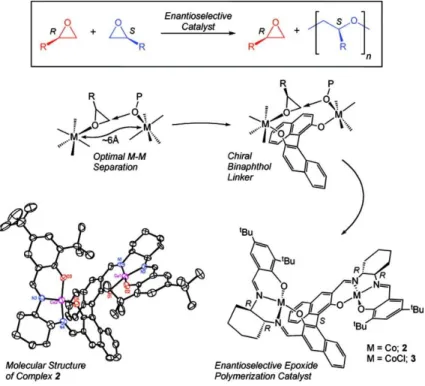
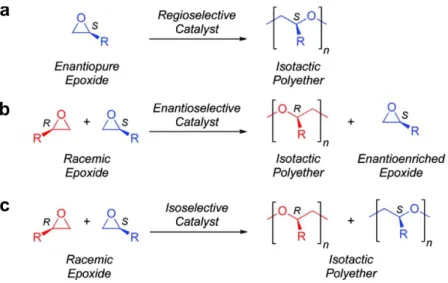
With the enantioselective catalyst, only one chiral form of the racemates participates in the process and the other remains. Coates and co-workers have been interested in establishing enantioselective polymerization to prepare stereoregular polyethers by designing and synthesizing the appropriate catalyst. 12 The reasonable mechanism is also deduced from the crystal structure of the catalyst. Despite the extremely high optical purity of >99%, the [mm] or mm isotactic triad content of the isotactic polymers reached about 90%.
After confirming the applicability of t-Bu-P4/alcohol-initiated AROP for the synthesis of isotactic polyethers, various epoxy monomers were used to study the effect of main chain tacticity on LCST behavior19 or thin film formation.20 In conclusion, the effect on LCST behavior was negligible , but the latter study showed that the isotacticity of the side chains of the brush block copolymers promoted a better quality of the morphologies in terms of lateral ordering and orientation.
Stereocomplex
- Definition
- Methods to characterize stereocomplexation
- Applications
Optical purity of kinetically resolved POs was determined by comparing the specific rotation value with the literature values. However, the same AROP in which butanol acted as the initiator and t-Bu-P4 acted as the base was successful as published by Satoh and co-workers.14 t-Bu-P4 (1-tert-butyl-4,4,4-tris( dimethylamino)-2,2-bis[tris(dimethylamino)-phosphoranylideneamino]-2Λ5,4Λ5-catenadi(phosphazene)) or simply phosphazene is an organic superbase synthesized by Schwesinger et al. and its effectiveness on the ROP of EO has been shown.15,16 Satoh's group has shown that the system allows the successful synthesis of polyethers with different architectures and side groups 1) at mild condition (room temperature), 2) in living and controlled manner and 3 ) without a chain transfer reaction.14,17,18 In particular, in 2015, Isono et al. The first example was the pair of isotactic and syndiotactic poly(methyl methacrylate) (PMMA) found by Fox et al.
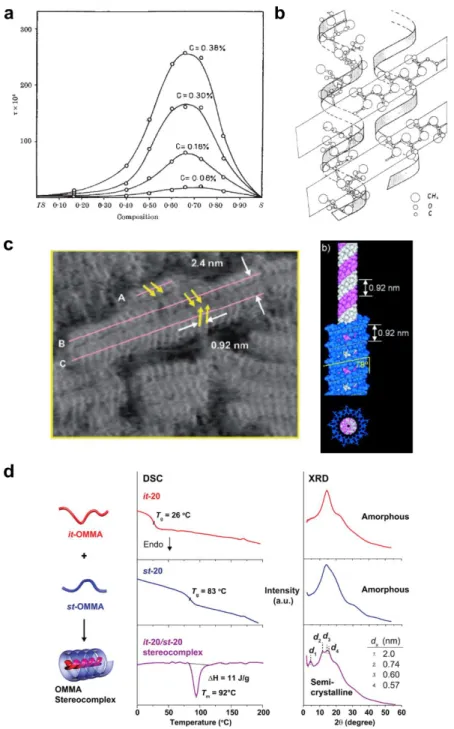
Based on the fact that the X-ray pattern of the latter case was identical to that of mixtures of isotactic and syndiotactic PMMAs, Liquori et al. Since stereocomplex is the formation of new crystallites, they can be characterized by a variety of spectroscopic and thermodynamic studies or imaging techniques. First, aggregation increases turbidity of polymeric solution, so the ratio between two polymers where turbidity clearly increases tells the composition as Liquori et al.
Nowadays, the emergence of more advanced technologies and precise polymerization techniques enabled more precise investigations on structural details26, such as the critical chain length required or the effects of molecular weight and dispersity on PMMA stereocomplex formation.27. In detail, PMMA stereocomplex formation has been used to develop a solid-phase molecular-scale template to synthesize stereoregular PMMA.28 Selective exfoliation of one polymer from the stereocomplex film has made porous film made of the other polymer with nanopores of structurally adjusted. Meanwhile, complementary stereocomplexation of PLA promoted hydrogelation.29 Other applications of stereocomplexing PLA or PLA-based copolymers have been well introduced in reviews. .
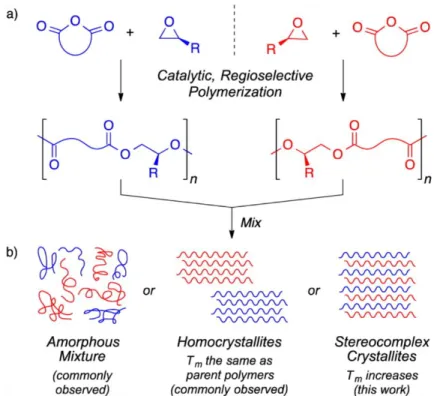
Different methods used to characterize the PMMA stereocomplex. a) Measurement of opacity of isotactic (IS)/syndiotactic (S) PMMA mixtures at different compositions and concentrations. Stereocomplexation of poly(propylene succinate). a) Structure of isotactic (S)-(blue) and (R)-poly(propylene succinate) (red) and showing the formation of their stereocomplex.
Experimental section
Synthesis and characterization of isotactic PAHGEs
A few minutes later, (S)-AHGE monomer (0.65 g, 3.26 mmol) was added and the solution was stirred at room temperature. The polymerization was quenched by the addition of benzoic acid after full consumption of the monomer as monitored by 1H NMR.
Investigation on stereocomplexation of the isotactic P(A)HGEs
The crude product was purified by flash column chromatography on silica gel in hexane/diethyl ether 4:1 to yield (S)-HGE monomer as a clear liquid (4.17 g, 53%). R)-HGE monomer was synthesized from (S)-HGE monomer in the same manner, except that (R)-epichlorohydrin was used instead of (S)-epichlorohydrin. A 50 mL Schlenk tube was flame dried under vacuum and purged with nitrogen three times. A few minutes later, (S)-HGE monomer (0.50 g, 3.16 mmol) was added and the solution was stirred at room temperature.
The polymerization was quenched by the addition of benzoic acid after the complete consumption of the monomer, as followed by. The eluate was concentrated under reduced pressure, which was then precipitated in hexane to yield isotactic (S)-PHGE as a pale yellow, self-contained gel (435 mg, 87%). First, 20 mg of completely dried polymer was dissolved in a minimal but equal amount of chloroform.
An equal amount of the two solutions was taken for mixing in another 4 mL vial. The final solution was allowed to evaporate the chloroform in air and further dried under vacuum for at least 1 day.
Results and Discussion
Synthesis and characterization of isotactic PAHGEs
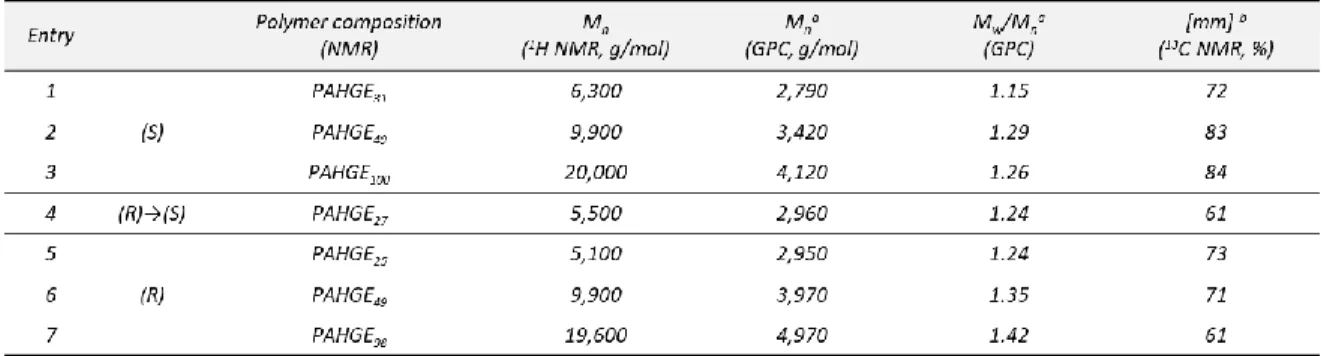
Further steps were taken to keep in mind the defective isotaxicity of the PAHGEs, although this may hinder a clear conclusion from this study. In addition, GPC traces of the PAHGEs using PMMA as a standard in DMF showed no trend (Table 1 and Figure 13). The Mn.GPC values were always lower than the Mn.NMR, but did not consistently increase with increasing Mn.NMR.
PAHGE216 (entry 6) showed the largest Mn.GPC over time, although it has high dispersion and a shoulder peak in its trace. First, each polymer was dissolved in DMF (1.5 mg/mL) and different proportions of the two solutions were taken according to the desired fraction to mix well to obtain a total of 2 mL of solution. Interestingly, the Mn.GPCs were all similar when mixed in different fractions, but only decreased when the proportion of (R)-PAHGE28 is 0.5, which means that the amount of the two enantiomeric chains is equal.
The result may have implied the existence of stereoselective interactions while it was still suspect due to the fact that GPC does not give absolute but relative information about molecular weight based on hydrodynamic volume. In summary, the synthesis of the chiral AHGE monomers and the resulting isotactic PAHGEs was introduced in section 3.1. The t-BuP4-catalyzed AROP successfully provided a series of PAHGEs with different molecular weights, but the polymers were not perfectly isotactic which differed from the previously reported papers.
This may be due to the relatively lower enantiopurity of the chiral AHGE monomers and the %ee values must be determined first. However, GPC characterization of the mixture of two enantiomeric polymers suggested that the stereoselective interactions can occur at the specific ratio.

Investigation on stereocomplexation of the isotactic P(A)HGEs
However, these peaks are not attributed to the glass transition from the fact that the glass transition temperature (Tg) of liquid glycidyl azide polymers is known to be −45 to −40 °C.35,36 Bulky pendant groups lower the Tg, so the Tg of our PAHGEs with hexyl spacers on the side chain may not be observed above -80 °C. The authors thus concluded that it was because the azide group is larger and less electronegative than the chlorine atom on poly(epichlorohydrins). From the GPC and DSC measurements, the isotactic PAHGEs were found not to form stereocomplex in our study.
Since the crystallinity indicates some tacticity, we tried to change the designed azidohexyl glycidyl ether (AHGE) monomer to hexyl glycidyl ether (HGE) monomer; to observe whether crystallinity occurs in isotactic polymer and the effect of azide group. As a preliminary study to investigate the effect of azide group on the crystallization of PAHGEs, only three polymers at fixed molecular weight (6,000 g/mol) each of the racemic, (S)- and (R)-HGE monomers were prepared. The structure of the monomer and corresponding polymer was identified by 1H and 13C NMR spectroscopy (Figures 23 and 24).
This implies that the %ee values of the chiral HGE monomers would not be high enough. It is reasonable because the Tg of isotactic poly(n-butyl glycidyl ether) with %[mm] value of 86.4 was -77 °C.11 The isotacticity of (S)-PHGE37 was only 5% higher than that of ( R)-PHGE42, but the slight modification not only increased the crystallization temperature (Tc), Tm, and the associated enthalpies (ΔHc and ΔHm), but also affected the physical appearance of the polymers. Here, the 1:1 mixture of (S)- and (R)-polymer was also crystallized, but all Tc, Tm, ΔHc, and ΔHm were significantly reduced compared to those of each parent polymer.
The reduction of the overall crystallinity or negative contribution to each other may arise because the two types of homocrystals acted as an obstacle by limiting space and thus preventing further growth of crystals. Briefly, the HGE monomer was synthesized as an analogue of the AHGE monomer without azide. The atactic and isotactic PHGEs with the same molecular weight were prepared by the t-Bu-P4-catalyzed AROP, but the polymers were also not perfectly isotactic.
DSC characterization of PHGE, including a 1:1 mixture of the two enantiomeric polymers, gave three conclusions;.
Conclusion