The Direction of the Korean Green New Deal for the Response to Climate Change: Focusing on the Mitigation of Greenhouse Gases in the Energy Sector
Inseong Son and Donggu Kim
Authors
Inseong Son and Donggu KimResearch Staff
Principal
Investigators Inseong Son ( Research Fellow, KEEI) Donggu Kim ( Research Fellow,KEEI) Participants Sooin Kim ( Expert Researcher, KEEI)
Jihyeon Kim ( Expert, KEEI)
Chapter 1. Introduction 1
1. Research Background 1
2. Research Purpose 5
Chapter 2. EU Green Deal and EU Strategy on Energy System Integration 7
1. EU Green Deal 7
2. EU Strategy on Energy System Integration 12 2.1. Building a Cyclical Energy System Centered on Energy
Efficiency First Principle 14
2.2. Acceleration of Electrification in the Energy Demand Sector based on RE Power Generation 16 2.3. Renewable, Low-carbon Fuel Delivery
for Difficult-to-Decarbonize Sectors 19 2.4. Establishment of Energy Markets Suitable
for Decarbonization and Distributed Resources 21
2.5. Energy Infrastructure Integration 24
2.6. Digitization of Energy System and
Innovation Framework 26
3. Renovation Wave 27
Chapter 3. Tasks of KGND in the Energy Sector 31
1. Current Status of KGND 31
1.1. Korean New Deal 1.0 31
1.2. Korean New Deal 2.0 37
2. Tasks in the Energy Sector of KGND 43 2.1. Diffusion of Low-carbon, Distributed Energy 43 2.2. Zero-energy Public Facilities Closely Related to
People's Lives 62
Chapter 4. Complementary Direction for KGND 73
1. Comparison of EU Strategy on Energy System Integration
and KGND 73
2. Complementary Direction of KGND 78
2.1. Visions for Korean Energy System 78
2.2. Linkage between Energy Sources or Sectors 80 2.3. Utilization of Hydrogen and Renewable
Low-carbon Fuels 82
2.4. Reflection of GHG Reduction Costs 83
2.5. Information Disclosure and Follow-up Management 84
Chapter 5. Reduction Potentials and Improvement Plan for RE Dissemination and Green 87
1. Reduction Potential from RE Dissemination Support 88
1.1. Housing Support Projects 90
1.2. Building Support Projects 93
1.3. Convergence Support Projects 95
1.4. Regional Support Projects 97
1.5. GHG Reduction Potential of the RE Dissemination
Support Project 99
2. Reduction Potentials of Green Remodeling 105 2.1. Green Remodeling of Old Public Rental Housing 106 2.2. Green Modeling for Public Buildings 114
3. Evaluation of RE dissemination Support and Reduction
Potential of Green Remodeling Projects 120 3.1. Reduction Potential Evaluation of RE
Dissemination Support 121
3.2. Evaluating the Reduction Potential of
Green Remodeling 123
4. Improvement Plans of RE Dissemination Support
and Green Remodeling 125
4.1. Measures to Expand self-Generation and
Consumption of RE 125
4.2. Promotion of Green Remodeling Projects 128
Chapter 6. Conclusion and Implications 131
References 139
Tables
Summary Table –1. Reduction Potential of RE Dissemination Support and Green remodeling (2020-2050) xxivTable 2-1. Highlights of EU Green Deal 8
Table 2-2. Six Action Plans in EU Strategy on Energy System
Integration 14
Table 3-1.2020-2025 Fiscal investment of KGND
(Korean New Deal 2.0) 42
Table 3-2. Detailed Tasks of Expanding Distributed System 46 Table 3-3. Tasks and Budgets for Expanding Distributed Systems 47 Table 3-4. Tasks of R&D and Demonstration Projects 49 Table 3-5. Tasks for Loans and Dissemination Support Projects 52 Table 3-6. Tasks of Just Transition Project 54 Table 3-7. Tasks of Projects to Accelerate the Dissemination of Electric and Hydrogen Vehicles 57 Table 3-8. Tasks for the Eco-friendly Transition Projects of
Old Vehicles and Ships 58
Table 3-9. Tasks of Core R&D for Green Mobility 61
Table 3-10. Tasks of Green Remodeling 64
Table 3-11. MOLIT's Green Remodeling-related Project budgets 66 Table 3-12. Tasks of Public Rental Green Remodeling Projects 68 Table 3-13. Green Modeling Support for Public Buildings 70 Table 3-14. Interest Support Project for Private Building
Green Remodeling 72
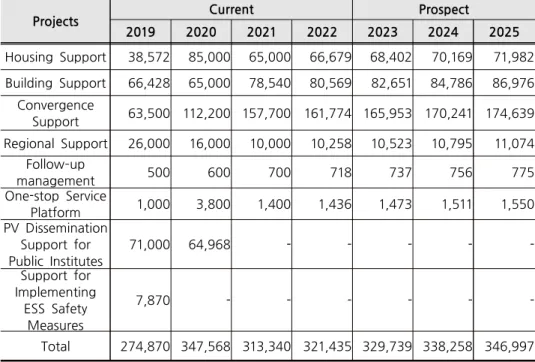
Table 5-1. Current (2019-2022) and Prospective (2023-2025) Budgets of RE Dissemination Support Projects 90 Table 5-2. Prospective Dissemination by Energy Source for
Housing Support Projects 92 Table 5-3. Current and Prospective Budgets for Building
Support Projects 94
Convergence Support Projects by Energy Source 97 Table 5-6. Dissemination Performance and Prospects of Regional Support Projects by Energy Source 99 Table 5-7. Facility Dissemination and Prospects of RE Support Project by Energy Source 100 Table 5-8. Current Status of Facility Dissemination and Energy Production by Energy Source 102 Table 5-9. New and Cumulative Power Generation and Heat Production of Facility Dissemination by Year 103 Table 5-10. GHG Reduction Potential of RE Dissemination
Support Projects 105
Table 5-11. Status of Old Public Rental Housing Green
Remodeling Project 107
Table 5-12. Estimated Project Scales of Old Public Rental Housing
Green Remodeling 108
Table 5-13. Residential Area per Household by Type of Public
Rental Housing 110
Table 5-14. Baseline Emissions from Existing Buildings 110 Table 5-15. Direct and Indirect Emissions from the
Residential Sector (2018) 112 Table 5-16. Reduction Potential from Old Public Rental Housing Green Remodeling Projects 113 Table 5-17. Number and Cost of Green Remodeling Projects for Public Buildings by Year 115 Table 5-18. Energy Diagnosis Results of Public Buildings 116 Table 5-19. Average GHG Emissions of Non-residential
Buildings (2018) 118
Table 5-20. Green Remodeling of Public Buildings Potential for
GHG Reduction 118
Table 5-21. Green Remodeling's Greenhouse Gas
Reduction Potential 120
Table 5-22. Potential Analysis of RE Dissemination Support Projects – Power Generation Sector 122 Table 5-23. Reduction Potential Analysis of Renewable Dissemination Support (Thermal Sector) and Green Remodeling 125 Table 6-1. Reduction Potential of RE Dissemination Support and Green Remodeling (2020-2025) 136
Summary Figure–2. Comparison of EU Green Deal and KGND*
and Complementary Direction of KGND xxvi Figure 1-1. GHG Emission Trend and 2030 NDC of Korea 5 Figure 2-1. Step-by-Step Path to the Hydrogen Ecosystem 11 Figure 2-2. EU Vision of Energy System Integration 13 Figure 2-3. Gas Fuel Consumption by Scenario 24 Figure 3-1. Economic Impacts and Expected Recovery Paths after the shock from COVID-19 32 Figure 3-2. Structure of the Korean New Deal 34 Figure 3-3. Investment Plans and Job Effects for Tasks by Sector 35 Figure 3-4. Green New Deal tasks of Korean New Deal 2.0 38 Figure 4-1. Comparison of EU Strategy on Energy System
Integration and KGND 78
Figure 4-2. Conceptual Diagram of Green Energy
Integration System 80
Figure 4-3. Green Hydrogen Production and Utilization Plans 83 Figure 5-1. GHG Emission Trends and Targets in the Transition Sector 121 Figure 5-2. GHG Emission Trends and Targets in the Building Sector 122 Figure 5-3. Conceptual Diagram of REP Issuance for RE Self-generation and Consumption 127 Figure 5-4. Providing Incentives for Self-generating with RE and
Expanding Consumption 128
Figure 6-1. Comparison of EU Green Deal and KGND and Complementary Direction of KGND 135
Summary
1. The Significance of this Research
The Necessity of this Research
○ In July 2020, the Korean government announced the Korean New Deal Comprehensive Plan, including a total investment plan of 160 trillion KRW from 2020 to 2025.
○ The government has set the goal of overcoming the economic crisis caused by COVID-19 and the climate and environmental crisis at the same time by investing a total of 73.4 trillion KRW from 2020 to 2025 in the Green New Deal sector of the Korean New Deal.
○ As the Paris Agreement was implemented earnestly, domestic greenhouse gas (GHG) reduction efforts should be transparently disclosed to the international community and evaluated. Hence, Korea should strengthen its actions to achieve its reduction targets.
○ Korea's GHG emissions continue to increase despite continuous efforts to reduce GHG with coal removal, renewable energy (RE) expansion, and energy efficiency improvement policies.
○ This moment when the transition to a carbon-neutral society needs to be accelerated urgently requires strategic research to maximize
the effect of national efforts through the Green New Deal on GHG reduction.
The Aims of this Research
○ This report compares and analyzes European Union’s (EU) Green Deal and the Korean Green New Deal (KGND) and evaluates the greenhouse gas reduction effect of KGND's representative projects.
Based on these results, this report aims to find a complementary direction to increase the KGND's response to climate changes.
2. EU Green Deal and EU Strategy on Energy System Integration
EU Green Deal
○ In 2019, European Commission (EC) announced EU Green Deal, which provides operational directions for each sector, such as the environment and economy, to achieve carbon neutrality by 2050.
- EU Green Deal sets primary directions for strengthening the greenhouse gas reduction target for 2030 and 2050, providing a stable supply of clean energy at a affordable price, and transforming the industry towards a clean and circular economy.
○ From March 2020, EC began to sequentially announce detailed implementation strategies for each sector following EU Green Deal.
In July, EC announced EU strategy on energy system integration.
EU Strategy on Energy System Integration
○ To realize cost-effective carbon neutrality, EU strategy on energy system integration seeks to shift from the traditional way of
operating under individual plans and infrastructure to a comprehensively planned system by linking all different energy sources and sectors.
○ The integrated energy system proposed by EU is characterized by a more efficient circulation system, expanded electrification, a clean power generation system, and a clean fuel supply to the non-power sector. Concerning this system, EU suggests six action plans:
○ The first action plan is to build a cyclical energy system that follows the energy efficiency first principle.
- EU defines the energy efficiency first principle as the core of system integration and suggests the need for guidelines and additional policies to apply it in practice.
- In addition, this action plan promotes the reuse of waste heat/waste energy by revising the RE guidelines, provides incentives for the utilization of bio-waste, etc., and supports capacity building for forming a circular energy community.
○ The second action plan is to speed up the electrification of the energy demand sector based on RE power generation.
- The core of this action plan is to promote electrification in end-consumption sectors such as buildings and transportation and to meet the increased demand for electricity with RE power generation.
- This action plan supports the dissemination (for example, Next Generation EU) and promotes decarbonization with the Renovation Wave in the building sector. It also activates the distribution of electric vehicles (EVs) in the transportation sector and supports technology development for electrification in the industrial sector.
○ The third action plan is to distribute renewable, low-carbon fuels to sectors where decarbonization is difficult.
- This action plan promotes the dissemination of sustainable low-carbon fuels (biofuels, hydrogen, etc.) in sectors where electrification and renewable heat are difficult to use, such as industrial processes, aviation, and shipping.
- This action plan establishes a minimum share or quota of renewable low-carbon fuels, develops a low-carbon fuel certification system based on full-cycle GHG emissions, and lays the foundation for the revitalization of carbon capture, utilization, and storage (CCUS).
○ The fourth action plan is to build an energy market suitable for decarbonization and distributed resources.
- The key to this action plan is to create a market that encourages consumers to choose the most efficient and affordable decarbonization option by properly reflecting all associated costs in energy carrier prices.
- This action plan addresses the high taxes and levies on electricity and provides guidelines for setting the non-energy portion of all energy carriers' rates on consistent criteria.
- This action plan restructures taxation and expands EU Emissions Trading Scheme (ETS) to promote electricity storage and green hydrogen production. It will also phase out fossil fuel direct subsidies and improve relevant regulations to facilitate market entry of renewable gas fuels.
○ The fifth action plan is to integrate energy infrastructures.
- This action plan promotes the consolidation of various energy
carriers by adopting a new and holistic approach during the energy infrastructure planning phase. It will also lead to an appropriate choice between developing new infrastructure and repurposing existing infrastructure.
- This action plan promotes investments in improving district heating and cooling systems and enables the use of hydrogen blends in existing gas networks. It also aims to establish a large-scale storage and transport infrastructure dedicated to hydrogen and carbon dioxide and revise Trans-European Networks for Energy (TEN-E) and Trans-European Transport Networks (TEN-T).
○ Finally, the sixth action plan is to digitize the energy system and build an innovation framework.
- This digitization will enable a dynamic and interconnected flow of energy carriers and promotes the interconnection of different markets.
- Research and innovation are vital factors for creating and utilizing synergies in the integrated energy system. Therefore, these efforts promote market entry of immature technologies and support large-scale demonstration projects of innovative technologies that have reached maturity.
Renovation Wave in the Building Sector
○ In May 2020, EC announced the Recovery Plan for Europe in response to the economic downturn caused by the COVID-19 pandemic. EU Green Deal, the main policy of this plan, presented a specific business plan through Green Deal initiatives.
○ The Renovation Wave included in the Green Deal initiatives aims to improve energy efficiency in the building sector and the affordability of energy prices for energy-poor households and regions.
- The policy focuses on reducing energy poverty, improving public sector energy efficiency, and decarbonizing air conditioning and heating systems to double the annual renovation rate by 2030.
3. KGND and Tasks in the Energy Sector
KGND Promotion Status
○ The Korean New Deal announced by the government in July 2020 set the vision of "from a chasing economy to a leading economy, from a carbon-dependent economy to a low-carbon economy, and from an unequal society to an inclusive society," suggesting three three policy directions: Digital New Deal, Green New Deal, and the reinforcement of safety net.
○ KGND for restructuring economic and social toward a low-carbon economy plans to invest 73.4 trillion KRW (42.7 trillion KRW from the government fund) by 2025 for eight tasks in three areas.
- The three areas include ① the green transition of urban, spatial, and living infrastructures (3 tasks), ② expansion of low-carbon, distributed energy (3 tasks), and ③ establishment of a green industry innovation ecosystem (2 tasks).
○ In July 2021, the government announced the Korean New Deal 2.0.
The government added the establishment of a carbon-neutral basis to the three areas of KGND and expanded and reinforced the detailed plans and scope of the existing tasks.
Tasks in the Energy Sector of KGND
○ A few of the tasks in the energy sector of the Korean New Deal that caught our eyes included three tasks in the expansion of low-carbon and distributed energy and zero energy for public facilities close to people’s lives in the green transition of urban, spatial, and living infrastructures.
○ The expansion of low-carbon and distributed energy aims to prepare for a transition toward a new energy paradigm in the future by spreading sustainable RE throughout society through R&D and facility investment. It includes three tasks.
- The first task, energy management efficiency improvement and intelligent smart grid establishment, is to lay the foundation for the power grid system's maintenance and the energy market's establishment. This project is divided into the expansion of distributed systems, the establishment of database for building energy diagnosis, and the undergrounding of power linds and cables.
- The second task, establishing a foundation for RE diffusion and supporting a just transition, is to lay the foundation for promoting core RE technology R&D and spreading RE dissemination. This task includes R&D and demonstration, loan and dissemination, and just transition support.
- The third task, expanding green mobility, is to disseminate electric and hydrogen vehicles (HVs) and carry out the eco-friendly transition of old diesel vehicles and ships. This task includes accelerating the dissemination of EVs and HVs, the eco-friendly transition of mobility, and core R&D for green mobility.
○ Zero-energy of public facilities closely related to people's lives is divided into green remodeling and green smart schools. Among them, green remodeling has higher relevance to the energy sector.
- Green remodeling induces improvement in the energy efficiency of private buildings by preemptively promoting zero energy through the installation of photovoltaics (PV) or replacement with eco-friendly insulation materials, etc.
- The two main projects of green remodeling are for old public rental housing and public buildings. Activating green remodeling for private buildings can also be added as another main project, providing financial support to promote performance improvement of private buildings.
4. Complementary Direction for KGND
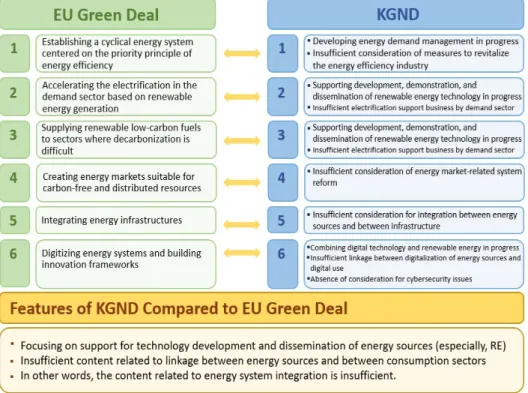
Comparing EU Strategy on Energy System Integration and KGND
○ As the first action plan, EU proposed establishing a cyclical energy system with the first principle of energy efficiency. KGND is promoting the core technology R&D for energy demand management, but insufficient to consider the revitalization measures for the energy efficiency industry.
○ The second action plan of EU is to accelerate the electrification of the energy demand sector based on RE power generation. Although RE dissemination is treated as important in the KGND, projects to support electrification in the demand sector are relatively lacking.
○ EU's third action plan is to deploy renewable, low-carbon fuels for difficult-to-decarbonize sectors. KGND supports the eco-friendly
transition of vehicles and ships and the development of reduction technologies specialized in the industrial sector. Still, it lacks consideration for fuel conversion in the aviation sector.
○ The fourth action plan of EU is to build an energy market suitable for decarbonization and distributed resources. KGND does not include reforms in energy market-related systems.
○ The fifth action plan of EU is to consolidate energy infrastructures.
KGND is not yet sufficiently considering integration between energy sources.
○ The sixth action plan of EU is to digitize the energy system and build an innovation framework. KGND is also conducting a technology development project for combining digital technology and RE power generation but covers the linkage between energy carriers.
○ Although the KGND sufficiently includes support for technology development and dissemination of individual energy sources, especially RE, it does not mention links between energy sources or energy supply and demand sectors.
Complementary Direction for KGND
○ The government should first set a vision for the future energy system of Korea and suggest tasks and measures to overcome obstacles to realize it.
- EU was able to present a vision of an energy system and a strategy to achieve it in line with the region's realities based on a long-term, in-depth analysis of society and the economy as a whole.
- KGND has been criticized for merely expanding or reorganizing existing policies and projects. Also, it does not include any plans for energy system integration. These shortages imply that KGND lacks visions for the future energy system.
- KEEI (2020e) presented the concept of an integrated green energy system as a vision of the future energy system. KGND should also be improved by referring to these research cases.
○ The government should strengthen the linkage between energy sources and sectors based on energy transition.
- An essential axis in the integrated energy system of EU is to establish flexible resources that can alleviate the volatility of RE through the linkage between energy sources or sectors.
- KGND also needs to strengthen further the linkage between various energy sources such as P2G, P2H, and V2G, green hydrogen production, or between sectors. Through this, the KGND should present a countermeasure against problems that may arise when RE generation, which is highly volatile, is put into the power grid on a large scale.
○ The government should consider expanding the use scope of hydrogen and renewable low-carbon fuels in sectors where electrification is not easy.
- EU plans to implement decarbonization by disseminating hydrogen and renewable low-carbon fuels (such as biofuels) for industrial processes and aviation and shipping sectors where electrification is not easy.
- KGND also needs to promote the development and commercialization of eco-friendly processes in the industrial
sector (using hydrogen, etc.) through a public-private partnership and the use of eco-friendly fuels in the transportation sector.
○ Institutional reform should be promoted to properly reflect GHG-related costs in the price of each energy source.
- EU aims to build a market that encourages consumers to choose the most efficient and affordable decarbonization option by appropriately reflecting the GHG-related costs of each energy carrier in their energy prices.
- KGND also needs to consider forcing companies to bear the reduction costs that match their emissions through the reorganization of energy tax and ETS.
- It is practical to induce efficient power consumption by reflecting the cost of GHG generated during power generation in the power price. Therefore, the government should adjust the retail electricity rate annually to reflect the climate and environmental charges and the cost of emission permits in the power generation sector.
○ The government should identify obstacles to project implementation, present detailed information for each project to solve them, transparently disclose progress and results, and periodically check project performance.
- Although the initial detailed tasks are disclosed through the website operated by the Korean New Deal working support group, tracking progress and performance is not available.
- Through KGND, the government should disclose what specific projects exist, how much budget is invested, and how they are progressing. In addition, the effectiveness of the KGND should be improved through periodic inspection of the project.
5. Reduction Potential and Improvement Plans for RE Dissemination Support and Green Remodeling
Reduction Potential of RE Dissemination Support
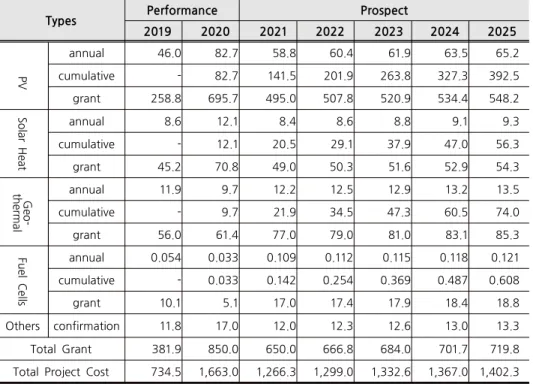
○ With RE dissemination support, it is expected that 1,372.2 MW of PV, 260,000 m2 of solar heat, 314.1 MW of geothermal heat, 26.4 MW of fuel cell, 0.8 MW of wind power, and 34.2 MW of wood pellets will be supplied from 2020 to 2025.
- This analysis focuses on housing support, building, convergence, and regional support, which are projects for disseminating RE facilities among RE dissemination support projects.
○ Through RE dissemination support, the 2025 GHG reduction of RE facilities to be supplied from 2020 to 2025 is expected to be about 1,038,000 tCO2eq.
- It is expected that the amount of power generation in 2025 through power generation facilities supplied during the same period will be 1,704 GWh, resulting in about 783,000 tCO2eq of GHG reduction.
- The amount of fossil fuel replacement in 2025 for heat production facilities supplied during the same period is projected to be 95,654 toe. The resulting GHG reduction would be about 255,000 tC〇2eq.
Reduction Potential of Green Remodeling
○ Green remodeling is expected to be carried out for 119,706 public rental housing units and 5,500 public buildings from 2020 to 2025.
○ The 2025 GHG reduction of buildings to be improved from 2020 to 2025 through green remodeling will be about 306,000 tC02eq.
- The contribution of green remodeling for old public rental housing to GHG reduction in 2025 is estimated to be about 168,000 tCO2eq.
- The contribution of green remodeling for public buildings to GHG reduction in 2025 is estimated to be about 138,000 tCO2eq.
Evaluating RE Dissemination Support and the Reduction Potential of Green Remodeling from the Perspective of NDC
○ Referring to the 2030 Nationally Determined Contributions (NDC) (40% reduction compared to 2018), which was deliberated and decided by the State Council in October 2021, we analyzed and evaluated the GHG reduction potential of RE dissemination support and green remodeling.
○ The GHG reduction in 2025 of power generation facilities supplied through RE dissemination support is about 783,000 tCO2eq, which is only about 1.0% of the decrease in the transition sector in 2025 according to the upgraded NDC of 78.1 MtC〇2eq.
- The low contribution of this project to GHG reduction is because the project's target is self-employed users, not power generators.
In other words, to significantly reduce transition-related GHG, the GHG of large-scale fossil fuel power plants must be reduced.
- According to the Ministry of Trade, Industry and Energy (MOTIE) (MOTIE, 2021c), RE dissemination support is significant in that it can increase the self-consumption of REs, avoid overinvestment in the power grid, and enhance the energy system's stability by distributing power generation sources.
○ GHG reduction in 2025 through heat production facilities supplied as RE dissemination support and green remodeling of old public rental housing and public buildings is estimated to be about 351,000 tCO2eq. According to the upgrade plan of NDC, this figure corresponds to 3.3% of the building-related reduction of 10.8 million tCO2eq (MtCO2eq) in 2025.
- Green remodeling for old public rental housing has great significance regardless of its contribution to GHG reduction in that it improves the vulnerable's living environment and quality of life.
Measures to Expand RE Self-generation and Consumption and Promote Green Remodeling
○ To expand RE self-generation and consumption, the government should supplement current systems so that the benefits of RE power generation facility investment can reach investors.
- The government needs to establish a system to promote RE self-generation investment to let the owners and tenants of buildings with RE self-generation facilities share costs and benefits. The new system should also enable interested parties to share the benefits of avoiding investment in large-scale power generation facilities and transmission lines due to RE self-generation and consumption.
○ To provide additional benefits for RE self-generation, the government needs to consider issuing Renewable Energy Points (REPs) for the consumed RE self-generation or introducing a transmission and distribution (T&D) rating system.
- Individual building owners can apply for REPs through an agency by collecting RE generation/consumption. If the owners have already received government or local subsidies, the ratio should be deducted from the issued REPs.
- Agencies receive REPs according to the application's performance, sell the points to obligatory suppliers, and settle the REP sales revenue based on the building owners' application amount.
- With the introduction of the T&D rating system, RE self-generation and consumption can reduce both electricity and T&D rates.
○ To expand green remodeling in the private sector, the government needs to link the Energy Efficiency Resource Standard (EERS) with green remodeling to supplement the system so that the benefits of green remodeling are attributable to building owners.
- It is also necessary to consider a plan to allow energy savings through the green remodeling project to be used by EERS or to design energy providers to achieve a certain percentage of their reduction goals through green remodeling.
6. Conclusion and Implications
○ The comparison between the details of the KGND with the six action plans presented in EU strategy on energy system integration suggests implications for establishing a Korean-style future energy system vision, transparent information disclosure, and follow-up management (Summary Figure-2).
○ Summary Table-1 shows the results of analyzing the GHG reduction potential of RE supply support and green remodeling projects. This result suggests improving the low contribution of transition and building sectors to the reduction target.
Summary Table-1. Reduction Potential of RE Dissemination Support and Green remodeling (2020-2050)
(Unit: 1,000 CO2eq)
Source: Created by the authors
○ To provide additional incentives for RE self-generation and consumption, the government needs to consider issuing REPs to building owners or facility investors and introducing T&D rating system (Summary Figure-1).
○ We may need to link green remodeling projects with EERS to expand green remodeling.
○ To achieve carbon neutrality, the transformation of the energy system is essential and requires a lot of investment. In this respect, the Green New Deal can contribute to achieving carbon neutrality.
○ It is necessary to continuously check and supplement project implementation through active communication with policy authorities, stakeholders, experts, and the general public.
Projects Types Reduction RE Dissemination Support power gneration facilities 782.7
heat production facilities 255.3 Green Remodeling old public rental housing 167.6
public buildings 137.9
Summary Figure-1. Measures to Provide incentives for Self-generating with RE and Expanding Consumption
Source: Created by the authors
Summary Figure-2. Comparison of EU Green Deal and KGND* and Complementary Direction of KGND
*KGND = Korean Green New Deal / EU = EU Green Deal; KR = KGND
Source: Created by the authors
Chapter 1
Introduction
1. Research Background
The 19th government, launched in 2017, tried to respond to the decline in economic growth rate and deepening polarization by promoting a shift to an economic paradigm based on an income-led growth strategy. However, the COVID-19 pandemic, which has spread rapidly since the beginning of 2020, has put countries worldwide into recession. The Korean government also had to develop a way to get through this crisis urgently. On July 14, 2020, President Moon Jae-in announced the Korean New Deal Comprehensive Plan to invest 160 trillion KRW from 2020 to 2025. This plan set the vision of a great transition to a leading economy, a low-carbon economy, and an inclusive society and presented the Green New Deal and the Digital New Deal as major policy directions. Tasks (out of 10 key tasks) related to the Green New Deal were ① Green Smart Schools, ② Smart Green Industrial Complexes, ③ Green Remodeling, ④ Green Energy, and ⑤ Eco-Friendly Future Mobility (Joint Ministries, 2020a). In addition, the government
added a New Deal for regional balance for regional economic innovation and balanced national development.
Following the Korean New Deal Comprehensive Plan, MOTIE and the Ministry of Environment (ME) jointly announced the detailed plan of the KGND on July 16. MOTIE and ME announced a plan to invest a total of 73.4 trillion KRW in the KGND projects from 2020 to 2025 to simultaneously overcome the economic, climate, and environmental crises caused by COVID-19. Aiming for a carbon-neutral (net-zero) society, KGND includes eight initiatives related to three major areas:
infrastructure green transition, green energy diffusion, and green industry innovation (Joint Ministries, 2020a). The government intends to achieve 2030 NDC and smoothly implement the Renewable Energy 3020 Implementation Plan by promoting the KGND.
Prior to this, on July 3, the National Assembly voted on the 3rd additional supplementary budget for 2020, including the Korean New Deal project budget (4.8 trillion KRW). Among them, the KGND-related budget was 1.2 trillion KRW. Of the KGND supplementary budget, 350 billion KRW was allocated to the green industry innovation ecosystem creation, and 470 billion KRW was allocated to investments related to low-carbon and distributed energy diffusion. The government expects large-scale eco-friendly investment projects in the energy sector under the KGND plan to promote GHG reduction and transition to a low-carbon society in the long term.
The expansion of government investment in GHG reduction is a response to the growing external pressure for GHG reduction. As the Paris Agreement is fully implemented, Korea must submit a Biennial Transparency Report (BTR) every two years from 2024. BTR should include detailed information to track GHG emissions and progress toward achieving NDCs. In addition, the international community will
diagnose and evaluate each country's reduction efforts through the Global Stock-Take (GST), which will be implemented every five years from 2023. Domestic reduction efforts will be transparently disclosed to the international community and continuously evaluated. Therefore, the government should push for more decisive measures to achieve the target.
Korea enacted the Framework Act on Low Carbon, Green growth in 2010 and has been working hard to reduce GHG. In particular, Korea has operated ETS since 2015, when the government introduced it for the first time n East Asia. Despite the government's continued efforts to reduce GHG through coal phase-out, expansion of renewable energy, and energy efficiency improvement policies, national emissions in 2018 recorded 727.6 MtCO2eq (2.5% increase compared to the previous year), continuously increasing 4 years in a row from 2015 (Figure 1-1).
According to the amendments to the 2030 GHG Reduction Roadmap (Joint Ministries, 2018), Korea's 2030 NDC is to reduce 37% of the 2030 GHG emission projection of 850.6 MtC02eq (BAU), and the target emission is 536 MtCO2eq. Of the 37% reduction, 32.5% is achieved through domestic emission reductions. For the remaining 4.5%, the government plans to utilize forest sinks and overseas reduction results. If we follow the domestic GHG emission route for a domestic reduction of 32.5% compared to BAU in 2030, the target emission will be 691 MtCO2eq for 2020, in 2025, MtCO2eq for 2025, and 574 MtCO2eq for 2030. It is essential (Figure 1-1).
In 2020, the government submitted its updated NDC to UN. In this plan, the government changed the method of setting NDC goals from comparing it to BAU to expressing the target emission as absolute figures. Accordingly, Korea changed its target to emit 536 MtCO2eq in 2030, a 24.4% reduction from 709 MtCO2eq in 2017.
Meanwhile, the government submitted a long-term low GHG emission development strategy (LEDS) to the UN in 2020 and confirmed carbon neutrality in 2050 as a national vision. As this target is set, some have pointed out that the 2030 NDC should be raised to match carbon neutrality in 2050. Accordingly, the government reviewed the plan to increase the 2030 NDC. In October 2021, the government announced an upwardly adjusted reduction goal to reduce 40% of the 2018 (emissions 727.6 MtCO2eq) by 2030. The State Council finalized the 2030 NDC upgrade plan (Joint Ministries, 2021d). As shown in Figure 1-1, to achieve the target of the 2030 NDC, GHG reduction must be implemented at a faster rate than the emission path of the existing reduction target.
At this point, to accelerate the transition to a low-carbon society, we need to evaluate how much the KGND project, pursued with the goal of smooth implementation of 2030 NDC and RE 3020, will contribute to the upgraded 2030 NDC. The government projected that the cumulative reduction through 2025 through the KGND would be 12.29 MtCO2eq (ME, 2020), but this is less than 10% of the reduction needed to achieve the existing 2030 target. In this situation, the government should use the KGND as a facilitator of the low-carbon energy transition and use it as an opportunity to secure the driving force for the greenhouse gas reduction policy. Considering this point, it is necessary to study the future direction of the energy sector within the KGND.
Figure 1-1. GHG Emission Trend and 2030 NDC of Korea
Sources: GIR (2020); Joint Ministries (2021d)
2. Research Purpose
This research aims to find a way to increase the emission reduction effect of KGND as a driving force for accelerating GHG reduction. To this end, we compare and review the major energy and greenhouse gas-related businesses of EU Green Deal and KGND. Next, we calculate the reduction potential for KGND's significant projects and evaluate the contribution to the upgraded 2030 NDC. Based on these results, this study suggests supplementary measures and improvement plans for KGND from the perspective of GHG reduction.
Chapter 2
EU Green Deal and EU Strategy on Energy System Integration
EU is leading in tackling climate change and reducing GHG emissions.
In 2019, EC announced the European Green Deal, a policy package covering all areas, including the environment and economy, to achieve carbon neutrality by 2050. Then, in 2020, as part of the Green Deal, the draft European Climate Law, which enacts the carbon-neutral goal of 2050, was announced. In June 2021, the European Parliament passed EU Climate Act. EU's efforts to respond to climate change focus on the energy sector. First, the structure of EU Green Deal is briefly reviewed, followed by EU energy system integration strategy announced as part of EU Green Deal.
1. EU Green Deal
In December 2019, EC announced EU Green Deal, a policy package and growth strategy covering all sectors, including the environment and economy, to achieve carbon neutrality by 2050. EU Green Deal has stated to reinforce GHG reduction targets by 2030 and 2050. The
strategy also sets the direction for a system for the stable supply of clean energy at an affordable price in the energy sector (EC, 2019a). In addition, EU Green Deal presented directions for achieving carbon neutrality in various fields, such as the industrial transition to a clean and circular economy, new construction and remodeling of energy-efficient buildings, and establishing a sustainable and smart transportation system (Table 2-1).
Table 2-1. Highlights of EU Green Deal
Source: Kim, S. and C. Kim (2020), p.8
From EU Green Deal, EC not only presents directions for each sector to achieve carbon neutrality but also proposes a financing plan to implement the EU Green Deal and a plan to support carbon-intensive activities through the European Green Deal Investment Plan. One of the main characteristics of this investment plan is that it has established just transition mechanisms so that no countries or regions are left behind in the transition to a climate-neutral society (S. Kim and C. Kim, 2020, p.35).
Sectors Highlights
GHG Reinforcement of reduction targets in 2030 and 2050 Energy Stable dissemination of clean energy at an appropriate price Industry Industry transition to a clean and circular economy Building Construction and remodeling of energy efficient buildings Transportation Building a sustainable and smart transportation system
Food Building a fair and healthy eco-friendly food system - from farm to table
Ecosystem Ecosystem and biodiversity protection
Pollution Creating an environment
free from harmful substances and pollution
In addition, EC believes that the participation and will of the public sector and stakeholders are essential for the success of EU Green Deal.
Accordingly, the EC has proposed the European Climate Pact as a venue to promote diverse citizen participation. Citizens can use this opportunity to share information and ideas about climate change and environmental issues and increase their understanding. In addition, an on/offline space will be established where citizens can share new ideas and activities and study them together. EC expects these activities to feed the grassroots movement about climate change and environmental issues (EC, 2019a).
The EU Green Deal presented only the direction for each sector to achieve carbon neutrality, and detailed implementation strategies for each sector were subsequently announced sequentially. First and foremost, in March 2020, the EC announced a new industry package for an internationally competitive clean digital Europe. This new industry package aims to strengthen international competitiveness by promoting green and digital transformation of the industrial sector and includes three detailed strategies: the new strategy for industries, the new strategy for small and mideum-sized enterprises (SMEs), and single market creation. The new industry strategy selected seven essential tasks, including the single digital market, climate-neutral support, investment, and finance, for carbon-neutral orientation and digitalization of the industrial structure (Y. Jang et al., 2020, p.5).
In July 2020, EC announced EU strategy on energy system integration.
This strategy is to lay the foundation for the green energy transition. EC states that it will be difficult to achieve 2050 carbon neutrality at minimal cost if energy-consuming sectors (transport, industry, buildings, etc.) and energy sources (electricity, gas, etc.) continue to operate under different value chains, rules, infrastructures, or schemes. judged (EC,
2020b). Accordingly, EC intends to establish a system that can comprehensively plan and operate by connecting various consumption sectors, energy carriers, and related infrastructure. To this end, EU strategy on energy system integration suggested 38 detailed plans centered on three pillars: building a circular energy system, electrification and securing renewable energy sources, and supplying clean fuels (KEEI, 2020c).
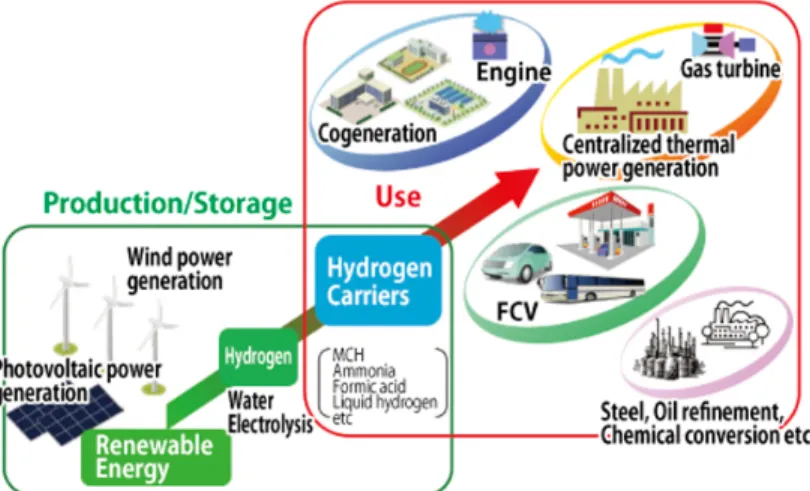
EC announced the hydrogen strategy for EU carbon neutrality at the same time as EU strategy on energy system integration. EC expects that hydrogen will contribute to decarbonization in difficult-to-electrify sectors. In addition, EC believes that hydrogen can help decarbonize industries, transport, power generation, and buildings in EU's integrated energy system by absorbing the volatility of renewable energy.
Ultimately, carbon-neutrality requires green hydrogen produced from RE (wind power, PV, etc.). However, EC has made it possible to use low-emission hydrogen to drive GHG reduction and market development in short to medium term (Figure 2-1; KEEI, 2020a).
In September 2020, EC announced a plan to raise the 2030 NDC goal from a 40 % reduction compared to 1990 to a 55 % reduction compared to 1990. EC suggested strengthening and expanding the scope of AEU-ETS, establishing regulations on land-use emissions, improving energy efficiency and renewable energy targets, and enhancing emission regulations for road transport vehicles to achieve the upwardly adjusted goal (KEEI, 2020f).
FIgure 2-1. Step-by-Step Path to the Hydrogen Ecosystem
Source: EC (2020d)
Then, in December 2020, the upgraded 2030 NDC was agreed on by the European Council (EUCO). The EC began reorganizing the system to achieve the raised reduction goal and, in July 2021, announced the Fit-for-55 policy package. This package aims to revise existing systems and policies aligned with the upgraded 2030 NDC (M. Kim and D. Kim, 2021). The main contents of the Fit-for-55 package include carbon pricing for road transport and building sector, introducing a carbon border adjustment mechanism, revising effort sharing regulations, amending energy tax, reorganizing the road transport sector, establishing sustainable transport fuel systems, revising the Renewable Energy Directive, and expanding net carbon sinks (M. Kim and D. Kim, 2021).
In October 2020, the EC unveiled the Renovation Wave to improve building energy efficiency. This strategy was designed on three main pillars to improve building energy efficiency: ▲ relieving energy poverty,
▲Improving energy efficiency in the public sector, and ▲ enhancing energy efficiency of cooling and heating (KEEI, 2020b). EC suggested
that this could be included in the EU Energy Efficiency Directive amendment. The introduction of the energy efficiency first principle, which sets out the minimum energy standard for all existing buildings in Europe, was also implied (KEEI, 2020b).
In October 2020, EC announced EU strategy on methane emission reduction and the strategy for the chemical sector that presents sustainability. After that, the EC offered the strategy to expand the maritime RE for EU carbon neutrality in November 2020. In December 2020, EC released the sustainable smart transportation strategy for decarbonizing the transportation sector and an amendment to the battery directive to enhance the sustainability of batteries.
Among the detailed implementation strategies announced after EU Green Deal, this report will focus on EU strategy on energy system integration and the Renovation Wave.
2. EU Strategy on Energy System Integration
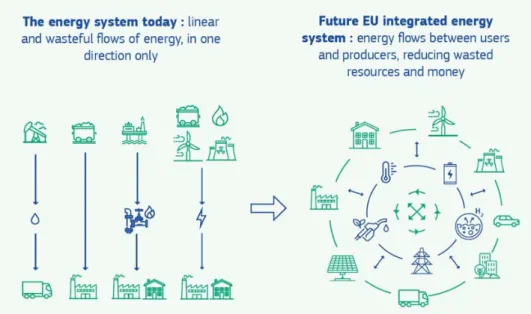
1)Currently, energy systems are segregated by energy source. EC determined that it would be impossible to achieve carbon neutrality cost-effectively in the current situation, which is technically and economically inefficient and causes significant resource loss. The holistic and harmonious planning and operation of energy systems across different energy carriers, infrastructures, and consumer sectors are essential to achieving carbon neutrality cost-effectively. Based on this understanding, the EC has proposed a strategy for energy system integration (Figure 2-2; EC, 2020b).
1) This section summarizes the discussion from “Powering a climate-neutral economy: An EU Strategy for Energy System Integration (EC, 2020b).”
Figure 2-2. EU Vision of Energy System Integration
Source: EC (2020c)
The integrated energy system envisioned by EU strategy has three characteristics: ① Efficient and cyclical energy systems that capture and reuse waste energy; ② Extensive electrification of consumption sectors (industry, heating, transportation, etc.) based on clean power generation systems; and ③ Clean fuel supply to sectors that are difficult to electrify, such as heavy industry and transport (EC, 2020c).
EU strategy suggests six action plans to build an integrated energy system: ① Building a circular energy system that follows the Energy Efficiency First Principle; ② Accelerating electrification of energy demand sector based on renewable energy generation; ③ Disseminating renewable low-carbon fuels, including hydrogen, to sectors where decarbonization is difficult; ④ Establishing an energy market suitable for decarbonization and distributed resources; ⑤ Integrating energy infrastructures; and ⑥ Establishing energy system digitalization and
innovation framework (EC, 2020b). In this section, we look at the details of each action plan.
Table 2-2. Six Action Plans in EU Strategy on Energy System Integration
Source: Created by the authors referring to EC (2020b)
2.1. Building a Cyclical Energy System Centered on Energy Efficiency First Principle
Improving energy efficiency reduces investment and other costs related to energy production, infrastructure construction, and energy consumption. EC has decided to apply the energy efficiency first principle to all policies as a core principle of system integration. EC also believes that enhancing the circulation of available resources and carrying out energy transition with more efficient technologies could help improve energy efficiency in the EU through system integration (EC, 2020b).
The EC suggested the need for guidance and other policy establishments to apply the energy efficiency first principle practically.
In particular, when consumers try to reduce energy consumption, switch to other energy sources, or share energy, EC ensures that the process
No. Highlights
1 Building a cyclical energy system that follows the energy efficiency first principle
2 Accelerating electrification of energy demand based on RE generation 3 Dissemination of renewable low-carbon fuels, including hydrogen, to sectors
where decarbonization is difficult
4 Building an energy market suitable for decarbonization and distributed resources
5 Energy infrastructure integration
6 Building energy system digitalization and innovation framework
adequately reflects the life-cycle energy inputs and carbon footprints of various energy carriers (EC, 2020b).
EC observed that local energy resources are used insufficiently or inefficiently in buildings and communities. The potential amount of waste heat/waste energy in the industrial sector and data centers is sufficient to enable recycling. However, most of these potentials are not yet utilized. Therefore, EC believes that a more cyclical energy system should be built by promoting the reuse of waste heat and energy. To this end, the EC revised the Renewable Energy Directive and the Energy Efficiency Directive to strengthen the connection between the waste heat generated from industrial sites and data centers and the district heating network. In addition, EC plans to promote waste heat recycling by strengthening the energy performance accounting and contract framework for using such waste heat in energy-saving projects (EC, 2020b).
The EC expects biogas produced from wastewater, bio waste, and residues will play an essential role in establishing a circular energy system. Direct use of biogas at the point of generation can reduce fossil fuel consumption. When biogas is used in the transportation sector, it can be injected into natural gas pipelines by upgrading biogas to biomethane. Some farm infrastructure is suitable for integrating PV-based power and heat production. Therefore, such infrastructure has the potential to not only use renewable energy for self-consumption but also inject it into the power grid. The EC will incentivize users to utilize biowaste and residues from the agriculture, food, and forestry sectors. In addition, the EC plans to strengthen its capacity to form rural circular energy communities through new communal agricultural policies, rescue funds, and LIFE programs.
2.2. Acceleration of Electrification in the Energy Demand Sector based on RE Power Generation
EC prepared the LEDS to be submitted to the UNFCCC and analyzed the path to achieving carbon neutrality in 2050 and low-carbon strategies across society and the economy. From the results, EC predicted that, through the implementation of carbon neutrality in 2050, the share of electricity in final energy consumption will increase to 30%
in 2030 and 50% in .2050 (EC, 2020b). Most of this increasing power demand must be met by RE. The share of renewables in the power mix will double by 2030 (55 to 60%) and account for around 84% by 2050 (EC, 2020b).
EC plans to use onshore renewable energy generation (PV, onshore wind, etc.) as well as offshore renewables to meet the growing electricity demand. EC expects to reuse the infrastructure of depleted natural gas fields through offshore renewable energy generation and install electrolyzers for hydrogen production in coastal areas adjacent to offshore power plants. In addition, EC plans to review the green public procurement (GPP)2 setting by amending the Renewable Energy Directive (EC, 2020b).
To support RE dissemination in the short term, EC will also use the Next Generation EU2),3) and evaluate the feasibility of financing through a new EU renewable energy financing mechanism (EC, 2020b).
EC expects that electrification by expanding the supply of heat pumps for heating and cooling will play a leading role in the decarbonization of
2) Green public procurement refers to purchasing environmentally friendly products and services from public institutions. The green public procurement policy is a recommendation. Accordingly, member countries and purchasing authorities may determine how to implement the policy or set its scope. EU proposes green standards for 20 products and services in the ‘Green Public Procurement Criteria [Shin, 2018; requoted from S.H. Kim and C.H. Kim, 2020 (p.46)]
3) Next Generation EU refers to a 750 billion euro stimulus package to support economic recovery after COVID-19 (EC, 2020f).
the building sector. EC estimates that the share of electricity in the residential sector's heating demand will increase to 40% by 2030 and 50-70% by 2050. The commercial sector's electricity percentage is expected to be around 65% by 2030 and 80% by 2050 (EC, 2018). EC points out that relatively high taxes and levies on electricity and low taxes on fossil fuels used in the heating sector (oil, gas, and coal) prevent fair competition between energy sources. EC identified this problem as the biggest obstacle to electrification in the building sector.
It plans to promote the electrification of the building sector through heat pumps, the supply of RE facilities in buildings such as Building-integrated photovoltaics (BIPV), and the dissemination of EV charging stations through the Building Renovation Wave (EC, 2020b).
In EU, the industrial sector consumes 60% of energy for heat production (EC, 2020b). EC believes that disseminating industrial heat pumps will promote decarbonization of low-temperature heat supply and waste heat recovery. On the other hand, EC understands that high-temperature heat production through electricity and the electrification of the process are in the development stage, and the lack of information on the currently available technology and the high cost are acting as obstacles to its diffusion. Accordingly, EC plans to preferentially support pilot projects for the electrification of low-temperature processes in the industrial sector through Horizon Europe4) and the Innovation Fund5).
EC understands that EVs will play the most crucial role in decarbonizing the transport sector and reducing pollutants. EC predicts that EVs will be able to compete with internal combustion vehicles from
4) Horizon Europ is a major funding program for research and innovation to respond to climate change, achieve the UN Sustainable Development Goals, and promote EU competitiveness and growth (EC, 2021a).
5) The Innovation Fund is a low-carbon technology and process innovation support program operated under EU ETS. The fund aims to demonstrate innovative technologies and make a breakthrough in industrial innovation. The main scope of support includes carbon capture and utilization (CCU), carbon capture and storage (CCS), RE supply, and energy storage technology (Son and Kim, 2020).
around 2025 due to a sharp drop in EV prices. EC has established a transition path from 2025 to achieve GHG-free transport. EC plans to amend the CO2 emission regulations for passenger cars and vans to comply with this. At the same time, it plans to support the installation of 1 million EV charging stations by 2025 (EC, 2020b).
The growing use of electricity in the end-demand sector means that the adequacy6) of renewable energy-based electricity supply to meet electricity demand in buildings, industry, and transport must be monitored (EC, 2020b). In other words, electrification in the demand sector will increase the difficulty in power system management as the proportion of renewable energy increases. In addition, regional and cross-border coordination among member countries in electricity supply and demand will become increasingly important. To address these issues, EC plans to introduce Regional Coordination Centers in 2022 (EC, 2020b).
On the other hand, the complete electrification of the transport sector requires strengthening the region's power system infrastructure. EVs and EV charging stations can be utilized for storage and flexibility in the power grid. Management of system congestion and expansion of system capacity is likely to lead to expensive investments. Smart charging and Vehicle-to-Grid (V2G) are essential to lowering this investment burden.
The EC proposed to develop Network Code on Demand Side Flexibility.
This code allows EVs, EV charging stations, and other energy systems (including heat pumps, etc.) to contribute to the flexibility of power grid operation, maximizing the utility of power consumption (EC, 2020b).
6) Adequacy of a power supply refers to always matching the power system's generation with its load (Marta et al., 2016).
2.3. Renewable, Low-carbon Fuel Delivery for Difficult-to-Decarbonize Sectors
Many industrial processes, aviation, and shipping sectors make it impossible or more expensive to electrify energy demand or use renewable heat. For these sectors, the EC will promote the dissemination of renewable or low-carbon fuels such as sustainable biogas, biomethane, biofuels, renewable low-carbon hydrogen,7〉 and synthetic fuels (EC, 2020b).
EC believes that biofuels will play an essential role in transport sectors where decarbonization is difficult, such as aviation and shipping, and biogas will contribute to the decarbonization of gas supply. The Renewable Energy Directive has introduced targets for using advanced biofuels and biogas in the transport sector. The Fuel Quality Directive7) also sets a GHG emission target to promote the supply of biofuels (EC, 2020b).
Hydrogen currently accounts for less than 2% of energy consumption in EU. However, EC expects that hydrogen will play an essential role in areas where decarbonization is difficult in the future. In particular, hydrogen can be used as a fuel in heavy-duty road transport such as bus and freight transport, rail transport that does not use electricity, shipping, and inland water transport. In addition, hydrogen can be used as a fuel or raw material in processes in the oil refining and chemical industries. Hydrogen can also be converted to synthetic fuels such as synthetic kerosene by reacting with CO2 (EC, 2020b).
Hydrogen produced from renewable power (green hydrogen) plays a significant role in integrated energy systems. Green hydrogen can store
7) Renewable hydrogen is obtained from an electrolyzer that splits water into hydrogen and oxygen by using renewable electricity. Low-carbon hydrogen refers to hydrogen produced from electrolysis on a fossil fuel basis in combination with a carbon capture process. This process dramatically reduces full life-cycle GHG emissions (EC, 2020g).
energy when the electricity supply is surplus. This function relieves the load on the system. Green hydrogen thus enables integrated energy systems to incorporate more variable REs (EC, 2020b).
The EU intends to establish a minimum share or quota of renewable low-carbon fuels (biofuels, biogas, hydrogen, etc.) in specific consumption sectors to promote the dissemination of renewable low-carbon fuels (EC, 2020b). In addition, to be clearly distinguished from other energy sources, the EU plans to comprehensively organize terms for all renewable low-carbon fuels, including hydrogen, and develop a European certification system based on full-cycle greenhouse gas emissions (EC, 2020b).
Financial support will also be provided for carbon-neutral integrated industrial complexes where the production and consumption of renewable, low-carbon fuels will take place. Support for fertilizer production using green hydrogen will also be promoted (EC, 2020b).
Even in a fully integrated energy system, it is impossible to reduce CO2
emissions in all sectors of the economy ultimately. Therefore, Carbon Capture and Storage (CCS) will likely play a significant role in climate-neutral energy systems. In particular, CCS can solve the problem of specific industrial processes that are difficult to reduce emissions. On the other hand, directly capturing and storing CO2 from biomass or the atmosphere is considered a net reduction (or negative emissions). In this case, CCS can offset residual emissions from other sectors (EC, 2020b).8)
An alternative to the permanent storage of captured CO2 is to combine the captured CO2 with renewable hydrogen to produce syngas, synthetic fuels, feedstocks, etc. [carbon capture and use (CCU)]. Currently, synthetic fuel production is inefficient because it requires a lot of energy
8) CCS captures and stores CO2 emitted from fossil fuels or industrial processes. Therefore, this method generally has the same amount of emission and capture, and neither emission nor absorption occurs throughout the system. However, biomass or the direct capture of CO2 from the atmosphere does not premise existing C〇2 emissions, resulting in a net reduction of the system.