Chap 3. Generation, Transformation and Deformation of Random Sea Waves
3.1 Simplified Forecasting Method of Wind Waves and Swell
Numerical model for directional wave spectrum: WAM or SWAN (including shallow water effects) ← good for both tropical (e.g. typhoon) and extratropical storms
SMB method: Assume a constant wind speed Uover a fixed fetch length F for a certain duration t. Good for extratropical storms (e.g. Northwesters on the west coast of Korea during winter) or wind wave generation in an enclosed basin.
Wilson’s formulas (Eqs. 3.1 and 3.2): Based on SMB method, but modified to be applicable to tropical cyclones of large temporal and spatial variation of wind.
Fully-developed condition: both F and t are long enough Fetch-limited condition: t is long enough, but F is limited Duration-limited condition: F is long enough, but t is limited
Minimum duration for fetch-limited condition = tmin ← Eqs. (3.3) or (3.4)
Minimum fetch length for fully-developed waves for given t = Fmin ← Eq. (3.5) If ttmin, fetch-limited → Use Eqs. (3.1) and (3.2)
If ttmin, duration-limited → Calculate Fmin using Eq. (3.5). Then use Eqs. (3.1) and (3.2) with F Fmin
Relationship between H1/3 and T1/3: T1/3 3.3(H1/3)0.63 (3.6) ← good for large waves comparable to design waves but gives lower limit of T1/3 for smaller waves (see Suh et al. 2010, Coastal Engineering 57, 375-384)
Swell height and period: Eqs. (3.7) and (3.8) as a function of swell travel distance D Relationship between wave height and period of wind waves and swell: Fig. 3.4
3.2 Wave Refraction (+Shoaling)
3.2.1 Introduction
Ray theory for regular waves
Conservation of energy:
0 0 2 0 2
8 1 8
1gH Cgb gH Cg b
which gives
r sK K H H 0
shoaling coefficient, ( , )
2 sinh 1 2 tanh
2 / 1
0 K f h
kh kh kh
C
K C s
g g
s
refraction coefficient, 0 K (f, ,h) b
Kr b r ; ) (f,h,0
3.2.2 Refraction Coefficient of Random Sea Waves
( , ) ( , , )2 0( , 0) 0 )
,
(f K f h K f h S f
S s r
( , )
2 0( , 0)
( , , 0)
2 0) , ( )
(
S f d K f h S f K f h d
f
S
s
r
0 0
2 0 0
0
0 0
2 0 0
0 0 0
max min
) , , ( ) , ( ) , (
) , , ( ) , ( ) , ( )
(
df d h f K h f K f S
df d h f K h f K f S df
f S m
r s
r s
Goda’s book uses
0 0
2 0
0 0
max min
) , ( ) ,
(f K f h d df
S
ms s
Define
1/20 0
s r eff
m K m
For example, Hm0 4 m0 = significant wave height after shoaling and refraction Hms0 4 ms0 = significant wave height due to shoaling only then, Hm0
Kr effHms0In actual calculations, the integration is performed by a summation of frequency and direction.
2 1/ 21 1
( ) ( )
M N
r eff ij r ij
i j
K E K
Goda’s book explains how to discretize f and .
area total )
0 (
0
S f df m) , , 2 , 1 ( )
( 0
~
~ i M
M df m f
iS
i
i
f f
f
) (f
S can be integrated analytically (e.g. B-M or P-M spectra), say )
exp(
)
(f af5 bf4 S
b bf a
b df a f S
m exp( ) 4
) 4 (
0 4
0 0
Similarly,
M f m
b f
f b b
bf a b
df a f
S i i i
f f
f f
f f
i i
i i
i i
4 0 4
~
~ 4
~
~ ~ )
exp(
]
~ ) ( 4 exp[
) 4 exp(
)
(
Hence,
) , , 2 , 1 1 (
~ ) exp(
]
~ ) (
exp[ 4 4 i M
f M b f
f
b i i i
Now we can find fi (i1,2,,M) starting from ~ 0
1 f . Representative frequency fi for the band (~fi
to ~fi fi )?
Goda suggests on the basis of T m0/m2 and
0 22 f S(f)df
m
iii m
f m
0
2
b Ma M
m i m 1
4
0 0
iii ii i
f f f f
f
i f f S f df af bf df
m
~
~ 3 4
~
~ 2
2 ( ) exp( )
Putting
b df d
f f
b 2 2 2
3 2
,
2 2 2 (~) 2 2
~ ) ( 2 ) 2
(~ 2
~) ( 2
2
2 exp( /2)
2 ) 2
2 / 2 exp(
2
i i i i
i i
f b
f f b f
f b
f
i b d
b d a
b
m a
Goda defines error function, t
0t x dx 2/2) exp(2 / 1 )
( , though usual definition is
t x dx
t
erf 0
2) exp(
/ 2 )
( so that erf()1. Thus,
2
2
22 ~ 2 ~
2 i i i
i b f b f f
b
m a
1/2 2 2 1/2
0
2 ~
~ 2 2
2
i i i
i i
i b M b f b f f
m
f m
which should correspond to Eq. (3.15) in Goda’s book if b1.03Ts4 (B-M spectrum):
2 / 1 2
/
1 2ln
ln 1 2 )
912 . 2 9 ( . 0
1
i
M i
M M f T
s i
It is required
~ ( 1,2, , )1 2 ln
2 b f 2 i M
i M
i
On the other hand,
f M b f
f
b i i ~i 1
~ exp
exp 4 4
Take
ln 1
~ 4
i f M
bi . Then
M M
i M
i 1 1
satisfied.
As for the discretization of wave angle (16-point bearing, see Table 3.2),
3.2.3 Computation of Random Wave Refraction by Means of the Energy Balance Equation
General transport equation for S (any scalar quantity):
Q V t S
S
( ) (sink or source of S)
where V = transport velocity of S. For S(t,x,y,f,) = directional random waves,
V = velocity following waves
vx vy v vf
dt df dt d dt dy dt
V dx, , , , , ,
with
gcos
x C
v , vy Cgsin
sin cos
y C x
C C
v Cg to account for refraction
0
vf assuming f does not change following the wave.
Then
S f v
S f v
Qv y f x S t
f S
y
x
) , ( )
, ( )
, ) (
, (
For steady state (S/t 0) with no sink or source (Q0),
0
Sv
y Sv
x Svx y for S(x,y,f,)
Assuming ) (x,y , or x, y, are independent variables,
sin
sin cos 0cos
y C x
C C S
y SCC x
SCC
g g
g
where C and Cg using linear wave theory depend on h(x,y) and frequency f . is computed by ray theory. We need boundary conditions for S.
Example in Goda’s book Fig. 3.7: Waves over a circular shoal
• Ts as well as Hs changes depending on locations (Fig. 3.8).
• Fig. 3.9 for regular waves shows larger spatial variations of wave heights.
Ref. Vincent and Briggs (1989). Refraction-diffraction of irregular waves over a mound, JWPCOE, 115(2), 269-284: Performed laboratory experiments on transformation of monochromatic and random directional waves over an elliptic shoal. They concluded that monochromatic waves using representative wave height and period (e.g. Hs and Ts) provide a poor approximation of irregular wave conditions if there is directional spread or high wave steepness.
Ref. Kweon, H.-M. (1998). A 3-D random breaking model for directional spectral waves, Jpornal of the Korean Society of Civil Engineers, 18(II-6), 591-599 (in Korean):
Include sink term due to wave breaking.
Ref. Mase, H. (2001). Multi-directional random wave transformation model based on energy balance equation, Coastal Engineering Journal, 43(4), 317-337: Include wave diffraction.
3.2.4 Wave Refraction on a Coast with Straight, Parallel Depth Contours
Snell’s law:
0
sin 0
sin
C C
can find (f,h,0)
0
Refraction coefficient
cos ) cos , ,
(f h 0 0
Kr
Shoaling coefficient 0 K (f,h) C
K C s
g g
s
Directional spectrum S(f,) in water depth h:
( , ) ( , , )
( , )) ,
( 0 0
1
0 2
0
K f h K f h S f
f
S s r
Need to specify S0(f,0) in deep water. For example, S0(f,0)S0(f)G(f,0) with )S0(f = B-M spectrum with given Hs Hm0 and Ts Tp/1.05,
G(f,0) = Mitsuyasu-type with given smax and
p 0,
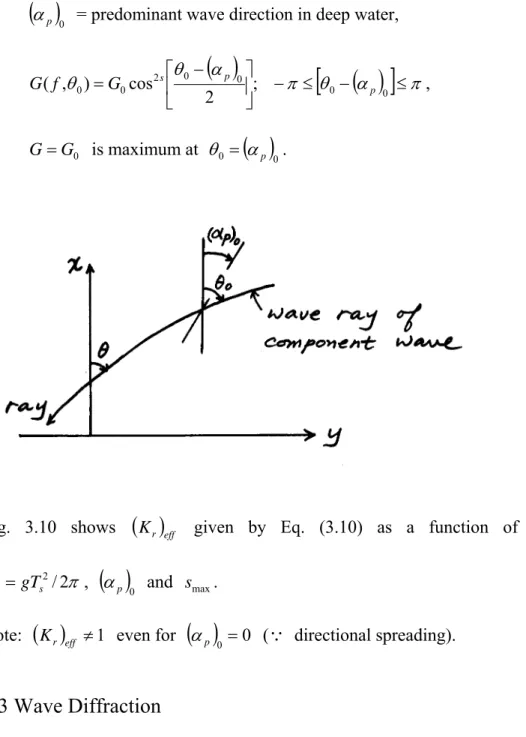
p 0 = predominant wave direction in deep water,
0 2 0 0 0 0
0 ;
cos 2 )
,
(f G s p p
G ,
GG0 is maximum at 0
p 0.Fig. 3.10 shows
Kr eff given by Eq. (3.10) as a function of h/L0 with 2
2/
0 gTs
L ,
p 0 and smax.Note:
Kr eff 1 even for
p 0 0 ( directional spreading).3.3 Wave Diffraction
3.3.1 Principle of Random Wave Diffraction Analysis
For linear monochromatic waves in constant water depth, Sommerfeld solution for a semi-infinite thin breakwater:
Diffraction coefficient Kd H(x,y)/Hi depends on f , i, and h=constant.
) , ( )
(
) , ,
; , ( )
, (
i i
i i
d
f S f
S
H h y x f K y x H
Frequency spectrum
Kd f i Si f i di y
x f
S( ) at given ( , ) ( , )2 ( , )
Since
0
2 0
0 ( ) ( , ) ( , ) ( , )
S f ddf K f S f ddf
df f
S d i i i i
therefore
Kd f i Si f i i f
S( , ) ( , )2 ( , )
Then
S f d Kd f i Si f i di f
S( ) ( , ) ( , )2 ( , )
In terms of zeroth moment,
m i Si f i d idf
Hm0
i
m0 i0
0 ( , ) 4
: incident significant wave height
0 0 0
0 S(f, )d df H 4 m
m
m
: significant wave height at (x,y)
0
2
0 ( , ) ( , )
K f S f ddf
m d i i i i
Define effective diffraction coefficient:
1/2
0 0
0 0
1/2 2
0 0
(3.22) in Goda's book where added
1 ( , ) ( , )
m d eff
m i i
i i d i i
i
H m
K i
H m
S f K f d df
m
Read Goda’s book for field measurement (Figs. 3.13 and 3.14).
Kd eff Kd based on regular waves with H H1/3 and T T1/3 = 0.07, which is significantly underestimated in this case.3.3.2 Diffraction Diagrams of Random Sea Waves
Kd f i x y h Si f i di h
y x f
S( ; , , ) ( , ; , , )2 ( , )
0
0(x,y,h) S(f)df
m ;
m0 i
0Si(f)df
0 2
2(x,y,h) f S(f)df
m ;
02
2 f S(f)df
m i i
peak )Tp(x,y,h from S(f); peak
Tp i from Si(f)2 0 0
0 4 m , T m /m
Hm ;
Hm0
i 4
m0 i,
T i
m0 i/ m2 i05 . 1 /
0, s p
m
s H T T
H ;
Hs i Hm0
i, Ts i
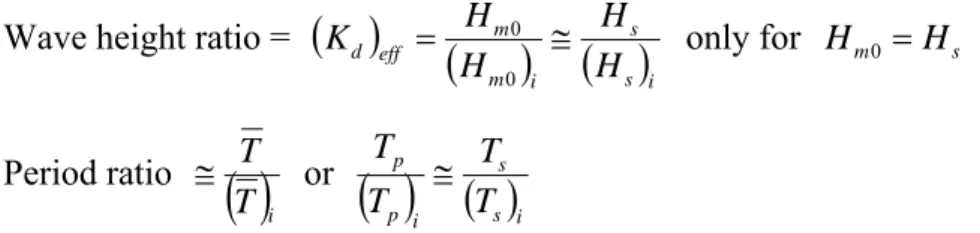
Tp i/1.05Wave height ratio =
s i s m im d eff
H H H
K H
0
0 only for Hm0 Hs
Period ratio
T i T or
s i s p ip
T T T
T
It is not specified in Goda’s book which relation is used for period ratio. It is likely to use T/
T i since Tp may be difficult to find. But Goda uses
Ts i to find L (p.82).Goda assumed Si(f,i)Si(f)G(f,i) with B-M frequency spectrum and Mitsuyasu-type directional spreading.
Need to specify
Hs i Hm0
i,
Ts i
Tp i/1.05, smax,
p i, constant depth h, and breakwater geometry.
(probably)
ratio period
ratio height Plotted
s i s d eff
T T K
for normal incidence only,
p i 0.Fig. 3.15 for a semi-infinite breakwater, for smax 10 (wind waves) and smax 75 (swell, more unidirectional).
Monochromatic versus directional random waves:
1) In general, monochromatic wave underestimates wave heights in sheltered area, and overestimates in open area.
2) The wave height ratio along the boundary of the geometric shadow (or the straight line from the tip of the breakwater to the wave direction) is 0.7 for directional random waves, while it is 0.5 for monochromatic waves.
Figs. 3.16~3.19 for breakwater gap (B/L1,2,4,8)
3.3.3 Random Wave Diffraction of Oblique Incidence
Construct your own computer program if exact solution is needed. Otherwise, use an approximate method suggested in the book.
3.3.4 Approximate Estimation of Diffracted Height by the Angular Spreading Method For large barriers (e.g. headlands and islands),
region d illuminate in
1
shadow geometric
in roughly 0
d d
K K
Neglect wave refraction.
0 0 ( , )
S f ddf
m i i i i
Assume 0Si for i /2.
02 /
2
0 / ( , )
S f ddf
m i i i i
0 2 /
2 /
2
0 ( , ) ( , )
K f S f ddf
m d i i i i
2 / for
0
2 / for Assume 1
1
1
i d
i d
K K
Then
0 /2 0
1 ( , )
S f ddf
m i i i
00 1 1( ) cumulative relative energy from / 2 to
Eq. (2.28) or Fig. 2.15 (B-M spectrum Mitsuyasu spreading)
E i
m P
m
1/2
1
1/20
0 E( )
i
d eff P
m
K m
10
and 2 0 for this problem
0 2 /
0 /2
0
2 1
) , (
) , (
df d f S
df d f S m
i i i
i i i
( 1)
( /2) ( 2)
0
0 E E E
i
P P
m P
m
in the text ) ( 1 ) (2 2 2
1
2 1
0 2 0
d d
E E
i d eff
K K
P m P
K m
3.3.5 Applicability of Regular Wave Diffraction Diagrams
Only for very narrow directional spreading
3.4 Equivalent Deepwater Wave
In real situation,Hydraulic model test in 2D wave flume,
In real situation, Hs KdKrKsKf
Hs 0In 2D wave flume, Hs KsH0' Thus, H0'KdKrKf
Hs 0
(unrefracted) equivalent deepwater wave height
For wave period, usually assumes Ts
Ts 0 error if diffraction is dominant.3.5 Wave Shoaling
Linear wave shoaling coeff.
L h C
C H
K H
g g
s function of
'
0 0
(3.25)
For shoaling of normally-incident linear random waves,
( ; )
( ) );
(f h K f h 2S0 f
S s can write a computer program easily.
For shoaling of nonlinear monochromatic waves, use Shuto (1974) model (read text).
Or you can use Eq. (3.31) with H1/3 and T1/3 (see Ex. 3.7).
3.6 Wave Deformation Due to Random Breaking
3.6.1 Breaker Index of Regular WavesBreaker index:
0
tan ,
b b
b
H h
h f L
Goda’s empirical formula (1970) for regular waves:
4/3
0 0
1 exp 1.5 1 15 tan ; 0.17
/
b b
b b
H A h
h h L L A
(3.32)
with L0 gT2/2 , which somewhat over-predicts over a steep slope. Rattanapikiton and Shibayama (2000) modified it to
4/3
0 0
1 exp 1.5 1 11tan ; 0.17
/
b b
b b
H A h
h h L L A
(3.33)
3.6.2 Hydrodynamics of Surf Zone
Regular waves break at a fixed location, but random waves break in a wide zone of variable water depth → surf zone
Incipient wave breaking of random waves:
incipient
4/3
0 0
0.12 1 exp 1.5 ( )b 1 11tan
b h
H
L L
Define (h1/3 peak) = water depth at which H1/3 becomes the maximum inside surf zone,
1/3 peak
(H ) = maximum value of H1/3 inside surf zone
1/3 peak
(h ) and (H1/3 peak) can be calculated by Figs. 3.28 and 3.29 and Eqs. (3.35)-(3.38).
Incipient breaker index of random waves: (H1/3 peak) / (h1/3 peak) in Fig. 3.30
Distribution of individual wave heights inside surf zone (see Fig. 3.31):
- Rayleigh distribution in relatively deep water
- Enhancement of large waves due to nonlinear shoaling near breaking point → longer right tail
- Breaking of large waves inside surf zone → upper tail truncated
- Regeneration of nonbreaking waves in much shallow area near shoreline → widening toward Rayleigh distribution (not shown in Fig. 3.31)
- Upper curves of Fig. 3.32 (lab, H2%/H1/31.4 for Rayleigh) and Fig. 3.33 (field, H1/10/H1/3 1.27for Rayleigh) prove these changes.
Water level change:
Wave setup () was computed using the results of monochromatic waves with Ts and H2 = mean square of random waves, the latter of which is affected by . Therefore, we need iteration to solve and H2 simultaneously. See Eq. (3.40) and Fig. 3.34.
(= at z0) = wave setup at still-water shoreline: Eq. (3.41) and Fig. 3.35
s(maximum ) = maximum wave setup on swash zone: Eq. (3.45)
Surf beat, (t): slow (30~300 s) fluctuation of free surface mainly inside surf zone
from Gaussian distribution with rms given by Eq. (3.46) Thus, hd (t)
3.6.3 Wave Height Variations on Planar Beaches
Before wave breaking, Rayleigh distribution may be assumed
H x H x
x x
p
;
exp 4 ) 2
( 2
0
(2.1)
After breaking, p0(x) p(x)
1 pb probability of nonbreaking
2 1 2
2 1
1
1
for 1
for
for 0 1
x x
x x x x
x x x
x x pb
Let 1
1
10 0
x pb p dxA since 1
0 0
p dxAssume p.d.f. adjusted for wave breaking:
1
( ) ) 1( p p0 x
x A
p b so that ( ) 1
0
p x dxNeed to estimate
limit lower
limit upper
2 1
x
x of wave breaking.
Use
4/3
0 0
tan 15 1 5 . 1 exp
1 L
A h L Hb
(3.32)
with
2
2
0 gTs
L and tan = beach slope
2 1
for 12 . 0
for 18 . 0
x x
x A x
Eq. (3.32) was developed for breaking point (hhb) of regular waves. But it may be used inside the surf zone if Hb = broken wave height, h = local depth.
Verification of the model with laboratory (Fig. 3.37) and field (Fig. 3.38) data Diagrams (Figs. 3.39 – 3.42) and formulas (Eqs. 3.47 – 3.48 and Table 3.6)
Improved and extended (H1/3 and Hmax → H, Hrms, Hm0, H1/3, H1/10 and Hmax) equations are given by Rattanapitikon and Shibayama (2013, Coastal Engineering Journal 55(3), 1350009-1~1350009-23)
3.7 Reflection of Waves and Their Propagation and Dissipation
3.7.1 Coefficient of Wave Reflection
R R
I
K H
H
Typical reflection coefficients are given in Table 3.8.
Reflection coefficient for sloping structure can be calculated by Eq. (3.50).
For perforated wall caissons, KR becomes minimum (0.3~0.4) at B/L0.15~0.2 (see Fig. 3.44). Under a standing wave system, maximum u at node maximum energy dissipation & minimum reflection at BL/4 B/L0.25. However, in reality, minimum reflection occurs at B/L0.15~0.2, due to inertia effect.
3.7.2 Propagation of Reflected Waves
r
i
(geometrical optics theory) diamond pattern of surface profile
For long-period waves incident at large angle, Mach stem is formed.
amplitude dispersion (Higher waves go faster.)
Reflection from finite length of seawall diffraction by breakwater gap
Reflection from very long seawall diffraction by semi-infinite breakwater (or angular spreading method for headland)
Effect of opposing wind (sea land): attenuates waves of large steepness, but its effect is minor for swell of low steepness.
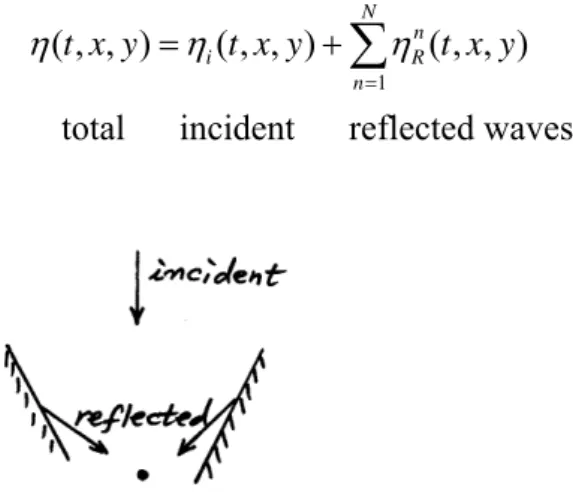
3.7.3 Superposition of Incident and Reflected Waves
For linear waves, we can superpose the free surface displacement:
N
n n R
i t x y t x y
y x t
1
) , , ( )
, , ( ) , ,
(
total incident reflected waves
Time-averaged energy per unit surface area:
0 2 at given (x,y) gm
g
; m0
0S(f)dfIf the distance from the reflective structure is more than one wavelength, we may assume
) ( 0 ),
, , 2 , 1 (
0 n N Rn Rm n m
n R
i
uncorrelated.
Then
N
n n R i
1 2 2
2
N
n
n R
i m m S(f)
m m
1 0 0
0
0 addition of area under spectrum
N
n
n m R m i
m H H
H
1
2 0 2
0 2
0 (3.51)
Fig. 3.48 indicates Hm0
Hm0
2i Hm0
2R at x L/ 0.73.8 Spatial Variation of Wave Height along Reflective Structures
3.8.1 Wave Height Variation near the Tip of a Semi-Infinite StructureWave height (crest elevation – trough elevation) along vertical wall (y0):
2
2 ( )
) 1
(C S C S
H H
I
S
where
u t dt C 0
2
cos 2
, S
0u t dt 2sin 2
, 2 sin2
2
L u x
Note: at x0, u0 CS0 HS/HI 1 As x, u, then
2
1 C ,
2
1
S 2
I S
H H
less undulation for irregular waves
For irregular waves, (Kd)eff was calculated by Eq. (3.22) with
I S
d H
K H
for component waves ( f Lu) Explains meandering damage of concrete caissons.
3.8.2 Wave Height Variation at an Inward Corner of Reflective Structures
2
I S
H
H (3.54)
for , 2
I S
H
H
, 4
2
I S
H
H
wave height HS= crest elevation – trough elevation
Same as sum of 4 waves
propagating in 4 different directions
If the length is finite, use a computer program or an approximate method given in Goda’s book.
3.8.3 Wave Height Variation along an Island Breakwater
cause undulation along wall (Fig. 3.54 and 3.55)
If BL, may add two waves diffracted from each tip:
3.9 Wave Transmission at Breakwaters and Low-Crested Structures
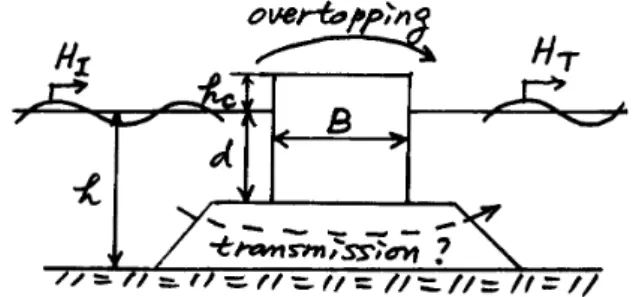
3.9.1 Wave Transmission Coefficient of Composite Breakwaterstransmission coefficient
I T
T H
K H
Wave transmission through rubble mound may be negligible.
Expect
function , ,B,T,moundmaterial, h
d H K h
I c T
Fig. 3.56 for regular wave tests may be applicable to irregular waves with
II H
H 1/3 and HT
H1/3
T (see Fig. 3.57) Eq. (3.57) T function c onlysi
K h
H
; Effect of h
d is minor (see Fig. 3.56) Eq. (3.58) horizontally composite breakwaters
1/3 1/3
(T ) / (T T )I 1.2KT 0.28
3.9.2 Wave Transmission Coefficient of Low-Crested Structures (LCS) Low-crested breakwater is built mostly for protection of sandy beaches
Wave transmission through LCS constructed with energy dissipating blocks: Fig. 3.58 (Tetrapods), Eq. (3.59)
Wave transmission over LCS: Eqs. (3.60)-(3.62)
Overall (through+over) transmission of LCS: Eq. (3.63) 3.9.3 Propagation of Transmitted Waves in a Harbor No reliable information is available (Read text)