저작자표시-비영리-변경금지 2.0 대한민국 이용자는 아래의 조건을 따르는 경우에 한하여 자유롭게
l 이 저작물을 복제, 배포, 전송, 전시, 공연 및 방송할 수 있습니다. 다음과 같은 조건을 따라야 합니다:
l 귀하는, 이 저작물의 재이용이나 배포의 경우, 이 저작물에 적용된 이용허락조건 을 명확하게 나타내어야 합니다.
l 저작권자로부터 별도의 허가를 받으면 이러한 조건들은 적용되지 않습니다.
저작권법에 따른 이용자의 권리는 위의 내용에 의하여 영향을 받지 않습니다. 이것은 이용허락규약(Legal Code)을 이해하기 쉽게 요약한 것입니다.
Disclaimer
저작자표시. 귀하는 원저작자를 표시하여야 합니다.
비영리. 귀하는 이 저작물을 영리 목적으로 이용할 수 없습니다.
변경금지. 귀하는 이 저작물을 개작, 변형 또는 가공할 수 없습니다.
A THESIS FOR THE DEGREE OF MASTER OF SCIENCE
Growth and Ginsenosides Content of Ginseng Sprouts under Far-red and UV-B Light
Treatments in Plant Factory
식물공장에서 far-red 및 UV-B 광 처리에 따른 새싹 인삼의 생육과 진세노사이드 함량
BY
JEWOOK CHOI
FEBRUARY, 2021
MAJOR IN HORTICULTURAL SCIENCE AND BIOTECHNOLOGY
DEPARTMENT OF AGRICULTURE, FORESTRY AND BIORESOURCES
THE GRADUATE SCHOOL OF SEOUL NATIONAL UNIVERSITY
i
Growth and Ginsenosides Content of Ginseng Sprouts under Far-red and UV-B Light Treatments in Plant
Factory
Jewook Choi
Department of Agriculture, Forestry and Bioresources The Graduate School of Seoul National University
ABSTRACT
Ginseng sprouts have a high content of saponins (ginsenosides) in their shoots, and their value as medicinal vegetables is increasing. However, there are no standardized cultivation guidelines for ginseng sprouts for raw foods, and the effect of light quality on growth and ginsenoside content in ginseng sprouts is not clear. The objective of this study was to analyze the growth and ginsenoside content of ginseng sprouts aeroponically grown in plant factories under far-red and ultraviolet-B (UV-B) light treatments. One-year-old ginseng seedlings (Panax ginseng C. A. Meyer) were transplanted into a plant factory with a photosynthetic photon flux density of 50 μmol m-2 s-1 using light- emitting diodes of red:blue = 1:1. Based on the phytochrome photostationary state value of solar radiation equal to 0.72, different far-red light treatments with 18 µmol m-2 s-1 for 16 h per day were applied from 0, 6, and 12 days after
ii
transplanting (DAT). For UV-B light treatments, different UV-B radiation exposure times with 0.1 W m-2 dose were applied for 1, 2, and 3 h on the day before harvest. Under normal growth conditions, suitable harvest date for aeroponically grown ginseng sprouts was determined to be 18 DAT due to a notable increase in stem hardness. Under additional far-red light, the electron transport rates of photosystems II and I of ginseng leaves increased, and nonphotochemical quenching decreased only at higher light intensities. Far-red light treatments significantly lowered the stem hardness but did not induce significant differences in other growth factors or ginsenoside contents, regardless of duration. Under additional UV-B radiation, no significant differences in photochemical characteristics or ginsenoside content were observed. As a result, additional far-red lighting can be utilized to maintain low stem hardness and extend the cultivation period.
Keywords: Aeroponics, Light quality, Medicinal plant, Panax ginseng, Saponin, Stem hardness
Student Number: 2019-22792
iii
CONTENTS
Page
ABSTRACT i
CONTENTS iii
LIST OF TABLES iv
LIST OF FIGURES v
LIST OF APPENDICES vii
INTRODUCTION 1
LITERATURE REVIEW 4
MATERIALS AND METHODS 8
RESULTS AND DISCUSSION 17
CONCLUSION 32
LITERATURE CITED 33
ABSTRACT IN KOREAN 49
APPENDICE 51
iv
LIST OF TABLES
Page Table 1. Growth of ginseng sprouts (Panax ginseng) under
different far-red treatments at 18 days after transplanting.
23
Table 2. Ginsenoside content per plant in shoots of ginseng sprouts (Panax ginseng) grown under different light treatments at 18 days after transplanting.
29
Table 3. Ginsenoside content per plant in roots of ginseng sprouts (Panax ginseng) grown under different light treatments at 18 days after transplanting.
30
v
LIST OF FIGURES
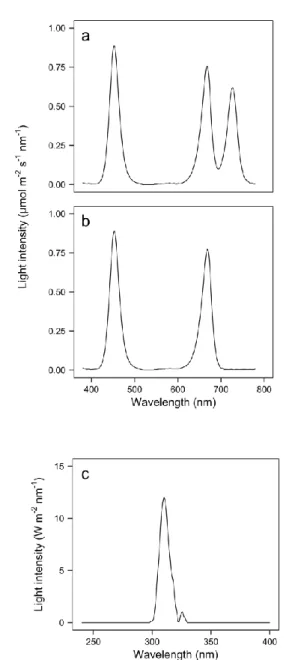
Page Fig. 1. Relative spectral distributions of red + blue (a), red + blue
+ far-red (b), and UV-B (c) light emitting diodes (LEDs) used in this study.
10
Fig. 2. Schematic diagram of far-red (a) and UV-B (b) light treatments.
13
Fig. 3. Growth characteristics of leaves, stems, and roots of ginseng sprouts (Panax ginseng) at days after transplanting (DAT).
19
Fig. 4. Total fresh and dry weights of ginseng sprouts that were treated with far-red light from the date of transplantation to the date of harvest (FR18d).
22
vi
LIST OF FIGURE
Page Fig. 5. Electron transport rates of photosystems I and II (ETRI and
ETRII, respectively) and nonphotochemical quenching (NPQ) in ginseng sprouts that were treated with far-red and UV-B light.
26
Fig. 6. Total ginsenoside content per plant of ginseng sprouts that were treated with far-red and UV-B light.
31
vii
LIST OF APPENDICES
Page Appendix 1. Growth of ginseng sprouts (Panax ginseng) grown
under far-red light at 6 days after transplanting.
51
1
INTRODUCTION
Ginseng is a representative medical plant and has long been used as a medical ingredient. Ginseng is reported to have antidiabetic (Cho et al. 2006;
Vuksan et al. 2008), anticancer (Nakata et al. 1998; Li et al. 2012), neuroprotective (Liao et al. 2002; Ye et al. 2013), immunomodulatory (Kang and Min 2012; Zhu et al. 2015), and antistress (Rai et al. 2003; Lee and Rhee 2017) effects. These useful effects are due to ginseng saponin (ginsenoside), which is known as the main ingredient of ginseng (Shibata et al. 1963).
Although ginseng roots have been mainly used as a medical ingredient, recent studies have found that ginseng leaves and stems contain higher levels of ginsenosides than roots during early growth stages (Kim et al. 2010a; Kim et al. 2015). In this respect, ginseng sprouts that can be eaten whole from leaf to root are gaining the spotlight as a healthy food. However, ginseng, which is a perennial semishade plant belonging to the Araliaceae family, does not prefer high temperature and high light conditions, so it is generally grown under shade nets (Won et al. 2008; You et al. 2015). In fact, leaves of ginseng grown under conventional cultivation environments cannot be eaten due to frequent disease and residual pesticides (Kim et al. 2010b; Lee et al. 2011).
Recently, plant factories with artificial lighting have been used for ginseng sprout production, which are free from external pollutants or diseases.
Moreover, precise environmental control can improve the uniformity and yield
2
of crops (Kozai 2013). Jeong et al. (2018) reported that a growth period of 1 to 4 months can be favorable for year-round production of ginseng sprouts.
However, despite the advantages of ginseng sprout production in plant factories, there are no clear cultivation guidelines considering growth characteristics and rheological properties.
Meanwhile, light plays an important role in plant growth and development;
in particular, light quality has a notable influence on plant growth and secondary metabolite production (Kim et al. 2004; Shohael et al. 2006; Shimizu 2016). A previous study reported that the intensity and ratio of red light affects the morphological properties and ginsenoside components of ginseng sprouts (Jang et al. 2020). In general, far-red light is known to increase plant growth indirectly through leaf expansion and thereby improve whole-plant net assimilation (Demotes-Mainard et al. 2016; Lee et al. 2016; Park and Runkle 2017; Kalaitzoglou et al. 2019). As a defense mechanism, plants generate various secondary metabolites under ultraviolet-B (UV-B) light (Jansen et al.
1998; Kakani et al. 2003; Jenkins 2009; Mewis et al. 2012; Hideg et al. 2013).
In particular, the synthesis of saponins in medicinal plants such as Glycyrrhiza uralensis, Withania somnifera, and Coleus forskohlii was triggered by UV-B radiation (Afreen et al. 2005; Takshak and Agrawal 2014, 2015).
However, few studies have improved the growth and ginsenoside content of ginseng sprouts by changing the light quality with supplemental UV-B and far-red light. The objective of this study was to analyze the growth and
3
ginsenoside content of ginseng sprouts aeroponically grown in plant factories under far-red and UV-B light treatments.
4
LITERATURE REVIEW
Ginseng and ginseng saponin
Ginseng is reported to have antidiabetic (Cho et al. 2006; Vuksan et al.
2008), anticancer (Nakata et al. 1998; Li et al. 2012), neuroprotective (Liao et al. 2002; Ye et al. 2013), immunomodulatory (Kang and Min 2012; Zhu et al.
2015), and antistress (Rai et al. 2003; Lee and Rhee 2017) effects. The mechanism of action for ginseng had been known after ginseng saponin (ginsenoside) were extracted by Shibata et al. (1963). Ginsenosides have been shown to be the major pharmacological ingredient among the components in ginseng (Cheng et al. 2013). More than 150 different types of ginsenosides have been isolated and identified that are contained in all parts of ginseng plant (Christensen 2008). According to the skeleton of the aglycones, ginsenosides are classified as two main types of dammarane and oleanane (Tritsch et al.
2010). Most ginsenosides of Panax ginseng are composed of a dammarane skeleton which consists of protopanaxadiol (PD) and protopanaxatriol (PT) (Lee et al. 2017). The total ginsenoside content is also important, but the PD/PT ratio is an important factor in terms of pharmacological efficacy (Jin et al.
1999). The PD lowers blood pressure and has a sedative effect, while the PT acts as a stimulant and increases blood pressure (Park et al. 1982). In the whole plant, the roots have been mainly used as a medical ingredient, but the leaves and stems contain more ginsenosides than the root during early growth stages
5
(Kim et al. 2010a; Kim et al. 2015). However, the leaves grown under conventional cultivation environments cannot be eaten due to frequent diseases and residual pesticides (Kim et al. 2010b; Lee et al. 2011).
Plant factories for medicinal plants
As a new plant production system, plant factory with artificial light can safely cultivate plants from external hazards and precisely control the environment, improving the uniformity and high yield of crops as well as resource use efficiency (Kozai 2013). High productivity can be achieved through uniform lighting, temperature and relative humidity obtained by minimizing the interaction with the external climate. Controlling these interactions can also improve the efficient uses of energy, water and CO2(Goto 2012). And plant factories can increase the productivity per area by extending plant cultivation to a vertical dimension, thus improving the utilization efficiency of crop production land (Eigenbrod and Gruda 2015). In addition, plant factories are more advantageous than greenhouses in controlling environmental factors, in particular, light quantity and quality (Kozai et al.
2019). Plant factories can be one of the new ways to grow medicinal plants, because all environmental factors can be controlled without any restrictions on climate and location (Goto 2016). Secondary metabolites in plants, which are major ingredients for medicine, are influenced by environmental factors such
6
as light, water, CO2, and temperature (Akula and Ravishankar 2011). Root-zone temperature promoted the accumulation of secondary metabolites of Coriandrum sativum L. grown in plant factories (Nguyen et al. 2020).
Perillaldehyde concentrations of green perilla bin ware significantly affected by light intensity and electrical conductivity of nutrient solution (Lu et al. 2017).
Lutein and β-carotene concentrations in spinach highly depend on light quantity and quality (Li et al. 2009).
Plant response according to far-red and UV-B light
Light affects the growth, morphogenesis and production of phytochemical compounds (Cioć et al. 2018). In particular, light quality has a great influence on plant growth and secondary metabolite production (Kim et al. 2004; Shohael et al. 2006, Shimizu 2016). In this regard, LEDs that have specific wavelengths are used to optimize the crop production and quality, thus enabling the target accumulation of plant antioxidant compounds (Loi et al. 2021). Far-red light is known to increase plant growth indirectly through leaf expansion, petiole elongation, and thereby improving the net assimilation whole-plant (Demotes- Mainard et al. 2016; Lee et al. 2016; Park and Runkle 2017; Kalaitzoglou et al.
2019). End-of-day lighting is being used to modulate extension growth by controlling the red:far-red ratio to improve the commercial value of ornamental plants (Zhang and Runkle 2019). Although UV-B can damage plants by causing
7
DNA damage and reactive oxygen species production, plants can produce various secondary metabolites under UV-B as one of the defense mechanism (Jansen et al. 1998; Kakani et al. 2003; Jenkins 2009; Mewis et al. 2012; Hideg et al. 2013; Lazzarin et al. 2020). In particular, the synthesis of saponins in medicinal plants such as Glycyrrhiza uralensis, Withania somnifera, and Coleus forskohlii was triggered by UV-B radiation (Afreen et al. 2005; Takshak and Agrawal 2014, 2015). Short exposure to UV-B led to an elevated expression of defense-related genes, increasing the resistance to pests in tomatoes (Escobar Bravo et al. 2019). In addition, UV-B light increases net plant photosynthesis of various plant species under high levels of photosynthetic active radiation (Lazzarin et al. 2020).
8
MATERIALS & METHODS
Plant materials and growth conditions
One-year-old spring ginseng roots (Panax ginseng C. A. Meyer) were used for the experiments. Pesticide-free ginseng roots were purchased from a farm and stored at -3°C. One day before planting, ginseng roots were moved to storage at 2°C and defrosted. Approximately 0.8 g of ginseng that was not soft and flawless was selected and planted in 4 cultivation boxes (L × W × H, 21 × 40 × 19 cm). For the nursery stage, the roots were grown in the dark until the stem grew 3 to 5 cm and then were grown at a photosynthetic photon flus density (PPFD) of 10 μmol m-2 s-1 for 16 h light periods using fluorescent tubes (FL40EX-D-2, Kumho Electric Inc., Seoul, Korea). Tap water was sprayed for 5 s every 30 min using an aeroponic cultivation system. Three days after lighting, the plants were transplanted into cultivation systems (L × W × H, 83
× 133 × 26 cm) in a plant factory using red and blue light-emitting diodes (LEDs) with spectrum peaks of 450 and 660 nm, respectively. The PPFD was set at 50 ± 2 µmol m-2 s-1 based on previous research (Jang et al. 2015b).The ratio of red and blue light was set at 1:1 based on previous research on ginseng growth and ginsenoside content (Jang et al. 2020), and the relative spectral distributions of red and blue LEDs are described in Fig. 1a. For the seedling and cultivation stages, the temperature and relative humidity were maintained at 19.5 ± 1.5°C and 70 ± 10%, respectively. The PPFDs and spectral irradiance
9
were measured using a quantum sensor (LI-250A, LI-COR, Lincoln, NE, USA) and a spectroradiometer (C-7000, Sekonic, Tokyo, Japan), respectively. The temperature and relative humidity were measured using a logger (Testo 174;
Testo GmbH & Co., Lenzkirch, Germany). All buds were removed to facilitate the growth of shoots and roots. Among the plants with one to three petioles, the plants with two petioles were selected for growth comparison.
10
Fig. 1. Relative spectral distributions of red + blue (a), red + blue + far-red (b), and UV-B (c) light emitting diodes (LEDs) used in this study.
11
Far-red light treatment
Based on the phytochrome photostationary state (PSS) value (Sager et al.
1988) of solar radiation equal to 0.72, the ratio of red and far-red (FR) light was maintained at 1.2. To match this ratio, the far-red light intensity was 18.5 μmol m-2 s-1 using far-red LEDs with a spectrum peak of 730 nm (EPILEDS, Tainan, Taiwan) (Fig. 1b). Far-red light treatments with different times and durations were applied to identify the changes in growth and ginsenoside content (Fig.
2a). In the treatments, n in FRn indicates the days of the treatment. FR18d is a continuous irradiation of far-red light from the date of transplantation to the date of harvest. FR12d and FR6d are the far-red light treatments from 6 and 12 days after transplanting (DAT) to the date of harvest, respectively.
12
UV-B radiation treatment
For UV-B radiation treatments, UV-B LEDs with a spectrum peak of 310 nm (Ericsong Company Ltd., Bucheon, Korea) were used (Fig. 1c). UV-B radiation exposure with a dose of 0.1 W m-2 was applied for 1, 2, and 3 h (0.36, 0.72, and 1.08 kJ m-2 d-1, respectively) on the day before harvest (Fig. 2b). The UV-B doses were equivalent to biologically effective UV radiation (UVBE) doses of 36, 72 and 108 J m-2 d-1, calculated using a biological spectral weighting function in the UV range (Flint and Caldwell 2003). According to the UVBE/photosynthetically active radiation (PAR) ratio of the standard solar spectrum on AM 1.5 (ASTM G173-03 2012), the UV-BBE/PAR ratios in this experiment were 50%, 100% and 150%. The light intensity and spectrum of the UV-B LED were measured with a UV sensor (MU-200, Apogee Instruments Inc., Logan, UT, USA) and a spectroradiometer in the range of 280–400 nm (Blue-Wave spectrometer, StellarNet Inc., Tampa, FL, USA).
13
Fig. 2. Schematic diagram of far-red (a) and UV-B (b) light treatments. FR18d, FR12d, and FR6d indicate the additional far-red radiation to the control from 0, 6, and 12 days after transplanting (DAT) to harvest, respectively.
UV1h, UV2h, and UV3h indicate 0.1 W m-2 UV-B radiation for 1, 2, and 3 h on the day before the harvest date, respectively. Refer to Fig. 1 for the light spectra of far-red and UV-B light treatments.
14
Growth measurement
Fresh and dry weights of leaf, stem, root, leaf area, stem length, and stem hardness were measured. Fresh weights were measured immediately after harvest, and dry weights were measured after those samples were oven-dried at 70°C for 120 h. Leaf area and stem length were measured using ImageJ software (U.S. National Institutes of Health, Bethesda, MD, USA). Stem hardness was measured using a CT3 texture analyzer (AMETEK Brookfield, Middleboro, MA, USA). In the experiment, to investigate an adequate harvest date, 10 plants were sampled every 3 days in a typical cultivation environment.
Five plants were sampled every 6 days in an experiment to detect the change by treating far-red and UV-B light.
Chlorophyll fluorescence measurement
The chlorophyll fluorescence was measured with a chlorophyll fluorescence meter (Handy PEA, Hansatech Instruments, Kings Lynn, UK) at room conditions. The middle part of each leaf was dark-adapted for 15 min using a leaf clip (HPEA/LC, Hansatech), with 5 replicates per treatment. The measurements were performed using a saturating pulse of 1500 μmol m−2 s−1 (a pulse duration of 1 s and a fixed gain of 1 ×) to obtain the maximal photochemical efficiency of photosystem II (Fv/Fm), which was calculated as [maximal fluorescence (Fm) - minimal fluorescence (F0)]/Fm. The electron
15
transport rates of photosystems I and II (ETRI and ETRII, respectively) and nonphotochemical quenching (NPQ) were measured in light curve mode using a Dual-PAM-100 measuring system (Dual PAM-100, Heinz Walz, Effeltrich, Germany) with software (Dual PAM v1.19, Heinz Walz). The light curve was determined with PPFDs of 0, 10, 18, 36, 94, 172, 214, 330, 501, 759, and 1,178 μmol m–2 s–1 for 30 s duration. The saturation pulse was 10,000 μmol m–2 s–1 for 300 ms. The actinic light was 31 μmol m–2 s–1, which is approximately half of the light intensity in the cultivation stage.
Analysis of ginsenosides by HPLC
The process of ginsenoside extraction was conducted by dividing ginseng shoots and roots. After soaking the freeze-dried ginseng shoots and roots in 2 mL of 70% methanol and homogenizing for 1 min, the samples were extracted using an ultrasonic bath (Hwashin Powersonic 420-1, Hwashin Tech Co., Ltd., Seoul, Korea) at 50°C for 30 min. After ultrasonic extraction, centrifugation was performed for 5 min at 13,000 rpm, and the supernatant was filtered using a 0.45 syringe filter (SV13P045NL, Hyundai micro, Seoul, Korea) for HPLC analysis. The P grade ginsenoside standards Rg1, Re, Rb1, Rc, Rb2, and Rd were purchased from ChromaDex (ChromaDex Inc., Santa Anna, CA, USA). The ginsenoside content was analyzed using an HPLC system (Ultimate3000, Thermo Fisher, Waltham, MA, USA) equipped with an autosampler and a UV
16
detector using a C18 column (4.6 mm x 250 mm, 5 µm, YoungjinBiochrom, Korea). Gradient elution was performed using solvent A (acetonitrile) and solvent B (distilled water). The flow rate of the mobile phase (0–1 min, 5% A;
1–45 min, 5–70% A; 45–50 min, 70–90% A; 50–55 min, 90% A; 55–56 min, 90–5% A; 56–60 min, 5% A) was 1 mL min-1, and the column temperature was 40°C. The samples were detected at an absorbance of 203 nm.
Statistical analysis
All statistical analyses were performed using R software (The R foundation, Vienna, Austria). The statistical significance of the differences was determined using Duncan’s multiple tests and one-way analysis of variance, evaluating significant differences at p < 0.05.
17
RESULTS AND DISCUSSION
Growth of ginseng sprout according to DAT
The leaflets began to fully expand from 3 DAT, and the leaf area and leaf dry weight gradually increased (Fig. 3). The dry weight of the stem gradually increased to 21 DAT. The fresh weight of the root decreased sharply to 3 DAT, did not change until 15 DAT, and increased after 18 DAT. The dry weight of root also decreased steeply to 3 DAT, remained constant until 9 DAT, and then increased, showing a steeper increase than the fresh weight. The total fresh weight of ginseng sprouts initially decreased below 1.07 g when planted in the plant factory, then began to increase from 12 DAT to 1.19 g, and increased gradually afterwards. The stem length increased steeply to 12 DAT and then gradually increased to 21 DAT. The stem hardness increased steeply by 12 DAT, remained constant at 18 DAT, and then increased steeply again at 21 DAT.
The stem hardness at 21 DAT was 22.9 N, which is approximately 125%
larger than that at 18 DAT, becoming too tough to eat raw. This is consistent with the results of Seong et al. (2019), who determined that a stem hardness of 19.2 N or more was regarded as a hardened stem that was not marketable.
Therefore, it was suggested that 18 DAT or earlier is appropriate for harvest considering stem hardness. The change pattern of the root weight decreasing sharply to 3 DAT in this study can be explained by the source-sink theory
18
(Marchi et al. 2005; Lemoine et al. 2013). After planting ginseng roots, the root weight decreased since the nutrients in the root were used for the growth of the shoot (Jeong et al. 2018). Afterwards, the distribution of assimilation products by photosynthesis increased the fresh and dry weight of roots. In conclusion, the growth of ginseng sprouts increases gradually, but given its rheological properties, harvesting at 18 DAT before the stem hardens is adequate for ginseng sprouts of high commercial value.
19
Fig. 3. Growth characteristics of leaves, stems, and roots of ginseng sprouts (Panax ginseng) at days after transplanting (DAT). The vertical bars indicate standard deviations (n = 10).
20
Characteristics of ginseng growth with far-red light treatment
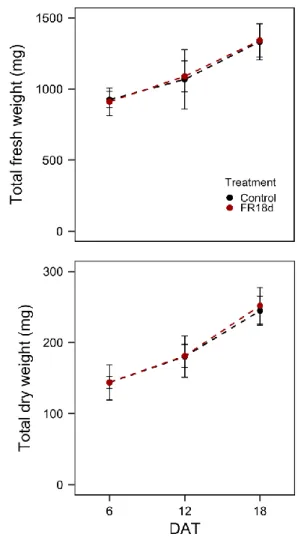
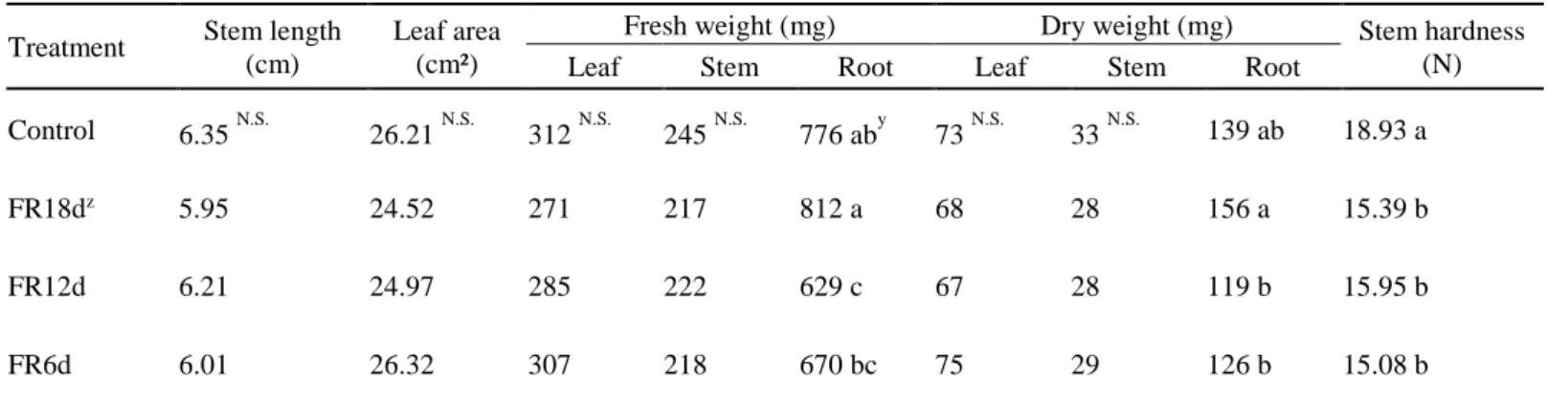
When the ginseng sprouts were treated with far-red light immediately after transplanting (FR18d), both the total fresh and dry weights of the plants did not have significant differences compared to the control regardless of measurement time (Fig. 4). In particular, there were no significant differences in stem length, leaf area, leaf fresh and dry weight, or stem fresh and dry weight, and the growth factors excluding roots even tended to decrease at 18 DAT (Table 1).
The growth of the plants had no significant differences in any growth factor except stem hardness between the far-red light treatment and the control. The stem hardness in the far-red treatment was significantly lower than that in the control.
The far-red light did not result in a significant difference in the growth of ginseng sprouts (Table 1, Fig. 4). In general, however, far-red light is known to accelerate leaf expansion and plant growth (Demotes-Mainard et al. 2016; Lee et al. 2016; Park and Runkle 2017; Kalaitzoglou et al. 2019). Kim et al. (2020) also reported that the leaf area of ginseng was increased and the fresh weight of the shoot was increased by far-red light. However, a recent study showed that blue light can work as an attenuator for far-red effects on plant growth (Park and Runkle 2019), which can be the cause of no effect on growth by far- red light in this study. In this study, a high fraction of blue light (50%) was used to improve the growth and ginsenoside content based on a previous report (Jang
21
et al. 2020). Meanwhile, Kim et al. (2020) showed that the leaf area and the total fresh weight were most improved when treated with red and blue light only with a 20% blue light ratio. Additionally, low levels of PPFD and far-red light can play a role as shade for plants (Hersch et al. 2014; Pedmale et al. 2016).
In this respect, additional far-red light at a low PPFD level of 50 μmol m-2 s-1 can have no effect on growth expansion. The short growth period of 18 days after transplanting can be insufficient to make a difference in the growth of ginseng sprouts by far-red treatment. Meanwhile, the far-red treatment produced significantly lower stem hardness than the control. Therefore, far-red treatment for several days before harvest can lower the stem hardness, which is expected to improve the texture of the stem. In other words, far-red lighting can be used to keep the stem hardness low and extend the cultivation period, producing larger ginseng sprouts.
22
Fig. 4. Total fresh and dry weights of ginseng sprouts that were treated with far-red light from the date of transplantation to the date of harvest (FR18d).
The vertical bars indicate standard deviations (n = 5). Refer to Fig. 2a for the treatment.
23
Table 1. Growth of ginseng sprouts (Panax ginseng) under different far-red treatments at 18 days after transplanting. Refer to Fig. 2 for treatments.
Treatment Stem length (cm)
Leaf area (cm²)
Fresh weight (mg) Dry weight (mg) Stem hardness
Leaf Stem Root Leaf Stem Root (N)
Control 6.35 N.S. 26.21 N.S. 312 N.S. 245 N.S. 776 aby 73 N.S. 33 N.S. 139 ab 18.93 a
FR18dz 5.95 24.52 271 217 812 a 68 28 156 a 15.39 b
FR12d 6.21 24.97 285 222 629 c 67 28 119 b 15.95 b
FR6d 6.01 26.32 307 218 670 bc 75 29 126 b 15.08 b
zFR18d, FR12d, and FR6d are far-red light treatments from the day after transplanting (DAT), 6 DAT, and 12 DAT to harvest, respectively
yDifferent letters indicate significant differences by Duncan’s multiple range test at p < 0.05
N.S.Not significant at p < 0.05 (n = 5)
24
Photochemical characteristics of ginseng leaves under far-red and UV- B treatments
The additional far-red light increased ETRII and ETRI and decreased NPQ only at higher light intensities (Fig. 5). At the highest level of PPFD, the ETRI in all FR treatments was higher, the ETRII in the FR12d treatment was higher, and the NPQ in the FR6d and FR12d treatments was lower than that in the control. In the UV treatment, the ETRII and ETRI showed the opposite tendency as the FR treatment (Fig. 5). On the other hand, the Fv/Fm was 0.79–
0.81 for all treatments with no significant difference (data not shown), which indicated normal leaves with intact photochemical activity of PSII. Although the Fv/Fm is one of the representative indicators of plant stress, the level tends to be less sensitive to light quality as well as abiotic stress than other chlorophyll fluorescence parameters (Yang et al. 2018; Yoon et al. 2020a, 2020c). Similarly, a previous study showed increased NPQ, decreased photochemical efficiency and unchanged Fv/Fm in grapevine leaves exposed to UV radiation (Martínez-Lüscher et al. 2013).
These ETR and NPQ results under the FR treatment were consistent with previous research, which showed that the long-term effect of far-red light on the quantum yield of photosystem II was accompanied by a reduction in NPQ (Zhen and Iersel 2017). In general, far-red light causes unbalanced excitation of photosystems I (PSI) and II (PSII) and preferentially excites PSI
25
(Hogewoning et al. 2012). Synergistically combined with short wavelength light, such as red and blue light, which overexcites PSII, the excitation of PSI under far-red light can enhance photosynthetic efficiency (Zhen et al. 2019). In this study, although the additional far-red light enhanced photochemical efficiency, the low PPFD level may not be enough to enhance plant growth (Table 1). Considering the photochemical efficiency and growth results in this study, it is necessary to find an optimal light intensity and quality at a light intensity higher than 50–80 μmol m-2 s-1, which are commercial conditions in current plant factories.
26
Fig. 5. Electron transport rates of photosystems I and II (ETRI and ETRII, respectively) and nonphotochemical quenching (NPQ) in ginseng sprouts that were treated with far-red and UV-B light. The vertical bars indicate standard deviations (n = 3). Refer to Fig. 2 for the treatment.
27
Changes in ginsenoside content under far-red and UV-B treatments
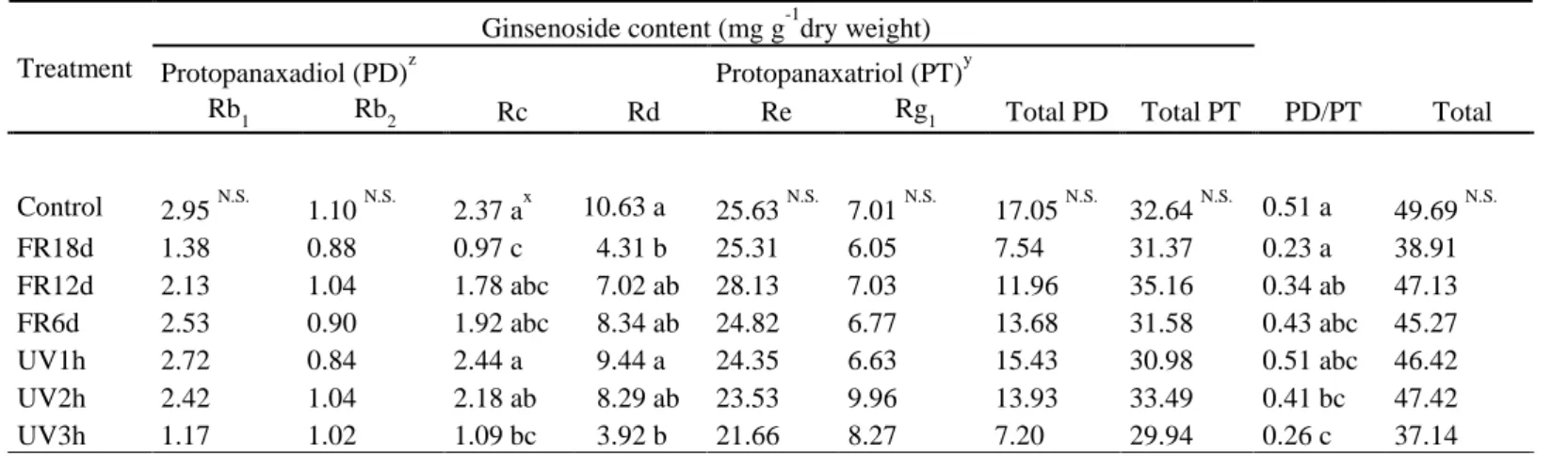
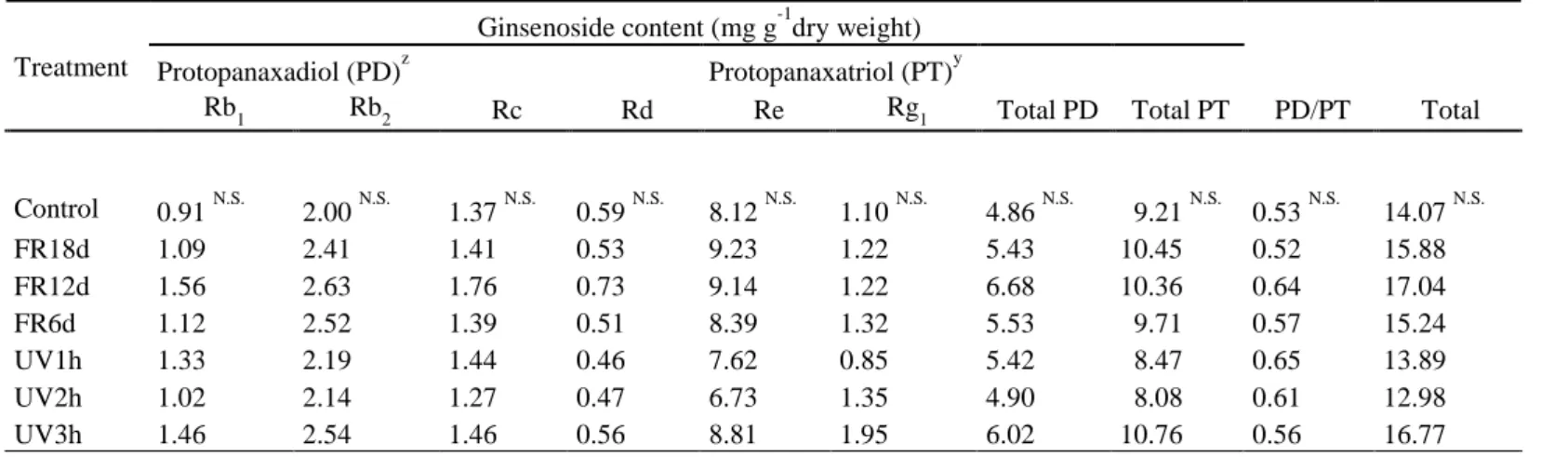
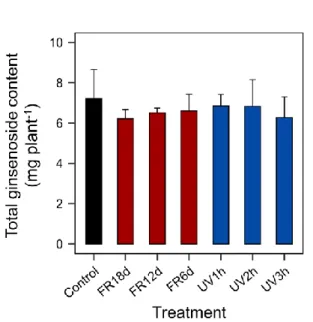
The total ginsenoside content in shoots under far-red or UV-B light treatment did not show a significant difference compared to the control (Table 2). In particular, the total ginsenoside content in shoots was smaller under longer treatments of far-red or UV-B light, indicating that when ginseng sprouts are grown for a short period of time, far-red or UV-B light does not have a positive effect on the ginsenoside content in shoots. Meanwhile, there was no significant difference in all kinds of ginsenosides in roots (Table 3). The total ginsenoside content per plant showed no significant difference between the treatments and tended to be lower in the treatment than in the control (Fig. 6).There have been few studies exploring the effect of light quality, such as far-red light, on ginsenoside content. In contrast to this study, Kim et al. (2020) reported that supplemental far-red light to red, green, and blue or to white LEDs increased ginsenoside content. Several studies have reported that UV-B radiation improves the antioxidant capacities and bioactive compounds of vegetables such as Brassica oleracea L., Hypericum perforatum L., and Lactuca sativa L. (Brechner et al. 2011; Lee et al. 2014; Yoon et al. 2020b). In contrast, it is difficult to conclude that there was a positive effect on ginseng shoots using UV-B treatment in this research. In previous studies, UV-B radiation exposure to Centella asiatica also did not affect the saponin concentration (Müller et al. 2013). However, the ginsenoside of
28
protopanaxadiol (PD) is known to be converted to the ginsenoside of protopanaxatriol (PT) as a defense mechanism under high light stresses (Haralampidis et al. 2001; Jang et al. 2015a). Similar to the previous study, the Rd content became lower with longer far-red and UV-B light treatments in this study. However, although there was no significant difference, the Rg1 content at UV2h or UV3h tended to be higher than that at the control. Rg1 has antioxidant and anti-inflammatory functions and recovers neural damage associated with the brain (Li et al. 2017; Gao et al. 2020). Therefore, to improve this efficacy, UV-B irradiation with more than 100% UV-B/PAR over a day under natural conditions may be a good method. In roots, there was almost no difference in all kinds of ginsenoside contents with far-red light and UV-B radiation treatments. Jang et al. (2020) also reported that changes in ginsenoside content with combinations of red and blue light were less common in roots than in leaves, and the total ginsenoside content in roots was not significantly different. Therefore, the reason that the ginsenoside content in roots was not affected by light treatment may be because roots that are not directly exposed to light react more slowly than shoots.
29
Table 2. Ginsenoside content per plant in shoots of ginseng sprouts (Panax ginseng) grown under different light treatments at 18 days after transplanting. Refer to Fig. 2 for treatments.
zProtopanaxadiol (PD) = Rb1 + Rb2 + Rc + Rd
yProtopanaxatriol (PT) = Re + Rg1
xDifferent letters indicate significant differences by Duncan’s multiple range test at p < 0.05 N.S.Not significant at p < 0.05 (n = 3)
Treatment
Ginsenoside content (mg g-1dry weight) Protopanaxadiol (PD)z Protopanaxatriol (PT)y
Rb1 Rb2 Rc Rd Re Rg1 Total PD Total PT PD/PT Total
Control 2.95 N.S. 1.10 N.S. 2.37 ax 10.63 a 25.63 N.S. 7.01 N.S. 17.05 N.S. 32.64 N.S. 0.51 a 49.69 N.S.
FR18d 1.38 0.88 0.97 c 04.31 b 25.31 6.05 7.54 31.37 0.23 a 38.91
FR12d 2.13 1.04 1.78 abc 07.02 ab 28.13 7.03 11.96 35.16 0.34 ab 47.13 FR6d 2.53 0.90 1.92 abc 08.34 ab 24.82 6.77 13.68 31.58 0.43 abc 45.27
UV1h 2.72 0.84 2.44 a 09.44 a 24.35 6.63 15.43 30.98 0.51 abc 46.42
UV2h 2.42 1.04 2.18 ab 08.29 ab 23.53 9.96 13.93 33.49 0.41 bc 47.42
UV3h 1.17 1.02 1.09 bc 03.92 b 21.66 8.27 7.20 29.94 0.26 c 37.14
30
Table 3.Ginsenoside content per plant in roots of ginseng sprouts (Panax ginseng) grown under different light treatments at 18 days after transplanting. Refer to Fig. 2 for treatments.
zProtopanaxadiol (PD) = Rb1 + Rb2 + Rc + Rd
yProtopanaxatriol (PT) = Re + Rg1
N.S.Not significant at p < 0.05 (n = 3) Treatment
Ginsenoside content (mg g-1dry weight) Protopanaxadiol (PD)z Protopanaxatriol (PT)y
Rb1 Rb2 Rc Rd Re Rg1 Total PD Total PT PD/PT Total
Control 0.91 N.S. 2.00 N.S. 1.37 N.S. 0.59 N.S. 8.12 N.S. 1.10 N.S. 4.86 N.S. 09.21 N.S. 0.53 N.S. 14.07 N.S.
FR18d 1.09 2.41 1.41 0.53 9.23 1.22 5.43 10.45 0.52 15.88
FR12d 1.56 2.63 1.76 0.73 9.14 1.22 6.68 10.36 0.64 17.04
FR6d 1.12 2.52 1.39 0.51 8.39 1.32 5.53 09.71 0.57 15.24
UV1h 1.33 2.19 1.44 0.46 7.62 0.85 5.42 08.47 0.65 13.89
UV2h 1.02 2.14 1.27 0.47 6.73 1.35 4.90 08.08 0.61 12.98
UV3h 1.46 2.54 1.46 0.56 8.81 1.95 6.02 10.76 0.56 16.77
31
Fig. 6. Total ginsenoside content per plant of ginseng sprouts that were treated with far-red and UV-B light. The vertical bars indicate standard deviations (n = 3). Refer to Fig. 2 for the treatment. Different letters indicate significant differences by Duncan’s multiple range test at p < 0.05.
32
CONCLUSION
This study analyzed the growth and ginsenoside content of ginseng sprouts grown under far-red and UV-B light treatments in a plant factory. Under normal growth conditions, the harvest date for aeroponically grown ginseng sprouts was 18 days after transplanting due to a sharp increase in stem hardness. Far- red light treatments significantly lowered the stem hardness but did not show significant differences in other growth factors, such as leaf area or fresh and dry weights of ginseng sprouts. Under FR treatment, the electron transport rates of photosystems II and I increased, and nonphotochemical quenching decreased only at higher light intensities. No significant difference in ginsenoside content was observed under the far-red and UV-B light treatments compared to the control. In this study, far-red and UV-B light treatments did not exert positive effects on growth and ginsenoside content, but additional far-red lighting can be used to keep the stem hardness low and extend the cultivation period to produce larger ginseng sprouts.
33
LITERATURE CITED
Afreen F, Zobayed SMA, Kozai T (2005) Spectral quality and UV-B stress stimulate glycyrrhizin concentration of Glycyrrhiza uralensis in hydroponic and pot system. Plant Physiol Biochem 43:1074–1081 Akula R, Ravishankar GA (2011) Influence of abiotic stress signals on
secondary metabolites in plants. Plant Signal Behav 6:1720–1731
ASTM G173-03 (2012) Standard tables for reference solar spectral irradiances:
direct normal and hemispherical on 37° tilted surface. ASTM International, West Conshohocken, PA, USA
Brechner ML, Albright LD, Weston LA (2011) Effects of UV‐B on secondary metabolites of St. John’s wort (Hypericum perforatum L.) grown in controlled environments. Photochem Photobiol 87:680–684
Cheng W, Wu D, Zuo Q, Wang Z, Fan W (2013) Ginsenoside Rb1 prevents interleukin-1 beta induced inflammation and apoptosis in human articular chondrocytes. Int Orthop 37:2065–2070
Christensen LP (2008) Ginsenosides: Chemistry, biosynthesis, analysis, and potential health effects. Adv Food Nutr Res 55:1–99
34
Cho WC, Chung WS, Lee SK, Leung AW, Cheng CH, Yue KK (2006) Ginsenoside Re of Panax ginseng possesses significant antioxidant and antihyperlipidemic efficacies in streptozotocin-induced diabetic rats. Eur J Pharmacol 550:173–179
Cioć M, Szewczyk A, Żupnik M, Kalisz A, Pawłowska B (2018) LED lighting
affects plant growth, morphogenesis and phytochemical contents of Myrtus communis L. in vitro. Plant Cell Tissue Organ Cult 132:433–447
Demotes-Mainard S, Péron T, Corot A, Bertheloot J, Le Gourrierec J, Pelleschi- Travier S, Crespel L, Morel P, Huché-Thélier L, Boumaza R, Vian A, Guérin V, Leduc N, Sakr S (2016) Plant responses to red and far-red lights, applications in horticulture. Environ Exp Bot 121:4–21
Eigenbrod C, Gruda N (2015) Urban vegetable for food security in cities: A review. Agron Sustain Dev 35:483–498
Escobar Bravo R, Chen G, Grosser K, Van Dam NM, Leiss KA, Klinkhamer P G (2019) Ultraviolet radiation enhances salicylic acid-mediated defense signaling and resistance to Pseudomonas syringae DC3000 in a jasmonic acid-deficient tomato mutant. Plant Signal Behav 14:e1581560
35
Flint SD, Caldwell MM (2003) A biological spectral weighting function for ozone depletion research with higher plants. Physiol Plant 117:137–144 Gao Y, Li J, Wang J, Li X, Li J, Chu S, Li L, Chen N, Zhang L (2020)
Ginsenoside Rg1 prevent and treat inflammatory diseases: A review. Int Immunopharmacol 87:106805
Goto E (2012) Plant production in a closed plant factory with artificial lighting.
Acta Hortic 956:37–49
Goto E (2016) Production of pharmaceuticals in a specially designed plant factory. Plant Factory. Academic Press, London, UK, pp 193–200 Haralampidis K, Bryan G, Qi X, Papadopoulou K, Bakht S, Melton R, Osbourn
A (2001) A new class of oxidosqualene cyclases directs synthesis of antimicrobial phytoprotectants in monocots. Proc Natl Acad Sci 98:13431–13436
Hersch M, Lorrain S, de Wit M, Trevisan M, Ljung K, Bergmann S, Fankhauser C (2014) Light intensity modulates the regulatory network of the shade avoidance response in Arabidopsis. PNAS 111:6515–6520
36
Hideg É , Jansen MA, Strid Å (2013) UV-B exposure, ROS, and stress:
Inseparable companions or loosely linked associates? Trends Plant Sci 18:107–115
Hogewoning SW, Wientjes E, Douwstra P, Trouwborst G, Van Ieperen W, Croce R, Harbinson J (2012) Photosynthetic quantum yield dynamics:
From photosystems to leaves. The plant cell 24:1921–1935
Jang IB, Lee DY, Yu J, Park HW, Mo HS, Park KC, Hyun DY, Lee EH, Kim KH, Oh CS (2015a) Photosynthesis rates, growth, and ginsenoside contents of 2-yr-old Panax ginseng grown at different light transmission rates in a greenhouse. J Ginseng Res 39:345–353
Jang I, Do G, Suh S, Yu J, Jang I, Moon J, Chun C (2020) Physiological responses and ginsenoside production of Panax ginseng seedlings grown under various ratios of red to blue light-emitting diodes. Hortic Environ Biotechnol 61:663–672
Jang YH, Park JE, An JU, Yoon HS, Hong KP (2015b) Effects of LED (light emitting diode) intensity on growth and quality of Panax ginseng in a plant factory. Hortic Sci Technol 33(Suppl I):190–191
37
Jansen MA, Gaba V, Greenberg BM (1998) Higher plants and UV-B radiation:
balancing damage, repair and acclimation. Trends Plant Sci 3:131–135 Jenkins GI (2009) Signal transduction in responses to UV-B radiation. Annu
Rev Plant Biol 60:407–431
Jeong DH, Lee DY, Jang IB, Yu J, Park KC, Lee EH, Kim YJ, Park HW (2018) Growth and ginsenoside content of one year old ginseng seedlings in hydroponic culture over a range of days after transplanting. Korean J Med Crop Sci 26:464–470
Jin SH, Park JK, Nam KY, Park SN, Jung NP (1999) Korean red ginseng saponins with low ratios of protopanaxadiol and protopanaxatriol saponin improve scopolamine-induced learning disability and spatial working memory in mice. J Ethnopharmacol 66:123–129
Kakani VG, Reddy KR, Zhao D, Sailaja K (2003) Field crop responses to ultraviolet-B radiation: A review. Agric For Meteorol 120:191–218 Kalaitzoglou P, Van Ieperen W, Harbinson J, van der Meer M, Martinakos S,
Weerheim K, Nicole C, Marcelis LF (2019) Effects of continuous or end-
38
of-day far-red light on tomato plant growth, morphology, light absorption, and fruit production. Front Plant Sci 10:322
Kang S, Min H (2012) Ginseng, the'immunity boost': the effects of Panax ginseng on immune system. J Ginseng Res 36:354
Kim G, Hyun D, Kim Y, Lee S, Kwon H, Cha S, Park C, Kim Y (2010a) Investigation of ginsenosides in different parts of Panax ginseng cultured by hydroponics. Hortic Sci Technol 28:216–226
Kim SJ, Hahn EJ, Heo JW, Paek KY (2004) Effects of LEDs on net photosynthetic rate, growth and leaf stomata of chrysanthemum plantlets in vitro. Sci Hortic 101:143–151
Kim YC, Lee JH, Bae YS, Sohn BK, Park SK (2010b) Development of effective environmentally-friendly approaches to control Alternaria blight and anthracnose diseases of Korean ginseng. Eur J Plant Pathol 127:443–
450
Kim YJ, Nguyen TKL, Oh MM (2020) Growth and ginsenosides content of ginseng sprouts according to LED-based light quality changes. Agronomy 10:1979
39
Kim YJ, Zhang D, Yang DC (2015) Biosynthesis and biotechnological production of ginsenosides. Biotechnol Adv 33:717–735
Kozai T (2013) Resource use efficiency of closed plant production system with artificial light: Concept, estimation and application to plant factory. Proc Jpn Acad Ser B 89:447–461
Kozai T, Niu G, Takagaki M (2019) Plant factory: an indoor vertical farming system for efficient quality food production. Academic Press, London, UK
Lazzarin M, Meisenburg M, Meijer D, Van Ieperen W, Marcelis LFM, Kappers IF, Van der Krol AR, Van Loon JJ, Dicke M (2020) LEDs make it resilient:
effects on plant growth and defense. Trends Plant Sci (in press)
Lee MJ, Son JE, Oh MM (2014) Growth and phenolic compounds of Lactuca sativa L. grown in a closed‐type plant production system with UV‐A,‐B,
or‐C lamp. J Sci Food Agric 94:197–204
Lee MJ, Son KH, Oh MM (2016) Increase in biomass and bioactive compounds in lettuce under various ratios of red to far-red LED light supplemented with blue LED light. Hortic Environ Biotechnol 57:139–147
40
Lee S, Rhee DK (2017) Effects of ginseng on stress-related depression, anxiety, and the hypothalamic–pituitary–adrenal axis. J Ginseng Res 41:589–594 Lee SW, Kim GS, Hyun DY, Kim YB, Kim JW, Kang SW, Cha SW (2011)
Comparison of growth characteristics and ginsenoside content of ginseng (Panax ginseng C.A. Meyer) cultivated with greenhouse and traditional shade facility. Korean J Med Crop Sci 19:157–161
Lee YS, Park HS, Lee DK, Jayakodi M, Kim NH, Koo HJ, Lee SC, Kim YJ, Kwon SW, Yang TJ (2017) Integrated transcriptomic and metabolomic analysis of five Panax ginseng cultivars reveals the dynamics of ginsenoside biosynthesis. Front Plant Sci 8:1048
Lemoine R, La Camera S, Atanassova R, Dédaldéchamp F, Allario T, Pourtau N, Bonnemain JL, Laloi M, Coutos-Thévenot P, Maurousset L, Faucher M, Girousse C, Lemonnier P, Parrilla J, Durand M (2013) Source-to-sink transport of sugar and regulation by environmental factors. Front Plant Sci 4:272
41
Li C, Cai J, Geng J, Li Y, Wang Z, Li R (2012) Purification, characterization and anticancer activity of a polysaccharide from Panax ginseng. Int J Biol Macromol 51:968–973
Li J, Hikosaka S, Goto E (2009) Effects of light quality and photosynthetic photon flux on growth and carotenoid pigments in spinach (Spinacia oleracea L.). Acta Hortic 907:105–110
Li Y, Suo L, Liu Y, Li H, Xue W (2017) Protective effects of ginsenoside Rg1
against oxygen-glucose-deprivation-induced apoptosis in neural stem cells. J Neurol Sci 373:107–112
Liao B, Newmark H, Zhou R (2002) Neuroprotective effects of ginseng total saponin and ginsenosides Rb1 and Rg1 on spinal cord neurons in vitro. Exp Neurol 173:224–234
Loi M, Villani A, Paciolla F, Mulè, G, Paciolla C (2021) Challenges and opportunities of light-emitting diode (LED) as key to modulate antioxidant compounds in plants: A review. Antioxidants 10:42
Lu N, Bernardo EL, Tippayadarapanich C, Takagaki M, Kagawa N, Yamori,W (2017) Growth and accumulation of secondary metabolites in perilla as
42
affected by photosynthetic photon flux density and electrical conductivity of the nutrient solution. Front Plant Sci 8:708
Marchi S, Sebastiani L, Gucci R, Tognetti R (2005) Sink-source transition in peach leaves during shoot development. J Am Soc Hortic Sci 130:928–
935
Martínez-Lüscher J, Morales F, Delrot S, Sánchez-Díaz M, Gomès E, Aguirreolea J, Pascual I (2013) Short-and long-term physiological responses of grapevine leaves to UV-B radiation. Plant Sci 213:114–122 Mewis I, Schreiner M, Nguyen CN, Krumbein A, Ulrichs C, Lohse M, Zrenner
R (2012) UV-B irradiation changes specifically the secondary metabolite profile in broccoli sprouts: induced signaling overlaps with defense response to biotic stressors. Plant Cell Physiol 53:1546–1560
Müller V, Albert A, Winkler JB, Lankes C, Noga G, Hunsche M (2013) Ecologically relevant UV-B dose combined with high PAR intensity distinctly affect plant growth and accumulation of secondary metabolites in leaves of Centella asiatica L. Urban. J Photochem Photobiol B 127:161–169
43
Nakata H, Kikuchi Y, Tode T, Hirata J, Kita T, Ishii K, Kudoh K, Nagata I, Shinomiya N (1998) Inhibitory effects of ginsenoside Rh2 on tumor growth in nude mice bearing human ovarian cancer cells. Jpn J Cancer Res 89:733–740
Nguyen DT, Lu N, Kagawa N, Kitayama M, Takagaki,M (2020) Short-term root-zone temperature treatment enhanced the accumulation of secondary metabolites of hydroponic coriander (Coriandrum sativum L.) grown in a plant factory. Agronomy 10:413
Park H, Parklee QH, Yoo KJ (1982) Relationship between ginsenoside content and stem color intensity of Panax ginseng. Appl Biol Chem 25:211–217 Park Y, Runkle ES (2017) Far-red radiation promotes growth of seedlings by
increasing leaf expansion and whole-plant net assimilation. Environ Exp Bot 136:41–49
Park Y, Runkle ES (2019) Blue radiation attenuates the effects of the red to far- red ratio on extension growth but not on flowering. Environ Exp Bot 168:103871
44
Pedmale UV, Huang SSC, Zander M, Cole BJ, Hetzel J, Ljung K, Reis PA, Sridevi P, Nito K, Nery JR, Ecker JR, Chory J (2016) Cryptochromes interact directly with PIFs to control plant growth in limiting blue light.
Cell 164:233–245
Rai D, Bhatia G, Sen T, Palit G (2003) Anti-stress effects of Ginkgo biloba and Panax ginseng: A comparative study. J Pharmacol Sci 93:458–464
Sager JC, Smith WO, Edwards JL, Cyr KL (1988) Photosynthetic efficiency and phytochrome photoequilibria determination using spectral data. Trans ASABE 31:1882–1889
Seong BJ, Kim SI, Jee MG, Lee HC, Kwon AR, Kim HH, Won JY, Lee KS (2019) Changes in growth, active ingredients, and rheological properties of greenhouse-cultivated ginseng sprout during its growth period. Korean J Med Crop Sci 27:126–135
Shibata S, Fujita M, Itokawa H, Tanako O, Ishii T (1963) Studies on the constituents of Japanese and Chinese crude drugs. XI. Panaxadiol, A sapogenin of ginseng roots.(1). Chem Pharm Bull 11:759–761
45
Shimizu H (2016) Effect of light quality on secondary metabolite production in leafy greens and seedlings. In LED Lighting for Urban Agriculture.
Springer, Singapore, pp 239–260
Shohael AM, Ali MB, Yu KW, Hahn EJ, Islam R, Paek KY (2006) Effect of light on oxidative stress, secondary metabolites and induction of antioxidant enzymes in Eleutherococcus senticosus somatic embryos in bioreactor. Process Biochem 41:1179–1185
Takshak S, Agrawal SÁ (2014) Secondary metabolites and phenylpropanoid pathway enzymes as influenced under supplemental ultraviolet-B radiation in Withania somnifera Dunal, an indigenous medicinal plant. J Photochem Photobiol B 140:332–343
Takshak S, Agrawal SB (2015) Defence strategies adopted by the medicinal plant Coleus forskohlii against supplemental ultraviolet-B radiation:
augmentation of secondary metabolites and antioxidants. Plant Physiol Biochem 97:124–138
Tritsch D, Hemmerlin A, Bach TJ, Rohmer M (2010) Plant isoprenoid biosynthesis via the MEP pathway: in vivo IPP/DMAPP ratio produced
46
by (E)-4-hydroxy-3-methylbut-2-enyl diphosphate reductase in tobacco BY-2 cell cultures. FEBS Lett 584:129–134
Vuksan V, Sung MK, Sievenpiper JL, Stavro PM, Jenkins AL, Di Buono M, Lee KS, Leiter LA, Nam KY, Arnason JT, Choi M, Naeem A (2008) Korean red ginseng (Panax ginseng) improves glucose and insulin regulation in well-controlled, type 2 diabetes: results of a randomized, double-blind, placebo-controlled study of efficacy and safety. Nutr Metab Cardiovasc Dis 18:46–56
Won JY, Lee CY, Oh DJ, Kim SM (2008) Changes of chlorophyll fluorescence and photosynthesis under different shade materials in Korean ginseng (Panax ginseng CA Meyer). Korean J Med Crop Sci 16:416–420
Yang X, Xu H, Shao L, Li T, Wang Y, Wang R (2018) Response of photosynthetic capacity of tomato leaves to different LED light wavelength. Environ Exp Bot 150:161–171
Ye R, Zhao G, Liu X (2013) Ginsenoside Rd for acute ischemic stroke:
Translating from bench to bedside. Expert Rev Neurother 13:603–613
47
Yoon HI, Kang JH, Kang WH, Son JE (2020a) Subtle changes in solar radiation under a green-to-red conversion film affect the photosynthetic performance and chlorophyll fluorescence of sweet pepper.
Photosynthetica 58:1107–1115
Yoon HI, Kim D, Son JE (2020b) Spatial and temporal bioactive compound contents and chlorophyll fluorescence of kale (Brassica oleracea L.) under UV‐B exposure near harvest time in controlled environments.
Photochem Photobiol 96:845–852
Yoon HI, Zhang W, Son JE (2020c) Optimal duration of drought stress near harvest for promoting bioactive compounds and antioxidant capacity in kale with or without UV-B radiation in plant factories. Plants 9:295 You J, Liu X, Zhang B, Xie Z, Hou Z, Yang Z (2015) Seasonal changes in soil
acidity and related properties in ginseng artificial bed soils under a plastic shade. J Ginseng Res 39:81–88
Zhang M, Runkle ES (2019) Regulating flowering and extension growth of poinsettia using red and far-red light-emitting diodes for end-of-day lighting. HortScience 54:323–327
48
Zhen S, Iersel MW (2017) Far-red light is needed for efficient photochemistry and photosynthesis. J Plant Physiol 209:115–122
Zhen S, Haidekker M, Iersel MW (2019) Far-red light enhances photochemical efficiency in a wavelength-dependent manner. Physiol Plant 167:21–33 Zhu H, Long MH, Wu J, Wang MM, Li XY, Shen H, Xu JD, Zhou L, Fang ZJ,
Luo Y, Li SL (2015) Ginseng alleviates cyclophosphamide-induced hepatotoxicity via reversing disordered homeostasis of glutathione and bile acid. Sci Rep 5:17536
49
ABSTRACT IN KOREAN
새싹 인삼은 지상부의 사포닌 함량이 높아 약용 채소로서의 가치가 높다. 그러나 새싹 인삼의 표준화된 재배 가이드라인이 없으며 새싹 인삼의 생육 및 진세노사이드 함량 증진에 관련된 광질 연구가 활발히 이루어지지 않았다. 본 연구의 목적은 far-red
및 UV-B 광 처리가 분무경 식물공장에서 재배되는 새싹 인삼의
생육 및 진세노사이드 성분에 미치는 효과를 분석하는 것이다.
1 년생 인삼 묘삼(Panax ginseng C. A. Meyer)을 분무경에 정식하여 광도 50 μmol m-2 s-1, 광질 R:B=1:1 의 식물공장 환경에서 생육의 변화를 측정하였다. Far-red 광 처리는 태양광의 수준인 Phytochrome photostationary state (PSS) 0.72 를 기준으로 하루 16 시간씩 18 μmol m-2 s-1 의 광도를 정식 후 0, 6, 12 일부터 처리하였다. UV-B 광 처리는 0.1 W m-2의 세기로 수확 전날 1, 2, 3 시간 동안 처리하였다.
수확 시기는 줄기 경도를 근거로 18 일로 설정하였다. 광도가 높을
때 far-red 에 의한 인삼 잎의 광계 II 와 광계 I 전자전달율이
높아졌고 비광화학적 소멸이 감소하였다. Far-red 광 처리는 줄기 경도를 낮추었지만, 처리 시기에 무관하게 새싹 인삼의 생육과 진세노사이드 함량에서 대조군에 비해 유의미한 차이를 보이지
50
않았다. UV-B 광 처리는 광화학적 특성과 진세노사이드 함량에서 유의미한 차이를 보이지 않았다. 결과적으로 far-red 보충광은 새싹인삼의 줄기 경도를 낮추고 재배기간을 연장시키는 데 사용될 수 있다.
추가 주요어: 경도, 광질, 분무경, 사포닌, 약용작물, 인삼, 줄기
학 번: 2019-22792
51
APPENDICES
Appendix 1. Growth of ginseng sprouts (Panax ginseng) grown under far-red light at 6 days after transplanting (n = 5). Refer to Fig. 2 for the treatment.
zP-values > 0.05 were regarded as non-significant (N.S.) by Studentized t-test.
Treatment Stem length (cm)
Leaf area (cm2)
Fresh weight (mg) Dry weight (mg) Stem hardness Leaf Stem Root Leaf Stem Root (N)
Control 4.95 9.55 129 153 643 30 16 98 10.26
FR18d 4.20 6.87 103 121 686 25 14 105 09.71
P-valuez N.S. 0.009 0.019 N.S. N.S. N.S. N.S. N.S. N.S.