저작자표시-비영리-동일조건변경허락 2.0 대한민국 이용자는 아래의 조건을 따르는 경우에 한하여 자유롭게
l 이 저작물을 복제, 배포, 전송, 전시, 공연 및 방송할 수 있습니다. l 이차적 저작물을 작성할 수 있습니다.
다음과 같은 조건을 따라야 합니다:
l 귀하는, 이 저작물의 재이용이나 배포의 경우, 이 저작물에 적용된 이용허락조건 을 명확하게 나타내어야 합니다.
l 저작권자로부터 별도의 허가를 받으면 이러한 조건들은 적용되지 않습니다.
저작권법에 따른 이용자의 권리는 위의 내용에 의하여 영향을 받지 않습니다. 이것은 이용허락규약(Legal Code)을 이해하기 쉽게 요약한 것입니다.
Disclaimer
저작자표시. 귀하는 원저작자를 표시하여야 합니다.
비영리. 귀하는 이 저작물을 영리 목적으로 이용할 수 없습니다.
동일조건변경허락. 귀하가 이 저작물을 개작, 변형 또는 가공했을 경우 에는, 이 저작물과 동일한 이용허락조건하에서만 배포할 수 있습니다.
Master’s of Arts Thesis
A Description of Korean Converbs and their Northeast Asian context
August, 2014
Richard John Hatcher JR
Department of Linguistics
The Graduate School
Seoul National University
ii
Abstract
Richard John Hatcher JR Department of Linguistics The Graduate School Seoul National University This paper is a study of Korean converbs in relation to the neighboring languages of Northeast Asia. It is based on the descriptive and theoretical advances made in modern linguistics and provides an extensive analysis of the key issues regarding converbs in Korean as well as ten other neighboring languages. The thesis consists of five sections including an introduction and conclusion.
The introduction consists of a background of the converb and its use in typological settings. Chapter 1 is subdivided into three parts, the first of which describes exactly what forms can be considered converbs in Korean and relates them to their traditional description in Korean grammar. This is followed by a description of Korean converbs categorized into those containing or lacking temporal values. Chapter 1 concludes with a short section regarding the origins and evolutionary paths of converbs. Chapter 2 is a comparison of the Korea data above with converbs in neighboring languages. These languages can be roughly grouped into two sets, the Transeurasian languages and the Protoasiatic languages, neither a language family in the traditional sense. Chapter 3 consists of a discussion on several
iii
trends within the converbal systems on Northeast Asian languages. The paper ends with a short conclusion.
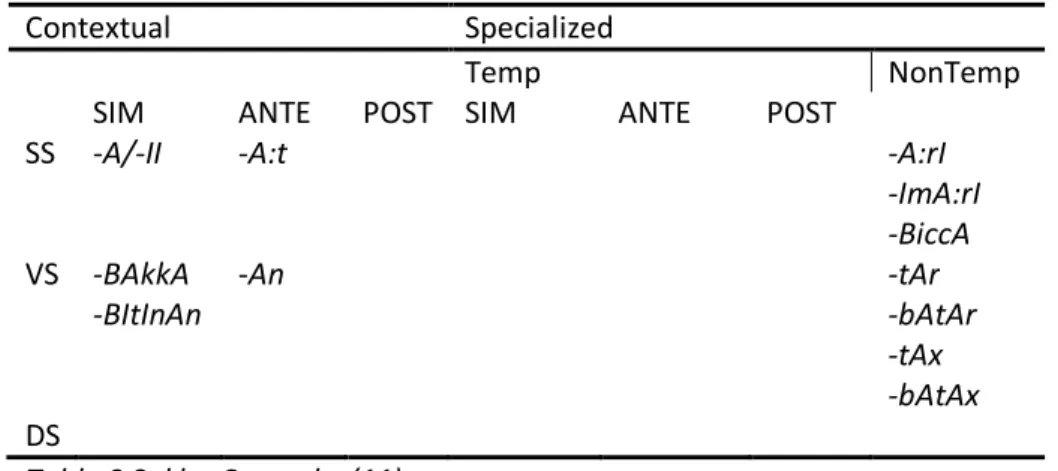
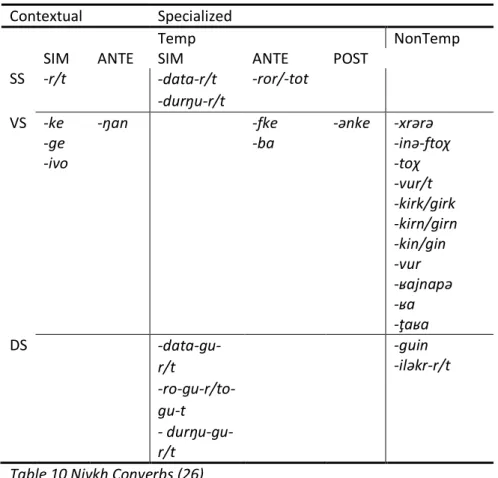
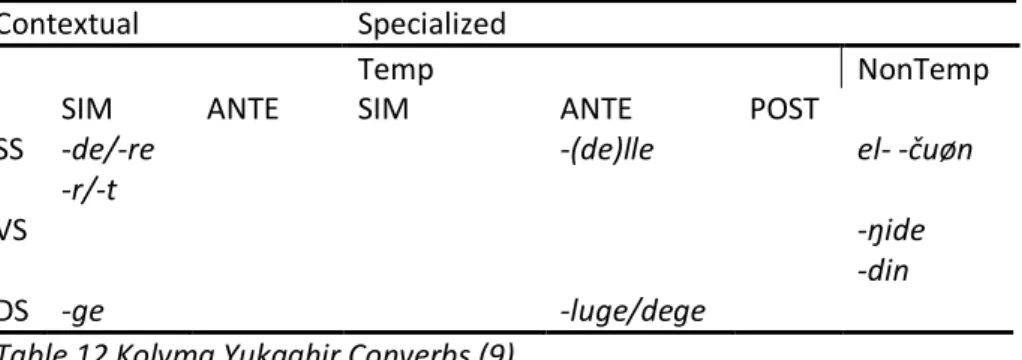
The Korean data is not atypical for the region. While it is true that Korean has a larger than average number of converbs, this is not unique to Korean for Nivkh contains nearly the same number. Korean’s lack of different-subject converbs and the paucity of posterior converbs is the overall trend for the region. It is also common for a language to have one highly contextual converb with a wide variety of possible interpretations.
Keywords: Korean, Converbs, Northeast Asia, Transeurasian, Paleoasiatic, Linguistic Typology
Student Number: 2012-22482
iv
Table of Contents
Abbreviations ... vi
Introduction ... 1
1. Korean Converbs ... 7
1.1. Korean Converbs Delimited ... 7
1.2. Korean Converbs Described ... 12
1.2.1. Temporal converbs ... 17
1.2.2. Non-temporal converbs ... 28
1.2.3. Tense and Converbs ... 44
1.2.4. Negation in Korean Converbs ... 44
1.3. Korean converbs Evolved ... 46
2. The broader Northeast Asian context ... 49
2.1. Transeurasian Languages ... 49
2.1.1. Japanese ... 49
2.1.1.1 Temporal Converbs ... 50
2.1.1.2 Non-temporal Converbs ... 57
2.1.1.3. Comparison ... 58
2.1.2. Tungusic ... 60
2.1.2.1. Ewenki ... 61
2.1.2.2. Udihe ... 70
2.1.2.3. Manchu... 75
2.1.3. Mongolic (Mongolian) ... 82
2.1.4. Turkic (Sakha) ... 89
2.2. Protoasiatic Languages ... 94
2.2.1. Nivkh ... 95
2.2.2. Ainu ... 109
2.2.3. Kolyma Yukaghir ... 121
2.2.4. Chukchi ... 126
3. Converbs in Northeast Asia ... 132
Conclusion ... 134
References ... 136
v
English Abstract ... ii 한국어 초록 ... 141
vi
Abbreviations
abl ablative abs absolutive case acc accusative add additive adv adverbializer al alienable poss.
all allative
anr action nom.izer ass assertive caus causative co coordinate comp complementizer conf confirmative cont continuative cv converb dat dative des desiderative dim diminutive dir directional dur durative emp emphatic ex exclusive fam familiar
foc focus
fut future gen genitive hab habitual imp imperative in inclusive inch inchoative ind indicative ind indef. pronoun inst instrumental int interrogative inv inverse ipfv imperfective iter iterative loc locative
mod modal
mut mutative case npast non-past neg negation ntr intransitive nml nominalizer O Object marker
of O-focus
p participle pap past participle part particle past past pf perfect pfv perfective pl plural poss possessive pp present participle pred predicative priv privative prog progressive proh prohibitive prol prolative prop propositive prp present participle quot quotative
refl reflexive rep repetitive res resultative seq sequential aspect sg singular
src source ss same subject sup supine
th thematic suffix top topic
tr transitiviser uncm uncompleted usit usitative mood
1
Introduction
The term, converb, has gained currency amongst both linguistic typologists and descriptive linguists in recent years. One particular work, Haspelmath and König (1995), can be seen as a watershed in the term’s wider usage. The above work treats the converb from a variety of perspectives, but most importantly argues for its cross-linguistic acceptance.
As a direct consequence of this work, the term converb is now used to describe similar morphosyntactic structures found in any language. The work goes on to refer to Korean converbs several times, but fails to treat them systematically (Nedjalkov 1995:100; Haspelmath 1995:58). It is the primary goal of this work to fill this gap by describing the converbs of Korean along these lines.
The term converb has had a long history and was first coined by Ramstedt in his description of Khalkha Mongolian (Ramstedt 1903). It later gained wider currency amongst Altaicists, who used the term to describe similar phenomena in other Altaic1 languages (Benzing 1955; von Gabain 1974). However, it was not until Nedjalkov & Nedjalkov (1988) that the term was first used in a general typological sense, describing both the Transeurasian (i.e. Altaic) and non-Transeurasian languages of the former USSR. Haspelmath (1995) then argued for a cross-linguistically valid
1 These languages have also been referred to as Transeurasian. In this paper, these languages will be referred to as Transeurasian when viewed from a typological perspective and Altaic from a genetic/historical perspective.
2
interpretation of the converb. Since then the term has been used in various descriptive and typological works from a wide range of languages, e.g.
Mongsen Ao (Coupe 2007), Tarma Quechua (Adelaar 2011).
The following section is a short description of the Korean language. It details some of Korean’s more salient typological features as well as some attempts at locating Korean within som larger language families.
The Korean language is one of several major languages spoken in East Asia. There are approximately 78 million speakers of worldwide (Yeon and Brown 2011). The majority of Korean speakers reside within the Korean Peninsula, with the number in South Korea totaling 48 million and North Korea 24 million. Besides these, a significant minority of Korean speakers live abroad primarily in China, the USA2, Japan and central Asia. This makes Korean the 13th most spoken languages in the world. (Lewis, Simons, and (eds.). 2013)
Korean is widely considered to be a linguistic isolate, although there have been several attempts to establish genetic relationships with other languages via comparative linguistics. Beginning with Ramstedt in 1928, a number of historical linguists have attempted to place Korean within the controversial Altaic language family (Lee and Ramsey 2011). This research has not as yet led to wide acceptance. Scholars in the west have been more attracted to a
2 According to the recent US census data, the number of Korean speakers has reached 1.1 million. (Camille 2013)
3
connection between Korean and Japanese, and this has also found support among many Altaicists who often place both Korean and Japanese within a Macro-Altaic family, in a separate phylum from those languages traditionally considered Altaic, i.e. Turkic, Mongolic, and Manchu-Tungusic.
There is a level of cultural and linguistic homogeneity on the Korean peninsula found scarcely elsewhere on the globe. No indigenous minority languages are found within the two countries’ borders. There is some minor geographically-based variation within Korean. Korean consists of seven dialectical regions which correspond for the great part with Korea’s traditional provincial divisions. Besides this, a divergence has existed between the standard forms used by the citizens of each Korea since 1945.
The primary differences between the dialects are phonological and lexical.
Nevertheless there is mutual intelligibility among the speakers of other dialects (Sohn 1999).
Although convincing evidence of a genetic relationship is lacking, Korean does however share many typological similarities with other Northeast Asian languages. For example its word order is primarily AOV- and SV. Its morphology is highly agglutinative and suffixing. Korean utilizes postpositions in its nominal phrases and is strictly right-headed. Most importantly for this work, Korean contains a large number of converbs, i.e. specialized verb forms denoting adverbial subordination in complex sentences.
4
Among traditional Korean grammarians the forms described above as converbs have normally been referred to as “linking affixes” (yenkyel emi3) or
“conjunctive affixes” (cebsok emi). Much of the work on this topic has involved the systematization by the affix’s semantic value or role in combining the two sentences (Cwu 1910) (Choy 1971) (He 1983). These authors also divide the affixes into coordinating (tungwi/taytung) and subordinating (congsok) forms (Kwon 2012). Typological work on Korean in English has more or less followed this format of semantic subcategorization of converbal forms (Sohn 2013) (Jaehoon and Brown 2011) (Sohn 2009).
The work aims to thoroughly discuss Korean converbs from a theoretically neutral perspective, i.e. theoretically informed but not theory driven perspective. The main goal of this work is twofold. The first goal is a thorough examination and description of Korean’s various converbs. Each converb will be examined with the goal of observing its semantic and syntactic characteristics. Secondly the Korean phenomenon will be set in the wider sphere of Northeast Asian languages. Korean converbs will be compared to those of Japanese, Ewen, Udihe, Manchu, Mongolian, Sakha, Nivkh, Yukaghir, and Chukchi. By comparing this Korean data with that of neighboring languages, one may determine how typical the Korean data are
3 All Korean will be transcribed via Yale Romanization excepting the names of authors who have established Romanized versions.
5
and whether it is useful to use this typological feature in determining a Northeast Asian sprachbund.
The remainder of this section is an outline of the paper. The introduction sketches several important topics treated at length in the following sections.
Part I consists of three sections describing Korean’s converbs. Section 1.1 will attempt to answer the questions of what exactly is a converb and how does this definition affect our description of phenomenon in Korean. Two differing concepts of the converb will be entertained and the concept which is more elucidating of the Korean data will then be adopted. Section 1.2 will deliver a categorization and description of various converbs in Korean including their categorization and morphosyntactic and semantic characteristics. Section 1.3 will briefly discuss some possible origins of Korean converbs as well as several common grammatical constructs derived from converbs.
Part 2 consists of ten sections each describing and comparing one neighboring language’s converbal system with that of Korean. Section 2.1 will enumerate and describe the converbs of Korea’s closest neighbor, Japanese.
This comparison is of significant importance for these languages have historically been compared to one another with arguments for a genetic relationship. A comparison of their respective sets of converbs may be of use to linguists interested in any relationship these two languages might share with one another. Moreover these two languages are by far the most spoken of all the languages described in the paper. Section 2.2 will compare the
6
converbs of three Tungusic languages, namely Ewen, Udihe and Manchu. The comparison of Manchu is also especially significant because it shares a long history of contact with Korean (Lee and Ramsey 2011:97). Section 2.3 will compare Mongolian converbs with those of Korean. Section 2.4 will compare the converbs of Sakha, the sole Turkic language lying in the target area with Korean. The sections 2.5 – 2.8 will each compare the converbs of one of the highly endangered Proto-Siberian languages, namely Nivkh, Ainu, Yukaghir and Chukchi. By comparing Korean with these languages spoken in Northeast Asia but crucially excluded from the Altaic hypothesis, one may discover whether the converbal strategy is evidence in favor of more closely linking Korean to the Transeurasian languages or the preference for converbs is an areal phenomenon adding no support to the Altaic hypothesis.
The paper concludes by summarizing the main characteristics of Korean converbs. This section will also include those converbal features found among all or most of the languages in the target region. Finally the significance of Korean converbs is given.
7
1. Korean Converbs
1.1. Korean Converbs Delimited
According to Haspelmath (1995), a converb is “a nonfinite verb form whose main function is to mark adverbial subordination. [emphasis in original]” In other words, a converb is a derived verb form analogous to the masdar4 and the participle. For Haspelmath, converbs complete the paradigm of deverbal forms as seen in (Table 1) below, modified from Haspelmath (1995:4). Converbs are therefore an inflectional form of the verb and not a separate word class or closely bound verb and complementizer as some in the Generative framework have clamed (Haspelmath 1995:4).
Word class: Noun Adjective Adverb
Derived verb form: Masdar Participle Converb Syntactic function:
Argument Adnominal modifier
Adverbial modifier Examples in Korean -m, -ki -nun, -n, -l -ko, -nikka, -ca Table 1 Korean’s derived verb forms
Haspelmath (ibid.) also lists several characteristics that describe the converb. These include being non-finite, subordinate and adverbial, i.e.
4 This is a term Haspelmath coined to describe the verbal noun, i.e. the English gerund. It is of Arabic origin and has been used to describe verbal nouns in that language.
8
adjunctive. The most important and widely agreed upon of these is non- finiteness. Converbal forms must contrast morphosyntactically with the finite verb forms. In other words, converbs may not form an independent clause (Haspelmath 1995) (Nedjalkov 1995) (Bisang 1995).
However, the traditional notion of finiteness is somewhat problematic.
Traditionally verb forms have been considered binary either fully finite, i.e.
containing specification for all verbal features or fully non-finite, having no specifications for any feature as was exhibited in classical languages of Europe. However since Lehmann (1988), finiteness has often been described according to an index or scale of desententialization and that verb forms may lie somewhere between the two traditional extremes. According to this scale, verb forms may vary in finiteness from fully-clausal finite forms at the one end to the fully-nominalized form, the masdar at the other.
For our discussion of Korean, all converbs differ from those finite forms by lacking any sentence-ender suffix (i.e. congkyel emi). This suffix is required on all finite forms and determines to which sentence type the predicate belongs (Sohn 2013:8). These sentence types have been described as declarative, interrogative, imperative and propositive (Sohn 2013). These same forms can also be described as modal affixes for they convey the speaker’s illocutionary force. According to the scale of desententialization, the loss of mood excludes converbs away from the most finite end of the index (Lehmann 1988:222). A subset of Korean converbs are also unable to
9
combine with tense-marked predicates. This subset should be placed even further toward the nonfinite end of the scale. In other words, all converbs in Korean are to some degree nonfinite as they all lack independent illocutionary force, but those which also lack independent tense are less finite than the others.
Haspelmath’s second criteria is that a converb’s primary function is adverbial, i.e. adjunctive. This means that the forms should not be used as arguments of a predicate or to modify a nominal. This excludes the –m and - ki used to nominalize verbs as well as the participles; -un, -nun, and -ul, traditionally referred to as prenouns (kwanhyengsa) in Korean grammar.
The final criterion is that converbs are subordinate or incorporated into a superordinate clause. This seems to match the subordinate category (congsok) well as described in the Korean literature. For Haspelmath those forms which are not subordinate are referred to as cosubordinate (tungwi/taytung) and excluded from his definition of converb. Nedjalkov (1995) on the other hand accepts both types as converbs and labels the subordinate forms, converbs proper and the cosubordinate forms as coordinative converbs. Nedjalkov’s distinction patterns well with the traditional categorization of congsok and taytung connective forms. This will be further described below in Section 1.2.
10
Several similar forms must now be excluded from our discussion of Korean converbs. Unlike Chinese and the majority of Southeast Asian languages, Korean makes little use of verb serialization. The definition of the term, verb serialization as used here, is identical to that defined by Bisang is given below (Bisang 1991:509).
Verb serialization is the unmarked juxtaposition of two or more verbs or verb phrases (with or without subject and/or object), each of which would also be able to form a sentence on its own.
The most important distinction between a serial verb and a converb lies in their morphological marking. As Bisang makes clear, some languages are more suited to serial verb strategies in clause linking, i.e. Chinese, while others utilize converbal strategies. Highly analytic languages like those of Southeast Asia, are characterized by a high degree of ambiguity in their finite verbs and therefore do not contrast them with a set of nonfinite verb forms.
Languages with more morphological marking on finite verbs are conversely capable of contrasting with nonfinite forms and may utilize converbal strategies.
Languages need not utilize one clause-linking strategy exclusively and indeed Korean has a limited number of serial verbs, i.e. those which Bisang refers to as ‘verb serialization in the narrow sense’ (Bisang 1995:145). Many of these serial verbs are related to movement, i.e. kacye kata ‘to bring’, tule ota ‘to come in’. It is notable that this phenomenon is used to form a single predicate and serial verb constructions do not result in complex sentences.
11
Another related phenomenon is that of the auxiliary verb. Auxiliary verbs are formally quite similar to converbs5. In traditional descriptions of Korean grammar these forms are often equated to the two phenomena described above, i.e. subordinating and cosubordinating clauses. In their seminal work on Korean grammar for example, Nam and Ko (2010:158-160) distinguish three types of connecting suffix, coordinating, subordinating and auxiliary.
These auxiliary forms do not function as clause linkers and therefore cannot be considered converbs.
Examples of serial verbs and auxiliary verbs can be seen in the following sentence extracted from Sohn (2013). This example consists of six verbs, only the last of which is finite, i.e. contains a sentence-final affix. The first three verbs (i.e. ki-, tul-, & o-) combine to form a lexical unit meaning crawl into (toward the speaker). The final three (po-, siph- & ha-) are auxiliary and mark aspect and modality. More specifically, the verb po- marks the attemptive aspect, while siph- marks the desiderative mood, and the final ha- indicates that the subject of the predicate is 3rd person (Sohn 2013).
1. ki-e tul-e o-a po-ko siph-e ha-nta crawl-SV enter-SV come-SV try-AV want-AV do-AV
‘wants to crawl in’
5 This is so, because most auxiliary verb forms are derived from converbal constructions diachronically, cf. section I.C.
12
1.2. Korean Converbs Described
Contextual Specialized
Temp NonTemp
SIM ANTE POST SIM ANTE
SS -kose
-teni -ta(ka)
-mye -myense
-ko -nula(ko) -le -lyeko -koca -ulako VS -myen -a/e(se)
-uni(kka) -ca(maca)
-tolok -ketun
-a/eto -umulo -(nu)ntey -
(nu)nteyto -kiey -key -nuni -tusi -tasiphi Table 2 Korean Converbs (26)
This section serves as a description of Korean converbs. It begins by detailing the parameters by which converbs may differ from one another. It then describes each converb of Korean giving any syntactic and semantic restrictions. An attempt is also made to differentiate any converbs that have similar functions. Lastly some space if given to describe what role tense and negation play in the converbal system of Korean.
In previous research, Korean converbs have typically been categorized according to either their syntactic or semantic features, with the majority favoring the latter (Kwon 2012). The first distinction one should
13
make is categorizing converbs is the one between co(sub)ordinating6 and subordinating forms. The former links two semantically (although not syntactically) independent clauses, and have been referred to as taytung yengkyel emi in the Korean literature. According to Haspelmath (1995), cosubordinating forms do not mark adverbial subordination and therefore are not considered converbs. He labels these forms medial verbs.
Another (perhaps simpler) solution is to use Nedjalkov’s typology of converbs, which distinguishes converbs proper (ie. subordinating) from coordinate converbs, (i.e. cosubordinating). Nedjalkov (1995) defines the converb negatively as a nonargumental and nonadnominal dependent verb form. This definition is similar to Haspelmath’s in that they both exclude masdars and participles, but Nedjalkov’s is to some degree less restrictive as it lacks the functional requirement of adverbial subordination.
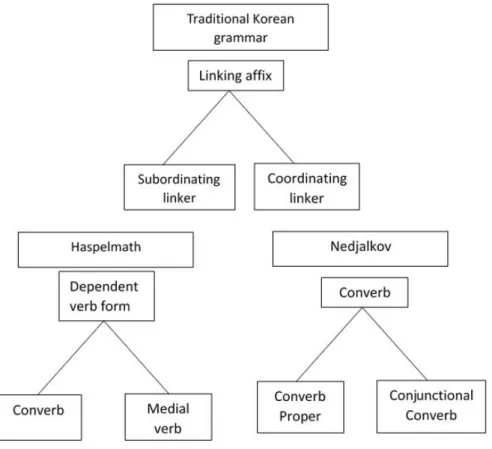
This distinction between Haspelmath and Nedjalkov’s definitions results in a difference in terminology (see Figure 1 below). Nedjalkov considers Haspelmath’s converbs and medial verbs both as converbs.
Consequently, Nedjalkov’s definition of the converb parallels the traditional Korean term, yenkyel emi. Haspelmath’s definition includes only a subset of yenkyel emi, namely congsok yenkyel emi. For Nedjalkov, the suffix -ko is
6 The term cosubordination is a term borrowed from Role and Reference Grammar and is used to label those clauses that share features of both subordinate and coordinate clauses. Cosubordinate clauses are like subordinate clauses in that they are morpho-syntactically dependent upon a superordinate clause, but like
coordinate clauses they do not modify another clause.
14
indisputably a converb, yet it still is characterized by some ambiguity as to which of the above types, i.e. converb proper or coordinate converb it belongs. The context must then determine which category the –ko-affixed form belongs to on a case by case process.
However Nedjalkov’s definition obscures the converb’s role as the adverbial/adjunctive inflection of a verb. Nor does this definition provide any meaningful tool for disambiguating morphemes like –ko. In other words, both definitions of the converb result in spome ambiguity regarding forms like -ko, but with Nedjalkov’s definition, we lose the important generalization that converbal clauses are overwhelmingly adverbial. Nedjalkov’s wider definition of the converb cannot complete the paradigm of deverbal forms (see above). For these reasons, this paper will assume Haspelmaths definition of the converb.
It should also be noted that the ambiguity between the cosubordination and subordination of some forms is not exclusive to Korean.
For instance, Kuno (1973) gives evidence that Japanese’s –te converb also performs as a medial form when the two clauses subjects are different.
15
As stated above, the affix –ko is found in both cosubordinating and a
subordinating clauses as exemplified below in (2). One possible explanation for this is that two –ko affixes exist in Korean, one cosubordinate denoting simple clausal conjunction and one subordinate with a range of possible semantic values. If we are to assume Korean contains two phonologically identical morphemes for –ko, then only the latter would be a converb. The former would be be considered medial verb. However, it is more likely that there is only one morpheme and context determines wheter it serves as a converb or a medial verb.
Figure 1: Correspondence of dependent verb form terminology
16
2. a) na-nun hankwuk salam-i-ko ku-nun cwungkwuk I-TOP Korean person-COP-CV he-TOP Chinese
salam-i-ta.7 person-COP-DEC
I am Korean and he is Chinese.
b) na-nun os-ul ip-ko ca-ss-ta.
I-TOP clothes-ACC wear-CV sleep-PAST-DEC
I slept wearing clothes. (I slept with my clothes on) (The National Institute of the Korean Language 2005:34)
Converbs are often categorized as either contextual or specialized converbs. Contextual converbs are characterized by a wide range of possible interpretations depending upon their syntactic and semantic context.
Specialized converbs have a sole specific semantic value independent of context.
Converbs may also differ regarding restrictions on the subject. Some converbs require a correferencing of the two clauses’ subjects, while others forbid such a correferencing. A third group permits such correferencing, but does not require it. These converbs are referred to as same-subject, different-subject and varying-subject converbs respectively.
Converbs are also categorized according to their composition. The first group are composed of a single morpheme that is unable to be decomposed into smaller constituent morphemes. The other type is formed from a complex morpheme that is decomposable into smaller base morphemes.
7 All examples of Korean converbs are taken from oykwukinul wihan hankwuke mwunpep 2.
17
We may also categorize converbs according to their semantic function. Thompson et.al. (2007) lists twelve types of adverbial clauses, namely; anterior, simultaneous, posterior, locational, manner, purpose, reason, circumstantial, conditional, concessive, substitutive, & additive. The first three are temporal in nature and express taxis, i.e. relative tense. The remaining adverbial clause types modify the supordinate converb similarly to the adverb.
The description of Korean converbs which follows is categorized according to semantic function. The result is that contextual converbs will be described separately for each possible interpretation. Temporal converbs are described first, listing Korean’s anterior, simultaneous and posterior converbs. This is then followed by a description of Korean’s non-temporal converbs. Finally the system is treated as a whole with a discussion of any notable characteristics of the system overall.
1.2.1. Temporal converbs
This description begins with a list of converbs that have at least one one temporal function. There are at least 11 converbs in Modern Standard Korean which carry these values. Of these the majority can be described as anterior converbs, that is to say the majority describe an action that takes place prior to the action of the matrix clause. In constrast, Korean contains only one posterior converb, namely -tolok.
18
The most likely reason for this asymmetry in temporal converbs is the iconicity principle, i.e. the sequential order principle. Iconicity states that the order of events will be mirrored in the speech chain. According to Kortmann (1991:117) more than 80 percent of converbal constructions in English display an iconic ordering of constituents. Unlike English, Korean is a strict V-final language and permits no adjuncts to follow the predicate. This implies that any converbal clause is necessarily located before the matrix predicate. Therefore, any posterior converbs must by their nature violate this principle and are consequently rare.
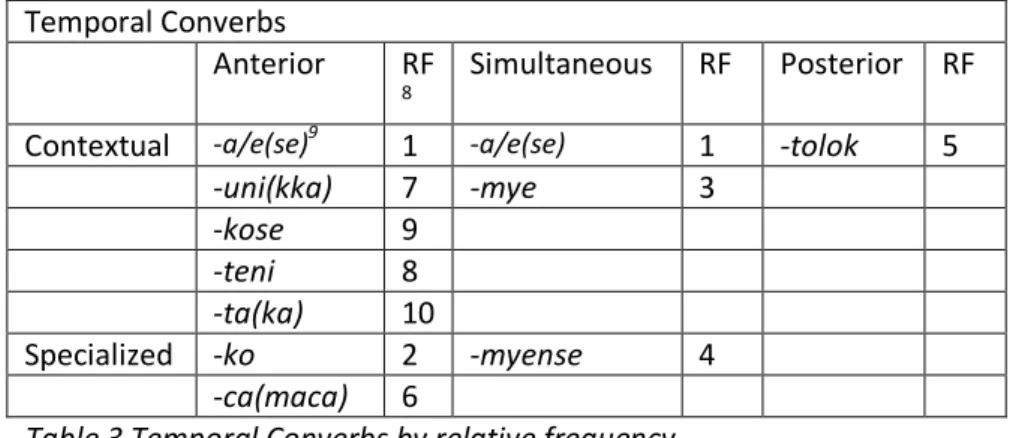
Temporal Converbs
Anterior RF
8 Simultaneous RF Posterior RF Contextual -a/e(se)9 1 -a/e(se) 1 -tolok 5
-uni(kka) 7 -mye 3
-kose 9
-teni 8
-ta(ka) 10
Specialized -ko 2 -myense 4
-ca(maca) 6
Table 3 Temporal Converbs by relative frequency
Anterior converbs
Anterior converbs are those which denote an action that takes place prior to the matrix clause predicate. There are a minimum of seven anterior
8 Relative Frequency according to the National Insitute for the Korean Langauge.
9 The parenthesis denote phonologically-motivated allomorphs while the square brackets denote elements of the converb that are voluntarily eliminable.
19
converbs in Korean. Anteriority is sometimes referred to as succession, kyeyki in the literature (Sohn 2009). All but one anterior converb are contextual, namely –ko, -a/e(se), -uni(kka), -kose, -teni, & -ta(ka). The sole specialized converb signifying anteriority is -camaca. Moreover, anterior converbs consist of both variable-subject as well as same-subject converbs.
The converbs –ko, and –a/e(se) are both primary converbs. The remainder of Korean’s temporal converbs are all secondary converbs and are composed as follows. The converb –uni(kka) is formed from the morphemes –ni and –kka, while –kose is derived from the converb –ko and the affix –se, and –teni is composed of the retrospective –te and the converb –ni. Finally, –taka contains the declarative ending –ta as well as the affix –ka. –camaca is derived from a complex predicative ending containing the contextual converb –ca and the prohibitive verb mal-ta also also marked by the same converb.
1. -ko
This first anterior converb listed is formed by –ko and and attaches directly to a verb. Although the tense affixes, -a/ess- & -keyss-, may be attached before the converb, when –ko functions as a converb only the matrix verb is marked for tense and carries scope over both clauses. As noted above -ko is also commonly found in cosubordinating clauses, i.e. as medial verbs. When –ko functions as a medial verb it is more likely to have an independent tense affix.
20
Lee (1993:459) states that this converb has no inherent temporal meaning, but only “acquires” such a meaning through context. This argument is not so different from Haspelmath’s concept of the contextual converb. Two predicates connected by –ko do not overlap temporally and there is no logical connection between the two, unlike both –uni(kka) or - a/e(se) . According to the National Institute for the Korean Language10 (2003), this converb is the second most frequently encountered converb.
Moreover, -ko is used in several constructions derived from the converb (see below).
3. swukcey-lul ha-ko nola-la homework-ACC do-CV play-IMP Do your homework and then play!
(The National Institute of the Korean Language 2005:34)
2. -a/e(se)
The converb, -a/e(se) signifies anteriority as its most fundamental value. Unlike –ko, this converb does require an intimate logical relationship between the two predicates (The National Institute of the Korean Language 2005:530). Lee (Lee 1993:454) states that the matrix predicate “takes place in the state produced by” the converbal11 predicate. That is to say that, the
10 A frequency list of all affixes including yenkyelemi can be found at the website, http://www.korean.go.kr/09_new/data/etc_view.jsp .
11 Lee (Lee 1993) refers to the converbs by their more common appellation, connectives.
21
action or state of the converbal clause directly affects the matrix predicate as seen in the sentences (4b-c).
This converb is often used as backgrounding for the matrix predicate, while the –ko converb merely states a preceding action. In (4b) the subject’s going to school directly affects his studying for this is where (s)he performs the act of studying. (4c) is considered ungrammatical because the relationship between the two clauses is more than solely temporal.
Like –ko, this converb is characterized by a very high frequency and tendency toward grammaticalization. It is also used in many grammatical constructions derived from the converb, including serial verbs and postpositions. This is the most common converb when considering the total frequency of all its allomorphs, namely –a, -e, -ase, & -ese. Unlike –ko, this converb may not be attached to verbs marked for tense and never performs as a medial verb.
4. a) hyeng-un tosekwan-ey ka-se kongpuha-ni elder.brother-TOP library-LOC go-CV study-INT
Did (your) elder brother go to the library and study?
b) hakkyo-ey ka-se kongbuha-yss-eyo school-LOC go-CV study-PAST-POL (She/he) went to school and studied.
c) *hakkyo-ey ka-ko kongbuha-yss-eyo school-LOC go-CV study-PAST-POL (She/he) went to school and studied.
(The National Institute of the Korean Language 2005:528, 530)
22
3. -uni(kka)
This contextual converb shares several characteristics in common with -a/e(se) above. Like -a/e(se), -uni(kka) signifies a intimate relationship between the two predicates. However, -uni(kka) may be affixed to verbs marked for tense. Also unlike the latter, the matrix clause that contains this converbal clause denotes a realization that is the result of the converbal predicate. Lukoff & Nam (1982) argues that this converb12 denotes an interpretation, the means by which the matrix predicate was discovered. This element of discovery is lacking in -a/e(se) and contributes to the distinction between these two converbs’ causal interpretations.
5. ecey hakkyo-ey ka-nikka yecenhi hakkyo-nun kongsa yesterday school-LOC go-CV still school-TOP construction cung-i-ess-eyo
middle.of-COP-PAST-POL
Yesterday (he) went to the school, but it was still under construction.
(The National Institute of the Korean Language 2005:619)
4. -kose
The secondary converb, –kose cannot attach to verbs marked for tense. When -kose signifies anteriority, it may be replaced a similar complex predicate, ie. –ko nase. In the example (6) below, pat-kose can be replaced with pat-ko nase without any change in meaning or nuance. Moreover in sentences consisting of several -kose clauses, only the final converbal clause
12 They do not use the term converb, but a translation of the generally accepted Korean term ‘connector’. This follows from the traditional Korean yenkyel emi.
23
is –kose. All others are simply –ko (The National Institute of the Korean Language 2005:45).
6. ku-nun cenhwa-lul pat-kose naka-ss-ta (s)he-TOP phone.call-ACC receive-CV go.out-PAST-DEC
(S)he got a phone call and left (the room).
(The National Institute of the Korean Language 2005:45)
5. -teni
The secondary converb, -teni is formed with the retrospective modal affix, –te and therefore the converbal clause must refer to an state or event occurring in the past. Moreover, like all clauses containing –te this converbal clause is restricted from having the speaker as subjuct (Sohn 2009:301). The relationship between the two predicates is usually in contrast to one another or in immediate anteriority (The National Institute of the Korean Language 2005:352).
7. akka ttalai-ka cip-ey o-teni short.time.ago young.daughter-NOM home-LOC come-CV insa-to an ha-ko pang-ey tuleka-ss-eyo
greet-FOC not do-CV room-LOC enter-PAST-POL
(My/His/Her) young daughter came home a short time ago and went to her room without saying hello.
(The National Institute of the Korean Language 2005:352)
6. -ta(ka)
This converb signifies that some state or event changes before its completion, i.e. the converbal action or state is interrupted and followed by the matrix predicate. This converb is also one of Korean’s few same-subject converbs, meaning that the subjects of both clauses must be identical.
24
Lee (1993:529) states that when –ta(ka) is formed from a telic verb, it denotes that the action was interrupted before the verb was achieved, while atelic verbs denote a simple interruption. When combined with a verb marked with the past tense suffix, this converb is frequently used to signify that the resulting states of some predicate are reversed as seen (9) below.
8. syawe-lul ha-taka chinku cenhwa-lul pat-ass-ta shower-ACC do-CV friend phone-ACC receive-PAST-DEC
While I was taking a shower, I received a call from a friend.
(The National Institute of the Korean Language 2005:279) 9. a) mwun-ul tat-ass-taka yel-ess-ta.
door-acc close-past-cv open-past-dec He closed the door and then opened it.
b) sin-ul sin-ess-taka pes-ess-ta.
shoe(s)-acc put.on-past-cv take.off-past-dec He put on the shoes and then took them off.
c) ku-nun cwuk-ess-taka salana-ss-ta he-top die-past-cv be.revived-past-cv
He died and then revived.
(Lee 1993:532)
7. -camaca
This converb denotes the instantaneous succession of states or events. Converbs of this type are sometimes referred to as immediate anterior converbs. The seeming reduplication of the converb with the prohibitive has been described as denoting a state between the event and not-the-event, i.e. the very last moment of the event. Converbal clauses of this type are restricted from being negative. This converb is replaceable with the primary contextual converb –ca, from which it is derived, but only - camaca permits the matrix clause to be in the imperative or propositive
25
mood. This converb may not be affixed to a verb marked for tense. In (10) below the action of the matrix clause, i.e. Yengi’s arrival is immediately preceded by the converbal clause of Chelsu’s departure.
10. chelsu-ka ka-camaca yengi-ka wa-ss-ta Chelsu-NOM go-CV Yengi-NOM come-PAST-DEC
As soon as Chelsu left, Yengi came.
(The National Institute of the Korean Language 2005:869)
Simultaneous converbs
There are at least three converbs in Korean that are used to express simultaneity. These converbs denote an action that takes place at the same time as the matrix clause.
1. -a/e(se)
The most common value for –a/e(se) is not simultaneity as described here, but anteriority. However in some cases the converbal clause gives background information stating when the matrix predicate does, should or may take place. In these cases simultaneity more accurately describe the relationship between the two clauses.
Lee (1993:566-567) gives several examples in which the temporal relation is not that of anteriority or sequence, but where “the time span of (the converbal predicate) endures or continues over that of the (matrix clause).” These examples are given below in (11). Many of these sentences may also be interpreted as causal. In the following example (12), the sentence could be the reply to both the question “when did you wake up?”
26
and “why did you wake up?” This interpretation of the converb has the same morphological restrictions as the anterior interpretation above.
11. a) celm-ese no-se
be.young-cv play-prop.fam
‘Let’s have fun while we are young.’
b) hae-ka iss-ese il-ul machy-ela sun-nom exist-cv work-acc finish-imp ‘Finish the work while the sun is up.’
c) ku ai-ka ely-ese acu chongmyeng ha-yss-ta that child-nom be.young-cv very bright be-past-dec
‘He was very bright as a child.’
(Lukoff and Nam 1982:567) 12. nal-i palk-ase ilena-ss-eyo
day-NOM bright-CV get.up-PAST-POL
When the day broke, (I) got up.
(Sohn 2009:315)
2. -mye
This converb expresses simultaneity and in such a role, and when it performs so it may be regarded as a same subject converb. In this
interpretation, the converb has a very similar value as the converb, –myense below. This converb, however, is more likely to be used in writing,
speeches, and presentations, while –myense is more likely to be used in everyday conversation. Moreover like –ko above, this converb is often used in cosubordinate clauses semantically coordinating two independent clauses.
13. kanguy-lul tul-umye cungyohan nayyong-un memo-lul lecture-ACC listen-CV important content-TOP memo-ACC ha-yss-ta
do-PAST-DEC
27 I took notes as I listened to the lecture.
(The National Institute of the Korean Language 2005:702)
3. -myense
This is Korean’s sole specialized converb that signifies simultaneity. It is a same subject converb like the primary converb –mye above. It is composed of the converb –mye and the topicalizer –n- followed by the suffix –se. In (14) below the speaker is perfoming both actions simultaneously.
14. na-nun nyusu-lul po-myense achimpap-ul mek-nun-ta I-TOP news-ACC watch-CV breakfast-ACC eat-PRES-DEC
I am watching the news as I eat breakfast.
(2005:708)
Posterior converbs
Posterior converbs denote an action that takes place after the matrix event. These are relatively rare in Korean. In fact there is only one converb used to express this temporal relationship, -tolok.
1. -tolok
Korean’s sole posterior converb, -tolok is commonly found in predicates denoting a period of time. The interpretation is that the matrix predicate takes place until the converbal clause action takes place. In other words this converb temporally delimits the matrix clause. Another term for such converbs is terminative converb as they denote the termination of the matrix predicate. This converb’s lexical restrictiveness may also be due to iconicity restrictions on Korean.
15. han tal-i nem-tolok cenhwa han tong eps-ta
28
one month-NOM exceed-CV phone one call not.BE-PRES.DEC
There was no calls for over a month.
(The National Institute of the Korean Language 2005:375)
Overview of temporal converbs
Korean contains at least 11 converbs expressing a temporal relationship between clauses. The majority of these converbs express anteriority while only one expresses posteriority. This asymmetry may be explained by the iconicity principle, which prefers the order of events to be mirrored in the speech act. Korean also contains many contextual converbs expressing temporal relationships with seven of the 11 converbs explored having more than one interpretation.
1.2.2. Non-temporal converbs
The following section describes all Korean converbs that do not express taxis but some other adverbial relationship, such as those described in Thompson et. al. (Adverbial clauses 2007), e.g. condition, cause, purpose, manner, concession etc. As above, we will categorize by semantic role and contextual converbs are bound to appear in more than one category.
Conditional converbs
The first set of non-temporal converbs treated are conditional. A conditional converb is one that is used to mark a conditional clause.
According to Thompson (ibid.) conditionals can be broadly divided into two types, reality conditionals and unreality conditionals. Korean contains two primary converbs expressing the conditional. Of these two the conditional
29
converb, -myen, is the more common by a large margin (The National Institute for the Korean Language 2003). The primary distinction between these converbs and others, like the causal and concessive converbs, is that the converbal clause of the former is hypothetical while that of the latter is factual (König 1995:68).
1. -myen
This converb is the standard method of marking conditional clauses in Korean. It may express either reality or unreality converbs. In (16) below, the converb expresses the reality conditional. Here the matrix clause is in the present tense stating what should happen if the conditions of the converb clause are met. Unreality converbs are usually marked with the past tense, – a/ess, as seen in (17) below. In this example the converbal clause is counterfactual and the matrix clauses states what would have taken place were the converbal clause’s contion(s) met.
16. onul sikan-i eps-umyen taum-ey manna-yo today time-NOM not.exist-CV next-LOC meet-POL
If (you) have no (free) time today, let’s meet next time.
(The National Institute of the Korean Language 2005:703) 17. cokum-man ilccik tochakha-yss-umyen pihayngki-lul nohchi-ci
little.bit-only early arrive-PAST-CV airplane-ACC miss-CMP
anh-ass-ul ke-yey-yo not-PAST-FUT thing-COP-POL
Had we arrived only a little earlier, we wouldn’t have missed the plane.
(The National Institute of the Korean Language 2005:704)
30
2. -ketun
Like -myen above, -ketun may express both reality and unreality conditionals by means of the past tense marker. The primary distinction between the two converbs is that the matrix verb containing this converb, -ketun must be propositive or imperative and cannot be declarative.
18. cwungyohan yaksok-i-ketun ese ka pwa-yo important appointment-COP-CV quickly go try-POL
Hurry up and go, if it is an important meeting.
(2005:9)
Concessive-conditional 1. -a/e(se)to
The converb, –a/e(se)to, is also used in concessive-conditional clauses. This vaule can be glossed with the English ‘even if’. This is an example of a secondary converb, constructed from the converb, -a/e(se) and –to. This converb patterns after the example of Hindi given in König (1995:60-61). When –to is used in its scalar interpretation, the converbal clause receives the concessive-conditional interpretation if the context is hypothetical and a concessive interpretation (see below) if the context is factual.
19. amwuli pappa-to achimpap-un kkok mek-nun however be.busy-CV breakfast-TOP certainly eat-PRES.PART kes-i coh-ayo
thing-NOM be.good-POL
However busy (you) may be, it is good to eat breakfast.
(The National Institute of the Korean Language 2005:520)
31
Causal converbs
Korean most prolific group of converbs are the causal converbs. This group consists of nine converbs ranging from the contextual -a/e(se) to the specialized –(u)mulo.
These converbs share in common with the concessive clause the characteristic of factuality. The primary distinction between the two types of clauses is that causal clauses assert a relation of regularity or tendency, i.e. [a
& b, if a then b], while concessive clauses imply a conflict of regularity between the two predicates, [*a & b, if a then –b] (König 1995:69).
1. -a/e(se)
Korean’s most common contextual converb, -a/e(se) is also used to express causal clauses. The relationship between the two clauses is vital in determining the interpretation of the -a/e(se) clause. As noted in other interpretations above, -a/e(se) may not combine with predicates marked for tense and its matrix clause must be declarative. In cases where the cause is an event, this converb requires the converbal event to be completed before the matrix predicate begins (The National Institute of the Korean Language 2005:530). In (20) below, there can be no temporal relation between the two clauses, but the narrowness is clearly the reason why the matrix clause is true.
20. kil-i cob-ase cha han tay-man cinaka-l su road-NOM narrow-CV car one clas-only pass-FUT.PART way
32 iss-eyo
exist-POL
The road is narrow and so only one car is able to pass (at a time).
(The National Institute of the Korean Language 2005:529)
33
2. -ni(kka]
This converb shares the same semantic interpretation as -a/e(se) above. However, -ni[kka] is not so morphosyntactically restricted in its usage.
It may combine with predicates marked for tense and the matrix clause may also be propositive or imperative as seen in (21) below. Lukoff and Nam (1982) describe some differences between the two converbs. They describe –ni(kka) as expressing logical justification for the matrix clause, while -a/e(se) simply expresses the cause.
21. onul –un pikonha-nikka nayil iyakiha-psita today-TOP be.tired-CV tomorrow talk-PROP.POL
(I) am tired today, so let’s talk tomorrow.
(The National Institute of the Korean Language 2005:619)
3. -nula(ko)
This converb is closely related to the converb -a/e(se) described above. Like that converb, it may not be subordinate to matrix clauses in either the propositive or imperative mood. Also it may not be combined with predicates marked for tense. The main distinction between –a/e(se) and –nula(ko) is the temporality. The results of -nula(ko) occur while the converbal predicate is taking place, while the results of the -a/e(se) clause must take place after the converbal clause is completed as described above (Lukoff and Nam 1982). In (22) below the subject didn’t realize the time while watching the video. The converbal clause takes place simultaneous to the matrix clause but the relationship is causal.
34
22. pitio-lul po-nulako sikan ka-nun cu-l video-ACC watch-CV time go-PRES.PART give.FUT.PART
molla-ss-eyo not.know-PAST-POL
(I) was watching a video and I didn’t realize that the time went.
(The National Institute of the Korean Language 2005:153)
4. -mulo
Like -a/e(se) and -nula(ko) above, -umulo may not be embedded in an imperative or propositive clause. However unlike them, -mulo may be combined with predicates marked for tense.
23. ku-nun pusan chulsin-i-mulo kyengnam satwuli-lul (s)he-TOP Busan background-COP-CV Gyeongnam accent-ACC
ssu-pnita use- PRES.DEC
(S)he uses the Gyeongnam accent, because (s)he is from Busan.
(The National Institute of the Korean Language 2005:711)
5. -ta(ka)
Like its temporal interpretation, the causal interpretation of –ta(ka) is a same-subject converb (The National Institute of the Korean
Language 2005:280). The matrix clause containing this converb is required to be negative. This is an example of Korean’s negative converbs. These converbs require the matrix clause to be syntactically or semantically negative.
24. kwasok-ul ha-taka kyelkwuk sako-lul nay-ko speed-acc do-cv finally accident-acc have-xx
mal-ass-ta prevent-past-dec
(She/he) was speeding and so finally had an accident.
(The National Institute of the Korean Language 2005:279)
35
6. -teni
As with the aboveThis converb contains the retrospective –te, which restricts its subject from being the 1st person. Moreover the cause marked with this converb must be something the speaker has experienced or realized and therefore must be factual and have occurred in the past. The 1st person restriction is not enforced when the converbal predicate is marked by the past, i.e. -(a)ss/(e)ss-teni.
25. kulehkey manhi mek-teni tongsayng-i baytal-i so much eat-CV sibling-NOM stomach.ache-NOM
na-ss-ta occur-PAST-DEC
(S)he ate so much that (his/her) sibling got a stomach ache.
(The National Institute of the Korean Language 2005:353)
7. -ca
The converb –ca cannot be combined with predicates that are marked for tense. It also cannot be subordinate to matrix clauses of any mood but declarative.
26. nal-i chuweci-ca nanpang kikyey-ka cal
day-NOM become.colder-CV heating appliance-NOM well palli-n-ta
be.sold-PRES-DEC
The days are getting colder so the heaters are selling well.
(The National Institute of the Korean Language 2005:847)
8. -(nu)ntey
This converb is used primarily for preliminary remarks, but can be used to express cause when the matrix clause is marked for the imperative or propositive moods.
36
27. pi-ka o-nuntey usan hana sa-psita rain-NOM come-CV umbrella one buy-PROP.POL
It's raining, so let's buy an umbrella.
(The National Institute of the Korean Language 2005:239)
9. -kiey
This converb may be combined with predicates marked for tense, but cannot be subordinate to imperative or propositive matrix clauses. The subject of the matrix clause containing this converb must be 1st person (The National Institute of the Korean Language 2005:80).
28. nalssi-ka tep-kiey changmwun-ul yel-ess-ta weather-NOM hot-CV window-ACC open-PAST-DEC
Because it was hot, (I) opened the window.
(The National Institute of the Korean Language 2005:80)
Overview
Five of the causal converbs are also used to express anteriority, namely -a/e(se), -ni(kka), -teni, -ta(ka), & -ca. This correlation between anteriority and cause is not only found in Korean, for Comrie et al. (2012) states that the causal interpretations of some Tsezic converbs is the byproduct of anterior converbs.
Purposive converbs
Thomspon et al. (2007) note that many langauges share the same morphology for marking both purpose clause and reason clauses. As the Korean data below shows, Korean contains two converbs that can express both of these relationships, i.e. -a/e(se) and –nula(ko). Purposive converbs
37
can be roughly divided into SS(same-subject) converbs and VS(varying- subject) converbs.
1. -a/e(se)
Like all the interpretations described above, the purposive interpretation cannot combine with predicates marked for tense. The context between the two predicates must determine whether the converb should have this interpretation.
29. emma-nun kachwulha-n tongsayng-ul chac-ase mother-TOP left-PAST.PART sibling-ACC search-CV
cenkwuk-ul tolatany-ess-e entire.country-ACC go.around-PAST-DEC
Mother went around the whole country looking for her sibling.
(The National Institute of the Korean Language 2005:529)
2. -le
This purpose converb is restricted to matrix clauses of movement.
The converb may not combine with predicates that are marked for tense. In the example below the matrix verb is ka-ta ‘to go’ while the purpose is to study.
30. taum cu-ka sihem-i-lase kongpuha-le tosekwan-ey ka-yo next week-NOM test-COP-CV study-CV library-LOC go-POL The test is next week so I'm going to the library to study.
(The National Institute of the Korean Language 2005:665)
3. –lye(ko)
This is an example of same-subject converb. It may not combine with predicates marked for tense (Kwon 2012:183).
38
31. na-nun uysa-ka toy-lyeko kongpuha-n-ta I-TOP doctor-NOM become-CV study-PRES-DEC I am studying to become a doctor.
(The National Institute of the Korean Language 2005:668)
4. -koca
This is another example of same-subject converb. Like -(u)lye[ko]
above it may not combine with predicates marked for tense (Kwon 2012:183).
32. tangsin-ul manna-koja yeki-kkaci wa-ss-supnita you-ACC meet-CV here-until come-PAST-DEC.POL (I) came here to meet you.
(The National Institute of the Korean Language 2005:56)
5. -key
13The converb, -key may not combine with predicates marked for tense. The matrix clause containing this converbal subordinate cannot be propositive. Unlike –le, -lyeko and –koca, this converb is a VS converb with differing subjects being exemplified in (33) below.
33. salam-tul-i cinaka-key wuli-tul-un person-PL-NOM pass-CV we-PL-TOP
pikyese-ss-ta
stand.out.of.the.way-PAST-DEC
We stood out of the way to let people pass.
(The National Institute of the Korean Language 2005:20)
13 This and the following two converbs are also referred to as resultative converbs in some literature (Kwon 2012:184-185).
39
6. -tolok
Like –key above, this converb may not combine with predicates marked for tense. It is also a VS converb and can replace –key as in (34).
34. salam-tul-i cinaka-tolok wuli-tul-un person-PL-NOM pass-CV we-PL-TOP pikyese-ss-ta
stand.out.of.the.way-PAST-DEC
We stood out of the way to let people pass.
(The National Institute of the Korean Language 2005:375)
7. -ulako
As with –key and –tolok above, this converb does not combine with predicates marked for tense (Kwon 2012:185).
35. cam-ul cal ca-ulako ttattushan uyu-lul masi-nun sleep-acc well sleep-cv warm milk-acc drink-pres.part
ke-ya thing-cop
(I) am drinking warm milk to sleep well.
(The National Institute of the Korean Language 2005:627)
8. -nula(ko)
This converb is much like those described above, except that it is used to describe negative consequences, i.e. the matrix predicate is often negative. Like the converbs above this converb may not combine with tense marked predicates. The matrix clause must also be in the declarative mood.
This is another example of a same-subject converb (The National Institute of the Korean Language 2005:154).
40
36. adul hakpi-lul tay-nulako apeci-nun sikol ttang-ul ta son tuition-ACC provide.for-CV father-TOP country land-ACC all
phal-ass-ta sell-PAST-DEC
Father sold all the land in the country to provide for (his) son's tuition.
(The National Institute of the Korean Language 2005:154)
Overview
The purpose converbs of Korean can be divided into same subject- converbs, i.e. -a/e(se), -le, -(u)lye[ko], -koca, -nula(ko) and varying-subject converbs, -key, -tolok, & -ulako. Korean also contains a negative purpose converb, whose matrix clause must express some negative action.
Manner
The following converbs each signify a relationship in which the converbal subordinate clause describes the manner in which the matrix predicate occurs.
1. -key
This converb combines with adjectives as well as a portion of verbs describing the manner or degree in which the matrix predicate occurs. This converb may not combine with predicates marked for tense (Kwon 2012:184).
37. na-nun meli-lul ccalp-key call-ass-ta I-TOP hair-ACC short-CV cut-PAST-DEC
I cut my hair short.
(The National Institute of the Korean Language 2005:20)
41
Comparative 1. -tasiphi
This converb signifies an action, to which the matrix verb is compared. The converbal action does not literally take place, but the matrix verb occurs in nearly the same fashion of the converbal clause. In the example below the woman does not literally fly, but runs so fast that she nearly flies. This converbal construction is often used for exaggeration. This converb may not combine with predicates marked for tense and the matrix clause may not be marked for imperative or propositive mood.
38. kunye-nun ttwi-nun kes-i anila nal-tasiphi she-TOP run-PRES.PART thing-NOM not.but fly-CV cenglyucang-ulo rush-PAST-DEC
bus.stop-TO tallyeka-ss-ta
She rushed to the bus stop not running but flying.
(The National Institute of the Korean Language 2005:330)
2. -tusi
This converb signifies a similarity between the two predicates. This
converb may combine with predicates marked with the past tense affix, -a/ess- (Kwon 2012:185).
39.