ABSTRACT
Background and Objectives: The purpose of this study was to determine the status of health- promoting behaviors in patients after percutaneous coronary intervention (PCI) and explore what factors affect healthy lifestyle behaviors.
Methods: A total of 120 patients with coronary artery disease after PCI was included in this study. The Health Promoting Lifestyle Profile (HPLP) II was used to assess health-promoting lifestyle behavior. Data analysis was performed by t-test, analysis of variance, and multiple linear stepwise regression analyses.
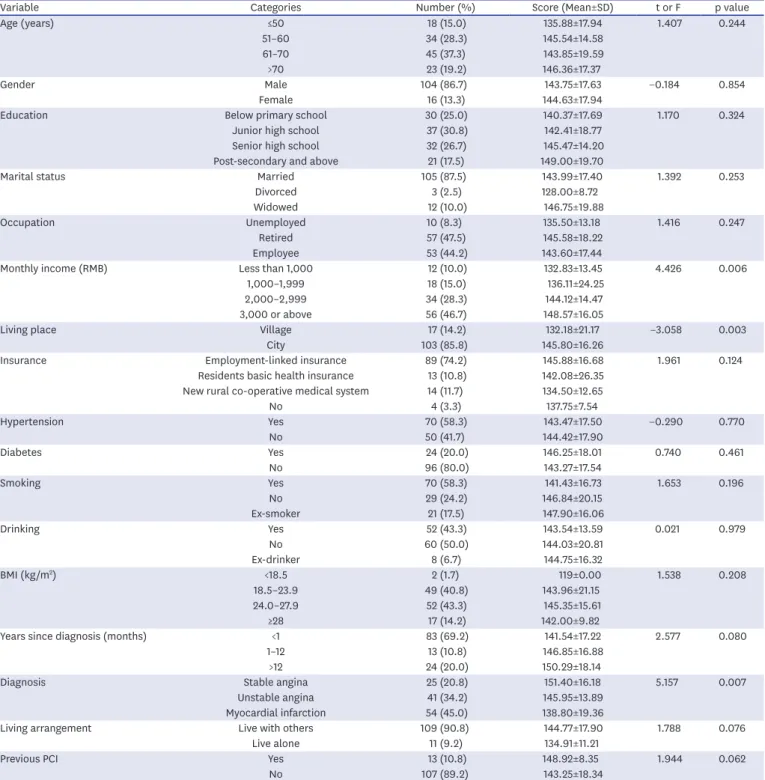
Results: The average age of the participants was 60.10±9.84 (range, 37–81) years old. Among the participants, 86.7% were men and 13.3% were women. In all, 24.2% of the patients had an excellent level of health-promoting lifestyle and 74.2% had a moderate level of health- promoting lifestyle. The spiritual growth scores were the highest, while stress management and physical activity scores were the lowest. The level of health-promoting lifestyle was higher for people with higher income and a diagnosis of stable angina.
Conclusions: Healthcare providers should focus on promoting physical exercise and stress management for patients after PCI. It is also necessary to keep an eye out for patients with low income and severe illness to encourage a health-promoting lifestyle in these subsets of patients.
Keywords: Cardiovascular diseases; Coronary artery disease; Health promotion;
Percutaneous coronary intervention
INTRODUCTION
Cardiovascular disease (CVD) is the leading cause of death globally.
1)In 2012, the World Health Organization (WHO) estimated that 17.5 million people died of CVD, accounting for 31% of the global death rate. Of these deaths, 7.4 million (13.1% of deaths worldwide) died of coronary artery disease (CAD).
2)In China, with the rapid development of the social economy, the lifestyles of people have changed greatly. In particular, with the aging population and the acceleration of urbanization, the prevalence of CVD risk factors in China have increased significantly, leading to the continued increase in the incidence of CVD. From 2002 to 2013, the mortality of CAD showed an upward trend. In 2013, 100.86 people out of 10 million died of CAD in urban areas, while in rural areas, the number was 98.68 people out of 10 million.
In the next 10 years, the number of patients with CAD will continue to grow rapidly. Over
Original Article
Received: Oct 9, 2017 Revised: Jan 25, 2018 Accepted: Feb 22, 2018 Correspondence to Qinghua Zhao, BD
Department of Nursing, the First Affiliated Hospital of Chongqing Medical University, No. 1 Youyi Road, Yuzhong District, Chongqing 400016, China.
E-mail: [email protected]
Copyright © 2018. The Korean Society of Cardiology
This is an Open Access article distributed under the terms of the Creative Commons Attribution Non-Commercial License (https://
creativecommons.org/licenses/by-nc/4.0) which permits unrestricted noncommercial use, distribution, and reproduction in any medium, provided the original work is properly cited.
ORCID iDs Ling Xiao
https://orcid.org/0000-0002-0486-7950 Pan Wang
https://orcid.org/0000-0002-9131-6451 Qin Fang
https://orcid.org/0000-0002-8324-7281 Qinghua Zhao
https://orcid.org/0000-0001-8627-1300 Funding
This work was supported by funding from the Chongqing Health and Family Planning Commission Scientific Research Projects (No.
2015ZDXM009).
Conflict of Interest
The authors have no financial conflicts of interest.
Ling Xiao , RN, MD 1 , Pan Wang , RN, BD 1 , Qin Fang 2 , and Qinghua Zhao 1
1
Department of Nursing, The First Affiliated Hospital of Chongqing Medical University, Chongqing, China
2