https://doi.org/10.5763/kjsm.2018.36.2.71 pISSN 1226-3729 eISSN 2288-6028
국내 운동선수에서 비타민 D 수치의 현 상태 및 결핍과 관련된 인자: 실내외 종목에 따른 차이, 나이, 성별,
체질량지수, 계절 변동과의 관련성
CM병원 정형외과
양 성 석ㆍ이 상 훈
Do Young Athletes Need Vitamin D Supplement? Vitamin D Status and Deficiency Related Factor on Sports Type (Indoor vs. Outdoor), Age, Sex, Body Mass Index,
Seasonal Variations in Korean Young Athletes
Seongseok Yang, Sang-Hoon Lhee
Department of Orthopedics and Sports Medicine, CM General Hospital, Seoul, Korea
Purpose: Several studies have suggested that vitamin D deficiency has significant effects on muscle weakness, injury and illness, and ultimately, exercise performance. However, studies on vitamin D status and deficiency related factors for young athletes are still lacking.
Methods: Four hundred athletes who have undergone serum vitamin D (D2 and D3) test were studied. Vitamins were classified into three groups (deficiency, insufficiency, and adequacy). Blood sampling time was classified into four groups (spring, summer, fall, and winter).
Results: Of the 400 athletes, 31.5% were deficient, 48.25% were insufficient, and 20.25% were adequate in vitamin D.
The group with lower vitamin D levels was older, had a higher body weight, and had higher body mass index.
Comparisons by sex were significantly lower in female athletes than male athletes for indoor sports. Seasonal comparisons were significantly lower in winter than in spring, summer, and autumn. When the correlation analysis between the characteristics of the athletes and vitamin D was analyzed, there was a weak negative correlation between age and body mass index and height and weight were not related. Athletes' vitamin D levels are higher than the general population, but about 80% of them have vitamin D deficiency.
Conclusion: Vitamin D deficiency causes exercise performance and performance deterioration; therefore, it is necessary to monitor and manage more closely when there are related factors.
Keywords: Athletes, Deficiency, Performance, Supplement, Vitamin D
Received: January 12, 2018 Revised: March 12, 2018 Accepted: April 20, 2018 Correspondence: Sang-Hoon Lhee
Department of Orthopedics and Sports Medicine, CM General Hospital, 13 Yeongdeungpo-ro 36-gil, Yeongdeungpo-gu, Seoul 07301, Korea Tel: +82-2-2678-0001, Fax: +82-2-2678-2175, E-mail: [email protected]
Copyright ©2018 The Korean Society of Sports Medicine
CC
This is an Open Access article distributed under the terms of the Creative Commons Attribution Non-Commercial License (http://creativecommons.org/
licenses/by-nc/4.0) which permits unrestricted non-commercial use, distribution, and reproduction in any medium, provided the original work is properly cited.
Body Mass Index, Seasonal Variations in Korean Young Athletes
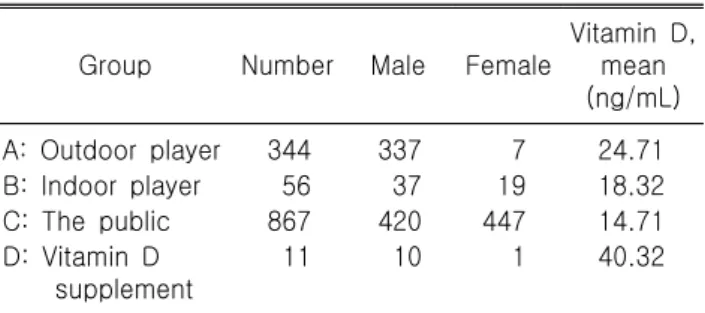
Table 1. Classification of participant
Group Number Male Female
Vitamin D, mean (ng/mL) A: Outdoor player 344 337 7 24.71
B: Indoor player 56 37 19 18.32
C: The public 867 420 447 14.71
D: Vitamin D supplement
11 10 1 40.32
서 론
비타민 D는 칼슘과 인의 항상성 유지, 부갑상선 호르몬 억제 및 뼈 대사, 면역 반응, 단백질 합성 등 중요한 역할을 하는 지용성 비타민으로 알려져 있다. 비타민 D의 생성 및 활성화는 햇빛, 음식, 간, 신장 등이 작용한다 1 . 정오에 30분 가량의 얼굴과 전완부 피부의 햇빛 노출은 하루에 2,000 IU의 비타민 D를 합성한다고 한다 2 .
근육의 기능 및 회복에 대한 비타민 D의 영향에 대한 여러 연구가 보고되고, 비타민 D 부족은 근력 약화와 통증, 부상 및 질병의 빈도 및 기간 , 피로 골절에 유의한 영향을 미치고 최종적으로는 운동수행능력 저하를 초래한다는 여러 연구가 발표되어 왔다 . 또한, 비타민 D의 중요성이 더욱 명백해지고, 비타민 D 결핍의 유병률과 운동 수행능력에 대한 연구들이 많이 진행되고 있다 3-7 .
비타민 D 결핍은 전 세계 인구에 걸쳐 보고되고 있다 8 . 우리나라 역시 비타민 D 수치는 평균 이하이며, 한국 국가 건강 영양 조사(The Korea National Health and Nutrition Examination Survey [KNHANES]) 2008–2013 및 국내 대학의 건강검진 조사에 따르면 80% 이상이 비타민 D가 부족하거나 결핍 수준으로 보고하였고 9 , 실내 운동선수의 경우도 비타민 결핍을 여러 연구에서 보고하고 있다 10,11 . 비타민 D결핍의 위험인자로는 섭취 제한, 실내 활동으로 인한 자외선 노출 부족 , 피부색, 위도, 복장, 자외선 차단제 등이 있으며, 위험군 으로는 나이, 무슬림 여성, 비만 등이 보고되고 있다 1,12 .
그러나 아직 국내의 젊은 운동선수에 대한 비타민 D 상태 및 결핍 관련 인자들에 대한 충분한 연구가 부족한 실정이다.
본 연구의 목적은 비타민 D는 대부분 자외선을 통해 피부에서 합성되는 만큼 운동선수에 있어서 실내/외 종목에 따른 차이 여부를 확인하고, 나이, 성별, 체질량지수(body mass index [BMI]), 계절 변동이 비타민 D 수치에 미치는 영향을 비교해 봄으로써 국내 젊은 운동선수에서의 비타민 D 수치의 현 상태 및 결핍과 관련된 인자에 대해 생각해보고자 한다.
연구 방법
2016년 2월 1일부터 2017년 2월 28일까지 본원 외래 진료를 위해 내원한 국내에서 활동 중인 젊은 elite 운동선수들을 후향 적으로 연구하였고, 진료 등의 이유로 자외선 노출 시간에 대한 변수를 최대한 줄이기 위하여 처음 진료시에 혈액 검사를 시행한 경우로 하였다.
먼저, 전체를 4개의 그룹으로 분류하였다. A와 B그룹은 12–37세의 운동선수로 A 그룹은 실외 운동선수, B그룹은 실내 운동선수로 본 연구의 목적을 위한 그룹이며, C 그룹은 대조군 을 위한 13–35세의 일반인 그룹이며, D 그룹은 비타민 D 제재 를 복용하여 통계에서는 제외된 운동선수 군으로 각각 분류하 였다. 운동선수는 운동 종목, 나이, 성별, 키(cm), 몸무게(kg), BMI (kg/m 2 ), 25-hydroxyvitamin D (25(OH)D, ng/mL), 혈청 칼슘 수치, 채혈 시기를 의료 기록을 통해 조사하였다.
우리는 serum 25(OH)D를 측정한 달을 확인하여 3–5월/6–8 월 /9–11월/12–2월의 3달 간격으로 봄, 여름, 가을, 겨울로 구분 하였다. Elecsys Vitamin D Assay (electrochemiluminescence binding assay for the in vitro determination of total 25- hydroxyvitamin D; Roche Diagnostics, Risch-Rotkreuz, The Switzerland)를 이용하여 환자의 serum 25(OH)D를 측정하였고, 다음과 같이 3군으로 분류하였다. 현재 전 세계적으로 인정되 는 serum 25(OH)D로 측정하는 비타민 D 수치에 대한 합의점은 없으나 , 일반적으로 32 ng/mL 이상은 adequacy, 20–32 ng/mL은 insufficiency, 20 ng/mL 이하는 deficiency로 받아들여진다 7,13 .
통계학적 분석은 SPSS ver. 18.0 (SPSS Inc., Chicago, IL, USA)을 이용하여 분석하였다. 비타민 D 상태에 따른 3군과 운동선수의 특성과의 관계는 analysis of variance (ANOVA) 검사를 이용하였고, 성별에 따른 비타민 D 수치의 차이는 독립 t 검정을 이용하고, 운동 종목(실내 vs. 실외 vs. 일반인)과 비타민 D 상태는 ANOVA검사를 이용하였다. 나이, BMI와 비타민 D 상태는 Pearson 상관계수를 이용한 상관분석을 이용 하였고 , 계절 간 비타민 D 상태 비교는 ANOVA test를 실시하였 으며 , 언급한 여러 변수의 영향을 모두 함께 고려하여 다중회 귀분석을 시행하였다.
결 과
12–37세 사이 400명의 운동선수(A, B그룹)와 비슷한 연령대
Table 3. Players demographics for each group of vitamin D status
Variable
Vitamin D status
p-value*
Deficiency (<20 ng/mL)
Insufficiency (20−32 ng/mL)
Adequacy (>32 ng/mL)
No. of players (%) 126 (31.5) 193 (48.25) 81 (20.25) -
Age (yr) 20.02±5.2 18.07±3.9 17.57±4.1 0.000
Vitamin D (ng/mL) 15.5±3.95 24±2.9 34±3.7 -
Height (cm) 175.94±7.8 175.57±9.1 175.50±8.1 0.925
Weight (kg) 75.92±13.1 75.23±13.4 70.62±11.1 0.021
Body mass index (kg/m
2) 24.41±3.2 24.25±2.8 22.80±2.9 0.001 Values are presented as mean±standard deviation unless otherwise indicated.
*By analysis of variance.
Table 2. Demographic of participant
Characteristics A: outdoor player B: indoor player C: the public
Age (yr) 17.91±3.80 22.71±6.10 23.99±6.83
Vitamin D (ng/mL) 24.71±7.19 18.32±7.29 14.71±5.36
Height (cm) 175.73±7.71 175.35±12.29 166.91±8.27
Weight (kg) 74.64±12.08 73.87±17.67 63.70±13.97
Body mass index (kg/m
2) 24.05±2.83 23.76±3.39 22.73±3.98
Calcium (mg/dL) 8.71±0.40 8.57±0.33 -
Values are presented as mean±standard deviation. Standard values of our laboratory: 25-hydroxyvitamin D, 32–80 μg/L;
Ca, 8.6−10 mg/dL.
Table 4. Comparison between sex/sport type and vitamin D status on players
Variable Number Vitamin D (ng/mL) p-value
Player 0.001*
Male 374 24.16±7.37
Female 26 18.95±8.25
Sport type 0.000
†Outdoor 344 24.71±7.19 Indoor 56 18.32±7.29 The public 867 14.71±5.36
Values are presented as mean±standard deviation.
*By t-test;
†By analysis of variance.
(13–35세)의 일반인 867명(C그룹)이 비교군으로 통계학적 분 석에 포함되었다. 비타민 제제를 복용한 11명(D그룹)은 통계 에서 배제하였다. 운동선수 중 남자선수는 374명, 여자선수는 26명이고, 실외종목 선수는 344명(남자 337명, 여자 7명), 실내 종목 선수는 56명(남자 37명, 여자 19명)이었다. 실외 종목 344명은 야구 306명, 축구 25명, 그 외 럭비 등 13명이었다.
실내 종목 56명은 농구 17명, 태권도 5명, 핸드볼 5명, 배구 4명, 그 외 배드민턴 등 25명이었다. 일반인은 남자 420명, 여자 447명이었다(Table 1).
전체 선수들의 평균나이는 18.58±4.5세(12–37세), 실내종목 선수들의 평균 나이는 22.71±6.1세(12–37세), 실외종목 선수들 의 평균 나이는 17.91±3.8세(12–35세)로 젊은 elite 선수들이었 다. 선수들의 평균 vitamin D 수치는 23.81±7.52 ng/mL (3.52–
46.15 ng/mL)로 insufficiency 상태였으며, 평균 키는 175.67±8.4 cm (150–221 cm), 평균 체중은 74.53±12.97 kg (40–150 kg), 평균 BMI는 24.01±2.91 kg/m 2 (17.3–32.6 kg/m 2 ), 평균 칼슘 수치는 8.69±0.39 mg/dL (7.6–10.2 mg/dL)이였다(Table 2).
126명(31.5%)의 선수가 비타민 D 결핍이 있었고, 193명 (48.25%)의 선수가 비타민 D 부족이 있었고, 81명(20.25%)이 정상 비타민 D 수치였다. 비타민 D 수치가 적은 그룹일수록
나이가 많았고(p=0.000), 몸무게가 많이 나갔으며(p=0.021), BMI가 높았다(p=0.001) (Table 3).
성별에 따른 평균 비타민 D 수치로 남자 선수는 24.16±
7.37 ng/mL, 여자선수는 18.95±8.25 ng/mL로 여자선수에서
유의하게 낮았으며(p=0.001), 실내외 종목에 따른 평균 비타민
D 수치는 실외종목 24.71±7.19 ng/mL, 실내종목 18.32±7.29
ng/mL로 실내종목의 운동선수 군에서 유의하게 낮았다
(p=0.000) (Table 4). 계절에 따른 평균 비타민 D 수치 비교는
Body Mass Index, Seasonal Variations in Korean Young Athletes
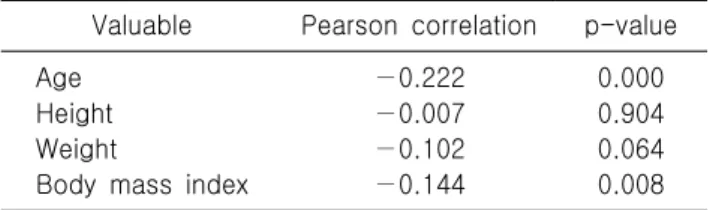
Table 6. Correlations between vitamin D level and each player parameter
Valuable Pearson correlation p-value
Age −0.222 0.000
Height −0.007 0.904
Weight −0.102 0.064
Body mass index −0.144 0.008
Table 5. Seasonal variation of vitamin D on players Season No. of patients Vitamin D (ng/mL) Spring 75 25.17±7.5 (11.4−43.5)
Summer 110 25.18±6.6 (14.2−46.1)
Fall 143 25.06±6.3 (7.76−39.0)
Winter 72 17.85±8.3 (3.52−40.8) Values are presented as mean±standard deviation (range).
Analysis of variance test: p=0.000; post-hoc test: spring, summer, fall vs. winter, p=0.000.
Table 7. Multiple regression analysis between vitamin D level and each player parameter
Valuable Regression Coefficient p-value
Sport type* −4.696 0.000
Season
†−1.880 0.000
Age −0.202 0.028
*Sport type: indoor and outdoor;
†Season: spring, summer, fall, and winter.
봄 25.17±7.5 ng/mL, 여름 25.18±6.6 ng/mL, 가을 25.06±
6.3 ng/mL, 겨울 17.85±8.3 ng/mL로 일조량이 많은 봄, 여름, 가을보다 겨울이 유의하게 낮았다(p=0.000) (Table 5).
선수들의 여러 가지 특성과 비타민 D와 관계를 평가하기 위하여 Pearson 상관계수를 이용하여 상관분석을 시행하였고, 나이(r=–0.222, p=0.000), BMI (r=–0.144, p=0.008)는 약한 음의 관계를 보였고, 키, 몸무게는 관계가 없는 것으로 나타났다 (Table 6). 여러 변수의 영향을 모두 함께 고려하여 시행한 다중회귀분석에서는 실내외 종목 차이와 계절변동, 나이의 회귀계수는 –4.696, –1.880, –0.202이며, 이 셋은 모두 p<0.05로 유의하였다(Table 7). 비타민 D를 복용한 D그룹 11명은 평균 나이는 21.8세, 평균 비타민 D 수치는 40.32 ng/mL (30.74–62.4 ng/mL), 종목은 야구 5명, 보디빌더 3명, 피겨, 쇼트트랙, 축구 1명씩이었다.
고 찰