Short Communication
J Vet Sci 2018, 19(6), 846-849ㆍhttps://doi.org/10.4142/jvs.2018.19.6.846
JVS
Received 11 Apr. 2018, Revised 15 Aug. 2018, Accepted 21 Aug. 2018
*Corresponding author: Tel: +86-13951140263; Fax: +86-523-86663808; E-mail: [email protected]
Journal of Veterinary Scienceㆍⓒ 2018 The Korean Society of Veterinary Science. All Rights Reserved.
This is an Open Access article distributed under the terms of the Creative Commons Attribution Non-Commercial License (http://creativecommons.org/licenses/
by-nc/4.0) which permits unrestricted non-commercial use, distribution, and reproduction in any medium, provided the original work is properly cited.
pISSN 1229-845X
eISSN 1976-555X
Molecular phylogenetic studies on clinical bovine piroplasmosis caused by benign Theileria in Shaanxi Province, China
Jing Wang
1,2,*, Jiyu Zhang
2, Zhen Zhu
2, Xuzheng Zhou
2, Bing Li
2
1
Department of Veterinary Pharmaceutical, Jiangsu Agri-animal Husbandry Vocational College, Taizhou 225300, China
2
Lanzhou Institute of Husbandry and Veterinary Pharmaceutical Science, Chinese Academy of Agricultural Sciences, Key Laboratory for Veterinary Drug Innovation, Ministry of Agriculture, Lanzhou 730050, China
A group of benign Theileria species, which are often referred to as T. orientalis/T. buffeli/T. sergenti group, has low pathogenicity in cattle.
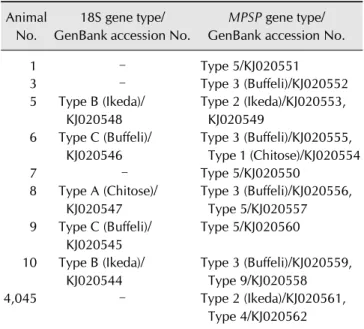
Herein, we report on Theileria spp. in cattle on a farm from China. Based on phylogenetic analysis of the major piroplasm surface protein gene sequences, we detected 6 genotypes that were categorized as Types 1, 2, 3, 4, and 5 as well as an additional Type 9 genotype. The new epidemiological features of the T. orientalis/T. buffeli/T. sergenti parasites in China indicate a greater diversity in the genetics of these species than had been previously thought.
Keywords: MPSP gene, Theileria spp., genotype, phylogeny
A group of benign Theileria species transmitted by Haemaphysalis ticks is often referred to as T. orientalis/T.
buffeli/T. sergenti group. The parasite’s presence is characterized by anemia, jaundice, depression, abortion, mortality, and the presence of Theileria in blood films [4]. Benign Theileria group parasites are widespread among cattle in subtropical and temperate zones [6], and the parasite can eventually lead to severe economic losses in endemic areas. For simplicity, T.
orientalis is used throughout this paper to denote this benign Theileria group. Herein, we report on Theileria spp. in cattle on a farm in the Shaanxi Province, a region in which disease outbreaks have occurred.
The exact taxonomic status of T. orientalis has been debated for many years. The 18S rRNA data have shown that parasites in this group can be divided into at least 8 types, A, B, B1, C, D, E, H, and T. buffeli (Warwick). However, the number of identified types is increasing and there is a lack of consensus on their nomenclature [12,13]. Recently, the gene encoding the major piroplasm surface protein (MPSP) was considered a highly useful marker in revealing the phylogeny of Theileria parasites [3].
The nomenclature for the benign Theileria group has not reached consensus to date. In 1995, Kubota et al. [7] divided the
group into at least four types, Ikeda (I), Chitose (C), Thai, and Buffeli (B), based on the allelic forms of the MPSP gene.
However, Kim et al. [6] proposed a different classification approach based on MPSP, in which there were 6 genotypes, designated Types 1 to 6. Subsequently, 5 additional genotypes, including Types 7, 8, and N1 to N3, were added to the list of previously described genotypes [3,5].
Theileriosis caused by the benign Theileria group is widely reported from countries neighboring China. However, there are few reports on the occurrence of benign Theileria in China. Liu et al. [8] and He et al. [2] have reported that Theileria spp. are present in Hubei Province of China. In addition, surveys have revealed that at least five genotypes of T. orientalis (Types 2, 3, 6, 7, and 8) exist in China [3].
This study investigated the genetic diversity of the benign
Theileria parasites in Huanglong county, which is located in the
northern part of Shaanxi Province, China, by analyzing blood
samples gathered from cattle at a farm where there was an
outbreak of clinical piroplasmosis following a severe tick
infestation (species unknown) in August 2013. Blood samples
were collected from 10 cattle showing appropriate clinical
signs: marked pallor in the oral and genital mucosa, anorexia,
and fever (rectal temperature with high readings ≤ 42
oC). The