• 검색 결과가 없습니다.

Infliximab Treatment for Refractory Kawasaki Disease in Korean Children

N/A
N/A
Protected

Academic year: 2022

Share "Infliximab Treatment for Refractory Kawasaki Disease in Korean Children"

Copied!
5
0
0

로드 중.... (전체 텍스트 보기)

전체 글

(1)

334

Open Access

Infliximab Treatment for Refractory Kawasaki Disease in Korean Children

Min Seob Song, MD

1

, Sang Bum Lee, MD

2

, Sejung Sohn, MD

3

, Jin Hee Oh, MD

4

, Kyung Lim Yoon, MD

5

, Ji Whan Han, MD

6

and Chul Ho Kim, MD

1

1

Department of Pediatrics, Paik Hospital, College of Medicine, Inje University, Busan,

2

Department of Pediatrics, College of Medicine, Kyungpook National University, Daegu,

3

Department of Pediatrics, Mokdong Hospital, College of Medicine, Ewha Womans University, Seoul,

4

Department of Pediatrics, St.Vincent’s Hospital, College of Medicine, The Catholic University of Korea, Suwon,

5

Department of Pediatrics, Eastwest Neo Medical Center, College of Medicine, Kyung Hee University, Seoul,

6

Department of Pediatrics, Uijeongbu St. Mary’s Hospital, College of Medicine, The Catholic University of Korea, Uijeongbu, Korea

ABSTRACT

Background and Objectives: This was a multicenter study to evaluate the usefulness of the tumor necrosis factor-alpha (TNF-α) blocker infliximab for treatment of Korean pediatric patients with refractory Kawasaki disease (KD). Subjects and Methods: Data from 16 patients throughout Korea who were diagnosed with refractory KD and received infliximab were collected retrospectively. Results: Complete response to therapy with cessation of fever occurred in 13 of 16 patients.

C-reactive protein (CRP) concentrations decreased following infliximab infusion in all 14 patients in whom it was measured before and after treatment. There were no infusion reactions or complications associated with infliximab except in 1 case with acute hepatitis occurring during treatment followed by calculous cholecystitis 4 months later. Fifteen patients had coro- nary artery (CA) abnormalities before infliximab therapy. Three had transient mild dilatation and 9 had CA aneurysms, with subsequent normalization in 4 patients, persistent mild dilatation in 3, persistent aneurysm in 2, and there were 3 cases (2 with CA aneurysm, 1 with mild CA dilatation) without follow-up echocardiography. Conclusion: The results of this study suggest that infliximab may be useful in the treatment of refractory KD, and it appears that there is no significant fur- ther progression of CA lesions developing after infliximab treatment. Multicenter trials with larger numbers of patients and long-term follow-up are necessary to assess the clinical efficacy and safety of infliximab in refractory KD. (Korean Circ J 2010;40:334-338)

KEY WORDS: Infliximab; Kawasaki disease.

Received: December 28, 2009 Revision Received: January 19, 2010 Accepted: February 9, 2010

Correspondence: Min Seob Song, MD, Department of Pediatrics, Paik Hospital, College of Medicine, Inje University, 1435 Jwa-dong, Haeun- dae-gu, Busan 612-030, Korea

Tel: 82-51-797-0114, Fax: 82-51-895-7785 E-mail: [email protected]

cc
This is an Open Access article distributed under the terms of the Cre- ative Commons Attribution Non-Commercial License (http://creativecom- mons.org/licenses/by-nc/3.0) which permits unrestricted non-commer- cial use, distribution, and reproduction in any medium, provided the ori- ginal work is properly cited.

Introduction

Coronary artery (CA) lesions, including dilatation and aneurysms, develop in 15% to 25% of children with untreat-

ed Kawasaki disease (KD).

1)2)

Administration of intravenous immunoglobulin (IVIG) is now well accepted as the stand- ard treatment for KD, and reduces the risk of coronary ar- tery aneurysm (CAA) to 3% to 5%.

3)4)

Approximately 10%

to 20% of patients with KD fail to become afebrile after the

first dose of IVIG,

5)6)

and the current practice for these pa-

tients is to administer repeated doses of IVIG. However, of

the patients who still remain febrile after repeated doses of

IVIG, no large randomized controlled clinical trial has es-

tablished their optimal management.

5)

These refractory KD

patients are at a much higher risk for developing CAA. The

KD patients refractory to IVIG were reported to improve

and defervesce after steroid therapy in several series,

7)

but

there are several reports concerning the adverse effects of

steroid treatment. No controlled clinical trials have estab-

(2)

lished their optimal use in managing refractory patients.

Even less data is published on the use of other therapies, which may include 1 or more repeat doses of IVIG, high-dose pulse methylprednisolone (MP), cyclophosphamide, metho- trexate, or plasmapheresis in IVIG-refractory KD.

8)9)

Recent- ly, infliximab (Remicade), a monoclonal antibody that blocks the biological activity of tumor necrosis factor-alpha (TNF- α), was used in a few refractory KD patients and reported to be effective and safe.

8)10)

Subjects and Methods

Refractory KD was defined as the persistence or reappear- ance of fever (≥38.0℃ or 100.4°F) at least 36 hours after the last of more than 2 doses of IVIG therapy and high-dose as- pirin with or without intravenous MP pulse therapy (30 mg/

kg/dose/day). Complete response was defined as the cessa- tion of fever within 12 hours of infliximab infusion therapy.

Sixteen cases were retrospectively collected from clinicians throughout Korea who had used infliximab, a monoclonal antibody against TNF-α, for patients with refractory KD be- tween July 2004 and November 2008.

Sixteen patients with acute KD (13 males, 3 females, medi- an age 2.8 years, range 0.2-5.8 years) received infliximab in- fusion after at least 2 doses of IVIG and daily aspirin (50-100 mg/kg/day) with or without MP pulse therapy for the fol- lowing indications: 1) persistent or recrudescent fever (14 patients) and 2) fever plus persistent arthritis (2 patients) (Table 1).

All 16 patients were Korean. All patients had prolonged fever and met either 4 of the 5 standard criteria for KD or 3 of the 5 criteria in addition to CAA by echocardiography.

9)

Demographic characteristics, therapies administered, C- reactive protein (CRP) concentrations before and after inflix- imab treatment, infliximab dose, response, and coronary ar- tery (CA) outcomes were recorded for all patients. Illness day 1 was defined as the first day of fever.

The internal diameter of the CA measured by transtho- racic echocardiography was defined as aneurysm with the following parameters: 1) if the internal lumen diameter was

>3 mm in children <5 years old or >4 mm in children >5 years old; 2) if the internal diameter of a measured segment was >1.5 times that of an adjacent segment; or 3) if the coro- nary lumen was clearly irregular by the Japanese Ministry of Health criteria classification.

10)11)

CA dilatation was defined as CA size larger than normal for age, but no apparent seg- mental aneurysm. Aneurysms were identified as saccular or fusiform.

Results

Treatment and patient outcomes

All patients received more than 2 doses of IVIG. Three pa- tients received more than 3 doses of IVIG (2 g/kg/dose/day), and 11 patients received more than 2 doses of IVIG and MP pulse therapy (30 mg/kg/dose/day).

All patients failed to become persistently afebrile follow- ing these treatments. Before infliximab therapy, the patients Table 1. Patient characteristics and outcomes

Patient

number Age

(year) Sex 1st IVIG

(day) Illness day

at treatment Response* Other treatment Oral steroid

(Y/N) Comment

01 3.5 M 5 11 Complete IVIG×2, MP×4 N

02 1.3 M 5 08 No IVIG×3 N One more IVIG

03 4.6 F 5 16 Complete IVIG×2, MP×2 N

04 1.1 M 3 10 Complete IVIG×3, MP×3 N

05 5.4 M 5 25 Complete IVIG×4, MP×4 N Arthralgia

06 0.3 M 4 29 Complete IVIG×2, MP×3 Y Hepatitis, Cholecystitis

07 2.4 F 5 16 Complete IVIG×2, MP×3 N

08 2.0 M 5 16 Complete IVIG×2, MP×2 Y

09 0.7 M 4 06 No IVIG×2 Y

10 4.7 M 5 21 Complete IVIG×2, MP×1 N Arthralgia

11 0.2 M 6 16, 40 No IVIG×2, MP×3 Y One more infliximab

12 3.9 M 4 19 Complete IVIG×2, MP×3 Y

13 15.0 M 3 20 Complete IVIG×2, MP×3 N

14 2.4 F 4 21 Complete IVIG×2 N

15 5.8 M 5 21 Complete IVIG×2 N

16 2.8 M 5 10 Complete IVIG×2 N

*Complete response: afebrile within 12 hours of infliximab infusion with complete resolution of clinical signs and symptoms. IVIG: intrave-

nous immunoglobulin, MP: intravenous methylprednisolone, 30 mg/kg/dose

(3)

had been either persistently or intermittently febrile for 6 to 40 days. Each of the 16 patients received a single infusion of 5-6.6 mg/kg of infliximab, with tapering of oral predniso- lone in 5 patients. Complete response occurred in 13 of the 16 patients, including 2 patients who achieved both resolu- tion of fever and accompanying persistent arthritis. There were 3 patients who did not achieve complete response. In patient no. 2, his fever subsided after infliximab infusion, but he was readmitted to another hospital because of recrudes- cent fever which responded to a fourth dose of IVIG. In pa- tient no. 9, the frequency and severity of his fever decreased from 3-4 times per day at higher than 38.5℃, to 1 time per day at around 38℃ for 3 days after infliximab therapy. His fever subsided after 1 additional dose of intravenous MP pulse therapy, followed by tapering of oral prednisolone. In patient no. 11, his fever subsided after infliximab therapy, but it recurred 24 days later, after the cessation of oral predniso- lone therapy.

Two patients (no. 5 and no. 10) with fever and arthritis tr- eated with infliximab, achieved dramatic and permanent resolution of their arthritis within 12 hours of the infusion.

In one, infliximab was administered for persistent mild fever and severe arthritis, and his arthritis resolved dramatically.

Likewise, in the other, high fever and persistent arthralgia resolved dramatically after infliximab treatment.

There were no infusion reactions to infliximab. However, in patient no. 6, acute hepatitis occurred during infliximab treatment; this was followed by calculous cholecystitis 4 mon- ths later, which was managed by supportive care (Table 1).

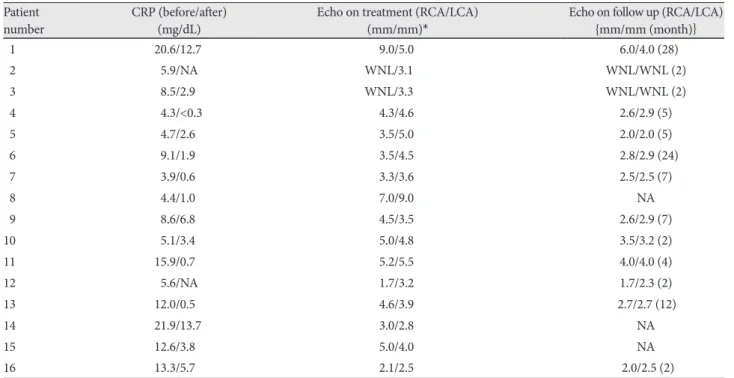
Changes in C-reactive protein concentrations Pretreatment levels were determined within 24 hours be- fore infliximab infusion, and posttreatment levels within 72 hours after infusion. All 16 patients had elevated CRP concen- trations before infliximab infusion, which decreased follow- ing infusion in all 14 patients for whom data was obtainable (Table 2).

Echocardiographic findings of coronary arterys Echocardiographic determinations of the maximum in- ternal diameters of the right and left CAs performed at any time during the disease course are shown in Table 2.

Fifteen patients had CA abnormalities (from mild CA dil- atation to aneurysm) documented by echocardiography be- fore infliximab therapy. Thirteen patients were followed up for 2 to 28 months (median follow-up: 5 months), and 3 cas- es were without follow-up. Three had transient mild CA dil- atation that resolved after infliximab infusion, and 9 had CAA with subsequent normalization in 4 patients, persistent mild dilatation in 3, and persistent aneurysm in 2 on follow- up echocardiography. Of 3 cases without follow-up echocar- diography, 2 had CAA and 1 had mild CA dilatation (Table 2).

Discussion

Although IVIG with aspirin therapy is effective for acute KD, numerous series have documented a 10% to 20% failure rate with persistence of fever and clinical and laboratory signs of inflammation.

5)8)12)

While a second infusion of IVIG (2 g/

Table 2. CRP values and echocardiographic findings of coronary artery Patient

number CRP (before/after)

(mg/dL) Echo on treatment (RCA/LCA)

(mm/mm)* Echo on follow up (RCA/LCA)

{mm/mm (month)}

01 20.6/12.7 9.0/5.0 6.0/4.0 (28)

02 05.9/NA WNL/3.100. WNL/WNL (2)

03 08.5/2.9 WNL/3.300. WNL/WNL (2)

04 04.3/<0.3 4.3/4.6 2.6/2.9 (5)

05 04.7/2.6 3.5/5.0 2.0/2.0 (5)

06 09.1/1.9 3.5/4.5 2.8/2.9 (24)

07 03.9/0.6 3.3/3.6 2.5/2.5 (7)

08 04.4/1.0 7.0/9.0 NA

09 08.6/6.8 4.5/3.5 2.6/2.9 (7)

10 05.1/3.4 5.0/4.8 3.5/3.2 (2)

11 15.9/0.70 5.2/5.5 4.0/4.0 (4)

12 05.6/NA 1.7/3.2 1.7/2.3 (2)

13 12.0/0.5 4.6/3.9 2.7/2.7 (12)

14 21.9/13.7 3.0/2.8 NA

15 12.6/3.80 5.0/4.0 NA

16 13.3/5.70 2.1/2.5 2.0/2.5 (2)

*Month: interval until follow-up echocardiography. CRP: C-reactive protein, LCA: left coronary artery, NA: not available, RCA: right coronary

artery

(4)

kg) is strongly recommended in all children with persistent or recrudescent fever, proposals are lacking on how to treat the small group of refractory KD (3-4%) still remaining feb- rile (up to one-third of IVIG-retreated patients).

12)13)

There are different therapeutic approaches, including either a third dose of IVIG (2 g/kg) or pulse MP, although patients failing to respond to a second infusion of IVIG seem to be refracto- ry to a third dose.

13-15)

Some have identified predictors of IVIG nonresponsiveness.

16)

But others have found no significant differences in characteristics between responders and non- responders.

17)

A study found that very early treatment of KD is likely to result in greater need for additional IVIG com- pared to conventional treatment.

18)

The use of corticosteroids in KD remains controversial.

Reluctance to use corticosteroids for KD dates to Kato’s study in 1979, in the pre-IVIG era.

19)

Others have reported the use of both intravenous MP and oral corticosteroids with good re- sults, predominantly in patients with refractory disease.

20)

Recent reports on the use of corticosteroids as “rescue thera- py” in IVIG-refractory KD have not shown an association be- tween corticosteroids and an increase in CAA.

7)

However, tr- eating refractory KD with corticosteroids should be under- taken with caution. The possible transient adverse effects of corticosteroids include sinus bradycardia, hyperglycaemia, and hypertension.

21)

In addition, even though fever initially resolved faster in patients receiving intravenous MP, there was a tendency for fever to recur later in MP-resistant patients, which delayed therapeutic decision-making, and ultimately the final resolution of fever.

22)

Steroid treatment has also been reported to be a risk for development of CAA and rupture.

4)

Infliximab is indicated for treating immune-modulated inflammatory disorders, including pediatric Crohn’s disease and juvenile idiopathic arthritis.

23)24)

In a recent study of inf- liximab therapy in patients with KD who failed to respond to repeated IVIG infusions, patients demonstrated dramatic improvement with no adverse events.

8)10)

It is thought to be beneficial in KD because TNF-α may be involved in the inflammatory process in acute KD. And recent- ly, Hirono et al.

25)

showed that serum concentrations of in- terleukin-6 and soluble TNF receptor-1 dramatically decreas- ed after infliximab treatment, and correlated with serum CRP concentrations and fevers. Hui-Yuen et al.

26)

have shown that TNF-α is necessary for the development of CA lesions in an animal model of KD.

Burns et al.

8)

reported that complete response to inflix- imab therapy with cessation of fever occurred in 14 of 16 patients. Hirono et al.

25)

reported that complete response to therapy with cessation of fever occurred in 8 of 11 patients. In our study, 13 of 16 patients (about 80%) had complete resp- onse. CRP concentrations were elevated in all patients before infliximab infusion, and following the infusion they were low- er in 14 patients in whom the concentrations were again de-

termined within 48 hours of treatment.

In our series, 2 patients with fever and arthritis treated with infliximab achieved dramatic resolution of their arthri- tis and fever within 12 hours of the infusion. Arthritis or ar- thralgia can occur in patients in the acute or subacute stage of KD. A minority of patients suffer from severe intractable arthritis or arthralgia. As with our cases, in those patients in- fliximab may prove useful.

Based on current reports, the risk of development of CAA is highest in the group of patients who do not respond to a sin- gle dose of IVIG. We saw rapidly progressive CA dilatation on frequent follow-up echocardiography in 4 refractory KD patients during MP pulse therapy. CA dilatation stopped, or the rate of progression at least slowed after infliximab treat- ment. It may be that there is no significant additional progres- sion of CA lesions after infliximab treatment, and that inflix- imab treatment for refractory KD may prevent rapidly pro- gressive CA dilatation. Fortunately, we did not have a fatal case. But there have been several fatal cases due to rapidly pro- gressive CA dilatation with subsequent rupture.

4)

We recommend that for a patient with refractory KD, fre- quent follow-up echocardiography is mandatory, and if a CAA progresses rapidly despite other therapies, including MP, early administration of infliximab should be considered.

Serum concentrations of the proinflammatory cytokine TNF-α are elevated in CA disease and acute KD patients.

26)27)

Therefore, it has been postulated that TNF-α blockade might be effective in the control of inflammation in patients with KD who fail to respond to IVIG. In our study, the cessation of fever and decrease in CRP levels following TNF-α blockade by infliximab treatment suggest that TNF-α is indeed an im- portant mediator of inflammation in this vasculitis. The suc- cess of TNF-α blockade in most patients in this study fur- ther supports the central role of TNF-α in KD pathogenesis.

The pharmacodynamics, pharmocokinetics, and safety of infliximab in children have not yet been fully established.

Similarly, the appropriate dose of infliximab for controlling inflammation in acute KD has not been determined. A dose of 5 mg/kg was used in the majority of patients in this series by extrapolation from data generated in pediatric patients with juvenile idiopathic arthritis and Crohn’s disease.

8)23)24)

Other considerations regarding infliximab therapy for re-

fractory KD include cost and safety. The most common symp-

toms of immediate infusion reactions have been flushing

and shortness of breath.

28)

No infusion reactions were noted

in our series. Complications of infliximab administration

include reactivation of latent tuberculosis, histoplasmosis,

increased risk of bacterial sepsis and lymphoma, develop-

ment of antinuclear antibodies, and heart failure.

8)29)30)

There

was only one mild complication in our series; acute hepatitis

occurred during treatment and calculous cholecystitis occur-

red 4 months later, which subsided with supportive care.

(5)

Concentrations of antibody to infliximab were not meas- ured in our study. Antibody formation should not be a prob- lem in KD, because usually only 1 dose of infliximab is need- ed. Because infliximab is administered only once for most patients with refractory KD, its administration may cause fewer complications in KD patients than in patients with Cro- hn’s disease or juvenile idiopathic arthritis, where it is ad- ministered repeatedly.

Even though infliximab is efficacious but not without pos- sible complications, we recommend it as second-line therapy for KD cases that are refractory to conventional therapy, un- til the results of long-term studies are available. However, we cautiously propose that early administration of infliximab rather than a second IVIG treatment should be considered for patients with rapidly progressive CA dilatation.

The limitations of this study include its retrospective na- ture, small number of patients, and the use of multiple dif- ferent therapies following the first IVIG treatment failure. In addition, we did not determine proinflammatory cytokine concentrations before and after infliximab treatment. Differ- ent IVIG preparations were used at each center. Concomitant anti-inflammatory therapies administered to several of these patients made it difficult to assess the effects of infliximab.

In conclusion, our study suggests that infliximab can be useful not only in the treatment of refractory KD but also in the prevention of progression of CA lesions. There were no infusion reactions and complications attributed to inflix- imab administration in 15 of 16 patients. Multicenter trials with a larger number of patients and long-term follow-up are necessary to assess the clinical efficacy and safety of inf- liximab for refractory KD.

REFERENCES

1) Kawasaki T, Kosaki F, Okawa S, Shigematsu I, Yanagawa H. A new infantile acute febrile mucocutaneous lymph node syndrome (MLNS) prevailing in Japan. Pediatrics 1974;54:271-6.

2) Kato H, Sugimura T, Akagi T, et al. Long-term consequences of Ka- wasaki disease: a 10- to 21-year follow-up study of 594 patients. Circula- tion 1996;94:1379-85.

3) Newburger JW, Takahashi M, Burns JC, et al. The treatment of Kawa- saki syndrome with intravenous gamma globulin. N Engl J Med 1986;

315:341-7.

4) Newburger JW, Takahashi M, Beiser AS, et al. A single intravenous infusion of gamma globulin as compared with four infusions in the tre- atment of acute Kawasaki syndrome. N Engl J Med 1991;324:1633-9.

5) Burns JC, Capparelli EV, Brown JA, Newburger JW, Glode MP. In- travenous gamma-globulin treatment and retreatment in Kawasaki disease. Pediatr Infect Dis J 1998;17:1144-8.

6) Durongpisitkul K, Soongswang J, Laohaprasitiporn D, Nana A, Pra- chuabmoh C, Kangkagate C. Immunoglobulin failure and retreat- ment in Kawasaki disease. Pediatr Cardiol 2003;24:145-8.

7) Lang BA, Yeung RS, Oen KG, et al. Corticosteroid treatment of re- fractory Kawasaki disease. J Rheumatol 2006;33:803-9.

8) Burns JC, Mason WH, Hauger SB, et al. Infliximab treatment for re- fractory Kawasaki syndrome. J Pediatr 2005;146:662-7.

9) Newburger JW, Takahashi M, Gerber MA, et al. Diagnosis, treat- ment, and long-term management of Kawasaki disease: a statement for health professionals from the Committee on Rheumatic Fever, Endo- carditis and Kawasaki Disease, Council on Cardiovascular Disease in the Young, American Heart Association. Circulation 2004;110:2747-71.

10) Weiss JE, Eberhard A, Chowdhury D, Gottlieb BS. Infliximab as a novel therapy for refractory Kawasaki disease. J Rheumatol 2004;31:

808-10.

11) Research Committee on Kawasaki Disease. Report of subcommittee on standardization of diagnostic criteria and reporting of coronary artery lesions in Kawasaki disease. Tokyo, Japan: Ministry of Health and Welfare; 1984.

12) Sundel RP, Burns JC, Baker A, Beiser AS, Newburger JW. Gamma globulin re-treatment in Kawasaki disease. J Pediatr 1993;123:657-9.

13) Burns JC, Glode MP. Kawasaki syndrome. Lancet 2004;364:533-44.

14) Freeman AF, Shulman ST. Refractory Kawasaki disease. Pediatr In- fect Dis J 2004;23:463-4.

15) Nachiappan J, May M, Hawker RE, Hong P. Resistant Kawasaki dis- ease. J Paediatr Child Health 2004;40:576-8.

16) Kobayashi T, Inoue Y, Takeuchi K, et al. Prediction of intravenous immunoglobulin unresponsiveness in patients with Kawasaki dis- ease. Circulation 2006;113:2606-12.

17) Fukunishi M, Kikkawa M, Hamana K, et al. Prediction of non-re- sponsiveness to intravenous high-dose gamma-globulin therapy in patients with Kawasaki disease at onset. J Pediatr 2000;137:172-6.

18) Muta H, Ishii M, Egami K, et al. Early intravenous gamma-globulin treatment for Kawasaki disease: the nationwide surveys in Japan. J Pe- diatr 2004;144:496-9.

19) Kato H, Koike S, Yokoyama T. Kawasaki disease: effect of treatment on coronary artery involvement. Pediatrics 1979;63:175-9.

20) Wright DA, Newburger JW, Baker A, Sumdel RP. Treatment of im- mune-globulin resistant Kawasaki disease with pulsed doses of corti- costeroids. J Pediatr 1996;128:146-9.

21) Miura M, Ohki H, Yoshiba S, et al. Adverse effects of methylprednis- olone pulse therapy in refractory Kawasaki disease. Arch Dis Child 2005;90:1096-7.

22) Furukawa T, Kishiro M, Akimoto K, Nagata S, Shimizu T, Yamashi- ro Y. Effects of steroid pulse therapy on immunoglobulin-resistant Ka- wasaki disease. Arch Dis Child 2008;93:142-6.

23) Lahdenne P, Vahasalo P, Honkanen V. Infliximab or etanercept in the treatment of children with refractory juvenile idiopathic arthritis: an open label study. Ann Rheum Dis 2003;62:245-7.

24) Baldassano R, Braegger CP, Escher JC, et al. Infliximab (REMI- CADE) therapy in the treatment of pediatric Crohn’s disease. Am J Ga- stroenterol 2003;98:833-8.

25) Hirono K, Kemmotsu Y, Wittkowski H, et al. Infliximab reduces the cytokine-mediated inflammation but does not suppress cellular infil- tration of the vessel wall in refractory Kawasaki disease. Pediatr Res 2009;65:696-701.

26) Hui-Yuen JS, Duong TT, Yeung RS. TNF-alpha is necessary for in- duction of coronary artery inflammation and aneurysm formation in an animal model of Kawasaki disease. J Immunol 2006;176:6294-301.

27) Shin JU, Cho HK, Shin MS. Elevated tumor necrosis factor-alpha in stable angina pectoris. Korean Circ J 2000;30:861-6.

28) Crandall WV, Mackner LM. Infusion reactions to infliximab in chil- dren and adolescents: frequency, outcome and a predictive model.

Aliment Pharmacol Ther 2003;17:75-84.

29) Keane J, Gershon S, Wise RP, et al. Tuberculosis associated with inf- liximab, a tumor necrosis factor alpha-neutralizing agent. N Engl J Med 2001;345:1098-104.

30) Mackey AC, Green L, Liang LC, Dinndorf P, Avigan M. Hepato-

splenic T cell lymphoma associated with infliximab use in young pa-

tients treated for inflammatory bowel disease. J Pediatr Gastroenterol

Nutr 2007;44:265-7.

수치

Table 2. CRP values and echocardiographic findings of coronary artery  Patient

참조

관련 문서

Severe disease activity and cy- tomegalovirus colitis are predictive of a nonresponse to infliximab in patients with ulcerative colitis. Guidelines for the management of

The station names have been rewritten with newly introduced Romanization Reference for Korean Place Names and Cultural Terms from January 2001.. As the observation elements

The station names have been rewritten with newly introduced Romanization Reference for Korean Place Names and Cultural Terms from January 2001.. As the observation elements

Stavins, Benefit-Cost Analysis in Environmental, Health, and Safety Regulation, American Enterprise Institute, The Annapolis Center, and Resources for the

– A fixed lump-sum price based on the quantities provided by the owner for the major components of the project. – Most infrastructure projects and

Where FPSO substructure costs have been estimated, these have been based on the lightship weight determined and using the same cost basis as the FSO hull. Costs for swivel,

In this study, the usage of most common cement for the ground material was highly reduced, and developed a solidifying agent for organic and inorganic

In conclusion, the result that the walk-using safety educational activities designed for young children had effects on their safety problem solving ability