• 검색 결과가 없습니다.

A Case of Concurrent Acute Viral Myocarditis andIntussusceptions in a 3-Year-Old Child

N/A
N/A
Protected

Academic year: 2022

Share "A Case of Concurrent Acute Viral Myocarditis andIntussusceptions in a 3-Year-Old Child"

Copied!
5
0
0

로드 중.... (전체 텍스트 보기)

전체 글

(1)

Introduction

Varicella-zoster virus (VZV) is a herpesvirus that caus- es two clinically distinct forms of disease, varicella (chickenpox) and herpes zoster (shingles). Primary VZV infection results in characteristic diffuse vesicu-

lar rash of chickenpox. Although vaccination substan- tially attenuates disease manifestations, significant complications such as secondary soft tissue infection, encephalitis, and pneumonia can occur. The specific types of complications among patients with chicken- pox also tend to vary by age. However, the most fre- quent chickenpox-related complications in children

A Case of Concurrent Acute Viral Myocarditis and Intussusceptions in a 3-Year-Old Child

Young-In Maeng

1

, Yu-Hoon Kim

2

,

Han-Young Lee

3

, Jun-Mo Kim

4

1

Department of Pathology, Catholic University of Daegu School of Medicine, Daegu, Korea,

2
Medical Examiner’s Office, National Forensic Service, Wonju, Korea,

3

Department of Forensic Investigation, Seoul Institute, National Forensic Service, Seoul, Korea,

4

Division of Forensic Medicine, Daegu Institute, National Forensic Service, Daegu, Korea

Received: July 8, 2015 Revised: August 7, 2015 Accepted: August 24, 2015 C

Co orrrre es sp po on nd de en nc ce e tto o Jun-Mo Kim

Division of Forensic Medicine, Daegu Institute, National Forensic Service, 33- 14 Hoguk-ro, Waegwan-eup, Chilgok 39872, Korea

Tel: +82-54-970-0530 Fax: +82-54-970-0529 E-mail: [email protected]

Chickenpox is an acute disease caused by the varicella-zoster virus (VZV), a her- pesvirus that causes human infection worldwide. Primary VZV infection routinely occurs during childhood and is usually a self-limiting illness in immunocompetent chil- dren. However, chickenpox can be a severe disease in adolescents, adults, and immunosuppressed or immunocompromised patients. Although vaccination substan- tially attenuates disease manifestations, significant complications such as secondary soft tissue infection, encephalitis, and pneumonia can occur. We present a rare autop- sy case of concurrent acute myocarditis and intussusceptions in a 3-year-old female child who presented with chickenpox followed by abdominal pain and sudden death.

The present case emphasizes the potential for fatal complications of viral infections, which should be considered in cases of sudden unexpected infectious death in chil- dren.

Key Words: Chickenpox; Intussusception; Myocarditis; Sudden death; Viral disease

(2)

include secondary bacterial infections and pneumo- nia.

Intussusception is the most common cause of intestinal obstruction in young children, and the majority of cases occur in those less than 24 months of age [1,2]. The exact pathogenesis and underlying caus- es of intussusception in children remain unknown, except for several pathogens, including adenovirus. A previous study suggested an association between viral infection and development of intussusceptions in young children [3]. In addition, myocarditis and conse- quent damage due to inflammation of the heart may result in myocardial dysfunction and heart failure.

Myocarditis causes are diverse, including infection, toxin, and autoimmunity. The most common cause of the infectious etiology is viral infection. We report an autopsy case of a 3-year-old female child with sudden unexpected death who presented with intussuscep- tions and acute myocarditis.

Case Report

The 3-year-old female child weighed 14 kg and mea- sured 91 cm. She was not diagnosed with serious dis- ease, malnutrition, or anatomical malformations before her death. Five days before her death, she pre- sented with mild fever, itching sensation, and charac-

teristic diffuse vesicle formations on her arms, legs, and face. She visited the pediatric clinic, was diag- nosed with chickenpox, and was prescribed anti-viral drugs and antihistamines. Three days later, the derma- tologic manifestation had subsided, but her fever per- sisted; a cough also developed. A physical exam revealed no pathologic signs in her respiratory tract.

The next day, she presented with newly developed symptoms of abdominal pain and dehydration due to vomiting. Although the dehydration was corrected with intravenous administration of fluids, her abdomi- nal pain remained intermittent. Twenty-four hours later, she unexpectedly collapsed at her home and was dead on arriving at the hospital.

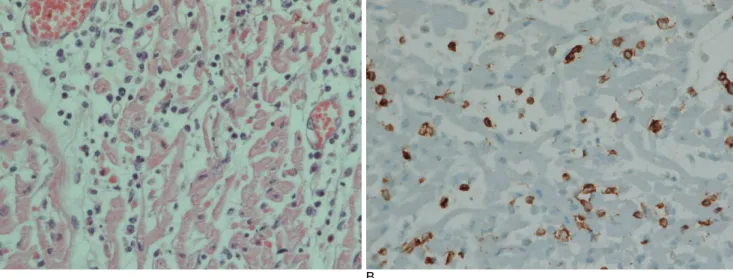
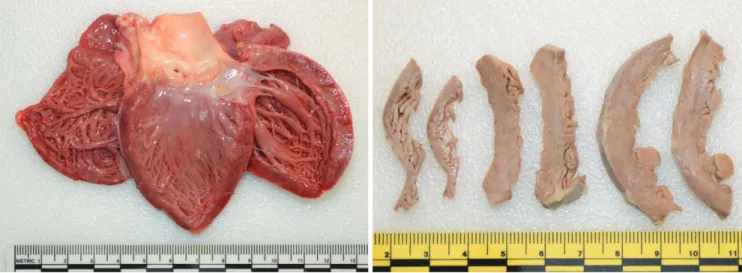
At autopsy, external examination revealed no struc- tural abnormalities, anatomical malformation, or phys- ical damage. Internal examination revealed multiple areas of gray-whitish lesions in serial sections of the myocardium (Fig. 1). Microscopic findings of the myocardium showed inflammatory infiltration with interstitial edema, degeneration of adjacent cardiomy- ocytes, and focal necrosis. Most of the infiltrates were mononuclear lymphocytes, but occasional neutrophils were also observed (Fig. 2A). Immunohistochemical staining showed most of the mononuclear lympho- cytes to be CD3-positive T lymphocytes (Fig. 2B, C).

Areas of intussusception were found at three distinct

A B

Fig. 1. Gross autopsy findings of the heart (A) with multiple areas of gray-whitish lesions on the cut surface after formalin fixation (B).

(3)

A B

Fig. 3. Gross autopsy findings of three areas of intestinal intussusceptions in the small intestine without visible peritonitis (A), and one of the opened intussusceptions (lesions are indicated by arrows) (B).

A B

C

Fig. 2. (A) Microscopic findings of inflammatory infiltration of the myocardium. The infiltrates are mostly lymphocytes (H&E, ×400).

Immunohistochemical staining of inflammatory cells with CD3 (B)

and CD20 (C) (×400).

(4)

sites about 123 cm, 150 cm, and 195 cm from the pyloric sphincter (Fig. 3). The intussusceptions mea- sured 1 cm, 2.5 cm, and 1.5 cm. Gross autopsy and microscopic examination revealed no evidence of peri- tonitis. No poisonous agent, drug, or chemical was detected in the blood and gastric contents. Bacterial culture of post-mortem blood was negative.

Discussion

Our patient’s illness began five days before her death as typical chickenpox with symptoms of fever and myalgia that developed into abdominal pain, vomiting, and sudden death. The intussusceptions could have been a constellation of the death process. Proof of death due to intussusceptions requires (1) confirma- tion of vomitus in the airway and (2) compatible events and symptoms prior to death [4]. However, on autopsy, her airway was clear of vomitus and the patient only had a history of dehydration. Therefore, additional investigation was required for better assess- ment of the cause of death other than the observed intussusceptions.

The other possibility was acute myocarditis. The clinical presentation of myocarditis is usually variable.

Affected patients typically present with a broad spec- trum of signs and symptoms ranging from subclinical to cardiogenic shock, arrhythmia, and even sudden death. Patients may have prodromal symptoms of fever, myalgia, and malaise prior to onset of heart dys- function. However, nonspecific signs and symptoms such as respiratory distress, anorexia, abdominal pain, and vomiting may be the most prominent presenting features, and might lead to an incorrect initial diagno- sis in many children [5-7]. In this context of potential- ly affected patients presenting with serious complica- tions such as cardiogenic shock and sudden death, it is possible that acute myocarditis caused death in this case, based on the clinical history of prodromal symp- toms as well as the histologic findings.

Our unique autopsy case demonstrates synchronous intestinal intussusceptions and acute myocarditis in a

female child after chickenpox. Intussusceptions are the most common cause of intestinal obstruction in young children; the majority occur in children less than 24 months of age [1,2]. The exact pathogenesis and underlying causes of intussusception in children remain unknown, except for several known viral infections, including enteric adenoviruses. Previous studies suggest a strong association between viral infection and development of intussusceptions in young children [3]. However, myocarditis results from inflammation of the heart muscle; the consequent damage results in myocardial dysfunction and may ultimately lead to heart failure. Its causes are diverse, including infection, toxin, and autoimmunity. The most common cause of the infectious etiology is viral infection, including Coxsackie B virus, adenovirus, parvovirus B19, Epstein-Barr virus, cytomegalovirus, and human herpes virus. In accordance with the results of previous studies, Morentin et al. [8] reported that the main cause of sudden unexpected death from infectious disease was myocarditis (35.7%) followed by bronchopneumonia (32.1%). Therefore, the concur- rent viral etiology of intussusceptions and myocarditis in this child might explain the presence of two distinct diseases in autopsy.

The present case emphasizes the possibility of fatal complications, which should be considered especially in cases of sudden unexpected infectious death of a child. Although our case is limited by the absence of serological or virological data, chickenpox is usually a clinical diagnosis. No further diagnostic testing is nec- essary in cases with typical clinical presentation. In addition, virus serology tests are not recommended for diagnosis of myocardial infection in patients with sus- pected myocarditis. Microbiological confirmation is sought only in cases with atypical features.

Furthermore, development of skin lesions typical of chickenpox makes an alternative diagnosis highly unlikely.

In conclusion, we present a case of a 3-year-old

female child with intussusceptions and acute

myocarditis possibly precipitated by chickenpox.

(5)

Although sudden unexpected death in children and young people has been scarcely studied, a significant proportion (16%) of all sudden deaths and a consider- able percentage (5%) of mortality from infectious dis- eases affect children and young people [8].

Traditionally, microbiological post-mortem investiga- tion has been underestimated. Most recently, however, genomics and proteomics have been proposed for investigation of the potential role of bacterial toxins in some cases of sudden death [9]. The only limitation of the present case is that, due to the routine autopsy process and protocol, microbiological analyses could not be performed except for microbiological culture.

Therefore, this article emphasizes the need for a spe- cific forensic procedure if there is suspicion of sudden unexpected death from infectious disease, including detailed rules on sample collection and autopsy proto- cols including polymerase chain reaction amplification and genetic sequencing, particularly in the context of negative microbiological cultures [8,10].

Conflicts of Interest

No potential conflict of interest relevant to this article was reported.

References

1. Okimoto S, Hyodo S, Yamamoto M, et al. Association of viral isolates from stool samples with intussusception in children. Int J Infect Dis 2011;15:e641-5.

2. Fischer TK, Bihrmann K, Perch M, et al. Intussusception in early childhood: a cohort study of 1.7 million children.

Pediatrics 2004;114:782-5.

3. Murphy TV, Gargiullo PM, Massoudi MS, et al. Intussus- ception among infants given an oral rotavirus vaccine. N Engl J Med 2001;344:564-72.

4. Iwase H, Motani H, Yajima D, et al. Two infant deaths linked to intussusception without peritonitis. Leg Med (Tokyo) 2010;12:151-3.

5. Canter CE, Simpson KP. Diagnosis and treatment of my- ocarditis in children in the current era. Circulation 2014;129:115-28.

6. Freedman SB, Haladyn JK, Floh A, et al. Pediatric my- ocarditis: emergency department clinical findings and di- agnostic evaluation. Pediatrics 2007;120:1278-85.

7. Durani Y, Egan M, Baffa J, et al. Pediatric myocarditis: p- resenting clinical characteristics. Am J Emerg Med 2009;27:942-7.

8. Morentin B, Suarez-Mier MP, Aguilera B, et al. Clinico- pathological features of sudden unexpected infectious death: population-based study in children and young adults. Forensic Sci Int 2012;220:80-4.

9. Morris JA, Harrison LM, Lauder RM. Sudden death from infectious disease. Forensic Pathol Rev 2011;6:121-44.

10. Morentin B, Fernandez-Rodriguez A. Sudden death by bac-

terial meningitis and septic shock: contribution of the post-

mortem diagnosis. Enferm Infecc Microbiol Clin

2006;24:471-2.

수치

Fig. 1. Gross autopsy findings of the heart (A) with multiple areas of gray-whitish lesions on the cut surface after formalin fixation (B).
Fig. 3. Gross autopsy findings of three areas of intestinal intussusceptions in the small intestine without visible peritonitis (A), and one of the opened intussusceptions (lesions are indicated by arrows) (B).

참조

관련 문서

The present researcher conducted a self-esteem test on 30 second-year students in J Girls' Commercial High School in Cheju City, and selected 20 of them

In other words the mother's scholarship who have a lot of conversation time with child in home also influences the father's open communication type and

Second, in the case of cash benefits, the government maintains subsidies for the disabled who have completely lost their working capacity and child care

Oulis CJ, Tsinidou K, Vadiakas G, Mamai-Homata E, Polychronopoulou A, Athanasouli T : Caries prevalence of 5, 12 and 15-year-old Greek children: A

This study aims to lower turnover of child-care teachers' who are the most important in the site of child-care, and improves child-care teachers' working environment

(in case of partially miscible and form a low-boiling azeotrope).

This book contains hundreds of complete, working examples illustrating many common Java programming tasks using the core, enterprise, and foun- dation classes APIs.. Java Examples

The purpose of the present study was to elucidate the effect of photography and reporting activities conducted at a day care center on 5-year-old