Introduction
Acute epiglottitis and epiglottic abscess are forms of acute inflammation of the epiglottis and adjacent structures. They are potentially life-threatening condi- tions and likely to be underdiagnosed or misdiagnosed in adults. Traditionally, acute epiglottitis is regarded as a disease of children; however, its prevalence among children has decreased owing to vaccination. In con- trast, the prevalence of adult epiglottitis has increased steadily. Moreover, epiglottic abscess formation is not an uncommon complication of adult epiglottitis.
Epiglottic abscess is reported to be a predictor of air- way obstruction and immediate airway intervention is needed in this clinical situation [1]. Herein, we de-
scribe the autopsy findings of two cases of sudden death from acute epiglottitis complicated by epiglottic abscess in adults, identified during postmortem exami- nation.
Case Reports
1. Case 1
According to the police report, a 39-year-old man who was being treated in a psychiatric hospital for schizo- phrenia presented with sore throat and dyspnea. His vital signs were blood pressure of 140/90 mm Hg, pulse rate of 98 per minute, respiration rate of 18 breaths per minute, and body temperature of 37.5� C.
After being administered a non-steroidal anti-inflam- matory drug injection, the patient suddenly developed
49
pISSN 2383-5702 eISSN 2383-5710
ⓒCopyright 2015 by the Korean Society for Legal Medicine
This is an Open Access article distributed under the terms of the Creative Commons Attribution Non-Commercial License (http://creativecommons.org/licenses/
by-nc/3.0) which permits unrestricted non-commercial use, distribution, and reproduction in any medium, provided the original work is properly cited.
Korean J Leg Med 2015;39:49-52
http://dx.doi.org/10.7580/kjlm.2015.39.2.49
Sudden Death from Acute Epiglottitis and Epiglottic Abscess in Adult
Sang Jae Noh, Ho Lee
Department of Forensic Medicine, Chonbuk National University Medical School, Jeonju, Korea
Received: April 15, 2015 Revised: May 1, 2015 Accepted: May 8, 2015
Correspondence to Ho Lee
Department of Forensic Medicine, Chonbuk National University Medical School, 567 Baekje-daero, Deokjin- gu, Jeonju 561-756, Korea
Tel: +82-63-270-3064 Fax: +82-63-270-4598 E-mail: [email protected]
Acute epiglottitis is an inflammation of the epiglottis and adjacent structures. Although the incidence is extremely rare, acute epiglottitis is a life-threatening medical emer- gency and can cause sudden respiratory obstruction. Herein, we describe two cases of sudden death from epiglottitis and epiglottic abscess. A 39-year-old man and 66- year-old man died after suffering from shortness of breath. Autopsies revealed diffuse swelling and abscess formation in the epiglottis and neighboring structures. These cases emphasize the medicolegal importance of sudden death from acute epiglottitis and epiglottic abscess in adults.
Key Words: Epiglottitis; Abscess; Airway obstruction; Sudden death; Adult Case Report
respiratory failure. Cardiopulmonary resuscitation (CPR) was performed by the medical staff, but the pa- tient died an hour after the first complaints of his symptoms. Previous medical records indicated that the patient had no medical health problems except schizophrenia. Autopsy findings indicated that his height was 181 cm and body weight was 87 kg.
External examination indicated the presence of CPR- related bruises on the chest and froth in the mouth.
Internal examination revealed that the right and left lungs weighed 1,123 g and 928 g, respectively, with edema and petechiae on the surface; the trachea and both bronchi were filled with white froth; the heart weighed 470 g and showed petechiae and stenosis of the right coronary artery; the epiglottis was erythema- tous and swollen with cystic changes on the lingual surface (Fig. 1A).
2. Case 2
According to the police report, a 66-year-old man visit- ed an outside emergency room for dyspnea one hour prior to his death. Two days prior, he had received medicine for sore throat at another clinic but his symptoms did not improve. Physical examination re- vealed redness of the throat only; however, laryngo-
scopic examination failed to provide an adequate view of the laryngeal structures. For diagnosis and proper management, the patient was transferred to a larger hospital. During transfer, his symptoms worsened and he developed respiratory arrest. Resuscitation was per- formed but he failed to recover and died. His family reported that he had taken medication for hyperten- sion. Autopsy findings indicated he was 178 cm tall with ordinary body type. Internal examination re- vealed that the right and left lungs weighed 1,245 g and 1,050 g, respectively, with edema and petechiae on the pleural surface. The heart showed petechiae and mild coronary artery stenosis. The epiglottis was severely edematous and erythematous and there was a focal yellowish color change along the right aryepiglottic fold (Fig. 1B). Both tonsils were normal.
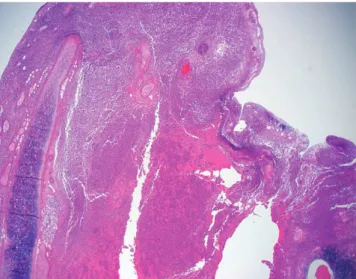
In both the cases, microscopic examination of the epiglottis revealed numerous acute inflammatory cells and necrotic debris in the mucosal and submucosal connective tissues (Fig. 2). These findings were consis- tent with epiglottitis and epiglottic abscess. There was no evidence of alternative lethal diseases or injuries to be the cause of death and no toxic agents or alcohol was detected.
http://www.kjlm.or.kr http://dx.doi.org/10.7580/kjlm.2015.39.2.49
50
Korean Journal of Legal Medicine│2015;39:49-52A B
Fig. 1.(A) Case 1: diffuse swelling of epiglottis with redness and cystic dilation on the right lingual surface (arrowhead). (B) Case 2: diffuse swelling of epiglottis with the formation of visible, yellowish abscess along the right aryepiglottic fold (arrow).
Discussion
Acute epiglottitis is a lethal condition and usually oc- curs in children. Since the widespread use of Haemophilus influenzae type B vaccination, there has been a reduction in the incidence of acute epiglottitis in the pediatric population. However, the incidence of adult epiglottitis has not decreased and acute epiglotti- tis has mostly become a disease of adults [2]. The an- nual incidence of adult epiglottitis per 100,000 resi- dents has ranged between 0.88 and 3.10 and is in- creasing. The individuals affected tend to be predomi- nantly men [1,3].
The major cause of epiglottitis is a primary infection due to Haemophilus influenzae type B or Streptococcus spp. in all age groups. Streptococcus pneumoniae is the major cause of adult epiglottitis [2]. In most cases, there is a low probability of identifying the causative pathogen by blood or respiratory tract cultures.
Noninfectious causes include trauma, inhalation burn, and the inhalation of drugs and chemical agents.
Epiglottic abscess complicate 24% of the cases of adult epiglottitis and occur more frequently in adults than in children. The prevalence of abscess is two-fold higher among those who need airway intervention [1].
The progression and manifestation of symptoms of
acute epiglottitis in adults is slower than that in chil- dren because the adult respiratory tract has a wider diameter [4,5]. The slow-progressing nature of adult epiglottitis contributes to the frequent formation of ab- scess in adults due to prolonged inflammation and co- alescence. Epiglottic abscess may result from a coales- cent epiglottic infection or secondary infection of an epiglottic retention cyst. Epiglottic abscess may also occur after radiotherapy for laryngeal cancer [4].
Anatomically, the lingual surface of the epiglottis is commonly involved [1]. In the present study, the pa- tient in case 1 had a cystic dilation of the lingual sur- face of the epiglottis and there was a visible yellow- colored abscess along the aryepiglottic fold in case 2.
In many cases of adult epiglottitis, the patients have comorbid diseases such as diabetes, hypertension, al- coholism, hepatitis, and malignancy [1,6,7]. The pa- tient in case 2 received medication for hypertension for a long time. Occasionally, death from epiglottic ab- scess occurs in patients with psychotic disorders such as schizophrenia [8]. Communication difficulties limit detection of the disease at an early stage. Furthermore, caustic and thermal epiglottitis due to ingestion of for- eign materials is more likely to occur in patients with mental disorders [9,10]. In case 1, the patient was hos- pitalized for schizophrenia and complained of a sore throat and dyspnea. Airway obstruction progressed quickly and he died an hour after the first complaints of his symptoms.
These cases emphasize the medicolegal importance of sudden death from acute epiglottitis and epiglottic abscess in adults for clinicians and forensic patholo- gists. In the two cases reported herein, patients died during hospitalization or transfer to the hospital, and medico-legal autopsies were requested to assess the possibility of medical negligence and to determine the cause of death. Sudden death from acute epiglottitis or epiglottic abscess is uncommon in adults and laryn- geal examination can be overlooked. We recommend considering a diagnosis of epiglottitis and a careful ex- amination by clinicians and forensic pathologists.
Furthermore, it is important to remember that epiglot-
http://dx.doi.org/10.7580/kjlm.2015.39.2.49 http://www.kjlm.or.kr
Acute Epiglottitis and Epiglottic in Adult│Sang Jae Noh, et al.
51
Fig. 2. Microscopic finding of epiglottitis and epiglottic abscess, with dense infiltration of neutrophils and necrotic material in mucosal and submucosal tissues (H&E, ×20).
tic abscess can develop frequently in patients with adult epiglottis, particularly among those with comor- bidities, such as diabetes, hypertension, and mental disorders.
Conflicts of Interest
No potential conflict of interest relevant to this article was reported.
References
1. Berger G, Landau T, Berger S, et al. The rising incidence of adult acute epiglottitis and epiglottic abscess. Am J Otolaryngol 2003;24:374-83.
2. Isakson M, Hugosson S. Acute epiglottitis: epidemiology and Streptococcus pneumoniae serotype distribution in adults. J Laryngol Otol 2011;125:390-3.
3. Guldfred LA, Lyhne D, Becker BC. Acute epiglottitis: epi-
demiology, clinical presentation, management and out- come. J Laryngol Otol 2008;122:818-23.
4. Harvey M, Quagliotto G, Milne N. Fatal epiglottic abscess after radiotherapy for laryngeal carcinoma. Am J Forensic Med Pathol 2012;33:297-9.
5. Stack BC Jr, Ridley MB. Epiglottic abscess. Head Neck 1995;17:263-5.
6. Hindy J, Novoa R, Slovik Y, et al. Epiglottic abscess as a complication of acute epiglottitis. Am J Otolaryngol 2013;34:362-5.
7. Shah RK, Stocks C. Epiglottitis in the United States: na- tional trends, variances, prognosis, and management.
Laryngoscope 2010;120:1256-62.
8. Yang KM, Jung NE, Kim JK, et al. Sudden death due to epiglottic abscess. Korean J Leg Med 2007;31:89-91.
9. Kahn MW, Miovic M, Perez-Cahill D. Epiglottitis in a psy- chotic, non-English-speaking adult. Psychiatr Serv 2000;51:254.
10. Kornak JM, Freije JE, Campbell BH. Caustic and thermal epiglottitis in the adult. Otolaryngol Head Neck Surg 1996;114:310-2.
http://www.kjlm.or.kr http://dx.doi.org/10.7580/kjlm.2015.39.2.49