Environmental Science
Vol. 33, No. 4, pp. 348-354, November, 2017 https://doi.org/10.7747/JFES.2017.33.4.348
Effects of Windbreak Planting on Crop Productivity for Agroforestry Practices in a Semi-Arid Region
Hyun-Kil Jo1 and Hye-Mi Park2,*
1Department of Ecological Landscape Architecture Design, Kangwon National University, Chuncheon 24341, Republic of Korea
2Department of Landscape Architecture, Graduate School, Kangwon National University, Chuncheon 24341, Republic of Korea
Abstract
Agroforestry has been practiced in arid and semi-arid regions for the purposes of preventing desertification and to increase income for locals. However, the intended effects of such practices have been limited due to strong winds and aridity. This study undertook multi-year monitoring of the productivity of income crops associated with windbreak planting in a semi-arid region of Mongolia, and explored strategies of windbreak planning to enhance the multi-purpose effects of agroforestry practices. The tree crown density of windbreak planting was on average 40% in one year after planting and 65% 2-3 years after, and thereby windspeeds were reduced by about 30% and 54%, respectively. Average windspeed reductions at leeward distances from the windbreak planting were approximately 60% within 3H (H=tree height), 50% at 5H, and 42% at 7-9H, presenting a pattern in which the farther the distance the less the reduction in windspeeds. The windbreak planting increased crop productivity by up to 6.8 times, compared to the productivity absent of windbreaks. Increases in the crown density as stated above resulted in increases of crop productivity by up to 3.6 times. Based on such results, this study proposed a model of windbreak planning as a typical land-use system of border windbreak planting or alternate windbreak planting of combining trees and income crops. The model also included tree planting with a crown density of 60% and allocation of income crops within a leeward distance of 5 times the height of the trees to reduce windspeeds by about 50%. The results from this study are applicable to practicing agroforestry not only at the study site but also in other regions worldwide where strong winds and aridity are problematic.
Key Words: crown density, leeward distance, windspeed reduction, planning model
Received: October 25, 2017. Revised: November 14, 2017. Accepted: November 16, 2017.
Corresponding author: Hye-Mi Park
Department of Landscape Architecture, College of Forest and Environmental Sciences, Kangwon National University, Chuncheon 24341, Republic of Korea
Tel: 82-33-250-8345, Fax: 82-33-259-5618, E-mail: [email protected]
Introduction
The desertification of arid and semi-arid regions has led to the development of yellow dust resulting in detrimental effects on natural ecosystems as well as socio-economic sys- tems in the form of air pollution, respiratory diseases, and loss of biodiversity (KFRI 2004; UNCCD 2012; Reynolds 2013). The total desert area of the world is approximately
5.2 billion ha, which accounts for about 40% of the total area of land, and an area of 6 million ha is becoming subject to desertification every year (UNDDD 2010; UNCCD 2012). The total area of desertification in Asia comprises approximately 1/3 of the total desert area of the world with desertification mostly under progress in China and Mongolia (KEI 2003), which causes damaging effects in the form of yellow dust to neighboring countries including
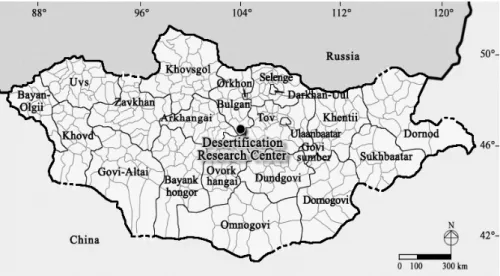
Fig. 1. Location of study site in Mongolia.
South Korea. Afforestation is essential to the prevention of desertification, and agroforestry of mixing afforestation with crops has been implemented as a sustainable method of increasing income for locals in arid and semi-arid regions. However, the growth of income crops in such re- gions is poor due to strong winds and aridity, which has re- sulted in limitations of reaching the intended effects of pre- venting desertification and increasing income for locals.
Therefore, diverse studies regarding agroforestry were undertaken to enhance the productivity of income crops in arid and semi-arid regions (Finch 1988; USDA NAC 2002; Shapo and Adam 2008; Campi et al. 2009), and sug- gested a windbreak planting as one of methods to mitigate wind damage on income crops. Based on the above-men- tioned studies, the windbreak planting reduced the evapo- transpiration and uprooting of income crops caused by strong winds and this led to improvements in quality and an increase in harvest yields by 10-20%. The effects of wind- break planting depend on the number of planting rows, planting density, tree height, and the distance of the space being protected from the planting (Robinette 1972; Grey and Deneke 1986; Finch 1988; Huke and Plecan 1988;
Kort 1988; Miller 2015). The windbreak effects of mul- ti-row planting were greater by up to 1.9 times compared to single row planting (USDA NAC 2002), and the appro- priate crown density to prevent income crops from wind damage was between 40-60% (Grey and Deneke 1986;
USDA NAC 2002). Park et al. (2012) reported that the ef- fects of a windbreak fence were most satisfactory in struc-
tures having a height of 0.4 m or greater and porosity of 20-30%. The windbreak planting was effective downwind up to 30 times the height of trees (Miller et al. 2015).
However, the optimal distance from the planting was found to differ according to different researchers. To produce the most satisfactory results, Grey and Deneke (1986) and Finch (1988) reported a distance at 10 times the height of trees while USDA NAC (2002) and Campi et al. (2009) suggested a distance at 4.7-5 times the height of trees.
As indicated through these instances, due to possible dif- ferences in the effects of windbreak planting within leeward distances of 10 times the height of trees, additional research regarding windbreak effects at shorter leeward distances is needed. Moreover, despite the probable differences in windbreak effects according to tree species and planting techniques, windspeeds and growth conditions, cultivated crops, and regional features, research related to such mat- ters in semi-arid regions subject to strong winds and short growth periods is currently lacking. Therefore, the purpose of this study is to undertake the multi-year monitoring of income crop productivity associated with windbreak plant- ing and to explore strategies of windbreak planning capable of enhancing the performance of agroforestry practices.
Materials and Methods
Study site
The site of this study was located at 47 degrees 19 minutes north latitude and 103 degrees 42 minutes east longitude,
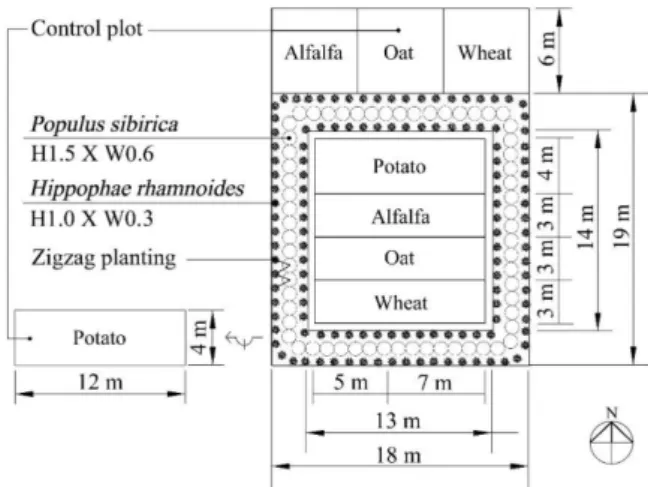
Fig. 2. Experiment design for windbreak planting and crop allocation.
as a property of the Desertification Research Center located within the Elsentasarhai region of Mongolia (Fig. 1).
Administratively, the site is part of Rashaant Soum of Bulgan Aimag, and is classified as a semi-arid steppe with desertification currently in progress. The site was selected due to it being possible to plant trees, sow income crops, and undertake on-site monitoring through collaborative re- search with the research center.
Windbreak planting and experiment design This study established a plot of 3-row windbreak plant- ing and a control plot with no windbreak across an area of approximately 500 m2 in May 2014, and sowed income crops in each of the plots (Fig. 2). Upon the recommen- dation of locals and experts knowledgeable about the study site, Populus sibirica and Hippophae rhamnoides were se- lected as tree species for windbreak planting. P. sibirica is a deciduous tree that naturally grows across the entire north- ern region of Mongolia and is known for its drought resist- ance and high wind tolerance (Ulziijargal 2011; Tungalag et al. 2012). H. Rhamnoides is a nitrogen-fixing deciduous shrub that naturally grows across the entire northwestern region of Mongolia, which produces a fruit rich in vitamins and amino acids used as ingredients for health supplements and cosmetics (Lee et al. 2012; Tungalag et al. 2012).
Potatoes, oats, wheat, and alfalfa as income crops were se- lected reflecting demands from locals and the short growth period of plants between the end of May to early September (MOFA 2011).
The 3-row windbreak plot was border planted with trees to control winds from all four directions, in which P. sibirica with a height of approximately 1.5 m and a crown width of 0.6 m was placed at the center of the planting rows and H.
rhamnoides with a low clear-length of about 1.0 m in height and 0.3 m in crown width was planted in a zig-zag pattern to the left and right of the P. sibirica. The total number of trees planted amounted to 227 individuals which included 62 P. sibirica trees and 165 H. rhamnoides trees. Income crops were distributed within a leeward distance at 10 times the height of trees in consideration of their windbreak effects. And 2 kgs of alfalfa, oats, and wheat as well as 5 kgs of potatoes were sowed across a 160 m2 area in and out of the windbreak planting plot. The annual crops except alfal- fa, a perennial forage crop were sowed repeatedly during the month of May for three years from 2014 to 2016.
Monitoring of windbreak effect and crop productivity Wind directions and speeds of the study site were meas- ured during the growth period between May-August for 4 years from 2014 to 2017. Monitoring of measuring growth and harvest yields of income crops as well as crown open- ings of the windbreak planting was undertaken every year during the end of August, the end of the growth period.
The wind directions were measured daily in 1-hour inter- vals by establishing an automatic weather observing device (Onset Computer Corporation, Massachusetts, USA).
Windspeeds were repeatedly measured 10 times at a height of 0.5 m, an average income crop height, in 1-hour intervals every day using a wind gauge (TSI ALNOR, AVM430, USA) at the windbreak planting plot and the control plot.
Windspeeds at the windbreak planting plot were measured at leeward distances of 1H (1 times the height of the plant- ed trees), 3H, 5H, 7H, and 9H in which the income crops were distributed. The crown opening of the windbreak planting was analyzed by horizontally taking photographs of the tree crowns repeatedly 5 times, overlapping the pho- tographs to a 0.5 cm×0.5 cm grid, and calculating the aver- age ratio of open grid points.
Growth and harvest yields of the income crops such as potatoes, oats, wheat, and alfalfa were measured and com- pared at the windbreak planting plot and the control plot for each year from 2014 to 2016. Potatoes, the belowground bi- omass in fresh weight of 10 randomly sampled individuals
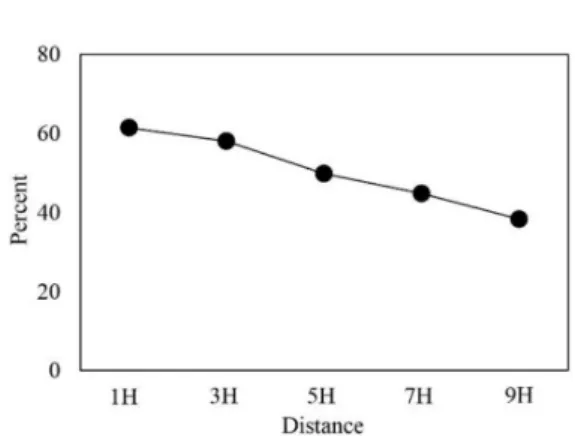
Fig. 3. Changes in windspeed reduction by leeward distance from wind- break planting*. *H=tree height.
from each treatment plot was weighed to 0.01 g using an electronic scale (AND, Electronic Balance FX-3200, USA).
The aboveground biomass in fresh weight of oats, wheat, and alfalfa was harvested within 3 randomly selected areas of 1 m2 for each crop species by treatment plot and meas- ured using the electronic scale.
Exploring proper windbreak planning
Based on the results of the above monitoring process un- dertaken for 4 years, this study explored desirable strategies of windbreak planning to enhance the performance of agro- forestry of combining tree planting with income crops.
Thus, practical information to implement sustainable agro- forestry was suggested including a land-use system, tree species and their sizes for planting, planting techniques, and planting densities.
Results and Discussion
Weather conditions
During the monitoring of the study site from 2014 to 2017, the annual temperature of the site averaged 1.2°C, and the average monthly temperature between the months of May and August, the growth period of plants, ranged from 9.6°C to 20.5°C. The study site was typically subjected to below zero temperatures from November to March in which tem- peratures dropped down to -40.4°C during the winter season.
On the other hand, temperatures reached up to 36.9°C dur- ing the summer season, which indicated drastic seasonal tem- perature differences of the study site. During the growth peri- od, the main directions of winds were observed as northerly and westerly and average windspeeds were measured in the range of 1.6 m/s to 4.1 m/s. During the month of May, the in- itial period of plant growth, strong winds recorded in the range of 18.9 m/s to 20.9 m/s frequently occurred. Such winds caused the uprooting of the trees planted for windbreak. For Bulgan Aimag, the province in which the study site was located, evapotranspiration was noted to be high compared to an annual precipitation of 220 mm and tended to increase by 2 mm or more each year (MOE 2008).
Effects of windbreak planting
The crown opening of the multi-layered 3-row wind- break planting, which was composed of P. sibirica with a
tree height of 1.5 m and H. rhamnoides with a tree height of 1.0 m, averaged about 59% in one year after planting, and 35% 2-3 years after planting. In other words, the crown density of the windbreak planting of this study fell within the 40-65% range. These crown densities of 40% and 65%
were analyzed to reduce windspeeds by 30% and 54%, respectively. The windspeed reduction ratios at different leeward distances from the windbreak planting 3 years after averaged 61.4% at a distance of 1H, 58.0% at 3H, 49.8% at 5H, 44.8% at 7H, and 38.3% at 9H (Fig. 3). Thus, the average windspeeds at leeward distances were reduced by ap- proximately 60% within 3H, 50% at 5H, and 42% at 7-9H.
These results indicated a tendency in which windspeed re- ductions were lessened as the distance increased. USDA NAC (2002) and Campi et al. (2009) also reported that windspeeds were reduced by 50-55% at distances of 5 times the height of trees. The average tree height of the windbreak planting in this study was 1.5 m, and the effects of windbreak are predicted to increase as tree heights increase.
Differences in crop productivity
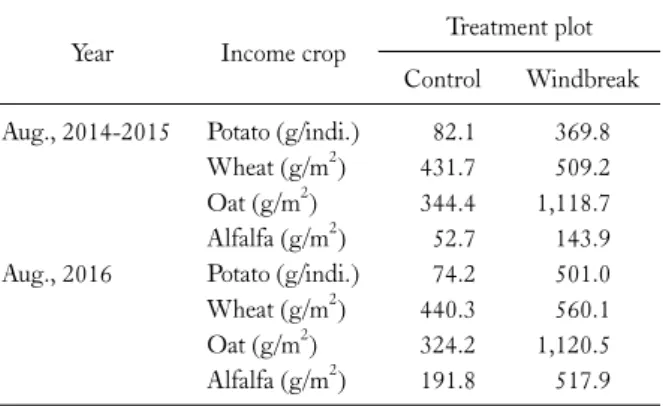
Table 1 presents the results of comparatively analyzing income crop productivity at the windbreak planting plot and the control plot. The fresh weight per sample of the po- tatoes harvested from the windbreak planting plot from 2014 to 2016 ranged between 370-501 g depending on their growth years, which was 4.5 to 6.8 times higher than that of the potatoes from the control plot (p<0.01). The fresh weight per unit area of the oats and wheat from the windbreak planting plot ranged between 509-560 g/m2 and 1,119-1,121 g/m2, respectively, which was 1.2 to 1.3 times
Table 1. Differences in crop productivity by treatment plot*
Year Income crop Treatment plot Control Windbreak Aug., 2014-2015 Potato (g/indi.) 82.1 369.8
Wheat (g/m2) 431.7 509.2 Oat (g/m2) 344.4 1,118.7 Alfalfa (g/m2) 52.7 143.9 Aug., 2016 Potato (g/indi.) 74.2 501.0 Wheat (g/m2) 440.3 560.1 Oat (g/m2) 324.2 1,120.5 Alfalfa (g/m2) 191.8 517.9
*The year was divided considering differences in crown opening of windbreak measured.
Fig. 4. Two alternative models of windbreak planning suggested to increase crop productivity in semi- arid region*. *Leeward distance and crown den- sity for about 50% windspeed reduction.
(p<0.05) and 3.2 to 3.5 times (p<0.01) higher than that of the oats and wheat from the control plot. The per unit area fresh weight of the alfalfa from the windbreak planting plot ranged between 144-518 g/m2, which was 2.7 times higher than that of the alfalfa from the control plot (p
<0.01). Thus, the 3-row windbreak planting was found to significantly increase the income crop productivity. Based on studies by Kort (1988), USDA NAC (2002) and Campi et al. (2009), the growth of income crops through a wind- break planting produced 6-44% greater productivity de- pending on their species compared to the control plot. The productivity through the windbreak planting of all income crops except wheat in this study was much greater than the results from the studies above.
As stated above, the crown density of the windbreak plant- ing was approximately 40% in one year after planting and 65% in 2016 two years after. Although the productivity of po- tato and alfalfa crops at the windbreak planting plot indicated a tendency to increase from 1.4 to 3.6 times as the crown den- sity increased, the productivity of oats and wheat showed no significant differences. Grey and Deneke (1986) and USDA NAC (2002) reported that the appropriate crown density of windbreak planting ranged between 40-60%. However, the findings of this study intimate that the optimum range of crown density, as one of factors affecting the productivity of income crops, could be variable with the crop species.
Windbreak planning for agroforestry practices The results from this study prove that the effects of windbreak planting on the productivity of income crops are
evident in growth environments having strong winds and aridity. The appropriate strategies of windbreak planning are required to achieve the multi-purpose effects of agro- forestry practices such as the prevention of desertification and creation of income. Two alternative models of wind- break planning are recommended as land-use systems of combining trees and income crops (Fig. 4): a) border wind- break planting in which windbreak trees are planted along all four directions of the borders of an income crop; and b) alternate windbreak planting in which windbreak trees and income crops are planted in an alternating way. The former model is recommended for application in sites in which winds from all directions need to be controlled and the lat- ter is suggested for application in sites in which main winds come from a single direction.
For the tree species used for windbreak planting, it is es-
sential to select a species that naturally grows in the harsh growing environments of Mongolia, which includes P. si- birica, Ulmus pumila, Haloxylon ammodendron, H. rha- mnoides, Larix sibirica, Picea obovate, Salix spp. (Ulziijar- gal 2011; Tungalag et al. 2012). Income crops should be chosen reflecting their growth environments and demands of local residents. As such an example, the crops selected for sowing in this study included potatoes, wheat, oats, and alfalfa. The distribution of income crops is recommended to keep within leeward distances of 5 times the height of trees to reduce windspeeds by up to 50%.
In addition, the windbreak planting must consider struc- tural properties such as the number of planting rows, layers, tree heights, and crown densities. This study applied the windbreak planting in 1-2 rows having low crown density, but its effects were found to be relatively lower. To achieve the effects of windbreak planting and crop production in the short term, a minimum of 3 rows of trees and shrubs should be planted perpendicular to the direction of the main winds, in which tall trees are placed at the center of the rows and shrubs with a low clear-length are planted in a zig-zag pattern to the left and right of the tall trees. The results from Park et al. (2012) as well as this study indicated sat- isfactory windbreak planting effects for tree heights in the range of 0.5-1.5 m. However, the planting of relatively tall- er trees is recommended, because increases in tree height lengthen leeward windbreak distances. A 60% crown den- sity of windbreak planting is appropriate to reduce wind- speeds by approximately 50%, based on the results from this study. Should shading from the crown growth of wind- break trees limit the growth of income crops, trimming or thinning practices are desirable to maintain proper growth environments for the income crops.
Conclusion
Afforestation is an essential practice for arid and semi-arid regions to prevent desertification, a serious environmental problem recognized internationally. Agroforestry practices of mixing tree planting and income crops as a sustainable approach have recently been implemented in the regions to increase income for locals as well as to prevent deserti- fication. However, strong winds and aridity in the regions limit the growth of income crops. To achieve the multi-pur-
pose effects of agroforestry, appropriate strategies of wind- break planting are required as a means of controlling such problems. Therefore, this study undertook the multi-year monitoring of income crop productivity associated with windbreak planting and explored strategies of windbreak planning to enhance the performance of agroforestry prac- tices.
The crown density of the windbreak trees planted for this study averaged approximately 40% in one year after plant- ing and 65% 2-3 years after. Such crown densities were found to result in windspeed reductions of 30% and 54%, respectively. Average windspeed reductions at leeward dis- tances from the windbreak planting were about 60% within 3H, 50% at 5H, and 42% at 7-9H, in which the farther the distance the less reduction in windspeeds. The income crop productivity at the windbreak planting plot was higher by a minimum 1.2 times to a maximum 6.8 times depending on the crop species, compared to that at the control plot with no windbreak. As the crown density of the windbreak plant- ing increased from 40% to 65%, the productivity of potato and alfalfa crops increased significantly.
Based on the study results, desirable strategies of wind- break planning were suggested including models of border windbreak planting and alternate windbreak planting as land-use systems of combining trees and income crops. The planning strategies also contained effective leeward wind- break distances for crop allocation, tree heights and layer structures, and crown densities. The leeward distribution of income crops is desirable within distances of 5 times the height of windbreak trees to reduce windspeeds by up to 50%. To achieve the effects of the windbreak planting in the short term, a minimum of 3 rows of trees and shrubs should be planted perpendicular to the direction of the main winds in a zig-zag pattern, in which the planting of taller trees is recommended over small-sized trees. A crown density of 60% is appropriate to obtain an approximately 50% reduc- tion of windspeeds.
This study serves as a stepping stone to find out detailed windbreak effectiveness at leeward distances and is sig- nificant in that a windbreak planning model including land-use systems and planting techniques was developed, based on repeated multi-year measurements of the wind- break planting effects. The results from this study are appli- cable not only at the study site but also in other regions
worldwide where strong winds and aridity are problematic in practicing agroforestry. The study results need further comparative verification in the future by conducting di- versified studies on windbreak planting in other regions having disadvantageous growth environments.
Acknowledgements
This study was carried out with the support of ‘R&D Program for Forest Science Technology (Project No.
2012021D10-1718-AA03)’ provided by Korea Forest Service (Korea Forestry Promotion Institute). The authors thank Dr. Akhmadi Khaulenbek with Institute of Geogra- phy & Geoecology (Desertification Research Center), Mongolia Academy of Sciences for his lavish help in plant- ing trees and sowing income crops.
References
Campi A, Palumbo AD, Mastrorilli M. 2009. Effects of tree wind- break on microclimate and wheat productivity in a Mediterra- nean environment. Eur J Agron 30: 220-227.
Finch SJ. 1988. Field windbreaks: design criteria. Agriculture, Ecosystems and Environment 22-23: 215-228.
Grey GW, Deneke FJ. 1986. Urban Forestry. 2nd ed. John Wiley
& Sons, New York.
KEI (Korea Environment Institute). 2003. Analyzing Northeast Asian Dust and Sandstorm Damages and Regional Cooperation Strategies I. Seoul. (in Korean)
KFRI (Korea Forest Research Institute). 2004. Cause and Mitigation of Desertification in Northeast Asian Regions. Korea Forest Research Institute, Seoul. (in Korean)
Kort J. 1988. Benefits of windbreaks to field and forage crops.
Agriculture, Ecosystems and Environment 22-23: 165-190.
Lee KG, Lee MH, Cho H. 2012. Development of sea buckthorn
beer using Mongolian sea buckthorn (Hippophae rhamnoides) fruit. Food Eng Prog 16: 129-133. (in Korean with English ab- stract)
Miller RW. 2015. Urban Forestry. 3th ed. Waveland Press, Long Grove, IL.
MOE (Ministry of Environment). 2008. A Study on Current Status and Mitigation Measures of Yellow Dust Outbreak in Mongolia. Ministry of Environment, Seoul. (in Korean) MOFA (Ministry of Foreign Affairs). 2011. Overview of Mongolia.
Ministry of Foreign Affairs, Seoul. (in Korean)
Park KH, Ding GD, Fang GL, Kim CB, Wu B, Bao YF, Gao GL, Jung SC, Moon KM. 2012. Comparative analysis of windbreak effect and installation cost of sand barrier with different height and porosity on sand land in China. J Korean Env Res Technol 15: 29-41. (in Korean with English abstract)
Reynolds JF. 2013. Desertification. In: Encyclopedia of Biodiver- sity (Levin SA, ed). Academic press, San Diego, pp 479-494.
Robinette GO. 1972. Plants, People and Environmental Quality.
USDI National Park Service, Washington, D.C.
Shapo H, Adam H. 2008. Modification of microclimate and asso- ciated food crop productivity in an alley-cropping system in Northern Sudan. In: Toward Agroforestry Design: An Ecologi- cal Approach (Jose S, Gordon AM, eds). Springer-Verlag, Dordrecht, pp 97-109.
Tungalag R, Jamsran T, Boldgiv B, Lkhagvasuren D. 2012. A Field Guide to the Trees and Shrubs of Mongolia. Munkhiin Useg, Ulaanbaatar.
Ulziijargal D. 2011. Survival rate and growth characteristics of plantation species by planting methods of desertified-area in Mongolia. MS thesis. Kyungpook National University, Daegu, Korea. (in Korean)
UNCCD (United Nations Convention to Combat Desertification).
2012. Desertification: A Visual Synthesis. Zoi Environment Network, Bresson.
UNDDD (United Nations Decade for Deserts and the Fight Against Desertification). Desertification. 2010.
USDA NAC (USDA National Agroforestry Center). 2002.
Windbreaks: An Agroforestry Practice. Lincoln, Nebraska.