1. 서 론
섬유 보강 콘크리트는 콘크리트의 취성적 특성과 낮은 인장강도의 개선 및 콘크리트의 균열제어를 위 해 1960년대 이후 꾸준히 연구되어 왔다(Yang, 2010;
Qian & Stroeven, 2000). 그 중, 강섬유 보강 콘크리트 는 국부적인 균열의 생성과 성장을 억제시켜 전단강 도 및 연성능력이 크게 증가할 뿐만 아니라 휨파괴와 피로파괴에 대한 저항능력이 우수한 장점을 가지고 있다(Kim et al., 2008). 이 같은 결과가 ACI 318-08 및 fib Model Code (2010)과 같은 구조설계기준에 채 택되어, 최소전단철근을 대신하여 사용하거나 강섬유 보강을 통해 증진된 휨인장강도를 설계에 반영하는
등 그 사용이 점차 확대되고 있다(Park, K.W. et al., 2014; ACI 318-08, 2008; fib Model Code, 2010). 그러 나 강섬유 보강 콘크리트는 단일 섬유의 형태로서 미 세균열에서 거시균열에 이르는 다양한 균열분포를 제 어하기에는 한계를 가지며, 일정 혼입량 이상에서 섬 유뭉침 현상이 발생하여 급격한 작업성 및 성능의 저 하를 일으키는 단점을 가지고 있다(Kim et al., 2008;
ACI committee 544, 1999).
상술한 강섬유 보강 콘크리트의 단점을 개선하기 위한 방안으로 콘크리트 내에 재료 특성이나 길이가 다른 2종 이상의 섬유를 사용하는 하이브리드 섬유 보강 콘크리트의 연구가 활발히 이루어지고 있는데, 그 결과, 여러 재료조합의 특성으로 인해 다양한 영 역의 균열제어 능력 및 강도와 연성을 향상시키는 효
DOI http://dx.doi.org/10.11004/kosacs.2015.6.4.058
비정질 강섬유와 유기섬유를 이용한 하이브리드 섬유보강 콘크리트의 작업성 및 강도 특성
권순오1 ∙ 배수호2 ∙ 이현진1 ∙ 김진우3 ∙ 이준철4
안동대학교 토목공학과 박사과정1 ∙ 안동대학교 토목공학과 교수2 ∙ 안동대학교 석ㆍ박사통합과정3 ∙
경북대학교 건축토목공학부 박사 후 연수연구원4
Workability and Strength Properties of Hybrid Fiber Reinforced Concrete Using Amorphous Steel Fiber and Organic Fiber
Kwon, Soon-Oh1ㆍBae, Su-Ho2ㆍLee, Hyun-Jin1ㆍKim, Jin-Oo3ㆍLee, Jun-Cheol4
1PhD., student, Department of Civil Engineering, Andong National University, Andong, Korea
2Professor, Department of Civil Engineering, Andong National University, Andong, Korea
3Graduate student, Department of Civil Engineering, Andong National University, Andong, Korea
4Postdoctoral researcher, Department of Architecture and Civil Engineering, Kyungpook National University, Daegu, Korea
Abstract: The purpose of this experimental research is to evaluate the workability and strength properties of hybrid fiber reinforced concrete containing amorphous steel fiber and organic fiber. For this purpose, the hybrid fiber reinforced concrete containing amorphous steel fiber(ASF) with polyamide(PA) and polyvinyl alcohol(PVA) fiber, respectively were made according to their total volume fraction of 0.5% for water-binder ratio of 33%, and then the characteristics such as the workability, compressive strength, and flexural strength of those were investigated. It was observed from the test results that the workability and compressive strength at 7 and 28 days were decreased and the flexural strength at 7 and 28 days was increased with increasing ASF and decreasing organic fiber.
Key Words: hybrid fiber reinforced concrete, amorphous steel fiber(ASF), polyamide(PA) fiber, polyvinyl alcohol(PVA) fiber, workability, compressive strength, flexural strength
주요어: 하이브리드 섬유 보강 콘크리트, 비정질 강섬유, PA 섬유, PVA 섬유, 작업성, 압축강도, 휨강도 Corresponding author: Bae, Su-Ho
Department of Civil Engineering, Andong National University, 1375 Gyeongdong-ro, Andong, Gyeongsangbuk-do 760-749, Korea Tel: +82-54-820-5896, Fax: +82-54-820-5896, E-mail: [email protected]
Received December 2, 2015 / Revised December 10, 2015 / Accepted December 14, 2015
과를 가져왔다(Won & Park, 2006; Lawer et al., 2000).
한편, 비정질 강섬유(amorphous steel fiber, ASF)는 액체 급냉의 원리를 이용한 용융방사(melt spinning) 기법에 의해 개발되어, 단순화된 공정으로 인해 에너 지 소비량 및 CO2 발생량 저감의 효과를 갖는다. 또 한, 이를 콘크리트에 혼입시 형상 특성상 얇은 두께 로 인해 잘 휘어지고 유연하여 굳지 않은 콘크리트의 유동성을 증진시키고, 표면적이 커서 바인더와의 높 은 결합력으로 인해 강도증진 및 균열제어의 효과를 가지고 있다(Ku et al., 2014; Cho et al., 2011; Park, M. S. et al., 2014).
유기섬유인 폴리아미드(polyamide, PA) 및 폴리비닐 알콜(polyvinyl alcohol, PVA) 섬유는 친수성 재료로서 강섬유에 비해 분산성을 증진시키는데, PA 섬유는 우 수한 내식성을 가지며 콘크리트에 혼입시 강섬유 콘 크리트와 유사한 휨인성 및 균열제어가 가능하고, PVA 섬유는 콘크리트의 단면에서 가교작용을 하여 미세 균열 억제 및 휨강도 개선 효과가 우수한 것으 로 알려져 있다(Nam et al., 2010; Jeon et al., 2014;
Kim et al., 2012).
따라서, 본 연구에서는 ASF와 유기섬유를 이용한 하이브리드 섬유보강 콘크리트의 작업성 및 강도 특 성을 규명하기 위하여 물-결합재비는 33%, 하이브리 드 섬유의 혼입률은 전체 체적비의 0.5%로 설정한 후, ASF와 PA 및 PVA 각각을 혼합 사용한 하이브리 드 섬유보강 콘크리트를 제작하여 이들의 작업성, 압 축강도 및 휨강도를 평가하고자 한다.
2. 실험 개요 2.1 사용 재료
하이브리드 섬유 보강 콘크리트를 제조하기 위하여 시멘트는 KS L 5201 (2010)의 규정에 적합한 H사 보 통 포틀랜드 시멘트를 사용하였고, 잔골재는 경북 안 동에서 생산된 낙동강산 하천사를, 굵은 골재는 최대 치수 25mm인 안동산 부순돌을 이용하였으며, 이들의 물리적 성질은 Tables 1∼3과 같다. 하이브리드 섬유 보강 콘크리트의 유동성을 조절을 위한 화학혼화제는 고강도 및 유동화 콘크리트용으로 사용되고 있는 S사 의 폴리카르본산계의 고성능 감수제(superplasticizer, SP)를 사용하였다(Table 4).
하이브리드 섬유 보강 콘크리트의 제조 방법에는 첫째, 직경 및 크기가 작은 마이크로(micro) 섬유와 직 경 및 크기가 큰 매크로(macro) 섬유를 사용하여 강도 및 연성을 증가시키는 방법, 둘째, 강성의 섬유와 연
성의 섬유 등 재료 특성이 다른 섬유를 사용하여 강 도와 연성을 증가시키는 방법, 셋째, 재령 초기에는 소성수축균열을 제어하고, 장기적으로는 역학적 성능 을 향상시키는, 콘크리트의 공용연수 전반에 영향을 미치도록 하는 방법, 넷째, 한 종류의 섬유가 콘크리 트의 성능을 증가시키고, 다른 종류의 섬유가 증가된 성능의 효율성을 더욱더 증가시키도록 하는 방법이 있다(Won & Park, 2006).
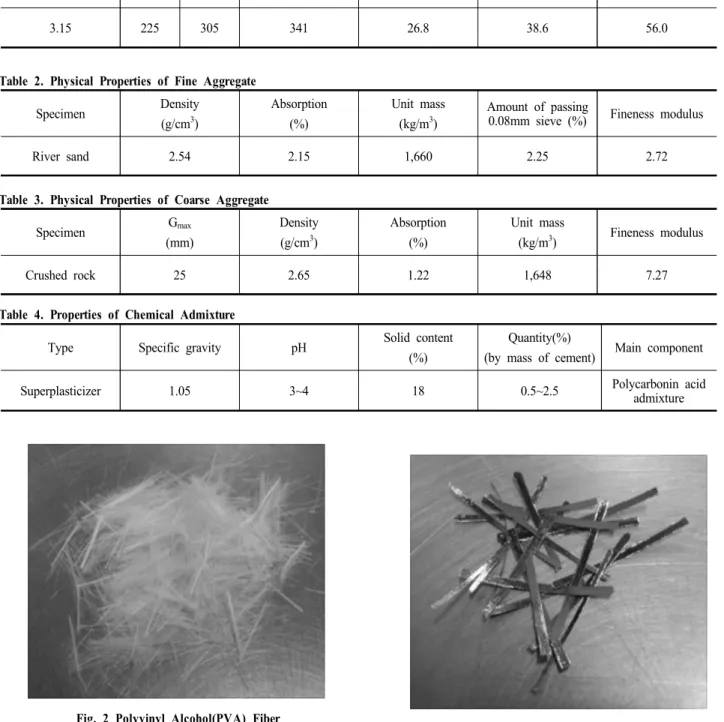
본 연구에서는 하이브리드 섬유보강 콘크리트를 제 조하기 위하여 상기 방법 중 두 번째 방법을 채택하 여, 무기섬유로서 경북대학교 금속공학과(이승훈)에서 개발한 비정질 강섬유(밀도: 7.16g/cm3, 길이: 30mm)와 유기섬유로서 K사의 PA 섬유(밀도: 1.14g/cm3, 길이:
30mm) 및 일본산의 PVA 섬유(밀도: 1.3g/cm3, 길이:
12mm)를 각각 혼합 사용하였으며, 이들의 형상은 Figs. 1∼3과 같다.
2.2 실험방법 2.2.1 공시체 제작
하이브리드 섬유 보강 콘크리트를 제조하기 위하여 Table 5와 같이 물-결합재비는 33%, 목표 슬럼프 및 공기량은 각각 180±25mm, 3.5±1.5%로 설정하였다. 하 이브리드 섬유의 혼입률은 전체 체적의 0.5%로 설정 하여, ASF와 PVA 및 PA 각각을 Table 5와 같이 조합 하여 결정하였다. 하이브리드 섬유보강 콘크리트의 작업성 평가를 위하여 고성능 감수제 첨가량은 1.5%
로 고정시킨 후, KS F 2402 (2012)에 따라 슬럼프를 측정하였으며, 압축강도 및 휨강도를 평가하기 위하 여 KS F 2403 (2014)에 따라 압축강도 시험용 원주형 공시체(∅100×200mm) 및 휨강도 시험용 각주형 공시 체(100×100×400mm)를 제작하였다. 제작된 공시체는 성형 후 24시간 경과하여 몰드를 제거한 후, 시험 재 령 전까지 20±3℃의 온도로 습윤양생하였다.
Table 1. Physical Properties of Cement Specific gravity
Setting time(min)
Blaine(m2/kg)
Compressive strength(MPa)
Initial Final 3 Days 7 Days 28 Days
3.15 225 305 341 26.8 38.6 56.0
Table 2. Physical Properties of Fine Aggregate
Specimen Density
(g/cm3)
Absorption (%)
Unit mass (kg/m3)
Amount of passing
0.08mm sieve (%) Fineness modulus
River sand 2.54 2.15 1,660 2.25 2.72
Table 3. Physical Properties of Coarse Aggregate
Specimen Gmax
(mm)
Density (g/cm3)
Absorption (%)
Unit mass
(kg/m3) Fineness modulus
Crushed rock 25 2.65 1.22 1,648 7.27
Table 4. Properties of Chemical Admixture
Type Specific gravity pH Solid content
(%)
Quantity(%)
(by mass of cement) Main component
Superplasticizer 1.05 3~4 18 0.5~2.5 Polycarbonin acid
admixture
Fig. 2 Polyvinyl Alcohol(PVA) Fiber 2.2.2 압축강도 평가
하이브리드 섬유 보강 콘크리트의 압축강도 특성을 평가하기 위하여 KS F 2405 (2010)에 따라 재령 7일 및 28일 압축강도 시험을 수행하였다(Fig. 4).
Fig. 3 Amorphous Steel Fiber(ASF) 2.2.3 휨강도 평가
하이브리드 섬유보강 콘크리트의 휨강도 특성을 평 가하기 위하여 KS F 2408 (2010)에 따라 3등분점 재 하 방법에 의해 재령 7일 및 28 휨강도 시험을 수행 하였다(Fig. 5).
Table 5. Mix Proportions of Hybrid Fiber Reinforced Concrete Speci-
mens
Fiber volume fraction(%) Slump (mm)
W/B (%)
S/a (%)
Unit mass(kg/m3) SP
(B*×%)
ASF PA PVA W* C* S* G*
Plain - - - 205
33 50 190 580 765 783
1.5
A 0.2 0.3 - 190 1.5
B 0.3 0.2 - 187 1.5
C 0.4 0.1 - 186 1.5
D 0.2 - 0.3 181 1.5
E 0.3 - 0.2 163 1.5
F 0.4 - 0.1 161 1.5
* W: Water, C: Cement, S: Fine aggregate, G: Coarse aggregate, B: Binder
Fig. 4 Compressive Strength Test
Fig. 5 Flexural Strength Test
3. 실험결과 및 고찰
3.1 작업성
일반적으로 콘크리트의 작업성은 슬럼프로 표시하 는데, 슬럼프가 클수록 작업성이 우수한 것을 나타낸 다. Fig. 6은 하이브리드 섬유보강 콘크리트의 슬럼프 를 나타낸 것으로, 섬유를 혼입하지 않은 플레인 콘 크리트보다 슬럼프가 약 15~40 mm 감소되어, 작업 성은 다소 저하되나, 유의성 수준은 아니며, 하이브리 드 섬유 혼입에 따른 뭉침현상은 나타나지 않아, 대 체적으로 작업성은 문제가 없는 것으로 나타났다. 또 한, 하이브리드 섬유보강 콘크리트는 비정질 강섬유 혼입량이 많고 유기섬유인 PA나 PVA 혼입량이 적을 수록 슬럼프가 다소 감소하는 것으로 나타나, 유기섬 유보다 비정질 강섬유 혼입량이 많을수록 작업성은 다소 불리한 것으로 나타났다.
3.2 압축강도
Fig. 7은 하이브리드 섬유보강 콘크리트의 섬유 조 합에 따른 재령 7일 및 28일 압축강도를 나타낸 것으 로, 유기섬유의 종류에 관계 없이 비정질 강섬유 혼 입량이 많고 유기섬유 혼입량이 적을수록 압축강도는 감소하는 것으로 나타났다.
한편, 하이브리드 섬유보강 콘크리트의 압축강도는 플레인 콘크리트보다 다소 작은 것으로 나타났으나, 하이브리드 섬유보강 콘크리트는 압축강도 증진보다 는 휨강도 및 인성 개선 목적으로 사용하므로, 하이 브리드 섬유보강 콘크리트는 압축강도가 약간 감소하 여도 사용상 문제가 없는 것으로 판단된다.
Fig. 6 Slump of Hybrid Fiber Reinforced Concrete
Fig. 7 Compressive Strength of Hybrid Fiber Reinforced Concrete
Fig. 8 Flexural Strength of Hybrid Fiber Reinforced Concrete
3.3 휨강도
Fig. 8은 하이브리드 섬유보강 콘크리트의 섬유 조 합에 따른 재령 7일 및 28일 휨강도를 나타낸 것으 로, 유기섬유의 종류에 관계 없이 비정질 강섬유 혼 입량이 많고 유기섬유 혼입량이 적을수록 휨강도는 증가하는 것으로 나타났다. 또한, 하이브리드 섬유보 강 콘크리트의 재령 28일 휨강도는 플레인 콘크리트 보다 최대 15%까지 증가하는 것으로 나타나(Table 5 의 배합 C), 본 연구에서 혼합 사용된 총 섬유량은 콘크리트 체적의 0.5%로, 일반적으로 사용되는 섬유 혼입량(1.0~1.5%)보다 적게 사용하여도 휨강도 증진 은 큰 것으로 나타났다.
4. 결 론
비정질 강섬유와 유기섬유를 혼입한 하이브리드 섬유보강 콘크리트의 섬유조합에 따른 작업성, 압축 강도 및 휨강도 특성을 평가한 결과로부터 다음과 같은 결론을 얻었다.
1. 하이브리드 섬유보강 콘크리트의 슬럼프는 플 레인 콘크리트보다 약 15~40 mm 감소되어, 작업성 은 다소 저하되나, 유의성 수준은 아니며, 하이브리 드 섬유 혼입에 따른 뭉침현상은 나타나지 않아, 대 체적으로 작업성은 문제가 없는 것으로 나타났다. 또한, ASF 혼입량이 많고 PA나 PVA 섬유 혼입량이 적을수록 슬럼프가 다소 감소하는 것으로 나타나, 유기섬유보다 비정질 강섬유 혼입량이 많을수록 작 업성은 다소 불리한 것으로 나타났다.
2. 하이브리드 섬유보강 콘크리트의 압축강도는 플레인 콘크리트보다 다소 작은 것으로 나타났으나, 하이브리드 섬유보강 콘크리트는 압축강도 증진보 다는 휨강도 및 인성 개선 목적으로 사용하므로, 하 이브리드 섬유보강 콘크리트는 압축강도가 약간 감 소하여도 사용상 문제가 없는 것으로 판단된다.
3. 유기섬유의 종류에 관계 없이 비정질 강섬유 혼입량이 많고 유기섬유 혼입량이 적을수록 하이브 리드 섬유보강 콘크리트의 휨강도는 증가하는 것으 로 나타났다. 본 연구에서 사용된 총 섬유량이 콘크 리트 체적의 0.5%일 때, ASF 0.4%와 PA 섬유 0.1%
혼합한 경우의 재령 28일 휨강도가 플레인 콘크리 트보다 최대 15%까지 증가하는 것으로 나타나, 휨 강도 증진에 가장 유리한 조합으로 나타났다.
감사의 글
본 연구는 국토교통부 국토교통기술지역특성화사 업의 연구비 지원(14RDRP-B076268)에 의해 수행되 었습니다.
References
ACI Committee 318 (2008), Building Code Requirement for Structural Concrete and Commentary (ACI 318-08), American Concrete Institute, pp. 430.
ACI Committee 544 (1999), Design Consideration for Steel Fiber Reinforced Concrete, American Concrete Institute.
Cho, C. G., Park, C. H., and Kim, H. J. (2011),
Evaluation of Shear Strength of Amorphous Steel Fiber-Reinforced Cementitious Mortar,Journal of Architecture Institute of Korea, Vol. 31, No. 2, pp.
329-330. (in Korean).
fib, (2010), fib Model Code 2010-First Complete Draft, International Federation for Structural Concrete, Vol. 1, pp.220-231.
Jeon, J. K., Kim, W. S., Yoon, J. H., and Jeon, C. K.
(2014),An Experimental Study on the Flexural Characteristics of Polyamide Fiber Reinforced Concrete,Journal of the Korea Concrete Institute, Vol. 26, No. 1, pp. 379-380. (in Korean).
Kim, W. S., Jung, D. H., and Cho, I. M. (2012),
Flexural Strength Characteristics of PVA Fiber Reinforced Clayey Soil-Cement Mixture,Journal of the Korean Society of Hazard Mitigation, Vol.
12, No. 5, pp. 101-111. (in Korean).
Kim, Y. I., L, Y. K., and Kim, M. S. (2008),Influence of Steel Fiber Volume Ratios on Workability and Strength Characteristics of Steel Fiber Reinforced High-Strength Concrete,Journal of the Korea Institute of Building Construction, Vol. 8, No. 3, pp. 75-83. (in Korean).
KS F 2402 (2012),Method of test for slump of concrete,Korean Agency for Technology and Standards (KS), Seoul, Korea. (in Korean).
KS F 2403 (2014),Standard test method for making and curing concrete specimens,Korean Agency for Technology and Standards (KS), Seoul, Korea.
(in Korean).
KS F 2405 (2010),Standard test method for compressive strength of concrete,Korean Agency for Technology and Standards (KS), Seoul, Korea.
(in Korean).
strength of concrete,Korean Agency for Technology and Standards (KS), Seoul, Korea. (in Korean).
KS L 5201 (2010),Fortland Cement,Korean Agency for Technology and Standards (KS), Seoul, Korea.
(in Korean).
Ku, D. O., Kim, S. D., Kim, H. S., and Choi, K. K.
(2014),Flexural Performance Characteristics of Amorphous Steel Fibe-Reinforced Concrete,
Journal of the Korea Concrete Institute, Vol. 26, No. 4, pp. 483-489. (in Korean).
Lawer, J. S., Zampini, D., and Shah, S. P. (2000),
Permeability of cracked hybrid fiber- reinforced under load,ACI Material Journal, Vol. 99, No.
4, pp. 379-385.
Nam, J. S., Kim, G. Y., Lim, C. H., Yun, K. H., Kim, M. H., and Jeon, J. K. (2010),Mechanical Properties of Tunnel Shotcrete with Polyamide Fiber Ratio,Journal of the Korea Concrete Institute, Vol. 22, No. 2, pp. 163-164. (in Korean).
Park, K. W., Lee, J. S., Kim, W., Kim, D. J., and Lee, G. Y. (2014),Cracking Behavior of RC Tension Members Reinforced with Amorphous Steel Fibers,
Journal of the Korea Concrete Institute, Vol. 26, No. 4, pp. 475-482. (in Korean).
Park, M. S., Lee, S. H., and Kim, Y. S. (2014),An experimental study on the strength properties of high strength mortar with hybrid fiber,Journal of the Architectural Institute of Korea, Vol. 34, No.
2, pp. 661-662. (in Korean).
Quan, C. X., and Stroeven, P. (2000),Fracture Properties of Concrete Reinforced with Steel-Polyehylene Hybrid Fibers,Journal of the Korea Concrete Institute, Vol. 22, No. 5, pp.
651-658.
Won, J. P., and Park, C. G. (2006),Performance and Application of Hybrid Fiber Reinforced Concrete,
Journal of the Korea Concrete Institute, Vol. 18, No. 1, pp. 22-27. (in Korean).
Yang, K. H. (2010),Slump and Mechanical Properties of Hybrid Steel-PVA Fiber Reinforced Concrete,
Journal of the Korea Concrete Institute, Vol. 22, No. 5, pp. 651-658. (in Korean).